onlinetaxupdate team wish to express sincere thanks to all the readers, authors, subscribers for the support extended to us.
|
Newsletter 115 dated 23.03.2024
|
|
|
|
|
|
|
|
|
Dear Reader,
|
Please find newsletter for your reading and reference.
|
|
Index of the Newsletter
- Recent updates
- Article by Mr. M.S.VIJAYAKUMAR
- Lawgics by Ms.Nidhi Aggarwal
- GST Notes by CMA Anil Sharma
- GST Daily by CA Pradeep Modi
- GST/IT/Customs in media
- Press Release
|
|
|
|
|
|
|
Haryana Excise & Taxation Department, issued an Instruction via memo no. 1217/GST-II daed 29.11.25 regrading taking up Suo-Moto Cases for Audit/ Scrutiny under the HGST Act, 2017.
|
Your attention is invited to the subject cited above. In this context, it is hereby directed that whenever any suo-moto case is proposed to be taken up for audit or scrutiny, the same shall be submitted with a clear, specific, and duly justified reasons and must also include the tentative quantum of tax evasion on the basis of available records, intelligence inputs, data analysis, or any other verifiable source of information.
|
Further, it is mandated that every such proposal for initiating suo-moto audit/scrutiny shall first be examined and recommended by the Deputy Excise and Taxation Commissioner (DETC) concerned and after the DETC's recommendations, the case file shall be forwarded to the Joint Excise and Taxation Commissioner (Range) for obtaining the necessary approval.
|
All field formations shall ensure strict compliance with these instructions. Any initiation of suo-moto action without adherence to the above-mentioned procedure shall be viewed seriously.
|
This issues with the approval of the competent authority.
|
|
|
|
|
|
|
|
Government of Assam, Guwahati issued Instruction no. 20/2025-GST dated 05.06.2025 prescribing Standard Operating Procedure on Road Vigilance.
|
No. CG/GST-40/2020/182 - To prevent tax evasion and protect government revenue, it is essential to establish a mechanism for monitoring the movement of goods and individuals engaged in transporting goods within Assam. Section 68 of the Assam Goods and Services Tax Act, 2017, grants the state government the authority to mandate specific documents that must be carried by the person in charge of a conveyance for any consignment of goods. Additionally, it empowers the proper officer to intercept such conveyances, verify the required documents, inspect the goods, and ensure compliance by the person in charge of the transport.
|
Rule 138 of the Assam Goods and Services Tax Rules, 2017 mandates the generation of an e-way bill and the electronic submission of relevant details on the common portal before initiating the movement of taxable goods valued at over fifty thousand rupees. Additionally, Rule 138A requires the person in charge of a conveyance to carry specific documents, including an invoice, bill of supply, delivery challan, and a copy of the e-way bill along with its number. Rule 138B authorizes the interception of conveyances for verification of documents and goods. Rule 138C stipulates that a summary report of every transit inspection must be recorded online by the proper officer within twenty-four hours, with a final report submitted within three days. Rule 138D further requires the online uploading of information related to vehicle detention.
|
To ensure the verification of e-way bills and necessary documents during the movement of goods by conveyance, as well as to conduct inspections aimed at preventing tax evasion, it has been deemed essential to implement random road vigilance at the following strategic locations:
|
(1) Srirampur (Dist-Kokrajhar) and (2) Chagolia (Dist. Dhubri)
|
For the purpose of such road vigilance the following guidelines are issued;
|
- Officers and staff will be deputed for road vigilance activities and each team will consist of one Superintendent of Taxes, two Inspector of Taxes and two Assistants respectively. Additionally, for all the teams a total of twenty assistants and grade-IV staff will be engaged for assistance.
- Each day, the road vigilance teams are expected to collectively inspect approximately 200 vehicles.
- All vehicles checked shall invariably have to be entered in the e-way bill portal as required under the Assam Goods and Services Tax Rules, 2017.
- On detection of irregularities and detection of tax evasion by the road vigilance team, penalty shall be levied as per provision of section 68 and 129 of the Assam Goods and Services Tax Act, 2017 as deemed fit.
- All teams should maintain a "Log Book" as per proforma furnish below:
- Daily report will have to be furnished to Apex Office by 09:00 A.M of the following day as per the following proforma with an intimation to the concerning Deputy Commissioner of Taxes:
- CCTV cameras shall be installed at the area of inspection and body worn camera shall be used while carrying vigilance activities. The footage of the body worn camera and CCTV videos shall be analyzed randomly at Apex Office during and after drive is completed.
- The road vigilance teams shall strictly follow the procedure laid down in the Assam Goods and Services Tax Act, 2017 and rules made there under. They shall also adhere to all the orders, instruction and circulars issued or to be issued from time to time by Commissioner of Taxes, Assam.
- The road vigilance teams shall ensure that such vehicle checking causes minimal/less disruptions/ disturbance in regular traffic movement. Further, the officers hall also ensure that the inspection/ checking of vehicles undertaken by them does not create a false impression about extensive / indiscriminate checking. Road vigilance teams shall keep devising their own plan for interception and time for such interception shall be unpredictable /random.
- For Non-GST items which are exempted from the purview of e-way bill vide clause (f) of sub-rule (14) of rule 138 of the Assam Goods and Services Tax Rules, 2017, the officers are required to follow the provisions of the Assam Value Added Tax Act, 2003 and rules made thereunder. In such cases, it should be ensured that the person in charge of a conveyance carry specific documents such as Delivery Note or Road Permit or Transit Pass, as the case may be along with other relevant documents.
- Any departure from the aforementioned directives will be take seriously. Additionally, instances of misuse of power or non-adherence to rules by officers will be addressed with strict measures.
This Order is issued with the concurrence of the Government and shall come into force with immediate effect.
|
|
|
|
|
|
|
|
New Delhi GST Investigation Wing issued Instruction No. 01/2025 -GST providing "Guidelines for arrest and bail in relation to offences punishable under the CGST Act, 2017".
|
Reference invited to the Instruction No. 02/2022-23 GST (Investigation) dated 17.08.2022 on the subject.
|
Hon'ble High Court of Delhi in case of KSHITIJ GHILDIYAL versus DIRECTOR GENERAL OF GST INTELLIGENCE, DELHI , vide judgment dated 16.12.2024, has held that grounds of arrest have to be communicated in writing to the arrested person. In coming to this conclusion, the Hon'ble Court has relied on the judgments of Hon'ble Supreme Court the cases of Pankaj Bansal Versus Union of India & Ors., Criminal Appeal Nos. 3051-3052 of 2023 { @ Special Leave Petition (Crl.) Nos. 9220-21 of 2023} dated 3rd October, 2023, and PRABIR PURKAYASTHA Vs STATE (NCT OF DELHI), CRIMINAL APPEAL (D. No. 42896/2023) Judgment dated 15.05.2024.
|
In this context it is relevant to note the distinction between 'reasons for arrest' and 'grounds of arrest' made by the Hon'ble Supreme Court in the case of PRABIR PURKAYASTHA Vs STATE (NCT OF DELHI), CRIMINAL APPEAL (D. No. 42896/2023). The relevant para of the said Judgment dated 15.05.2024, reads as follows:
|
49. It may be reiterated at the cost of repetition that there is a significant difference in the phrase 'reasons for arrest' and 'grounds of arrest'. The reasons for arrest as indicated in the arrest memo are purely formal parameters, viz, to prevent the accused person from committing any further offence, for proper investigation of the offence, to prevent the accused person from causing the evidence of the offence to disappear or tempering with such evidence in any manner, to prevent the arrested person for making inducement, threat or promise to any person acquainted with the facts of the case so as to dissuade him from disclosing such facts to the Court or to the Investing Officer. These reasons would commonly apply to any person arrested on charge of a crime whereas the 'grounds of arrest' would be required to contain all such details in hand of the Investigating Officer which necessitated the arrest of the accused. Simultaneously, the grounds of arrest informed in writing must convey to the arrested accused all basic facts on which he was being arrested so as to provide him an opportunity of defending himself against custodial remand and to seek bail. Thus, the 'grounds of arrest' would invariably be personal to the accused and cannot be equated with the 'reasons of arrest' which are general in nature."
|
In light of the above, Para 4.2.1 of Instruction 02/2023 GST (Investigation) dated 17.08.2022 is amended and may be read as follows -
|
Para 4.2.1 - The grounds of arrest must be explained to the arrested person and also furnished to him in writing as an Annexure to the Arrest Memo. Acknowledgement of the same should be taken from the arrested person at the time of service of the Arrest Memo.
|
|
|
|
|
|
Office of the Commissioner of Commercial Taxes, Nandanam, Chennai issued Circular No. 07/2026-TNGST dated 25.06.2026 regarding GST- Return Scrutiny under Section 61 of the TNGST Act, 2017 and adjudication proceedings - Prior approval for suo moto scrutiny notices and ex parte orders.
|
Detailed guidelines were issued to the Proper officers for adjudication in the Assessment Circles, in the Circular cited, to make adjudication process more transparent, reduce the litigations and realize revenue.
|
In this direction, system generated scrutiny notices based on risk parameters have been made available to the Proper Officers to ensure uniformity and monitoring of the return scrutiny process. Instructions have also been issued to all Proper Officers to process the system-generated scrutiny notices by following the provisions of the GST Acts and Rules and training has been imparted for adherence to quality standards in the adjudication process.
|
The scrutiny notices generated by the IT wing of the department and made available are detailed below:
|
|
|
|
|
|
Directorate of Commercial Taxes, Kolkatta issued Order No. 4302CT dated 04.07.2025 regarding Extension of period for completion of Audit as per the proviso to sub-section (4) of section 65 of the WBGST Act, 2017 for the period starting on or after 1st day of April, 2021 and ending on or before 31st day of March, 2022 or part thereof.
|
WHEREAS Audit of selected registered persons under section 65 of the West Bengal Goods and Services Tax Act, 2017 (hereinafter referred to as the said Act) for the period starting on or after 1st day of April, 2021 and ending on or before 31st day of March, 2022 or part thereof has commenced;
|
AND WHEREAS sub-section (4) of section 65 of the said Act stipulates that Audit has to be completed within a period of three (03) months from the date of commencement;
|
AND WHEREAS the progress of audit in all these cases got delayed due to requests received from various auditees for further time for production of books of accounts as required for completion of audit;
|
AND WHEREAS I am satisfied that such Audit cases cannot be completed within three months from the individual date of their commencement;
|
NOW THEREFORE, in exercise of the power conferred by proviso to sub-section (4) of section 65 of the said Act, I hereby extend the period for completion of Audit cases for the period starting on or after 1st day of April, 2021 and ending on or before 31st day of March, 2022 or part thereof, for a further period till the 22nd day of August, 2025 or three months from the actual date of commencement whichever is later.
|
This order shall come into force with immediate effect.
|
|
|
|
|
|
ICAI - Institute of Chartered Accountants of India published Technical Guide on GST Annual Return - Form GSTR-9 & GST Reconciliation Statement in Form GSTR-9C, both November 2026 edition.
|
Due date to file GSTR-9 and 9C is 31st December, 2026 for FY 2025-26.
|
|
|
|
|
|
|
|
The Institute of Chartered Accountants of India (ICAI) published second edition of Handbook on Liability to Pay in Certain Cases under GST in October 2026.
|
|
|
|
|
|
CBIC issued Notification No. 35/2026-Customs dated 24.08.2026 regarding Amendment in the Export Policy of Wheat
|
|
|
|
|
|
|
|
CBIC issued Notification No. 34/2026-Customs dated 24.08.2026 regarding Amendment in the Export Policy of Wheat Flour and related products
|
|
|
|
|
|
|
|
CBIC issued Notification No. 33/2026-Customs dated 21.08.2026 regarding Amendment in Para 1.25 of the Foreign Trade Policy, 2023
|
|
|
|
|
|
|
|
CBIC issued Notification No. 32/2026-Customs dated 21.08.2026 regarding Amendment to Para 4.63 of FTP 2023
|
|
|
|
|
|
|
|
CBIC issued Notification No. 31/2026-Customs dated 20.08.2026 regarding Amendment in import policy of Raw Sugar classified under Exim Code 170114 of Chapter 17 of Schedule -1 (Import Policy) of ITC (HS), 2022 and one-time conversion from Advance Authorisation Schedule to Tariff Rate Quota (TRQ) Scheme.
|
|
|
|
|
|
|
|
CBIC issued Notification No. 30/2026-Customs dated 21.08.2026 that Seeks to exempt 10 lakh MT of raw sugar falling under tariff heading 1701 from the whole of the customs duty leviable thereon under the First Schedule to the Customs Tariff Act, 1975, up to 31st October, 2026, when imported under the Tariff Rate Quota (TRQ) Scheme (Open General Licence...
|
|
|
|
|
|
Central Board of Indirect Taxes and Customs (CBIC) issued Instruction no. 20/2026-Customs dated 07.10.2026 regarding Amendment to Electronics and Information Technology Goods (Requirement for Compulsory Registration) Order, 2021 – inclusion of Screen Protectors for smartphones
|
|
|
|
|
|
Directorate General of Foreign Trade (DGFT) issued Notification No. 44/2026-27 dated 12.10.2026 regarding Amendment in Export Policy of Prepared Culture Media
|
|
|
|
|
|
Union Commerce and Industry Minister Piyush Goyal on Wednesday set March 31, 2027 , as the deadline for complete digitisation of services provided by the Directorate General of Foreign Trade (DGFT), aiming to eliminate the need for physical visits to its offices from 01.04.2027, according to a statement by the Ministry of Commerce and industry.
|
The announcement came as Goyal virtually inaugurated Vanijya Bhawan and Udyog Bhawan in Jaipur, making Rajasthan the first state to bring offices of the Ministry and its associated organisations under one roof.
|
Congratulating the Department of Commerce and the Department for Promotion of Industry and Internal Trade (DPITT) on the initiative, Goyal called replicating the model across the country, particularly in all state capitals. He said the proposed centres would serve as one-stop hubs for promoting exports, investments, international trade and industrial development, while supporting businesses in contributing to the vision of Viksit Bharat 2047.
|
"Goyal said that the co-location of offices, digitisation and introduction of faceless assessments would enhance transparency, accountability and public confidence. A unified presence of the Ministry of Commerce and Industry in each State would assure businesses and stakeholders that they could access support and guidance through a single location," the release said.
|
He further emphasised that the initiative should go beyond bringing government offices under once roof and focus on improving service delivery, simplifying procedures and enhancing ease of doing business. He also called for greater participation from government departments, state representatives, exports, importers, investors and industry stakeholders to ensure effective implementation, the Ministry said in the release.
|
Setting March 31, 2027, as the deadline for complete digitisation, Goyal directed that all services, including applications for licenses, permits and Special Chemicals, Organisms, Materials, Equipment and Technologies (SCOMET) approvals, be made available entirely online.
|
He further directed the digitisation of historical data and records maintained by Regional Authorities (RAs) of the Directorate General of Foreign Trade (DGFT) across the country.
|
The Minister said that April 1, 2027 , applicants should no longer be required to physically visits government offices to access these services.
|
For cases requiring verification of original documents, Goyal suggested setting up dedicated counters and installing computers at office entrances to facilitate document verification and uploading.
|
He also advocated greater reliance on self-certification and a trust-based approach towards citizens and businesses, emphasising the need to reduce unnecessary procedural requirements.
|
"Goyal also called for the simplification of processes, formats, and forms, and urged the departments to break organisational silos and work collectively to deliver better outcomes for businesses and citizens. He said that improved coordination between the two departments and the various organisations under the Ministry would be essential to achieving the objectives of the initiative," the release added. (ANI)
|
|
|
|
|
|
|
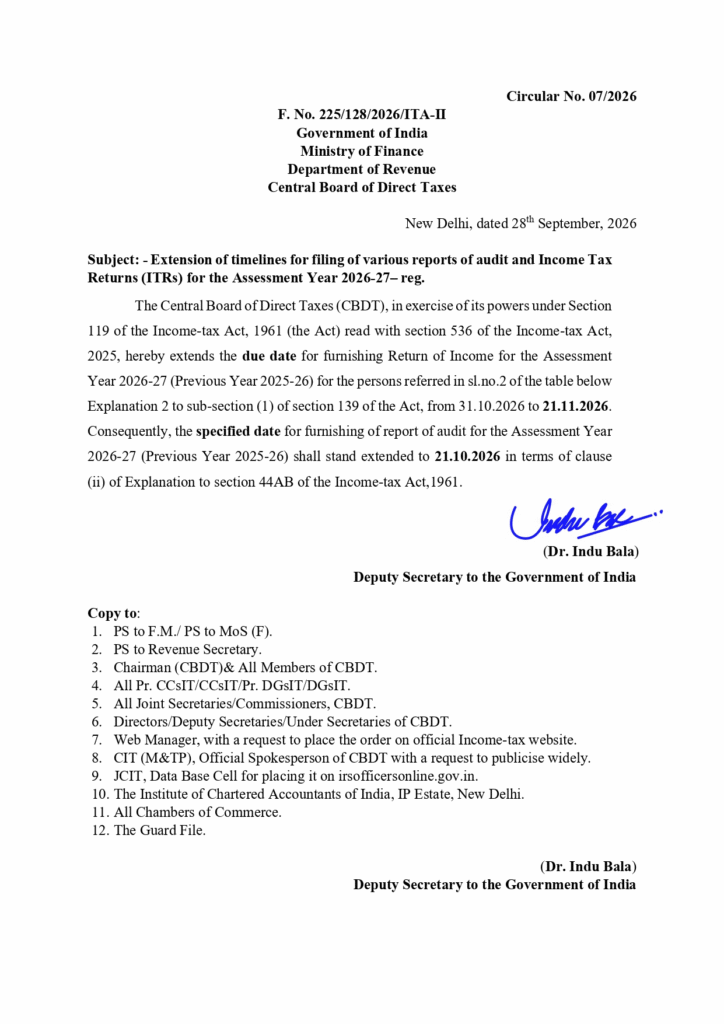
Central Board of Direct Taxes issued Circular no. 7 of 2026 dated 28.09.2026 regarding Extension of timelines for filing of various reports of audit and Income tax Returns (ITRs) for the Assessment Year 2026-27
|
|
|
|
|
|
|
|
|
Central Board of Direct Taxes issued Guidelines dated 13.06.2025 vide F. No. 225/37/2025/ITA-II, regarding compulsory selection of returns for Complete Scrutiny during the Financial Year 2025-26 - procedure for compulsory selection in such cases.
|
2. The parameters for compulsory selection of returns for Complete Scrutiny during Financial Year 2025-26 and procedure for compulsory selection in such cases are prescribed as under:
|
3. Clarification: It is clarified that where return has been furnished in response to notice u/s 142(1) of the Act and such notice u/s 142(1) of the Act was issued due to the information contained in NMS Cycle/AIS/Statement of Financial Transactions (SFT)/ CPC-TDS information / information received from Directorate of I&CI, such return will not be taken up for compulsory scrutiny. Selection of such cases for scrutiny will be done through the CASS cycle.
|
4. Issuance of notice u/s 143(2) in certain cases:
|
4.1 Jurisdictional Assessing Officers (JAOs) shall upload the underlying documents for access by NaFAC in the following cases which are to be completed by NaFAC on or before 31.03.2026 and Notice u/s 143(2)/142(1) of the Act calling for information shall be served on the assess through NaFAC in these caes:
|
(a) Cases (other than search & seizures/survey) in which notices u/s 148 of the Act have been issued where return is either furnished or not furnished in response to notice u/s 148 of the Act.
|
(b) Cases in which notices u/s 142(1) of the Act calling for return, have been issued & no returns have been furnished.
|
4.2 Cases, where notices u/s 148 of the Act have been issued pursuant to search & seizure/survey actions conducted on or after the 01.04.2021 but before 01.09.2024, if lying outside Central Charges,
|
(i) where return is furnished, the Jurisdictional Assessing Officer (JAO) concerned shall serve the Notice u/s 143(2) of the Act and Pr.CIT/Pr.DIT/CIT/DIT concerned shall ensure that such cases transfer these cases to central charges u/s 127 of the Act.
|
(ii) where return is not furnished, these cases shall be transferred to central charges for further necessary action.
|
4.3 During the course of Search & Seizure action, information relating to some other persons, who may have one-off/very few or limited financial transaction(s) with the main assessee group covered in the search u/s 132/ 132A of the Act, may be found. Such persons are not integrally connected with the core business of the main assessee searched and do not belong to the same business group. Often such persons are also not residing in the same city as that of the main assesssee. In such cases, the relevant information is generally passed on to the jurisdictional AO for assessing them u/s 148 (for searches conducted/requisition made after 01.04.2021) of the Income-tax Act, 1961. It is clarified that such non-search cases selected u/s 148 of the Act are not required to be transferred to the Central Charges unless covered by the Board's guidelines under F.No. 299/107/2013-IT (Inv.III)/1568 dated 25.04.2014.
|
5. For Assessing Officers in International Taxation and Central Circle charges:
|
5.1 The cases shall be selected for compulsory scrutiny by the International Taxation and Central Circle charges following the above prescribed parameter at Para 2 with prior administrative approval of Pr.CIT/Pr.DIT/CIT/DIT concerned and these selected cases for compulsory scrutiny shall continue to be handled by International Taxation and Central Circle charges respectively, as earlier.
|
5.2 It is further clarified that communication to NaFAC for access and/or further action after selection for Compulsory Scrutiny will not apply to the International taxation and Central charges.
|
6. Time limit: As per the proviso to section 143(2) of the Act, the time limit for service of notice u/s 143(2) of the Act for the ITRs filed in the Financial Year (FY) 2024-25 which are selected for Compulsory Scrutiny is 30.06.2025.
|
7. These instructions may be brought to the notice of all concerned for necessary compliance.
|
|
|
|
|
|
|
|
Central Board of Direct Taxes issued Order u/s 119 of the Income tax Act, 1961 to further allow the trusts / institutions/ funds who have mistakenly filed Form No. 10B instead of Form No. 10BB and vice-versa, to furnish such audit report in the applicable Form No. 10B / 10BB on or before 10.11.2024.
|
|
|
|
|
|
Central Board of Direct Taxes (CBDT) issued notification no. 134/2026 dated 08.10.2026 to hereby make following rules to amend the income tax rules, namely -
|
These rules may be called the Income tax (Sixth Amendment) Rules, 2026
|
They shall come into force on the date of their publication in the official gazette
|
|
|
|
|
|
|
|
Central Board of Direct Taxes (CBDT) issued notification no. 132/2026 dated 28.09.2026 to hereby make the following further amendments to the Notification no. S.O.359 dated 30.03.1988 -
|
|
|
|
|
|
|
|
Show cause notice which is usually termed as SCN is a notice issued by the proper officer to the registered tax payer to explain or justify the claim of input tax credit or tax not paid and has violation of GST Law for a particular period. Normally SCN issued in the prescribed format are providing an opportunity to the tax payer to give evidence or proof in support of their contention. Goods and services tax (GST) authorities have issued demand notices worth of Rs.1.45 lakh crore in December 2023 over discrepancies in annual returns and claims for input tax credit for financial year 2018. The large number is because the last date for serving notices for 2017-18 was extended to December 31, 2023. This shows that the government is taking action against non-compliance and it is high time that businesses start taking GST litigation seriously.
|
A show cause notice is a formal and written request issued by the tax authorities to an individual or business, thus giving an opportunity to provide a satisfactory explanation or justification for a certain action or behavior. In the context of Indirect Taxation in India, a show cause notice under GST may be issued by the GST authorities to a business or individual for various reasons, such as non-compliance with GST laws and regulations, evasion of tax, or other suspected offences, for which the business houses has to give their relevant and related information and documents in support of their contention, proving that they have fulfilled the conditions as per law and there is no violation of law in any situation. Show Cause Notice is the foundation on which the department has to build up its case - CCE Bangalore V Brindavan Beverage P Ltd [2007 (213) ELT 487.
|
The SCN which is not generated through online or which is not bearing the DIN (Document Identification Number) is not valid and the finance minister told that without DIN, no need to give importance to the notice. Normally the proper officer will give first fifteen days for responding to the notice and the dealers has to file their explanation in writing with documentary evidence. If the dealers could not file within the stipulated time, they will be given another opportunity of 15 days thus they are totally given a period of 30 days for filing their reply. If required a personal hearing on any working day will also be given to the dealer by the proper officer. Issuance of a second SCN invoking extended period after the first SCN invoking extended period of time has been issued is legally not tenable. However, the second SCN, if issued would also need to establish the ingredients required to invoke extended period independently. For example, in cases where clearances are not reported by the assessee in the periodic return, second SCN invoking extended period is quite logical whereas in cases of willful mis-statement regarding the clearances made under appropriate invoice and recorded in the periodic returns, second SCN invoking extended period would be difficult to sustain as the department comes in possession of all the facts after the issuance of first SCN. Therefore, as a matter of abundant precaution, it is desirable that after the first SCN invoking extended period, subsequent SCNs should be issued within the normal period of limitation. If the dealers have neither filed reply nor produced documents in person, the proper officer will proceed further and pass orders as proposed in the Show Cause Notice. The burden of Proof is on the taxing authorities to show that the particular case or item in question is taxable in the manner claimed by them.” - Union of India and Others V. Garware Nylons and Others.
|
A show cause notice and the documents relied upon in the Show Cause Notice needs to be served on the assessee for initiation of the adjudication proceedings. The documents/records which are not relied upon in the Show Cause Notice are required to be returned under proper receipt to the persons from whom they are seized. Show Cause Notice itself may incorporate a clause that not relied upon records may be collected by the concerned persons within 30 days of receipt of the Show Cause Notice. The designation and address of the officer responsible for returning the relied upon records should also be mentioned in the Show Cause Notice. This would ensure that the adjudication proceedings are not delayed due to non-return of the non-relied upon documents.
|
Show Cause Notice –Related sections under GST
Where SCN is required to be issued under CGST Act, 2017:
|
• Section 10 – Wrongful availment of Composition scheme
|
• Section 21 – recovery of credit distributed in excess by ISD
|
• Section 35 – failure to record supply of goods or services
|
• Section 50 – Interest on delayed payment
|
• Section 51 – Tax deduction at source in default
|
• Section 52 – Tax collection at source in default
|
• Section 63 – Discrepancy found in scrutiny of returns
|
• Section 65 – Detection of tax not paid or short paid during Audit
|
• Section 66 – Detection of tax not paid or short paid during special Audit
|
As per the Circular no 96/1 /2017 dated 19.1.2017, a SCN should ideally comprise of the following parts, though it may vary from case to case:
- Introduction of the case
- Legal frame work
- Factual statement and appreciation of evidences
- Discussion, facts and legal frame work,
- Discussion on Limitation
- Calculation of duty and other amounts due
- Statement of charges
- Authority to adjudicate.
The Show Cause Notice will generally contain the following information:
|
- Show Cause Notice Number and Date of Issuance
- The name and address of the recipient
- The GST registration number of the recipient
- The Nature of defect, allegation and error found in the returns filed by the dealers
- The nature of provisions of law which the dealers have violated either under section 73 or 74 by substantiating his allegations
- The adjudication officer should quantify the tax that has been evaded by the dealers should be specifically mentioned and the notice which does not contain the quantum is not a valid notice.
- The time granted for furnishing the reply should be specifically mentioned in the notice and the adjudication officer should have signed in the SCN with date.
- The adjudication officer should also specify in the case if the dealers have not filed reply with proof what will be penal action that will be initiated should also be clearly mentioned in the SCN.
When SCN is issued by the adjudication officer
- SCN is issued under various occasion by the adjudication officer and the following are some of the major items for which show cause notices are normally issued.
- SCN may be issued if the taxpayer is found to be non-compliant with the GST laws, such as failed to furnish the Returns in GSTR1, 3B and other returns prescribed for every dealers under respective type, non-payment of required tax to be paid, filing returns belatedly every month, and not maintaining proper books of accounts.
- SCN may be issued if the GST authorities suspect that the taxpayer is attempting to evade taxes by misrepresenting the nature of their supplies or by claiming ineligible input tax credits or claiming exemptions.
- SCN may be issued if the GST authorities suspect that the taxpayer has malafide intention to evade tax by issue of bogus invoice and thus leading others to claim and avail wrong input tax credit thus violating the provisions of law under section
- SCN may be issued if the adjudication officer finds and suspect that the dealers are indulging in fraudulent activity of claiming wrong input tax credit
- SCN may be issued if the GST authorities find that the taxpayer is supplying goods or services without proper documentation, such as invoices or E-way bill/ delivery challan
The authority issuing the SCN should clearly lay down the legal provisions in respect of which the person shall be put to notice. While specifying the provisions, care should be taken to be very accurate in listing all the provisions and the law in respect of which the contraventions are to be alleged in the SCN. Notice should spell out the exact nature of deficiency. The extract of the show cause notice does not seem to challenge inadequacy of the documents. It could be that such inadequacy could be inferred there from but the notice, which is meant to put the recipient on notice, must always spell out the exact charge. A notice, which is ambiguous or capable of interpretation, cannot be the ground for sustaining an order based on the inference drawn from the show cause notice - Mehta Pharmaceuticals vs Commissioner Of Cus. And C. Ex. On 4 April, 2003-Equivalent citations: 2003 (157) ELT 105 Tri Mumbai.
|
The facts relating to act of omission and commission pertinent to the initiation of the proceedings against the noticee need to be stated in a most objective and precise manner. All evidences in form of documents, statements and material evidence resumed during the course of enquiry/ investigation should be organised serially in a manner so as to establish the charges against the noticee. While discussing the facts and evidences, care should be taken to be precise and succinct in expression so that unnecessary details are avoided.
|
The circumstances under which normally Show cause notices are issued by the officer.
- Delay in filing GSTR-1 and GSTR-3B consecutively for more than 6 months
- Mismatches with reference to GSTR 2B, 3B and GSTR 1
- Difference between GSTR 1 and E- Way bill.
- Failed to get GST registration as required under the provisions of the act.
- The dealers have not paid the tax dues or made short payment of tax
- Wrongly availed ITC/ Refund wrongly claimed
- Anti-profiteering cases
- Non-furnishing of information return, within the given time limit
- Non-Compliance with E-invoicing
- E-invoice and E-way bill amount does not tally.
It is important for businesses and individuals to take show cause notices under GST seriously and respond to them promptly and appropriately. Ignoring or failing to respond to a show cause notice can result in serious consequences, including financial penalties, legal action, and damage to the business’s reputation. The GST authorities have wide-ranging powers to issue SCNs and to take further action if the taxpayer is unable to provide a satisfactory explanation.
|
Some common actions that may be taken include:
- Imposing a penalty: The GST authorities may impose a penalty on the taxpayer if they are found to be non-compliant with the GST laws or if they are found to have evaded taxes.
- Initiating legal proceedings: The GST authorities may initiate legal proceedings against the taxpayer if they are found to be involved in fraudulent activities or if they fail to provide a satisfactory explanation in response to the SCN.
- Disqualifying the taxpayer from availing ITCs: The GST authorities may disqualify the taxpayer from availing ITCs if they are found to be misusing ITCs or if they fail to provide a satisfactory explanation in response to the SCN.
How to handle a Show Cause Notice issued by the GST authorities:
The dealers on receipt of SCN should react immediately and any delay will lead to complications. The following are the general caution to be looked into:
|
- The dealers should read the notice carefully and understand the reasons stated for the issuance of the notice with the help of GST Practioner, auditor and accountants.
- Determine whether the allegations made in the notice are correct or not. If you believe that the allegations are incorrect, the dealers should prepare a detailed reply along with proof of documents.
- The dealers should collect all relevant documents and records that support his response to the show cause notice. This may include invoices, receipts, bank statements, and any other supporting evidence.
- The response should be in writing and, addressing each of the allegations made in the notice. The dealers have to ensure himself to provide a clear and concise explanation for each point, and provide supporting evidence wherever necessary.
- The reply should be submitted to the GST authorities within the time specified in the notice. It is better to have a consultancy with tax practioners and advocate in drafting the case if the dealers could not draft it correctly.
- If the dealers are not satisfied with the outcome of the show cause notice and found that the notice is not correct the dealers can prefer the option to go for a legal remedy by filing an appeal before the Appellate forum and if necessary, writ appeal can also be preferred.
- It is important to note that failure to respond to a show cause notice or to comply with the terms of the notice can result in penalties, fines, and other consequences under GST laws. Therefore, it is important to take the show cause notice seriously and to seek professional advice if necessary.
What is the procedure for issuing a Show Cause Notice under GST?
The procedure for issuing a Show Cause Notice under GST is as follows:
|
- The tax authorities conduct an investigation or departmental audit to determine whether a taxpayer has violated any GST laws or evaded taxes.
- If the tax authorities find evidence of non-compliance or evasion, they may issue a Show Cause Notice to the taxpayer.
- The Show Cause Notice can be sent to the taxpayer via e-mail or on the official portal. It can also be sent via registered post or delivered a physical copy.
- The Show Cause Notice includes the details of the alleged violation of the provision of the GST Act or the rules and regulations of the act, and the action that the tax authorities propose to take against the taxpayer.
- The taxpayer is given a specified period of time, usually 15-30 days, to respond to the Show Cause Notice and provide an explanation for the alleged violation.
- The taxpayer can either accept the allegations and offer to pay the taxes and penalties as per the Show Cause Notice, or contest the allegations and provide an explanation for their actions.
- The tax authorities consider the response of the taxpayer and decide whether to accept the explanation and close the case or to proceed with the proposed action.
Covers determination of tax not paid or short paid or erroneously refunded or ITC availed wrongly or utilized for any reason other than fraud, wilful misstatement or suppression of facts.
|
Covers determination of tax not paid or short paid or erroneously refunded or ITC availed wrongly or utilized by reason of fraud, wilful misstatement or suppression of facts.
|
The circumstances where the adjudication officer initiate proceedings under section 73 or 74
- The taxpayer fails to comply with the notice issued by the adjudication officer u/s 61 or explanation given is not found satisfactory to the notices issued by him
- The taxpayer has violated the conditions prescribed for availing composition scheme under the CGST ACT 2017
- There are other cases of tax not paid/short paid/erroneously refunded/ITC wrongly availed or utilized
- The input service distributor has distributed excess credit or distributed credit in contravention to the provisions of the Act
- With reference to Section 51 of the CGST ACT the Tax deduct at source authorities would not have made TDS deduction.
- The case where GST audit under section 65 of the CGST has been taken by the department.
- Cases where special audit under section 66 of the CGST act has been initiated.
- If survey has been conducted by the authorities as under section 67 of the CGST act and recommended.
Important rulings under GST on issue of SCN:
In the Following instances the Show cause notices were squashed by the Hon’ble high court
|
• Cases where the Constitutional vires of the very enactment under which the proceedings are initiated is under challenge;
|
• Cases where the proceedings have been initiated or concluded in total violation of the principles of natural justice; and
|
• Where the orders impugned are totally without jurisdiction or where private and public wrongs are so inextricably mixed up or where prevention of public injury and the vindication of public justice demands that recourse the Article 226 of the Constitution be taken.
|
Cases
- Special director v Mohd. Ghulam Ghouse [2004 (164) E.L.T. 141 (S.C.) - writ petition should not be entertained by High Court unless issuance of notice was totally non est in eye of law
- Kirloskar Computer Service Ltd. Vs. Union of India [1998 (98) E.L.T 355 (Kar.)
- Indian Cardboard Industries Limited v. Collector of Central Excise,
GST Registration Can’t be Cancelled Merely Stating a Firm as Bogus. The Allahabad High Court held in M/s Apparent Marketing Private Limited.
The department surveyed the petitioner’s business premises and issued a notice proposing the cancellation of registration. The department proposed the cancellation as the petitioner was found bogus during the inspection. The department could cancel the registration only if the assessee found one of the five conditions of Section 29(2). Since the statute has not used the word ‘bogus’, the Court ruled that registration under the Act cannot be cancelled by merely describing the firm as bogus.
|
The Court ruled that the notice seeking to cancel the petitioner’s GST registration remained defective as the reason for cancellation does not fall under Section 29(2) of the GST Act. Hence, the High Court allowed the petition and set aside the order passed by the Assistant Commissioner, State-Tax, cancelling the petitioner’s GST registration. (in favour of assessee)
|
ITC can’t be denied merely because registration of supplier was cancelled with retrospective effect
The Hon’ble Calcutta High Court in M/s Gargo Traders v/s Joint Commissioner, Commercial Taxes (State Tax) W.P.A. 1009 OF 2022 JUNE 12, 2023.
|
The Petitioner claimed credit of input tax against supply made from a supplier – The said claim was rejected by respondent-revenue on the ground that supplier from whom petitioner claimed to have purchased goods were all fake and non-existing. The petitioner's claim of input tax credit was rejected due to supplier's fraudulent activity. Since petitioner had paid amount of purchased articles as well as tax on same through bank and not in cash and without proper verification, it could not be said that there was any failure on the part of petitioner, order rejecting said claim was to be set aside. (in favour of assesee).
|
Department can’t expect from buyer to verify that seller obtained GST registration by producing fake documents or not. THE Hon'ble ANDHRA PRADESH HC in the case of ARHAAN FERROUS AND NON-FERROUS SOLUTIONS PVT. LTD. V/s DEPUTY ASSISTANT COMMISSIONER-1 (ST) decided on 3-8-2023.
What is the responsibility of Purchaser if Seller obtained GST registration by producing fake documents?
|
Responsibility of purchaser would be limited to the extent of establishing that he bonafidely purchased goods from the seller for valuable consideration by verifying GST registration of the seller available on the official web portal;
|
the purchaser need not aware of credentials and business activities of the seller or about the fact that the seller obtained GST registration by producing fake documents.
|
Maya Appliances (P.) Ltd. v. Assistant Commissioner, Circle 8, Chennai - 131 taxmann.com 163 (Madras)
The petitioner was a manufacturer & supplier of LPG stoves, wet grinders etc. and registered tax payer under the Goods and Services Tax. The Competent Authority issued show-cause notice to petitioner and provided all details regarding allegations and asked to submit within 30 days its representations/defense or documents to defend its case by availing opportunity. The petitioner filed writ petition praying to quash impugned show-cause notice
|
The Hon’ble High Court observed that writ filed against a show cause notice may be entertained only if it is established that authority issued show cause notice has no jurisdiction to issue such notice or allegation of mala fides are raised against official concerned. The petitioner had not established any acceptable ground for the purpose of entertaining the writ Petition. Thus, the petition to be dismissed and the petitioner would be expected to defend case before competent authority by submitting explanations/defense statements and thereafter, the authorities would be bound to consider the materials available on record as well as the grounds raised by the petitioner in their defense statement and pass speaking order. (in favour of Revenue)
|
Sahibabad Printers vs. Additional Commissioner CGST (Appeals) and Others 2020-TIOL-2164-HC-ALL
GST refund filed by the petitioner was rejected for non-filing of reply to the Show Cause Notice (SCN). The rejection was also upheld by the first appellate authority. The Allahabad High Court observed that the SCN issued by the adjudicating authority merely mentioned the reason as “others” for the rejection of refund. Further, the reasons for rejection of refund should be specifically contained and communicated to the taxpayer. The Court, therefore, held that there was a violation of principles of natural justice and remanded the matter to the lower authority for fresh adjudication. (in favour of assessee).
|
The Gujarat High Court in M/S Virani Metal Industries v. State of Gujarat (SCA No.13233 of 2022 decided on 30.11.2022) held that the SCN issued without reasons and vague is bad in law and liable to be set aside.
|
M/s. Virani Metal Industries (hereinafter referred to as the “Petitioner”) is engaged in the manufacturing of copper wire from the copper scrap and was registered under the State Goods and Services Tax Act, 2017 (hereinafter referred to as the “SGST Act”) on 09.08.2018.
|
On 19.08.2021, a search was conducted at the premises of the Petitioner under Section 67(2) of the SGST Act. Panchnama was drawn and documents were seized.
|
On 06.09.2021, once again the spot verification was carried out and the Petitioner received a SMS regarding the blocking of its Input Tax Credit (hereinafter referred as “ITC”). The Petitioner requested the Assistant Commissioner (State Tax), Surat to provide reasons for blocking of ITC by communication dated 28.09.2021.
|
On 01.11.2021, summons were issued to the Petitioner by the Directorate General of GST Intelligence (hereinafter referred as the “DGGI”), Vadodara Regional Unit to appear in person on 11.10.2021.
|
During the pendency of the investigation by DGGI, a Show Cause Notice (hereinafter referred to as the “SCN”) was issued by the Assistant Commissioner (State Tax), Surat proposing to cancel the registration of the Petitioner.
|
The Petitioner filed a reply to the SCN on 08.10.2021 and further filed an application seeking revocation of suspension of registration.
|
The Assistant Commissioner (State Tax), Surat vide Order dated 26.10.2021 cancelled the registration of the Petitioner effective from 01.10.2021. The Petitioner further filed an application dated 27.10.2021 seeking revocation of cancellation. The Assistant Commissioner (State Tax), Surat issued a communication dated 24.11.2021 asking the Petitioner to appear in person on 26.11.2021.
|
Subsequently, the Petitioner filed an appeal under Section 107 of the SGST Act, challenging the Order dated 26.10.2021 before the Commissioner (Appeals). The Commissioner (Appeals) vide Order dated 09.05.2022 directed the Assistant Commissioner (State Tax), Surat to activate the registration of the Petitioner, which was restored on 12.05.2022.
|
Another show-cause notice dated 17.05.2022, was served upon the Petitioner proposing cancellation of registration. The Petitioner replied on 25.05.2022, requesting the Department to decide the show-cause notice within two weeks.
|
The Petitioner was served with a Letter dated 29.07.2022 to appear physically with the documents i.e. bills, e-way bills, transport receipts, VAT receipts, inward and outward entries etc. In the response, the Petitioner informed that all the documents were with the DGGI due to the pending investigation. Despite the reply dated 01.08.2022 of the Petitioner, a suo-moto order dated 03.08.2022 (hereinafter referred to as the “Impugned Order”) was served cancelling the registration with effect from 17.05.2022 and directing the Petitioner to pay the amount within 10 days from the date of the Impugned Order.
|
Hence, aggrieved by the Impugned Order and the actions of the Assistant Commissioner (State Tax), Surat, the Petitioner approached the High Court of Gujarat by way of a Writ Petition.
|
ISSUES BEFORE THE HIGH COURT
1. Whether the SCN dated 17.05.2022 is valid as per the provisions of the GST law?
|
2. Whether the suo moto initiation of proceedings for cancellation of registration is according to the provisions of GST law?
|
CONTENTIONS OF THE PARTIES
Mr. Anandodaya Mishra on behalf of the Petitioner contended that no provision of the GST law permitted the Respondents to initiate proceedings for cancellation of registration and hence, the Order dated 03.08.2022 is ex-facie illegal and without jurisdiction.
|
The Petitioner relied upon Aggarwal Dyeing and Printing Works v. State of Gujarat & Ors. (SCA No.18860 of 2021) and argued that the SCN dated 17.05.2022 proposing the cancellation of registration is bereft of any reasons, and is in clear violations of principles of natural justice.
|
It was submitted that the documents were lying with DGGI in furtherance of pending investigation and the Respondent had cancelled the registration without the application of mind under Rule 22(3) vide order dated 03.08.2022.
|
The Respondents asserted that the Petitioner was served a SCN dated 17.05.2022 again and a personal hearing was also provided and thereafter the registration was cancelled, hence, there is no illegality in the action of the Respondents.
|
It was contended that the Petitioner failed to provide the documents and hence, the registration was cancelled. Moreover, ITC was wrongly availed by the Petitioner on the basis of purchases made from bogus firms whose registration have been cancelled ab-initio.
|
DECISION AND FINDINGS
The High Court observed that the SCN dated 28.09.2021 provided only one day time to the Petitioner to file the reply. Moreover, in the cancellation of registration order dated 26.10.2021, the demand payable by the Petitioner is nil.
|
The Court opined that the suo-moto initiation of proceedings for cancellation of registration is bad in law as no such liberty was granted by the Commissioner (Appeals). Moreover, there was no specific reason for the initiation of cancellation of registration proceedings and the SCN dated 17.05.2022 does not state any reasons and is vague.
|
The Court relied on Aggarwal Dyeing and Printing Works vs. State of Gujarat & Ors. (SCA No.18860 of 2021) and held that the SCN dated 17.05.2022 is vague and without reasons and was quashed and set aside and the Impugned Order was also quashed and set aside.
|
The Court provided the liberty to the Assistant Commissioner (State Tax), Surat to issue any fresh SCN with reasons and after providing the opportunity of being heard to the Petitioner and to decide the case on merits and disposed of the petition.
|
Summary Notice under DRC-01 is not a substitute for proper SCN required to be issued under Section 74: HC Sidhi Vinayak Enterprises v. State of Jharkhand 148 taxmann.com 416 (Jharkhand)
The department has conducted search operation in the business premise of the petitioner for wrong availment of input tax credit. The department has issued summary SCN in pursuance of the search conducted by them in DRC 01. The dealers have submitted reply which was rejected and the adjudication officer has issued summary order imposing tax and penalty. The assessee has filed writ petition against the notice & order and contended that both show cause notice as well as order was issued in summary. The department submitted that the petitioner participated in the proceedings by furnishing a reply in Form GST DRC-06 and therefore, there was no denial of principles of natural justice.
|
The Hon’ble High Court noted that even though petitioner submitted reply, the department has not taken the provisions of the said action as such the summary of show cause notice cannot be considered as show cause notice as mandated under section 74(1). In the instant case, the proceeding suffered from material irregularity and hence not sustainable being contrary to section 74(1) and subsequent proceedings/impugned orders cannot sanctify same. Therefore, it was held that the summary of show cause notices issued in Form GST DRC-01 as well as impugned orders were liable to be quashed.
|
There is no liability of interest if the petitioner himself has reversed ITC before it is being utilised.-HC Grundfos Pumps India (P.) Ltd. v. Joint Commissioner of GST & Central Excise 150 taxmann.com 176 (Madras)
The petitioner was an assessee under the erstwhile Central Excise regime and migrated into the regime of GST. The unutilized credit was carried forward as transitional credit on introduction of GST by the petitioner. The said credit was not reflected in the Electronic Credit Ledger (ECL), and the petitioner has taken credit as the same is available in Form GSTR-3B return. The audit wing of GST department during audit demanded interest on ITC which was claimed in GSTR-3B.
|
The petitioner submitted that when ITC without explanation, came to be reflected in ECL, such credit was reversed without set off/utilization against output tax liability at any point of time. However, the department passed demand order levying interest. It filed writ petition against the levy of interest.
|
The Hon’ble High Court held that the liability to interest arises only in case of actual utilisation of credit by assessee. By virtue of amendment in 2022 with retrospective effect from 2017, interest liability was attracted only when ITC wrongly availed and utilized with revenue impact. However, in present case, original error of non-maintenance of ECL was admittedly attributable to department. Moreover, the petitioner did not utilise credit and reversed the same. Thus, it was held that there was no liability to interest and the impugned order to extent to which it levied interest under section 50(3) was to be set aside.
|
Gauhathi HC stayed operation of demand-cum-show cause notice issued by dept. without issuing Form GST ASMT-10 PepsiCo India Holdings (P.) Ltd. v. Union of India 157 taxmann.com 428
The petitioner company was served with a demand-cum-show cause notice under section 73(1) alleging that there was an un-reconciled ITC amount as reflected in GSTR-9C for financial year 2017-18 and petitioner was liable to reverse wrongly availed and utilized ITC along with applicable interest and penalty. Writ petition was filed against the demand cum SCN and the main contention was that before invoking section 73(1) of the CGST ACT mandatorily that Form GST ASMT 10 should be issued which was not issued in the present case.
|
The Hon’ble High Court Gauhati has noticed that in instant case, Form GST ASMT-10 was not issued to petitioner. Therefore, prima facie the act of issuance of impugned Demand-cum-Show Cause Notice under Section 73(1) by proper officer was without compliance of mandatory provisions of Section 61 read with Rule 99. Thus, the Court held that the operation of impugned Demand-cum-Show Cause and stayed the proceedings.
|
The Hon’ble Calcutta High Court in the case of M/s. Diamond Beverages (P.) Ltd. v. Assistant Commissioner of CGST & CX
M/s. Diamond Beverages (P.) Ltd. was issued with a Show Cause Notice dated August 16, 2023 alleging that the Petitioner had availed/utilized input tax credit (“ITC”) arising out of debit notes issued by the suppliers, who have not filed FORM GSTR-3B returns and whose registration were cancelled retrospectively. The dealers have replied with necessary documents and evidence within the stipulated time. Despite that the authority have issued a pre-show cause notice in Part A of Form GST DRC-01A dated March 31, 2023. The Petitioner also submitted their reply to the Impugned pre-SCN dated April 11, 2023, and requested a personal hearing. The adjudication officer has passed assessment order on 25.9.2023 as per the provisions of section 73(1) of the CGST ACT 2017 without considering the contentions of the petitioner. Aggrieved against the orders the petitioner filed WP in the High Court of Calcutta. The court have directed that the adjudication officer has to investigate or inquire into the matter by taking relevant details at the supplier’s end. If it is not done the true facts will not emerge and consequently the issuance of SCN will be an un accomplished fact. In the instant case, the Respondent has not conducted any such investigation and proceeded to issue the Impugned SCN. It was Held that, both appeal and writ petition were allowed. The matter was remanded back to the Respondent to the stage of the Impugned pre-SCN. Hence, the impugned SCN was set aside.
|
Durge Metals v. Appellate Authority and Joint Commissioner State Tax - 150 taxmann.com 333 (Madhya Pradesh)
The petitioner has filed writ petition before the High Court and contended that show cause notice issued to petitioner was vague and does not contain any relevant details. The dealers were not able to respond to same and therefore, all consequential actions of passing of order and rejection of appeal were illegal. The Hon’ble High Court noted that Section 75 of CGST Act itself prescribes for affording reasonable opportunity and it is incumbent upon revenue to afford same to assessee and any deficiency in that regard vitiates end result. In the instant case, the SCN was vague in nature as it neither contained the material and information nor the statement containing details of ITC transaction under question. However, the petitioner didn’t specifically raise the said ground before the Appellate Authority but the fact would remain that mandatory provisions of Section 74 of GST Act make it incumbent upon the Revenue to ensure the show cause notice to be speaking enough to enable the assessee to respond to the same. Therefore, the impugned orders and show cause notice were to be quashed with a liberty to competent authority to proceed in matter in accordance with law.
|
Monetary Limit for issuance of show cause notices and passing of orders:
Department has issued Circular no. 31/05/2018- GST dated 09.02.2018 where monetary limit for issuance of SCN & passing or orders is notified:
|
Conclusion:
Show cause notice is mandatory requirement for raising any demand under GST act 2017 except payment of interest u/s 50 and assessment of non-filer of returns u/s 62 of the act. SCN is the foundation on which adjudicating authority has to build up the case. It is the document served on the taxable person asking him to explain with reason as to why a particular course of action should not be taken against him. It must be speaking and well-reasoned. Issuance of show cause notice should be with open mind. Taxable person should be of clear view that it is only proposal and his reply will be considered before taking any decision. It is very important for all taxpayers to ensure that all SCNs received are issued within due time & penalty is correctly demanded.
|
|
|
|
|
|
|
|
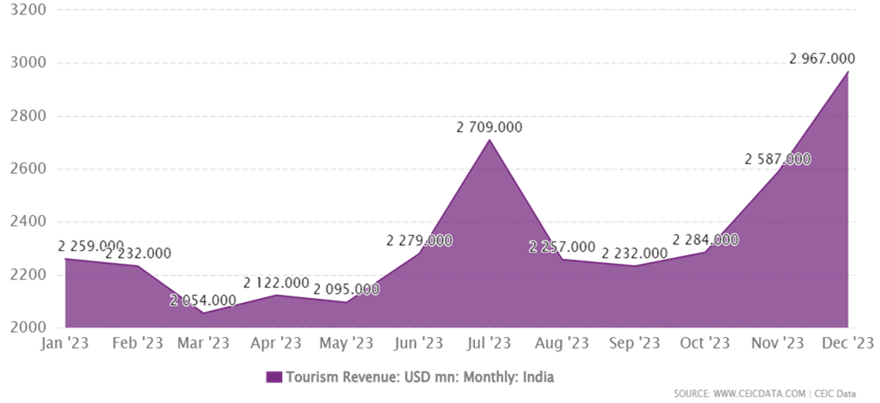
Tourism is a significant contributor to the Indian economy, providing socioeconomic benefits and positively impacting industries like food manufacturing, services, and construction. It creates jobs, generates income and foreign exchange. The tourism and hospitality industry includes accommodations, catering, transportation, attractions, and travel agencies/tour operators.
|
With passage of time and increase in prosperity, most people recognise the importance of work life balance. Nowadays, people take vacations sooner than ever, be it local or foreign, everyone loves to explore. Such a trend has given rise to tour and travel operators. People who make sure you enjoy without any problem. Let us see what GST has for these agents. Travel and Tourism sector holds great strategic importance. Apart from providing employment, income, foreign exchange for the country, it has a positive impact on other associated industries such as food manufacturing, services, construction etc. In addition, investments in infrastructural facilities such as transportation, accommodation and other tourism related services lead to an overall development of infrastructure in the economy.
|
"tour operator" means any person engaged in the business of planning, scheduling, organizing, arranging tours (which may include arrangements for accommodation, sightseeing or other similar services) by any mode of transport, and includes any person engaged in the business of operating tours.
|
|
Thus from the above definition we can see that if an entity is providing the service of organizing a tour which may include all facilities and amenities the entity acts as a tour operator. In this industry entities may either arrange the whole tour by themselves or make arrangements through other connected tour operators. The GST liability changes accordingly. Let us see how GST is applicable in different situations.
|
|
|
Business Models for Tour Operators
|
Tour operators can use different business models to sell travel-related services and merchandise. The following are some popular business models for tour operators:
|
Tour Package: The tour operator includes their margin in the total fees charged, acting as a service provider that coordinates bookings with various counterparts.
|
Pure Agent Tour Operator: The tour operator helps travellers find suitable suppliers and facilitates transactions but only charges for their services, not the end service provided.
|
Flight and Hotel Booking with Backend Commission: The tour operator facilitates transactions and bookings without charging customers any fees. Instead, the ultimate supplier pays a commission to generate sales.
|
GST Registration for Tour Operator & Travel Agents
|
Every business in India whose aggregate turnover in a financial year is above Rs 40 Lakhs and Rs. 20 lakhs in special category states will have to get GST Registration Mandatorily.
|
So, tour operators and travel agents also need to get GST Registration Online as per above GST Registration Threshold Limit. Furthermore, GST Registration is mandatory, if tour operators and travel agents make inter-state taxable supply or makes taxable supply of goods or service or both on behalf of other taxable people.
|
GST Implications on Various Travel Related Services by Agents
|
- GST on Air Ticket Booking Services by Agents
- 18% GST on commission income, service charges, and other charges collected from passengers
- Input Tax Credit (ITC) available on GST paid on commission/service charge by an air travel agent
- GST on travel agents’ commission is charged at 18%
- The type of GST imposed depends on the location of supply
A tour operator may either choose one of the tax treatments.
|
Services provided own account basis Heading -9985 -Collect GST at 5%
|
Conditions to be satisfied
|
- No input tax credit available except input tax credit of input service in the same line of business (i.e. tour operator service procured from another tour operator)
- The bill issued for supply of this service indicates that it is inclusive of charges of accommodation and transportation required for such a tour and the amount charged in the bill is the gross amount charged for such a tour including the charges of accommodation and transportation required for such a tour.
Tour operator Collects GST at 18% - ITC available.
|
- Input tax credit will be available but, in most cases, the major expenses will be hotel accommodation for which the place of supply will be where hotel is situated. And the tax collected will be CGST + SGST. Thus in order to claim ITC the entity should be registered in the state where service is supplied.
Tour operator may provide service on pure agent basis. The entity needs to collect tax on the commission received. Tax needs to be paid at 18% on the commission received. Conditions to act as pure agent
|
The expenditure or costs incurred by a entity as a pure agent of the recipient of supply (customer) shall be excluded from the value of supply, if all the following conditions are satisfied, namely,-
|
- the entity acts as a pure agent of the recipient of the supply, when he makes the payment to the third party on authorisation by such recipient;
- the payment made by the pure agent on behalf of the recipient of supply has been separately indicated in the invoice issued by the pure agent to the recipient of service; and
- the supplies procured by the pure agent from the third party as a pure agent of the recipient of supply are in addition to the services he supplies on his own account.
Pure agent means a person who-
|
- enters into a contractual agreement with the recipient of supply to act as his pure agent
- neither intends to hold nor holds any title to the goods or services or both so procured or supplied
- does not use for his own interest such goods or services so procured; and
- receives only the actual amount incurred to procure such goods or services in addition to the amount received for supply he provides on his own account.
Services provided by a tour operator to a foreign tourist
|
Services provided in respect of tours conducted in India will be taxable as the place of supply is in India. In case of Services provided by a tour operator to a foreign tourist in relation to a tour conducted wholly outside India will be NIL
|
The major sources of income of Tour Operators & Travel Agents are:
|
- Commission from Airline,
- Sale Tour Packages, both inbound and outbound,
- Travel Related Services like Visa, Passport etc,
- Hotel Bookings,
- Car Rental Services, Travel Insurance,
- Railway Reservations.
1) Commission from Airlines
|
An Air Travel Agent gets commission from the Airlines for booking of air tickets. He also gets income in the form of processing fees etc from the client for whom he books the tickets. Since the income is generated from airlines as well as the client there are two parties involved and hence two separate invoices have to be issued.
|
There are 2 options available to the Agent to pay GST-
|
Option 1 : GST @ 18% on Commission /PLA upload incentive / any other form of incentive on Issue of invoice on Airline/ Consolidator.Service Fees @ 18% on Issue invoice on Passenger.
|
Option 2 : As per rule 32 of CGST Rules - The value of services in relation to booking of tickets for travel by air, shall be 5% of basic fare in case of local flight and 10% in case of international flight. Accordingly – GST on basic fare- For domestic booking 0.9% of Basic Fare and For International Booking 1.8% of basic fare. The Air Travel agent can pay tax on any of the option given above.
|
2) Sale of Tour package, Inbound and Outbound
|
Tours organized by the Tour Operator, within India for the tourist coming from abroad is generally known as inbound tours.Tours organized by the Tour Operator, outside India, for the tourist going abroad is generally known as outbound tour.The tour operator may do it on commission basis or second on principle basis i.e. he does all the bookings and later raises the bill on client.
|
- If the tour is on commission basis, then the tour operator will be acting as an intermediary and the place of supply shall be the location of service provider i.e. in India and hence the services will now become taxable and Taxable @ 18%.
- If the tour is on principle basis then the place of supply of service shall be the location of performance of service i.e. in India and Taxable @ 5% without ITC.
3) Travel related services like Visa, Passport etc
|
- If the agent pays government fees or consular charges, which are usually incurred while applying for visa, on behalf of consumer, such fees will not attract GST. However, if agent charges service fee for these services, he will collect GST from the end consumer.
- If the services are outsourced from another service provider (For example a travel agent from Mumbai has to outsource a Hyderabad Agent to get the Visa for US), GST paid on the Delhi Agents Invoice can be claimed as ITC and only the difference can be paid to the Government.
4) Commission on Hotel Booking
|
In most of the cases, tour operator helps in or arranges accommodation as well, be it hotels or resorts or any other place.In this case, the agent acts as intermediary for the purpose of booking tours for his clients.In case it is domestic hotel booking then the place of supply shall be as per the general rule i.e. location of hotel. In case it is international hotel booking then the place of supply shall be location of Agent. ‘
|
5) Car Rental services, Rental services
|
- In case of renting motor cab, 18% GST will apply.
- Travel agents also issue Mediclaim policies and travel insurance to their clients to insure them against any unfortunate happening while on a trip.
Tour agent may book tickets in railway for his client. For this, he gets a commission from railway as well. This is just like commission from Airlines.He also charges service fee to his clientIn both the cases, GST applicable is 18%No commission is paid by the railways to such agents, and no GST levied in this case..The SAC (Service Accounting Code) assigned to Rail travel agents is 9967.
|
GST on Booking of Hotel/Cruise by Agent
|
- Place of supply depends on the location of the hotel for domestic hotel bookings and the location of the service provider for international hotel bookings
- GST charged on the commission received from passengers.
- 18% on Commission received from the hotel. ITC is available.
- If the hotel invoice is not in the name of the client, the tax will be based on the full amount charged for the booking.
- Depending on the situation, the applicable GST rate will either be 12%-18% with Input Tax Credit or 5% without Input Tax Credit.
- However, for international bookings not within the taxable territory, no GST will be charged
The Indian tourism industry is vital for the economy, creating jobs and boosting various industries. Tour operators use different business models and must register for GST if their turnover exceeds the threshold limit or as per other GST regulations. GST implications on various services, such as air ticket booking, tour packages, hotel and cruise booking, and rail travel agents’ commission, vary based on a number of factors.
|
|
|
|
|
|
3. Lawgics by Ms.Nidhi Aggarwal
|
Ms. Nidhi Aggarwal is delighted to present judgment with a great vision to spread complex GST law in a simple manner amongst the taxpayers, tax professionals, students and knowledge seeker.
|
|
Recently added notes are listed below:
|
|
|
|
|
|
|
|
4. GST Notes by CMA Anil Sharma
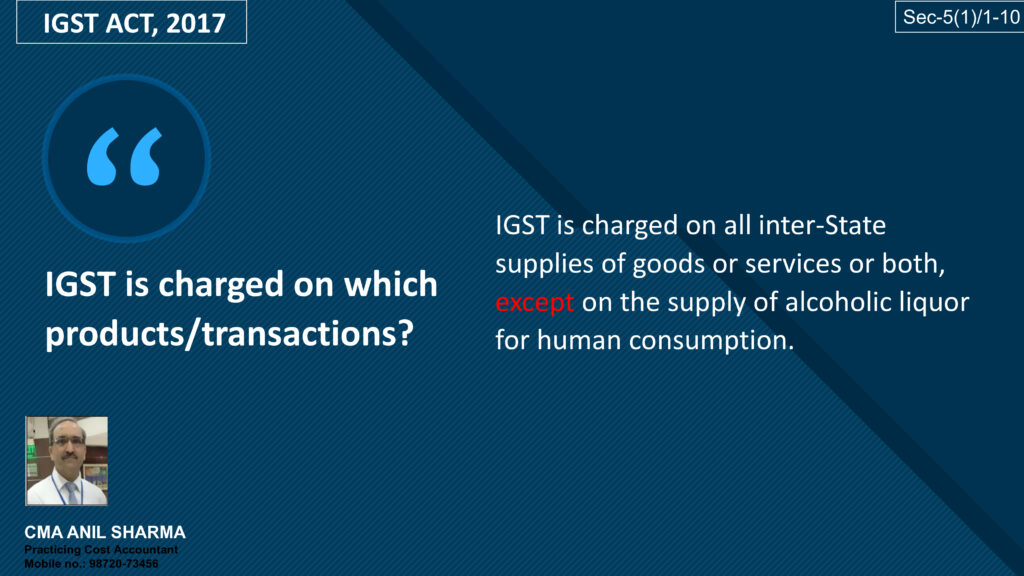
1) Shri CMA Anil Sharma, Shri CMA Gurdev Singh Saini and Smt. CMA Bhawna Sharma posted Chapter-19 recently containing CGST Act in simple language in PPT format. This is to make dealers, professionals, academicians, students etc. understand the basics of GST laws.
|
Chapter 1, 2 & 3 on IGST Act is being added
|
|
|
|
|
|
|
|
|
5. GST Daily by CA Pradeep Modi
CA Pradeep Modi is presenting judgment analysis under title 'GST Daily - Stay yourself updated'
|
|
|
|
|
|
Recap of Latest updates posted on 27.08.2026
|
CBIC issued Notification No. 30/2026-Customs dated 21.08.2026 regarding Seeks to exempt 10 lakh MT of raw sugar falling under tariff heading 1701 from the whole of the customs duty leviable thereon under …
|
GSTN is taking downtime to enhance its services on the GST Portal on 26.08.2026 from 12:00 AM onwards until 6:30 am of 26.08.2026.
|
The Hon’ble Supreme Court in M/s G.R. Infra Projects Limited set aside the Show Cause Notice dated June 13, 2025 issued under Section 74 of the CGST Act read with the MPGST Act for the FY 2018-19, and held that a bland and mechanical recital of the words ‘fraud or concealment of facts’,
|
Indian Railway Finance Corporation Ltd received a show cause notice from the GST Authority demanding ₹549.32 crore. The notice, issued under Section 73 of the Central Goods and Services Tax Act, 2017, cites excess input tax credit claims for FY23.
|
The Anti-Corruption Bureau (ACB) on Monday arrested a state tax officer and a senior assistant in Nirmal district for demanding and accepting a bribe of ₹50,000 in connection with a GST audit.
|
CBIC issued Notification No. 71/2026-Customs (N.T.) dated 25.08.2026 regarding Fixation of Tariff Value of Edible Oils, Brass Scrap, Areca Nut, Gold and Silver
|
CBIC issued Notification no. 21/2026-Customs (ADD) dated 21.08.2026 that Seeks to continue applicability of anti-dumping duty on imports of Natural Mica based Pearl Industrial Pigments ..
|
CBDT issued notification no. 115/2026 dated 21.08.2026 to hereby approves deduction under section 45(3)(a)(i) of the Income tax Act, 2025 to the International Institute of Bio Technology and Toxicology , Tamil Nadu for Scientific Research
|
I request the views of tax professionals and TDS experts on the following issue under the Income-tax Act, 2025, regarding reporting in Form 140.
|
|
|
|
|
|
|
|
THE HON'BLE ALLAHABAD HIGH COURT IN THE CASE OF Vibhuti Tyres V/s State of U.P., decided on 7-5-2025
|
✔️ Is it justified that GST order with higher demand than show-cause notice?
|
👉 The Hon'ble High Court Judgement:-
|
✔️ Where in show-cause notice amount representing tax, interest and penalty was indicated as Rs. 8,81,080, but in order, much higher demand was raised at Rs. 32,97,336, same was in violation of section 75(7); matter was to be remanded back.
|
Section 75 of Central Goods and Services Tax Act, 2017
|
|
|
|
|
|
|
|
THE HON'BLE JHARKHAND HIGH COURT IN THE CASE OF Sadanand Prasad Barnwal V/s State of Jharkhand, decided on 8-5-2025
|
✔️ Is it valid if SCN and order under section 73 for lack of digital signature of issuing authority?
|
👉 The Hon'ble High Court Judgement:-
|
✔️ Where both summary of SCN in Form GST DRC-01 and order under section 73 did not bear digital signature of concerned authority, both SCN and order were to be quashed.
|
Section 161, read with section 73 of Central Goods and Services Tax Act, 2017
|
|
|
|
|
|
|
|
THE HON'BLE CALCUTTA HIGH COURT IN THE CASE OF Edelweiss Rural & corporate Services Ltd. V/s Deputy Commissioner of Revenue, decided on 5-5-2025
|
✔️ What would be Refund if business stood closed and registration was cancelled?
|
👉 The Hon'ble High Court Judgement:-
|
✔️ Where Refund sanction order had itself observed that assessees business was closed down, its registration was cancelled and it had no tax dues refund claim was already allowed, direction to credit refund amount to credit ledger instead of bank account of assessee was self-contradictory since there was no business for assessee to take benefit of refund credited to assessees credit ledger.
|
Section 54 of Central Goods and Services Tax Act, 2017
|
|
|
|
|
|
|
|
THE HON'BLE JHARKHAND HIGH COURT IN THE CASE OF Sri Ram Stone Works V/s State of Jharkhand, decided on 9-5-2025
|
✔️ Can GST Notice would be issued under Section 61 of CGST Act merely on the basis of difference between sale price and market price?
|
👉 TheHon'ble High Court Judgement:- ✔️ Clear objective of section 61 is to enable an Assessing Officer to point out discrepancies and errors which are occurring in return filed by a registered person with that of related particulars; notice under section 61 cannot be issued comparing particulars at which assessee has sold its goods with that of prevalent market price.
|
|
|
|
|
|
|
|
THE HON'BLE ALLAHABAD HIGH COURT IN THE CASE OF Gopal Trading Company V/s State of U.P., decided on 7-5-2025
|
✔️ Can excess stock during search warrants proceedings would be confiscation under section 130 of CGST?
|
👉 The Hon'ble High Court Judgement:-
|
✔️ Where in search at premises of assessee, excess stock was found, Act specifically contemplates that proceedings under section 73/74 should be pressed; proceedings under section 130 could not have been pressed.Section 67, read with sections 73, 74 and 130, of Central Goods and Services Tax Act, 2017
|
|
|
|
|
|
|
|
THE HIGH COURT AT CALCUTTA Anmol Stainless Pvt. Ltd. V/s Deputy Commissioner of State Tax, Serampore Charge
|
✔️ Can any demand order would be stayed on as SCN issued under extended Section 73(9) timeline citing lack of force majeure?
|
👉 The Hon'ble High Court Judgement:-
|
✔️ Where show cause cum demand notice was issued in respect of period April, 2019 to March, 2020 as late as on 30-4-2024 in view of Notification Nos. 9/2023-CT and 56/2023-CT by which time limit for issuance of order under section 73(9) was extended while assessee challenged same on ground that there was no force majeure prevailing at relevant time and, hence, respondents could not have relied on these Notifications, there was prima facie case; affidavit-in-opposition to writ petition was to be filed and demand was to be stayed.
|
Section 73, read with section 168A, of Central Goods and Services Tax Act, 2017
|
|
|
|
|
|
|
|
THE HON'BLE MADRAS HIGH COURT IN THE CASE OF Union of India V/s Flemingo Duty Free Shop Pvt. Ltd. , decided on 29-4-2025
|
✔️ Is it justified for Revenue to examine if tax impact was revenue neutral or resulted in loss of revenue before taking any action?
|
👉 TheHon'ble High Court Judgement:-
|
✔️ Where petitioner entered into concession agreement with Airport Authority of India for operation of Duty Free Shop at International Airport and paid minimum guarantee/revenue share, revenue Authorities should examine as to whether tax effect was in fact revenue neutral or there was any loss of revenue and thereafter proceed in accordance with law.
|
|
|
|
|
|
|
|
THE HON'BLE ALLAHABAD HIGH COURT IN THE CASE OF
|
Arena Superstructures Pvt. Ltd. V/s Union of India, decided on 22-4-2025
|
✔️ Can department would be create any demand if Once resolution plan approved?
|
👉 The Hon'ble High Court Judgement:-
|
✔️ Assessee submitted that once resolution plan had been approved by NCLT, GST department could not create further dues by way of passing orders.
|
✔️ The HON'BLE Supreme Court in the case of Vaibhav Goel v. Deputy Commissioner of Income-tax 172 taxmann.com 601 (SC), held that successful resolution applicant cannot be faced with "undecided" claims after resolution plan had been accepted.
|
✔️ In view of same, it was clear that once resolution plan was approved by NCLT, all other creditors were barred from raising claims subsequently - Accordingly, impugned assessment order was to be set aside.
|
Section 74 of Central Goods and Services Tax Act, 2017
|
|
|
|
|
|
|
|
THE HON'BLE GUJARAT HIGH COURT IN THE CASE OF BVM Pharma V/s Union of India, decided on 27-3-2025
|
✔️ Can GST would be levied on assignment of leasehold rights in land and building?
|
👉 The Hon'ble High Court Judgement:-
|
✔️ Where assessee-lessee transferred leasehold rights of its industrial plot to third party-assignee by transfer order and thus, third party-assignee would now become lessee, assignment of leasehold rights of land and building by assessee would not be subject to levy of GST.
|
✔️ In Gujarat Chamber of Commerce and Industry v. Union of India 2025 it was held that provisions of section 7(1)(a) providing for scope of supply read with clause 5(b) of Schedule II and Clause 5 of Schedule III would not be applicable to such transaction of assignment of leasehold rights of land and building and same would not be subject to levy of GST.
|
|
|
|
|
|
|
|
THE HON'BLE DELHI HIGH COURT IN THE CASE OF Gurudas Mallik Thakur V/s Commissioner of Central Goods and Service Tax, decided on 23-4-2025
|
✔️ Can Filing of appeal under section 107 would be available to either taxable persons or any aggrieved person too?
|
👉 The Hon'ble High Court Judgement:-
|
✔️ Where petitioner-director of a company filed writ petition challenging levy of penalty on him on ground of ITC fraud and took stand that he had already resigned at relevant time, since matter required closer scrutiny on facts as to who was responsible for running company, petitioners should avail appellate remedy.
|
✔️ Filing of appeal under section 107 is permissible by any person and not merely by a taxable person.
|
|
|
|
|
|
|
|
THE HON'BLE MADRAS HIGH COURT IN THE CASE OF Tvl. Arun Traders V/s Union of India, decided on 8-4-2025
|
✔️ Can pre-deposit would be paid later on if it is inadvertently not deposited at time of filing appeal?
|
👉 The Hon'ble High Court Judgement:-
|
✔️ Where 10 per cent of pre-deposit amount was not paid to department at time of filing appeal due to inadvertence, in interest of justice, assessee should deposit required pre-deposit amount and Appellate Authority should restore appeal.
|
Section 107 of Central Goods and Services Tax Act, 2017
|
|
|
|
|
Edit this to insert text.
|
|
|
6. GST/Income Tax in Media
|
|
|
|
|
The Goods and services tax (GST) authorities are planning to electronically record details of invoices issued by shops and businesses to retail consumers under a pilot project covering select sectors from April 1, 2027, to improve tax compliance, two officials told Business Standard.
|
The move will enable tax officials to access the large volume of retail transactions in sectors prone to tax evasion and assess whether businesses are correctly reporting their sales and paying the appropriate amount of GST, they said.
|
Currently, businesses with annual sales of more than ₹5 crore have to electronically register invoices issued to other businesses on a government-designated portal, subject to certain exemptions. Extending this reporting requirement, known as e-invoicing, to sales to end consumers is the next logical step towards enhancing tax compliance.
|
Businesses currently report their aggregate sales through GST returns rather than individual retail transactions. E-invoicing at the retail level is expected to help tax officials match these transactions with the sales reported by businesses in their tax returns, one of the officials said.
|
The GST Council, at its 54th meeting in September 2024, had recommended a voluntary trial of electronic recording of consumer bills in select sectors and states.
|
The Council proposed introducing the system on a voluntary basis initially and subsequently making it mandatory in sectors prone to tax evasion, according to the minutes of the meeting, which are publicly available. Restaurants were cited as one of the sectors where retail e-invoicing could be introduced.
|
The Council had identified several potential benefits, including better tax compliance, environmental gains from avoiding physical invoices and lower costs. Consumers would receive e-invoices on their mobile phones.
|
Officials said the government was now keen to take the pilot project forward.
|
An email sent to the Ministry of Finance on October 23 seeking comments for the story remained unanswered till press time.
|
Banks, insurers and non-banking financial companies (NBFCs) are among those currently exempt from e-invoicing for transactions with other businesses. However, the Centre and state governments are also considering bringing their business-to-business invoices under the requirement, the first official said. This is not part of the proposed pilot project.
|
Managing retail sales data
A third official, who also spoke on condition of anonymity, said the idea of electronically capturing retail invoices had been discussed for years, but implementation was delayed by the challenge of processing the enormous volume of small-value transactions taking place every day.
|
Storing and processing such volumes would require substantial server capacity, and the earlier technology infrastructure was not equipped to handle that scale, the official said.
|
Retail e-invoicing could also help foreign tourists claim GST refunds on purchases made in India before taking the goods back to their home countries, as customs officers would be able to verify the tax paid more easily, the official said.
|
Another government official said the GST Network (GSTN), which manages the technology backbone of the GST system, awarded Infosys a fresh seven-year contract in 2025 after the original arrangement, which had already been extended beyond its initial five-year term, ended.
|
Officials believe the new arrangement has factored in the need for higher storage and processing capacity.
|
They said storing invoices in a common system could reduce compliance costs by enabling more efficient invoice matching and audits, instead of relying on separate statements and manual checks.
|
Digital records carrying timestamps could also improve transparency and make subsequent changes to invoices easier to track, they said.
|
The government is also studying how countries such as Brazil and Chile operate their e-invoicing systems. Both have long used electronic invoices for business and consumer transactions, officials said.
|
Experts said the impact of e-invoicing in retail could be significant. “E-invoicing could be leveraged by the government to incentivise customers who seek GST valid invoice for their purchases, thereby encouraging the unorganised sector moving to the organised,” an tax expert said.
|
Experts also welcomed the possibility of withdrawing the business-to-business (B2B) exemption for financial sector entities. Another tax expert said e-invoicing in sectors such as banking, NBFCs and insurance would bring all B2B transactions in the economy under the system.
|
“Customers of these sectors would also benefit. It would be important to give sufficient time to these sectors as they have very high volumes of B2B transactions, and also use several custom/bespoke billing systems,” he said.
|
“Overall, it is a positive change and the GST Policy wing can collaborate with the sector associations to make this a success,” he said.
|
On B2C e-invoicing, he said it could enable better integration of digital payment and invoicing systems, supporting automated reconciliation and reporting.
|
Another tax expert said banks and NBFCs handle millions of small charges every day.
|
“Keeping the B2C pilot focused on technology-enabled sectors such as organised retail, e-commerce, quick commerce and online gaming while moving financial institutions only on the B2B side first, is a practical approach,” he said.
|
Source: Business Standard
|
|
|
|
|
|
|
|
Under the current GST returns framework, taxpayers are required to furnish details of their outward supplies in FORM GSTR-1. Based on such details, a statement of input tax credit (ITC) is made available to the recipients in FORM GSTR-2B for availment of input tax credit. To aid furnishing of return in FORM GSTR-3B of a tax period, tax liability of a supplier is being auto-populated on the portal based on the details furnished in his FORM GSTR-1, and available input tax credit is being autopopulated in his FORM GSTR-3B on the portal based on his FORM GSTR-2B. Currently, taxpayers can edit such auto-populated tax liability and available input tax credit in FORM GSTR-3B, before filing the same. Such editing may result in discrepancies between
|
a. tax liability reported in FORM GSTR-1 and tax paid in FORM GSTR-3B; and
|
b. ITC available in FORM GSTR-2B and ITC availed in FORM GSTR-3B.
|
2. These discrepancies often lead to issuance of demand notices by tax officers and system generated intimations to taxpayers. In view of reducing the mismatches between the tax liability reported in FORM GSTR-1 and the tax paid in FORM GSTR3B, and between the ITC available in FORM GSTR-2B and the ITC availed in FORM GSTR-3B, various facilities have been introduced on the portal in the past. These facilities enable correct reporting of tax liability and ITC details in FORM GSTR-3B, including correction of such details, wherever required, in the source statements i.e. FORM GSTR-1 and FORM GSTR-2B, rather than direct editing in FORM GSTR-3B. These facilities include:
|
a. FORM GSTR-1A, to enable taxpayers to amend their FORM GSTR-1 details before filing FORM GSTR-3B;
|
b. Invoice Management System (IMS), to facilitate reconciliation of ITC available in FORM GSTR-2B with the ITC availed in FORM GSTR-3B;
|
c. Electronic Credit Reversal and Re-claimed Statement, to facilitate accurate reporting of reversal and re-claim of ITC; and
|
d. RCM Ledger/ITC Statement, to facilitate accurate reporting of ITC availment in respect of supplies liable to reverse charge
|
3. The above-mentioned facilities though made available on the portal, have, except for FORM GSTR-1A, not been notified in CGST Rules, 2017. It is seen that some taxpayers are either not using or not properly using these facilities and continue to manually edit auto-populated details in FORM GSTR-3B, resulting in continued issuance of demand notices by tax officers and system generated intimations to taxpayers on account of mismatches in tax liability and ITC, causing inconvenience to taxpayers while also weakening the ITC chain integrity.
|
4. Accordingly, there is a need to further strengthen the return-filing framework, so as to provide an improved alternate mechanism of amendment of tax liability and ITC details in return in FORM GSTR-3B, which reconciles with the details of outward supplies furnished in FORM GSTR-1 and the details of available ITC in FORM GSTR2B, thereby minimizing mismatches. Such a framework will improve the accuracy of tax liability and ITC reporting, enhance compliance, and strengthen the foundation for the effective implementation of other process reforms recommended by the GST Council.
|
GST Council recommendations
5. In view of the above, the GST Council in its 57th meeting held on 8th October, 2026, took note of the various scenarios which require the taxpayers to edit autopopulated values in FORM GSTR-3B and recommended an Alternate mechanism of amendment of tax liability and ITC details in return in FORM GSTR-3B, building on the existing facilities and recommending certain new facilities as follows:
|
- i. Enhancement of FORM GSTR-1/1A/IFF for better reconciliation with FORM GSTR-3B and other statements
- The absence of supply-type-wise granularity in FORM GSTR-1/1A/IFF may lead to incorrect auto-population of the corresponding tables in FORM GSTR-3B, requiring manual correction by taxpayers. For instance, credit notes, debit notes, advances received, and advances adjusted are not categorised by the nature of supply, such as regular outward supplies, supplies under section 9(5), or zero-rated supplies. As a result, they may be reported under the table for taxable outward supplies in FORM GSTR- 3B, instead of the appropriate relevant table.
- Further, the existing format of FORM GSTR-1 does not enable taxpayers to reconcile supplies made through electronic commerce operators with the corresponding details furnished by the ECOs in FORM GSTR-8 and made available on the common portal.
- Accordingly, enhancements to FORM GSTR-1/1A/IFF have been recommended to enable identification of the nature of the underlying supply in respect of credit notes, advances, and similar documents. This would ensure correct auto-population of tax liability in FORM GSTR-3B and obviate the need for amending the auto-populated liability in FORM GSTR-3B.
- Further, to facilitate the taxpayers in furnishing details in FORM GSTR1/1A/IFF on the portal, user interface improvements, such as tool tips and guided navigational paths on the portal have been suggested.
- ii. Expanding the scope of rectifications to be made through FORM GSTR-1A
- At present, FORM GSTR-1A cannot be used to add or amend details relating to earlier tax periods, or to correct the GSTIN of the recipient. This restricts taxpayers from rectifying any error regarding the earlier tax period or relating to change in GSTIN of the recipient before filing FORM GSTR-3B. Accordingly, it has been recommended that this restriction may be removed.
- iii. Rectification of details furnished in FORM GSTR-3B of an earlier tax period
- It was observed that certain taxpayers rectify tax liability for outward supplies of an earlier tax period directly in FORM GSTR-3B, without correcting the underlying details in FORM GSTR-1/1A. Accordingly, it has been recommended that such rectification be made only through the amendment tables of FORM GSTR-1/1A, instead of amending the autopopulated liability detail in FORM GSTR-3B, directly. However, rectification of reverse-charge tax liability may be made directly through adjustments in the FORM GSTR-3B of a subsequent tax period.
- iv. Reporting of details of outward supplies in FORM GSTR-1 where tax had been discharged through FORM GST DRC-03
- Where any amount of tax has been paid through FORM GST DRC-03 in pursuance of a proceeding such as the audit, inspection, scrutiny or enforcement activity by the tax authorities, and the taxpayer intends to pass on the ITC in respect of the same to the recipient, then if he reports the invoice or debit note details in FORM GSTR-1/1A, the liability gets auto-populated in FORM GSTR-3B. As the taxpayer has already paid the tax liability through FORM GST DRC-03, he may be resorting to editing liability in FORM GSTR-3B, so as to avoid duplication of payment of said tax liability.
- To prevent such duplication, it has been recommended that FORM GST DRC-03 be enhanced to enable the taxpayer to declare, within seven days of payment, the details of the underlying invoice(s) or debit note(s). In such cases, when the said invoice or debit note details are reported in FORM GSTR-1/1A, the corresponding tax liability for the said invoice or debit note will not be added to the auto-populated liability in FORM GSTR-3B, thus avoiding any duplication of payment of tax. The details of such invoice or debit note will also be made available in corresponding FORM GSTR-2B of the recipient for availment of ITC.
- v. Correct reporting of reverse charge liability in FORM GSTR-3B
- To facilitate the taxpayers in correct reporting of tax liability and input tax credit in respect of supplies liable to reverse charge, RCM Liability and ITC Statement was introduced on the portal from August 2024 period onwards for monthly filers and July-September 2024 period onwards for quarterly filers. A facility was also provided to report cumulative closing balance, if any, upto that period.
- To further streamline correct reporting of such tax liability and ITC, it has been recommended to notify the said statement in CGST Rules, 2017 and to require that ITC claimed on inward supplies under reverse charge (other than import of goods) in FORM GSTR-3B of a tax period should not exceed the tax liability under RCM declared in the said FORM GSTR-3B and the closing balance available in the said statement.
- Accordingly, an Electronic Statement of tax paid on Reverse charge basis and input tax credit claimed has been recommended in FORM GST PMT-02B. Also, amendment has been recommended in FORM GST PMT-04, so as to allow a taxpayer to report discrepancies, if any, in the said statement.
- vi. Mandating and clarifying the usage of Invoice Management System (IMS) for better reconciliation of input tax credit details in FORM GSTR-3B
- IMS has been available on the portal since October 2024. It allows recipients to accept, reject, or keep pending inward supply details communicated by supplier. The salient features of IMS are as follows:
- The taxpayer may keep documents pending on IMS, in respect of which the conditions of eligibility of ITC under section 16(2) of CGST Act are presently not fulfilled, but which may get fulfilled subsequently. Upon fulfillment of the requisite conditions, such documents may be subsequently accepted by the recipient on IMS.
- The taxpayer may reject a document on IMS, if any discrepancy in the document communicated on IMS is noticed or where the document is found to not pertain to him.
- If no action is taken on a document communicated on IMS for generation of FORM GSTR-2B of a tax period before filing of FORM GSTR-3B for the said tax period, the same is considered to have been accepted by the recipient on IMS.
- ITC pertaining to accepted or deemed accepted documents is made available in FORM GSTR-2B and accordingly autopopulated in Table 4(A) of FORM GSTR-3B for the corresponding tax period. Conversely, the ITC pertaining to documents kept pending or rejected in IMS is not made available in FORM GSTR2B and accordingly not auto-populated in Table 4(A) of FORM GSTR-3B for the corresponding tax period.
- An action taken on any document on IMS by the recipient can be revised any number of times upto the filing of his FORM GSTR3B for the tax period for which FORM GSTR-2B is being generated. Based on the revised action taken on IMS, FORM GSTR-2B can be also revised, which will also revise the autopopulated ITC in FORM GSTR 3B.
- These above-mentioned features of IMS improve the reconciliation between ITC available in FORM GSTR-2B and ITC availed in FORM GSTR-3B.
- With a view to facilitate ease of taking action on IMS, offline tool has been made available on GST Portal, to enable taxpayers to undertake actions on both individual as well as bulk invoices in an efficient manner.
- To reduce inadvertent rejections or premature acceptance of credit notes, it has been recommended to extend the period for which a credit note may be kept pending on IMS:
a) By Monthly filers: Until filing of FORM GSTR-3B for next-to-next month, to the month in which the credit note was communicated to the taxpayer, but not later than the end of the month in which the due date for filing of the return in FORM GSTR-3B for the said next to next month falls. Thereafter, the credit note will be deemed accepted.
|
Example: Say a credit note was communicated by the supplier in his FORM GSTR-1 filed on 11th May, 2026, for the month of April 2026, to the recipient “A”. The same shall reflect in the IMS of “A” for the month April 2026. This credit note can be kept pending on the IMS by “A” till the date of filing of FORM GSTR-3B for the month of June, 2026 (which is next to next month of April 2026). However, if FORM GSTR-3B of June 2026 is not filed by “A” upto 31st July 2026 (which is the last date of the month in which the return for the month June 2026 was due), then the said credit note shall be deemed to have been accepted by “A” on IMS.
|
b) By Quarterly filers: Until filing of FORM GSTR-3B for the next quarter after the quarter in which the credit note was communicated to the taxpayer, but not later than the end of the month in which the due date for filing of the return in FORM GSTR-3B for the said next quarter falls. Thereafter, the credit note will be deemed accepted.
|
Example: Say a credit note was communicated by the supplier in his FORM GSTR-1 filed on 11th May, 2026 for the month of April 2026, to a recipient “A”,. The same shall reflect in the IMS of “A” for the quarter April–June 2026. This credit note can be kept pending on the IMS by “A” till the date of filing of FORM GSTR-3B for the quarter of July–September 2026 (which is next quarter to April–June 2026). However, if FORM GSTR-3B of July–September 2026 is not filed by “A” upto 31st October 2026 (which is the last date of the month in which the return for the quarter July–September 2026 was due), then the said credit note shall be deemed to have been accepted by “A” on IMS.
|
-
- It has further been recommended to provide an option for the suppliers to link credit notes and debit notes with the underlying invoices in FORM GSTR-1/1A/IFF, on a purely voluntary basis, to help recipients take informed decisions and to reduce the need of keeping credit notes pending or rejecting them on IMS.
- Since acceptance, rejection, and keeping documents pending on IMS improve ITC reconciliation, the GST Council has recommended that management of available ITC in FORM GSTR-3B should be carried through IMS instead of directly amending auto-populated ITC in FORM GSTR-3B. GST Council has also recommended notifying relevant amendment in GST Rules and FORMS for the same purpose.
- The Council also recommended issuance of a circular to guide the taxpayers in correct manner of taking action on IMS.
- vii. Facilitating taxpayers in correct reporting of reversal and reclaim of ITC in FORM GSTR-3B:
- In order to facilitate the taxpayers in correct and accurate reporting of reversal and reclaim of input tax credit, a statement namely, Electronic Credit Reversal and Reclaim Statement was introduced on the GST portal from August 2023 return period onwards, with a facility to report their cumulative closing balance of input tax credit, if any, which had been reversed but not re-availed upto that time.
- To further streamline correct reporting, it has been recommended to notify the said statement in CGST Rules, 2017 and to require that reclaimed input tax credit in FORM GSTR-3B shall not exceed the balance available in the said statement.
- Accordingly, an Electronic Credit Reversal and Reclaim Statement has been recommended in FORM GST PMT-02A. Also, amendment has been recommended in FORM GST PMT-04, so as to allow a taxpayer to report discrepancies, if any, in the said statement.
- Further, amendment has been recommended in Table 4 of FORM GSTR3B to provide for a separate Table 4(AA) in FORM GSTR-3B for reporting reclaimed ITC, so as to obviate the need for amending the auto-populated ITC details in Table 4(A)(5) of FORM GSTR-3B.
- viii. Streamlining the manner of rectification of errors made in reporting input tax credit in FORM GSTR-3B
- After suppliers furnish outward supply details, recipients act on IMS to generate FORM GSTR-2B and are generally required to manually report RCM ITC, ITC reversals, and ITC re-claims in FORM GSTR-3B. Such manual interventions are prone to errors and omissions.
- As the temporary reversals made in Table 4(B)(2) of FORM GSTR-3B are credited to the Electronic Credit Reversal and Re-claim Statement, any excess temporary reversal done in Table 4(B)(2) can be rectified by reclaiming the excess amount so reversed in a subsequent return. However, no such systematic mechanism exists to rectify any excess reversal of ITC, reversed permanently in Table 4(B)(1) of FORM GSTR3B.
- Accordingly, it has been recommended to provide a systemic mechanism, by way of a new form, FORM GST PMT-10 to undertake rectifications of such excess reversals of permanent nature reported in Table 4(B)(1) of FORM GSTR-3B of an earlier tax period, on the basis of self-assessment.
- ix. Enhancement in FORM GSTR-2B in respect of ITC distributed by ISD
- ITC distributed by an Input Service Distributor (ISD) as ineligible in FORM GSTR-6 does not currently flow as available ITC in FORM GSTR2B and is therefore not auto-populated in Table 4(A)(4) of FORM GSTR3B.
- Accordingly, enhancements have been recommended in FORM GSTR2B and FORM GSTR-3B, to provide that ITC distributed by an ISD as ineligible need not be reversed again by recipients in Table 4(B)(1) of FORM GSTR-3B as such ITC will be auto-populated as ineligible ITC in Table 4(D)(2) of FORM GSTR-3B.
- Currently, ITC attributable to an ineligible ISD credit note is reduced from eligible ITC on the portal. Since such a credit note relates to ineligible ITC, its impact should instead flow to the ineligible ITC section, i.e., Table 4(D)(2) of FORM GSTR-3B.
- Accordingly, enhancements have been recommended in FORM GSTR2B to ensure that ITC relating to ineligible credit notes distributed by an ISD is not adjusted against eligible ITC distributed by the ISD.
6. Besides the above, the GST Council also recommended issuance of a circular to clarify the correct manner of reporting ITC availment and its reversal in FORM GSTR3B, in the context of IMS, the Electronic Credit Reversal and Re-claimed Statement, and the Electronic Statement of tax paid on reverse charge basis and ITC claimed.
|
7. The Council recommended that, with the above proposed measures, there may not be any need for directly rectifying/amending the details of liability (autopopulated from FORM GSTR 1/1A/IFF) and details of ITC (auto-populated from FORM GSTR-2B) in FORM GSTR-3B. Thus, any amendment/correction of liability will be done through FORM GSTR-1/1A/IFF instead of directly amending auto-populated values in FORM GSTR-3B. Further, any management of ITC will be done through IMS, Electronic Credit Reversal and Re-claimed Statement, and the Electronic Statement of tax paid on reverse charge basis and ITC claimed, FORM GST PMT-04 and FORM GST PMT-10, instead of directly amending the auto-populated details in FORM GSTR-3B. To allow stakeholders sufficient time to align their systems and practices, the Council recommended that this proposed Alternate mechanism of amendment of tax liability and ITC details in return in FORM GSTR-3B, and corresponding amendments to the CGST Rules, 2017, may be brought into force from the return period of April, 2027.
|
Public consultation
8. Furthermore, the Council recommended that the proposed measures be placed in the public domain for a time-bound consultation to provide an opportunity to taxpayers, tax practitioners, industry associations, and other stakeholders to submit comments and suggestions on the proposed measures. In this regard, the amendments recommended by the Council in CGST Rules, 2017 and in the CGST FORMs are placed at Annexure A* and Annexure B*, respectively. The circular recommended by the Council for clarifying the correct manner of reporting ITC availment and its reversal in FORM GSTR-3B is placed at Annexure C*.
|
9. Accordingly, all the stakeholders are invited to examine the proposed measures and submit their comments, suggestions, and inputs by Monday, 30th November. The same shall be examined and duly considered before finalisation of the amendments to the said Forms and Rules.
|
* Kindly note that the amendments proposed in the CGST Rules, 2017 and CGST Forms placed in Annexure A and Annexure B respectively, have been highlighted in red.
|
|
|
|
|
|
|
|
India’s ambition to become a Viksit Bharat requires an economy in which enterprises of every size can grow, wherever they begin. Over the past twelve years, our government has worked to create those conditions. The introduction of the goods and services tax (GST) in 2017 established a common national framework for indirect taxation. Next-Gen GST carries that effort forward, drawing on nine years of implementation and the experience of taxpayers and states.
|
Under Prime Minister Narendra Modi’s vision, Next-Gen GST was conceived with two connected purposes: To reduce and rationalise rates, and to make compliance easier. The rate changes took effect on September 22, 2025. The next phase of process reforms will come before the GST Council shortly. Together, these efforts seek to give households relief, businesses greater certainty and taxpayers a system in which they can fulfil their obligations without avoidable difficulty.
|
The states have been partners throughout. They brought their priorities and experience to the Council, helped shape the decisions and undertook their implementation. I thank them for that commitment. GST’s progress rests on this willingness to pursue a shared national purpose while respecting each government's responsibilities.
|
The results provide grounds for confidence. Between October 2025 and July 2026, the value of reported taxable supplies grew by 25.8 per cent over the corresponding period a year earlier. A lighter rate structure has been accompanied by a substantial expansion in reported economic activity. This is an encouraging foundation for a reform intended to support both enterprise and public finances.
|
That resilience is visible in the latest revenue figures. Gross GST collections reached ₹12.46 trillion during April-September 2026, up 11.6 per cent over the corresponding period last year. Every month from June through September recorded double-digit annual growth; together, collections for these four months accelerated by nearly 15 per cent. Net collections, after refunds, also grew by 10.4 per cent over the half year. Taxpayer relief has coexisted with growth in the resources available for development.
|
The breadth of the expansion matters as much as its scale. Reported taxable supplies grew across all 11 sector groups and all major states. In an economy as diverse as India’s, this spread is significant. Growth across sectors and regions creates opportunities for more businesses to participate in expanding markets, and for more communities to benefit from the demand, investment and employment that follow.
|
Reported sales to consumers (B2C) also rose by 26.7 per cent in the post-reform comparison. When tax relief is reflected in prices, families have more room to meet other needs or save. Consumer relief and enterprise growth are closely connected: The purchasing power of households sustains demand for the goods and services that businesses provide. The benefits can extend from the household to the retailer, the supplier and the producer.
|
For small and medium enterprises, a national market is valuable when it opens a practical route to customers beyond their immediate surroundings. Businesses in Tier-II and Tier-III towns should be able to build those relationships while continuing to invest and employ people locally. Enterprises expanding into these towns, in turn, can create opportunities for local suppliers and distributors. GST’s common framework supports these connections; simpler administration must make them easier to sustain.
|
Participation in that framework is substantial. GST registrations across Central and state jurisdictions stood at approximately 17.1 million at the end of August, up nearly 15 per cent from a year ago. For the April–July 2026 tax periods, GSTR-3B returns filed by their due dates were 12.6 per cent higher than for the same periods last year. These improvements place a corresponding responsibility on the administration: Regular compliance must be supported by reliable service, clear guidance and timely resolution of difficulties.
|
The functioning of input tax credit is another important part of this experience. The post-reform figures show that the share of tax liability discharged through credits rose, while accumulated credit declined relative to taxable supplies. This is encouraging for businesses that depend on the effective use of eligible credit. For a smaller firm, working capital determines how readily it can purchase inputs, fulfil an order and take on the next one.
|
Refunds are equally relevant. Approximately ₹1.80 trillion was refunded during April-September. Returning amounts due to businesses is part of a well-functioning tax system. Greater predictability in this process would help enterprises plan purchases and production with more confidence. The taxpayer’s experience of receiving an eligible refund is an important measure of administrative performance.
|
The states also have a stronger revenue position. Their aggregate SGST (state GST) receipts, including their share of IGST (integrated GST) settlements, grew by about 16 per cent during April-September this year. These resources support investment in infrastructure and public services, which improve the conditions in which families and enterprises pursue their aspirations. The gains can therefore reinforce one another: Household relief supports demand, enterprise strengthens economic activity, and public revenues help sustain development.
|
The experience also points to the work ahead. A growing system must remain attentive to the costs it imposes on smaller participants. Their time and resources are limited. Each improvement in filing, credit or refunds should allow more of those resources to be devoted to running and expanding a business.
|
The proposals before the Council on October 7 have been developed through sustained work with the states. They address registration, returns, refunds, disputes and improved flow of input tax credit, with the aim of reducing the time and cost of compliance. Taxpayer experience must continue to guide implementation.
|
The GST’s growing maturity gives us a stronger foundation for the next stage of reform. The same commitment to clarity, certainty and respect for the taxpayer guides our work on direct taxes. A dependable tax system enables enterprises to plan beyond their immediate obligations and invest in opportunities that take time to mature. Giving them that confidence, wherever they operate, helps build the economic strength of a Viksit Bharat as envisioned by Prime Minister Narendra Modi.
|
The writer is the Union Minister of Finance and Corporate Affairs
|
Source: Business Standard
|
|
|
|
|
|
|
|
The Preventive Wing of the Central Goods and Services Tax (CGST) Commissionerate, Shimla, has uncovered an alleged GST fraud involving input tax credit of around ₹5.55 crore in the Kala Amb industrial area of Sirmaur district. The investigation has also led to the arrest of Gaurav Jain, managing director of M/s Samay Pharma India Private Limited, Trilokpur.
|
How Was the Alleged GST Fraud Carried Out?
CGST officials alleged that Samay Pharma and M/s Dual Healthcare claimed input tax credit using fake invoices issued by several firms that either did not exist or were found to be non-genuine.
|
The investigation found that ITC worth around ₹5.55 crore was allegedly claimed through invoices linked to 10 such firms. Officials examined the transactions to determine whether the supplies mentioned in these invoices had actually taken place.
|
What Did Officials Find About the Goods?
Officials said the invoices showed the purchase of goods, but there was no evidence confirming that those goods were actually transported.
|
E-way bills and toll-plaza records also did not support the movement of goods mentioned in the invoices, raising questions about whether the transactions reflected genuine supplies.
|
How Were GST Refund Claims Allegedly Involved?
Officials further alleged that the fake input tax credit was later included in GST refund claims.
|
The suspected credit was allegedly used in an attempt to obtain money back from the government through the GST refund mechanism.
|
What Other Irregularities Were Found?
During the investigation, officials found several suspicious transactions, fake firms and invoices without actual movement of goods.
|
They also alleged that shell entities were being used to manipulate the GST credit and refund system.
|
What Evidence Did Investigators Examine?
The CGST team recorded statements from several people during the investigation and examined digital evidence.
|
The inquiry also looked at invoices, the firms connected to them and records relating to the alleged movement of goods.
|
Why Was the Managing Director Arrested?
Based on the evidence collected during the investigation, Gaurav Jain, managing director of M/s Samay Pharma India Private Limited, was arrested.
|
The arrest was made under Section 69(1) of the Central Goods and Services Tax Act, 2017.
|
Follow for daily updates on cybercrime, corporate fraud, DFIR, hacking, investigations, and digital forensics
|
|
|
|
|
|
|
|
GST officers have arrested a partner of a firm engaged in trading of iron and steel goods for fraudulently availing input tax credit of over Rs 15.78 crore.
|
Investigations by the Central Goods & Services Tax (CGST), Delhi South Commissionerate's anti-evasion branch revealed that the firm had availed inadmissible ITC on the basis of invoices issued by multiple firms, several of which were found to be non-existent, non-functional, suspended or cancelled.
|
Field verification also established that certain suppliers had no genuine business activity at their declared places of business.
|
In a statement, the Finance Ministry said, "CGST Delhi South Commissionerate have arrested a partner of the firm engaged in trading of iron and steel goods in a case involving fraudulent availment, utilisation and passing on of inadmissible ITC aggregating to over Rs 15.78 crore through bogus invoices of approximately Rs 87.67 crore."
|
Further inquiry established that ITC was availed without actual receipt of goods and was also passed on to various recipients through invoices issued without corresponding supply of goods.
|
Based on the evidence gathered during the investigation and statements recorded under Section 70 of the CGST Act, 2017, the accused was arrested on September 14 and produced before the Patiala House Court, which remanded him to judicial custody for 14 days.
|
|
|
|
|
|
|
|
The Superintendent of Central GST, Mohit Pratap Singh, was caught while allegedly accepting a bribe of Rs 8 lakh through a mediator, the Lokayukta said.
|
Lokayukta sleuths trapped the Central government officer while he was allegedly accepting the bribe at Kendriya Sadan in Koramangala here, according to a statement.
|
According to the Lokayukta, Singh had demanded the money to "close a false complaint" filed against the complainant, Syed Zameer, in connection with pending Central GST dues. PTI GMS SSK
|
|
|
|
|
|
|
|
Punjab’s excise and taxation officials detained 170 vehicles carrying goods suspected to be in violation of GST provisions, officials said on Monday.
|
The operation, carried out jointly by all State Investigation and Preventive Units with special focus on Mandi Gobindgarh and Khanna, led to the seizure of iron scrap and finished iron/steel goods valued at more than Rs 5 crore.
|
Excise and Taxation Minister Harpal Singh Cheema described the drive as “a wake-up call for those who think they can get away with it.” He emphasised that the government is determined to plug every loophole and ensure that tax compliance becomes the rule of the day rather than the exception.
|
A substantial number of vehicles were found without proper invoices and prescribed documents, a clear violation of the GST law.
|
Punjab will not allow tax evasion to eat into the state’s revenue. Every legitimate rupee must reach the public exchequer, for it is the lifeblood of development, Cheema said in a statement.
|
The minister further informed that the detained consignments are undergoing detailed verification, which is expected to be completed within a week. PTI CHS MPL MPL
|
|
|
|
|
|
|
|
The Telangana Commercial Taxes Department has issued detailed guidelines governing the use of Artificial Intelligence tools and other third party online platforms by its officers, making individual officers personally accountable for any unauthorised sharing of taxpayer information through such platforms.
|
Circular No. 1/2026, issued by the department, allows officers to use AI for generic research, drafting and administrative efficiency, but makes it clear that such use cannot come at the cost of taxpayer confidentiality, data security or the independent application of mind by officers.
|
The circular prohibits officers and staff from typing, pasting, uploading, scanning, photographing, dictating, transcribing or otherwise transmitting taxpayer related information into any public or commercial AT tool, chatbot, generative AI platform, document analyster, summariser translation or transcription service, or cloud based analytical software, unless the platform has been expressly authorised in writing by the Commissioner of Commercial Taxes or the Government of Telangana.
|
CA Jitendra Patel, Partner, Indirect Tax, N.A.Shah Associates LLP, said the circular was a significant and welcome step towards the responsible use of AI by tax officers.
|
"The Telangana commercial taxes department's circular No. 1/2026 is a significant and welcome step towards the responsible use of Artificial Intelligence (AI) by tax officers. While the circular encourages the use of AI for research, drafting and administrative efficiency, it rightly emphasises that taxpayers' confidentiality and the independent application of mind by officers cannot be compromised and liable to penal action," Patel said.
|
Officers face personal accountability
The restrictions cover a wide range of taxpayer information, including GSTIN, PAN, legal name or trade name, address and contact particulars, bank account details, returns and annexures, financial statements, invoices, e way bill data, discrepancy reports, notices, assessment, adjudication or appellate orders, audit material, refund applications, inspection , search and investigation records, statements recorded during proceedings, and internal notes or legal opinions relating to an identifable taxpayer.
|
The circular also makes clear that the responsibility for protecting such information rests with the officer concerned. Unauthorised transmission of taxpayer information to an external AI platform can therefore expose the officer to disciplinary, legal and data protection consequences.
|
Ikesh Nagpal, Lead, Indirect Tax, AKM Global, said the circular strikes a balance between the use and AI and the need to protect taxpayer confidentialy.
|
"The Telangana Commercial Taxes Department's circular strikes a pragmatic balance between embracing AI and safeguarding taxpayer confidentiality. Rather than prohibiting AI, it permits its responsible use while drawing a firm boundary against sharing identifiable taxpayer information on unauthorised platforms. This is particularly relevant for tax administration, where officers routinely handle highly sensitive financial and transactional data," Nagpal said.
|
"More importantly, the circular reinforces that AI may assist but cannot replace the officers' independent application of mind. Every AI generated legal proposition or case citation must be independently verified, and the final order must reflect the officer's own reasoning. This approach places accountability where it belongs with the decision make while still allowing technology to improve efficiency in tax administration," he added.
|
AI cannot replace tax officer's judgment
The department has also stressed that AI cannot replace the independent judgment required from officers, particularly while issuing notices, assessments, adjudication orders and other quasi judicial decisions.
|
Manoj Mishra, Partner and Tax controversy Management leader, Grand Thornton Bharat, said the circular comes at a time when AI is becoming increasingly embedded in legal and tax workflows.
|
"As AI becomes increasingly embedded in legal and tax workflows, the focus has rightly shifted from whether AI should be used to ensuring it is used responsibly and within the boundaries of law. Recent judicial interventions, where courts have cautioned against mechanical reliance on AI generated content and even set aside orders lacking independent application of mind, underscore that technology cannot substitute statutory decision making. Recent Telangana's Circular on AI use is therefore a timely and pragmatic intervention. It reinforces that taxpayers information remains confidential under the GST framework and the Digital Personal Data Protection Act, and that unauthorised disclosure on public AI platforms can trigger disciplinary, legal and data protection consequences. By permitting AI for generic research and drafting while mandating human verification, confidentiality safeguards and independent judgment, the circular offers and balanced governance framework that could serve as a useful precedent for tax administrations across the country , "Mishra said.
|
"The circular makes one point unmistakably clear: custodianship of taxpayer data carries personal accountability. Any unauthorised disclosure through public AI platforms may expose the officer to disciplinary action, criminal and data protection consequences, while also jeopardising the validity of the underlying tax proceedings. AI may improve administrative efficiency, but responsibility for data security, legal accuracy and independent decision making cannot be delegated to an algorithm," he added.
|
Public AI platforms treated as third party transmission
Aravind Srivatsan, Partner and India Tax Leader, Nangia Global, described the framework as what could be termed a first of its kind detailed code governing the use of AI tools by tax department staff.
|
He said the Telangana Government has acknowledged that officers are increasingly using AI based tools to improve the speed, consistency and quality of their work, while making it clear that such use cannot compromise taxpayer confidentiality, data security of the officer's independent judgment.
|
Srivatsan pointed out that large language models, generative AI platforms, chatbots, document analysers, summarisers, translators, transcription services and coding assistants may process information on private servers, frequently outside India. Information entered into such platforms may also be logged, retained , reviewed or used for model training, he said.
|
According to Srivatsan , typing , pasting, uploading, scanning, photographing or dictating departmental material into an external AI platform amounts to electronic transmission of information to a third party and can create risks of data leakage, misuse and subsequent litigation.
|
He said that where an officer transmits taxpayer particulars to an external AI engine without authority of law or taxpayer consent, the act can attract personal accountability.
|
Disciplinary, criminal and data protection consequences
The circular provides for consequences where taxpayer information is disclosed without authorisation. These can include disciplinary action under the applicable Telangana Civil Services rules, possible criminal consequences under applicable law and data protection consequences under the Digital Personal Data Protection Act, 2023.
|
The circular also addresses the potential impact on tax proceedings where AI generated material is used without proper verification. An officer remains responsible for the accuracy of statutory provisions, legal propositions and judicial precedents relied upon in an official proceeding.
|
Aditya Singhania, Founder of Trackase, said the guidelines could address the unauthorised and unconscious sharing of taxpayer data through general AI applications while also establishing individual responsibility for breaches.
|
He said the framework draws a clear distinction between the role of humans and machines in proceedings where tax officers exercise quasi judicial authority. He also pointed to instances where courts have taken cognisance of non existent. AI generated citations and said the Telangana framework provides detailed guidance for responsible use of AI by tax officials.
|
Officers told to delete past taxpayer data
The department has also addressed information that may already have been entered into AI platforms.
|
Officers and staff have been directed, to the extent technically feasible, to delete taxpayer related information previously entered into AI platforms, along with associated chat histories and stored files.
|
The restrictions also extend to the use of personal mobile phones, tablets, laptops, personal email accounts and personal cloud storage for processing departmental material through AI tools.
|
At the same time, the circular does not prohibit AI use altogether. Officers can use AI for generic research, drafting assistance and language related tasks, provided identifiable taxpayer information is not shared and AI generated material is independently verified before being relied upon.
|
The framework effectively places a clear boundary around the use of AI in tax administration. AI can be used as an efficiency tool, but the responsibility for taxpayer confidentiality, data security, legal accuracy and independent decision making remains with the tax officer.
|
Source: cfo economictimes
|
|
|
|
|
|
|
|
The tax department is increasingly using artificial intelligence (AI), data analytics and information from multiple government databases to identify anomalies, detect potential tax risks and sharpen scrutiny of taxpayers.
|
According to tax officials and chartered accountants TNIE spoke to, the approach is moving beyond checking individual tax returns to analysing patterns across Income Tax Returns, GST returns, e-invoices, e-way bills, registrations and historical taxpayer behaviour. The objective is to make scrutiny more targeted and improve voluntary compliance.
|
The Income-Tax department already processes information available through systems such as the Annual Information Statement (AIS), which gives taxpayers details of financial transactions and income-related information available with the tax authorities. More sophisticated AI tools could help identify patterns across these datasets and flag cases requiring closer examination.
|
Jigar Doshi, country head - Indirect Tax, Ascentium India, said the department's scrutiny and audit process was no longer limited to information submitted in a particular return.
|
“Increasingly, the department is able to run data-driven simulations across multiple sources — including Income Tax Returns, GST returns, e-invoices, e-way bills, registrations and historical taxpayer behaviour — to identify anomalies and potential tax risks,” he said.
|
GST audits go deeper
GST administration is also making greater use of centralised analytics to identify suspicious transactions and taxpayers. Platforms such as DGRAM are used to flag fake registrations, suspicious input tax credit (ITC) chains and potential tax-evasion patterns, while BIFA (Business Intelligence and Fraud Analytics) acts as a risk and exception-reporting engine using the all-India GST database.
|
At the state level, tax administrations are also developing their own analytical capabilities. Maharashtra's Business Intelligence & Data Warehouse (BIDW), for instance, combines a data warehouse with an analytics layer to help identify cases for scrutiny and audit.
|
“Manual audits and sample testing alone may not be sufficient against AI-enabled regulatory scrutiny,” says Rajat Mohan, managing partner at AMRG Associates, adding that businesses are facing greater scrutiny of historical transaction data and cross-period discrepancies.
|
GST audits can involve reconciliation across GSTR-1, GSTR-3B, GSTR-2B, e-way bills and e-invoices. Automated systems can identify differences in ITC, outward supplies and turnover, as well as claims involving suppliers whose registrations were subsequently cancelled or who failed to discharge their tax liabilities.
|
The scale of information available to tax authorities is significant. India had more than 1.65 crore GST taxpayers as of May 2026, generating millions of invoices and returns that can be analysed alongside income-tax information.
|
This allows authorities to identify issues such as unusual refund claims, short payment of GST, excessive ITC claims and inconsistencies between sales and purchases.
|
The growing ability to combine information from GST, income tax, customs and other government systems could allow tax authorities to build a wider financial profile of taxpayers.
|
According to experts, this means for businesses conventional reconciliation of books with tax returns may no longer be sufficient. Companies may increasingly need to identify potential risks before they are flagged by the department.
|
AI could also allow the department to alert taxpayers to potential discrepancies, seek clarification digitally and escalate cases for formal scrutiny where required.
|
However, AI is likely to remain an aid rather than a substitute for human judgment. Officers would still have to verify facts and take responsibility for assessment decisions.
|
“AI is an enabler,” one tax official said, stressing that the taxpayer or professional taking the final tax position would continue to be accountable. AI cannot be treated as a substitute for human judgment, particularly in complex tax matters.
|
Source: The New Indian Express
|
|
|
|
|
|
|
|
The Central Bureau of Investigation (CBI) has arrested Superintendent, Land and Building Section at office of Commissioner of CGST and Central Excise, Raigad and a CGST consultant, in a bribery case.
|
The CBI registered the instant case on 09.09.2026 against the accused Superintendent and unknown others based on a complaint by the Project Head of a private realty company at New Panvel. The realty company had undertaken a redevelopment project of two Buildings at Sector 17, New Panvel. A total of 24 of these flats are owned by the CGST & Central Excise, Raigad Commissionerate for which the necessary approvals from the local authority have already been received. It was alleged in the complaint that the accused Superintendent demanded Rs. 1 Crore for the NOC and handing over of the flats for redevelopment. During the verification of the complaint, the accused officer demanded Rs. 10 Lakh in cash on 10.09.2026, Rs. 20 Lakh as downpayment of a flat purchased by the accused public servant and Rs. 70 Lakh on later stage for other officers of DG HRD CGST, New Delhi.
|
The CBI laid a trap on 10.09.2026 while the accused Superintendent directed the complainant to handover Rs. 10 Lakh undue advantage to a CGST consultant, who was present there. Both the accused persons have been arrested on 10.09.2026 and were produced before the competent court on 11.09.2026 which has granted two days of police custody of both the accused persons.
|
Further investigation is being undertaken.
|
|
|
|
|
|
|
|
Amid the growing use of artificial intelligence in tax administration, the state commercial taxes department has imposed strict safeguards on the use of AI tools by its officials, making them personally accountable for any unauthorised disclosure of taxpayer information through such platforms.
In circular No. 1/2026, the department allowed the use of AI for generic research, drafting and administrative tasks, but underscored that taxpayer confidentiality, data security and independent decision-making by officers cannot be compromised for convenience.
|
The guidelines prohibit officers and staff from typing, pasting, uploading, scanning, photographing, dictating, transcribing or otherwise transmitting taxpayer-related information to any public or commercial AI tool, chatbot, generative AI platform, document analyser, summariser, translation or transcription service, or cloud-based analytical software.
|
Such platforms may be used for taxpayer-related information only if they have been expressly authorised in writing by the commissioner of commercial taxes or the Telangana govt.
|
The move comes at a time when the department is increasingly deploying AI-driven systems for taxpayer monitoring, risk assessment, and scrutiny. While AI is being leveraged to detect anomalies and improve tax administration, the circular seeks to ensure that sensitive taxpayer data does not flow into unauthorised external platforms during the process.
|
The department has also cautioned officials against relying on AI-generated outputs as a substitute for their own judgement.
|
Officials remain responsible for independently examining facts, interpreting the relevant tax laws and arriving at decisions based on their own assessment.
|
The circular makes it clear that responsibility for compliance rests with individual officers. It warns that any unauthorised sharing, disclosure or transmission of taxpayer information through AI tools or other third party platforms could attract penal action, reinforcing accountability as the department expands the use of technology in tax administration.
|
Source: The Times of India
|
|
|
|
|
|
|
|
The Preventive Wing of the Central Goods and Services Tax (CGST) Commissionerate, Shimla, has unearthed an Rs 6.55-crore fraud involving fake invoices and fraudulent claims of input tax credit (ITC) and GST refunds in the Kala Amb industrial area of Sirmaur district and arrested the managing director (MD) of a pharma company. The accused has been identified as Gaurav Jain, MD of M/s Samay Pharma India Private Limited, Trilokpur, Sirmaur. According to officials, the investigation revealed that Samay Pharma and M/s Dual Healthcare had allegedly availed ITC on the basis of invoices issued by several fake and non-existent supplier firms.
|
It was found that ITC amounting to Rs 5.55 crore had allegedly been claimed through invoices linked to 10 non-existent firms. The officials also found that the invoices showed supplies for which the actual movement of goods could not be verified through e-way bills and toll-plaza data.
|
The alleged fraudulent ITC was subsequently included in the GST refund claims, with an attempt reportedly made to obtain cash refunds from the government exchequer.
|
The investigating officials found the alleged use of fake firms, invoices without actual movement of goods, suspicious accounting entries and shell entities to manipulate the GST input-credit and refund mechanism.
|
The officials recorded the statements of various people and examined digital evidence, based on which Jain was arrested under Section 69(1) of the Central GST Act, 2017.
|
|
|
|
|
|
|
|
The West Bengal Authority for Advance Ruling (AAR) has held that electricity charges recovered by a commercial building maintenance company from occupants at actual cost, without any markup or profit, will not attract Goods and Services Tax (GST).
|
The ruling was pronounced on September 1 in the case of DH Maintenance Ltd, which provides common-area maintenance and facility management services for a commercial building in Kolkata.
|
DH Maintenance pays electricity charges to distribution company CESC Ltd for electricity consumed in the building and recovers the cost from the occupants. The company sought clarity on whether such recovery could be treated as reimbursement in the capacity of a “pure agent” and excluded from the value of its maintenance services for GST purposes.
|
A pure agent under GST is a person who incurs costs or expenses on behalf of a client while providing a main service, and later claims reimbursement for the exact amount spent without adding any markup.
|
Under the proposed billing arrangement, electricity used in individual offices for normal consumption and heating, ventilation and air-conditioning (HVAC) would be charged according to sub-meter readings. The electricity cost for common areas would be distributed among the occupants based on the super-built-up area of their respective units. The company would recover the electricity cost without adding any profit or markup.
|
The issue was significant because electricity supplied along with maintenance services would ordinarily form part of a composite supply. In such a case, the GST rate applicable to the principal maintenance service would apply to the electricity component as well.
|
However, the AAR relied on Circular No. 206/18/2023-GST dated October 31, 2023. The circular provides that where electricity is supplied along with renting of immovable property or maintenance services, it generally forms part of a composite supply. But where electricity is recovered on an actual basis — at the same amount charged by the electricity distribution company — the supplier is deemed to be acting as a pure agent for the electricity supply.
|
Interestingly, the AAR observed that DH Maintenance did not strictly satisfy the normal pure-agent test. It noted that electricity was an integral part of the maintenance and management services provided by the company.
|
The authority, however, said the specific deeming provision in the 2023 circular would apply. Since DH Maintenance proposed to charge occupants the same amount as charged by CESC, without any markup or profit, the electricity recovery would be treated as pure-agent recovery.
|
The AAR also extended this treatment to electricity used in common areas. The balance amount of the CESC bill, after accounting for electricity consumed in individual offices and HVAC, would be apportioned among occupants according to their respective areas.
|
“This ruling reinstates the position under the Circular on the taxability of electricity charges recovered on a metered basis, i.e. HVAC and non-HVAC, and aligns with the position adopted by most industry players. A key aspect, however, is the ruling’s finding that electricity charges relating to common area are also non-taxable as recovered in the capacity of pure agent,” said Harpreet Singh, partner, Indirect Tax, Deloitte.
|
“While this is a welcome position, it remains contentious and is likely to be challenged by the tax authorities before the Appellate Authority,” he added.
|
For January 2026, the CESC bill was Rs 20.19 lakh for 196,520 kilowatt-hours (kWh) of consumption. Of this, Rs 10.24 lakh related to non-HVAC consumption in individual offices, Rs 6.35 lakh to HVAC consumption and Rs 3.61 lakh to common-area consumption.
|
The Revenue had pointed out that similar issues had arisen in earlier adjudication proceedings for 2018-19 and 2019-20. The AAR, however, distinguished those proceedings, saying they related to the company’s existing billing pattern, whereas the present ruling concerned the proposed billing pattern.
|
The AAR ultimately ruled that electricity charges recovered at actual cost, including charges relating to HVAC and common-area consumption, would be excluded from the value of the company’s supply and would not attract GST under the proposed arrangement.
|
Source: Business Standard
|
|
|
|
|
|
|
|
Haryana State Vigilance and Anti-Corruption Bureau (SV&ACB) on Thursday arrested a State GST excise and taxation officer (ETO) and a chartered accountant from Jind as they were caught accepting a cash bribe in connection with a pending tax notice.
|
The accused have been identified as ETO Divesh Sahu of the SGST department and CA Ajay Sharma. According to the vigilance bureau they were taken into custody following a trap laid by the bureau’s Jind unit.
|
Officials said Sahu had allegedly demanded ₹5 lakh from the proprietor of a private company of Jind to refrain from taking strict action on a notice issued under Section 74 of the SGST and CGST Act, 2017. The notice related to alleged tax evasion of ₹75 lakh.
|
According to the complaint Sahu used Sharma as an intermediary to collect the money. The first instalment of ₹3 lakh was to be paid on Thursday, with the balance to follow later. The complainant approached the Anti-Corruption Bureau office in Jind. After verifying the allegation, a vigilance team laid a trap and caught Sharma accepting the bribe at his office on Bhiwani Road. The entire amount of ₹3 lakh was recovered from him.
|
An FIR has been registered at Police Station SV&ACB, Karnal, under Sections 7 and 7A of the Prevention of Corruption Act, 1988. Both accused are being questioned and further investigation is underway, the bureau said.
|
|
|
|
|
|
|
|
HDFC Life Insurance Company Ltd on Friday (September 11) said that the Commissioner (Appeals-III), CGST & Central Excise, Mumbai, has confirmed the total Goods and Services Tax (GST) demand, including interest and penalty, in a case involving the period from July 1, 2017 to March 31, 2022.
|
"This is with reference to the intimation dated February 06, 2025, disclosing the details of the GST Order (Period involved - July 1, 2017 to March 31, 2022, Tax Demand – ₹942.18 crore, Interest as applicable and Penalty – ₹2,422.97 crore) received from the Additional Commissioner, CGST & Central Excise, Palghar Commissionerate, Maharashtra on February 05, 2025," HDFC Life Insurance Company said in a regulatory filing.
|
The original order, received in February 2025, involved a tax demand of ₹942.18 crore and a penalty of ₹2,422.97 crore, along with applicable interest.
|
HDFC Life said it received the appeal order on September 10, 2026. The order confirms the total tax demand, including interest and penalty, as mentioned in the original GST order issued by the Additional Commissioner, CGST & Central Excise, Palghar Commissionerate, Maharashtra.
|
The company said the order will have no adverse material impact on its financial operations. HDFC Life will further contest the matter by filing an appeal before the GST Appellate Tribunal.
|
|
|
|
|
|
|
|
Commercial Taxes Department Chief Commissioner Babu A has said that the State is leveraging GST and related commercial tax data to develop a real-time mechanism for assessing economic activity and estimating Gross Value Added (GVA) across key sectors.
|
Addressing the 8th Collectors’ Conference at the Secretariat on Thursday, Babu said the GST-based assessment of manufacturing activity was showing a 19.6 per cent year-on-year growth up to July, compared with the approximately 18 per cent growth recorded up to the first quarter. The estimated manufacturing GVA stood at around Rs 1.75 lakh crore. He said the GST-based estimate was closely matching the First Advance Estimates of the Planning Department, which are based on sample surveys, with the variation being only around 0.6 percentage points. According to him, the close correlation demonstrated the potential of GST data for real-time economic assessment.
|
The Commercial Taxes Department has developed an AI-based analytical methodology to calculate GVA using GST data generated by manufacturing units in the State. The system also incorporates e-way bill data to improve the accuracy of the estimates by taking into account the movement of goods into and out of the State.
|
Source: The New India Express
|
|
|
|
|
|
|
|
The Gujarat assembly on Thursday passed two bills, one amending the Gujarat Goods and Services Tax (GST) Act to bring it in line with decisions of the GST Council and other seeking to regulate the manufacture, storage, distribution, sale and quality control of livestock and poultry feed.
|
The Gujarat GST (Amendment) Bill, 2026 was brought to ensure consistency between the Central GST framework and Gujarat Goods and Services Tax Act, 2017. The amendments will align state GST provisions with changes in central laws and facilitate uniform implementation of the revised provisions.
|
Presenting the bill, state finance minister Kanu Desai said the amendments would provide greater clarity on credit notes and enable quicker refunds under the inverted duty structure. He said the Rs 1,000 threshold for refunds on exported goods would also be removed.
At present, refunds are not granted when the amount is below Rs 1,000. An amendment to Section 54 will remove the threshold for refund claims relating to exported goods on which tax has been paid, allowing such refunds to be processed irrespective of the amount.
|
The assembly also passed the Gujarat Livestock Feed, Poultry Feed And Mineral Mixture (Regulation Of Production, Storage, Distribution, Sale And Quality Control) Bill, 2026. The legislation seeks to establish a comprehensive legal framework governing the manufacture, storage, distribution and sale of livestock and poultry feed, mineral mixtures and compound feed ingredients, besides ensuring quality control.
Presenting the bill, state animal husbandry minister Jitu Vaghani said Gujarat has more than 106 lakh buffaloes and around 96 lakh cows, besides large populations of sheep, goats and poultry. He said the legislation was aimed at ensuring that livestock and poultry receive quality feed and that standards are maintained in its production and distribution.
|
Source: The Times of India
|
|
|
|
|
|
The Income Tax Appellate Tribunal (ITAT) is open to setting up a camp office at Shimla for Himachal Pradesh litigants and considering a similar arrangement for Jammu and Kashmir, even as it rules out the feasibility of a separate regular Bench for Himachal Pradesh because of its relatively small contribution to the pending caseload at Chandigarh. The tribunal has brought down its nationwide pendency from around 3 lakh cases to approximately 60,000, with fresh institution and disposal rates now almost matching.
|
ITAT Officiating President Mahavir Singh, in Chandigarh on an official visit, said a proposal from the local zone could pave the way for a camp office at Shimla or anywhere else in the State to facilitate litigants from Himachal Pradesh. He also indicated that a similar arrangement could be considered for Jammu and Kashmir.
|
On the possibility of expanding the tribunal’s presence in the region, Singh clarified that its jurisdiction covered Punjab, Haryana, Jammu and Kashmir and Himachal Pradesh. The tribunal presently has two Benches at Chandigarh and one at Amritsar.
|
Explaining why a separate regular Bench for Himachal Pradesh was not feasible, he said: “We are having two Benches at Chandigarh and one Bench at Amritsar. Pendency in Chandigarh is around 2,400. So, out of 2,400, Himachal contributes only 400. So, it is not feasible.”
|
However, he made it clear that a camp office remained a possibility. “But camp office, yes. If proposal will come from local zone, then definitely at Shimla or any camp office can be done. So that, to give ease to the local litigants,” he said.
|
He separately extended the possibility to Jammu and Kashmir, saying: “Similarly, J&K also, if proposal will come from general office, it will be done.” The indication assumes significance for litigants who otherwise have to travel to the existing Benches for the adjudication of income tax appeals.
|
Pendency reduced from 3 lakh to 60,000
On the tribunal’s nationwide pendency, Singh said the institution had achieved a substantial reduction from approximately 3 lakh cases at an earlier stage to around 60,000 presently.
|
“Tribunal presently is having a pendency of around 60,000. And I’ll tell you, we take great pride in telling that we are the only institution in the country which has reduced the pendency. At one point of time, our pendency was 3 lakh,” he said.
|
Describing the reduction as a major institutional achievement, he added: “From 3 lakh to 60,000, it is a big achievement. I feel pride in this because I am part of this institution from last 25 years.”
|
He acknowledged that pendency had increased somewhat over the past two to three years, attributing it to the improved disposal rate of appeals by Commissioners of Income Tax (Appeals).
|
“Again, because in last 2-3 years, because CIT appeals are working, so the disposal rate in CIT appeal in last 2 years increased. So, due to that, little increase is there. Now, it is at 60,” he said.
|
Asked whether fresh institution exceeded disposal, Singh answered in the affirmative but said the two were almost matching. “Institution is more, yes. But we are matching, almost matching,” he said.
|
New buildings, land acquisition and cadre restructuring
On the need to strengthen infrastructure and manpower in view of the increasing demands on the tribunal, Singh said several initiatives had been undertaken under the leadership of ITAT President Justice C.V. Bhadang. He said new buildings had been created for the Calcutta, Ahmedabad and Delhi Benches, while land was being acquired at other locations.
|
“Our President Justice C.V. Bhadang, after taking over, has taken many steps like building infrastructures. He has created new buildings of Calcutta Benches, Ahmedabad Benches, Delhi for that purpose. And other places also, we are acquiring plots,” he said.
|
The tribunal was also in the process of acquiring land for its Mumbai operations. “For Bombay, we are in the process of acquiring a land,” he added.
|
On manpower, Singh said a cadre restructuring proposal had been mooted and was undergoing the requisite inter-ministerial process. “We have mooted a cadre restructuring proposal before Ministry. And that is in the process. And I think within a year or six months, it will be over,” he said.
|
Explaining the time involved, he said: “Because it is a long process. We have to go to DOPT, we have to go to Expenditure Ministry. So, that process is taking time. But we are in the process of doing the things.”
|
ITAT itself functions as an ADR mechanism
On whether alternative dispute resolution (ADR) could help reduce litigation, Singh said the tribunal’s own functioning incorporated elements of an informal dispute-resolution mechanism because it was not bound by the strict procedural requirements applicable to ordinary civil courts.
|
“ADR, we are working as an ADR actually as far as litigation at this level is concerned because we are not bound by strict civil procedure code, strict evidence Act,” he said.
|
Describing the tribunal’s hearing procedure, he added: “The tribunal procedure is very informal. Any day, if you have occasion to see, you will see it is very normal and formal. It is not strict rule based.”
|
He said the relatively informal procedure enabled the tribunal to pronounce decisions in a large majority of cases on the same day. He added the relatively informal procedure enabled the tribunal to pronounce decisions in a large majority of cases on the same day. “In 90 per cent cases, we pronounce there and there. So, we work as an ADR also,” he said.
|
However, he distinguished the tribunal’s role from the scope for resolving income tax disputes before they reach the appellate stage. Such mechanisms, he said, would have to be developed by the Revenue Ministry or the Income Tax Department.
|
Asked specifically whether pre-litigation counselling could make a difference, Singh agreed that it could prevent a certain proportion of disputes from entering the litigation process. “Yes, it can. It can reduce. For that, department has to take steps,” he said.
|
One order can dispose of 20 similar cases
On measures to improve case management and accelerate disposals, Singh said the tribunal was regularly identifying matters in which the issues had already been covered by the Supreme Court or the High Court, and segregating them. It was also consolidating disputes involving similar questions so that a common decision could help dispose of multiple appeals.
|
Explaining the benefit, he added: “One case can dispose of 20 cases. So, these type of steps we are taking regularly.” He also underlined the role of technology in identifying and consolidating matters and tracking the institution of appeals.
|
“Yes, role of technology is very much needed. It helps in consolidation of the matters…. Everything is on fingertips. Technology is helping,” he said.
|
AI cannot take final judicial decisions
On the possibility of AI-driven courts handling income tax disputes in the future, Singh said artificial intelligence was still at a nascent stage and could not be entrusted with final judicial decision-making. “AI is in very nascent stage actually. And it is only in experimental stage. In final decision making, it cannot be implemented,” he said.
|
He acknowledged that AI could assist in litigation-related work, including arguments, but maintained that such assistance could not be equated with the actual exercise of judicial discretion. “No doubt, it can be used for the purpose of litigation, arguments, etc. And to some extent, some help can be taken. But it is not a final thing,” he said.
|
Explaining the limitation, he said adjudication required the application of the human mind and an approach grounded in compassion and fairness. “Because AI, what result it will give, nobody knows. Litigation is such a thing where you have to apply your mind. And you have to be compassionate and even-handed,” he said. “If you are not compassionate, then no purpose of this creating courts.”
|
Same-day pronouncement of orders a transparency measure
On transparency and building public and corporate confidence in the tribunal, Singh highlighted its practice of pronouncing judgments immediately after hearings in most cases. He said the tribunal’s rules provided for pronouncement of judgments in court, enabling litigants and their counsel to know the outcome without waiting for a subsequent date.
|
“Actually, the decision making in tribunal, like our rules say so, that you pronounce judgments there and then. I know that 80-90 per cent cases, our pronouncement is there and then. That means finality comes in that judgement,” he said.
|
Explaining the procedure, he added: “Then public knows that immediate after conclusion of hearing. In court itself, we pronounce that your appeal is allowed, dismissed or partly allowed. This issue is allowed; this issue is dismissed.”
|
He said the presence of the counsel and assessee during the pronouncement ensured that the parties immediately knew the outcome. “So, if counsel along with the assessee is sitting, they come to know that it has become final. So, this is a transparency. So, there is complete transparency,” he said.
|
Clarifying that the practice did not extend to every matter, Singh said larger cases requiring deliberation were reserved for judgment.
|
“Some bigger matters, etc., there we reserve the judgments. And we keep for, their deliberations are required. There are very few cases,” he said.
|
|
|
|
|
|
|
|
A Pune woman has won a ₹60 lakh income tax dispute after the Income Tax Appellate Tribunal (ITAT) accepted her explanation that the cash deposited in her bank account had been gifted by her late husband for her and their two minor daughters. The tribunal directed the tax department to delete the entire addition, ruling that her explanation could not be rejected merely because her husband was no longer alive to confirm the gift.
|
In its order dated 13 October 2026, in the case of Surekha Subhash Parve vs ITO, Ward 5(4), Pune (ITA No. 3137/PUN/2025), the Pune bench of the ITAT set aside the decision of the National Faceless Appeal Centre (NFAC), which had upheld the tax officer's addition of ₹60 lakh as unexplained money under Section 69A of the Income Tax Act, 1961.
|
The ruling is relevant for families dealing with financial transactions and cash gifts between spouses, particularly when one spouse dies and the surviving family has to establish the source of money during income tax proceedings.
|
Why did the income tax department question the ₹60 lakh deposit?
The dispute relates to the financial year 2015-16, corresponding to assessment year 2016-17. Information available with the income tax department showed that Parve had deposited ₹60.07 lakh in cash in her Bank of Maharashtra savings account during the year.
|
The department initiated reassessment proceedings after finding that she had not filed an income tax return for the relevant assessment year. The assessing officer issued notices seeking an explanation for the deposits. In response, Parve said that ₹60 lakh represented a gift from her husband, Subhash Ashruba Parve, who had subsequently died.
|
She explained that her husband had been handling the family's financial affairs and that the money was intended for her and their two minor daughters. She also said that she had difficulty gathering the supporting documents after his death on 17 March 2023.
|
The assessing officer, however, was not satisfied with the explanation. He noted that her bank account had total unexplained credits of ₹75 lakh, including ₹60 lakh in cash deposits and ₹15 lakh received through clearing cheques. In the absence of what he considered adequate documentary evidence establishing the source of the cash, he added ₹60 lakh to her taxable income under Section 69A.
|
The NFAC subsequently upheld the addition, noting that Parve had not furnished the necessary supporting documents during the first appeal proceedings.
|
What evidence did the widow submit before ITAT?
Before the tribunal, Parve's counsel argued that the cash belonged to her late husband and had been gifted to her and their two daughters. The counsel also pointed out that she was a homemaker without an independent source of income and had not regularly filed income tax returns.
|
To substantiate her explanation, she submitted her bank statements showing the transactions, Form 26AS, her own affidavit, affidavits from her two daughters, her husband's death certificate and other supporting documents. She also provided the PAN details of her daughters and explained the circumstances surrounding the cash gift.
|
The tribunal observed that Parve had established the identity of the donor, her relationship with him and the PAN details of the donor. It also noted that her husband was no longer alive to provide a confirmation or affidavit regarding the gift.
|
The bench comprising Vice-President R.K. Panda and Judicial Member Astha Chandra held that the affidavits and confirmations submitted by the family had not been established to be false or untrue.
|
The tribunal also considered the Supreme Court's ruling in CIT vs Smt. P.K. Noorjahan (1999), which clarified that additions under deeming provisions such as Section 69A are not automatic. The word 'may' in the provision gives tax authorities discretion, which must be exercised after considering the facts and circumstances of each case.
|
Accepting the widow's explanation, the tribunal concluded that the source of the cash deposits could not simply be rejected because the donor had died. It directed the assessing officer to delete the entire ₹60 lakh addition and allowed her appeal.
|
Are cash gifts from a spouse taxable?
Under the income tax provisions applicable to assessment year 2016-17, gifts received from a spouse were not taxable under Section 56(2)(vii), as a spouse is treated as a relative for this purpose.
|
However, this exemption does not automatically protect every cash deposit from tax scrutiny. Taxpayers may still be required to establish the nature and source of money when the assessing officer questions unexplained deposits under Section 69A.
|
Under the current tax framework, Section 56(2)(x) also exempts gifts received from specified relatives, including a spouse. The exemption from tax on gifts and the requirement to explain the source of money are separate issues.
|
The ITAT's decision therefore highlights the importance of maintaining supporting documents for family financial transactions. Bank statements, gift declarations, affidavits, donor identification details and other evidence establishing the circumstances of a transfer can help taxpayers defend their claims during scrutiny.
|
The ruling is based on the specific facts and evidence presented in this case and does not mean that every unexplained cash deposit claimed as a gift from a spouse will automatically be accepted.
|
|
|
|
|
|
|
|
The Securities and Exchange Board of India (SEBI) has recommended scrapping long-term capital gains (LTCG) tax on equity investments by foreign investors and proposed tax relief for domestic mutual fund investors switching between schemes. The recommendations are aimed at attracting overseas capital and encouraging retail investors to remain invested in domestic mutual funds amid weak equity market returns.
|
According to a Reuters report on 2 November, the proposals have been submitted to the government as part of SEBI's pre-Budget representations ahead of the Union Budget in February 2027. The recommendations are non-binding, and the final decision rests with the government.
|
SEBI proposes removing LTCG tax for foreign investors
Currently, foreign investors pay 12.5% LTCG tax on eligible equity investments held for more than 12 months. Short-term capital gains (STCG) on equity investments held for 12 months or less attract a 20% tax. Investors also pay securities transaction tax (STT) on trades and withholding tax on dividends.
|
SEBI has recommended removing the LTCG tax to reduce the tax burden on foreign investors and improve India's attractiveness as an investment destination.
|
The proposal comes amid sustained foreign investor selling in Indian equities. Foreign investors have sold a record $31 billion worth of Indian stocks in 2026, while domestic markets have underperformed several emerging market peers over the past two years.
|
Vishal Lohia, Partner at Dhruva Advisors, said the proposed tax relief was a constructive step but cautioned against viewing taxation as the only reason behind foreign investor outflows. “Taxes do not act in isolation,” he said, pointing to factors such as India's relatively high equity valuations, global geopolitical developments, oil prices and currency movements. He added that greater regulatory and tax certainty, along with faster dispute resolution, would be important to sustaining long-term foreign investment.
|
SEBI's recommendations follow several meetings with foreign investors over the last two years, during which taxation emerged as a recurring concern. The regulator has also flagged that transaction costs associated with investing in Indian equities are among the highest across jurisdictions.
|
Mutual fund investors may get tax relief on scheme switches
SEBI has also proposed exempting domestic mutual fund investors from LTCG tax when they switch from one scheme to another, provided they have held the existing investment for more than a year.
|
Currently, switching between mutual fund schemes is treated as a redemption from the existing scheme and a fresh investment in another. Any resulting taxable capital gain attracts tax, even when investors are simply moving their money between schemes rather than withdrawing it from the market.
|
If accepted, SEBI's proposal could allow investors to switch eligible holdings without an immediate LTCG tax liability. This would give investors greater flexibility to realign their portfolios without the tax implications associated with redemption.
|
The proposal is particularly relevant given the size of India's mutual fund industry. Domestic mutual funds manage assets worth ₹82.6 trillion, while monthly investment schemes bring in an average of ₹3,000 crore.
|
What happens next?
Both proposals are part of SEBI's pre-Budget recommendations and are yet to receive government approval. The Finance Ministry will have the final say on whether these tax changes are incorporated into the Union Budget 2027.
|
Until then, existing capital gains tax provisions will continue to apply to foreign equity investors and domestic mutual fund investors.
|
|
|
|
|
|
The government has begun a review of basic customs duty concessions and exemptions currently applicable to 118 products as part of the budget 2027-28 exercise, people familiar with the discussions said.
|
The list includes goods required to set up power projects, components for panel display modules, textile machinery, battery scrap, certain photovoltaic cells, drugs and optical fibre cables. The exercise covers a statutory review of concessions expiring on March 31 and September 30, 2027.
|
The basic customs duty rate ranges up to 30% on these goods. Respective line ministries have reached out to industry seeking their inputs on whether these exemptions and concessional rates should continue, be withdrawn or allowed to lapse. "Industry has been asked for detailed justification supported by data on domestic production, imports, existing capacity and planned investment in these goods," said one of the people.
|
Customs duty concessions and exemptions on 32 products such as certain fish oil, shuttleless looms and open cell used to manufacture interactive flat panel displays are up for a statutory review. The government is also reviewing unconditional exemptions given to 86 goods, including fuel oil, some medicines, urea, stents, probiotics, waste and scrap of critical minor metals such as gallium and germanium and waste of lithium-ion batteries.
|
Unconditional exemptions are full waivers of duty without requiring importers to fulfil post-import conditions. "Duty review and rationalisation is a routine exercise done to correct the inverted duty structure and promote local manufacturing," said an official.
|
A major theme of budget FY27 was tariff rationalisation with many conditional and unconditional exemptions reviewed, several extended and sunset clauses removed. The measures included selective rate changes, such as withdrawal of certain concessional or nil duties, extension of benefits for exports, renewable energy, semiconductors, pharmaceuticals, medical devices, aircraft manufacturing and MRO, nuclear power and electric mobility. Specific duties for certain consumer goods such as umbrellas were revised.
|
Source: The Economic Times
|
|
|
|
|
|
|
|
The Central Board of Indirect Taxes and Customs (CBIC) will conduct outreach programmes and handhold MSMEs to encourage them to opt for the Eligible Manufacturer Importer (EMI) scheme, a senior official said on Wednesday.
|
With less than 1,000 businesses opting for the EMI scheme since its launch on April 1, the CBIC, effective September 15, "substantially reduced" the data and documentation requirements for businesses who enrol under the scheme.
|
"The scheme has not taken off the way we had envisaged. We will conduct outreach programmes on the benefits of the scheme and with simplified documentation, we hope the EMI scheme will gain greater acceptability," an official said.
|
|
|
|
|
|
An international passenger was caught trying to smuggle nearly 1.6 kg of gold worth about Rs 2.4 crore by concealing it in his undergarment at Delhi's Indira Gandhi International Airport, officials said.
|
The passenger was travelling from Jeddah to Dhaka via Delhi when CISF personnel intercepted him during routine security checks on Saturday evening.
|
According to the CISF, security staff noticed three oval-shaped capsules concealed in the passenger's groin area during frisking.
|
“During routine frisking, CISF staff on security duty observed three oval-shaped capsules concealed in the groin area of the passenger's undergarment. Acting promptly on this observation, the capsules were isolated for examination, which revealed a gold-like substance inside,” the CISF said.
|
Customs officials examined the recovered material and found it weighed about 1.597 kg.
|
“The passenger, along with the recovered capsules, was handed over to Customs officials at the airport for further legal action as per due process,” the statement added.
|
The CISF said smugglers are using increasingly innovative methods to conceal gold and other contraband.
|
“Frisking and screening procedures at IGIA are carried out with close attention to detail, and personnel are regularly sensitised to emerging patterns of concealment used by smugglers, including concealment on the person.”
|
Source: The New Indian Express
|
|
|
|
|
|
|
|
The Central Board of Indirect Taxes and Customs (CBIC) has released a standardized checklist for Customs officers to review prior to approving import consignments of cosmetics, drugs, and medical devices.
|
Under the provisions of the Drugs and Cosmetics Act, 1940, these goods must adhere to strict regulatory compliance, including mandatory licenses, permissions, and registration certificates. According to the CBIC circular, the newly introduced checklist aligns with measures established by the Central Drugs Standard Control Organisation (CDSCO) aimed at promoting ease of doing business for these sectors.
|
The compliance guidelines organize the products into seven distinct categories:
|
• Drugs as Active Pharmaceutical Ingredients (APIs)
|
• Imports for Personal Use
|
• Import of Small Quantities of New Drugs by Medical Institutions
|
• Imports for Testing and Analysis
|
• Medical Devices (further divided into in vitro diagnostic kits/devices, general medical device imports, and raw materials used for manufacturing)
|
To enable expedited clearances, businesses are required to upload all necessary documentation onto the e-SANCHIT portal. "... The field formations may be sensitised to check the documents at the time of out of charge," the CBIC stated.
|
Industry experts have welcomed the shift toward a streamlined, digital process:
|
• Sivakumar Ramjee, Executive Director - Indirect Tax at Nangia Global: "By mandating a standardised, electronic verification protocol across all ports, this directive eliminates arbitrary bureaucratic hurdles and brings transparency to the clearance process." He noted that the circular marks a monumental shift from discretionary manual vetting to an objective, checklist-driven compliance framework for medical device imports. "Instead of a manual discretionary method, it's moving towards a checklist-based clearance which will give more certainty during import of medical devices," Ramjee said, emphasizing that it will reduce port dwell times, shield companies from punitive demurrage charges, and accelerate the medical supply chain.
|
• Rajat Mohan, Managing Partner at AMRG & Associates: "Its success will depend on whether these checklists lead to predictable, uniform verification rather than another layer of discretionary scrutiny," Mohan added, noting that the CBIC has effectively consolidated and standardized the existing CDSCO compliance framework directly into the Customs clearance process.
|
Source: The Economic Times
|
|
|
|
|
|
|
|
GST Council recommends removal of arrest provisions under GST
|
GST Council recommends raising prosecution threshold from ₹1 crore to ₹5 crore
|
GST Council recommends reduction in general penalty from ₹25,000 to ₹10,000
|
GST Council recommends wider eligibility for input tax credit and refunds
|
GST Council recommends further simplification of registration and compliance processes
|
GST Council recommends faster refunds to improve working capital for businesses
|
GST Council recommends common standards for GST notices and proceedings
|
GST Council recommends measures for smoother movement of goods across states
|
GST Council recommends intelligence-based and authorised interception of goods
|
GST Council recommends simplified GST registration for small sellers on e-commerce platforms
|
GST Council recommends measures to facilitate export of services
|
GST Council approves in-principle optional scheme for small consumer-facing businesses with turnover up to ₹5 crore
|
Press release ID 2320934 dated 08.10.2026
|
The 57th Meeting of the GST Council was held today in New Delhi, under the chairpersonship of the Union Finance & Corporate Affairs Minister Smt. Nirmala Sitharaman.
|
The participants included Chief Ministers of Delhi, Goa, Haryana, Jammu & Kashmir, Karnataka, Kerala, Maharashtra, and Meghalaya; Deputy Chief Ministers of Manipur and Telangana; the Finance Ministers and senior members of States/Union Territories with Legislative Assembly, Secretary, Department of Revenue; Chairman and Members of Central Board of Indirect Taxes & Customs and senior officials of the Ministry of Finance.
|
Next-Gen reforms made as per recommendations of the GST Council in its 56th meeting last year had focussed on rate rationalisation and reduction of rates. In the 57th meeting today, GST Council made recommendations relating to process reforms primarily covering registration, returns, refund and adjudication; clarifications regarding applicability of GST on supply of certain goods and services; and other measures for trade facilitation and streamlining compliances in GST. FAQs are being issued for clarification of doubts. Major recommendations made in the 57th GST Council meeting are as below:
|
A1. Registration related reforms
|
1. Streamlining registration process with clear guidelines on filing and processing
|
1.1 As per recommendations of GST Council made in 56th meeting, automatic registrations, without officer intervention, are being granted by the portal under rule 14A of the CGST Rules, 2017, in cases where the applicant does not intend to pass on ITC more than ₹2.5 lakh per month. To streamline processing of registration applications in remaining cases, the GST Council made the following recommendations in the 57th meeting:
|
- issuance of a comprehensive circular specifying the documents and information required for GST registration, along with frequently asked questions (FAQs), to simplify the filing and processing of registration applications.
- amendment in the registration application in FORM GST REG-01, to provide for drop boxes for selection of prescribed documents/information, so that both the taxpayer and the tax officer have clarity regarding the documents/information to be furnished.
- The GST portal to provide user-friendly interface, for filing registration application with clear navigational paths, drop-down lists, tool-tips and contextual guidance to facilitate correct filing of such applications.
1.2 This will reduce rejections and queries raised in respect of registration applications on account of lack of correct information/details and will expedite processing of registration applications by the tax officers.
|
2. Rationalization of Procedure for Amendment in GST registration:
|
2.1 The GST Council recommended an amendment to rule 19 of the CGST Rules, 2017, to provide for automatic acceptance of amendments to all registration particulars on the portal, except those relating to the Principal Place of Business (PPoB). Further, for taxpayers registered under rule 14A of the CGST Rules, 2017 (automatic route), amendments of all registration particulars, including those relating to the PPoB, will be accepted automatically on the portal.
|
2.2 This will facilitate easy and almost real time updation of registration details on the portal in such cases, without interface with the tax officers.
|
3. Rationalization of registration cancellation process under GST:
|
3.1 The GST Council recommended amendments in the CGST Act, 2017 and the CGST Rules, 2017, to simplify the registration cancellation process, as follows:
|
3.1.1 Automatic cancellation of registration on the application of the taxpayer
|
Phase 1: The applications for cancellation of registration in FORM GST REG-16 will be accepted automatically by the system, once all pending returns are filed and all dues are paid, in the following cases:
|
- where the taxpayer has not passed on ITC exceeding ₹2.5 lakh in any of the months since registration;
- where the taxpayer has passed on ITC exceeding ₹2.5 lakh in a month, but has filed the final return in FORM GSTR-10 within specified time period.
Phase 2: All the applications for cancellation of registration will be accepted automatically by the system, once all pending returns are filed and all dues are paid. FORM GST REG-16 will be amended so that the details of FORM GSTR-10 can be furnished in the said application itself.
|
3.1.2 Suo-moto cancellation of registration
|
- Amendment in rule 21 of the CGST Rules, 2017, to omit certain grounds of cancellation of registration by the tax officers.
- Amendment in rule 21A and rule 22 of the CGST Rules, 2017 and insertion of rule 23A in CGST Rules, 2017, to provide for a mechanism of system based cancellation and revocation of registration based on non-compliance and subsequent compliance of the defaults of non-filing return or non-furnishing of the details of the bank account, within specified time period.
3.2 These measures will simplify and expedite the process of cancellation of registration and will reduce officer interface and bring more transparency to the cancellation process.
|
4. Simplified GST registration mechanism for small sellers on the Electronic Commerce Operators (ECO) platform:
|
4.1 The GST Council, in its 56th meeting had given an in-principle approval to provide a Simplified GST registration mechanism for small sellers on the Electronic Commerce Operators (ECO) platform. In continuity of the same, the Council in the 57th meeting recommended insertion of rule 14B in the CGST Rules, 2017, to provide for a simple mechanism for registration for small suppliers making supplies of goods through ECOs, in States/UTs, where they do not have physical presence, and where they intend to pass on ITC not more than₹2.5 lakh per month, excluding stock transfers between distinct persons, by declaring the warehouse of an ECO in that State/UT, as their Principal Place of Business (PPoB). Registration in such cases will be granted automatically by the system, subject to certain conditions.
|
4.2 This will enable small sellers to expand their business to other States through e-commerce platforms without having to set up a place of business in each State and will give a significant boost to ease of doing business.
|
A2. Return related reforms
|
5. Alternate mechanism for making amendment of liabilities and input tax credit in returns to minimize mismatches and reduction of notices/intimations on account thereof:
|
5.1 The GST Council recommended inter-alia the following measures to streamline return filing process, so as to minimize mismatches in liability and input tax credit (ITC) in returns:
|
- Enhancements in FORM GSTR-1/1A/IFF to enable better reconciliation of the details furnished in these forms with the details reported in the return in FORM GSTR-3B.
- Insertion of a rule 86D in the CGST Rules, 2017, to provide for a facility namely, “Electronic Statement of tax paid on Reverse charge basis and input tax credit claimed” on the portal, to facilitate the taxpayers in correct reporting of tax liability and ITC on supplies liable to RCM in returns.
- Insertion of sub-rule (1A) in rule 61 of the CGST Rules, 2017 to provide a mechanism of correct reporting and correction/rectification of liability in the return, so that liability in the return in FORM GSTR-3B aligns with the details of liability furnished in FORM GSTR-1/1A/IFF.
- Amendment in FORM GST DRC-03, to declare the details of the underlying invoice for which payment has been made.
- Insertion of sub-rule (6A) in the rule 60 of the CGST Rules, 2017, in respect of the facility namely, Invoice Management System (IMS), to allow a recipient to accept, reject or keep pending a document pertaining to inward supply received on the portal, for the purpose of generation of statement of ITC in FORM GSTR-2B, subject to certain conditions, including the period for which a credit note can be kept pending on IMS.
- Insertion of rule 86C in the CGST Rules, 2017 to provide for a facility namely, “Electronic Credit Reversal and Reclaim Statement” on the portal, to facilitate the taxpayers in correct reporting of ITC reversed and reclaimed in FORM GSTR-3B.
- Insertion of sub-rule (1B) in the rule 61 of the CGST Rules, 2017, to provide a mechanism of correct reporting and correction/rectification of ITC in the return, so that ITC availed in the return in FORM GSTR-3B aligns with the details of ITC made available in FORM GSTR-2B.
- Issuance of a circular to clarify the manner of furnishing correct and proper information of ITC and reversal thereof in return in FORM GSTR-3B, in the context of IMS, Electronic Credit Reversal and Reclaim Statement and Electronic Statement of tax paid on Reverse charge basis and input tax credit.
5.2 The Council recommended that the provisions regarding alternate mechanism for amendment of liability and ITC in the GST return, may be brought into force from the return of April, 2027.These measures will considerably reduce mismatches in liability and ITC in returns, thus not only reducing demand notices and system generated intimations on account of such mismatches, but also improving the integrity of ITC across the supply chain, thereby facilitating taxpayers.
|
5.3 Further, the Council recommended placing the proposed revised mechanism in the public domain for a time-bound consultation. Union Finance Minister was authorized to approve requisite changes/modifications, as may be necessary, based on feedback received from the stakeholders.
|
A3. Refunds related reforms
|
6. Faster, system-based automated processing of refunds
|
6.1. The GST Council recommended amendments in section 54 of the CGST Act, 2017 and the relevant CGST Rules, 2017, to provide for system-based processing and sanctioning of refund claims, pertaining to excess balance in electronic cash ledger, zero-rated supplies, and inverted duty structure, in the following two phases.
|
- Full refund claim of excess balance in the electronic cash ledger will be sanctioned automatically by the system, without officer intervention.
- Time limit for issuance of acknowledgement or deficiency memo to be reduced from 15 days to 10 days. Deemed acknowledgement by the system, where such acknowledgement or deficiency memo is not issued by the proper officer within 10 days of the application.
- For refund claims on account of zero-rated supplies and inverted duty structure, 90% of the amount claimed will be sanctioned on provisional basis automatically by the system, without officer intervention, on the basis of identification and evaluation of risk by the system.
- System-based automated acknowledgment (without officer intervention) on due verification of the refund application by the system.
- In such acknowledged cases, automated sanction of full refund claim by the system (without officer intervention), in respect of claims pertaining to zero rated supplies, after adjusting pending dues, if any, on the basis of identification and evaluation of risk by the system.
6.2 For expediting and streamlining the refund process, the Council further recommended amendments in the CGST Act, 2017 and the CGST Rules, 2017, to inter-alia provide for:
|
- Amendment in refund application in FORM GST RFD-01, to capture the details in the said application in a system-readable format and dispense with the requirement of uploading scanned documents in case of refund claims pertaining to zero rated supply and inverted duty structure.
- Amendment in rule 89(4)(C) of the CGST Rules, 2017, to remove the restriction for maximum amount of turnover of zero-rated supply of goods, as 1.5 times the value of like goods domestically supplied.
- Amendment in section 54(14) of the CGST Act, 2017, to add an explanation that the threshold of Rs. 1000 shall be applicable in respect of total refund amount, i.e. the amount under CGST, SGST/UTGST and IGST taken together.
6.3 With a view to ensuring greater clarity and certainty on the interest payable on refund of pre-deposit paid for filing appeals, the Council recommended, -
|
- amendment in section 115 of the CGST Act, 2017, to make it a standalone provision in respect of the rate of interest applicable for the refund of such pre-deposit amount, and
- issuance of a circular to clarify issues regarding rate of interest on refund of pre-deposit.
6.4. These measures will streamline and expedite refund processing through greater automation and reduced manual intervention, thereby facilitating timely sanction of eligible refunds and reducing compliance burden for taxpayers as well as interface with the department. Introduction of automation will ensure transparency, certainty, and uniformity and will also improve cash flows for taxpayers.
|
A4. Reforms related to dispute resolution
|
7.1 The GST Council recommended issuance of a circular to provide comprehensive guidelines to the tax officers to streamline process of issuance of demand notices, adjudication orders and appeal orders, inter alia, covering issues relating to, quality of demand notices and adjudication/appeal orders, timely issuance such notices/orders, proper invocation of grounds of fraud, wilful misstatement or suppression of facts only based on merits in each case, adherence to the principles of natural justice including the conduct of personal hearings.
|
7.2 Further, to reduce compliance burden and litigation, the Council further recommended amendment in section 73, section 74 and section 74A of the CGST Act, 2017, to inter-alia provide:
|
- minimum threshold of Rs. 10,000/- (CGST + SGST + IGST + Cess) for issuance of show cause notices. Thus, no notices will be issued if the tax amount involved is less than Rs. 10,000/-. The Council also recommended for a statutory provision to provide that any notices and appeals, involving an amount less than Rs. 10,000, and pending on date of the provision for the said minimum threshold coming into force, will be decided as if the said threshold of Rs. 10,000/- had been in force when the notice was issued.
- for deeming penalty amount as ‘charge’, where full tax amount is voluntarily paid, alongwith interest and penalty, within the specified time limit.
- for a reduced penalty of 5% in non-fraud cases, where tax along with interest is discharged within 30 days (under section 73) or 60 days (under section 74A) of the adjudication order.
- removal of condition of minimum penalty of Rs. 10,000/-, in non-fraud cases.
7.3 The GST Council recommended reducing the maximum general penalty under section 125 of the CGST Act, 2017 from Rs. 25,000/- to Rs. 10,000/-.
|
7.4 The Council recommended amendment in the provisos to section 107(6) and section 112(8) of the CGST Act, 2017 to provide an upper limit of ₹40 crore (Rs. 20 crore under CGST and Rs. 20 crore under SGST/UTGST) on the pre-deposit payable for filing an appeal before the Appellate Authority or the Appellate Tribunal, respectively, in cases where the order involves only penalty and no demand of tax. This will ease the financial burden on taxpayers and make it easier for them to access appellate remedies in such cases.
|
B. Other major reforms under GST
|
B1. Reforms for improving seamless flow of Input Tax Credit (ITC)
|
8. Refund of accumulated ITC on account of capital goods and input services:
|
8.1 The Council recommended amendment in clause (ii) of proviso to section 54(3) of the CGST Act, 2017, and in the CGST Rules, 2017, to provide for refund of accumulated ITC on account of capital goods in case of refund pertaining to zero-rate supplies, and of accumulated ITC on account of input services and capital goods in case of refund pertaining to inverted duty structure.
|
8.2 The Council recommended that the refund of accumulated ITC on input services for refunds pertaining to inverted duty structure shall be available in respect of ITC availed on input services on or after 1st November, 2026.
|
8.3 In respect of refund of ITC on capital goods in refunds pertaining to zero rated supplies and inverted duty structure, the Council recommended that refund of ITC on capital goods will be spread over 60 months, and shall be available in respect of ITC availed on capital goods on or after 1st April, 2027.
|
8.4 This will ease working capital constraints for taxpayers and remove blockage of ITC on account of input services and capital goods in such cases.
|
9. Rationalization of blocked ITC by amendment in section 17(5) of the CGST Act, 2017: The Council recommended amendment in section 17(5) of the CGST Act, 2017 to remove the restrictions on availment of ITC inter-alia on the supplies of outdoor catering, health and life insurance, telecommunication towers, pipelines laid outside factory premises, free samples, goods destroyed or written off on expiry of shelf life as required by law. This will reduce the cascading of taxes and ensure a smoother flow of ITC across the supply chain.
|
B2. Reforms relating to exports/zero rating of supplies of goods and services
|
10. The GST Council recommended:
|
- omission of sub-clause (v) of clause (6) of section 2 of the IGST Act, 2017, so as to remove the condition of supplier and recipient of services not being establishments of a distinct person, under Explanation 1 to section 8 of the IGST Act, 2017, for a supply of services to qualify as an “export of services”. This will facilitate refunds for Indian services providers in respect of services supplied to/through their foreign offices/branches and thus will promote export of services from India.
- issuance of a circular to clarify various issues related to receipt of payment in foreign exchange or Indian rupees as permissible, for export of goods and services.
- omission of clause (a) of section 13(3) of IGST Act, 2017, so that the place of supply for services in cases where goods are made physically available by the recipient of services to the supplier, will be determined as per the default provision under section 13(2) of the IGST Act, 2017 i.e. the location of the recipient of such services. This will facilitate access to export-related benefits under GST for Indian service providers providing such services to foreign recipients.
- insertion of an explanation to section 16(1) of the IGST Act, 2017 to provide that in the cases where goods are supplied to an overseas buyer, but the delivery of goods is made to the said buyer in an SEZ/FTWZ, and the payment for such supply is received in convertible foreign exchange or in Indian Rupees wherever permitted by the RBI, then such a supply will be deemed to be supply of goods to an SEZ/FTWZ. This will provide certainty regarding zero rating benefit to Indian manufacturers making supply of goods for overseas buyers by making delivery to them in an SEZ/FTWZ for warehousing or further processing.
B3. Ease of living and doing business
|
11. Rationalization of provisions relating to arrest and prosecution
|
11.1 The Council has recommended complete withdrawal of arrest powers under GST by omission of section 69 of CGST Act, 2017.
|
11.2 With a view to further strengthening a progressive and trust-based tax regime, while retaining effective deterrence against fraud and evasion, the Council recommended the following measures:
|
- The monetary threshold for prosecution to be raised from ₹1 crore to ₹5 crore.
- Omission of clause (i) of section 132(1) of the CGST Act, 2017, deletion of the words "evades tax" in clause (e) of section 132(1) and deletion of words "or in any other manner deals with" in clause (h) of section 132(1) of the CGST Act, 2017.
- Amendment in clause (c) of section 132(1) of the CGST Act, 2017, to cover only offence of fraudulent availment of ITC without receipt of goods or services or without invoice or bill.
- Rationalizing the amount of punishment for various offences under section 132 of the CGST Act, 2017.
12. Rationalization of provisions relating to E-way Bill
|
12.1 The GST Council recommended amendments in section 68, section 129 and section 130 of the CGST Act, 2017 so as to inter-alia provide that, -
|
- a conveyance carrying goods can be intercepted only on specific intelligence and with the authorisation of an officer not below the rank of Joint Commissioner.
- Inspection and further action for detention or seizure can be taken when either the supplier, or the recipient, is located or registered in the State where interception is being made. No interception in the transit States.
- Where no e-way bill has been generated, or the conveyance is not carrying any document to show the origin or destination of the goods, as the case may be, the goods can be inspected, detained or seized, irrespective of the jurisdiction.
- Provision of confiscation of goods/conveyances under section 130 of CGST Act not applicable in respect of goods/conveyances in transit.
12.2 This will enable smooth movement of goods and conveyances and will improve businesses supplies and transportation efficiency.
|
13. Treatment of transfer of title in Intellectual Property Rights (IPR): The Council recommended amendment in Schedule-II of CGST Act, 2017 to provide that transfer of title in IPRs, whether temporary or permanent, will be uniformly treated as supply of services. This will ease GST compliances and will facilitate smoother cross border transactions involving IPR.
|
14. Amendment in rule 86A of the CGST Rules, 2017 to provide for opportunity of being heard to the taxpayer: The GST Council recommended amendment in rule 86A of the CGST Rules, 2017 to provide a mechanism for enabling a taxpayer to file an objection against blocking of any amount in electronic credit ledger and to avail a personal hearing before the proper officer takes a decision on such objection.
|
15. Extending relief for small taxpayers on late fees: The GST Council recommended waiver of late fee on delayed filing of return under section 39(1) of the CGST Act, 2017, for taxpayers with an annual turnover up to Rs. 5 crore in the preceding financial year, if the said delayed return is filed by the end of the month in which it was due.
|
16. Clarification in respect of various issues through circulars: The GST Council recommended issuance of circulars to provide clarity and to remove ambiguities arising due to varied interpretations by the field formations, in respect of the following issues:
|
- Issues relating to Input Service Distributor (ISD) mechanism for distribution of input service credit.
- Availment of input tax credit by banking companies and financial institutions including NBFCs who opt for section 17(4) of the CGST Act, 2017.
- Various issues relating to payment of pre-deposits.
- Admissibility of input tax credit in respect of demonstration vehicles in certain situations.
- Omission of rule 96 (10) of the CGST Rules, 2017 to be effective from 23.10.2017, in accordance with the Hon’ble Supreme Court decision.
17. Concept note for an optional scheme for Annual Return Quarterly Payment (ARQP): The GST Council approved in-principle a concept note for an optional Annual Return Quarterly Payment (ARQP) scheme for taxpayers having an aggregate turnover equal to or less than Rs. 5 Crore in the preceding financial year and engaged exclusively in supplies to unregistered persons (B2C supplies).
|
18. The Council also made the following recommendations to streamline compliances in GST:
|
- amendment in section 16, section 37 and section 39 of the CGST Act, 2017, to align provisions relating to furnishing of statement of outward supply under section 37 and the return under section 39 of the CGST Act, 2017 with the provisions relating to time limit for availment of input tax credit under section 16(4) of the CGST Act, 2017.
- amendment in section 9(5) of the CGST Act, 2017, to provide clarity regarding liability of the ECO to pay tax for the notified services, irrespective of the business models being followed by him.
- introduction of a validation clause in CGST Act, 2017, for validation of notices which have been held invalid by various courts on the ground of having been issued for multiple financial years.
- extending e-invoicing to domestic supplies received from an unregistered person where the tax is payable under reverse charge mechanism, as well as to the import of services, for taxpayers having aggregate annual turnover of Rs. 5 crore and above.
19. The Council approved various amendments to the CGST Act, 2017 and the GSTAT (Appointment and Conditions of Service of President and Members) Rules, 2023 to align the provisions in respect of the GST Appellate Tribunal with the relevant provisions of the Tribunals Reforms Act, 2026 and the National Tribunals Commission and Qualification, Selection and Conditions of Service of Chairpersons and Members of Tribunals Rules, 2026.
|
C. Changes/ Clarifications in relation to GST rates on Goods and Services:
|
C1. Recommendations relating to goods
|
1. To clarify that sublimation paper is classified under heading 4809. It has also been decided to regularise the past cases on “as is where is” basis.
|
2. To clarify that the notification entries related to toys in the GST Rate Schedules also covers all other categories of toys (such as dolls, puzzles and other toys) mentioned in heading 9503 in the Customs Tariff Act, 1975 and is not restricted to tricycles, scooters, pedal cars only (Sr. No. 497 of Schedule I and Sr. No. 616 of Schedule II of notification No. 09/2025-CTR dated 17.09.2025).
|
3. To provide clarity that sea-weed extract based bio-stimulants, which are registered under Schedule VI to the Fertiliser (Inorganic, Organic or Mixed) (Control) Order, 1985, are classifiable under heading 3101 as fertilisers. Further, it has been decided to regularise the past cases on “as is where is” basis (Explanation to be inserted in Sr. No. 237 of Schedule I of notification No. 09/2025-CTR).
|
4. To clarify that the suppliers of second-hand vehicles, under the GST margin scheme, are allowed to avail Input Tax Credit (ITC) on various inputs (other than second-hand vehicles) or input services such as spares, repair and maintenance services, technology services, rent, marketing and advertisement services, etc. The restriction on availment of ITC under the said scheme applies only on the tax paid on the procured second-hand vehicles. .
|
5. To bring waste and scrap of plastics, electrical and electronics waste and scrap, waste and scrap of tyres, and used cooking oil under Reverse Charge Mechanism (RCM) when the said waste and scrap is supplied by unregistered person to registered person provided that the supplier shall take registration as and when it crosses threshold limit and the recipient who is liable to pay under RCM shall pay tax even if supplier is under threshold. Further Tax Deducted at Source (TDS) @ 2% has been introduced when the said specified waste and scrap is supplied by registered person to registered person (B to B).
|
6. To provide clarity on the tax treatment of supply of Psyllium seeds (Isobgul/ Isabgol) by prescribing NIL rate of GST on the same, irrespective of whether the seeds are fresh, chilled, frozen or dried.
|
7. To correct the anomaly of GST treatment on re-treaded tractor tyres by aligning the GST rate thereon with that applicable on new tractor tyres.
|
8. To exempt the Compensation Cess not levied by the Canteen Stores Department (CSDs) on two and four wheelers for the period 01.07.2017 to 30.09.2022, and by CSDs and Unit Run Canteens on aerated drinks for the period 01.07.2017 to 31.03.2022.
|
C2. Recommendations relating to services
|
1. Passenger transport and rental of motor vehicles using Electric Vehicles
|
- To provide an option to pay GST at the rate of 5%, with restricted input tax credit, on passenger transport services and rental services of motor vehicles with operators, where the service is supplied using an electric vehicle, and the cost of battery charging is included in the consideration.
2. Transportation and delivery services supplied through Electronic Commerce Operators
|
- To bring delivery services, other than courier and postal, supplied through an ECO under Section 9 (5) of CGST Act, 2017, where the person supplying such services is not liable for registration under Section 22 (1) of the CGST Act, 2017 and to prescribe GST rate of 5% without ITC for such delivery services;
- To prescribe a GST rate of 5% without ITC for delivery services in relation to goods where such goods are supplied/ordered through an ECO;
- To exclude the GST exemption on the services of transportation of goods to unregistered persons by GTA under Entry 21A of Notification No. 12/2017-Central Tax (Rate), where such services are in relation to goods which are supplied/ordered through an ECO.
3. Motor vehicle leasing transactions
|
- To clarify the GST treatment of certain statutory and ancillary recoveries such as registration charges, road tax, insurance and FASTag charges incurred by the lessor which are subsequently recovered from the lessee in connection with the leasing of motor vehicles.
4. Input Tax Credit in the same line of business
|
- To allow limited input tax credit in the same line of business, for the supply of restaurant/outdoor catering services, hotel accommodation services for value up to Rs. 7500 per unit per day, and gym/fitness services in the same manner as is currently available for passenger transportation services, tour operator services and renting of motor vehicles services.
5. Transport of passengers by Helicopters from/to specified states
|
- To exempt from GST, the services of passenger transportation by helicopter on seat-sharing basis from/to airports/helipads located in north-eastern states, Sikkim and Bagdogra in West Bengal.
6. Storage or warehousing of seeds meant for sowing:
|
- To exempt from GST, the services by way of storage or warehousing of seeds meant for sowing.
- To exempt from GST, the agricultural support services of curing coffee provided by the coffee curers to the cultivators.
8. Taxability of the services of Seamen’s Provident Fund Organisation
|
- To exempt from GST, the services provided by Seamen’s Provident Fund Organisation (SPFO) to persons governed by the Seamen’s Provident Fund Act, 1966.
9. Research & Development Services
|
- To provide for a simple mechanism of self-certification by the head of institution/organization undertaking research and development services, certifying that the activity is in the nature of research and development and not consultancy, for the purpose of determining eligibility for exemption under Entry 44A of Notification 12/2017 – Central Tax (Rate).
10. Import of services by Indian establishments of foreign shipping lines
|
- To exempt the import of services by an establishment of a foreign shipping company in India from a related person or any of its establishment outside India, when made without consideration;
- To regularize the past period on “as is where is” basis.
11. Upfront/concession amount paid to NHAI under Toll Operate Transfer Model for highway projects
|
- To exempt from GST, the services of the grant of exclusive right, license and authority by the Government including local Authority, governmental authority and government entity to the concessionaire for highway projects to demand, collect and appropriate toll fee.
12. Operation and Maintenance services for highway projects under TOT model
|
- To provide a special procedure regarding the valuation and time of payment of GST on Operation and Maintenance (O&M) services provided by concessionaires to the concessioning authority for highway projects in TOT model.
13. Fund Transfer Pricing mechanism in banks
|
- To clarify that the notional amount regarded as “interest” in the books of accounts for the activity of notional transfer of funds between the branches of the banks by the head office as part of Funds Transfer Pricing transactions is covered by the definition of “interest”, given in Notification No. 12/2017-Central Tax (Rate).
Note: The recommendations of the GST Council have been presented in this release containing major item of decisions in simple language for information of the stakeholders. The same would be given effect through the relevant circulars/ notifications/ law amendments which alone shall have the force of law.
|
|
|
|
|
|
|
Hope the above updates is of use to you. Please share your input and feedback at taxupdate.otu@gmail.com
|
|
|
|
|
|
|
|
 
|
Visit our website
|
OTU provides you
|
- Articles on various topics
|
|
- Media - GST, Income Tax & Press R.
|
|
|
|
|