|
onlinetaxupdate team wish to express sincere thanks to all the readers, authors, subscribers for the support extended to us. Please share your feedback at
|
taxupdate.otu@gmail.com or 7738647904
|
Newsletter 126 dated 15.07.2024
|
|
|
|
|
|
|
|
|
Dear Reader,
|
Please find newsletter for your reading and reference.
|
|
Index of the Newsletter
- Recent updates
- Budget Posts
- Article
- Lawgics by Ms.Nidhi Aggarwal
- GST Notes by CMA Anil Sharma
- GST Daily by CA Pradeep Modi
- PPT/Handbook
- GST/IT/Customs in media
- Latest Update - Recap
|
|
|
|
|
|
|
CBIC issued Notification no. 02/2026 – Central Tax dated 07.05.2026.
|
|
|
|
|
|
|
|
Central Board of Indirect Taxes and Customs (CBIC) issued Notification no. 01/2026 – Central Tax dated 21.04.2026 that Seeks to extends the due date for furnishing the return in FORM GSTR-3B for the month of March, 2026 till the twenty-first day of April, 2026.
|
|
|
|
|
|
|
|
CBIC issued Notification no. 20/2025 – Central Tax dated 31.12.2025 which Seeks to notify Central Goods and Services Tax (Fifth Amendment) Rules, 2025 whereby Rule 31D regarding Value of supply of goods on basis of retail sale price is inserted.
|
|
|
|
|
|
|
|
CBIC issued Notification no. 19/2025 – Central Tax dated 31.12.2025 which Seeks to notify supplies under section 15(5) of CGST Act for valuation based on Retail sale price (RSP)
|
|
|
|
|
|
CBIC issued Notification no. 01/2026-Central Tax (Rate) dated 30.04.2026 that Seeks to amend Notification No 9/2025 - Central tax (Rate) to align them with changes made vide Finance Act, 2026
|
|
|
|
|
|
|
|
CBIC issued Notification no. 18/2025-Central Tax (Rate) dated 31.12.2025 Seeking to amend Notification 09/2025- Central Tax (Rate), to prescribe GST rates on tobacco products.
|
|
|
|
|
|
|
|
Central Board of Indirect Taxes and Customs (CBIC) issued Notification no. 18/2025-Central Tax (Rate) dated 24.10.2025 Seeking to amend notification No. 26/2018-Central Tax(Rate) dated 31.12.2018.
|
|
|
|
|
|
Central Board of Indirect Taxes and Customs (CBIC) issued Circular no. 256/02/2026-GST dated 25.07.2026 to provide Clarification regarding filing of appeal by department before the Goods and Services Appellate Tribunal (GSTAT) against order of appellate authority (where Orders-in-Original have been passed by a Common Adjudicating Authority in DGGI cases)
|
Government of India
Ministry of Finance
Department of Revenue
Central Board of Indirect Taxes and Customs
GST Policy Wing
F. No. CBIC-20010/12/2026-GST
|
Circular No. 256/02/2026-GST dated 25.07.2026
|
The Principal Chief Commissioners/ Chief Commissioners (All)
|
The Principal Directors General/ Directors General (All)
|
Subject: Clarification regarding filing of appeal by department before the Goods and Services Appellate Tribunal against order of appellate authority (where Orders-in-Original have been passed by a Common Adjudicating Authority in DGGI cases) – reg.
|
Kind attention is drawn to notification No. 02/2022-Central Tax dated 11th March, 2022 wherein para 3A and Table V were inserted in notification No. 02/2017-Central Tax dated 19th June, 2017 (and further amended by notification No. 27/2024- Central Tax, dated 25th November, 2024), to empower Additional/ Joint Commissioners of Central Tax of specified Central Tax Commissionerates (hereinafter referred to as “Common Adjudicating Authority” or “CAA”), with all India Jurisdiction for the purpose of adjudication of the show cause notices issued by the officers of the Directorate General of Goods and Services Tax Intelligence (herein after referred as “DGGI”).
|
2. Attention is further drawn to circular No. 169/01/2022-GST dated 12th March 2022 and circular No. 239/33/2024-GST dated 4th December 2024 wherein guidelines were issued with respect to assignment of show cause notices for adjudication and passing of order by a CAA, in respect of cases investigated by the officers of the DGGI.
|
3. Further, vide circular No. 250/07/2025-GST dated 24th June 2025, guidelines were issues with respect to reviewing and revisional authority and appeal by department before the appellate authority against orders passed by a CAA.
|
4. References have been received from field formations seeking clarification regarding filing of appeal by the department before the Goods and Services Tax Appellate Tribunal (hereinafter referred to as ‘GSTAT’), against an order of appellate authority (where Order-in-Original has been passed by a Common Adjudicating Authority in respect of DGGI cases). Clarifications are being sought as to:
|
(a) who will be the reviewing authority in respect of such orders of appellate authority in CAA cases?;
|
(b) which jurisdictional authority will be required to file an appeal before the GSTAT in such CAA cases?; and
|
(c) whether appeal before the GSTAT, in such CAA cases, is required to be filed before the bench of GSTAT having territorial jurisdiction over the location of the taxable person/ noticee or is to be filed before the bench of GSTAT having jurisdiction over Commissionerate of the CAA.
|
5. The GSTAT has been constituted under section 109 of the CGST Act, 2017. The territorial jurisdiction of the benches of the GSTAT has been notified through, the notification S.O. 3048(E) [F. NO. A-50050/150/2008-CESTAT-DOR dated the 31st July, 2024 (as amended from time to time), issued by the Central Government under the said section on the recommendations of the GST Council. Appeals to the GSTAT are governed by the provisions of section 112 of the CGST Act, 2017.
|
6. The matter has been examined in consultation with the Union Ministry of Law and Justice. In order to ensure uniformity in the procedure of filing of departmental appeals before the GSTAT in such cases (where Orders-in-Original have been passed by a CAA in DGGI cases), the Central Board of Indirect Taxes and Customs, hereby issues the following clarifications in respect of procedure to be followed for the purposes of review of orders passed by the appellate authority in such CAA cases and for filing of appeal by department against such order of appellate authorities:
|
(a). Communication of order by the appellate authority: The appellate authority, upon passing of an order-in-appeal, under section 107 of the CGST Act, in respect of an appeal arising from an order-in-original passed by the Common Adjudicating Authority, shall upload the order-in-appeal on the common portal, and shall also send a copy of the said order to the Pr. Commissioner/ Commissioner of CGST Commissionerate having jurisdiction over Common Adjudication Authority, through email, along with a with a physical copy.
|
(b). The Pr. Commissioner/ Commissioner of CGST Commissionerate having jurisdiction over the Common Adjudication Authority, shall examine the said order-in-appeal passed by the appellate authority in such cases, after seeking comments and inputs from DGGI (if required) at the earliest, and he shall, forward such comments to the jurisdictional CGST Pr. Commissioner/ Commissioners of all the taxable persons/ noticees involved in the said order-in-original, with his recommendations.
|
(c). Reviewing authority: The jurisdictional CGST Pr. Commissioner/ Commissioner of a particular taxable person/ noticee shall be the reviewing authority under sub-section (3) of section 112 of CGST Act, 2017 in respect of the order passed by the appellate authority in such CAA cases, in respect of the said taxable person/ notice under his jurisdiction. The said reviewing authority (including the Pr. Commissioner/ Commissioner having jurisdiction over the Common Adjudication Authority) shall, examine the matter regarding the legality and propriety of the order of appellate authority in such CAA cases after taking into consideration, inter alia, the comments and recommendations referred to in para (b) above in accordance with provisions of sub-section (3) of section 112 of CGST Act, 2017. Where the reviewing authority is of the opinion that an appeal is required to be filed by the department against order of the appellate authority in such CAA cases, he may for the purpose of satisfying himself as to the legality or propriety of the said order and for determination of such points arising out of the said order, as may be specified him, may, by order, appoint and direct any officer subordinate to him for filing and pursuing the appeal by the department before the GSTAT.
|
(d). Separate appeals have to be filed in respect of each of the taxable person/ noticee, against the order of appellate authority in such CAA cases, by the jurisdictional CGST Commissionerate of the taxable person/ noticee, before the concerned Bench of the GSTAT having territorial jurisdiction over such taxable person/ noticee.
|
(e). After such application to the GSTAT has been made, the jurisdictional CGST Pr. Commissioner/ Commissioner shall also intimate the Pr. Commissioner/ Commissioner of CGST Commissionerate having jurisdiction over the Common Adjudication Authority, along with a copy of the appeal filed in this respect. Where the reviewing authority is of the opinion that no appeal by the department is required to be filed against the order of the appellate authority in CAA cases, he shall intimate the same to Pr. Commissioner/ Commissioner of CGST Commissionerate having jurisdiction over the Common Adjudication Authority.
|
7. Difficulty, if any, in implementation of the above instructions may please be brought to the notice of the Board.
|
(Gaurav Singh)
Commissioner (GST)
|
|
|
|
|
|
|
|
Central Board of Indirect Taxes and Customs (CBIC) issued Circular no. 255/01/2026-GST dated 25.06.2026 to provide Clarification regarding jurisdiction in cases involving migration/ transfer of taxable persons from one jurisdiction to another jurisdiction.
|
|
|
|
|
|
|
|
Central Board of Indirect Taxes and Customs (CBIC) issued Circular no. 254/11/2025-GST dated 27.10.2025 regarding Assigning proper officer under section 74A, section 75(2) and section 122 of the Central Goods and Services Tax Act, 2017
|
|
|
|
|
|
|
|
Central Board of Indirect Taxes and Customs (CBIC) issued Circular no. 253/10/2025-GST dated 01.10.2025 for withdrawal of circular No. 212/6/2024-GST.
|
F. No. CBIC-20001/3/2025-GST
Government of India
Ministry of Finance
Department of Revenue
Central Board of Indirect Taxes and Customs
GST Policy Wing
|
Circular No. 253/10/2025 – GST dated 01.10.2025
|
The Principal Chief Commissioners / Chief Commissioners (All)
|
The Principal Director Generals / Director Generals (All)
|
Subject: Withdrawal of circular No. 212/6/2024-GST dated 26th June, 2024 – reg.
|
Kind attention is invited to circular No. 212/6/2024-GST dated 26th June, 2024 wherein clarifications were given in relation to mechanism for providing evidence of compliance of conditions of Section 15(3)(b)(ii) of the CGST Act, 2017 by the suppliers.
|
2. In order to ensure uniformity in the implementation of the provisions of the law across field formations, the Board, in exercise of its powers conferred by section 168(1) of the Central Goods and Services Tax Act, 2017, hereby withdraws, circular No. 212/6/2024-GST dated 26th June, 2024. Therefore, the procedure prescribed vide the aforesaid circular for providing evidence of compliance of conditions of Section 15(3)(b)(ii) shall not be required.
|
3. It is requested that suitable trade notices may be issued to publicize the contents of this Circular.
|
4. Difficulty, if any, in implementation of this circular may please be brought to the notice of the Board.
|
(Gaurav Singh)
Commissioner (GST)
|
|
|
|
|
|
|
|
Central Board of Indirect Taxes and Customs (CBIC) issued Circular no. 252/09/2025-GST dated 23.09.2025 regarding Communication to taxpayers through eOffice - requirement of Document Identification Number (DIN)
|
F. No. GST/INV/DIN-Utility/2022-23
Government of India
Ministry of Finance
Department of Revenue
(Central Board of Indirect Taxes and Customs)
|
Circular No. 252/09/2025 -GST dated 23.09.2025
|
Subject: Communication to taxpayers through eOffice - requirement of Document Identification Number (DIN) - reg.
|
Attention is invited to Board's Circular No. 122/41/2019- GST dated 05th November 2019 and 128/47/2019-GST dated 23rd December 2019 regarding Generation and Quoting of Document Identification Number (DIN), initially on specified documents and subsequently expanded to all communications (including e-mails) sent to taxpayers and concerned persons.
|
2. Attention is also invited to subsequent Board's Circular No. 249/06/2025-GST dt. 09th June 2025 clarifying that for communications via GST common portal (in compliance with Section 169 of the CGST Act, 2017) having verifiable Reference Number (RFN), quoting of Document Identification Number (DIN) is not required and such communication bearing RFN is to be treated as a valid communication.
|
3. On similar lines, it has been brought to the notice of the Board that communications issued through eOffice of CBIC bear an automatically generated unique ‘Issue number’. However, no online utility was available to verify the authenticity of such communications through Issue number, hence DIN was required to be generated and quoted on such communications. Now an online utility has been developed and made functional (URL https://verifydocument.cbic.gov.in ) , where the taxpayers and other concerned persons can verify online the electronically generated unique “Issue number” borne on communications dispatched using public option in eOffice application by CBIC officers. Upon verification, this utility confirms the Issue number, and other details and provides information to authenticate the document, like, -
|
i. File number,
ii. Date of issuing the document,
iii. Type of communication,
iv. Name of Office issuing the document,
v. Recipient name (masked),
vi. Recipient address (masked),
vii. Recipient email (masked).
|
4. The name of the office issuing the document is captured from the data available within eOffice, while the document type, recipient name, recipient address, recipient email are entered in the metadata by the officers creating the document. Officers responsible for issuing communications via CBIC's eOffice must mandatorily fill and ensure correctness of this information in the metadata while creating the draft before its approval.
|
5. In light of the above, quoting separate DIN on such communications dispatched using public option in eOffice application, which already bear issue number, will result into two different electronically generated verifiable unique numbers namely Issue No. & DIN on the same communication, which renders quoting of separate DIN on such communication unnecessary. It is therefore decided that for communications dispatched using public option in CBIC’s eOffice application, the verifiable eOffice ‘Issue number’ shall be deemed to be the Document Identification Number and such communication shall be treated as a valid communication.
|
6. The Document Identification Number generated through DIN utility shall continue to be mandatorily quoted on all other communications which have either not been dispatched using public option in CBIC’s eOffice application or which do not bear the verifiable Reference Number (RFN) generated on GST common portal.
|
7. To the above extent, Circular No. 122/41/2019- GST dated 05th November 2019, Circular No. 128/47/2019-GST dated 23rd December 2019 and Circular No. 249/06/2025-GST dated 09th June 2025 issued by the Board, stands modified.
|
भवदी य,
(डॉ . अभि )
आयु क्त, (आरआई & आई)
सी
.बी .आई.सी ., राजस्व विविवभाग
ई मे ल आई डी : gstinv-cbic@gov.in
|
To,
1. All Pr. Chief Commissioners/Chief Commissioners, CGST Zones/ CGST & Customs Zones.
2. All Principal Directors General/Directors General under CBIC.
3. DG-Systems for incorporating appropriate information/link for taxpayers for verification of documents containing eOffice ‘Issue No.’ along with verification links for communications bearing DIN or RFN generated through GST Common portal.
4. The webmaster, CBIC for uploading on official website.
|
|
|
|
|
|
Haryana Excise & Taxation Department, issued an Instruction via memo no. 1217/GST-II daed 29.11.25 regrading taking up Suo-Moto Cases for Audit/ Scrutiny under the HGST Act, 2017.
|
Your attention is invited to the subject cited above. In this context, it is hereby directed that whenever any suo-moto case is proposed to be taken up for audit or scrutiny, the same shall be submitted with a clear, specific, and duly justified reasons and must also include the tentative quantum of tax evasion on the basis of available records, intelligence inputs, data analysis, or any other verifiable source of information.
|
Further, it is mandated that every such proposal for initiating suo-moto audit/scrutiny shall first be examined and recommended by the Deputy Excise and Taxation Commissioner (DETC) concerned and after the DETC's recommendations, the case file shall be forwarded to the Joint Excise and Taxation Commissioner (Range) for obtaining the necessary approval.
|
All field formations shall ensure strict compliance with these instructions. Any initiation of suo-moto action without adherence to the above-mentioned procedure shall be viewed seriously.
|
This issues with the approval of the competent authority.
|
|
|
|
|
|
Central Board of Indirect Taxes and Customs (CBIC) issued Circular no. 45/2026-Customs dated 09.10.2026 regarding Clarification regarding scope of the term "Power Bank" under S.no. 325 of Table I of notification No. 45/2025-Customs dated 24.10.2025
|
|
|
|
|
|
Central Board of Indirect Taxes and Customs (CBIC) issued Instruction no. 20/2026-Customs dated 07.10.2026 regarding Amendment to Electronics and Information Technology Goods (Requirement for Compulsory Registration) Order, 2021 – inclusion of Screen Protectors for smartphones
|
|
|
|
|
|
|
|
Central Board of Indirect Taxes and Customs (CBIC) issued Instruction no. 19/2026-Customs dated 05.10.2026 regarding Authentication and forwarding of Export Declaration Forms (EDFs) at Non-EDI Customs locations.
|
|
|
|
|
|
CBIC issued Notification No. 35/2026-Customs dated 24.08.2026 regarding Amendment in the Export Policy of Wheat
|
|
|
|
|
|
|
|
CBIC issued Notification No. 34/2026-Customs dated 24.08.2026 regarding Amendment in the Export Policy of Wheat Flour and related products
|
|
|
|
|
|
OFFICE OF THE PRINCIPAL COMMISSIONER OF CUSTOMS (AIR CARGO), AIR CARGO COMPLEX, MEENAMBAKKAM, CHENNAI 600 016 issued PUBLIC NOTICE No : 15/2025 dated 29.07.2025 regarding Enablement of Voluntary Payment electronically on ICEGATE e-Payment Platform
|
Attention of all the Importers, Exporters, General Trade, Other stakeholders, members of trade and Officers of Air Cargo Commissionerate, Chennai is invited to CBIC's circular No. 27/2024- customs dated 23.12.2024 on above mentioned subject.
|
2. In line with Government's commitment to digitize all the services and to make it paperless, ICEGATE e-Payment Platform has been enabled with electronic collection of Voluntary/Self-Initiated Payments (SIP).
|
3. This new functionality has been envisaged to replace the existing TR6 payments which are currently being done manually at various Customs Stations. This functionality shall enable the users to generate a self-initiated challan for voluntary payments and then make payments through the ICEGATE e-payment platform without any further approval by officers of Customs.
|
4. While using the voluntary payment Facility at ICEGATE, the users may take note of the below-mentioned aspects:
|
- a. The Voluntary Payment module will be accessible as a post login functionality. Users must be registered on ICEGATE to access this feature;
- b. This facility is enabled with payments which are primarily meant for imports/exports cleared in the past. In other words, the facility is not a replacement for challans generated by ICES/ECCS/SEZ online/ACES applications. Therefore, it should not be used for payment of customs duties for clearance of any live consignments;
- c. The various purposes, for which the payment can be made are provided in Annexure-A, wherein, it is advised to select the same carefully while making payment.
- d. The proof of payment may be submitted to the concerned sections/field formations for taking further action,
- The officer may verify the payment details using https://foservices.icegate.gov.in/#/epayment/enquiry
5.1 Currently, ICEGATE users can make voluntary payments as a debit from the Electronic Cash Ledger (only available for IEC holders and Customs Brokers).
|
5.2 In case, users wish to initiate challan-wise payment, the ICEGATE platform also allows user to make transaction-wise payment on the platform, whereby the systems design takes care of routing the payment instantaneously through Electronic Cash Ledger before accounting for duty payment. On completion of testing for voluntary payment acceptance, at present, following modes are enabled for such challan wise payments:
|
- a. Nine (9) banks under internet banking through authorized bank mode, as per Annexure-B
- b. NEFT/RTGS through RBI
- Payment Aggregator mode
5.3 Remaining banks shall be enabled as and when the testing is complete. In all other modes, users already have an option to deposit the amount in the Electronic Cash Ledger through remaining authorized modes and use the same for making voluntary payment using Electronic Cash Ledger
|
6. Since the above facility is aimed at replacing the current procedure of making Over The-Counter (OTC) payment using TR-6 Challan, all the officers in Air Cargo Complex, Chennai are not to accept any payments through manual TR-6 challan after 19 JULY, 2025, unless the same is approved by the concerned Pr. Commissioner/Commissioner of Customs. The approval must clearly spell out the reasons for resorting to the manual method of payment. The field officers can view the voluntary challans through 'Payment Status - Voluntary Payment' option available in 'Service' section of ICEGATE portal (http://www.icegate.gov.in)
|
7. An user manual on the Voluntary/Self-Initiated Payment (SIP) facility to handhold and onboard the users has been uploaded (http://www.icegate.gov.in/guidelines/voluntary-payment) on the ICEGATE platform
|
8. Difficulties faced, if any, may be brought to the notice of Joint Commissioner/Additional Commissioner designated as Systems manager in Air Cargo Complex Chennai for necessary action or e-mail the difficulties faced to the following e-mail ID, pcommr7acc-cuschn@gov.in.
|
9. All the stakeholders including the trade and concerned associations are requested to take note of the above. All officers to treat this as Standing instruction.
|
This is issued with the approval of Principal Commissioner of Customs, Air Cargo Commissionerate
|
To,
All Concerned
Copy submitted to:
The Principal Chief Commissioner of Customs,
Chennai Customs Zone .
Copy to:
|
- The Principal Commissioner/Commissioner of Chennai Customs ZoneChennai- I/Chennai–II/ Chennai-III/Chennai-IV/ Chennai Audit.
- The Additional / Joint Commissioners of Customs, Chennai VII
Commissionerate
- All Dy. /Asst Commissioners of Customs, Chennai VII Commissionerate.
- The D.C. (EDI), ACC, Chennai, for uploading on website of Chennai–VII
Commissionerate.
- The Supdt. CHS for notice board display purpose
- Hindi Cell
Annexure-A
One of the following purposes to be selected while using Voluntary
Payment Facility at ICEGATE:
|
- i. Payment pursuant to an Investigation:
- ii. Payment pursuant to Audit;
- iii. Payment pursuant to Internal Compliance; EPCG (Payment of Duty,
- interest. penalty);
- iv. EODC (Payment of Duty, interest, penalty);
- v. Advanced License/Authorization (Payment of Duty):
- vi. IGCR (Payment of Duty, interest, penalty);
- vii. Payment at the time of Pre-Notice Consultation;
- viii. Payment for notices under section 28(2) and 28(4) of Customs Act,
- 1962;
- ix. Payment for closure of proceedings in terms of section 28(5) of the
- Customs Act. 1962:
- x. Payment of interest:
- xi. Payment of penalty:
- xii. Pre-Deposit against appeals:
- xiii. Amounts arising out of proceedings before Settlement Commission:
- xiv. Fines imposed by any order;
- xv. Payment of outstanding demands/ Arrear payments:
- xvi. Amounts arising out of disposal of Uncleared/Unclaimed Goods:
- xvii. Amounts arising out of disposal of seized goods;
- xviii. Amounts arising out of disposal of confiscated goods:
- xix. Amounts arising out of Court Attachment orders;
- xx. Advance ruling (CAAR) fees;
- xxi. Cost recovery charges;
- xxii. Transshipment fees;
- xxiii. Merchant overtime charges;
- xxiv. Bill of Entry (BE) amendment fees;
- xxv. Shipping Bill (SB) amendment fees;
- xxvi. Payments not mentioned above;
- Punjab National Bank (PNB)
- Kotak Mahindra Bank
- IDBI Bank
- Karnataka Bank
- Canara Bank
- Karur Vysya Bank (KVB)
- South Indian Bank (SIB)
- Federal Bank
- IndusInd Bank
|
|
|
|
|
Union Commerce and Industry Minister Piyush Goyal on Wednesday set March 31, 2027 , as the deadline for complete digitisation of services provided by the Directorate General of Foreign Trade (DGFT), aiming to eliminate the need for physical visits to its offices from 01.04.2027, according to a statement by the Ministry of Commerce and industry.
|
The announcement came as Goyal virtually inaugurated Vanijya Bhawan and Udyog Bhawan in Jaipur, making Rajasthan the first state to bring offices of the Ministry and its associated organisations under one roof.
|
Congratulating the Department of Commerce and the Department for Promotion of Industry and Internal Trade (DPITT) on the initiative, Goyal called replicating the model across the country, particularly in all state capitals. He said the proposed centres would serve as one-stop hubs for promoting exports, investments, international trade and industrial development, while supporting businesses in contributing to the vision of Viksit Bharat 2047.
|
"Goyal said that the co-location of offices, digitisation and introduction of faceless assessments would enhance transparency, accountability and public confidence. A unified presence of the Ministry of Commerce and Industry in each State would assure businesses and stakeholders that they could access support and guidance through a single location," the release said.
|
He further emphasised that the initiative should go beyond bringing government offices under once roof and focus on improving service delivery, simplifying procedures and enhancing ease of doing business. He also called for greater participation from government departments, state representatives, exports, importers, investors and industry stakeholders to ensure effective implementation, the Ministry said in the release.
|
Setting March 31, 2027, as the deadline for complete digitisation, Goyal directed that all services, including applications for licenses, permits and Special Chemicals, Organisms, Materials, Equipment and Technologies (SCOMET) approvals, be made available entirely online.
|
He further directed the digitisation of historical data and records maintained by Regional Authorities (RAs) of the Directorate General of Foreign Trade (DGFT) across the country.
|
The Minister said that April 1, 2027 , applicants should no longer be required to physically visits government offices to access these services.
|
For cases requiring verification of original documents, Goyal suggested setting up dedicated counters and installing computers at office entrances to facilitate document verification and uploading.
|
He also advocated greater reliance on self-certification and a trust-based approach towards citizens and businesses, emphasising the need to reduce unnecessary procedural requirements.
|
"Goyal also called for the simplification of processes, formats, and forms, and urged the departments to break organisational silos and work collectively to deliver better outcomes for businesses and citizens. He said that improved coordination between the two departments and the various organisations under the Ministry would be essential to achieving the objectives of the initiative," the release added. (ANI)
|
|
|
|
|
|
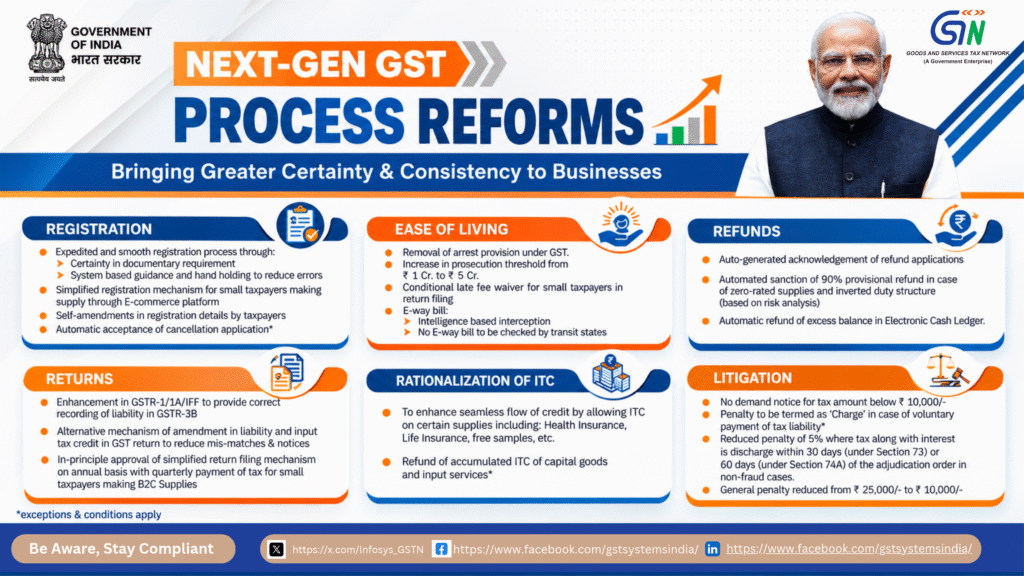
Government of India taken following decisions for process reforms
|
- GST Registrations
- Ease of Living
- Refunds
- Returns
- Rationalisation of ITC
- Litigation
|
|
|
|
|
|
|
|
|
|
GSTN Advisory no. 687 dated 04.11.2026
|
It is hereby informed that, in view of the substantial volume of E-Way Bills generated, the existing numbering capacity is expected to be exhausted. Accordingly, the following revisions in the numbering formats are proposed with effect from 1 January 2027
|
It is hereby informed that, in view of the substantial volume of E-Way Bills generated, the existing numbering capacity is expected to be exhausted. Accordingly, the following revisions in the numbering formats are proposed with effect from 1 January 2027
|
All stakeholders, including taxpayers, GSPs, ERP/software providers and API integrators, are advised to make necessary modifications to their applications, APIs, database schemas and validation rules to accommodate the revised numbering formats.
|
The changes will be released in the Sandbox environment shortly for testing, and the relevant details will be published on the E-Way Bill Portal. Stakeholders are requested to ensure system readiness well before 1 January 2027 to facilitate a seamless transition and avoid any disruption to E-Way Bill-related operations.
|
|
|
|
|
|
|
|
GSTN Advisory no. 685 dated 01.11.2026
|
Some changes have been introduced on the GST portal for taxpayers registered under or opting for, the Composition Scheme. These changes will apply to applications filed through Form REG-01, CMP-02, CMP-04 and REG-14.
|
1. Introduction of New Composition Category
A new category has been introduced for composition taxpayers: “Person eligible for composition levy under Section 10(2A)”
|
Accordingly, taxpayers will now have the following options related to composition scheme:
|
Option A (Existing categories – multiple selections allowed)
|
- Manufacturers, other than manufacturers of such goods as may be notified by the Government for which option is not available
- Suppliers making supplies referred to in clause (b) of paragraph 6 of Schedule II
- Any other supplier eligible for composition levy falling in Section 10(1)
Option B (New category – single selection)
|
- Person eligible for composition levy under Section 10(2A)
Taxpayers can select either Option A categories or Option B category. But both the options cannot be selected together.
|
2. Facility to Change Composition Category through REG-14
A new functionality has been introduced to enable composition taxpayers to change/update their category through Amendment application (REG-14).
|
Taxpayers must ensure that the selected category is correctly updated across all GSTINs linked to the same PAN.
|
|
|
|
|
|
Central Board of Direct Taxes (CBDT) issued notification no. 134/2026 dated 08.10.2026 to hereby make following rules to amend the income tax rules, namely -
|
These rules may be called the Income tax (Sixth Amendment) Rules, 2026
|
They shall come into force on the date of their publication in the official gazette
|
|
|
|
|
|
CBDT has issued Notification No. 114/2026 dated 14.08.2026, notifying the rules and prescribed forms under the Foreign Assets of Small Taxpayers Disclosure Scheme, 2026.
|
|
|
|
|
|
|
|
The Income Tax e-Filing Portal has enabled a dedicated grievance facility for taxpayers to report complaints relating to corruption, misbehaviour, harassment and sexual harassment.
|
Under the grievance mechanism, complainants can select the relevant category and provide details including the name and designation of the officer concerned, along with a description of the grievance. The portal specifically provides categories for “Corruption” and “Mis-behaviour/harassment/sexual harassment.”
|
The facility is expected to strengthen transparency, accountability and taxpayer grievance redressal by providing an online mechanism for reporting serious complaints relating to official conduct.
|
|
|
|
|
|
|
|
Index:
- Amendments to the Central Goods and Services Tax Act, 2017 (CGST Act):
- Amendments to the Integrated Goods and Services Tax Act, 2017 (IGST Act):
- Amendments to the Union Territory Goods and Services Tax Act, 2017 (UTGST Act):
- Amendments to the Goods and Services Tax (Compensation to States) Act, 2017:
Amendments to the Central Goods and Services Tax Act, 2017 (CGST Act):
- Section 9 Amendment: Sub-section (1) of Section 9 is amended to include the words "and un-denatured extra neutral alcohol or rectified spirit used for manufacture of alcoholic liquor, for human consumption "after" alcoholic liquor for human consumption."
- Section 10 Amendment: Sub-section (5) of Section 10 is amended to add the reference to "section 74A" after "section 73 or section 74."
- Insertion of Section 11A :A new Section 11A is inserted, allowing the Government, upon being satisfied that a prevalent practice regarding the levy or non-levy of central tax on any supply of goods or services was or is in place, to issue a notification directing that the central tax payable on such supplies, or the excess central tax collected, shall not be required to be paid.
- Section 13 Amendment: Sub-section (3) of Section 13 is amended:
- Clause (b) is modified to clarify that the supplier needs to issue the invoice only in cases where it is required.
- A new clause (c) is inserted, providing that the date of issue of the invoice by the recipient shall be considered where the recipient is required to issue the invoice.
- The first proviso is amended to include a reference to the newly inserted clause(c).
- Section 16 Amendment:
- A new sub-section (5) is inserted, allowing registered persons to take input tax credit (ITC) for invoices or debit notes pertaining to Financial Years 2017-18 to 2020-21in any return filed by November 30, 2021.
- A new sub-section (6) is inserted, specifying that if a registration is cancelled and later revoked, the person shall be entitled to ITC for relevant invoices or debit notes in a return filed within specific timelines after the revocation order.
- Section 17 Amendment: Sub-section (5), clause (i) is amended to restrict the applicability of Section 74 for the period up to the Financial Year 2023-24, excluding references to Sections 129 and 130.
- Section 21: Amendment to include reference to the newly introduced Section 74A, in addition to Sections 73 and 74.
- Section 30: Introduces a new proviso in subsection (2) which states that revocation of cancellation of registration shall be subject to conditions and restrictions as may be prescribed.
- Section 31:
- Amendment to sub section (3)(f) to mandate that the period within which the tax must be paid shall be prescribed.
- Insertion of an explanation under clause (g) to clarify that a "supplier who is not registered" includes those registered solely for tax deduction under Section 51.
- Section 35: Amendment to include reference to Section 74A along with Sections 73 and 74 in sub section (6).
- Section 39: Substitution of subsection (3) to require registered persons who deduct tax at source under Section 51 to file monthly returns in a prescribed form and manner, regardless of whether any deductions have been made during that month.
- Section 49: Amendment to include reference to Section 74A in subsection (8)(c).
- Section 50: Amendment to include reference to Section 74A in the proviso of subsection (1).
- Section 51: Amendment to include reference to Section 74A in subsection (7).
- Section 54: Removal of the second proviso in subsection (3).
- Insertion of a new subsection (15) disallowing refunds of unutilized input tax credit or integrated tax paid on zero-rated supplies of goods if those goods are subject to export duty.
- Section 61: Amendment to include reference to Section 74A in subsection (3).
- Section 62: Amendment to include reference to Section 74A in subsection (1).
- Section 63: Amendment to include reference to Section 74A.
- Section 64: Amendment to include reference to Section 74A in subsection (2).
- Section 65: Amendment to include reference to Section 74A in subsection (7).
- Section 66: Amendment to include reference to Section 74A in subsection (6).
- Section 70: Insertion of a new subsection (1A) mandating that all persons summoned must attend as directed and truthfully provide statements or documents during examination.
- Section 73: Amendment to marginal heading to specify that the determination of tax applies to periods up to FY 2023-24.
- Insertion of a new subsection (12) to confirm that the provisions of this section apply only to tax determination up to FY 2023-24.
- Section 74: Amendment to marginal heading to specify that the determination of tax applies to periods up to FY 2023-24.
- Insertion of a new subsection (12) to confirm that the provisions of this section apply only to tax determination up to FY 2023-24.
- Omission of Explanation 2.
- Insertion of Section 74A: Introduces provisions for tax determination, refunds, and penalties for the period starting from FY 2024-25 onwards.
- Specifies the process and timelines for issuing notices, determining tax, and the applicable penalties.
- Provides different penalty structures depending on whether the non-payment or short payment of tax was due to fraud or other reasons.
- Clarifies the process for concluding proceedings and defines the term "suppression" in the context of this section.
- Section 75: Sub-section (1): The applicability of Section 75(1) is extended to include references to sub-sections (2) and (7) of Section 74A.
- Insertion of Sub-section (2A): A new provision is added where, if an Appellate Authority, Appellate Tribunal, or court finds that the penalty under Section 74A(5)(ii) is not sustainable due to the absence of fraud, willful misstatement, or suppression of facts, the person shall be liable to pay a penalty under Section 74A(5)(i).
- Sub-section (10): Substituted to clarify that adjudication proceedings shall be deemed concluded if the order is not issued within the prescribed time limits in Section 73(10), Section 74(10), or Section 74A(7).
- Sub-sections (11), (12), and (13): Expanded to include references to Section 74A in addition to Sections 73 and 74.
- Section 104: The Explanation in sub-section (1) is amended to include references to sub- sections (2) and (7) of Section 74A.
- Section 107:
- Sub-section (6)(b): The term "twenty-five" is replaced with "twenty."
- Sub-section (11): References to Section 74A are added in the second proviso.
- Section 109:
- Sub-section (1): Expanded to allow the Principal Bench to conduct examinations or adjudicate cases referred to in Section 171(2), if notified.
- Sub-section (5): Added provisos that specify certain cases to be adjudicated only by the Principal Bench.
- Sub-section (6): Amended to make the President’s powers subject to the provisions of sub-section (5).
- Section 112:
- Sub-sections (1) and (3): Amendments effective from August 1, 2024, allowing the filing of appeals or applications withinthe prescribed period or withinthree months after the date notified by the Government, whichever is later.
- Sub-section (6): Added provisions allowing applications to be filed within three months after the expiry of the period specified in sub-section (3).
- Sub-section (8)(b): The terms "twenty percent" and "fifty crore rupees" are replaced with "ten per cent" and "twenty crore rupees," respectively.
- Section 122: Sub-section (1B): The term "Any electronic commerce operator who" is substituted with "Any electronic commerce operator, who is liable to collect tax at source under section 52."
- Section 127: The section is amended to include references to Section 74A in addition to Sections 73 and 74.
- Insertion of Section 128A: A new section providing for the waiver of interest and penalty under specific conditions where a person pays the full amount of tax for periods from July 1, 2017, to March 31, 2020, as specified in Section 128A(1). Conditions for the conclusion of proceedings, as well as exceptions, are also detailed.
- Section 140: Sub-section (7): Amended retrospectively from July 1, 2017, to include invoices received prior to, on, or after the appointed day.
- Section 171: Sub-section (2): Adds a proviso allowing the Government to specify a date from which the Authority shall not accept requests for examination regarding the reduction of tax rates or input tax credits. The section also clarifies the definition of "Authority" to include the "Appellate Tribunal."
- Schedule III: New paragraphs are added, specifically addressing the treatment of co- insurance premiums and reinsurance commissions in GST, clarifying the responsibilities of the lead insurer and reinsurer regarding tax payments.
- Section 150: Provides that no refund will be made for taxes paid or input tax credits reversed under circumstances where such payments or reversals would not have been required if Section 118 had been in force at all relevant times.
Amendments to the Integrated Goods and Services Tax Act, 2017 (IGST Act):
- Section 5(1): A new clause is hereby inserted, bringing within the ambit of goods subject to integrated tax, "un-denatured extra neutral alcohol or rectified spirit used for the manufacture of alcoholic liquor for human consumption.
- New Section 6A: A mechanism is introduced whereby the Government may, upon being satisfied that a general practice of non-levy or short-levy of integrated tax was prevalent, exempt the payment of integrated tax (or excess tax) on certain supplies.
- Section 16(4): This section is clarified to ensure that claims for refunds of integrated tax paid on zero-rated supplies are to be governed in accordance with the provisions of the Central Goods and Services Tax Act, 2017.
- Section 16(5): It is stipulated that no refund of unutilized input tax credit shall be permitted on zero-rated supplies of goods if such goods are subject to export duty.
- Section 20 (Proviso): A proviso is added to cap the maximum amount payable for each appeal to the Appellate Authority or Tribunal at ₹40 crore.
Amendments to the Union Territory Goods and Services Tax Act, 2017 (UTGST Act):
- Section 7(1): A clause similar to that inserted in the IGST Act, includes "un-denatured extra neutral alcohol or rectified spirit used for the manufacture of alcoholic liquor for human consumption" under the goods subject to Union Territory tax.
- New Section 8A: A provision analogous to Section 6A of the IGST Act is introduced, allowing the Government to waive the Union Territory tax (or excess tax) if it is satisfied that a general practice of non-levy or short levy of tax was prevalent.
Amendments to the Goods and Services Tax (Compensation to States) Act, 2017:
- New Section 8A: This new section authorizes the Government to waive the cess (or excess cess) payable on certain supplies, provided it is satisfied that a general practice of non-levy or short levy of cess was prevalent.
|
|
|
|
|
|
|
The Parliament received the assent of the President on the 16th August, 2024 and the Finance Bill is now 'The Finance (No. 2) Act, hereby published for general information.
|
|
|
|
|
|
|
|
Parliamentary approval for the 2024-25 Budget was completed Thursday with Rajya Sabha returning the relevant pieces of legislation to Lok Sabha.
|
Rajya Sabha returned the appropriation and finance Bills for 2024-2025 after Finance Minister Nirmala Sitharaman responded to the Opposition’s attack that the Budget was anti-middle class, saying the government had reduced the burden on the middle class.
|
The Upper House returned the Appropriation (No. 2) Bill, 2024, the Jammu and Kashmir Appropriation (No. 3) Bill, 2024 and the Finance (No. 2) Bill, 2024, which were passed by the Lok Sabha on Wednesday.
|
This completes the Budgetary exercise for 2024-25.
|
Replying to the discussion on the three Bills, the Finance Minister said the effective capital expenditure this year would be `15.02 lakh crore, an increase of 18% from 2023-2024. She said the increasing capital expenditure since 2020 had a bearing on private investment, consumption and exports.
|
She added that the Centre was not doing that alone, but was giving states 50-year interest-free loans, “which eventually will be treated probably as grants”.
|
She said allocations of `22.91 lakh crore were estimated for states in 2024-2025, an increase of `2.49 lakh crore from last year.
|
She said the government has simplified taxation.
|
“Compared with very many developed economies, which have actually increased the tax rates, despite the pressure from Covid times, we have actually reduced the burden on the middle class substantially,” the Minister said.
|
Responding to demands from Opposition MPs, including TMC MP Dola Sen and DMK MP Dr. Kanimozhi NVN Somu, to withdraw 18% GST on health insurance premiums, Sitharaman asked if the MPs had raised the issue with the Finance Ministers of their states who are members of the GST Council.
|
|
|
|
|
|
|
|
On the withdrawal of 18% goods and services tax (GST) on life and health insurance premiums, Finance Minister Nirmala Sitharaman said on August 7, 2024, that tax had been there on medical insurance even before the introduction of GST. During her reply to the amendments of Finance Bill, 2024, Sitharaman said, "I want to raise two important points - tax has been there on medical insurance even before the introduction of GST. There was already a pre-GST tax on medical insurance before the GST was introduced. This is not a new issue, it was already there in all the states. Those protesting here... did they discuss regarding the removal of this tax in their states?"
|
A GST of 18% on life or health insurance policies pinches policyholders and discourages citizens from taking a new or higher insurance cover. The pain of policyholders gets amplified as insurance is a product where most beneficiaries will get the benefit only when they face an eventuality like death or hospitalisation. What this means is that in some cases, they would pay the premium and high tax but not get the benefit.
|
Around Rs 24,000 crore was collected from GST on health and life insurance in the last three financial years. Sitharaman said, "73-74% of the amount collected under the GST goes to the states."
|
The finance minister highlighted that states had two-thirds share in GST Council and they were capable of taking a decision.
|
“Several suggestions have come up and I shall take up with the GST Council,” Sitharaman said.
|
While the insurance industry has been raising its voice against this, the issue of 18% goods and services tax (GST) on life and health insurance premiums has again come to the forefront now. The political parties of the INDIA bloc have recently protested the high tax outside the Parliament building and demanded that the central government withdraw this GST. A few days ago, Union Minister of Road Transport and Highways Nitin Gadkari wrote to Finance Minister Nirmala Sitharaman urging her to roll back the 18% GST on such financial products. After Gadkari's letter, West Bengal Chief Minister Mamata Banerjee has also urged Sitharaman to remove GST on insurance premiums.
|
GST on insurance: 'Levying GST on life insurance premiums amounts to levying tax on the uncertainties of life' says Nitin Gadkari's letter to FM
Gadkari has said it concisely in his letter. “Levying GST on life insurance premiums amounts to levying tax on the uncertainties of life,” said the letter dated July 28, 2024. The minister has highlighted the concerns outlined in a memorandum submitted by the Nagpur Division Life Insurance Corporation Employees Union about matters affecting the insurance industry. Referring to the memo, the minister said: “The union feels that the person who covers the risk of life’s uncertainties to give protection to the family should not be levied tax on the premiums to purchase cover against this risk. Similarly, the 18% GST on medical insurance premiums is proving to be a deterrent for the growth of this segment of business, which is socially necessary.”
|
Banerjee argued that the imposition of GST on insurance premiums increases the financial burden on the common people. "This additional burden may be acting as a deterrent for many individuals from taking new policies or continuing their existing insurance coverage, thereby leaving them vulnerable to unforeseen financial distress," her letter read.
|
'Insurance is a basic necessity, can't levy GST on premiums'
Insurance industry players have been actively advocating for the removal of this tax, arguing that it significantly increases the cost of insurance coverage for policyholders.
|
Sumit Rai, MD & CEO, of Edelweiss Life Insurance, says, "It is indisputable that insurance is a basic necessity, given its role of providing financial protection to households during adversities like death, disease or disability. It, therefore, cannot be categorised with luxury items like perfumes, chocolates, etc, which currently attract the same 18% GST. Other necessities like food, clothing, and medicines, attract 5-12% GST. Given its longer-term assets, the insurance sector also plays a key role in the country’s advancement by supporting longer-term projects like infrastructure development. It is, therefore, critical that GST on insurance is rationalised to bring down the tax burden and make the product attractive to the consumer. Not only will it support the regulator’s vision of ‘Insurance for all by 2047’, but also will be aligned with the government’s development agenda."
|
It's high time govt removes GST from health insurance premiums
A GST of Rs 24,500 crore has been collected on health insurance and reinsurance premiums in the past three years, according to the Ministry of Finance’s data. Certain schemes like Rashtriya Swasthya Bima Yojana (RSBY), Universal Health Insurance Scheme, Jan Argoya Bima Policy, and Niramaya Health Insurance Scheme are exempt from GST.
|
With premiums surging rapidly, it is even more crucial now to not add any tax on insurance premiums, especially in medical insurance. According to a survey published in May 2024, health insurance premiums have risen significantly for many policyholders. Over half (52% of the respondents) reported a premium increase of more than 25% in the past year, while 21% experienced a hike of 50% or more. Around 31% of the respondents saw their health insurance premiums rise by 25-50%.
|
Pankaj Nawani, CEO of CarePal Secure, says, "Reconsidering the 18% GST on insurance is crucial because health insurance acts as a public good. The government subsidises these costs, but the top 50% are equally vulnerable to catastrophic health expenses. Despite this, health insurance coverage has stagnated at just 1% for over two decades. To ensure broader coverage and foster economic stability, we must encourage insurance uptake across all income levels. Without adequate health insurance, the top income brackets face financial strain that impacts their ability to contribute to the economy and support the government’s social initiatives."
|
Will the Centre remove 18% GST on the insurance premiums?
On the Opposition’s accusation that the Centre has collected Rs 24,500 crore from health insurance GST, Amit Malviya, in-charge of the Bharatiya Janata Party's information and technology department, says, "Of the total collection of Rs 24,529 crore from health insurance (18%), half of it, i.e. Rs 12,264 crore, goes straight to the states (SGST 9%). It doesn't even come to the Centre. Of the Centre's share of collection, roughly 41% is devolved back to the States again as part of Tax Devolution as per Finance Commission's formula!"
|
On the demand to remove the 18% GST, he tweeted: "On cutting GST Rates, Govt of India alone can’t cut the GST rates on health insurance. That decision lies with the GST Council, where states hold 2/3rd power to bring changes."
|
|
|
|
|
|
|
|
The Lok Sabha on Wednesday passed the Finance Bill 2024 after the central government relaxed the freshly-introduced new capital gains tax on real estate, allowing taxpayers an option to switch to a new lower tax rate or stay with the old regime that had higher rate with indexation benefit.
|
Union Finance Minister Nirmala Sitharaman in her Budget speech for 2024-25 proposed to lower the long-term capital gains tax on real estate to 12.5 per cent from 20 per cent but without the indexation benefit. Today, she moved an amendment to the bill to give the option.
|
The amendment came after the new provision was criticised for raising tax incidence and disincentivizing investments in the real estate.
|
What is Indexation benefit?
Indexation benefit allows taxpayers to arrive at the cost price of the property after adjusting for inflation.
|
What does the new amendment say?
The major amendment in the Bill relates to restoration of indexation benefit on sale of properties bought prior to July 23, 2024. Now, individuals or HuFs who purchased houses before July 23, 2024, can opt to pay LTCG tax under the new scheme at the rate of 12.5 per cent without indexation or claim the indexation benefit and pay 20 per cent tax.
|
The Lower House later approved the bill with 45 official amendments by voice vote.
|
Sitharaman on taxes and middle class:
Sitharaman also said that the FY25 Budget proposals were aimed at promoting investment and benefiting the middle class.
|
She said that the hike in tax exemption limit on long-term capital gains in listed equities and bonds to Rs 1.25 lakh from Rs 1 lakh will benefit the middle class investing in stock markets.
|
The Modi government, she said, has brought in a simplified taxation regime and eased compliance without drastically increasing taxes. The reduction in customs duty on various goods will promote trade and investment and generate employment, she added.
|
Bill to now go to Rajya Sabha:
The Finance Bill 2024 will now go to the Rajya Sabha for discussion but the Upper House does not have powers, as per the Constitution, to reject a money bill. It only can return such bills and if they don't do so within the stipulated 14 days, the legislation is considered as approved.
|
Responding to demands for the removal of GST on health and life insurance premiums, Sitharaman said that 75 per cent of the GST collected goes to states.
|
Prior to levying 18 per cent GST on health insurance (premium), all states used to levy tax on insurance premiums. So when GST was rolled out, the tax automatically got subsumed into GST, Sitharaman said.
|
|
|
|
|
|
|
|
Following outrage and concerns from certain quarters over the Budget proposal to remove indexation benefits on long-term capital gains (LTCG), the government Tuesday decided to offer taxpayers a choice to pay 20 per cent LTCG tax with indexation benefit on sale of property acquired before July 23, 2024.
|
The other option introduced in the Budget to pay the tax on LTCG at a reduced rate of 12.5 per cent without indexation will also be available to taxpayers, as per the list of amendments moved by the government in the Finance Bill. Taxpayers can pay the lower tax amount of the two options.
|
These amendments are being seen as a major rollback of the LTCG-related announcements pertaining to the real estate sector in the Budget. While the government had defended the new LTCG tax regime saying indexation benefit back for property bought before Budget that the removal of indexation was more than made up for by the lower tax rate of 12.5 per cent in a vast majority of transactions, the proposals had led to a backlash with calls for relief coming from various sections, including real estate investors and property owners.
|
The amendment, however, makes it clear that for purchases of property after the cut-off date of July 23, 2024, only the new regime with LTCG tax at the rate of 12.5 per cent without indexation will be applicable.
|
Indexation is the process of adjusting the original purchase price of an asset or investment; it allows a taxpayer to neutralise the impact of inflation while paying tax on capital gains. It involves revising upwards the cost of acquisition of an asset based on the inflation over the period for which it was held.
|
Without indexation, particularly in cases where the asset was held for an extended period, the gains may appear extremely high, but they may not paint a realistic picture.
|
With these amendments, effectively all properties purchased before the Budget presentation date — July 23 — have been grandfathered. In the original proposal, there was no grandfathering for properties bought after April 1, 2001. For properties purchased before that date, the fair market value as on April 1, 2001 was to be taken as the cost of acquisition. Put simply, grandfathering is a provision that allows an old rule or law to be applicable to some or all situations up to a certain date, while the new rule or law is applicable to all situations after that date.
|
It may be noted that the amendments provide for a choice between the old and the new LTCG tax regimes only for properties acquired before July 23.
|
“In the case of transfer of a long-term capital asset, being land or building or both, by an individual or HUF (Hindu Undivided Family), which is acquired before the 23rd day of July, 2024, the taxpayer can compute his taxes under the new scheme (at the rate of 12.5 per cent without indexation) and old scheme (at the rate of 20 per cent with indexation) and pay such tax which is lower of the two,” a source said, explaining the key amendment.
|
Notably, the amendments have brought back the indexation benefit for immovable property only and not other unlisted assets like gold. For unlisted securities or shares, the capital gains would be taxed at 10 per cent for transfers before July 23 and 12.5 per cent on or after July 23.
The biggest fear around the Budget proposal on LTCG taxations was that the changes would result in a jump in LTCG tax liability for those looking to sell property. Sensing the anxiety, the Finance Ministry and the Income Tax Department issued multiple clarifications in a bid to assure taxpayers. According to the government, the new LTCG tax regime, even without the benefit of indexation, would be beneficial in a vast majority of cases, as nominal real estate returns are generally in the region of 12-16 per cent per annum, much higher than inflation.
|
Only where returns are low—less than about 9-11 per cent per annum—the earlier tax rate would be beneficial, the Income Tax Department had said, adding that such low returns in real estate are “unrealistic and rare”. The government had also clarified that rollover benefits had not been touched, which means that if capital gains are invested in Section 54EC bonds or used for buying or constructing residential real estate up to specified limits, LTCG would continue to be exempt from tax.
|
Notwithstanding the government’s claims that the new simplified LTCG tax regime shall be beneficial in a majority of cases, concerns persisted. The other major criticism was the absence of grandfathering for purchases made over the past 24 years. There was a clamour for all properties purchased before the Budget presentation date to be grandfathered, and the government has now given into that demand with the amendments to the Finance Bill.
|
There have also been apprehensions that the new regime without the indexation benefit is likely to result in higher frequency of secondary market real estate sales as people would not want to hold on to assets beyond three to five years. Another concern that has been flagged by some industry watchers and even Opposition lawmakers is that the new regime may incentivise use of more cash in property transactions, as sellers will be tempted to deflate the actual transaction value on paper in order to pay less tax.
|
Among the other amendments to the Finance Bill, the Finance Ministry has also amended the definition of undisclosed income for block assessments. Yogesh Kale, Executive Director, Nangia Andersen LLP said, “For the purpose of block assessment provisions, the definition of “undisclosed income” is proposed to be amended to include incorrect claim of exemption within its purview. Originally, the definition included incorrect claims only of expense, deduction or allowance, among other things.”
|
|
|
|
|
|
|
|
The government on Tuesday sought to address a significant concern stemming from the 2024-25 Budget announcement by introducing flexibility in the computation of long-term capital gains (LTCG) tax on unlisted assets, including properties.
|
For any assets, such as land or buildings, sold before July 23, taxpayers can choose between the new and old regimes, opting for whichever results in a lower tax liability.
|
Under the new LTCG regime, the tax rate is set at 12.5 per cent without the benefit of indexation. Conversely, the old regime imposes a 20 per cent tax but allows for indexation benefits. This flexibility effectively serves as a grandfathering provision for all property transactions completed before the Budget's presentation in Parliament on July 23.
|
This adjustment is among the key amendments proposed in the Finance Bill, 2024, regarding the taxation of immovable properties.
|
About 25 additional amendments have been proposed in the Bill. Of these 19 pertain to direct taxes and the remaining to indirect tax laws including customs.
|
Finance Minister Nirmala Sitharaman is expected to present this amendment, along with others, in the Lok Sabha on Wednesday following her response to the debate on the Finance Bill 2024.
|
Commenting on the tweak, Sudhir Kapadia, a senior advisor at EY, said: "With this proposed change to the original Finance Bill, the government has clearly heeded the legitimate concerns of many taxpayers. Without indexation, the tax outgo could have been higher for those selling older properties." He further said what is now proposed gives “the best of both worlds”.
|
The 2024-25 Budget outlines an overhaul of the capital gains tax regime, including lowering the LTCG rate from 20 per cent to 12.5 per cent and eliminating indexation benefits for homes purchased on or after April 1, 2001.
|
This proposal has sparked concerns regarding real estate transactions, as indexation has historically allowed homeowners to account for inflation in tax calculations.
|
Under the originally proposed rule, homeowners would not have been able to adjust for inflation, potentially leading to substantial taxes, especially on older properties with lower selling prices.
|
Indexation is a method used to adjust the purchase price of an asset, such as property, for inflation over time, reducing the taxable capital gains upon sale. By removing indexation, the government aims to simplify the tax calculation process.
|
However, this change has led to higher tax liabilities for property owners, as the original purchase price is now used for calculating capital gains without adjustment for inflation.
|
|
|
|
|
|
|
|
The Association of Mutual Funds of India has urged the government to reconsider tax proposals on capital gains in equities and debt instruments in the Union budget 2024 introduced last week. The budget has proposed to increase short-term capital gains tax from 15% to 20% and long-term capital gains tax from 10% to 12.5%. AMFI has asked for reinstatement of the earlier capital gains taxation rates as the percentage hike is large.
|
"Increasing tax rates on both short-term and long-term gains will deter common investors from choosing mutual funds. Any change in taxation will hamper the efforts to move people from traditional savings to investments," the association said.
|
Moreover, AMFI requested the securities and transaction tax on futures and options be reinstated to the earlier rates, as arbitrage funds and equity savings funds mainly use derivatives for hedging as the underlying assets.
|
"The available arbitrage has now been reduced due to an increase in short-term capital gains tax. Further, the increased STT on futures will add to the cost of these funds," AMFI said.
|
The lobby group has also sought a relook into the proposed removal of indexation benefits from debt mutual funds or provide for holding costs of debt mutual funds to be indexed till July 23, 2024.
|
"We request grandfathering to be permitted for investments made in the respective categories (equities and debt) of funds," AMFI said, explaining the application of new tax rates on a retrospective basis can be detrimental to investor confidence and deter new investors from entering the capital markets.
|
On Section 50AA
The definition of what qualifies as a debt mutual fund has been changed under Section 50AA of the Income Tax Act.
|
The budget proposed to amend the definition of 'Specified Mutual Funds' under Section 50AA of the Income Tax Act that refers to: a) funds investing more than 65% in debt or money market instruments; or b) funds that invest more than 65% in units of funds referred to in (a).
|
Post-amendment, a debt mutual fund is considered a short-term capital asset irrespective of the holding period and will be taxed at applicable rates, whereas for listed bonds, the long-term tax rate is 12.5% and the holding period is kept at 12 months for these securities to be qualified for long-term tax.
|
"With the proposed definition, investors will lose out on long-term capital gains applicability at a much lower threshold of debt/money market investments than envisaged under Clause (a).
|
"AMFI has sought that the definition of Clause (b) be redefined to funds that invest more than 90% in units of funds investing in debt/money market instruments, and the amendment be implemented with immediate effect rather than the proposed April 1, 2026.
|
It has called for capital gains on the redemption of units of debt-oriented mutual funds held for more than one year to be taxed at a rate of 12.5%.
|
|
|
|
|
|
|
|
Expert CMA Anil Sharma, an TIOL Awardee (2021) deliberated on Decoding Indirect Tax in Budget 2024
|
|
|
|
|
|
|
|
No, the Honorable Madras High Court in the case of Tvl. Cargotec India (P.) Ltd. v. Assistant Commissioner (ST) allowed the writ petition and held that no recovery measures shall be undertaken by the GST authorities for a period of three months from the date of such order as per the proviso to Section 78 of the Central Goods and Services Tax, 2017.
|
The Honorable Madras High Court observed that the proviso to Section 78 of the Tamil Nadu Goods and Services Tax Act, 2017, may be invoked only if the proper officer records in writing the reason as to why he considers it expedient in the interest of the revenue to require the taxable person to make payment even before the expiry of the prescribed three-month period. In the case in hand, no material was placed on record to justify invoking the proviso to Section 78 of the CGST Act. The Honorable Court held that the Respondents either refund the recovered amount or re-credit the same to the Petitioner's Electronic Cash or Credit Ledgers, as the case may be, within one months from the date of receipt of the copy of the said Order because the Respondents failed to satisfactorily explain the recourse to the proviso to Section 78 of the CGST Act.
|
As per Circular No. 03/03/2017- GST dated 5th July 2017, the Proper officer for recovery under section 79 of the CGST Act, 2017 is the jurisdictional Deputy or Assistant Commissioner of Central Tax. The Proper officer under proviso to section 78 (for early recovery) is the jurisdictional Principal Commissioner/ Commissioner of Central Tax. Recently, instruction no. 01/2024-GST dated 30.05.2024 has been issued by the CBIC laying down guidelines for initiation of recovery proceedings before three months from the date of service of demand order. Important to mention that the decision for early recovery action under proviso to section 78 is a non-appealable decision, although not listed in section 121 (Non-appealable decisions or orders).
|
|
|
|
|
|
No, the Honorable Rajasthan High Court in the case of M/s. Thekedar Nand Lal Sharma v. State of Rajasthan and Ors. dismissed the writ petition and held that the writ petition against the Assessment Order is not maintainable since the remedy of appeal is not availed during the period of limitation.
|
The Honorable Rajasthan High Court noted that the Petitioner did not file the appeal and admittedly was aware of the impugned Order passed. Further noted that the Petitioner deliberately chose not to file the appeal and avail the remedy of appeal prescribed under Section 107 of the CGST Act but waited for the prescribed period of limitation for filing of appeal to expire. The Honorable High Court relying upon the judgment of the Honorable Supreme Court in the case of Assistant Commissioner (CT) LTU, Kakinada & Ors. vs. Glaxo Smith Kline Consumer Health Care Limited wherein it was held that the writ petition cannot be filed for granting of relief against the assessment order passed, when the appeal could not be filed within the prescribed period, therefore, being barred by limitation, the Honorable High Court opined that the writ petition is not maintainable and the writ petition is dismissed.
|
To approach the High Court, it must be shown to the Honorable Court that the proceedings;
|
a) Deserves intervention to stop the march of injustice;
|
b) Remedy necessary, cannot be allowed in adjudication or in appeal.
|
Timelines are extremely important in the GST Law. If the appeal is not preferred within the time limit allowed (3+1 month) under section 107 of the CGST Act, then it operates as a "Prescription" where the right/ remedy under the law is lost due to delay.
|
Similar orders were delivered by the Honorable Madras High Court in the case of Tvl. Sri Maharaja Industries v. The Assistant Commissioner (ST) (FAC) and in the case of Thiruchy Royal Steels v. Deputy State Tax Officer wherein the writ was rejected by stating if the alternate remedy is available, then the petitioner should exercise that before filing a writ petition.
|
|
|
|
|
|
No, the Honorable Patna High Court in the case of Pawan Carrying Corporation v. State of Bihar held that the proper officer must have issued the notice within seven days of detention or seizure of goods or conveyance. Section 129 starts with the Non-obstante clause and there is no reason to wait for an application by the driver of the vehicle for the verification of the goods when the vehicle is intercepted. Lastly, the order should be passed within seven days of the service of notice of such detention or seizure of goods or conveyance. The Honorable Patna High Court observed that the vehicle was intercepted on 22.12.2023, and there was no reason for the verification of the goods to wait for an application by the driver of the vehicle. Further noted that even if the detention is stated to be on 28.12.2023, the notice was only issued on 05.01.2024, after the seven days provided in Section 129(3) of CGST Act. Further, when the Petitioner had required for time on the seventh day from the date of serving of notice, nothing prevented the Respondent from rejecting the said prayer and passing the order, especially where the matter is kept pending, the proceedings would be barred by limitation. The Honorable Court held that the limitation is clear and definite. The facts of the case indicate that the Respondents did not act in accordance with the Section 129 of the CGST Act. Therefore, there is no reason to sustain the demand raised. Hence, the impugned Order passed for the detention of the vehicles was set aside and directed the Respondents to release the vehicle with the goods immediately.
|
As soon as the goods or conveyance is seized, an application under section 129(1)(c) must be preferred to the intercepting officer to seek the provisional release by furnishing security in MOV-08 and seek the release in MOV-05.
|
As per Section 129(3) of the CGST Act, the proper officer detaining or seizing goods or conveyance shall issue a notice within seven days of such detention or seizure, specifying the penalty payable, and thereafter, pass an order within seven days from the date of service of such notice, for payment of penalty under clause (a) or clause (b) of sub-section (1). If the notice is not issued within the specified time limits under section 129(3), then the whole proceedings are tainted and without the authority of law.
|
Orders were issued on the same subject matter in the case of Udhayan Steels Private Limited v. Deputy Tax Officer (Int.) & Anr. by the Honorable Madras High Court.
|
|
|
|
|
|
1. As a participant in preliminary to final discussion, and a member of Drafting Committee, Law Review Committee and Law Committee, I am bound to express my views on this, just passed, 7th anniversary of introduction of GST in India.
|
2. A good tax system should be simple, transparent, efficient and promote our rank in Ease of Doing Business (if we need FDI, which is dire need for India) for all stake holders, viz. taxpayer, consultants and Administration. Being a Regressive Tax, these characteristics are all the more necessary concomitants.
|
3. The astounding benefits to all are worth appreciating. Total online work (no carrying books, accountant and consultant to ever busy officer), adieu to multiple Tax Laws (Centre, State and Local bodies), varied rates, additional tax, surcharge, turnover tax (highest slabs being 35!) to limited slabs that are less than the cumulative effect of all taxes, almost single point, burying cascading (non-adjustable tax on Inter-State transactions and on Excise Duty & Service tax), worries to get Central and State declarations, are astronomical reliefs to all businesses. Today, all front and back-end operations of all taxing jurisdictions are performed on common portal of GSTN by all viz. Revenue, Taxpayer and consultants.
|
4. Arvind Subramanian's report on Revenue Neutral Rate proposed average tax rate at 15.6% but by November 2017 the average tax rate had come down to 11.6%. The revenue from July 2017 was a mere Rs. 93,590 crore. The year 2017-18, the first year provided Rs. 7,19,078 lakh crore, a paltry monthly average of Rs. 79,897. Usual general growth in Central and State jurisdictions was around 5-6%. Considering 20-21 and 21-22 as no growth periods due to covid-19, with this growth rate, the revenue in 23-24 should have been Rs. 9,07,744 lakh crore. The GST revenue of year 23-24 is Rs. 20.18 lakh crore. Revenue for April 2024 at Rs. 2.10 lakh crore (highest ever) and for May 2024 at Rs. 1.73 lakh crore are the baby steps towards.
|
5. There is 2.8 times increase in revenue. Additionally, the registrations were 65 lakh (highly exaggerated) and today at 1.40 lakh (conservative) is a 2.15 times increase. It has contributed to the exceptionally high growth in Income tax as well. An energetic government may consider embarking on improvement, considering it as a cushion.
|
Next Steps - Short Term and Long Term
|
6. Such a hugely important tax like GST must strive for improvement continuously. After the introduction of GST in July 2017, the then late Finance Minister Arun Jaitley, set up a Law Review Committee (LRC) in September 2017 to review the Law. The LRC was disbanded after March 2018, but should be made a permanent body. The erstwhile LRC comprised only officers but now trade also should get a chance to represent.
|
7. Government has constituted a GoM for Rate rationalisation but again even after submission of its report and action taken, a permanent Fitment Committee, with representation from Trade is must.
|
8. Establishment of Tribunals for hearing Second Appeal has got delayed beyond legitimate expectations. The body should start the work as soon as possible. High Courts and Supreme Court do take up the cases, but the litigant is denied one additional opportunity, in particular about factual matters.
|
9. More than 12% of taxpayers have opted for composition and are paying 1% tax on turnover. Strangely their turnover in goods in most cases, is below Rs. 40 lakh. Opting for composition must be made conditional by a minimum fees of Rs. 40 thousand.
|
10. Around 70% of taxpayers are issuing less than 10 B2B invoices a month and are only traders. At one hand every B2B invoice must be made compulsory to be an e-invoice and on the other hand there must be a simpler return for these. A few basic questions regarding business in the beginning must hide many of unnecessary rows and columns. The higher compliance cost discourages compliance.
|
11. MSMEs hitherto enjoying exemption from Central Excise up to a turnover of Rs. 150 lakh need some hand-holding. Though the limit and expanse of these has been expanded, and some reliefs have been given, these still need some more help.
|
12. The provision in Section 129 attract penalty for "contravention of the provisions of this Act or the rules made thereunder" but nearly all the High Courts have ruled that there would be no penalty till there is intention to evade tax. The Section 130 mostly applies where there is "intention to evade tax". These sections need revisit. While revisiting it is imperative that for mere breach of provisions (Section 129) the penalty should not be so high.
|
13. Lastly, the provisions of arrest under Section 69 ask for "reason to believe" is not commensurate with the business environment. It also need revisit.
|
14. The distribution of taxpayers between Centre was agreed upon a formula in 2017. It has been long time, the Council needs to visit it again.
|
15. GST in India is the greatest of culmination of an experiment where Centre and States have pooled their sovereignty to give birth to a Unified entity for India. This is precursor to many more such pooling. It must be nurtured to its full potential. The future should be ushered day by day or year by year. The matter in queue are Real Estate, Electricity Duty, Stamp Duty, Goods and passenger tax, Tax on Vehicles and believe me also the Alcoholic Liquor for Human Consumption.
|
|
|
|
|
|
The recent changes in the valuation mechanism for corporate guarantees can serve as a boost for all pending writs before various High Courts. The principle here is straightforward: ‘NO VALUATION MECHANISM, NO TAX
|
The 1% value that was previously notified with respect to the guarantee offered by the holding company has now been limited to cross-border cases only, leaving domestic valuation open.
|
However, there is still confusion regarding the revised valuation. It provides a 1% value based on the amount of guarantee offered per annum. The intention seems to be the actual value of guarantee utilized per annum, rather than the maximum amount of guarantee that can be invoked.
|
A potential dispute may arise when the revenue or the taxpayer decides whether to or not to adopt the 1% valuation (where there is an Input Tax Credit leakage) in the case of local guarantees as well.
|
Considering these issues, I personally think that a complete overhaul of the provisions related to corporate guarantee valuation is necessary.
|
|
|
|
|
|
With all due respect, it appears that the circular extends beyond the provisions of GST and couldn’t address the inherent nature of guarantee contracts. The following extract may shed some light on the reasoning:
|
“The activity of supplying the service of providing a corporate guarantee is not linked with the actual disbursal of the loan. The service provided by the guarantor to the guarantee is essentially taking on the risk of default. Therefore, it is clarified that the value of the supply of the service of providing a corporate guarantee will be calculated based on the amount guaranteed and will not be based on the amount of loan actually disbursed to the recipient of the corporate guarantee.”
|
One might ask, can the risk of default arise if the loan is not disbursed at all?
|
“To illustrate, if a corporate guarantee is issued for a period of, say, five years, then the value of such guarantee is to be calculated at one per cent per year of the amount of such guarantee offered, or the actual consideration, whichever is higher. In other words, the value of such corporate guarantee provided would be 5% of the amount guaranteed or the actual consideration, whichever is higher. Therefore, GST would be payable on such amount at the time of issuance of such corporate guarantee, i.e., 5% of the amount guaranteed or the actual consideration, whichever is higher.”
|
‼️This seems to contradict the previous paragraph where it is clarified that the supply is essentially the default risk taken by the guarantor. Isn't the default risk related to the potential default rather than the total amount guaranteed? How is the period relevant if at all the risk covers the entire defaulted amount??‼️
|
|
|
|
|
|
Hon’ble Supreme Court addressed a similar issue recently: whether the purchase of motor cars by a company, provided as prerequisites to its whole-time directors, falls under the category of ‘commercial purpose’ or ‘personal consumption.’
|
Here are the key points from the Supreme Court's ruling:
|
1. Nexus with Profit Generation: The purchase of goods or services should be closely and directly related to profit-generating activities.
|
2. Identity Not Conclusive: The identity of the purchaser alone does not determine whether the purpose is commercial. Instead, the dominant intention behind the transaction matters.
|
3. Personal Use vs. Profit Generation: If the primary purpose of purchasing the goods or services is personal use (by the purchaser or their beneficiary), it may not be considered for commercial purposes.
|
4. In this case, the company bought a car for the personal use of its whole-time director and immediate family members. Therefore, the dominant purpose was to provide it as a perquisite to the director.
|
5. Lack of Evidence for Commercial Use: There is no record indicating that the company used the car for any commercial purpose.
|
6. Income Tax Benefit: The fact that the company claimed an income tax deduction does not alter the analysis unless a clear nexus to profit generation is established.
|
|
|
|
|
|
Facts of the Case:
The Petitioner has submitted a detailed challenge against the denial of Input Tax Credit (ITC). Their main arguments can be categorized into three points:
|
- The denial of ITC is unjust despite having valid tax invoices, proof of payment, and receipt of goods.
- In some instances, suppliers have not remitted the tax, which is not reflected in their returns due to technical reasons or defaults.
- The Petitioners argue that the non-availability of tax payment in GSTR-2A should not impact their ITC entitlement if they possess valid documentation, as per Rule 36.
Submissions by the Petitioner:-
The document addresses the following key points regarding Input Tax Credit (ITC) and GSTR-2A:
|
- GSTR-2A is an auto-populated, read-only document based on suppliers' GSTR-1. It is meant for facilitation and should not affect ITC entitlement.
- A CBIC press release from October 18, 2018, clarifies that GSTR-2A is intended for facilitation and does not impact the eligibility for ITC.
- The burden of proving ITC eligibility lies on the claimant. Valid invoices, payment proofs, and receipt of goods are sufficient to meet this burden.
- The law should not require actions that are impossible, such as ensuring suppliers remit the tax.
- Collecting and recovering taxes is the state's responsibility, not that of the recipient dealers.
- Section 16(4) is criticized as arbitrary. Procedural provisions, like deadlines and delayed GSTR-3B filings, should not override substantive rights, such as the entitlement to ITC.
The petitioners request either declaring Section 16(2)(c) unconstitutional or interpreting it in a way that prevents the denial of Input Tax Credit (ITC) due to procedural errors or suppliers' defaults. They advocate for a balanced approach that does not penalize bona fide recipients for issues outside their control, stressing the need to protect their constitutional rights and uphold the integrity and goals of the GST system.
|
Submissions by the department:-
The respondents argue that a taxing statute can only be deemed unconstitutional if it is manifestly arbitrary, unreasonable, beyond legislative competence, or violates constitutional rights. They contend that Sections 16(2)(c) and 16(4) of the GST provisions are designed to ensure tax compliance and integrity, which are neither arbitrary nor unreasonable, thereby maintaining the balance and proper functioning of the GST system.
|
Sections 16(2)(c) and 16(4) establish necessary conditions and time limits for claiming Input Tax Credit (ITC). These provisions ensure that ITC is claimed only when the tax is actually paid to the government, preventing fraudulent claims and maintaining the integrity of the tax chain. The time limit for claiming ITC, as stipulated in Section 16(4), promotes timely tax compliance and helps the government in making accurate budgetary estimations.
|
Findings & Decision of the court:-
A. Retrospective effect of Procedural Amendments:
|
The Court ruled that the amendment in the Finance Act 2022, which extends the due date for filing returns under Section 39 from September 30th to November 30th, is procedural and aims to address initial compliance difficulties.
|
Consequently, for the period from July 1, 2017, to November 30, 2022, if a dealer filed the return after September 30th but before November 30th, their Input Tax Credit (ITC) claim should be processed if otherwise entitled. The procedural amendment is given retrospective effect from July 1, 2017.
|
Additionally, petitioners who missed availing the benefits within the prescribed time limit can approach the GST authority within thirty days from the date of the judgment to avail themselves of these benefits.
|
Tax authorities must consider ITC claims based on the amended deadlines and provide retrospective effect to procedural changes.
|
B. Constitutional Validity of Sections 16(2)(c) and 16(4):
|
A taxing statute can be declared unconstitutional if it infringes upon the fundamental rights guaranteed under Part III of the Constitution of India, including Article 14.
|
“Article 14 of the Constitution of India guarantees the right to equality before the law and equal protection of the laws within the territory of India. This provision ensures that every individual is treated equally and without discrimination.”
|
The nature of the claim to Input Tax Credit under the GST Act is that ITC is a benefit or concession provided to dealers within the statutory scheme. Although, it may be considered an entitlement, it is subject to conditions and restrictions outlined in the law. The Court upheld the view that ITC is not an absolute right but a concession subject to statutory provisions.
|
The specific sections mentioned (Section 16(2)(c) and Section 16(4) of the CGST/SGST Act) were scrutinized for their constitutionality. It was determined that these provisions, which impose conditions and time limits on claiming ITC, are crucial for balancing tax collection and revenue allocation. The courts have upheld their validity, emphasizing the importance of adhering to statutory conditions for granting ITC.
|
The High Court of Kerala emphasized the need for a fair and balanced GST system in its recent judgment, addressing concerns raised by the petitioners. The court highlighted the importance of not unduly burdening genuine taxpayers due to the defaults of others, underscoring the necessity of protecting taxpayers' constitutional rights while upholding the integrity of the GST framework.
|
|
|
|
|
|
Facts of the Case:
The case revolves around a challenge to the Show Cause Notice (SCN) and the adjudication order, particularly regarding the attachment of the petitioner’s bank account. The primary issues in this case pertain to the principles of natural justice, the service of notice, and the petitioner's opportunity to respond to the SCN.
|
The SCN was issued on July 26, 2023, under Section 73 of the CGST Act. The notice was not uploaded in the “view notices and orders” section but in the “view additional notices and orders” section of the portal.
|
Submissions by the Petitioner:-
The petitioner argued that he was unaware of the show cause notice and the adjudication order due to placed in improper manner on GST portal. The show cause notice was posted in the "view additional notices and orders" section instead of the "view notices and orders" section. As a result, he missed the notice and did not respond in time. Consequently, an ex parte adjudication order was issued, leading to the attachment of his bank account for Rs. 78,37,155.
|
The petitioner’s counsel contended that the show cause notice was non-compliant with statutory requirements, as it allotted merely 15 days to respond rather than the mandated 30 days. The counsel substantiated this claim with screenshots from the GST portal and referenced rulings from various courts that underscored the importance of proper service of notices.
|
Submissions by the department:-
The learned advocate for the respondents, argued that the petitioner was given 15 days to respond to the show cause notice, but the adjudication order was passed only after 30 days. The petitioner did not attempt to respond during this period. He contended that the petitioner did not suffer any prejudice since he could have responded even after the initial 15 days but before the order was passed under Section 73 (9) of the said Act. The adjudication order was issued 30 days after the show cause notice, so the claim of inadequate response time is invalid.
|
Regarding the visibility of the show cause notice and the adjudication order on the portal, counsel of respondent stated that the respondents have no control over this, as it is managed by the GSTN authorities. He further argued that the petitioner has an effective alternative remedy available and suggested that the Court allow the petitioner to approach the appellate authority.
|
Findings & Decision of the court:-
- It was acknowledged that there might have been some confusion due to the SCN being in the “view additional notices and orders” section. Without conclusively determining whether this constituted due service of notice, the court considered the potential confusion.
- The court allowed the petitioner to approach the appellate authority for redress. The attachment order dated February 21, 2024, was quashed as it could not be sustained.
The court recognized the principles of natural justice and the need for clear communication of notices. It granted the petitioner the opportunity to appeal, considering the confusion that may have arisen from the placement of the SCN in an unexpected section of the portal. The quashing of the attachment order underscores the importance of ensuring taxpayers are adequately informed and given a fair chance to respond.
|
|
|
|
|
|
Notification No. 12/2024-Central Tax dated 10.07.2024
1. Rule 8 (Application for registration), in sub-rule (4A), after the first proviso, the following proviso shall be inserted, w.e.f a date to be notified: -
|
“Provided further that every application made under sub-rule (4) by a person, other than a person notified under sub-section (6D) of section 25, who has not opted for authentication of Aadhaar number, shall be followed by taking photograph of the applicant where the applicant is an individual or of such individuals in relation to the applicant as notified under sub-section (6C) of section 25 where the applicant is not an individual, along with the verification of the original copy of the documents uploaded with the application in FORM GST REG-01 at one of the Facilitation Centers notified by the Commissioner for the purpose of this sub-rule and the application shall be deemed to be complete only after successful verification as laid down under this proviso.”
|
2. Rule 21 – Registration to be cancelled in certain cases:-
|
- Amended (i) in clause (f), after the words, letters and figures “FORM GSTR-1”, the letters, words and figures “, as amended in FORM GSTR-1A if any,” shall be inserted;
- Added (ii) after clause (g), the following clause shall be inserted, namely: -
“(ga) violates the provisions of third or fourth proviso to sub-rule (1) of rule 23; or”.
|
3. Rule 21(A) – Suspension of registration:-
|
This amendment ensures that both the initial GSTR-1 and any subsequent changes made in GSTR-1A are considered for the criteria outlined in Rule 21A.
|
4. Rule 28 – Value of supply of goods or services or both between distinct or related persons, other than through an agent (w.e.f.26.10.2023):-
|
- Amendment in sub-rule (2)
a. after the words “who is a related person”, the words “located in India” shall be inserted;
|
b. after the words “amount of such guarantee offered”, the words “per annum” shall be inserted.
|
- Further, a new proviso has been added stipulating that if the recipient is eligible for claiming full input tax credit (ITC), the invoice value will be considered as the value of the services supplied. In essence, full ITC eligibility ensures that the invoice value serves as the accepted supply value.
5. Rule 36- Documentary requirements and conditions for claiming input tax credit (w.e.f. 10.07.2024):
|
Rule 36(4)(a) Amended as “FORM GSTR-1, as amended in FORM GSTR-1A if any” for words “FORM GSTR-1”.
|
6. Rule 37A- Reversal of input tax credit in the case of non-payment of tax by the supplier and re-availment thereof (w.e.f. 10.07.2024):-
|
after the words, letters and figures “FORM GSTR-1”, the letters, words and figures “, as amended in FORM GSTR-1A if any,” shall be inserted.
|
7. Rule 39- Procedure for distribution of input tax credit by Input Service Distributor w.e.f. Notified date:-
|
(i) for sub-rule (1), the following sub-rule shall be substituted, namely: –
|
“(1) An Input Service Distributor shall distribute input tax credit in the manner and subject to the following conditions, namely:--
|
- ITC must be distributed for a month in the same month and details furnished in FORM GSTR-6.
- The amount of credit distributed cannot exceed the available credit for distribution.
- ITC for services attributed to a specific recipient must only be distributed to that recipient.
- ITC for services attributed to multiple recipients must be distributed pro-rata based on each recipient’s turnover relative to the aggregate turnover of all relevant recipients.
- For services attributable to all recipients, ITC must be distributed pro-rata based on each recipient’s turnover relative to the aggregate turnover of all recipients operational during the relevant period.
- Eligible and ineligible ITC must be separately distributed as per Section 17(5) of the rules.
- ITC on central, state, union territory, and integrated taxes must be distributed separately.
- ITC on integrated tax must be distributed as integrated tax to all recipients.
- For recipients in the same state/UT as the ISD, distribute as central and state/UT tax; for different states/UTs, distribute as integrated tax.
- Issue invoices for ITC distribution as per Rule 54(1), clearly indicating it’s for ITC distribution.
- Issue credit notes for reducing already distributed ITC as per Rule 54(1).
- Additional ITC from a debit note must be distributed in the month the debit note is included in FORM GSTR-6, following specified conditions.
- ITC reduction from a credit note must be apportioned in the same ratio as the original ITC distribution and adjusted accordingly.
(ii) A registered person with the same PAN and State code as an Input Service Distributor (ISD) can issue an invoice, credit note, or debit note under sub-rule (1A) of rule 54 to transfer the credit of common input services subject to tax under sections 9(3) or 9(4). The ISD then distributes this credit among distinct persons as per the provisions of sub-rule (1).
|
(iii) in sub-rule (2), for the words and brackets “clause (j)”, the words and brackets “clause (n)” shall be substituted;
|
(iv) in sub-rule (3), for the words and brackets “clause (h)”, the words and brackets “clause (l)” shall be substituted;
|
These amendments seek to enhance the transparency and effectiveness of credit allocation by the ISD, ensuring correct attribution of input services and enabling accurate credit transfer within entities sharing the same PAN.
|
8. Rule 40- Manner of claiming credit in special circumstances,w.e.f. 10.07.2024:
|
After the words “FORM GSTR-1”, insert “and in FORM GSTR-1A, if any.
|
9. Rule 48 - Manner of issuing invoice,w.e.f. 10.07.2024:
|
After the words “FORM GSTR-1”, insert “and in FORM GSTR-1A, if any
|
10. Rule 59- Form and manner of furnishing details of outward supplies, w.e.f. 10.07.2024:
|
- the following proviso shall be inserted,
“under the Goods and Services Tax (GST) system where a registered person can amend or provide additional details of their outward supplies of goods or services (or both) after submitting details in FORM GSTR-1, but before filing the return in FORM GSTR-3B for a particular tax period. The amendment or additional details can be furnished electronically through the GST common portal, either directly or via a designated Facilitation Centre notified by the Commissioner.”
|
ii. in sub-rule (4), with effect from 1st day of August, 2024, for the words “two and a half lakh rupees” wherever they occur, the words “one lakh rupees” shall be substituted;
|
iii. sub-rule (4A) shall be inserted, Namely:-
|
“(4A) The additional details or the amendments of the details of outward supplies of goods or services or both furnished in FORM GSTR-1A may, as per the requirement of the registered person, include the –
|
(a) invoice wise details of -
|
- inter-State and intra-State supplies made to the registered persons; and
- inter-State supplies with invoice value more than one lakh rupees made to the unregistered persons;
(b) consolidated details of -
|
- intra-State supplies made to unregistered persons for each rate of tax; and
- State wise inter-State supplies with invoice value upto one lakh rupees made to unregistered persons for each rate of tax;
(c) debit and credit notes, if any, issued during the month for invoices issued previously.”.
|
11. Rule 60- Form and manner of furnishing details of inward supplies, w.e.f. 10.07.2024:-
|
Amendment to Sub-rule (1): The amendment introduces "FORM GSTR-1A" alongside "FORM GSTR-1" as documents that need to be considered.
|
Amendment to Sub-rule (7): This introduces a new clause (iia) which specifies that taxpayers need to include additional details or amendments related to outward supplies. These details should be from FORM GSTR-1A, which is filed between the day after the due date of FORM GSTR-1 for the previous tax period and the due date of FORM GSTR-1 for the current tax period.
|
These changes expand the requirements for including details from FORM GSTR-1A in the GST filings, ensuring that updated information is accounted for in the current tax period.
|
12. Rule 62- Form and manner of submission of quarterly return by the composition supplier, w.e.f. 10.07.2024:- “Provided that the return in FORM GSTR-4 for a financial year from FY 2024-25 onwards shall be required to be furnished by the registered person till the thirtieth day of June following the end of such financial year”.
|
13. Rule 78- Matching of details furnished by the e-Commerce operator with the details furnished by the supplier, w.e.f. 10.07.2024: After the words “supplier in FORM GSTR-1”, insert “, as amended in FORM GSTR-1A if any”.
|
14. Rule 88B- Manner of calculating interest on delayed payment of tax, w.e.f. 10.07.2024: “Provided that where any amount has been credited in the Electronic Cash Ledger as per provisions of sub-section (1) of section 49 on or before the due date of filing the said return, but is debited from the said ledger for payment of tax while filing the said return after the due date, the said amount shall not be taken into consideration while calculating such interest if the said amount is lying in the said ledger from the due date till the date of its debit at the time of filing return.”.
|
15. Rule 88C- Manner of dealing with difference in liability reported in statement of outward supplies and that reported in return, w.e.f. 10.07.2024:in sub-rule (1), after the words, letters and figures “FORM GSTR-1”, the letters, words and figures “, as amended in FORM GSTR-1A if any,” shall be inserted.
|
16. Rule 89- Application for refund of tax, interest, penalty, fees or any other amount, w.e.f. 10.07.2024:
|
(i) Added Sub-rule 1B after 1A for New Provisions of Refund Claims: Any person, claiming refund of additional integrated tax paid on account of upward revision in price of the goods subsequent to exports, and on which the refund of integrated tax paid at the time of export of such goods has already been sanctioned as per rule 96, may file an application for such refund of additional integrated tax paid, electronically in FORM GST RFD-01 through the common portal, subject to the provisions of rule 10B, before the expiry of two years from the relevant date as per clause (a) of Explanation (2) of section 54;
|
Provided that the said application for refund can, in cases where the relevant date as per clause (a) of Explanation (2) of section 54 of the Act was before the date on which this sub-rule comes into force, be filed before the expiry of two years from the date on which this sub-rule comes into force.”;
|
(ii) after clause (ba), inserted clause (bb) and (bc):
|
“(bb) The detailed list of documentation requirements for claiming a refund based on an upward revision in the price of exported goods. Here's a summary:
|
Export Invoices: Number, date, and copies of invoices issued for the export.
|
Shipping Bills or Bills of Export: Number, date, and copies of shipping bills or bills of export related to the exported goods.
|
Bank Realisation Certificate (BRC) or Foreign Inward Remittance Certificate: Number, date, and copies issued by Authorised Dealer-I Bank, confirming receipt of foreign exchange related to the export.
|
Refund Details: Information about any refunds already sanctioned under specific rules.
|
Supplementary Invoices or Debit Notes: Number, date, and copies of invoices or debit notes issued after upward price revision of exported goods.
|
Additional Integrated Tax Payment: Details and proof of payment of additional integrated tax, if applicable, and interest paid on it.
|
Foreign Inward Remittance Certificate for Additional Remittance: Number, date, and copies of certificates from Authorised Dealer-I Bank confirming additional foreign exchange remittance due to price revision post-export.
|
Certificate from Chartered Accountant/Cost Accountant: Confirmation that the additional foreign exchange remittance is due to post-export price revision, along with copies of contracts or relevant documents indicating the need for price revision and the revised prices.
|
(bc) a reconciliation statement, reconciling the value of supplies declared in supplementary invoices, debit notes or credit notes issued along with relevant details of Bank RealisationCertificate or foreign inward remittance certificate issued by Authorised Dealer-I Bank, in a case where the refund is on account of upward revision in price of such goods subsequent to exports;”.
|
17. Inserted Rule 95B- Refund of tax paid on inward supplies of goods received by Canteen Stores Department, w.e.f. 10.07.2024
|
The new provisions for refund of central tax paid by the Canteen Stores Department under the Ministry of Defence on inward supplies of goods. Here's a summary:
|
Refund Eligibility: The Canteen Stores Department can claim a refund of fifty percent of the central tax paid on goods received for subsequent supply to Unit Run Canteens or authorized customers.
|
Application Process: Refund applications must be submitted quarterly in FORM GST RFD-10A through the common portal.
|
Processing: Applications will be processed similar to those in FORM GST RFD-01 under rule 89, subject to conditions including:
|
- Goods received against tax invoices from registered suppliers.
- Supplier details submitted in FORM GSTR-1 and GSTR-3B.
- Applicant's details (name and GSTIN) mentioned in the tax invoice.
- Goods received for subsequent supply to specified entities of the Canteen Stores Department.
Overall, the provisions specify the conditions and process for claiming central tax refunds on inward supplies by the Canteen Stores Department for subsequent distribution within its authorized network.
|
18. Rule 96- Refund of integrated tax paid on goods exported out of India, w.e.f. 10.07.2024:
|
(i) The excerpt describes amendments to sub-rule (1) of a rule, likely under GST regulations:
|
Clause (a): A proviso is added after clause (b), stipulating that after mentioning "FORM GSTR-1", any amended version in "FORM GSTR-1A" should also be considered.
|
Clause (b): A proviso is added after clause (c), allowing exporters to electronically file FORM GST RFD-01 for a refund of additional integrated tax paid due to price revisions post-export. This applies when the integrated tax initially paid during export has already been refunded as per sub-rule (3) of the same rule. The refund application process is governed by the provisions outlined in rule 89.
|
(ii) in sub-rule (2), after the words, letters and figures “contained in FORM GSTR-1”, the letters, words and figures “, as amended in FORM GSTR-1A if any,” shall be inserted.
|
19. Rule 96A- Refund of integrated tax paid on export of goods or services under bond or Letter of Undertaking, w.e.f. 10.07.2024: An amendment stipulates that an additional 15-day grace period shall be granted after the lapse of one year, inclusive of all extensions authorized by the Reserve Bank of India, or whichever is later, from the invoice issuance date for exports. This extension applies if the exporter has not received payment in convertible foreign exchange or Indian rupees for such services.
|
20. Rule 110,111,113 Substituted relation to Appeal, Application to the Appellate Tribunal w.e.f. 10.07.2024:-
|
- Appeals must be filed electronically using FORM GST APL-05 along with relevant documents. Manual filing is allowed only with special permission from the Registrar.
- Cross-objections should be filed electronically using FORM GST APL-06, or manually with Registrar permission.
- Appeals and cross-objections must be signed as per rule 26.
- If the appealed order is on the common portal, a final acknowledgement (FORM GST APL-02) is issued after removal of defects, with the provisional acknowledgement date considered as the filing date.
- If the order isn't on the portal, a self-certified copy must be submitted within seven days of filing FORM GST APL-05.
- Fees for appeals depend on the amount involved, with a minimum of Rs. 5,000 and maximum of Rs. 25,000. No fee is required for rectification applications under sub-section (10) of section 112.
- An appeal must be filed electronically using Form GST APL-07 along with relevant documents. A provisional acknowledgement is issued immediately upon filing.
- Manual filing in Form GST APL-07 is allowed only if permitted by the Registrar through a special or general order, with specified conditions and restrictions.
- Filed electronically in Form GST APL-06. Manual filing is allowed under special or general orders from the Registrar, with specified conditions.
- Both appeals and cross-objections must be signed as per Rule 26 specifications.
- If the appealed order is on the common portal, a final acknowledgement (Form GST APL-02) is issued upon removal of defects, considering the date of provisional acknowledgement as the filing date.
- If the order is not on the portal, a self-certified copy must be submitted within seven days of filing Form GST APL-07. The final acknowledgement is issued upon removal of defects, with the submission date of the order copy considered as the filing date if delayed beyond seven days.
- The term "Registrar" refers to a government-appointed official, which includes Joint Registrar, Deputy Registrar, and Assistant Registrar.
The provision allows an appellant to withdraw their appeal or application before the issuance of an order under section 113(1) of the GST Act. If the appeal or application is withdrawn after the final acknowledgment in FORM GST APL-02 has been issued, approval from the Appellate Tribunal is required. The Tribunal must decide on the withdrawal within fifteen days of application filing. Any new appeal or application filed after withdrawal must adhere to the time limits specified in section 112(1) or (3) of the Act.
|
21. Rule 138- Information to be furnished prior to commencement of movement of goods and generation of e-way bill, w.e.f. Notified date:-“Provided also that an unregistered person required to generate e-way bill in FORM GST EWB-01 in terms of the fourth proviso to sub-rule (1) or an unregistered person opting to generate e-way bill in Form GST EWB-01, on the common portal, shall submit the details electronically on the common portal in FORM GST ENR- 03 either directly or through a Facilitation Centre notified by the Commissioner and, upon validation of the details so furnished, a unique enrolment number shall be generated and communicated to the said person.”.
|
22. Rule 142-Notice and order for demand of amounts payable under the Act, w.e.f 10.07.2024:-
|
Sub-rule (2) Amendment: The amendment replaces the requirement for the proper officer to issue an acknowledgment in FORM GST DRC-04 for payments reported in FORM GST DRC-03. Instead, it mandates that an acknowledgment in FORM GST DRC-04 shall be made available to the person electronically through the common portal.
|
Sub-rule (2A) Insertion: After reporting in FORM GST DRC-01A, the proper officer may issue an intimation in Part-C of FORM GST DRC-01A to accept payments or submissions made by the person.
|
New Sub-rule (2B): This sub-rule introduces a procedure where if a person pays tax, interest, penalty, or any other amount under specified sections through an intimation in FORM GST DRC-03, they can file an application electronically in FORM GST DRC-03A on the common portal. This allows the amount paid through FORM GST DRC-03 to be credited in the Electronic Liability Register in FORM GST PMT-01 against the relevant debit entry, as if the payment was made on the date of the intimation in FORM GST DRC-03. However, once anorder in FORM GST DRC-05 concludes proceedings related to such payment, no further application in FORM GST DRC-03A can be filed.
|
23. Rule 163- Consent based sharing of information:-said rule 163, in sub-rule (1), in clause (c), after the words, letters and figures “FORM GSTR-1”, the letters, words and figures”, as amended in FORM GSTR-1A if any,” shall be inserted.
|
Notification No. 13/2024 – Central Tax dated 10.07.2024 (Rescinded Notification No. 27/2022-Central Tax dated 26.12.2022, w.e.f. 10.07.2024)
Notification No. 27/2022 - Central Tax states that the provisions of sub-rule 4A of the CGST Rules, 2017,
|
The rule states that an application made under a specific sub-rule must undergo additional verification steps if the applicant has opted for Aadhaar authentication and is identified based on data analysis and risk parameters. These steps include:
|
- Biometric-based Aadhaar authentication.
- Photograph of the applicant or relevant individuals.
- Verification of the original documents uploaded with the application.
This verification must take place at a designated Facilitation Centre, and the application will be considered complete only after this process is finished.
|
Notification No. 14/2024 – Central Tax dated 10.07.2024
Exemption from Filing Annual Return for Financial Year 2023-24
|
Section 44 annual return:-That every registered person, other than an Input Service Distributor, a person paying tax under section 51 or section 52, a casual taxable person and a non-resident taxable person, shall furnish an annual return for every financial year electronically in such form and manner as may be prescribed on or before the thirty-first day of December following the end of such financial year;
|
Hereby exempts the registered person whose aggregate turnover in the financial year 2023-24 is up to two crore rupees, from filing annual return for the said financial year.
|
Notification No. 15/2024-Central Tax w.e.f. 10.07.2024
Amendment in Notification No. 52/2018-Central Tax with reduction in rate of TCS with NN- 15/2024-Central Tax w.e.f. 10.07.2024:-The amendment is made under sub-section (1) of section 52 of the Central Goods and Services Tax Act, 2017 (CGST Act), which empowers the Central Government to notify the tax rate for supplies made through electronic commerce operators. The rate has been lowered from 0.5 percent to 0.25 percent.
|
Notification No. 01/2024-Integrated Tax dated 10.07.2024
Seeks to amend Notification No. 02/2018-Integrated Tax, dated 20.09.2018has been issued under Integrated Tax to lower the tax rate from 1 percent to 0.5 percent.
|
Notification No. 01/2024-Union Territory Tax:
Seeks to amend Notification No. 12/2018-Union Territory Tax, dated 28.09.2018- under Union Territory Tax, the rate has been reduced from 0.5 percent to 0.25 percent.
|
Link given for full PDF below:
|
|
|
|
|
|
Facts of the Case:
The petitioner requested the court to quash an ex-parte demand order and show cause notice issued by the Deputy Commissioner, Sector - 9, Lucknow, Uttar Pradesh, under Section 73 of the SGST Act. A preliminary objection was raised regarding the petition's maintainability, highlighting that an appeal is available under Section 107 of the GST Act against the impugned order.
|
Submissions by the Petitioner:-
The petitioner's counsel referred to an earlier judgment (Eveready Industries India Ltd. Vs. State of U.P.) in which the court highlighted the importance of a personal hearing before issuing an adverse order. The petitioner contended that the show cause notice failed to indicate a date, time, or place for a hearing, effectively denying the opportunity for a personal hearing. The petitioner argued that he had responded to the notice under Section 61, but there was no record of a response to the notice under Section 73 or any request for an extension to submit a reply.
|
Submissions by the Respondent:-
The submission from the Deputy Commissioner, which indicated that notices were issued under Sections 61 and 73 of the SGST Act, but the petitioner did not respond.
|
Findings & Decision of the court:-
The court distinguished the current case from the Eveready Industries, noting that the petitioner had not replied to the show cause notice under Section 73.
|
The court held that it was the duty of the petitioner to respond to the show cause notice. The lack of a specified date, time, or place for a hearing in the notice did not justify ignoring the notice. The court dismissed the writ petition, stating that the petitioner has a statutory remedy available under Section 107 of the Central GST Act.
|
|
|
|
|
|
4. Lawgics by Ms.Nidhi Aggarwal
|
Ms. Nidhi Aggarwal is delighted to present judgment with a great vision to spread complex GST law in a simple manner amongst the taxpayers, tax professionals, students and knowledge seeker.
|
|
Recently added notes are listed below:
|
|
|
|
|
|
Synopsis: The Delhi High Court dismissed the writ petition involving fraudulent ITC claims, directing the petitioner to pursue appellate remedy u/s 107 of the CGST Act.
|
Caste name: Banson Enterprises & Anr. vs Assistant Commissioner CGST & Ors.
|
Citation: W.P. (C) 6503/2025 dated 15.05.2025
|
Authority: Delhi High Court
|
The petition challenges the Order-in-Original dated 02.02.2025 based on a Show Cause Notice (SCN) dated 03.08.2024 A search was conducted, and statements were recorded including that of one Director admitting to the issuance of fake invoices during the Central Excise period. It was alleged that the Petitioner issued goods-less invoices to enable fraudulent Input Tax Credit (ITC) claims amounting to Rs. 1.85 crore.
|
Contentions of the Petitioner:
|
SCN was issued by unauthorized officer, thus, violates Rule 142(1)(a) of CGST Rules. No pre-consultation as required under Rule 142(1A) of CGST Rules was issued. Consolidated SCN for multiple financial years was issued and challenge to such consolidated action is pending in a separate matter (Quest Infotech case).
|
Contentions of the Department:
The impugned order is appealable, hence writ is not maintainable. The Petitioner’s Director admitted to allegations. Natural justice was followed as the Petitioner received the SCN, filed a reply, and availed of personal hearing. Reliance must be made on SC judgments and Allahabad HC rulings emphasizing alternate remedy u/s 107 CGST Act.
|
Findings and Decision of the Court:
The Court refused to interfere under writ jurisdiction, citing:
|
- No breach of fundamental rights or principles of natural justice.
- Availability of a statutory remedy (appeal) under Section 107 CGST Act.
The Court noted that the Allegations involve serious misuse of ITC, requiring fact-based adjudication, not suited for writ jurisdiction. Thus, the Petitioner was granted liberty to file appeal, and if filed with pre deposit, the appeal shall not be dismissed on limitation.
|
|
|
|
|
|
|
|
Synopsis: GST RC cancellation is not justified as petitioner was not given fair opportunity to respond.
|
Case Name: M/s. Genius Orthos Industries VS Union of India & Ors.
|
Citation: WRIT TAX No. 542 of 2023 dated 24.04.2025
|
Authority: Allahabad High Court
|
The petitioner was engaged in the business of surgical goods and its GST registration was cancelled on 19.12.2022 after a physical verification of its premises allegedly found no inputs, finished goods, or workers. A show cause notice was issued prior to cancellation, but the petitioner claimed they were not informed of the specific material findings leading to the cancellation. The appeal against the cancellation was also dismissed.
|
Contentions of the Petitioner:
|
The principles of natural justice were violated, as no proper notice of the specific material against them was given. Cancellation was based on vague grounds, and the watchman at the premises had confirmed that business activities were conducted, albeit irregularly. Rule 25 of the CGST Rules and Form GST REG 30 was not referenced in actual SCN.
|
Contentions of the Department:
|
The petitioner had due knowledge of the discrepancies found during physical verification and failed to provide a satisfactory explanation. Claimed that the cancellation order was justified due to absence of business activity at the registered premises.
|
Findings and Decision of the Court:
|
The High Court found that the cancellation was done without due process, especially considering that:
|
- The material used for cancellation was never properly shared with the petitioner.
- The statement of the watchman indicating occasional business activity was ignored.
- The physical verification report (GST REG-30) was not referenced in the show cause notice.
Thus, impugned cancellation and appellate orders were quashed and the matter was remanded to the proper authority for fresh adjudication within three months, ensuring that a reasoned and speaking order is passed after an Opportunity of hearing is granted. The petitioner may submit relevant evidence.
|
|
|
|
|
|
|
|
Synopsis: Rejection of appeal on ground that appeal was not filed electronically under Rule 108 of CGST Rules, 2017 is invalid in case of non availability of order–in–original on GST portal and Appeal being filed manually.
|
Case Name: M/s Appolo Sesame Industries & Anr. VS Assistant Commissioner of CGST, Division X, Nadiad & Ors
|
Citation: R/Special Civil Application No. 571 of 2025 dated 24.04.2025
|
Authority: Gujarat High Court
|
The petitioners challenged the rejection of their appeal against an Order-in-Original dated 30.10.2023. They had filed the appeal manually in Form GST APL-01, as the order was not available on the GST portal, making electronic filing impossible. Despite this, the Appellate Authority rejected the appeal on 27.09.2024, stating it was not filed electronically, as required under Rule 108(1) of the CGST Rules, 2017.
|
Contentions of the Petitioner:
|
The order-in-original was not available on the portal, so manual filing was the only viable option. A pre-deposit of 10% of the disputed dues was paid. The Appellate Authority ignored the proviso to Rule 108(1), which allows manual filing if the order is unavailable electronically. The Appellate Authority failed to issue the mandatory provisional acknowledgment, despite receiving the appeal.
|
Contentions of the Department:
|
The appeal was filed offline without fulfilling electronic filing requirements. The Appellate Authority argued that procedural rules were not followed, hence the rejection was valid.
|
Findings and Decision of the Court:
|
The High Court found that the Appellate Authority failed to apply its mind to the facts. It held that the rejection of the appeal violated Rule 108(1) of the CGST Rules, as manual filing is permitted when the order is not available on the portal. The impugned rejection order was set aside and the matter was remanded to the Appellate Authority to hear and decide the appeal on merits.
|
|
|
|
|
|
|
|
Synopsis: The demand order was quashed on the ground that the hearing notices must not be merely uploaded on portal but also e-mailed to petitioner.
|
Case Name: Shri Krishna Sales VS Commissioner of Delhi Goods and Service Tax & Ors.
|
Citation: W.P. (C) 5524/2025 dated 29th April, 2025
|
Authority: Delhi High Court
|
Brief facts of the case:
The petitioner challenged the Show Cause Notice (SCN) dated 26.09.2023 and demand order dated 25.12.2023, issued by the Delhi GST authorities. The challenge also extended to Notification No. 09/2023 Central Tax dated 31.03.2023, which extended the time limits for adjudication under Section 73 of the CGST Act. The SCN was only uploaded under the "Additional Notices and Orders" tab on the GST portal and did not come to the petitioner’s notice. The petitioner filed a rectification application, which was considered time-barred.
|
Contentions of the Petitioner:
The SCN and subsequent hearing notices were not properly served, being uploaded in a location on the portal that made them easy to miss. The notification extending limitation was issued improperly under Section 168A without valid GST Council approval and is under challenge before the Supreme Court (SLP No. 4240/2025).The demand order was passed ex parte without giving a fair opportunity to respond.
|
Contentions of the Department:
The SCN was uploaded properly as per current GST portal functionality. The notification extending time limits is valid and backed by GST Council recommendation (in some cases), with related petitions already under consideration in the Supreme Court. The petitioner’s application for rectification was rightly rejected due to limitation bar.
|
Findings and Decision of the Court:
The demand order dated 25.12.2023 was set aside. The Court allowed the petitioner to file a reply to the SCN within 30 days. The hearing notice must be communicated not just through the portal but also via email. The adjudication order shall be passed afresh, after granting a personal hearing. The outcome of this case will be subject to the final decision of the Supreme Court in the pending SLP on the validity of the notifications.
|
|
|
|
|
|
5. GST Notes by CMA Anil Sharma
|
1) Chapter-7 of IGST Act containing 12 slides is added in the Notes section'. It covers POS for inter state transactions including export.
|
Authored by CMA Anil Sharma Sir, with a vision to simply the complex GST Law for taxpayer, professional, taxmen etc.
|
|
|
|
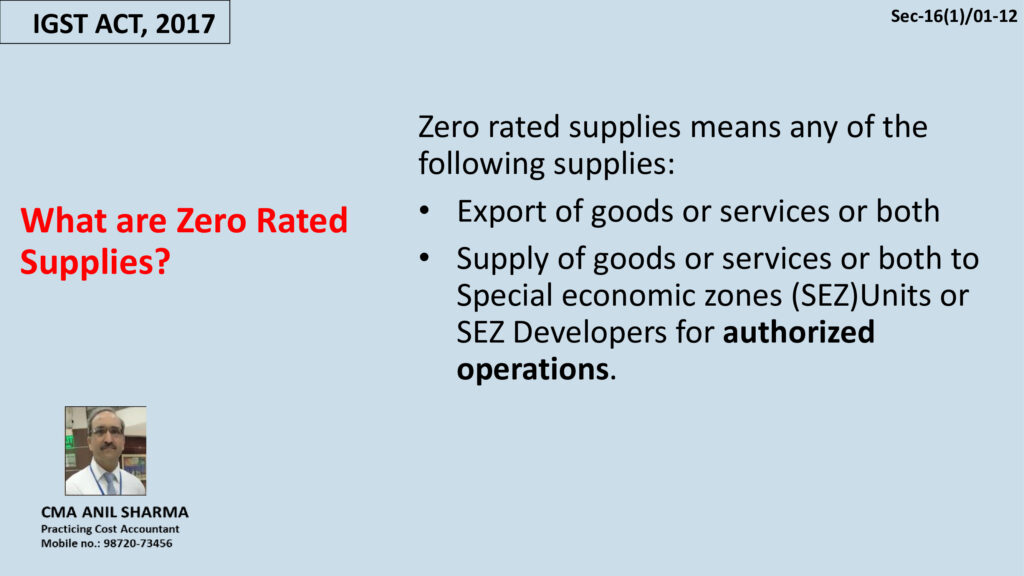
|
|
|
|
|
6. GST Daily by CA Pradeep Modi
CA Pradeep Modi is presenting judgment analysis under title 'GST Daily - Stay yourself updated'
|
|
|
|
|
|
|
Recap of Latest updates posted on 27.08.2026
|
CBIC issued Notification No. 30/2026-Customs dated 21.08.2026 regarding Seeks to exempt 10 lakh MT of raw sugar falling under tariff heading 1701 from the whole of the customs duty leviable thereon under …
|
GSTN is taking downtime to enhance its services on the GST Portal on 26.08.2026 from 12:00 AM onwards until 6:30 am of 26.08.2026.
|
The Hon’ble Supreme Court in M/s G.R. Infra Projects Limited set aside the Show Cause Notice dated June 13, 2025 issued under Section 74 of the CGST Act read with the MPGST Act for the FY 2018-19, and held that a bland and mechanical recital of the words ‘fraud or concealment of facts’,
|
Indian Railway Finance Corporation Ltd received a show cause notice from the GST Authority demanding ₹549.32 crore. The notice, issued under Section 73 of the Central Goods and Services Tax Act, 2017, cites excess input tax credit claims for FY23.
|
The Anti-Corruption Bureau (ACB) on Monday arrested a state tax officer and a senior assistant in Nirmal district for demanding and accepting a bribe of ₹50,000 in connection with a GST audit.
|
CBIC issued Notification No. 71/2026-Customs (N.T.) dated 25.08.2026 regarding Fixation of Tariff Value of Edible Oils, Brass Scrap, Areca Nut, Gold and Silver
|
CBIC issued Notification no. 21/2026-Customs (ADD) dated 21.08.2026 that Seeks to continue applicability of anti-dumping duty on imports of Natural Mica based Pearl Industrial Pigments ..
|
CBDT issued notification no. 115/2026 dated 21.08.2026 to hereby approves deduction under section 45(3)(a)(i) of the Income tax Act, 2025 to the International Institute of Bio Technology and Toxicology , Tamil Nadu for Scientific Research
|
I request the views of tax professionals and TDS experts on the following issue under the Income-tax Act, 2025, regarding reporting in Form 140.
|
|
|
|
|
|
|
|
THE HON'BLE ALLAHABAD HIGH COURT IN THE CASE OF Vibhuti Tyres V/s State of U.P., decided on 7-5-2025
|
✔️ Is it justified that GST order with higher demand than show-cause notice?
|
👉 The Hon'ble High Court Judgement:-
|
✔️ Where in show-cause notice amount representing tax, interest and penalty was indicated as Rs. 8,81,080, but in order, much higher demand was raised at Rs. 32,97,336, same was in violation of section 75(7); matter was to be remanded back.
|
Section 75 of Central Goods and Services Tax Act, 2017
|
|
|
|
|
|
|
|
THE HON'BLE JHARKHAND HIGH COURT IN THE CASE OF Sadanand Prasad Barnwal V/s State of Jharkhand, decided on 8-5-2025
|
✔️ Is it valid if SCN and order under section 73 for lack of digital signature of issuing authority?
|
👉 The Hon'ble High Court Judgement:-
|
✔️ Where both summary of SCN in Form GST DRC-01 and order under section 73 did not bear digital signature of concerned authority, both SCN and order were to be quashed.
|
Section 161, read with section 73 of Central Goods and Services Tax Act, 2017
|
|
|
|
|
|
7. PPT/Handbook on GST
|
- Synopsis of Circulars and Notifications pursuant to 53rd GST Council meeting Click here
|
|
|
8. GST/Income Tax in Media
|
|
|
|
|
|
|
|
|
|
|
|
Hope the above updates is of use to you. Please share your input and feedback at taxupdate.otu@gmail.com
|
|
|
|
|
|
|
|
 
|
Visit our website
|
OTU provides you
|
- Articles on various topics
|
|
- Media - GST, Income Tax & Press R.
|
|
|
|
|
