|
|

|
Newsletter no. 73 dated 27.02.2023
|
|
|
|
|
|
This website contains information about recent changes mainly in GST laws. It also contains Articles on various topic in GST. Please visit the website and read more.
|
|
|
|
Index
|
5. Book by CMA Anil Sharma
|
|
|
|
|
|
|
|
GSTN Advisory no. 672 dated 19.09.2026
|
This is an advance information to the all users – Taxpayers and Tax Officers, of GST System who use Digital Certificate Signature on the GST Portal.
|
A new version of emSigner (v3.3) is being made available for download for the purpose of providing compatibility with tokens (USB dongles) that are issued on or after 21-September-2026.
|
A. Users with valid certificates: There is no change for the users having existing valid digital certificates and their existing token (USB Dongle) are working, as of 21-Sep-2026. If your existing DSC works normally, you may continue using your current emSigner version.
|
If you encounter signing failures or if your certificate does not appear for selection despite correctly installed token drivers, upgrade to the emSigner version 3.3 by following steps given under point-B below. The emSigner version 3.3 is backward compatible to support the existing tokens (USB dongles).
|
B. Users with newly issued tokens: The users who have been issued a new token (USB Dongle) on or after 21-Sep-2026, either due to issuance of new certificate and dongle, or renewal of certificate in a new dongle, shall have to upgrade to version 3.3 of emSigner by following below steps:
|
Step-1. Please ensure that your system – desktop / laptop / AIO which on which the DSC is used for the GST System, meets the following minimum system requirements:
|
1.1 Operating system and hardware
|
Step-2.Download & install the version 3.3 of emSigner from the GST Portal by navigating to https://www.gst.gov.in/help/docsigner - the older versions of emSigner will not work for such new DSC dongles issued from 21 September 2026 onwards.
|
C. Validity and future renewal: Under CCA’s advisory, DSCs downloaded onto FIPS 140-2 dongles on or before 21 September 2026 can continue to be used until the DSC expires. That date does not automatically invalidate existing DSCs. Subsequent renewal or fresh issuance generally requires a FIPS 140-3 dongle, subject to CCA’s specified exceptions. The CCA migration advisory may be referred for more details on this aspect by navigating to https://cca.gov.in/sites/files/pdf/news/Advisory_on_Migration_from_FIPS_140- 2_to_FIPS_140-3.pdf
|
Please create a ticket on the GST Helpdesk if you need any assistance while upgrading to the emSigner version 3.3 and our teams shall get in touch for resolution.
|
|
|
|
|
|
|
|
GSTN is taking downtime to enhance its services on the GST Portal on 18.09.2026 from 12:00 AM onwards until 2:00 am of 18.09.2026.
|
|
We shall be enhancing services on the GST portal on : 18th Sept’26 12:00 AM onwards. GST Portal services will not be available until 18th Sept’26 02:00 AM. The inconvenience caused is regretted.
|
|

|
|
|
|
|
|
|
|
|
GSTN is taking downtime to enhance its services on the GST Portal on 17.09.2026 from 03:00 AM onwards until 4:30 am of 17.09.2026.
|
|
We shall be enhancing services on the GST portal on : 17th Sept’26 03:00 AM onwards. GST Portal services will not be available until 17th Sept’26 04:30 AM. The inconvenience caused is regretted.
|
|

|
|
|
|
|
|
|
|
|
Central Board of Direct Taxes (CBDT) issued notification no. 120/2026 dated 17.09.2026 to hereby make following rules further to amend the Income tax Rules, 2026 , namely -
|
These rules may be called the Income-tax (Fourth Amendment) Rules, 2026
|
|
|
|
|
|
|
|
Directorate of Income Tax (Systems) of Central Board of Direct Taxes (CBDT) issued notification no. 3/2026 dated 15.09.2026 to prescribe Procedure for registration of reporting person/entity and submission of Form No. 98 as per rule 160 of the Income tax Rules, 2026.
|
Rule 160 of the Income-tax Rules, 2026 (hereinafter, "the Rules") specifies that every person referred to in clauses (a) and (b) of sub-rule (2), who has received any declaration in Form No. 97 in relation to a transaction specified in column 2 of Table in rule 159, shall furnish a statement in Form No. 98.
|
2. As per rule 160, the statement in Form No. 98 shall be furnished through online transmission of electronic data to a server designated for this purpose. As per sub-rule 3 of rule 160, the statement in Form No. 98 shall:
|
(a) where the declarations are received by the 30th September, be furnished by the 31st
October of that year; and
|
(b) where the declarations are received by the 31st March, be furnished by the 30th April
of the financial year immediately following the financial year in which the form is
received.
|
3. In exercise of the powers under rule 332 of the Income-tax Rules, 2026, the Director General of lncome-tax (Systems) hereby lays down the following procedure:.
|
(a) Registration and Generation of Income Tax Department Reporting Entity Identification Number (ITDREIN): The reporting person/entity is required to get registered with the Income Tax Department by logging in to the e-filing website (https://eportal.incometax.gov.in) with the log-in ID used for the purpose of filing the Income Tax Return of the reporting person/entity. The reporting person/entity needs to click on "Reporting Portal" link under "Pending Actions" tab at e-filing portal to access "Reporting Portal" for first time registration. The reporting person/entity will mandatorily be required to enter the details of form type, category and address of reporting person/entity along with the details of the principal officer.
|
On successful submission, the ITDREIN is generated and the principal officer will receive a confirmation e-mail on his/her registered e-mail address and SMS at his/her registered mobile number. There will be no option to deactivate ITDREIN, once it is generated.
|
The reporting person/entity already registered for compliance of erstwhile Form No: 61 are not required to register for Form No. 98 and the existing ITDREIN as well as the respective principal officers shall continue to remain valid. For the purpose of verification of Form No. 98, the principal officer will act as "Designated Director".
|
(b) Submission of Form No. 98: As per rule 160, a statement in Form No. 98 is required to be furnished by the reporting person/entity. The prescribed Schema, Report Generation and Validation Utility for Form No. 98 and Generic Submission Utility can be downloaded from the Reporting Portal under "Resources" tab. The prepared Statement to be filed is required to be digitally signed by and uploaded at the Reporting Portal or through Generic Submission Utility through the login credentials (PAN and password) of the principal officer.
|
(c) Submission of correction statement: In case the reporting person/entity comes to know or discovers any inaccuracy in the information provided in the statement or the defects have been communicated to the reporting person/entity through Data Quality Report (DQR) after submission of Statement, it is required to remove the defects by submitting a correction statement. The number of "Reports Requiring Correction (RRC)" will be visible against the original statement on Reporting Portal. The user can download the DQR file from the DQR column under "Statements" Tab of Reporting Portal, which can then be opened on the Report Generation Utility to find and fix the errors. The reporting person/entity needs to rectify all the defects till the number of "Reports Requiring Correction (RRC)" becomes zero within the specified period.
|
(d) Deletion of Submitted Reports in a statement: In case the reporting person/entity wishes to delete the inadvertently filed reports within a statement, it can choose the statement type as "Deletion Statement" and file all such reports within a single statement to be deleted with exact previously filed values against each field. The manner of filing Deletion Statement shall be similar to submission of correction statement.
|
(e) Security, archival and retrieval policies: The reporting person/entity is required to document and implement appropriate information security policies and procedures with clearly defined roles and responsibilities to ensure security of submitted information and related information/documents. The reporting person/entity is also required to document and implement appropriate archival and retrieval policies and procedures with clearly defined roles and responsibilities to ensure that submitted information and related information/documents are available promptly to the competent authorities.
|
This notification shall come into force with effect from /5~f September 2026. The Reporting for F.Y. 2025-26 and earlier years (including correction/ deletion) will continue as per the provisions of the Income-tax Act, 1961 and the Income-tax Rules, 1962, through Form No. 61 as per Notification No. 2 of 2018 dated 05.04.2018.
|
|
|
|
|
|
|
|
The Preventive Wing of the Central Goods and Services Tax (CGST) Commissionerate, Shimla, has uncovered an alleged GST fraud involving input tax credit of around ₹5.55 crore in the Kala Amb industrial area of Sirmaur district. The investigation has also led to the arrest of Gaurav Jain, managing director of M/s Samay Pharma India Private Limited, Trilokpur.
|
How Was the Alleged GST Fraud Carried Out?
CGST officials alleged that Samay Pharma and M/s Dual Healthcare claimed input tax credit using fake invoices issued by several firms that either did not exist or were found to be non-genuine.
|
The investigation found that ITC worth around ₹5.55 crore was allegedly claimed through invoices linked to 10 such firms. Officials examined the transactions to determine whether the supplies mentioned in these invoices had actually taken place.
|
What Did Officials Find About the Goods?
Officials said the invoices showed the purchase of goods, but there was no evidence confirming that those goods were actually transported.
|
E-way bills and toll-plaza records also did not support the movement of goods mentioned in the invoices, raising questions about whether the transactions reflected genuine supplies.
|
How Were GST Refund Claims Allegedly Involved?
Officials further alleged that the fake input tax credit was later included in GST refund claims.
|
The suspected credit was allegedly used in an attempt to obtain money back from the government through the GST refund mechanism.
|
What Other Irregularities Were Found?
During the investigation, officials found several suspicious transactions, fake firms and invoices without actual movement of goods.
|
They also alleged that shell entities were being used to manipulate the GST credit and refund system.
|
What Evidence Did Investigators Examine?
The CGST team recorded statements from several people during the investigation and examined digital evidence.
|
The inquiry also looked at invoices, the firms connected to them and records relating to the alleged movement of goods.
|
Why Was the Managing Director Arrested?
Based on the evidence collected during the investigation, Gaurav Jain, managing director of M/s Samay Pharma India Private Limited, was arrested.
|
The arrest was made under Section 69(1) of the Central Goods and Services Tax Act, 2017.
|
Follow for daily updates on cybercrime, corporate fraud, DFIR, hacking, investigations, and digital forensics
|
|
|
|
|
|
|
|
GST officers have arrested a partner of a firm engaged in trading of iron and steel goods for fraudulently availing input tax credit of over Rs 15.78 crore.
|
Investigations by the Central Goods & Services Tax (CGST), Delhi South Commissionerate's anti-evasion branch revealed that the firm had availed inadmissible ITC on the basis of invoices issued by multiple firms, several of which were found to be non-existent, non-functional, suspended or cancelled.
|
Field verification also established that certain suppliers had no genuine business activity at their declared places of business.
|
In a statement, the Finance Ministry said, "CGST Delhi South Commissionerate have arrested a partner of the firm engaged in trading of iron and steel goods in a case involving fraudulent availment, utilisation and passing on of inadmissible ITC aggregating to over Rs 15.78 crore through bogus invoices of approximately Rs 87.67 crore."
|
Further inquiry established that ITC was availed without actual receipt of goods and was also passed on to various recipients through invoices issued without corresponding supply of goods.
|
Based on the evidence gathered during the investigation and statements recorded under Section 70 of the CGST Act, 2017, the accused was arrested on September 14 and produced before the Patiala House Court, which remanded him to judicial custody for 14 days.
|
|
|
|
|
|
|
|
The Superintendent of Central GST, Mohit Pratap Singh, was caught while allegedly accepting a bribe of Rs 8 lakh through a mediator, the Lokayukta said.
|
Lokayukta sleuths trapped the Central government officer while he was allegedly accepting the bribe at Kendriya Sadan in Koramangala here, according to a statement.
|
According to the Lokayukta, Singh had demanded the money to "close a false complaint" filed against the complainant, Syed Zameer, in connection with pending Central GST dues. PTI GMS SSK
|
|
|
|
4. GST Article
|
|
Edit this to insert text.
|
|
|
|
|
The ITAT, New Delhi in ACIT v. Sh. Sanjay Choudhary has affirmed the decision of the Appellate Authority holding that the exemption claimed under Section 54F of the Income Tax Act, 1961 (“the IT Act”) would be granted to the assessee on its residential properties and assessee cannot be said to have not ‘Purchased’ the properties for not having the sale deed executed in its favour. Held that, acquisition of the properties by the assessee otherwise then by the registered sale deeds fall in the ambit of word ‘purchase’. Further held that, the nature and extent of construction like house, plot, cottage, farm house or villa are only indicative of the fact that property purchased is not a commercial property and is not an agricultural property.
|
Sh. Sanjay Choudhary (“the Respondent”) had filed the Return of Income (“ROI”) for the Assessment Year (“A.Y.”) 2013-14 declaring total income of INR 16,94,792/- and the assessment was completed as per Section 143(3) by the Revenue Department (“the Appellant”) on March 28, 2016, computing the taxable capital gain at INR 1,23,01,476/-.
|
The Principal Commissioner of Income Tax (“PCIT”) was of the view that the Respondent had made a wrong calculation of capital gains, primarily for reason that it considered the property to be not held for 36 months and accordingly vide order dated March 5, 2018 directed to withdraw the deduction claimed and granted to the Respondent and remanded the issue back to be examine afresh.
|
Thereafter, the Appellant concluded that the capital gain was a Long Term Capital Gain (“LTCG”), and disallowed the exemption claimed under Section 54F of the IT Act vide assessment order dated December 31, 2018, on the ground that the three properties which the Respondent claimed to have purchased out of LTCG, were not covered for the ‘purchase’ under Section 54F of the IT Act. Further, initiated penalty proceedings under Section 271(1)(c) for furnishing inaccurate particulars of the income.
|
The Respondent preferred an appeal wherein, the Appellate Authority granted the benefit of Section 54F of the IT Act to the Respondent vide order dated January 29, 2020 (“the Impugned Order”).
|
Being aggrieved, this appeal has been filed by the Appellant, on the ground that, the Appellate Authority erred by not deleting the disallowance and considering the three properties acquired by the Respondent to be duly purchased, as they do not fall under the category of residential properties. Further contended that, the order passed by the PCIT was not appealed against, and hence became final as the Appellate Authority did not cancel or annul it.
|
Whether exemption under Section 54F of the IT Act would be available for the properties purchased by the Respondent?
|
The ITAT, New Delhi in ITA No.1274/Del/2020 held as under:
|
- Noted that, the Appellant had discredited the purchase of three properties on the basis of documents other than sale deeds.
- Observed that, the execution of the sale deed or any document of Conveyance in favour of vendee, only transfers the ‘legal title’ for the purpose of civil consequences. The ownership of a property is a bundle of interests and apart from the registered sale deed or any other document of conveyance, vendee can acquire interest in semblance of right of owner by documents like GPA or agreement to sell.
- Opined that, the acquisition of the three properties by the Respondent, other than through registered sale deeds, falls within the ambit of the word "purchase" used in Section 54/54F of the IT Act.
- Stated that, the Appellant did not doubt the payments made by the Respondent out of LTCG for the purchase of three properties, then for not having the sale deed executed in the Respondent’s' favour does not mean that the Respondent did not 'purchase' the properties as per statutory compliance.
- Relied on the judgement of ITAT, Jaipur in ACIT V. Om Prakash Gyal wherein, it was held that only requirement for claiming exemption under Section 54F of the IT Act is construction of residential house and it does not matter that house constructed is on agricultural land.
- Held that, the three properties of the Respondent are considered as a residential property as nature and extent of construction or nomenclature like house, plot, cottage, farm house or villa are only indicative of the fact that property purchased is neither a commercial property nor is an agricultural property.
- Upheld the decision of the Appellate Authority.
Section 54F of the IT Act:
|
“Capital gain on transfer of certain capital assets not to be charged in case of investment in residential house.
|
(1) Subject to the provisions of sub-section (4), where, in the case of an assessee being an individual or a Hindu undivided family, the capital gain arises from the transfer of any long-term capital asset, not being a residential house (hereafter in this section referred to as the original asset), and the assessee has, within a period of one year before or two years after the date on which the transfer took place purchased, or has within a period of three years after that date constructed, one residential house in India (hereafter in this section referred to as the new asset), the capital gain shall be dealt with in accordance with the following provisions of this section, that is to say,-
|
(a) if the cost of the new asset is not less than the net consideration in respect of the original asset, the whole of such capital gain shall not be charged under section 45 ;
|
(b) if the cost of the new asset is less than the net consideration in respect of the original asset, so much of the capital gain as bears to the whole of the capital gain the same proportion as the cost of the new asset bears to the net consideration, shall not be charged under section 45:
|
Provided that nothing contained in this sub-section shall apply where-
|
(i) owns more than one residential house, other than the new asset, on the date of transfer of the original asset; or
|
(ii) purchases any residential house, other than the new asset, within a period of one year after the date of transfer of the original asset; or
|
(iii) constructs any residential house, other than the new asset, within a period of three years after the date of transfer of the original asset; and
|
(b) the income from such residential house, other than the one residential house owned on the date of transfer of the original asset, is chargeable under the head "Income from house property".
|
Explanation.-For the purposes of this section,-
|
"net consideration", in relation to the transfer of a capital asset, means the full value of the consideration received or accruing as a result of the transfer of the capital asset as reduced by any expenditure incurred wholly and exclusively in connection with such transfer.
|
(2) Where the assessee purchases, within the period of two years after the date of the transfer of the original asset, or constructs, within the period of three years after such date, any residential house, the income from which is chargeable under the head "Income from house property", other than the new asset, the amount of capital gain arising from the transfer of the original asset not charged under section 45 on the basis of the cost of such new asset as provided in clause (a), or, as the case may be, clause (b), of sub-section (1), shall be deemed to be income chargeable under the head "Capital gains" relating to long-term capital assets of the previous year in which such residential house is purchased or constructed.
|
(3) Where the new asset is transferred within a period of three years from the date of its purchase or, as the case may be, its construction, the amount of capital gain arising from the transfer of the original asset not charged under section 45 on the basis of the cost of such new asset as provided in clause (a) or, as the case may be, clause (b), of sub-section (1) shall be deemed to be income chargeable under the head "Capital gains" relating to long-term capital assets of the previous year in which such new asset is transferred.
|
(4) The amount of the net consideration which is not appropriated by the assessee towards the purchase of the new asset made within one year before the date on which the transfer of the original asset took place, or which is not utilised by him for the purchase or construction of the new asset before the date of furnishing the return of income under section 139, shall be deposited by him before furnishing such return such deposit being made in any case not later than the due date applicable in the case of the assessee for furnishing the return of income under sub-section (1) of section 139 in an account in any such bank or institution as may be specified in, and utilised in accordance with, any scheme which the Central Government may, by notification in the Official Gazette, frame in this behalf and such return shall be accompanied by proof of such deposit ; and, for the purposes of sub-section (1), the amount, if any, already utilised by the assessee for the purchase or construction of the new asset together with the amount so deposited shall be deemed to be the cost of the new asset:
|
Provided that if the amount deposited under this sub-section is not utilised wholly or partly for the purchase or construction of the new asset within the period specified in sub-section (1), then,-
|
(a) the amount of capital gain arising from the transfer of the original asset not charged under section 45 on the basis of the cost of the new asset as provided in clause (a) or, as the case may be, clause (b) of sub-section (1), exceeds
|
(b) the amount that would not have been so charged had the amount actually utilised by the assessee for the purchase or construction of the new asset within the period specified in sub-section (1) been the cost of the new asset, shall be charged under section 45 as income of the previous year in which the period of three years from the date of the transfer of the original asset expires; and
|
(ii) the assessee shall be entitled to withdraw the unutilised amount in accordance with the scheme aforesaid.”
|
DISCLAIMER: The views expressed are strictly of the author and A2Z Taxcorp LLP. The contents of this article are solely for informational purpose and for the reader’s personal non-commercial use. It does not constitute professional advice or recommendation of firm. Neither the author nor firm and its affiliates accepts any liabilities for any loss or damage of any kind arising out of any information in this article nor for any actions taken in reliance thereon. Further, no portion of our article or newsletter should be used for any purpose(s) unless authorized in writing and we reserve a legal right for any infringement on usage of our article or newsletter without prior permission.
|
|
|
|
|
|
|
|
The ITAT, Pune in Mukesh PadamchandSogani v. ACIT, has overturned the order passed by the Revenue Department for disallowing the Tax Deducted at Source (“TDS”) to be provided to the assessee for the income under the head ‘salaries’. Held that, the requirement is only for the amount of TDS, and not the amount eventually deposited with the government after the deduction and since the Employer had deducted TDS from the salary of the assessee, the TDS has to be allowed in intimation under Section 143(1) of the Income Tax Act, 1961 (“the IT Act”) notwithstanding the fact that it was not deposited.
|
Mukesh PadamchandSogani(“the Appellant”) is the employee of the firm M/s. Earth Water Limited (“the Employer”). The Appellant declared the total income of INR 38,57,500 /- under the head ‘Salaries’ and claimed credit for TDS of INR 9,04,632/-. However, after processing the return under Section 143(1) of the IT Act, TDS from salary only tuned to INR 83,483/- was allowed and the remaining TDS of INR 8,21,149/- was not allowed due to a "Mismatch".
|
Subsequently, an appeal was preferred before the Revenue Department (“the Respondent”). The Appellant contended that, the Employer deducted TDS from the salary but failed to deposit the same from May, 2018 onwards and further, had not paid salary from October 2018. The Respondent confirmed the intimation under Section 143 of the IT Act, not allowing the credit for INR 8,21,149/- because of Form No. 26 AS not reflecting the same vide order dated December 9, 2021(“the Impugned Order”).
|
Being aggrieved, this appeal has been filed.
|
Whether the disallowance of TDS by the Respondent is sustainable?
|
The ITAT, Pune in ITA No.29/PUN/2022 held as under:
|
- Observed that, the Employer had deducted the TDS from the Appellant’s salary throughout the year, but did not deposit it, and as it was not reflected on the Form No. 26AS the processing of return u/s.143(1) did not allow the credit for such amount.
- Noted that, insolvency proceedings against the Employer are in progress and till date no salary for the period October, 2018 onwards has been paid.
- Analysed Section 15 of the IT Act, and noted that any salary due from an employer, whether paid or not, is chargeable to tax under the head 'Salaries', which indicates that the salary income becomes chargeable to tax at the time of either receipt or becoming due, whichever is earlier.
- Further observed that, if the salary became due and was offered by the Appellant in accordance with Section 15 of the IT Act, but it was not paid for the last six months. There is no corresponding provision in the IT Act that exempts an employee from getting a deduction of such salary, which was included in the total income on a due basis but remained unpaid.
- Analysed Section 143 (1) of the IT Act and noted that the word "paid" is absent in the context of TDS, which means that credit for TDS is allowed only when it is deducted, and there is no further stipulation of payment. The benefit of TDS has to be allowed to the deductee, irrespective of its subsequent deposit or non-deposit by the deductor.
- Further analysed Section 234B of the IT Act, and noted, that when a deductor has duly deducted TDS but not paid the same to the exchequer, and the gap between "tax which would be deductible" as per section 209(1)(d) of the IT Act and "TDS" as per section 143(1)(c) still persists.
- Stated that, the requirement is only for the amount of TDS, and not the amount eventually deposited with the government after the deduction.
- Held that, since the Employer had deducted TDS of INR 8,21,149/- from the salaries of the Appellant, the TDS has to be allowed in intimation under Section 143(1) of the IT Act notwithstanding the fact that it was not deposited.
- Overturned the Impugned Order.
Section 143(1) of the IT Act:
|
Where a return has been made under section 139, or in response to a notice under sub-section (1) of section 142, such return shall be processed in the following manner, namely:-
|
(a) the total income or loss shall be computed after making the following adjustments, namely:-
|
(i) any arithmetical error in the return;
|
(ii) an incorrect claim, if such incorrect claim is apparent from any information in the return;
|
(iii) disallowance of loss claimed, if return of the previous year for which set off of loss is claimed was furnished beyond the due date specified under sub-section (1) of section 139;
|
(iv)disallowance of expenditure or increase in income indicated in the audit report but not taken into account in computing the total income in the return;
|
(v) disallowance of deduction claimed under section 10AA or under any of the provisions of Chapter VI-A under the heading “C.-Deductions in respect of certain incomes”, ifthe return is furnished beyond the due date specified under sub-section (1) of section 139; or
|
(vi) addition of income appearing in Form 26AS or Form 16A or Form 16 which has not been included in computing the total income in the return:
|
Provided that no such adjustments shall be made unless an intimation is given to the assessee of such adjustments either in writing or in electronic mode:
|
Provided further that the response received from the assessee, if any, shall be considered before making any adjustment, and in a case where no response is received within thirty days of the issue of such intimation, such adjustments shall be made;
|
Provided also that no adjustment shall be made under sub-clause (vi) in relation to a return furnished for the assessment year commencing on or after the 1st day of April, 2018;
|
(b) the tax , interest and fee, if any, shall be computed on the basis of the total income computed under clause (a);
|
(c) the sum payable by, or the amount of refund due to, the assessee shall be determined after adjustment of the tax , interest and fee, if any, computed under clause (b) by any tax deducted at source, any tax collected at source, any advance tax paid, any relief allowable under section 89, any relief allowable under an agreement under section 90 or section 90A, or any relief allowable under section 91, any rebate allowable under Part A of Chapter VIII, any tax paid on self-assessment and any amount paid otherwise by way of tax, interest or fee;
|
(d) an intimation shall be prepared or generated and sent to the assessee specifying the sum determined to be payable by, or the amount of refund due to, the assessee under clause (c); and
|
(e) the amount of refund due to the assessee in pursuance of the determination under clause (c) shall be granted to the assessee:
|
Provided that an intimation shall also be sent to the assessee in a case where the loss declared in the return by the assessee is adjusted but no tax interest or fee is payable by, or no refund is due to, him:
|
Provided further that no intimation under this sub-section shall be sent after the expiry of nine months from the end of the financial year in which the return is made.
|
Explanation.-For the purposes of this sub-section,-
|
(a) "an incorrect claim apparent from any information in the return" shall mean a claim, on the basis of an entry, in the return,-
|
(i) of an item, which is inconsistent with another entry of the same or some other item in such return;
|
(ii) in respect of which the information required to be furnished under this Act to substantiate such entry has not been so furnished; or
|
(iii) in respect of a deduction, where such deduction exceeds specified statutory limit which may have been expressed as monetary amount or percentage or ratio or fraction;
|
(b) the acknowledgment of the return shall be deemed to be the intimation in a case where no sum is payable by, or refundable to, the assessee under clause (c), and where no adjustment has been made under clause (a).”
|
DISCLAIMER: The views expressed are strictly of the author and A2Z Taxcorp LLP. The contents of this article are solely for informational purpose and for the reader’s personal non-commercial use. It does not constitute professional advice or recommendation of firm. Neither the author nor firm and its affiliates accepts any liabilities for any loss or damage of any kind arising out of any information in this article nor for any actions taken in reliance thereon. Further, no portion of our article or newsletter should be used for any purpose(s) unless authorized in writing and we reserve a legal right for any infringement on usage of our article or newsletter without prior permission.
|
|
|
|
|
|
|
|
The Hon’ble Telangana High Court in M/s. Southern Enterprises v. Appellate Joint Commissioner ST has set aside the order cancelling GST Registration of the assessee due to non-filing of GST Returns for the continuous period of 6 months, on the ground that the GST Tribunal has not been constituted and the assessee should not be left without remedy. Remanded the matter back to the Revenue Department to decide the matter afresh in accordance with the law and to provide reasonable opportunity of hearing to the assessee. Further, permitted the assessee to submit the GST Returns as per the statute.
|
M/s. Southern Enterprises (“the Petitioner”) is a proprietorship firm engaged in the business of sale and offering service of air conditioners. The Petitioner was issued a Show Cause Notice (“SCN”) dated November 9, 2020 (“the Impugned SCN”) by the Revenue Department (“the Respondent”) due to the non-filing of GST Returns for the continuous period of 6 months. A reply dated November 19, 2020 was submitted, however it was not considered satisfactory by the Respondent therefore, the GST Registration of the Petitioner was cancelled under Section 29 of the Central Goods and Services Tax Act, 2017 (“the CGST Act”) vide Order-in-Original dated December 10,2020 (“the OIO”).
|
Subsequently, an appeal was filed by the Petitioner, which was rejected by the Appellate Authority vide Order-in-Appeal dated January 11, 2023 (“the OIA”) on the grounds that it was filed beyond the period of limitation.
|
Being aggrieved, this petition has been filed contending that,
|
Whether the cancellation of GST Registration of the Petitioner is sustainable?
|
The Hon’ble Telangana High Court in W.P. No. 2471 of 2023 held as under:
|
- Noted that, since no GST Tribunal has been constituted in the State of Telangana in terms of Section 112 of the CGST Act, this writ petition has been filed. Further, the issue is no longer res integra.
- Relied on its earlier judgment in M/s. ChennaKrishnamaCharyuluKarampudi v. Additional Commissioner (Appeals-1) , wherein, the Court remanded the matter back to the primary authority for reconsideration and did not express any opinion on the merits of the case as the GST Registration of the assessee was cancelled on the ground of non-filing of returns and as GST Tribunal was not constituted under Section 109 of the CGST Act, Petitioner was left without any remedy.
- Held that, since there is no GST Tribunal in the State of Telangana and the Petitioner should not be left without remedy, it would be just and proper if the entire matter is remanded back to Respondent to reconsider the case of the Petitioner and thereafter to pass appropriate order in accordance with law.
- Set aside the OIO and the OIA.
- Remanded the matter back to the Respondent for the fresh decision in accordance with the law and to provide reasonable opportunity of hearing to the Petitioner.
- Permitted the Petitioner, to submit the GST Returns as per the statute.
Section 29 of the CGST Act:
|
“Cancellation or suspension of registration-
|
(1) The proper officer may, either on his own motion or on an application filed by the registered person or by his legal heirs, in case of death of such person, cancel the registration, in such manner and within such period as may be prescribed, having regard to the circumstances where,––
|
(a) the business has been discontinued, transferred fully for any reason including death of the proprietor, amalgamated with other legal entity, demerged or otherwise disposed of; or
|
(b) there is any change in the constitution of the business; or
|
(c) the taxable person is no longer liable to be registered under section 22 or section 24 or intends to optout of the registration voluntarily made under sub-section (3) of section 25:
|
Provided that during pendency of the proceedings relating to cancellation of registration filed by the registered person, the registration may be suspended for such period and in such manner as may be prescribed.
|
(2) The proper officer may cancel the registration of a person from such date, including any retrospective date, as he may deem fit, where,––
|
(a) a registered person has contravened such provisions of the Act or the rules made thereunder as may be prescribed; or
|
(b) a person paying tax under section 10 has not furnished the return for a financial year beyond three months from the due date of furnishing the said return; or
|
(c) any registered person, other than a person specified in clause (b), has not furnished returns for such continuous tax period as may be prescribed; or
|
(d) any person who has taken voluntary registration under sub-section (3) of section 25 has not commenced business within six months from the date of registration; or
|
(e) registration has been obtained by means of fraud, wilful misstatement or suppression of facts:
|
Provided that the proper officer shall not cancel the registration without giving the person an opportunity of being heard.
|
Provided further that during pendency of the proceedings relating to cancellation of registration, the proper officer may suspend the registration for such period and in such manner as may be prescribed.
|
(3) The cancellation of registration under this section shall not affect the liability of the person to pay tax and other dues under this Act or to discharge any obligation under this Act or the rules made thereunder for any period prior to the date of cancellation whether or not such tax and other dues are determined before or after the date of cancellation.
|
(4) The cancellation of registration under the State Goods and Services Tax Act or the Union Territory Goods and Services Tax Act, as the case may be, shall be deemed to be a cancellation of registration under this Act.
|
(5) Every registered person whose registration is cancelled shall pay an amount, by way of debit in the electronic credit ledger or electronic cash ledger, equivalent to the credit of input tax in respect of inputs held in stock and inputs contained in semi-finished or finished goods held in stock or capital goods or plant and machinery on the day immediately preceding the date of such cancellation or the output tax payable on such goods, whichever is higher, calculated in such manner as may be prescribed:
|
Provided that in case of capital goods or plant and machinery, the taxable person shall pay an amount equal to the input tax credit taken on the said capital goods or plant and machinery, reduced by such percentage points as may be prescribed or the tax on the transaction value of such capital goods or plant and machinery under section 15, whichever is higher.
|
(6) The amount payable under sub-section (5) shall be calculated in such manner as may be prescribed.”
|
DISCLAIMER: The views expressed are strictly of the author and A2Z Taxcorp LLP. The contents of this article are solely for informational purpose and for the reader’s personal non-commercial use. It does not constitute professional advice or recommendation of firm. Neither the author nor firm and its affiliates accepts any liabilities for any loss or damage of any kind arising out of any information in this article nor for any actions taken in reliance thereon. Further, no portion of our article or newsletter should be used for any purpose(s) unless authorized in writing and we reserve a legal right for any infringement on usage of our article or newsletter without prior permission.
|
|
|
|
|
|
5. GST Notes by CMA Anil Sharma
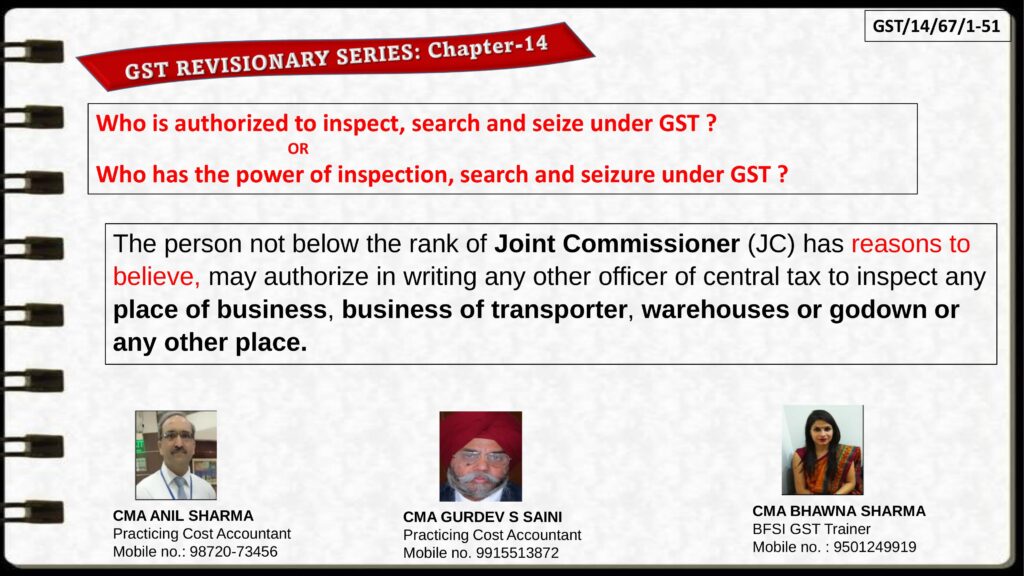
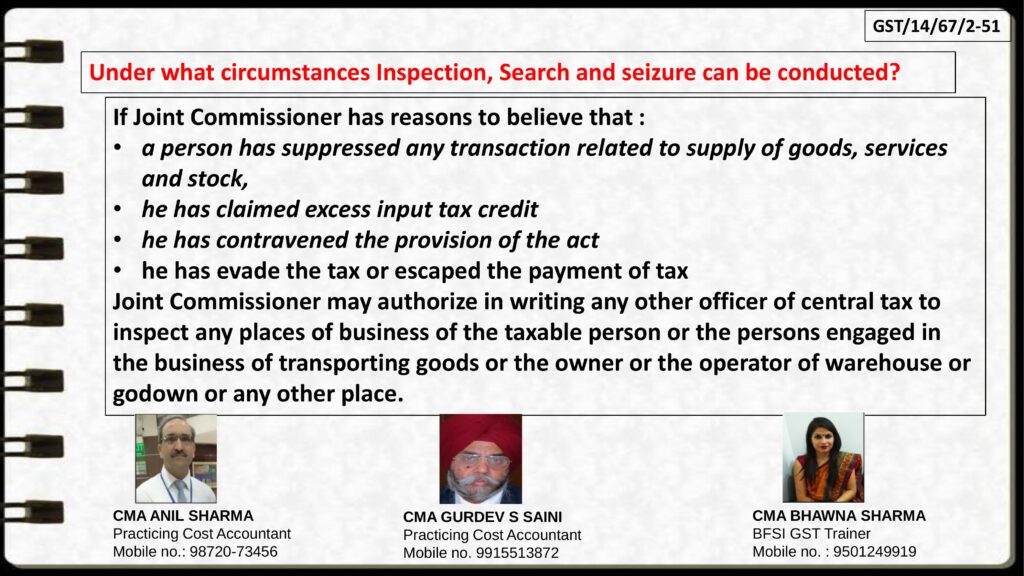
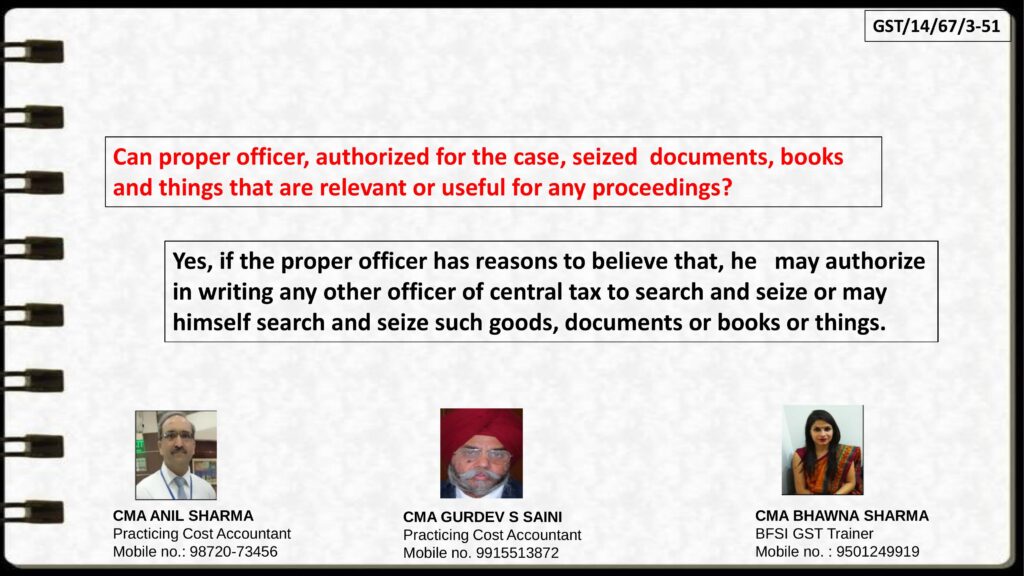
1) Shri CMA Anil Sharma, Shri CMA Gurdev Singh Saini and Smt. CMA Bhawna Sharma posted Chapter-14 containing CGST Act in simple language in PPT format. This is to make dealers, professionals, academicians, students etc. understand the basics of GST laws. Each Chapter in CGST Act, 2017 is explained in the form of Slides as given below for easy understanding of the Act:
|
Chapter-14 slides given below:-
|
|
|
|
|
|
|
|
|
|
6) Book by CMA Anil Sharma, B.Com (Honrs), M.Com, FCMA co-author of the book
|
|
Handbook on GST Audit by Tax Authorities has authored yet another book
|
|
title Goods & Service Tax – Some Perceptions and Reflections. Buy now at Price Rs.300/-.
|
|
|
|
|
|
You wish to publish your Article?
|
If you wish to share your article with maximum readers then please send them at taxupdate.otu@gmail.com. We shall publish it with all due credit to you.
|
|
|
|
|
|
|
Hope the above updates is of use to you. Please share your input and feedback at taxupdate.otu@gmail.com
|
|
|
|
|
|
 
|
Visit our website
|
OTU provides you
|
- Articles on various topics
|
|
- Media - GST, Income Tax & Press R.
|
|
- Notes / Newsletter etc.
|
|
|
|
|