|
|

|
|
|
|
|
|
onlinetaxupdate team wish to express sincere thanks to all the readers, authors, subscribers for the support extended to us.
|
|
|
|
Dear Reader,
|
Please find newsletter for your reading and reference.
|
|
Newsletter no.101 dated 16.09.2023
|
|
|
Index of the Newsletter
- Recent updates
- GST & Income tax in media
- Article
- Lawgics by Ms. Nidhi Aggarwal
- GST notes by CMA Anil Sharma
|
|
|
|
|
|
|
Income tax department issued FAQs on the Taxation and Other laws (Amendment) Bill, 2026.
|
|
|
|
|
|
CBDT has issued Notification No. 114/2026 dated 14.08.2026, notifying the rules and prescribed forms under the Foreign Assets of Small Taxpayers Disclosure Scheme, 2026.
|
|
|
|
|
|
|
|
The Income Tax e-Filing Portal has enabled a dedicated grievance facility for taxpayers to report complaints relating to corruption, misbehaviour, harassment and sexual harassment.
|
Under the grievance mechanism, complainants can select the relevant category and provide details including the name and designation of the officer concerned, along with a description of the grievance. The portal specifically provides categories for “Corruption” and “Mis-behaviour/harassment/sexual harassment.”
|
The facility is expected to strengthen transparency, accountability and taxpayer grievance redressal by providing an online mechanism for reporting serious complaints relating to official conduct.
|
|
|
|
|
|
|
|
Common offline utility for Form 3CA-3CD and 3CB-3CD
Form 3CA-3CD: Audit report under section 44AB of the Income -tax Act, 1961, in a case where the accounts of the business or profession of a person have been audited under any other law and Statement of Particulars required to be furnished under Section 44AB of the Income-tax Act, 1961
|
Form 3CB-3CD: Audit report under section 44AB of the Income -tax Act 1961, in the case of a person referred to in clause (b) of sub - rule (1) of rule 6G and Statement of Particulars required to be furnished under Section 44AB of the Income-tax Act, 1961
|
Edge browser installation is required before installing the utility.
|
|

|
Date of first release of Form Utility 10-Sep-2021
|
Date of Latest release of Form Utility 02-Apr-2026
|
|
|
|
Date of first release of Form Schema 26-Oct-2021
|
Date of latest release of Form Schema 01-Apr-2026
|
|

|
Form 10B (A.Y. 2023-24 Onwards)
Audit Report under clause (b) of the tenth proviso to section 10(23C) and section 12A(1)(b)(ii) of Income tax act,1961, in the case of a fund or trust or institution or any university or other educational institution or any hospital or other medical institution.
|
|
|
|
Date of first release of Form Utility 24-Aug-2023
|
Date of Latest release of Form Utility 01-Apr-2026
|
|
|
|
Date of first release of Form Schema 08-Sep-2023
|
Date of latest release of Form Schema 01-Apr-2026
|
|
|
|
Form 10B (Upto A.Y. 2022-23)
Audit report under section 12A(b) of the Income-tax Act, 1961, in the case of charitable or religious trusts or institutions
|
|
|
|
(Version PR3.1) (1.19 MB)
|
Date of first release of Form Utility 06-Sep-2022
|
Date of Latest release of Form Utility 04-Oct-2022
|
|
|
|
Date of first release of Form Schema 19-Aug-2022
|
Form 10BB (A.Y. 2023-24 Onwards)
Audit report under clause (b) of the tenth proviso to clause (23C) of section 10 and sub-clause (ii) of clause (b) of sub-section (1) of section 12A of the Income-tax Act, 1961, in the case of a fund or trust or institution or any university or other educational institution or any hospital or other medical institution which is required to be furnished under clause (b) of the tenth proviso to clause (23C) of section 10 or a trust or institution which is required to be furnished under sub-clause (ii) of clause (b) of section 12A
|
|
|
|
Date of first release of Form Utility 11-Oct-2023
|
Date of Latest release of Form Utility 01-Apr-2026
|
|
|
|
Date of first release of Form Schema 21-Sep-2023
|
Date of latest release of Form Schema 01-Apr-2026
|
|
|
|
Form 10BB (Upto A.Y. 2022-23)
Audit report under section 10(23C) of the Income-tax Act, 1961, in the case of any fund or trust or institution or any university or other educational institution or any hospital or other medical institution referred to in sub-clause (iv) or sub-clause (v) or sub-clause (vi) or sub-clause (via) of section 10(23C)
|
|
|
|
Date of first release of Form Utility 02-Sep-2022
|
|
|
|
Date of first release of Form Schema 17-Aug-2022
|
Form 15CA
Information to be furnished for payments to a non-resident not being a company, or to a foreign company.
|
|
|
|
|
|
|
|
Date of first release of Form Schema 02-Oct-2021
|
Form 15CB
Certificate of an accountant.
|
|
|
|
|
|
|
|
Date of first release of Form Schema 02-Oct-2021
|
Form 29B
Report under section 115JB of the Income-tax Act, 1961 for computing the book profits of the company.
|
|
|
|
Date of first release of Form Schema 09-Aug-2022
|
Date of latest release of Form Schema 01-Apr-2026
|
|
|
|
Form 29C
Report under section 115JC of the Income-tax Act, 1961 for computing Adjusted Total Income and Alternate Minimum Tax of the person other than a company.
|
|
|
|
Date of first release of Form Schema 09-Aug-2022
|
Date of latest release of Form Schema 01-Apr-2026
|
|
|
|
Form 3CEB
Report from an accountant to be furnished under section 92E relating to international transaction(s) and specified domestic transaction(s).
|
|
|
|
Date of first release of Form Utility 04-Oct-2022
|
Date of Latest release of Form Utility 01-Apr-2026
|
|
|
|
Date of first release of Form Schema 02-Sep-2022
|
Date of latest release of Form Schema 23-Dec-2025
|
|
|
|
Source: Income tax portal
|
|
|
|
|
|
|
|
Income tax Return forms and its version for AY 2026-27
|
Common Offline Utility (ITR 1,2,3 and ITR 4)
Common Offline Utility for filing Income-tax Returns ITR 1, ITR 2, ITR 3 and ITR 4 for the AY 2026-27
|
|
|
|
(version 1.2.3) (47.6 MB)
|
Date of release of latest version of utility 14-Aug-2026
|
Date of release of first version of utility 20-May-2026
|
Date of release of latest version of utility 02-Sep-2026
|
Date of release of first version of utility 20-May-2026
|
ITR 1
For individuals being a resident (other than not ordinarily resident) having total income upto Rs.50 lakh and having Income from Salaries, two house properties, other sources (Interest etc.), long-term capital gains under section 112A up to Rs. 1.25 lakh, and agricultural income up to Rs.5 thousand
|
|
|
|
Date of release of latest version of utility 31-Jul-2026
|
Date of release of first version of utility 15-May-2026
|
|
|
|
Date of first release of JSON Schema 15-May-2026
|
Date of latest release of JSON Schema 30-Jun-2026
|
|
|
|
Date of first release of validation 15-May-2026
|
Date of latest release of validation 15-May-2026
|
ITR 2
For Individuals and HUFs not having income from profits and gains of business or profession.
|
|
|
|
Date of release of latest version of utility 13-Aug-2026
|
Date of release of first version of utility 26-May-2026
|
Date of first release of JSON Schema 26-May-2026
|
Date of latest release of JSON Schema 13-Aug-2026
|
|
|
|
Date of first release of validation 26-May-2026
|
Date of latest release of validation 26-May-2026
|
|
|
|
Date of first release of validation 26-May-2026
|
Date of latest release of validation 26-May-2026
|
ITR 3
For individuals and HUFs having income from profits and gains of business or profession.
|
Date of release of latest version of utility 01-Sep-2026
|
Date of release of first version of utility 18-Jun-2026
|
|
|
|
Date of first release of JSON Schema 18-Jun-2026
|
Date of latest release of JSON Schema 30-Jun-2026
|
|
|
|
Date of first release of validation 18-Jun-2026
|
Date of latest release of validation 18-Jun-2026
|
ITR 4
For Individuals, HUFs and Firms (other than LLP) being a resident having total income upto Rs.50 lakh and having income from business and profession which is computed under sections 44AD, 44ADA or 44AE, and having long-term capital gains under section 112A upto Rs. 1.25 lakh
|
Date of release of latest version of utility 01-Sep-2026
|
Date of release of first version of utility 15-May-2026
|
|
|
|
Date of first release of JSON Schema 15-May-2026
|
Date of latest release of JSON Schema 30-Jun-2026
|
|
|
|
Date of first release of validation 15-May-2026
|
Date of latest release of validation 15-May-2026
|
ITR 5
For persons other than- (i) individual, (ii) HUF, (iii) company and (iv) person filing Form ITR-7
|
Date of release of latest version of utility 01-Sep-2026
|
Date of release of first version of utility 07-Aug-2026
|
Date of release of latest version of utility 01-Sep-2026
|
Date of release of first version of utility 07-Aug-2026
|
Date of release of latest version of utility 01-Sep-2026
|
Date of release of first version of utility 07-Jul-2026
|
|
|
|
Date of first release of JSON Schema 07-Jul-2026
|
Date of latest release of JSON Schema 05-Aug-2026
|
|
|
|
Date of first release of validation 07-Jul-2026
|
Date of latest release of validation 07-Jul-2026
|
ITR 6
For Companies other than companies claiming exemption under section 11
|
Date of release of latest version of utility 20-Aug-2026
|
Date of release of first version of utility 20-Aug-2026
|
Date of release of latest version of utility 20-Aug-2026
|
Date of release of first version of utility 20-Aug-2026
|
Date of release of latest version of utility 04-Aug-2026
|
Date of release of first version of utility 04-Aug-2026
|
|
|
|
Date of first release of JSON Schema 04-Aug-2026
|
|
|
|
Date of first release of validation 04-Aug-2026
|
ITR 7
For persons including companies required to furnish return under sections 139(4A) or 139(4B) or 139(4C) or 139(4D) only
|
Date of release of latest version of utility 14-Aug-2026
|
Date of release of first version of utility 14-Aug-2026
|
Date of release of latest version of utility 14-Aug-2026
|
Date of release of first version of utility 14-Aug-2026
|
|
|
|
Date of release of latest version of utility 01-Sep-2026
|
Date of release of first version of utility 09-Jul-2026
|
|
|
|
Date of first release of JSON Schema 09-Jul-2026
|
Date of latest release of JSON Schema 09-Jul-2026
|
|
|
|
Date of first release of validation 09-Jul-2026
|
Date of latest release of validation 09-Jul-2026
|
Source: Income tax portal
|
|
|
|
|
|
Office of the Commissioner of Commercial Taxes, Nandanam, Chennai issued Circular No. 07/2026-TNGST dated 25.06.2026 regarding GST- Return Scrutiny under Section 61 of the TNGST Act, 2017 and adjudication proceedings - Prior approval for suo moto scrutiny notices and ex parte orders.
|
Detailed guidelines were issued to the Proper officers for adjudication in the Assessment Circles, in the Circular cited, to make adjudication process more transparent, reduce the litigations and realize revenue.
|
In this direction, system generated scrutiny notices based on risk parameters have been made available to the Proper Officers to ensure uniformity and monitoring of the return scrutiny process. Instructions have also been issued to all Proper Officers to process the system-generated scrutiny notices by following the provisions of the GST Acts and Rules and training has been imparted for adherence to quality standards in the adjudication process.
|
The scrutiny notices generated by the IT wing of the department and made available are detailed below:
|
|
|
|
|
|
Central Board of Indirect Taxes and Customs (CBIC) issued Notification no. 02/2026 – Central Tax dated 07.05.2026.
|
GOVERNMENT OF INDIA
MINISTRY OF FINANCE
DEPARTMENT OF REVENUE
|
Notification No. 02/2026 – Central Tax dated 07.05.2026
|
S.O. 2286(E).— In exercise of the powers conferred by sub-section (1A) of section 101A of the Central Goods and Services Tax Act, 2017 (12 of 2017) (hereinafter referred to as the said Act), the Central Government, on the recommendations of the Council, hereby empowers the Principal Bench of the Appellate Tribunal, New Delhi constituted under sub-section (3) of section 109 of the said Act, to hear appeals made under section 101B of the said Act.
|
This notification shall be deemed to have come into force on the 1st day of April, 2026.
|
BALASUBRAMANIAN KRISHNAMURTHY,
Joint Secretary
|
|
|
|
|
|
|
|
Central Board of Indirect Taxes and Customs (CBIC) issued Notification no. 01/2026 – Central Tax dated 21.04.2026 that Seeks to extends the due date for furnishing the return in FORM GSTR-3B for the month of March, 2026 till the twenty-first day of April, 2026.
|
GOVERNMENT OF INDIA
MINISTRY OF FINANCE
DEPARTMENT OF REVENUE
CENTRAL BOARD OF INDIRECT TAXES AND CUSTOMS
Notification No. 01 /2026 Central Tax dated 21.04.2026
|
G.S.R (E)… ( In exercise of the powers conferred by sub section (6) of section 39 of the Central Goods and Services Tax Act, 2017 (12 of 2017), the Commissioner, on the recommendations of the GST Council, hereby extends the due date for furnishing the return in FORM GSTR 3B for the month of March, 2026 till the twenty first day of April, 2026, for the registered persons who are required to furnish return under sub section (1) of section 39 read with clause (i) of sub rule (1) of rule 61 of the Central Goods and Services Tax Rules, 2017.
|
2. This notification shall come into effect from 20th day of April, 2026.
|
(Kangale Shrunkhala Motiram)
Director
|
|
|
|
|
|
India's E-way bill generation under the Goods and Services Tax (GST) in June this year registered a robust 14.5 per cent increase to 136.77 million from 119.46 million in the same month of the previous year, reflecting the rising level of economic activity in the country.
|
On a sequential basis, e-way bill generation increased 0.5 per cent from 136.08 million in the previous month.
|
E-way bills are mandatory for the transportation of consignments valued at more than Rs 50,000 and are widely tracked as a high-frequency indicator of domestic trade activity, supply chain movement, and GST compliance.
|
"The E-way bill numbers for June point to sustained resilience in goods movement and steady GST compliance. The fact that generation stayed near record highs suggests that domestic trade activity remains healthy, while also reflecting the growing formalisation of the economy," said Harpreet Singh, Partner, Deloitte.
|
On June 15, the GST Council’s updated E-Way Bill regulations came into force for logistics operations. These changes collectively tighten the E-Way Bill system at both ends of every shipment from the moment a bill is generated to the moment goods are confirmed delivered. The tightening of regulations is aimed at eliminating fake billing, stopping ITC fraud, and creating an unbroken digital audit trail from supplier to end-consumer.
|
Meanwhile, the government’s Goods and Services Tax (GST) revenue grew 13.9 per cent to Rs 1.95 lakh crore in June 2026, the highest growth rate in 13 months.
|
According to provisional data released by the Ministry of Finance, net GST collections, after adjusting for refunds, rose 11.2 per cent to Rs.1.62 lakh crore from Rs 1.46 lakh crore in June 2025. Growth was primarily driven by a 34.6 per cent increase in GST revenues from imports, which reached Rs 60,038 crore, while GST collections from domestic transactions rose 6.5 per cent to Rs 1.35 lakh crore. Refund disbursements also increased 29.1 per cent to Rs 32,436 crore, supporting business liquidity while maintaining robust revenue growth.
|
During April-June FY27, gross GST collections reached Rs 6.32 lakh crore, registering an 8.4 per cent increase over the corresponding period of the previous financial year. Domestic GST collections stood at Rs 4.54 lakh crore, while GST revenue from imports grew 26.2 per cent to Rs 1.77 lakh crore. Net GST collections for the period amounted to Rs 5.40 lakh crore after refunds of Rs 91,482 crore.
|
|
|
|
|
|
Title: GST Appellate Tribunal Practice Manual incorporating GST Litigations & its Management
|
Authored by Advocate Ramesh Chandra Jena
|
About the Book:
- Chapter 1 GST in India & Overview
- Chapter 2 GST Litigation & its Management
- Chapter 3 Show Cause Notice
- Chapter 4 Demand Order and Recovery
- Chapter 5 First Appellate Authority
- Chapter 6 Revisional Authority
- Chapter 7 High Court
- Chapter 8 Input Tax Credit
- Chapter 9 Reverse Charge Mechanism
- Chapter 10 Refund under GST
- Chapter 11 Inspection, Search, Seizure, Summons & Arrest
PART II GSTAT LAW & PROVISIONS
|
- Chapter 12 Appellate Tribunal and Benches thereof
- Appendix 1 GSTAT (Procedure) Rules, 2025
- Appendix 2 Online Filing of Appeals and Applications — User Manual
- Chapter 13 Summary of Landmark Judgments
- Chapter 14 Summary of Important Instructions/Circulars Issued by CBIC
|
|
|
|
|
|
|
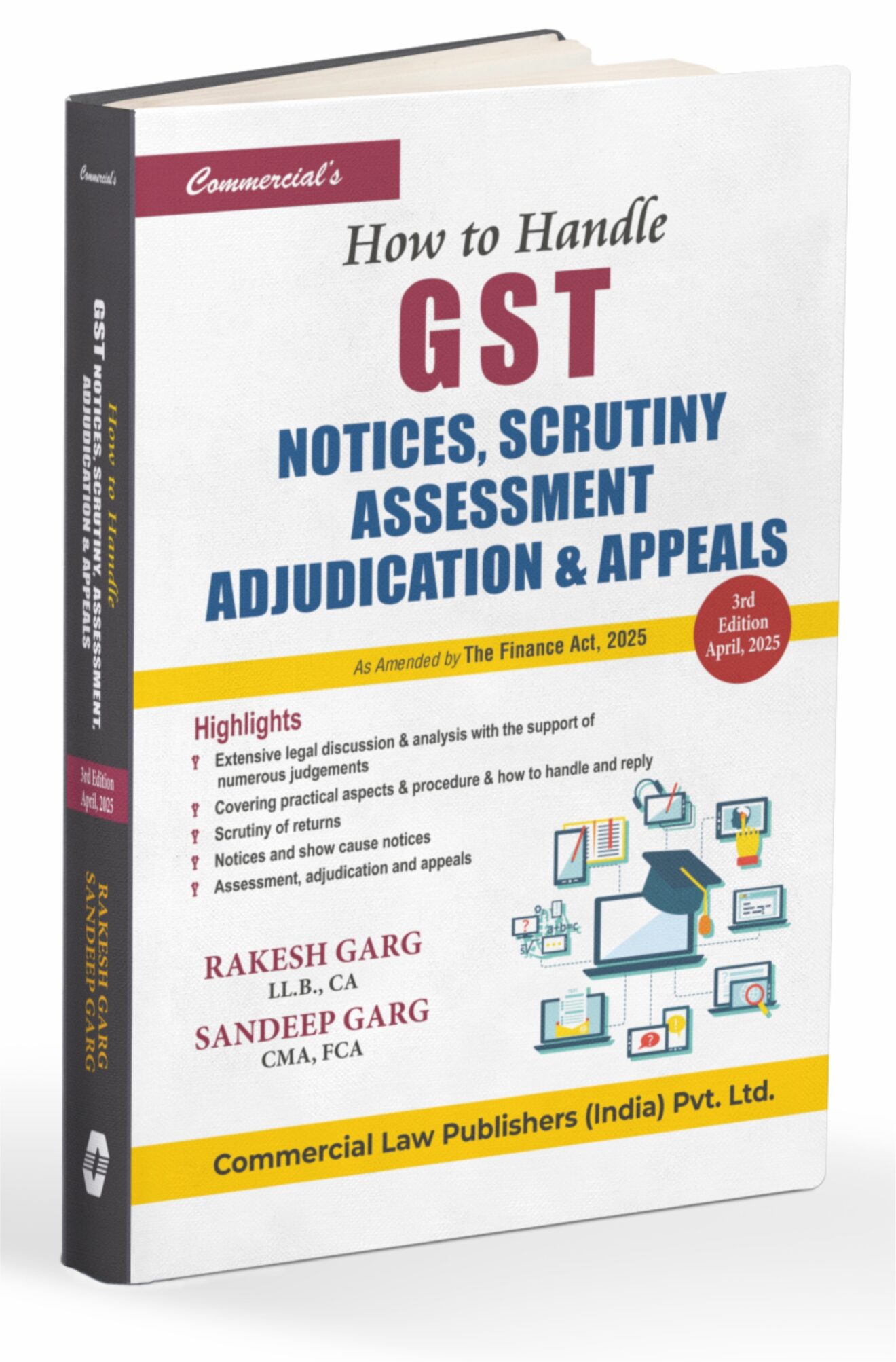
Title: How to Handle GST Notices Scrutiny, Assessment, Adjudication & Appeals as amended by Finance Act, 2025
|
Authored by Rakesh Garg, LLB CA, & Sandeep Garg, LLB CA
|
About the book
- Concepts and Framework of GST
- Major litigation areas in the GST
- Scheme of Assessment
- Provisional Assessment
- Scrutiny of Returns
- Non-filer of Returns
- Assessment of Unregistered Persons
- Summary Assessment
- GST Audit
- Assessment and Audit related Provisions & Forms
- SCN under sec 73/74/74A – Scope, Circumstances and Time Limit
- SCN under sec 73/74/74A – Voluntary Payment
- SCN under sec 73/74/74A – Defense and Replies
- SCN under sec 73/74/74A – Adjudication
- Tax collected but not paid
- SCN under sec 73/74/74A – Practical aspects
- SCN under sec 73/74/74A related Provisions
- Amnesty Scheme under the GST
- Summons under the GST
- Other Notices under the GST
- Appeals under the GST
- Sample Appellate Documents
- Partical Aspect – Appeals
|
|
|
|
|
List of GSTIN generating IRN -
|
Source: E-invoicing portal
|
|
|
|
|
|
|
|
E-invoicing threshold limit
|
|
|
|
|
|
|
|
|
|
The Goods and services tax (GST) authorities are planning to electronically record details of invoices issued by shops and businesses to retail consumers under a pilot project covering select sectors from April 1, 2027, to improve tax compliance, two officials told Business Standard.
|
The move will enable tax officials to access the large volume of retail transactions in sectors prone to tax evasion and assess whether businesses are correctly reporting their sales and paying the appropriate amount of GST, they said.
|
Currently, businesses with annual sales of more than ₹5 crore have to electronically register invoices issued to other businesses on a government-designated portal, subject to certain exemptions. Extending this reporting requirement, known as e-invoicing, to sales to end consumers is the next logical step towards enhancing tax compliance.
|
Businesses currently report their aggregate sales through GST returns rather than individual retail transactions. E-invoicing at the retail level is expected to help tax officials match these transactions with the sales reported by businesses in their tax returns, one of the officials said.
|
The GST Council, at its 54th meeting in September 2024, had recommended a voluntary trial of electronic recording of consumer bills in select sectors and states.
|
The Council proposed introducing the system on a voluntary basis initially and subsequently making it mandatory in sectors prone to tax evasion, according to the minutes of the meeting, which are publicly available. Restaurants were cited as one of the sectors where retail e-invoicing could be introduced.
|
The Council had identified several potential benefits, including better tax compliance, environmental gains from avoiding physical invoices and lower costs. Consumers would receive e-invoices on their mobile phones.
|
Officials said the government was now keen to take the pilot project forward.
|
An email sent to the Ministry of Finance on October 23 seeking comments for the story remained unanswered till press time.
|
Banks, insurers and non-banking financial companies (NBFCs) are among those currently exempt from e-invoicing for transactions with other businesses. However, the Centre and state governments are also considering bringing their business-to-business invoices under the requirement, the first official said. This is not part of the proposed pilot project.
|
Managing retail sales data
A third official, who also spoke on condition of anonymity, said the idea of electronically capturing retail invoices had been discussed for years, but implementation was delayed by the challenge of processing the enormous volume of small-value transactions taking place every day.
|
Storing and processing such volumes would require substantial server capacity, and the earlier technology infrastructure was not equipped to handle that scale, the official said.
|
Retail e-invoicing could also help foreign tourists claim GST refunds on purchases made in India before taking the goods back to their home countries, as customs officers would be able to verify the tax paid more easily, the official said.
|
Another government official said the GST Network (GSTN), which manages the technology backbone of the GST system, awarded Infosys a fresh seven-year contract in 2025 after the original arrangement, which had already been extended beyond its initial five-year term, ended.
|
Officials believe the new arrangement has factored in the need for higher storage and processing capacity.
|
They said storing invoices in a common system could reduce compliance costs by enabling more efficient invoice matching and audits, instead of relying on separate statements and manual checks.
|
Digital records carrying timestamps could also improve transparency and make subsequent changes to invoices easier to track, they said.
|
The government is also studying how countries such as Brazil and Chile operate their e-invoicing systems. Both have long used electronic invoices for business and consumer transactions, officials said.
|
Experts said the impact of e-invoicing in retail could be significant. “E-invoicing could be leveraged by the government to incentivise customers who seek GST valid invoice for their purchases, thereby encouraging the unorganised sector moving to the organised,” an tax expert said.
|
Experts also welcomed the possibility of withdrawing the business-to-business (B2B) exemption for financial sector entities. Another tax expert said e-invoicing in sectors such as banking, NBFCs and insurance would bring all B2B transactions in the economy under the system.
|
“Customers of these sectors would also benefit. It would be important to give sufficient time to these sectors as they have very high volumes of B2B transactions, and also use several custom/bespoke billing systems,” he said.
|
“Overall, it is a positive change and the GST Policy wing can collaborate with the sector associations to make this a success,” he said.
|
On B2C e-invoicing, he said it could enable better integration of digital payment and invoicing systems, supporting automated reconciliation and reporting.
|
Another tax expert said banks and NBFCs handle millions of small charges every day.
|
“Keeping the B2C pilot focused on technology-enabled sectors such as organised retail, e-commerce, quick commerce and online gaming while moving financial institutions only on the B2B side first, is a practical approach,” he said.
|
Source: Business Standard
|
|
|
|
|
|
|
|
Under the current GST returns framework, taxpayers are required to furnish details of their outward supplies in FORM GSTR-1. Based on such details, a statement of input tax credit (ITC) is made available to the recipients in FORM GSTR-2B for availment of input tax credit. To aid furnishing of return in FORM GSTR-3B of a tax period, tax liability of a supplier is being auto-populated on the portal based on the details furnished in his FORM GSTR-1, and available input tax credit is being autopopulated in his FORM GSTR-3B on the portal based on his FORM GSTR-2B. Currently, taxpayers can edit such auto-populated tax liability and available input tax credit in FORM GSTR-3B, before filing the same. Such editing may result in discrepancies between
|
a. tax liability reported in FORM GSTR-1 and tax paid in FORM GSTR-3B; and
|
b. ITC available in FORM GSTR-2B and ITC availed in FORM GSTR-3B.
|
2. These discrepancies often lead to issuance of demand notices by tax officers and system generated intimations to taxpayers. In view of reducing the mismatches between the tax liability reported in FORM GSTR-1 and the tax paid in FORM GSTR3B, and between the ITC available in FORM GSTR-2B and the ITC availed in FORM GSTR-3B, various facilities have been introduced on the portal in the past. These facilities enable correct reporting of tax liability and ITC details in FORM GSTR-3B, including correction of such details, wherever required, in the source statements i.e. FORM GSTR-1 and FORM GSTR-2B, rather than direct editing in FORM GSTR-3B. These facilities include:
|
a. FORM GSTR-1A, to enable taxpayers to amend their FORM GSTR-1 details before filing FORM GSTR-3B;
|
b. Invoice Management System (IMS), to facilitate reconciliation of ITC available in FORM GSTR-2B with the ITC availed in FORM GSTR-3B;
|
c. Electronic Credit Reversal and Re-claimed Statement, to facilitate accurate reporting of reversal and re-claim of ITC; and
|
d. RCM Ledger/ITC Statement, to facilitate accurate reporting of ITC availment in respect of supplies liable to reverse charge
|
3. The above-mentioned facilities though made available on the portal, have, except for FORM GSTR-1A, not been notified in CGST Rules, 2017. It is seen that some taxpayers are either not using or not properly using these facilities and continue to manually edit auto-populated details in FORM GSTR-3B, resulting in continued issuance of demand notices by tax officers and system generated intimations to taxpayers on account of mismatches in tax liability and ITC, causing inconvenience to taxpayers while also weakening the ITC chain integrity.
|
4. Accordingly, there is a need to further strengthen the return-filing framework, so as to provide an improved alternate mechanism of amendment of tax liability and ITC details in return in FORM GSTR-3B, which reconciles with the details of outward supplies furnished in FORM GSTR-1 and the details of available ITC in FORM GSTR2B, thereby minimizing mismatches. Such a framework will improve the accuracy of tax liability and ITC reporting, enhance compliance, and strengthen the foundation for the effective implementation of other process reforms recommended by the GST Council.
|
GST Council recommendations
5. In view of the above, the GST Council in its 57th meeting held on 8th October, 2026, took note of the various scenarios which require the taxpayers to edit autopopulated values in FORM GSTR-3B and recommended an Alternate mechanism of amendment of tax liability and ITC details in return in FORM GSTR-3B, building on the existing facilities and recommending certain new facilities as follows:
|
- i. Enhancement of FORM GSTR-1/1A/IFF for better reconciliation with FORM GSTR-3B and other statements
- The absence of supply-type-wise granularity in FORM GSTR-1/1A/IFF may lead to incorrect auto-population of the corresponding tables in FORM GSTR-3B, requiring manual correction by taxpayers. For instance, credit notes, debit notes, advances received, and advances adjusted are not categorised by the nature of supply, such as regular outward supplies, supplies under section 9(5), or zero-rated supplies. As a result, they may be reported under the table for taxable outward supplies in FORM GSTR- 3B, instead of the appropriate relevant table.
- Further, the existing format of FORM GSTR-1 does not enable taxpayers to reconcile supplies made through electronic commerce operators with the corresponding details furnished by the ECOs in FORM GSTR-8 and made available on the common portal.
- Accordingly, enhancements to FORM GSTR-1/1A/IFF have been recommended to enable identification of the nature of the underlying supply in respect of credit notes, advances, and similar documents. This would ensure correct auto-population of tax liability in FORM GSTR-3B and obviate the need for amending the auto-populated liability in FORM GSTR-3B.
- Further, to facilitate the taxpayers in furnishing details in FORM GSTR1/1A/IFF on the portal, user interface improvements, such as tool tips and guided navigational paths on the portal have been suggested.
- ii. Expanding the scope of rectifications to be made through FORM GSTR-1A
- At present, FORM GSTR-1A cannot be used to add or amend details relating to earlier tax periods, or to correct the GSTIN of the recipient. This restricts taxpayers from rectifying any error regarding the earlier tax period or relating to change in GSTIN of the recipient before filing FORM GSTR-3B. Accordingly, it has been recommended that this restriction may be removed.
- iii. Rectification of details furnished in FORM GSTR-3B of an earlier tax period
- It was observed that certain taxpayers rectify tax liability for outward supplies of an earlier tax period directly in FORM GSTR-3B, without correcting the underlying details in FORM GSTR-1/1A. Accordingly, it has been recommended that such rectification be made only through the amendment tables of FORM GSTR-1/1A, instead of amending the autopopulated liability detail in FORM GSTR-3B, directly. However, rectification of reverse-charge tax liability may be made directly through adjustments in the FORM GSTR-3B of a subsequent tax period.
- iv. Reporting of details of outward supplies in FORM GSTR-1 where tax had been discharged through FORM GST DRC-03
- Where any amount of tax has been paid through FORM GST DRC-03 in pursuance of a proceeding such as the audit, inspection, scrutiny or enforcement activity by the tax authorities, and the taxpayer intends to pass on the ITC in respect of the same to the recipient, then if he reports the invoice or debit note details in FORM GSTR-1/1A, the liability gets auto-populated in FORM GSTR-3B. As the taxpayer has already paid the tax liability through FORM GST DRC-03, he may be resorting to editing liability in FORM GSTR-3B, so as to avoid duplication of payment of said tax liability.
- To prevent such duplication, it has been recommended that FORM GST DRC-03 be enhanced to enable the taxpayer to declare, within seven days of payment, the details of the underlying invoice(s) or debit note(s). In such cases, when the said invoice or debit note details are reported in FORM GSTR-1/1A, the corresponding tax liability for the said invoice or debit note will not be added to the auto-populated liability in FORM GSTR-3B, thus avoiding any duplication of payment of tax. The details of such invoice or debit note will also be made available in corresponding FORM GSTR-2B of the recipient for availment of ITC.
- v. Correct reporting of reverse charge liability in FORM GSTR-3B
- To facilitate the taxpayers in correct reporting of tax liability and input tax credit in respect of supplies liable to reverse charge, RCM Liability and ITC Statement was introduced on the portal from August 2024 period onwards for monthly filers and July-September 2024 period onwards for quarterly filers. A facility was also provided to report cumulative closing balance, if any, upto that period.
- To further streamline correct reporting of such tax liability and ITC, it has been recommended to notify the said statement in CGST Rules, 2017 and to require that ITC claimed on inward supplies under reverse charge (other than import of goods) in FORM GSTR-3B of a tax period should not exceed the tax liability under RCM declared in the said FORM GSTR-3B and the closing balance available in the said statement.
- Accordingly, an Electronic Statement of tax paid on Reverse charge basis and input tax credit claimed has been recommended in FORM GST PMT-02B. Also, amendment has been recommended in FORM GST PMT-04, so as to allow a taxpayer to report discrepancies, if any, in the said statement.
- vi. Mandating and clarifying the usage of Invoice Management System (IMS) for better reconciliation of input tax credit details in FORM GSTR-3B
- IMS has been available on the portal since October 2024. It allows recipients to accept, reject, or keep pending inward supply details communicated by supplier. The salient features of IMS are as follows:
- The taxpayer may keep documents pending on IMS, in respect of which the conditions of eligibility of ITC under section 16(2) of CGST Act are presently not fulfilled, but which may get fulfilled subsequently. Upon fulfillment of the requisite conditions, such documents may be subsequently accepted by the recipient on IMS.
- The taxpayer may reject a document on IMS, if any discrepancy in the document communicated on IMS is noticed or where the document is found to not pertain to him.
- If no action is taken on a document communicated on IMS for generation of FORM GSTR-2B of a tax period before filing of FORM GSTR-3B for the said tax period, the same is considered to have been accepted by the recipient on IMS.
- ITC pertaining to accepted or deemed accepted documents is made available in FORM GSTR-2B and accordingly autopopulated in Table 4(A) of FORM GSTR-3B for the corresponding tax period. Conversely, the ITC pertaining to documents kept pending or rejected in IMS is not made available in FORM GSTR2B and accordingly not auto-populated in Table 4(A) of FORM GSTR-3B for the corresponding tax period.
- An action taken on any document on IMS by the recipient can be revised any number of times upto the filing of his FORM GSTR3B for the tax period for which FORM GSTR-2B is being generated. Based on the revised action taken on IMS, FORM GSTR-2B can be also revised, which will also revise the autopopulated ITC in FORM GSTR 3B.
- These above-mentioned features of IMS improve the reconciliation between ITC available in FORM GSTR-2B and ITC availed in FORM GSTR-3B.
- With a view to facilitate ease of taking action on IMS, offline tool has been made available on GST Portal, to enable taxpayers to undertake actions on both individual as well as bulk invoices in an efficient manner.
- To reduce inadvertent rejections or premature acceptance of credit notes, it has been recommended to extend the period for which a credit note may be kept pending on IMS:
a) By Monthly filers: Until filing of FORM GSTR-3B for next-to-next month, to the month in which the credit note was communicated to the taxpayer, but not later than the end of the month in which the due date for filing of the return in FORM GSTR-3B for the said next to next month falls. Thereafter, the credit note will be deemed accepted.
|
Example: Say a credit note was communicated by the supplier in his FORM GSTR-1 filed on 11th May, 2026, for the month of April 2026, to the recipient “A”. The same shall reflect in the IMS of “A” for the month April 2026. This credit note can be kept pending on the IMS by “A” till the date of filing of FORM GSTR-3B for the month of June, 2026 (which is next to next month of April 2026). However, if FORM GSTR-3B of June 2026 is not filed by “A” upto 31st July 2026 (which is the last date of the month in which the return for the month June 2026 was due), then the said credit note shall be deemed to have been accepted by “A” on IMS.
|
b) By Quarterly filers: Until filing of FORM GSTR-3B for the next quarter after the quarter in which the credit note was communicated to the taxpayer, but not later than the end of the month in which the due date for filing of the return in FORM GSTR-3B for the said next quarter falls. Thereafter, the credit note will be deemed accepted.
|
Example: Say a credit note was communicated by the supplier in his FORM GSTR-1 filed on 11th May, 2026 for the month of April 2026, to a recipient “A”,. The same shall reflect in the IMS of “A” for the quarter April–June 2026. This credit note can be kept pending on the IMS by “A” till the date of filing of FORM GSTR-3B for the quarter of July–September 2026 (which is next quarter to April–June 2026). However, if FORM GSTR-3B of July–September 2026 is not filed by “A” upto 31st October 2026 (which is the last date of the month in which the return for the quarter July–September 2026 was due), then the said credit note shall be deemed to have been accepted by “A” on IMS.
|
-
- It has further been recommended to provide an option for the suppliers to link credit notes and debit notes with the underlying invoices in FORM GSTR-1/1A/IFF, on a purely voluntary basis, to help recipients take informed decisions and to reduce the need of keeping credit notes pending or rejecting them on IMS.
- Since acceptance, rejection, and keeping documents pending on IMS improve ITC reconciliation, the GST Council has recommended that management of available ITC in FORM GSTR-3B should be carried through IMS instead of directly amending auto-populated ITC in FORM GSTR-3B. GST Council has also recommended notifying relevant amendment in GST Rules and FORMS for the same purpose.
- The Council also recommended issuance of a circular to guide the taxpayers in correct manner of taking action on IMS.
- vii. Facilitating taxpayers in correct reporting of reversal and reclaim of ITC in FORM GSTR-3B:
- In order to facilitate the taxpayers in correct and accurate reporting of reversal and reclaim of input tax credit, a statement namely, Electronic Credit Reversal and Reclaim Statement was introduced on the GST portal from August 2023 return period onwards, with a facility to report their cumulative closing balance of input tax credit, if any, which had been reversed but not re-availed upto that time.
- To further streamline correct reporting, it has been recommended to notify the said statement in CGST Rules, 2017 and to require that reclaimed input tax credit in FORM GSTR-3B shall not exceed the balance available in the said statement.
- Accordingly, an Electronic Credit Reversal and Reclaim Statement has been recommended in FORM GST PMT-02A. Also, amendment has been recommended in FORM GST PMT-04, so as to allow a taxpayer to report discrepancies, if any, in the said statement.
- Further, amendment has been recommended in Table 4 of FORM GSTR3B to provide for a separate Table 4(AA) in FORM GSTR-3B for reporting reclaimed ITC, so as to obviate the need for amending the auto-populated ITC details in Table 4(A)(5) of FORM GSTR-3B.
- viii. Streamlining the manner of rectification of errors made in reporting input tax credit in FORM GSTR-3B
- After suppliers furnish outward supply details, recipients act on IMS to generate FORM GSTR-2B and are generally required to manually report RCM ITC, ITC reversals, and ITC re-claims in FORM GSTR-3B. Such manual interventions are prone to errors and omissions.
- As the temporary reversals made in Table 4(B)(2) of FORM GSTR-3B are credited to the Electronic Credit Reversal and Re-claim Statement, any excess temporary reversal done in Table 4(B)(2) can be rectified by reclaiming the excess amount so reversed in a subsequent return. However, no such systematic mechanism exists to rectify any excess reversal of ITC, reversed permanently in Table 4(B)(1) of FORM GSTR3B.
- Accordingly, it has been recommended to provide a systemic mechanism, by way of a new form, FORM GST PMT-10 to undertake rectifications of such excess reversals of permanent nature reported in Table 4(B)(1) of FORM GSTR-3B of an earlier tax period, on the basis of self-assessment.
- ix. Enhancement in FORM GSTR-2B in respect of ITC distributed by ISD
- ITC distributed by an Input Service Distributor (ISD) as ineligible in FORM GSTR-6 does not currently flow as available ITC in FORM GSTR2B and is therefore not auto-populated in Table 4(A)(4) of FORM GSTR3B.
- Accordingly, enhancements have been recommended in FORM GSTR2B and FORM GSTR-3B, to provide that ITC distributed by an ISD as ineligible need not be reversed again by recipients in Table 4(B)(1) of FORM GSTR-3B as such ITC will be auto-populated as ineligible ITC in Table 4(D)(2) of FORM GSTR-3B.
- Currently, ITC attributable to an ineligible ISD credit note is reduced from eligible ITC on the portal. Since such a credit note relates to ineligible ITC, its impact should instead flow to the ineligible ITC section, i.e., Table 4(D)(2) of FORM GSTR-3B.
- Accordingly, enhancements have been recommended in FORM GSTR2B to ensure that ITC relating to ineligible credit notes distributed by an ISD is not adjusted against eligible ITC distributed by the ISD.
6. Besides the above, the GST Council also recommended issuance of a circular to clarify the correct manner of reporting ITC availment and its reversal in FORM GSTR3B, in the context of IMS, the Electronic Credit Reversal and Re-claimed Statement, and the Electronic Statement of tax paid on reverse charge basis and ITC claimed.
|
7. The Council recommended that, with the above proposed measures, there may not be any need for directly rectifying/amending the details of liability (autopopulated from FORM GSTR 1/1A/IFF) and details of ITC (auto-populated from FORM GSTR-2B) in FORM GSTR-3B. Thus, any amendment/correction of liability will be done through FORM GSTR-1/1A/IFF instead of directly amending auto-populated values in FORM GSTR-3B. Further, any management of ITC will be done through IMS, Electronic Credit Reversal and Re-claimed Statement, and the Electronic Statement of tax paid on reverse charge basis and ITC claimed, FORM GST PMT-04 and FORM GST PMT-10, instead of directly amending the auto-populated details in FORM GSTR-3B. To allow stakeholders sufficient time to align their systems and practices, the Council recommended that this proposed Alternate mechanism of amendment of tax liability and ITC details in return in FORM GSTR-3B, and corresponding amendments to the CGST Rules, 2017, may be brought into force from the return period of April, 2027.
|
Public consultation
8. Furthermore, the Council recommended that the proposed measures be placed in the public domain for a time-bound consultation to provide an opportunity to taxpayers, tax practitioners, industry associations, and other stakeholders to submit comments and suggestions on the proposed measures. In this regard, the amendments recommended by the Council in CGST Rules, 2017 and in the CGST FORMs are placed at Annexure A* and Annexure B*, respectively. The circular recommended by the Council for clarifying the correct manner of reporting ITC availment and its reversal in FORM GSTR-3B is placed at Annexure C*.
|
9. Accordingly, all the stakeholders are invited to examine the proposed measures and submit their comments, suggestions, and inputs by Monday, 30th November. The same shall be examined and duly considered before finalisation of the amendments to the said Forms and Rules.
|
* Kindly note that the amendments proposed in the CGST Rules, 2017 and CGST Forms placed in Annexure A and Annexure B respectively, have been highlighted in red.
|
|
|
|
|
|
|
|
India’s ambition to become a Viksit Bharat requires an economy in which enterprises of every size can grow, wherever they begin. Over the past twelve years, our government has worked to create those conditions. The introduction of the goods and services tax (GST) in 2017 established a common national framework for indirect taxation. Next-Gen GST carries that effort forward, drawing on nine years of implementation and the experience of taxpayers and states.
|
Under Prime Minister Narendra Modi’s vision, Next-Gen GST was conceived with two connected purposes: To reduce and rationalise rates, and to make compliance easier. The rate changes took effect on September 22, 2025. The next phase of process reforms will come before the GST Council shortly. Together, these efforts seek to give households relief, businesses greater certainty and taxpayers a system in which they can fulfil their obligations without avoidable difficulty.
|
The states have been partners throughout. They brought their priorities and experience to the Council, helped shape the decisions and undertook their implementation. I thank them for that commitment. GST’s progress rests on this willingness to pursue a shared national purpose while respecting each government's responsibilities.
|
The results provide grounds for confidence. Between October 2025 and July 2026, the value of reported taxable supplies grew by 25.8 per cent over the corresponding period a year earlier. A lighter rate structure has been accompanied by a substantial expansion in reported economic activity. This is an encouraging foundation for a reform intended to support both enterprise and public finances.
|
That resilience is visible in the latest revenue figures. Gross GST collections reached ₹12.46 trillion during April-September 2026, up 11.6 per cent over the corresponding period last year. Every month from June through September recorded double-digit annual growth; together, collections for these four months accelerated by nearly 15 per cent. Net collections, after refunds, also grew by 10.4 per cent over the half year. Taxpayer relief has coexisted with growth in the resources available for development.
|
The breadth of the expansion matters as much as its scale. Reported taxable supplies grew across all 11 sector groups and all major states. In an economy as diverse as India’s, this spread is significant. Growth across sectors and regions creates opportunities for more businesses to participate in expanding markets, and for more communities to benefit from the demand, investment and employment that follow.
|
Reported sales to consumers (B2C) also rose by 26.7 per cent in the post-reform comparison. When tax relief is reflected in prices, families have more room to meet other needs or save. Consumer relief and enterprise growth are closely connected: The purchasing power of households sustains demand for the goods and services that businesses provide. The benefits can extend from the household to the retailer, the supplier and the producer.
|
For small and medium enterprises, a national market is valuable when it opens a practical route to customers beyond their immediate surroundings. Businesses in Tier-II and Tier-III towns should be able to build those relationships while continuing to invest and employ people locally. Enterprises expanding into these towns, in turn, can create opportunities for local suppliers and distributors. GST’s common framework supports these connections; simpler administration must make them easier to sustain.
|
Participation in that framework is substantial. GST registrations across Central and state jurisdictions stood at approximately 17.1 million at the end of August, up nearly 15 per cent from a year ago. For the April–July 2026 tax periods, GSTR-3B returns filed by their due dates were 12.6 per cent higher than for the same periods last year. These improvements place a corresponding responsibility on the administration: Regular compliance must be supported by reliable service, clear guidance and timely resolution of difficulties.
|
The functioning of input tax credit is another important part of this experience. The post-reform figures show that the share of tax liability discharged through credits rose, while accumulated credit declined relative to taxable supplies. This is encouraging for businesses that depend on the effective use of eligible credit. For a smaller firm, working capital determines how readily it can purchase inputs, fulfil an order and take on the next one.
|
Refunds are equally relevant. Approximately ₹1.80 trillion was refunded during April-September. Returning amounts due to businesses is part of a well-functioning tax system. Greater predictability in this process would help enterprises plan purchases and production with more confidence. The taxpayer’s experience of receiving an eligible refund is an important measure of administrative performance.
|
The states also have a stronger revenue position. Their aggregate SGST (state GST) receipts, including their share of IGST (integrated GST) settlements, grew by about 16 per cent during April-September this year. These resources support investment in infrastructure and public services, which improve the conditions in which families and enterprises pursue their aspirations. The gains can therefore reinforce one another: Household relief supports demand, enterprise strengthens economic activity, and public revenues help sustain development.
|
The experience also points to the work ahead. A growing system must remain attentive to the costs it imposes on smaller participants. Their time and resources are limited. Each improvement in filing, credit or refunds should allow more of those resources to be devoted to running and expanding a business.
|
The proposals before the Council on October 7 have been developed through sustained work with the states. They address registration, returns, refunds, disputes and improved flow of input tax credit, with the aim of reducing the time and cost of compliance. Taxpayer experience must continue to guide implementation.
|
The GST’s growing maturity gives us a stronger foundation for the next stage of reform. The same commitment to clarity, certainty and respect for the taxpayer guides our work on direct taxes. A dependable tax system enables enterprises to plan beyond their immediate obligations and invest in opportunities that take time to mature. Giving them that confidence, wherever they operate, helps build the economic strength of a Viksit Bharat as envisioned by Prime Minister Narendra Modi.
|
The writer is the Union Minister of Finance and Corporate Affairs
|
Source: Business Standard
|
|
|
|
|
|
|
|
The Preventive Wing of the Central Goods and Services Tax (CGST) Commissionerate, Shimla, has uncovered an alleged GST fraud involving input tax credit of around ₹5.55 crore in the Kala Amb industrial area of Sirmaur district. The investigation has also led to the arrest of Gaurav Jain, managing director of M/s Samay Pharma India Private Limited, Trilokpur.
|
How Was the Alleged GST Fraud Carried Out?
CGST officials alleged that Samay Pharma and M/s Dual Healthcare claimed input tax credit using fake invoices issued by several firms that either did not exist or were found to be non-genuine.
|
The investigation found that ITC worth around ₹5.55 crore was allegedly claimed through invoices linked to 10 such firms. Officials examined the transactions to determine whether the supplies mentioned in these invoices had actually taken place.
|
What Did Officials Find About the Goods?
Officials said the invoices showed the purchase of goods, but there was no evidence confirming that those goods were actually transported.
|
E-way bills and toll-plaza records also did not support the movement of goods mentioned in the invoices, raising questions about whether the transactions reflected genuine supplies.
|
How Were GST Refund Claims Allegedly Involved?
Officials further alleged that the fake input tax credit was later included in GST refund claims.
|
The suspected credit was allegedly used in an attempt to obtain money back from the government through the GST refund mechanism.
|
What Other Irregularities Were Found?
During the investigation, officials found several suspicious transactions, fake firms and invoices without actual movement of goods.
|
They also alleged that shell entities were being used to manipulate the GST credit and refund system.
|
What Evidence Did Investigators Examine?
The CGST team recorded statements from several people during the investigation and examined digital evidence.
|
The inquiry also looked at invoices, the firms connected to them and records relating to the alleged movement of goods.
|
Why Was the Managing Director Arrested?
Based on the evidence collected during the investigation, Gaurav Jain, managing director of M/s Samay Pharma India Private Limited, was arrested.
|
The arrest was made under Section 69(1) of the Central Goods and Services Tax Act, 2017.
|
Follow for daily updates on cybercrime, corporate fraud, DFIR, hacking, investigations, and digital forensics
|
|
|
|
|
|
|
|
GST officers have arrested a partner of a firm engaged in trading of iron and steel goods for fraudulently availing input tax credit of over Rs 15.78 crore.
|
Investigations by the Central Goods & Services Tax (CGST), Delhi South Commissionerate's anti-evasion branch revealed that the firm had availed inadmissible ITC on the basis of invoices issued by multiple firms, several of which were found to be non-existent, non-functional, suspended or cancelled.
|
Field verification also established that certain suppliers had no genuine business activity at their declared places of business.
|
In a statement, the Finance Ministry said, "CGST Delhi South Commissionerate have arrested a partner of the firm engaged in trading of iron and steel goods in a case involving fraudulent availment, utilisation and passing on of inadmissible ITC aggregating to over Rs 15.78 crore through bogus invoices of approximately Rs 87.67 crore."
|
Further inquiry established that ITC was availed without actual receipt of goods and was also passed on to various recipients through invoices issued without corresponding supply of goods.
|
Based on the evidence gathered during the investigation and statements recorded under Section 70 of the CGST Act, 2017, the accused was arrested on September 14 and produced before the Patiala House Court, which remanded him to judicial custody for 14 days.
|
|
|
|
|
|
|
|
The Superintendent of Central GST, Mohit Pratap Singh, was caught while allegedly accepting a bribe of Rs 8 lakh through a mediator, the Lokayukta said.
|
Lokayukta sleuths trapped the Central government officer while he was allegedly accepting the bribe at Kendriya Sadan in Koramangala here, according to a statement.
|
According to the Lokayukta, Singh had demanded the money to "close a false complaint" filed against the complainant, Syed Zameer, in connection with pending Central GST dues. PTI GMS SSK
|
|
|
|
|
|
|
|
Punjab’s excise and taxation officials detained 170 vehicles carrying goods suspected to be in violation of GST provisions, officials said on Monday.
|
The operation, carried out jointly by all State Investigation and Preventive Units with special focus on Mandi Gobindgarh and Khanna, led to the seizure of iron scrap and finished iron/steel goods valued at more than Rs 5 crore.
|
Excise and Taxation Minister Harpal Singh Cheema described the drive as “a wake-up call for those who think they can get away with it.” He emphasised that the government is determined to plug every loophole and ensure that tax compliance becomes the rule of the day rather than the exception.
|
A substantial number of vehicles were found without proper invoices and prescribed documents, a clear violation of the GST law.
|
Punjab will not allow tax evasion to eat into the state’s revenue. Every legitimate rupee must reach the public exchequer, for it is the lifeblood of development, Cheema said in a statement.
|
The minister further informed that the detained consignments are undergoing detailed verification, which is expected to be completed within a week. PTI CHS MPL MPL
|
|
|
|
|
|
|
|
The Telangana Commercial Taxes Department has issued detailed guidelines governing the use of Artificial Intelligence tools and other third party online platforms by its officers, making individual officers personally accountable for any unauthorised sharing of taxpayer information through such platforms.
|
Circular No. 1/2026, issued by the department, allows officers to use AI for generic research, drafting and administrative efficiency, but makes it clear that such use cannot come at the cost of taxpayer confidentiality, data security or the independent application of mind by officers.
|
The circular prohibits officers and staff from typing, pasting, uploading, scanning, photographing, dictating, transcribing or otherwise transmitting taxpayer related information into any public or commercial AT tool, chatbot, generative AI platform, document analyster, summariser translation or transcription service, or cloud based analytical software, unless the platform has been expressly authorised in writing by the Commissioner of Commercial Taxes or the Government of Telangana.
|
CA Jitendra Patel, Partner, Indirect Tax, N.A.Shah Associates LLP, said the circular was a significant and welcome step towards the responsible use of AI by tax officers.
|
"The Telangana commercial taxes department's circular No. 1/2026 is a significant and welcome step towards the responsible use of Artificial Intelligence (AI) by tax officers. While the circular encourages the use of AI for research, drafting and administrative efficiency, it rightly emphasises that taxpayers' confidentiality and the independent application of mind by officers cannot be compromised and liable to penal action," Patel said.
|
Officers face personal accountability
The restrictions cover a wide range of taxpayer information, including GSTIN, PAN, legal name or trade name, address and contact particulars, bank account details, returns and annexures, financial statements, invoices, e way bill data, discrepancy reports, notices, assessment, adjudication or appellate orders, audit material, refund applications, inspection , search and investigation records, statements recorded during proceedings, and internal notes or legal opinions relating to an identifable taxpayer.
|
The circular also makes clear that the responsibility for protecting such information rests with the officer concerned. Unauthorised transmission of taxpayer information to an external AI platform can therefore expose the officer to disciplinary, legal and data protection consequences.
|
Ikesh Nagpal, Lead, Indirect Tax, AKM Global, said the circular strikes a balance between the use and AI and the need to protect taxpayer confidentialy.
|
"The Telangana Commercial Taxes Department's circular strikes a pragmatic balance between embracing AI and safeguarding taxpayer confidentiality. Rather than prohibiting AI, it permits its responsible use while drawing a firm boundary against sharing identifiable taxpayer information on unauthorised platforms. This is particularly relevant for tax administration, where officers routinely handle highly sensitive financial and transactional data," Nagpal said.
|
"More importantly, the circular reinforces that AI may assist but cannot replace the officers' independent application of mind. Every AI generated legal proposition or case citation must be independently verified, and the final order must reflect the officer's own reasoning. This approach places accountability where it belongs with the decision make while still allowing technology to improve efficiency in tax administration," he added.
|
AI cannot replace tax officer's judgment
The department has also stressed that AI cannot replace the independent judgment required from officers, particularly while issuing notices, assessments, adjudication orders and other quasi judicial decisions.
|
Manoj Mishra, Partner and Tax controversy Management leader, Grand Thornton Bharat, said the circular comes at a time when AI is becoming increasingly embedded in legal and tax workflows.
|
"As AI becomes increasingly embedded in legal and tax workflows, the focus has rightly shifted from whether AI should be used to ensuring it is used responsibly and within the boundaries of law. Recent judicial interventions, where courts have cautioned against mechanical reliance on AI generated content and even set aside orders lacking independent application of mind, underscore that technology cannot substitute statutory decision making. Recent Telangana's Circular on AI use is therefore a timely and pragmatic intervention. It reinforces that taxpayers information remains confidential under the GST framework and the Digital Personal Data Protection Act, and that unauthorised disclosure on public AI platforms can trigger disciplinary, legal and data protection consequences. By permitting AI for generic research and drafting while mandating human verification, confidentiality safeguards and independent judgment, the circular offers and balanced governance framework that could serve as a useful precedent for tax administrations across the country , "Mishra said.
|
"The circular makes one point unmistakably clear: custodianship of taxpayer data carries personal accountability. Any unauthorised disclosure through public AI platforms may expose the officer to disciplinary action, criminal and data protection consequences, while also jeopardising the validity of the underlying tax proceedings. AI may improve administrative efficiency, but responsibility for data security, legal accuracy and independent decision making cannot be delegated to an algorithm," he added.
|
Public AI platforms treated as third party transmission
Aravind Srivatsan, Partner and India Tax Leader, Nangia Global, described the framework as what could be termed a first of its kind detailed code governing the use of AI tools by tax department staff.
|
He said the Telangana Government has acknowledged that officers are increasingly using AI based tools to improve the speed, consistency and quality of their work, while making it clear that such use cannot compromise taxpayer confidentiality, data security of the officer's independent judgment.
|
Srivatsan pointed out that large language models, generative AI platforms, chatbots, document analysers, summarisers, translators, transcription services and coding assistants may process information on private servers, frequently outside India. Information entered into such platforms may also be logged, retained , reviewed or used for model training, he said.
|
According to Srivatsan , typing , pasting, uploading, scanning, photographing or dictating departmental material into an external AI platform amounts to electronic transmission of information to a third party and can create risks of data leakage, misuse and subsequent litigation.
|
He said that where an officer transmits taxpayer particulars to an external AI engine without authority of law or taxpayer consent, the act can attract personal accountability.
|
Disciplinary, criminal and data protection consequences
The circular provides for consequences where taxpayer information is disclosed without authorisation. These can include disciplinary action under the applicable Telangana Civil Services rules, possible criminal consequences under applicable law and data protection consequences under the Digital Personal Data Protection Act, 2023.
|
The circular also addresses the potential impact on tax proceedings where AI generated material is used without proper verification. An officer remains responsible for the accuracy of statutory provisions, legal propositions and judicial precedents relied upon in an official proceeding.
|
Aditya Singhania, Founder of Trackase, said the guidelines could address the unauthorised and unconscious sharing of taxpayer data through general AI applications while also establishing individual responsibility for breaches.
|
He said the framework draws a clear distinction between the role of humans and machines in proceedings where tax officers exercise quasi judicial authority. He also pointed to instances where courts have taken cognisance of non existent. AI generated citations and said the Telangana framework provides detailed guidance for responsible use of AI by tax officials.
|
Officers told to delete past taxpayer data
The department has also addressed information that may already have been entered into AI platforms.
|
Officers and staff have been directed, to the extent technically feasible, to delete taxpayer related information previously entered into AI platforms, along with associated chat histories and stored files.
|
The restrictions also extend to the use of personal mobile phones, tablets, laptops, personal email accounts and personal cloud storage for processing departmental material through AI tools.
|
At the same time, the circular does not prohibit AI use altogether. Officers can use AI for generic research, drafting assistance and language related tasks, provided identifiable taxpayer information is not shared and AI generated material is independently verified before being relied upon.
|
The framework effectively places a clear boundary around the use of AI in tax administration. AI can be used as an efficiency tool, but the responsibility for taxpayer confidentiality, data security, legal accuracy and independent decision making remains with the tax officer.
|
Source: cfo economictimes
|
|
|
|
|
|
|
|
The tax department is increasingly using artificial intelligence (AI), data analytics and information from multiple government databases to identify anomalies, detect potential tax risks and sharpen scrutiny of taxpayers.
|
According to tax officials and chartered accountants TNIE spoke to, the approach is moving beyond checking individual tax returns to analysing patterns across Income Tax Returns, GST returns, e-invoices, e-way bills, registrations and historical taxpayer behaviour. The objective is to make scrutiny more targeted and improve voluntary compliance.
|
The Income-Tax department already processes information available through systems such as the Annual Information Statement (AIS), which gives taxpayers details of financial transactions and income-related information available with the tax authorities. More sophisticated AI tools could help identify patterns across these datasets and flag cases requiring closer examination.
|
Jigar Doshi, country head - Indirect Tax, Ascentium India, said the department's scrutiny and audit process was no longer limited to information submitted in a particular return.
|
“Increasingly, the department is able to run data-driven simulations across multiple sources — including Income Tax Returns, GST returns, e-invoices, e-way bills, registrations and historical taxpayer behaviour — to identify anomalies and potential tax risks,” he said.
|
GST audits go deeper
GST administration is also making greater use of centralised analytics to identify suspicious transactions and taxpayers. Platforms such as DGRAM are used to flag fake registrations, suspicious input tax credit (ITC) chains and potential tax-evasion patterns, while BIFA (Business Intelligence and Fraud Analytics) acts as a risk and exception-reporting engine using the all-India GST database.
|
At the state level, tax administrations are also developing their own analytical capabilities. Maharashtra's Business Intelligence & Data Warehouse (BIDW), for instance, combines a data warehouse with an analytics layer to help identify cases for scrutiny and audit.
|
“Manual audits and sample testing alone may not be sufficient against AI-enabled regulatory scrutiny,” says Rajat Mohan, managing partner at AMRG Associates, adding that businesses are facing greater scrutiny of historical transaction data and cross-period discrepancies.
|
GST audits can involve reconciliation across GSTR-1, GSTR-3B, GSTR-2B, e-way bills and e-invoices. Automated systems can identify differences in ITC, outward supplies and turnover, as well as claims involving suppliers whose registrations were subsequently cancelled or who failed to discharge their tax liabilities.
|
The scale of information available to tax authorities is significant. India had more than 1.65 crore GST taxpayers as of May 2026, generating millions of invoices and returns that can be analysed alongside income-tax information.
|
This allows authorities to identify issues such as unusual refund claims, short payment of GST, excessive ITC claims and inconsistencies between sales and purchases.
|
The growing ability to combine information from GST, income tax, customs and other government systems could allow tax authorities to build a wider financial profile of taxpayers.
|
According to experts, this means for businesses conventional reconciliation of books with tax returns may no longer be sufficient. Companies may increasingly need to identify potential risks before they are flagged by the department.
|
AI could also allow the department to alert taxpayers to potential discrepancies, seek clarification digitally and escalate cases for formal scrutiny where required.
|
However, AI is likely to remain an aid rather than a substitute for human judgment. Officers would still have to verify facts and take responsibility for assessment decisions.
|
“AI is an enabler,” one tax official said, stressing that the taxpayer or professional taking the final tax position would continue to be accountable. AI cannot be treated as a substitute for human judgment, particularly in complex tax matters.
|
Source: The New Indian Express
|
|
|
|
|
|
|
|
The Central Bureau of Investigation (CBI) has arrested Superintendent, Land and Building Section at office of Commissioner of CGST and Central Excise, Raigad and a CGST consultant, in a bribery case.
|
The CBI registered the instant case on 09.09.2026 against the accused Superintendent and unknown others based on a complaint by the Project Head of a private realty company at New Panvel. The realty company had undertaken a redevelopment project of two Buildings at Sector 17, New Panvel. A total of 24 of these flats are owned by the CGST & Central Excise, Raigad Commissionerate for which the necessary approvals from the local authority have already been received. It was alleged in the complaint that the accused Superintendent demanded Rs. 1 Crore for the NOC and handing over of the flats for redevelopment. During the verification of the complaint, the accused officer demanded Rs. 10 Lakh in cash on 10.09.2026, Rs. 20 Lakh as downpayment of a flat purchased by the accused public servant and Rs. 70 Lakh on later stage for other officers of DG HRD CGST, New Delhi.
|
The CBI laid a trap on 10.09.2026 while the accused Superintendent directed the complainant to handover Rs. 10 Lakh undue advantage to a CGST consultant, who was present there. Both the accused persons have been arrested on 10.09.2026 and were produced before the competent court on 11.09.2026 which has granted two days of police custody of both the accused persons.
|
Further investigation is being undertaken.
|
|
|
|
|
|
|
|
Amid the growing use of artificial intelligence in tax administration, the state commercial taxes department has imposed strict safeguards on the use of AI tools by its officials, making them personally accountable for any unauthorised disclosure of taxpayer information through such platforms.
In circular No. 1/2026, the department allowed the use of AI for generic research, drafting and administrative tasks, but underscored that taxpayer confidentiality, data security and independent decision-making by officers cannot be compromised for convenience.
|
The guidelines prohibit officers and staff from typing, pasting, uploading, scanning, photographing, dictating, transcribing or otherwise transmitting taxpayer-related information to any public or commercial AI tool, chatbot, generative AI platform, document analyser, summariser, translation or transcription service, or cloud-based analytical software.
|
Such platforms may be used for taxpayer-related information only if they have been expressly authorised in writing by the commissioner of commercial taxes or the Telangana govt.
|
The move comes at a time when the department is increasingly deploying AI-driven systems for taxpayer monitoring, risk assessment, and scrutiny. While AI is being leveraged to detect anomalies and improve tax administration, the circular seeks to ensure that sensitive taxpayer data does not flow into unauthorised external platforms during the process.
|
The department has also cautioned officials against relying on AI-generated outputs as a substitute for their own judgement.
|
Officials remain responsible for independently examining facts, interpreting the relevant tax laws and arriving at decisions based on their own assessment.
|
The circular makes it clear that responsibility for compliance rests with individual officers. It warns that any unauthorised sharing, disclosure or transmission of taxpayer information through AI tools or other third party platforms could attract penal action, reinforcing accountability as the department expands the use of technology in tax administration.
|
Source: The Times of India
|
|
|
|
|
|
|
|
The Preventive Wing of the Central Goods and Services Tax (CGST) Commissionerate, Shimla, has unearthed an Rs 6.55-crore fraud involving fake invoices and fraudulent claims of input tax credit (ITC) and GST refunds in the Kala Amb industrial area of Sirmaur district and arrested the managing director (MD) of a pharma company. The accused has been identified as Gaurav Jain, MD of M/s Samay Pharma India Private Limited, Trilokpur, Sirmaur. According to officials, the investigation revealed that Samay Pharma and M/s Dual Healthcare had allegedly availed ITC on the basis of invoices issued by several fake and non-existent supplier firms.
|
It was found that ITC amounting to Rs 5.55 crore had allegedly been claimed through invoices linked to 10 non-existent firms. The officials also found that the invoices showed supplies for which the actual movement of goods could not be verified through e-way bills and toll-plaza data.
|
The alleged fraudulent ITC was subsequently included in the GST refund claims, with an attempt reportedly made to obtain cash refunds from the government exchequer.
|
The investigating officials found the alleged use of fake firms, invoices without actual movement of goods, suspicious accounting entries and shell entities to manipulate the GST input-credit and refund mechanism.
|
The officials recorded the statements of various people and examined digital evidence, based on which Jain was arrested under Section 69(1) of the Central GST Act, 2017.
|
|
|
|
|
|
|
|
The West Bengal Authority for Advance Ruling (AAR) has held that electricity charges recovered by a commercial building maintenance company from occupants at actual cost, without any markup or profit, will not attract Goods and Services Tax (GST).
|
The ruling was pronounced on September 1 in the case of DH Maintenance Ltd, which provides common-area maintenance and facility management services for a commercial building in Kolkata.
|
DH Maintenance pays electricity charges to distribution company CESC Ltd for electricity consumed in the building and recovers the cost from the occupants. The company sought clarity on whether such recovery could be treated as reimbursement in the capacity of a “pure agent” and excluded from the value of its maintenance services for GST purposes.
|
A pure agent under GST is a person who incurs costs or expenses on behalf of a client while providing a main service, and later claims reimbursement for the exact amount spent without adding any markup.
|
Under the proposed billing arrangement, electricity used in individual offices for normal consumption and heating, ventilation and air-conditioning (HVAC) would be charged according to sub-meter readings. The electricity cost for common areas would be distributed among the occupants based on the super-built-up area of their respective units. The company would recover the electricity cost without adding any profit or markup.
|
The issue was significant because electricity supplied along with maintenance services would ordinarily form part of a composite supply. In such a case, the GST rate applicable to the principal maintenance service would apply to the electricity component as well.
|
However, the AAR relied on Circular No. 206/18/2023-GST dated October 31, 2023. The circular provides that where electricity is supplied along with renting of immovable property or maintenance services, it generally forms part of a composite supply. But where electricity is recovered on an actual basis — at the same amount charged by the electricity distribution company — the supplier is deemed to be acting as a pure agent for the electricity supply.
|
Interestingly, the AAR observed that DH Maintenance did not strictly satisfy the normal pure-agent test. It noted that electricity was an integral part of the maintenance and management services provided by the company.
|
The authority, however, said the specific deeming provision in the 2023 circular would apply. Since DH Maintenance proposed to charge occupants the same amount as charged by CESC, without any markup or profit, the electricity recovery would be treated as pure-agent recovery.
|
The AAR also extended this treatment to electricity used in common areas. The balance amount of the CESC bill, after accounting for electricity consumed in individual offices and HVAC, would be apportioned among occupants according to their respective areas.
|
“This ruling reinstates the position under the Circular on the taxability of electricity charges recovered on a metered basis, i.e. HVAC and non-HVAC, and aligns with the position adopted by most industry players. A key aspect, however, is the ruling’s finding that electricity charges relating to common area are also non-taxable as recovered in the capacity of pure agent,” said Harpreet Singh, partner, Indirect Tax, Deloitte.
|
“While this is a welcome position, it remains contentious and is likely to be challenged by the tax authorities before the Appellate Authority,” he added.
|
For January 2026, the CESC bill was Rs 20.19 lakh for 196,520 kilowatt-hours (kWh) of consumption. Of this, Rs 10.24 lakh related to non-HVAC consumption in individual offices, Rs 6.35 lakh to HVAC consumption and Rs 3.61 lakh to common-area consumption.
|
The Revenue had pointed out that similar issues had arisen in earlier adjudication proceedings for 2018-19 and 2019-20. The AAR, however, distinguished those proceedings, saying they related to the company’s existing billing pattern, whereas the present ruling concerned the proposed billing pattern.
|
The AAR ultimately ruled that electricity charges recovered at actual cost, including charges relating to HVAC and common-area consumption, would be excluded from the value of the company’s supply and would not attract GST under the proposed arrangement.
|
Source: Business Standard
|
|
|
|
|
|
|
|
Haryana State Vigilance and Anti-Corruption Bureau (SV&ACB) on Thursday arrested a State GST excise and taxation officer (ETO) and a chartered accountant from Jind as they were caught accepting a cash bribe in connection with a pending tax notice.
|
The accused have been identified as ETO Divesh Sahu of the SGST department and CA Ajay Sharma. According to the vigilance bureau they were taken into custody following a trap laid by the bureau’s Jind unit.
|
Officials said Sahu had allegedly demanded ₹5 lakh from the proprietor of a private company of Jind to refrain from taking strict action on a notice issued under Section 74 of the SGST and CGST Act, 2017. The notice related to alleged tax evasion of ₹75 lakh.
|
According to the complaint Sahu used Sharma as an intermediary to collect the money. The first instalment of ₹3 lakh was to be paid on Thursday, with the balance to follow later. The complainant approached the Anti-Corruption Bureau office in Jind. After verifying the allegation, a vigilance team laid a trap and caught Sharma accepting the bribe at his office on Bhiwani Road. The entire amount of ₹3 lakh was recovered from him.
|
An FIR has been registered at Police Station SV&ACB, Karnal, under Sections 7 and 7A of the Prevention of Corruption Act, 1988. Both accused are being questioned and further investigation is underway, the bureau said.
|
|
|
|
|
|
The Income Tax Appellate Tribunal (ITAT) is open to setting up a camp office at Shimla for Himachal Pradesh litigants and considering a similar arrangement for Jammu and Kashmir, even as it rules out the feasibility of a separate regular Bench for Himachal Pradesh because of its relatively small contribution to the pending caseload at Chandigarh. The tribunal has brought down its nationwide pendency from around 3 lakh cases to approximately 60,000, with fresh institution and disposal rates now almost matching.
|
ITAT Officiating President Mahavir Singh, in Chandigarh on an official visit, said a proposal from the local zone could pave the way for a camp office at Shimla or anywhere else in the State to facilitate litigants from Himachal Pradesh. He also indicated that a similar arrangement could be considered for Jammu and Kashmir.
|
On the possibility of expanding the tribunal’s presence in the region, Singh clarified that its jurisdiction covered Punjab, Haryana, Jammu and Kashmir and Himachal Pradesh. The tribunal presently has two Benches at Chandigarh and one at Amritsar.
|
Explaining why a separate regular Bench for Himachal Pradesh was not feasible, he said: “We are having two Benches at Chandigarh and one Bench at Amritsar. Pendency in Chandigarh is around 2,400. So, out of 2,400, Himachal contributes only 400. So, it is not feasible.”
|
However, he made it clear that a camp office remained a possibility. “But camp office, yes. If proposal will come from local zone, then definitely at Shimla or any camp office can be done. So that, to give ease to the local litigants,” he said.
|
He separately extended the possibility to Jammu and Kashmir, saying: “Similarly, J&K also, if proposal will come from general office, it will be done.” The indication assumes significance for litigants who otherwise have to travel to the existing Benches for the adjudication of income tax appeals.
|
Pendency reduced from 3 lakh to 60,000
On the tribunal’s nationwide pendency, Singh said the institution had achieved a substantial reduction from approximately 3 lakh cases at an earlier stage to around 60,000 presently.
|
“Tribunal presently is having a pendency of around 60,000. And I’ll tell you, we take great pride in telling that we are the only institution in the country which has reduced the pendency. At one point of time, our pendency was 3 lakh,” he said.
|
Describing the reduction as a major institutional achievement, he added: “From 3 lakh to 60,000, it is a big achievement. I feel pride in this because I am part of this institution from last 25 years.”
|
He acknowledged that pendency had increased somewhat over the past two to three years, attributing it to the improved disposal rate of appeals by Commissioners of Income Tax (Appeals).
|
“Again, because in last 2-3 years, because CIT appeals are working, so the disposal rate in CIT appeal in last 2 years increased. So, due to that, little increase is there. Now, it is at 60,” he said.
|
Asked whether fresh institution exceeded disposal, Singh answered in the affirmative but said the two were almost matching. “Institution is more, yes. But we are matching, almost matching,” he said.
|
New buildings, land acquisition and cadre restructuring
On the need to strengthen infrastructure and manpower in view of the increasing demands on the tribunal, Singh said several initiatives had been undertaken under the leadership of ITAT President Justice C.V. Bhadang. He said new buildings had been created for the Calcutta, Ahmedabad and Delhi Benches, while land was being acquired at other locations.
|
“Our President Justice C.V. Bhadang, after taking over, has taken many steps like building infrastructures. He has created new buildings of Calcutta Benches, Ahmedabad Benches, Delhi for that purpose. And other places also, we are acquiring plots,” he said.
|
The tribunal was also in the process of acquiring land for its Mumbai operations. “For Bombay, we are in the process of acquiring a land,” he added.
|
On manpower, Singh said a cadre restructuring proposal had been mooted and was undergoing the requisite inter-ministerial process. “We have mooted a cadre restructuring proposal before Ministry. And that is in the process. And I think within a year or six months, it will be over,” he said.
|
Explaining the time involved, he said: “Because it is a long process. We have to go to DOPT, we have to go to Expenditure Ministry. So, that process is taking time. But we are in the process of doing the things.”
|
ITAT itself functions as an ADR mechanism
On whether alternative dispute resolution (ADR) could help reduce litigation, Singh said the tribunal’s own functioning incorporated elements of an informal dispute-resolution mechanism because it was not bound by the strict procedural requirements applicable to ordinary civil courts.
|
“ADR, we are working as an ADR actually as far as litigation at this level is concerned because we are not bound by strict civil procedure code, strict evidence Act,” he said.
|
Describing the tribunal’s hearing procedure, he added: “The tribunal procedure is very informal. Any day, if you have occasion to see, you will see it is very normal and formal. It is not strict rule based.”
|
He said the relatively informal procedure enabled the tribunal to pronounce decisions in a large majority of cases on the same day. He added the relatively informal procedure enabled the tribunal to pronounce decisions in a large majority of cases on the same day. “In 90 per cent cases, we pronounce there and there. So, we work as an ADR also,” he said.
|
However, he distinguished the tribunal’s role from the scope for resolving income tax disputes before they reach the appellate stage. Such mechanisms, he said, would have to be developed by the Revenue Ministry or the Income Tax Department.
|
Asked specifically whether pre-litigation counselling could make a difference, Singh agreed that it could prevent a certain proportion of disputes from entering the litigation process. “Yes, it can. It can reduce. For that, department has to take steps,” he said.
|
One order can dispose of 20 similar cases
On measures to improve case management and accelerate disposals, Singh said the tribunal was regularly identifying matters in which the issues had already been covered by the Supreme Court or the High Court, and segregating them. It was also consolidating disputes involving similar questions so that a common decision could help dispose of multiple appeals.
|
Explaining the benefit, he added: “One case can dispose of 20 cases. So, these type of steps we are taking regularly.” He also underlined the role of technology in identifying and consolidating matters and tracking the institution of appeals.
|
“Yes, role of technology is very much needed. It helps in consolidation of the matters…. Everything is on fingertips. Technology is helping,” he said.
|
AI cannot take final judicial decisions
On the possibility of AI-driven courts handling income tax disputes in the future, Singh said artificial intelligence was still at a nascent stage and could not be entrusted with final judicial decision-making. “AI is in very nascent stage actually. And it is only in experimental stage. In final decision making, it cannot be implemented,” he said.
|
He acknowledged that AI could assist in litigation-related work, including arguments, but maintained that such assistance could not be equated with the actual exercise of judicial discretion. “No doubt, it can be used for the purpose of litigation, arguments, etc. And to some extent, some help can be taken. But it is not a final thing,” he said.
|
Explaining the limitation, he said adjudication required the application of the human mind and an approach grounded in compassion and fairness. “Because AI, what result it will give, nobody knows. Litigation is such a thing where you have to apply your mind. And you have to be compassionate and even-handed,” he said. “If you are not compassionate, then no purpose of this creating courts.”
|
Same-day pronouncement of orders a transparency measure
On transparency and building public and corporate confidence in the tribunal, Singh highlighted its practice of pronouncing judgments immediately after hearings in most cases. He said the tribunal’s rules provided for pronouncement of judgments in court, enabling litigants and their counsel to know the outcome without waiting for a subsequent date.
|
“Actually, the decision making in tribunal, like our rules say so, that you pronounce judgments there and then. I know that 80-90 per cent cases, our pronouncement is there and then. That means finality comes in that judgement,” he said.
|
Explaining the procedure, he added: “Then public knows that immediate after conclusion of hearing. In court itself, we pronounce that your appeal is allowed, dismissed or partly allowed. This issue is allowed; this issue is dismissed.”
|
He said the presence of the counsel and assessee during the pronouncement ensured that the parties immediately knew the outcome. “So, if counsel along with the assessee is sitting, they come to know that it has become final. So, this is a transparency. So, there is complete transparency,” he said.
|
Clarifying that the practice did not extend to every matter, Singh said larger cases requiring deliberation were reserved for judgment.
|
“Some bigger matters, etc., there we reserve the judgments. And we keep for, their deliberations are required. There are very few cases,” he said.
|
|
|
|
|
|
|
|
A Pune woman has won a ₹60 lakh income tax dispute after the Income Tax Appellate Tribunal (ITAT) accepted her explanation that the cash deposited in her bank account had been gifted by her late husband for her and their two minor daughters. The tribunal directed the tax department to delete the entire addition, ruling that her explanation could not be rejected merely because her husband was no longer alive to confirm the gift.
|
In its order dated 13 October 2026, in the case of Surekha Subhash Parve vs ITO, Ward 5(4), Pune (ITA No. 3137/PUN/2025), the Pune bench of the ITAT set aside the decision of the National Faceless Appeal Centre (NFAC), which had upheld the tax officer's addition of ₹60 lakh as unexplained money under Section 69A of the Income Tax Act, 1961.
|
The ruling is relevant for families dealing with financial transactions and cash gifts between spouses, particularly when one spouse dies and the surviving family has to establish the source of money during income tax proceedings.
|
Why did the income tax department question the ₹60 lakh deposit?
The dispute relates to the financial year 2015-16, corresponding to assessment year 2016-17. Information available with the income tax department showed that Parve had deposited ₹60.07 lakh in cash in her Bank of Maharashtra savings account during the year.
|
The department initiated reassessment proceedings after finding that she had not filed an income tax return for the relevant assessment year. The assessing officer issued notices seeking an explanation for the deposits. In response, Parve said that ₹60 lakh represented a gift from her husband, Subhash Ashruba Parve, who had subsequently died.
|
She explained that her husband had been handling the family's financial affairs and that the money was intended for her and their two minor daughters. She also said that she had difficulty gathering the supporting documents after his death on 17 March 2023.
|
The assessing officer, however, was not satisfied with the explanation. He noted that her bank account had total unexplained credits of ₹75 lakh, including ₹60 lakh in cash deposits and ₹15 lakh received through clearing cheques. In the absence of what he considered adequate documentary evidence establishing the source of the cash, he added ₹60 lakh to her taxable income under Section 69A.
|
The NFAC subsequently upheld the addition, noting that Parve had not furnished the necessary supporting documents during the first appeal proceedings.
|
What evidence did the widow submit before ITAT?
Before the tribunal, Parve's counsel argued that the cash belonged to her late husband and had been gifted to her and their two daughters. The counsel also pointed out that she was a homemaker without an independent source of income and had not regularly filed income tax returns.
|
To substantiate her explanation, she submitted her bank statements showing the transactions, Form 26AS, her own affidavit, affidavits from her two daughters, her husband's death certificate and other supporting documents. She also provided the PAN details of her daughters and explained the circumstances surrounding the cash gift.
|
The tribunal observed that Parve had established the identity of the donor, her relationship with him and the PAN details of the donor. It also noted that her husband was no longer alive to provide a confirmation or affidavit regarding the gift.
|
The bench comprising Vice-President R.K. Panda and Judicial Member Astha Chandra held that the affidavits and confirmations submitted by the family had not been established to be false or untrue.
|
The tribunal also considered the Supreme Court's ruling in CIT vs Smt. P.K. Noorjahan (1999), which clarified that additions under deeming provisions such as Section 69A are not automatic. The word 'may' in the provision gives tax authorities discretion, which must be exercised after considering the facts and circumstances of each case.
|
Accepting the widow's explanation, the tribunal concluded that the source of the cash deposits could not simply be rejected because the donor had died. It directed the assessing officer to delete the entire ₹60 lakh addition and allowed her appeal.
|
Are cash gifts from a spouse taxable?
Under the income tax provisions applicable to assessment year 2016-17, gifts received from a spouse were not taxable under Section 56(2)(vii), as a spouse is treated as a relative for this purpose.
|
However, this exemption does not automatically protect every cash deposit from tax scrutiny. Taxpayers may still be required to establish the nature and source of money when the assessing officer questions unexplained deposits under Section 69A.
|
Under the current tax framework, Section 56(2)(x) also exempts gifts received from specified relatives, including a spouse. The exemption from tax on gifts and the requirement to explain the source of money are separate issues.
|
The ITAT's decision therefore highlights the importance of maintaining supporting documents for family financial transactions. Bank statements, gift declarations, affidavits, donor identification details and other evidence establishing the circumstances of a transfer can help taxpayers defend their claims during scrutiny.
|
The ruling is based on the specific facts and evidence presented in this case and does not mean that every unexplained cash deposit claimed as a gift from a spouse will automatically be accepted.
|
|
|
|
|
|
|
|
The Goods and Services Tax Appellate Tribunal, Surat Bench (“GSTAT”) in Assistant Commissioner, CGST & Central Excise v. Filatex India Limited dismissed 46 appeals filed by the Revenue under Section 112(3) of the CGST Act, 2017 and upheld the refund of IGST paid under reverse charge mechanism (“RCM”) on ocean freight, on the ground that the declaration of the levy as unconstitutional in Union of India v. Mohit Minerals Private Limited operates retrospectively and that a taxpayer who was not a party to that litigation can also claim refund, without any separate order in its own name.
|
- Filatex India Limited (“the Respondent”), a registered manufacturer, imported goods and paid IGST under RCM on ocean freight in terms of Entry 10 of Notification No. 10/2017-Integrated Tax (Rate) read with Entry 9(ii) of Notification No. 8/2017-Integrated Tax (Rate), issued under Section 5(3) of the IGST Act, 2017.
- The Hon’ble Gujarat High Court in Mohit Minerals Pvt. Ltd. v. Union of India declared both the notifications ultra vires the IGST Act, 2017 and unconstitutional. The appeals of the Union of India were dismissed by the Hon’ble Supreme Court on May 19, 2022.
- In April 2023, the Respondent filed 46 refund claims for IGST paid on ocean freight. Show cause notices proposed rejection on two grounds: (i) the Supreme Court judgment does not mention retrospective effect and is therefore effective from May 19, 2022 only; and (ii) the Respondent had availed and utilised the IGST credit, so a simultaneous refund claim would amount to unjust enrichment.
- The Respondent replied that a provision declared ultra vires is deemed non-existent from inception, and that the credit was not utilised in substance since sufficient balance existed under CGST and SGST, the ITC balance having to be seen as a whole and IGST being exhausted first as per the prescribed method.
- The adjudicating authority rejected all the claims, holding that the judgment is not retrospective and that the balance of ITC could not be considered as a whole, the IGST balance having to remain in the electronic credit ledger for a refund. The judgments relied upon by the Respondent were brushed aside without discussion.
- The Additional Commissioner (Appeals), Vadodara vide common Order-in-Appeal No. VAD-CGST-002-APP-ADC-349-394-2023-24 dated March 28, 2024 set aside the orders. Relying on P.V. George v. State of Kerala and M.A. Murthy v. State of Karnataka, it held that a levy declared ultra vires is deemed never to have existed. Examining Sections 49A and 49B, Rule 88A and Circular No. 98/17/2019-GST dated April 23, 2019, it held that the Respondent was bound to exhaust IGST credit first and, applying the maxim lex non cogit ad impossibilia, rejected the utilisation objection.
- Pursuant to the Commissioner’s order dated December 5, 2024 under Section 112(3), the Revenue filed 46 appeals before the GSTAT.
- Rule 89(2) requires a copy of the order holding that refund is due; the Respondent, not being a party to Mohit Minerals, cannot treat that judgment as such an order.
- The Supreme Court judgment does not mention any retrospective effect and operates from May 19, 2022 onwards; benefits and notifications cannot be given retrospective effect unless specified, relying on Union of India v. C. Krishna Reddy, Commissioner v. Adani Exports Ltd. and CCE, Chennai v. Indian Organic Ltd.
- Drawing a parallel with Mafatlal Industries Ltd. v. Union of India , where the Central Duties of Excise (Retrospective Exemption) Act, 1986 enabled refunds, it was argued that no such notification has been issued for refund of GST paid on ocean freight. Reliance was also placed on M. Nagaraj v. Union of India for prospective application of judgments.
- Orally, the Authorised Representative argued that once IGST credit is utilised it cannot be refunded even if CGST and SGST credit remains, IGST being a separate pool, and that refund would amount to unjust enrichment. Reliance was placed on SN Tradelink Pvt. Ltd. v. State of Gujarat , where refund was allowed only after reversal of credit through Form GST DRC-03, which had not been done here.
- The Revenue pointed to no perversity, illegality or jurisdictional error in the Order-in-Appeal and merely sought to re-agitate issues; the utilisation and reversal issue was never raised in the appeal.
- A provision declared ultra vires is non-existent from inception and judgments declaring the law apply retrospectively unless expressly made prospective, relying on Kanishk Sinha v. State of West Bengal , M.A. Murthy v. State of Karnataka , Louis Dreyfus Company Pvt. Ltd. v. Union of India (Andhra Pradesh High Court, 2025) and Sunrise Timply Company Pvt. Ltd. v. Union of India (Calcutta High Court, 2026).
- A declaration by a constitutional court binds all authorities and the benefit is available to every person, whether or not a party; the judgment itself is the “order” under Rule 89(2); no further notification is needed for consequential refunds; and Krishna Reddy, Adani Exports and Indian Organic deal with retrospectivity of executive exemption notifications, while M. Nagaraj deals with a constitutional amendment.
- Whether the Authorised Representative of the Revenue can raise, before the GSTAT, the ground of utilisation of IGST credit when that ground was not specified by the Commissioner in his order under Section 112(3) of the CGST Act, 2017?
- Whether refund of IGST paid on ocean freight can be denied, or amounts to unjust enrichment, merely because the IGST credit was availed and utilised, when sufficient unutilised balance of CGST and SGST remained in the electronic credit ledger?
- Whether the judgment in Mohit Minerals, which is silent on its temporal operation, applies only prospectively from May 19, 2022?
- Whether a taxpayer who was not a party to Mohit Minerals can claim refund on the basis of that judgment, and whether the judgment constitutes the “order” contemplated under Rule 89(2) of the CGST Rules, 2017?
The GSTAT, Surat Bench inAppeal Nos. APL/11/SRT/2026 to APL/56/SRT/2026, Final Order No. GUJ/SRT/002 to 047/2026 held as under:
|
- Observed that the ground of utilisation of IGST credit is neither present in the appeal nor specified in the Commissioner’s order dated December 5, 2024 under Section 112(3). It was not that the issue escaped the Commissioner’s mind, as it was one of the grounds in the show cause notices, was replied to, was rejected by the adjudicating authority and was decided in favour of the Respondent by the Appellate Authority, yet the Commissioner did not find that part of the order to be “not correct, legal or proper”.
- Held that an officer filing an appeal under Section 112(3) cannot travel beyond the authorisation granted by the Commissioner, and that a ground which has been considered and dropped by the Commissioner cannot be raised by the Authorised Representative.
- Noted that, in any case, SN Tradelink does not support the Revenue. In that case the IGST credit had been utilised and the refund was allowed after reversal through Form GST DRC-03 by utilising the SGST balance. The judgment does not hold that refund is barred if IGST has been utilised.
- Held that holding a combined unutilised balance of CGST and SGST equivalent to the refund amount, and debiting the refund amount against it in the credit ledger, amounts to non-utilisation of the credit in substance. Accordingly, no double benefit or unjust enrichment arises.
- Observed that the Revenue is under an erroneous belief that judgments, like laws, operate prospectively. Unless otherwise specified, all laws are prospective and all judgments are retrospective, because courts interpret and declare the law and do not legislate. The levy did not become unconstitutional because of the judgments; it was always so. Prospective overruling, first applied in Golak Nath v. State of Punjab , is an exception available only where the Court itself so declares, and no such declaration exists in Mohit Minerals. Reliance was placed on Kanishk Sinha and Louis Dreyfus .
- Noted that M. Nagaraj does not help the Revenue, as it concerned constitutional amendments on reservation in promotions and the extract from Indra Sawhney only reinforces that where the Supreme Court wants its judgment to be prospective, it directs so. Hence, refund cannot be rejected on the ground that Mohit Minerals does not state that it has retrospective effect.
- Held that under Articles 265 and 300A of the Constitution, tax collected under a levy declared ultra vires and unconstitutional is without authority of law from inception, whether or not the taxpayer was a party to the writ petition. The nine-Judge Bench in Mafatlal excludes the category of “unconstitutional levy” from the proposition that “each one must fight his own battle”; the only exception is a person who himself unsuccessfully challenged the very provision and allowed that decision to attain finality. The Respondent never challenged the levy and lost.
- Held that the declaration that the levy is void ab initio is itself the legal foundation for refund and is the “order” contemplated under Rule 89(2). No further order in the name of the claimant is required, as the entitlement flows directly from Article 265 and does not depend on adjudication inter partes.
- Noted that the High Courts have allowed refund of IGST paid on ocean freight in identical facts, in Comsol Energy and Shree Mahesh Oil Products, and that limitation was not a ground of appeal before the GSTAT.
- Directed that the order of the Appellate Authority is upheld and the appeals filed by the Revenue are dismissed. The department shall process the refund claims and pay the refund amounts and interest to the Respondent, to the extent not already paid, with interest under Section 56 payable for the period of delay beyond 60 days from the date of the original application. For instance, for applications filed on April 22, 2023, interest would run from June 22, 2023 till the date of actual payment.
Section 5(3) of the IGST Act, 2017 empowers the Government, on the recommendation of the Council, to notify categories of supply on which tax is payable by the recipient under RCM. Entry 10 of Notification No. 10/2017-Integrated Tax (Rate) made the Indian importer liable for services of transportation of goods by vessel from outside India up to the customs station of clearance in India, with the rate prescribed by Entry 9(ii) of Notification No. 8/2017-Integrated Tax (Rate). The Gujarat High Court struck down both entries, inter alia on the footing of double taxation where ocean freight already forms part of the value of goods imported on CIF basis, and the Supreme Court upheld the decision.
|
Section 54 of the CGST Act, 2017 read with Rule 89(2) governs refund. Section 54(1) prescribes a two-year time limit and Section 54(8)(e) requires the amount to be credited to the Consumer Welfare Fund where the incidence of tax has been passed on, which is the statutory form of the unjust enrichment bar. Rule 89(2) requires a copy of the order resulting in the refund. The Tribunal has now clarified that, for an unconstitutional levy, the judgment declaring the levy void is itself such an order.
|
Sections 49A and 49B and Rule 88A prescribe that IGST credit is first utilised towards IGST liability, then CGST and then SGST. Since the utilisation of IGST credit first is mandatory and automatic, the Tribunal rightly looked at substance, namely the combined unutilised CGST and SGST balance, rather than treating each head of credit as a watertight silo.
|
Section 112(3) of the CGST Act, 2017 empowers the Commissioner to call for and examine the record of an order of the Appellate Authority or Revisional Authority and to direct a subordinate officer to apply to the Tribunal for determination of such points as may be specified in his order. The Tribunal has confined the officer’s authority strictly to those specified points. The Section 112(3) order of the Commissioner should therefore be obtained and examined in every Revenue appeal, as it limits the scope of the Revenue’s case.
|
Section 56 of the CGST Act, 2017 provides for interest where refund is not granted within 60 days from the date of receipt of the application. The Tribunal has directed interest from the 61st day of the original application. As Section 56 prescribes different rates depending on whether the refund arises from an order that has attained finality, the rate applicable should be verified while computing the claim.
|
- Union of India v. Mohit Minerals Private Limited (Supreme Court) – affirmed the Gujarat High Court’s decision declaring the RCM levy on ocean freight ultra vires and unconstitutional.
- Bharat Oman Refineries Ltd. v. Union of India and Comsol Energy Pvt. Ltd. v. State of Gujarat (Gujarat High Court) – refund of IGST paid on ocean freight directed; in Comsol Energy the deficiency memos were quashed and refund of Rs. 93.54 lakh was directed with simple interest at 6% per annum, and the Limitation Act, not Section 54, was held to govern an unconstitutional levy.
- Shree Mahesh Oil Products v. Union of India (Rajasthan High Court) – petition disposed of in terms of Mohit Minerals and Comsol Energy even though the Gujarat High Court judgment was then under challenge and not stayed.
- Louis Dreyfus Company Private Limited v. Union of India (Andhra Pradesh High Court) – the plea that Mohit Minerals operates prospectively was negated; a judgment declaring the law operates retrospectively unless the Supreme Court itself declares otherwise.
- Kanishk Sinha v. State of West Bengal (Supreme Court) – the judgment of a constitutional court is always retrospective unless the judgment itself states that it operates prospectively.
Contrary and distinguishable judgments
|
- SN Tradelink Pvt. Ltd. v. State of Gujarat – relied on by the Revenue. Refund was allowed there after the petitioner reversed the credit through Form GST DRC-03 using the SGST balance. The Tribunal distinguished it, observing that it does not lay down that refund is barred once IGST is utilised.
- Mafatlal Industries Ltd. v. Union of India – the principle that “each one must fight his own battle” and the exception for a person who has himself lost a challenge to the levy, which has attained finality, continue to apply. The Tribunal held that this exception does not reach a taxpayer who never litigated the levy.
- Union of India v. C. Krishna Reddy, Commissioner v. Adani Exports Ltd. and CCE, Chennai v. Indian Organic Ltd. – these deal with retrospective application of exemption notifications and circulars issued by the executive, and were held to have no application to the retrospective effect of a judicial declaration.
- M. Nagaraj v. Union of India and Golak Nath v. State of Punjab – the doctrine of prospective overruling applies only where the Court itself directs, and does not displace the default rule that judgments operate retrospectively.
This is a Tribunal ruling in a batch of 46 appeals and, being an order of a Bench of the Appellate Tribunal, it is appealable to the High Court under Section 117 of the CGST Act, 2017 on a substantial question of law. Until then it is a strong persuasive precedent for importers who paid IGST on ocean freight under RCM and for other taxpayers who paid tax under a levy that has been judicially declared void. Taxpayers should keep the following in view:
|
- Confirm that the taxpayer never itself challenged the levy and lost, as that is the only exception recognised in Mafatlal.
- Work out month-wise the combined unutilised CGST and SGST balance against the IGST refund claimed. Where the balance was not sufficient, the reversal route through Form GST DRC-03 followed in SN Tradelink may need to be considered.
- The Tribunal did not decide limitation, as it was not a ground of appeal. Taxpayers who have not yet filed claims should examine the limitation position carefully, keeping in view the Limitation Act, 1963 as applied in Comsol Energy and the date from which the mistake can be said to have been discovered.
- Where a refund is sanctioned late, claim interest under Section 56 from the 61st day of the original application, as directed by the Tribunal.
|
|
|
|
|
|
|
The GST Appellate Tribunal, State Bench Bengaluru (“GSTAT”) in Gopinath TM v. Mukand Limited partly allowed the Revenue's appeal and held that interest under Section 50 of the Central Goods and Services Tax Act, 2017 (“the CGST Act”) is payable on the differential tax discharged through debit notes/supplementary invoices issued under Section 142(2)(a) pursuant to a retrospective upward price revision under a pre-GST contract, since the enhanced value relates back to the original date of clearance; however, the Tribunal upheld the dropping of penalty under Section 122 as the default arose from a bona fide interpretation of the transitional provisions.
|
- Mukand Limited (“the Assessee”) cleared goods during April 2017 to June 2017 under the erstwhile pre-GST regime. The contracts contained price escalation clauses and the transaction values were subsequently revised upwards.
- Pursuant to the revision, the assessee issued debit notes/supplementary invoices under Section 142(2)(a) of the CGST Act on September 29, 2018 and October 15, 2018 and discharged the differential tax of Rs. 54,44,190 by reporting the same in GSTR-1 and paying through GSTR-3B of those months, without paying interest.
- The Assistant Commissioner, Hosapete Division vide Order-in-Original (OIO) dated March 28, 2022 confirmed the appropriation of tax and demanded interest of Rs. 13,85,623 under Section 50 along with penalty under Section 122 (Rs. 5,44,419).
- The Additional Commissioner (Appeals), Belagavi vide Order-in-Appeal (OIA) dated June 30, 2023 set aside the interest and the penalty, holding that the due date for discharging GST on supplementary invoices is the 20th of the month following their issuance.
- Aggrieved, the Revenue preferred an appeal before the GSTAT. The Revenue contended that whether tax is "due" depends on the time of supply under Section 12 and not on the date of the debit note; that Sections 39(7) and 34(4) are merely reporting machinery; and that penalty was wrongly dropped as tax was due from the date of the actual supplies.
- The assessee contended that declaring the debit notes in GSTR-1 and paying tax in GSTR-3B for the month of issuance is timely compliance under Sections 39(7) and 34(4); that Section 12 does not apply to pre-GST removals and Section 142(2)(a) deems the supplementary invoice to be an outward supply under the GST law with a 30-day window; that Steel Authority of India is inapplicable since its request for provisional assessment under the earlier regime was denied; and that penalty must fall if interest fails.
- Whether a retrospective upward price revision under a pre-existing contract, treated as a deemed outward supply under Section 142(2)(a) of the CGST Act, extinguishes the historical interest liability on delayed payment of tax, or whether the enhanced value relates back to the date of original clearance so as to attract interest under Section 50?
- Whether Sections 39(7) and 34(4) of the CGST Act shift the due date for payment of differential tax to the 20th of the month following the issuance of the debit note?
- Whether the ratio of the Supreme Court in Steel Authority of India Ltd. is inapplicable merely because the assessee was denied provisional assessment under the erstwhile regime?
- Whether penalty under Section 122 is imposable where the differential tax was voluntarily discharged under a bona fide understanding of the transitional provisions?
The GST Appellate Tribunal, State Bench Bengaluru inAPL/258/BUR/2026held as under:
|
- Observed that, in terms of the larger Bench ruling of the Hon'ble Supreme Court in Steel Authority of India Ltd. v. CCE (paragraph 63), where a price escalation operates retrospectively, the finalised price is the true value of the goods even at the time of original removal; treating tax as payable only when prices are finalised or supplementary invoices are raised does violence to the Act.
- Noted that the deeming fiction in Section 142(2)(a) is only a procedural and administrative gateway to report the differential transaction, issue a GST-compliant debit note and discharge tax through the portal. It neither creates a fresh charging event nor alters the original point at which the enhanced value accrued, and is not a "legal time-machine" that erases the time-value of money enjoyed by the assessee.
- Held that Sections 39(7) and 34(4) are purely procedural reporting mechanisms and do not shift the due date; the "fresh tax point" theory under Sections 12 and 142(2)(a) is untenable. As the differential tax relates back to the original clearance period, interest under Section 50 attaches automatically.
- Held that the Steel Authority ratio rests on the economic reality of price variation clauses and not on the label of "provisional assessment"; denial of provisional assessment is a distinction without a difference.
- Held that penalty under Section 122 is unwarranted as the differential tax arose from a contractual escalation during a complex legislative transition, without suppression or deliberate non-compliance, and was voluntarily discharged on finalisation of prices.
- Directed that the OIA be set aside to the extent it deleted interest, and that the interest demand of Rs. 13,85,623 under Section 50 be restored and upheld; the dropping of penalty is confirmed and the Revenue's appeal is partly allowed.
Provisions invoked: Section 142(2)(a) of the CGST Act is a transitional provision. Where, in pursuance of a contract entered into before the appointed day (July 01, 2017), the price of goods or services is revised upwards on or after that day, the registered person who removed or provided them must issue a supplementary invoice or debit note within thirty days of the price revision, and such document is deemed to have been issued in respect of an outward supply made under the GST law. Section 50(1) imposes an automatic and compensatory liability to pay interest, at the notified rate of 18% per annum, on tax not paid within the prescribed period, running from the day succeeding the due date till the date of payment. Section 39(7) requires payment of tax by the last date for furnishing the return, Section 34 requires a debit note to be declared in the return for the month of its issuance, and Section 12 governs the time of supply of goods. The real contest is whether the deeming fiction in Section 142(2)(a), read with Sections 34 and 39(7), moves the "due date" to the month of the debit note, or whether the due date remains anchored to the original supply.
|
Pari materia judgments: The Tribunal has transplanted the excise jurisprudence on price variation into the GST framework. The following rulings support the view taken:
|
- Steel Authority of India Ltd. v. Commissioner of Central Excise, Raipur - The Hon'ble Supreme Court (three-Judge Bench) held that where the price is revised retrospectively under an escalation clause, the revised price is the price even at the time of removal, and interest under Section 11AB of the Central Excise Act, 1944 is payable on the differential duty from the date of removal and not from the date of the supplementary invoice. The Tribunal read this as reaffirming CCE v. SKF India Ltd. and CCE v. International Auto Ltd. .
- Traco Cable Co. Ltd. v. Commissioner of Central Excise & Customs - CESTAT, applying Steel Authority, held that supplementary invoices relate to the date of original clearance and interest on the differential duty is payable, while setting aside the penalty for want of any violation. The approach on both interest and penalty is consistent with the present ruling.
Contrary views: Under the GST regime, a first appellate authority (Commissioner (Appeals), CGST, reported in February 2026) had taken a view in favour of taxpayers in a similar fact pattern. It held that a debit note for price escalation is a supplementary invoice, that its time of supply falls under the residuary clause of Section 12 (the date on which the return is due) and not on the original supply, and that Section 50(1) is attracted only on failure to pay within the prescribed period; interest and penalty were accordingly set aside. That reasoning is substantially the same as the OIA in the present case and now stands displaced by this Tribunal ruling, although an order of a State Bench is only persuasive outside its territorial jurisdiction. Before the larger Bench settled the law under the excise regime, certain CESTAT benches had also held that no interest is payable on supplementary invoices raised on a later-crystallised escalation ; that line of reasoning stands overtaken by Steel Authority.
|
Our view: The ruling brings welcome clarity for supply contracts with price variation clauses, but a few aspects deserve attention. First, the Tribunal treats Section 142(2)(a) as purely procedural, whereas the text deems the supplementary document to be an outward supply "made under this Act". Section 50 presupposes tax payable under the GST law, and for April 2017 to June 2017 clearances the original liability was under the earlier regime; the order does not examine how the interest period is reckoned for the pre-July 01, 2017 stretch and simply restores the OIO quantification. Second, the issue involves interpretation of a transitional provision and may well be a substantial question of law for an appeal to the High Court under Section 117 of the CGST Act, which can be filed within 180 days. Third, the penalty relief rests on the absence of suppression and on voluntary payment on finalisation of prices, which is fact-specific.
|
|
|
|
|
|
|
|
The Goods and Services Tax Appellate Tribunal (“GSTAT”), Chennai Bench in LTM Limited v. Commissioner of GST & Central Excise cured the registry defect relating to pre-deposit and directed admission of the appeal on the ground that the amount of Rs. 32,94,735 already deposited at the first appellate stage exceeded the cumulative pre-deposit of Rs. 10,78,084 required under Sections 107(6) and 112(8) of the Central Goods and Services Tax Act, 2017 (“the CGST Act”) on the tax surviving in dispute, and held that a fresh 10% payment cannot be insisted upon merely because Section 112(8)(b) uses the words “in addition to the amount paid under sub-section (6) of section 107”.
|
- LTM Limited (“the Appellant”) was served with Order-in-Original No. 02/2021-GST-JC dated October 29, 2021 confirming a tax demand of Rs. 3,29,47,353 along with interest and penalty.
- The Appellant deposited Rs. 32,94,735 (being 10% of the tax in dispute) through FORM GST DRC-03 dated January 28, 2022 and filed the first appeal under Section 107 of the CGST Act.
- By Order-in-Appeal No. 16/2023 dated March 31, 2023, the First Appellate Authority (“FAA”) remanded the demand of Rs. 2,75,56,933 and upheld the demand of Rs. 53,90,420 (transitional credit of Rs. 17,965 and input tax credit of Rs. 53,72,455). The remanded demand, since reduced to Rs. 17,43,997 vide de novo order dated August 13, 2024, is the subject of separate proceedings.
- The Appellant filed an appeal before the GSTAT confined to the upheld demand of Rs. 53,90,420. The Registry raised a defect on pre-deposit under Section 112(8) and, by Defect Notice dated August 06, 2026, called for the Electronic Liability Register reflecting adjustment of the pre-deposit against the relevant demand ID.
- Appellant: The aggregate pre-deposit required under Sections 107(6) and 112(8) on the disputed tax of Rs. 53,90,420 is only Rs. 10,78,084, against which Rs. 32,94,735 already stands deposited. No demand ID/FORM GST APL-04 had been generated on the portal for the impugned order, making an adjustment through FORM GST DRC-03A impossible. Reliance was placed on Manoranjan Dash (GSTAT, Cuttack), Ashirwad Food Industries (Jharkhand High Court), CBIC Circular No. 224/18/2024-GST and the recommendations of the 53rd GST Council.
- Revenue: While confirming the deposit of Rs. 32,94,735 (FORM GST DRC-04 issued), it was contended that Section 112(8)(b) requires payment of 10% of the remaining tax in dispute “in addition to” the amount paid under Section 107(6), and hence Rs. 5,39,042 must be separately paid notwithstanding that the earlier deposit is in excess.
- Whether, where the amount deposited under Section 107(6) of the CGST Act exceeds the cumulative pre-deposit under Sections 107(6) and 112(8) computed on the tax surviving in dispute before the Tribunal, a further deposit of 10% is required for maintaining the appeal before the GSTAT?
- Whether an amount already lying with the Revenue against the same demand can be reckoned towards the pre-deposit under Section 112(8)(b) without a fresh challan being paid after the first appellate order?
The GSTAT, Chennai Bench in Filing No. 2626059101000236 held as under:
|
- Observed that, the measure of pre-deposit under Section 112(8)(b) is the tax in dispute “arising from the said order” and “in relation to which the appeal has been filed”, i.e. Rs. 53,90,420 and not the much larger original demand; the remanded demand is not before the Tribunal.
- Observed that, the words “in addition to the amount paid under sub-section (6) of section 107” fix a cumulative quantum of 20% of the tax in dispute (10% at the first appellate stage plus a further 10% at the Tribunal stage), and the opening words “has paid” only require that the requisite amount stands paid on the date of filing. The Act neither requires the further 10% to be paid by a fresh challan after the first appellate order nor bars reckoning an amount already lying with the Revenue against the same demand.
- Noted that, even on the Revenue’s reading of “in addition to”, the requirement is met: out of Rs. 32,94,735 already deposited, Rs. 5,39,042 is attributable to the first appeal under Section 107(6)(b) and a further Rs. 5,39,042 to the present appeal under Section 112(8)(b), together making the aggregate of Rs. 10,78,084.
- Observed that, pre-deposit is not a separate levy but a portion of the disputed tax itself, adjusted against the demand if the appellant fails and refunded with interest under Section 115 read with Section 56 if the appellant succeeds. Requiring the Revenue to first refund the excess with interest and the Appellant to then re-deposit out of the very same money is a circular exercise that serves no revenue purpose, and a construction leading to such an anomalous result must be avoided. Section 112(8) being a procedural condition for access to the appellate remedy and not a charging provision, a literal reading does not require a meaningless double payment.
- Noted that, the view is supported by Ashirwad Food Industries v. Union of India (Jharkhand High Court), Manoranjan Dash v. Commissioner, CT & GST, Odisha (GSTAT, Cuttack – affirmed on the Revenue’s review application) and MMTC-PAMP India (P.) Ltd. v. Deputy Commissioner (Madras High Court), and that no contrary decision was cited by the Revenue.
- Noted that, para 7.2 and para 8.2 of CBIC Circular No. 224/18/2024-GST dated July 11, 2024 permit amounts paid through the Electronic Liability Register or FORM GST DRC-03 to be adjusted towards pre-deposit under Sections 107 and 112, and such circulars bind the departmental officers. The Revenue’s own verification report dated September 07, 2026 proved the deposit.
- Noted that, the Finance (No. 2) Act, 2024 reduced the pre-deposit under Section 112(8) from 20% to 10% and the cap from Rs. 50 crore to Rs. 20 crore to ease the working-capital burden of appellants, and insisting on a fresh deposit when three times the required amount already lies with the Revenue would defeat this object.
- Held that, the pre-deposit requirement under Section 112(8) of the CGST Act stands satisfied, no further pre-deposit is required and the defect stands cured.
- Directed that, (i) out of Rs. 32,94,735, an amount of Rs. 10,78,084 shall stand appropriated for this appeal and shall not be reckoned for any other proceeding (the deposits of Rs. 20,40,200 dated June 12, 2026 relating to the separate appeal against Order-in-Appeal No. 332/2025 and Rs. 1,74,399 relating to the remanded demand were not reckoned); (ii) the jurisdictional proper officer shall map Rs. 10,78,084 against the demand in the Electronic Liability Register as and when the demand ID is generated and the Appellant shall file FORM GST DRC-03A in terms of the Circular; (iii) the FAA shall electronically generate FORM GST APL-04 within one month, which the Revenue’s Authorised Representative shall upload on the GSTAT portal immediately upon generation; and (iv) the Appellant shall upload an undertaking that the 10% pre-deposit already made shall not be utilised or adjusted against any other demand.
- Hence, the Registry is directed to admit the appeal after compliance of the above directions.
Statutory scheme. Section 107(6) of the CGST Act makes payment of the admitted amount in full and 10% of the remaining amount of tax in dispute (subject to the prescribed cap) a pre-condition for filing an appeal before the FAA. Section 112(8) similarly provides that no appeal shall be filed before the GSTAT unless the appellant has paid the admitted amount in full and a sum equal to 10% of the remaining amount of tax in dispute, “in addition to the amount paid under sub-section (6) of section 107”, subject to a maximum of Rs. 20 crore. Before the Finance (No. 2) Act, 2024, the Tribunal-stage deposit was 20% with a cap of Rs. 50 crore. The cumulative deposit across both stages is thus 20% of the tax in dispute, and a successful appellant is entitled to refund of the pre-deposit with interest under Section 115 read with Section 56.
|
The controversy. The Revenue’s stand has been that the words “in addition to” create a separate, fresh liability of 10% at the Tribunal stage, irrespective of the amount lying in the Electronic Liability Register. The difficulty arises most acutely where the first-stage deposit was made against a large original demand which was thereafter substantially reduced or remanded by the FAA, so that the earlier deposit already exceeds 20% of the surviving demand. The Bench has rightly held that the yardstick is the tax in dispute in the appeal being filed and that the earlier deposit, being part of the disputed tax and not a separate levy, must be given credit. The ruling also underlines that Section 112(8) is a procedural gateway to the appellate remedy, and must receive a purposive construction.
|
Illustration of the computation adopted by the Bench:
|
CBIC Circular No. 224/18/2024-GST dated July 11, 2024. The Circular, issued under Section 168(1) of the CGST Act, clarifies the mechanism for adjustment of amounts paid through the Electronic Liability Register or FORM GST DRC-03 (and adjusted through FORM GST DRC-03A) towards pre-deposit under Sections 107 and 112. The Bench has used it to show that the Board itself treats the stage and mode of payment as immaterial so long as the amount stands deposited against the disputed demand.
|
Pari materia provisions. The erstwhile indirect tax laws contained a similar pre-deposit regime in Section 35F of the Central Excise Act, 1944 and Section 129E of the Customs Act, 1962. CBEC Circular No. 984/08/2014-CX dated September 16, 2014 recognised that amounts paid during investigation or audit, before filing of the appeal, count towards the mandatory pre-deposit. The Bench drew on this position to hold that GST law, which was aligned with the erstwhile regime by the 2024 amendment, cannot be read more harshly.
|
- Ashirwad Food Industries v. Union of India – the Hon’ble Jharkhand High Court held that where Rs. 23.85 lakh was deposited at the first stage against a demand of about Rs. 2.38 crore, later reduced to about Rs. 40 lakh, there was no question of making any further pre-deposit before the Tribunal.
- Manoranjan Dash v. Commissioner, CT & GST, Odisha – the GSTAT, Cuttack Bench held that no further pre-deposit is required. On the Revenue’s application seeking reconsideration of the expression “in addition to”, the Bench affirmed its view by order dated September 21, 2026 , holding that pre-deposit is not a payment towards any separate or independent liability and that a literal insistence would give an anomalous or unworkable result.
- MMTC-PAMP India (P.) Ltd. v. Deputy Commissioner [ 164 taxmann.com 37] – the Hon’ble Madras High Court computed the Section 112(8) requirement cumulatively, giving credit for amounts already remitted and directing payment only of the shortfall.
Contrary view. No decision taking a contrary view was cited by the Revenue before the Bench. The Revenue’s contention rests on a literal reading of Section 112(8)(b) and on the settled principle that the right of appeal is a creature of statute which can be exercised only on fulfilment of the conditions attached to it, pre-deposit being one such condition (Vijay Prakash D. Mehta v. Collector of Customs (Preventive) ). However, that principle only requires the condition to be satisfied; it does not answer whether an amount already lying with the Revenue against the same demand satisfies it. Where the deposit actually falls short of 20% of the surviving tax, the shortfall must still be paid, as in MMTC-PAMP.
|
Practical takeaways. (i) The pre-deposit is to be tested against the tax surviving in dispute in the appeal and not the original demand; (ii) keep the DRC-03/DRC-04 and Electronic Liability Register records ready to answer a Registry defect notice; (iii) ensure that the FAA generates FORM GST APL-04 so that a demand ID is available for adjustment through FORM GST DRC-03A; (iv) where the same deposit could serve several proceedings, earmark it carefully, as the Bench has directed that the amount appropriated to one appeal cannot be reckoned again elsewhere, and an undertaking to that effect is required; and (v) Revenue may yet carry the issue further, but this order, read with the Odisha and Jharkhand rulings and the Circular, gives taxpayers a strong footing against a demand for a second 10%.
|
|
|
|
|
|
|
|
The GST Appellate Tribunal, Bengaluru Bench (“GSTAT”) in Commissioner of Central GST, Bengaluru v. M G Automobiles Sales and Services dismissed the Revenue’s appeal and upheld the order of the First Appellate Authority setting aside the demand of CGST and SGST along with interest and penalty on the ground that the assessee had adjusted excess IGST, arising from an erroneous payment of output tax on credit notes, against its CGST and SGST liability, and held that such cross-head adjustment, though procedurally incorrect, was bona fide and revenue neutral during the first year of GST implementation and could not justify a fresh demand.
|
M/s M G Automobiles Sales and Services (“the Respondent”), a partnership firm in Ballari, Karnataka, is engaged in the sale and service of motor vehicles and parts.
|
During September, October and November 2017, the Respondent received credit notes from its supplier and, instead of reversing the corresponding ITC, added the tax attributable to those credit notes to its output tax liability and paid it in GSTR-3B by utilising ITC from the electronic credit ledger (CGST Rs 3,53,544, SGST Rs 3,53,544 and IGST Rs 22,30,083).
|
In December 2017, on realising the error, the Respondent reversed the ITC and reduced its output tax liability in GSTR-1 and GSTR-3B, reporting only the net figures. As there was no sufficient IGST output liability in that month and GSTR-3B had no column to carry forward the excess, the Respondent adjusted the excess IGST of Rs 22,30,083 on its own against its CGST liability of Rs 11,15,064 and SGST liability of Rs 11,15,064 for December 2017, without claiming a refund.
|
Pursuant to an audit, a show cause notice was issued under Section 73(1) of the CGST Act, 2017 proposing to recover Rs 22,30,083 as short-paid IGST along with interest and penalty. The Adjudicating Authority confirmed a demand of Rs 22,30,128 (CGST Rs 11,15,064 and SGST Rs 11,15,064) with interest and penalty under Sections 50 and 73(9). The First Appellate Authority set aside the order, holding that the tax had already reached the exchequer, there was no net loss of revenue and a lenient view was warranted in the initial period of GST. The Revenue, after a review under Section 112(3), appealed to the GSTAT.
|
The Revenue contended that Sections 9 and 49 mandate payment under the specific tax heads, that no provision permits “offsetting” an IGST overpayment against CGST and SGST through GSTR-3B, that Circular No. 26/26/2017-GST dated December 29, 2017 allows adjustment only within the same head in subsequent months, that the only remedy for overpayment was a refund under Section 54 and that revenue neutrality cannot override the statutory mechanism.
|
The Respondent contended that all payments (except RCM) were made by utilising ITC, that Section 49 permits cross-utilisation of IGST credit towards CGST and SGST, that the adjustment followed Para 4 of the said Circular, that the excess IGST would in any case have been absorbed by its IGST liability of Rs 1,04,84,872 for March 2018, and that there was effectively no short payment. It also relied on decisions of the Kerala, Allahabad and Madras High Courts on payment under a wrong tax head.
|
- Whether the Respondent could, on its own, adjust the excess IGST arising from an erroneous payment of output tax on credit notes against its CGST and SGST liability for December 2017 through GSTR-3B, without claiming a refund under Section 54 or carrying the amount forward against IGST liability of subsequent months?
- Whether the decisions on payment under a wrong tax head were applicable to such utilisation of excess IGST against CGST and SGST?
- Whether such adjustment, being procedurally incorrect but bona fide and revenue neutral in the first year of GST, could sustain the demand of tax, interest and penalty under Section 73?
The GST Appellate Tribunal, Bengaluru Bench in Appeal No. APL/43/BUR/2026held as under:
|
- Observed that, during July 2017 to March 2018 there was no provision under the Act or Rules requiring a recipient to reverse ITC on receipt of a credit note, and the notice’s premise that ITC ought to have been reversed had no legal support.
- Noted that, GSTR-3B had no column to carry forward excess tax and, in terms of Para 4 of Circular No. 26/26/2017-GST, the Respondent had correctly reported only the net figures in GSTR-1 and GSTR-3B.
- Noted that, had the Respondent claimed a refund of the excess IGST under Section 54, the amount debited from the electronic credit ledger would have been re-credited as IGST ITC under Rule 92(1A), usable towards CGST and SGST under Section 49; the other option was to adjust the excess against IGST liability of subsequent months. The only infraction was that the refund and re-credit procedure was not followed.
- Held that, the wrong-head decisions relied upon (Kerala, Allahabad and Madras High Courts) do not directly apply, as the case concerns utilisation of excess IGST against CGST and SGST and not payment of CGST and SGST as IGST, though the principle that an assessee should not suffer where there is no loss of revenue supports the Respondent.
- Held that, the initial payment of tax and subsequent reversal of ITC show bona fide conduct, the adjustment caused no revenue loss, and a lenient view is warranted for errors in the first year of GST, relying on the Hon’ble Karnataka High Court in Orient Traders.
- Condoned the variance between the notice (IGST Rs 22,30,083) and the order (CGST and SGST Rs 22,30,128) as a departmental oversight in the initial phase of GST.
- Hence, dismissed the appeal and set aside the demand of tax, interest and penalty for July 2017 to March 2018, with no order as to costs.
The dispute turns on the interplay of Sections 49, 54 and 39(9) of the CGST Act. Section 49(4) permits the amount in the electronic credit ledger to be used for payment of output tax, and Section 49(5)(a) provides that IGST credit is first utilised towards IGST and the balance towards CGST and SGST. The Revenue’s case was that this covers utilisation of credit and not adjustment of excess output tax already paid under one head. The Tribunal bridged the gap through Section 54 read with Rule 92(1A) of the CGST Rules, 2017, under which a refund of tax paid by debiting the electronic credit ledger is re-credited through FORM GST PMT-03 as ITC in the same ledger. As the same IGST would thus have become available for CGST and SGST, the direct adjustment was treated as a shortcut that skipped the procedure and not as a loss to the exchequer.
|
Para 4 of Circular No. 26/26/2017-GST clarifies that, as GSTR-3B has no provision for differential figures of past months, corrections are to be made on a net basis in the return of the month in which the error is noticed, with no negative entries, the balance being adjusted in subsequent months and a refund being claimed where adjustment is not feasible. The Tribunal read this as supporting the net reporting by the Respondent but not the cross-head set-off, which it described as a procedural lapse that was condoned. Once the amount was treated as already paid, there was no short payment to attract Section 73 or interest under Section 50.
|
The Tribunal also noted that, for 2017-18, a recipient was not required to reverse ITC on a credit note: Section 34 operated only on the supplier’s output tax liability, the matching under Section 43 was never operationalised and the section was omitted with effect from October 01, 2022. The proviso to Section 34(2) has since been substituted with effect from October 01, 2025 to link the supplier’s reduction of output tax with reversal of ITC by the recipient, so credit notes must now be handled under the amended mechanism.
|
Pari materia and supportive decisions
|
The Hon’ble Kerala High Court in Saji S. v. Commissioner, State GST Department directed that tax and penalty remitted under the SGST head instead of IGST be transferred to the IGST head, reading Section 77 along with Rule 92. The Tribunal drew on its principle that an assessee should not suffer for a technical error where there is no loss of revenue.
|
The Hon’ble Karnataka High Court in Orient Traders v. Deputy Commissioner of Commercial Taxes (Audit)-3 took a lenient view of bona fide errors in GSTR-3B for July 2017 and March 2018 and permitted the figures to be corrected, as the periods fell in the first year of GST. The Court, however, clarified that the order was passed on peculiar facts and would not be a precedent, a caution that applies equally to the present ruling.
|
The Hon’ble Madras High Court in SYA Homes v. Assistant Commissioner (ST) held that where the entire tax was discharged within time but under the IGST head instead of CGST and SGST, the taxpayer cannot be made to pay again and then seek a refund, and directed appropriation of the IGST towards the CGST and SGST liability within 30 days of an application. The Court held that Section 77 and Section 19 of the IGST Act cover only cases of mischaracterisation of the supply and not a mere wrong-head payment.
|
The Hon’ble Karnataka High Court in GR Tech Services Pvt. Ltd. v. Assistant Commissioner of Commercial Taxes (Audit) quashed the demand, interest and penalty where IGST had been paid on supplies later held to be intra-State, and remanded the matter for adjustment under Section 77(2) read with Rule 92.
|
Where the refund route is chosen, the Hon’ble Karnataka High Court in Merck Life Science Pvt. Ltd. v. Union of India held the limitation under Section 54 and Rule 89(1A) to be directory where the excess IGST was undisputed and the same tax had been discharged under the correct head, so that the refund cannot be rejected merely as time barred.
|
The Hon’ble Supreme Court in Union of India v. Bharti Airtel Ltd. held that rectification of GSTR-3B is permissible only through the mechanism under Section 39(9) read with Rule 61 and that a registered person cannot unilaterally rectify an electronically filed return, given the cascading effect on other stakeholders. The Revenue is likely to rely on this decision, which the present order does not refer to; the Tribunal rested its view on revenue neutrality and the first-year context. Even the favourable High Court rulings above direct an application or an order for adjustment and do not endorse self-help.
|
The ruling is a lenient view confined to the first year of GST and to a revenue-neutral error. Going forward, excess tax paid under one head should be recovered through a refund under Section 54 with re-credit under Rule 92(1A), or carried forward against the same head in later returns, and not set off against another head in GSTR-3B. Taxpayers facing demands for similar errors in the early years may rely on this order along with the decisions above.
|
|
|
|
|
|
|
|
The Hon'ble Supreme Court in Commissioner of State Tax & Ors. v. Mehali Papers Private Limited & Ors. dismissed the Special Leave Petition filed by the Revenue, both on the ground of delay of 324 days and on merits, thereby leaving undisturbed the judgment of the Hon'ble Gujarat High Court which directed refund of unutilised input tax credit of compensation cess paid on coal used in manufacture of goods exported as zero-rated supplies on payment of IGST.
|
The Hon'ble Gujarat High Court disposed of two connected writ petitions by a common judgment, taking Atul Limited (the assessee) as the lead matter. The present SLP arises out of the connected Special Civil Application No. 19949 of 2022, in which Mehali Papers Private Limited is a respondent.
|
The assessee is a manufacturer of chemical products, supplying goods to SEZ units and exporting them outside India. For its manufacturing operations, it generated captive power by purchasing coal from the open market, on which compensation cess was levied under the Goods and Services Tax (Compensation to States) Act, 2017 (the Cess Act) and credit of the same was availed.
|
The finished goods were exported as zero-rated supplies on payment of IGST, but without payment of compensation cess, since the finished goods were not leviable to cess. For FY 2019-20, the assessee had availed cess credit of Rs. 13,46,38,852 on coal and filed a refund application in Form RFD-01 for Rs. 3,39,02,063, being the cumulative cess credit proportionate to such zero-rated supplies, under Section 11 of the Cess Act read with Section 16(3) of the IGST Act, Section 54(3) of the CGST Act and Rule 89(4) of the CGST Rules.
|
The Revenue issued a show cause notice in Form RFD-08 dated February 25, 2021, proposing to reject the claim on the ground that refund of cumulative cess credit is available only where zero-rated supplies are made without payment of IGST. The refund was rejected by an order in Form RFD-06 dated April 08, 2021, and the appeal under Section 107(1) of the CGST Act was also dismissed vide order dated May 19, 2022. Aggrieved, the assessee approached the High Court, also seeking a declaration that para 5 of Circular No. 45/19/2018-GST dated May 30, 2018 and para 42 of Circular No. 125/44/2019-GST dated November 18, 2019 are contrary to Section 11 of the Cess Act.
|
Contentions: The assessee argued that Sections 9 and 11 of the Cess Act apply the provisions of the GST law mutatis mutandis to the levy, input tax credit and refund of cess, that Section 16(1) of the CGST Act entitles it to credit of cess on coal used in the course of furtherance of business, and that the issue was covered by the earlier decision of the same Court in Patson Papers Pvt. Ltd. v. Union of India . The Revenue conceded before the High Court that the issue was no longer res integra in view of Patson Papers.
|
The High Court allowed the writ petitions on July 24, 2025. The Revenue then filed the present SLP before the Hon'ble Supreme Court, with a delay of 324 days, along with an application for condonation of delay. No appearance is recorded for the respondents.
|
- Whether the SLP filed by the Revenue, which is barred by 324 days and for which no cogent explanation is offered, deserves to be entertained, when an SLP against the common impugned judgment had already been dismissed?
- Whether a registered person is entitled to refund of unutilised input tax credit of compensation cess paid on coal used in the manufacture of goods exported on payment of IGST, where such goods are not leviable to compensation cess, under Section 54(3) of the CGST Act read with Section 16 of the IGST Act and Section 11(2) of the Cess Act?
- Whether Circular No. 45/19/2018-GST and Circular No. 125/44/2019-GST can be relied upon by the Revenue to deny such refund?
- Observed that, the Revenue had misinterpreted the Circulars, which only provide that cess credit cannot be utilised for payment of IGST and do not bar refund of cess credit that remains unutilised because cess is not payable on the zero-rated output.
- Noted that, the assessee paid IGST on exports, but was not required to pay compensation cess as the exported goods are exempt from the levy, and the credit is fully attributable to zero-rated supplies.
- Held that, the assessee is entitled to refund of unutilised input tax credit of cess paid on coal under Section 54(3) of the CGST Act read with Section 16 of the IGST Act and Section 11(2) of the Cess Act, and the proviso to Section 11(2) is not applicable on these facts. The facts being identical, Patson Papers squarely applies.
- Directed that, the refund applications be processed and the cess amount claimed be sanctioned, and the impugned orders were quashed and set aside.
The Hon'ble Supreme Court inSLP (C) Diary No. 56367/2026 held as under:
|
- Observed that, the SLP is reported to be beyond time by 324 days.
- Noted that, an SLP against the common impugned order has already been dismissed by the Court vide order dated February 13, 2026.
- Held that, there is no cogent explanation for the delay and the SLP is dismissed both on the ground of delay as well as on merits.
- Directed that, pending applications, if any, shall stand disposed of.
Provisions invoked: The controversy arises from the interplay of three provisions. Section 54(3) of the CGST Act allows refund of unutilised input tax credit at the end of a tax period, but its first proviso restricts the refund to zero-rated supplies made without payment of tax and to inverted duty structure cases. Section 16 of the IGST Act treats exports as zero-rated supplies, which can be made either under bond or Letter of Undertaking without payment of IGST, or on payment of IGST with refund of the tax so paid. Section 11(2) of the Cess Act applies the IGST Act and Rules mutatis mutandis to cess on inter-State supplies, but its proviso permits utilisation of cess credit only towards payment of cess on outward supplies.
|
Stand of the Revenue: Relying on para 5 of Circular No. 45/19/2018-GST and para 42 of Circular No. 125/44/2019-GST, the Revenue contended that where goods are exported on payment of IGST, cess credit cannot be used to pay that IGST in view of the proviso to Section 11(2), and hence no refund of cess credit is admissible. The Circulars do clarify that the exporter under bond or LUT can claim refund of cess credit on coal and that, on payment of IGST, cess credit cannot be utilised for the IGST.
|
Reasoning of the High Court: The Court drew a distinction between utilisation and refund. The assessee never sought to utilise cess credit towards payment of IGST. Since no cess is payable on the exported goods, the cess credit on coal remains stranded, and the proviso to Section 11(2) is not even attracted. Refund of the IGST paid on exports and refund of the unutilised cess credit are separate entitlements, and the Circulars cannot curtail the latter.
|
Effect of the Supreme Court order: The order dismisses the SLP on delay as well as on merits, but does not contain a detailed discussion of the law. In terms of Kunhayammed& Ors. v. State of Kerala &Anr. , a dismissal of an SLP by a non-speaking order does not amount to a declaration of law under Article 141 of the Constitution, and the doctrine of merger is not attracted. Therefore, strictly speaking, the law continues to rest on the Gujarat High Court judgments in Patson Papers and Atul Limited, which bind authorities in Gujarat and are of strong persuasive value elsewhere. That said, the Revenue has now failed at the Supreme Court stage repeatedly on this issue, and the Court's refusal to condone a delay of 324 days is consistent with Postmaster General v. Living Media India Ltd. , where it was held that Government departments are not entitled to any special treatment on limitation.
|
Related judgments: The foundation of this line is Patson Papers Pvt. Ltd. v. Union of India (Gujarat High Court), where it was held that refund of unutilised cess credit on coal is admissible even where the exports are on payment of IGST, provided the exported goods are exempt from cess. The Revenue's SLP against this judgment was also reported to have been dismissed by the Supreme Court. The Gujarat High Court has followed the same view in other cases involving coal cess refunds where reliance on Circular No. 125/44/2019-GST was held to be misplaced.
|
Contrary and cautionary view: The Revenue may seek to rely on Union of India v. VKC Footsteps India Pvt. Ltd. , where the Hon'ble Supreme Court held that the provisos to Section 54(3) are substantive restrictions on refund of unutilised ITC and not mere conditions of eligibility. Since the first proviso speaks of zero-rated supplies made "without payment of tax", an argument can be advanced that refund is unavailable on exports with payment of IGST. In our view, VKC Footsteps dealt with inverted duty structure and refund on input services under Rule 89(5), whereas here the claim is of cess credit attributable to zero-rated supplies on which no cess is leviable, and the High Court has read Section 54(3) together with Section 16 of the IGST Act and Section 11(2) of the Cess Act. The point is therefore likely to be raised again outside Gujarat.
|
Practical takeaways: Exporters in coal-intensive sectors, such as chemicals, paper, steel and aluminium, who have accumulated compensation cess credit on coal and exported on payment of IGST, should evaluate fresh refund claims within the limitation period under Section 54(1) of the CGST Act, and review refund claims already rejected on the basis of the Circulars for appeal or writ remedies. Such claims should clearly show that the cess credit is attributable to zero-rated supplies, that the output is not leviable to cess, and that no part of the cess credit has been utilised towards IGST. The Supreme Court's strict view on delay is also a reminder that timelines for appeals and writs must be adhered to.
|
|
|
|
|
|
|
|
The Hon’ble Punjab and Haryana High Court in Ernst and Young LLP v. Union of India and Others quashed paragraph 4.6 of Circular No. 197/09/2023-GST dated July 17, 2023 to the extent it bars refund of interest paid under Rule 96A(1) of the CGST Rules, 2017, and held that where the tax paid on account of delayed realisation of export proceeds has been refunded, the Revenue cannot retain the interest paid on that tax merely on the strength of a circular, as such retention must have an independent basis in the Act or the Rules.
|
- Ernst and Young LLP (the “Petitioner”) exports professional services to clients located outside India without payment of IGST, having furnished a Letter of Undertaking (“LUT”) under Rule 96A of the CGST Rules, 2017.
- Rule 96A(1)(b), as applicable to the Petitioner, required the export consideration to be realised in convertible foreign exchange within one year from the date of invoice, failing which the tax along with interest under Section 50 of the CGST Act, 2017 was payable.
- The Petitioner could not realise the consideration within one year and therefore deposited the tax along with interest. The consideration was, however, subsequently realised, though after the prescribed period.
- The Petitioner claimed refund of both the tax and the interest. The tax was refunded vide orders dated April 12, 2022 and April 13, 2022, but the refund of interest was rejected.
- The Additional Commissioner (Appeals), CGST, Gurugram upheld the rejection vide order dated February 28, 2023 by relying on paragraph 4.6 of Circular No. 197/09/2023-GST, which provides that no refund of the interest paid in compliance with Rule 96A(1) shall be admissible.
- Aggrieved, the Petitioner filed a writ petition seeking to quash the appellate order to that extent and a declaration that paragraph 4.6 of the Circular is ultra vires the CGST Act.
Contentions of the Petitioner:
|
- The Act does not prescribe any time limit for receipt of payment in convertible foreign exchange under Section 2(6)(iv) of the IGST Act, 2017; the one-year period is found only in Rule 96A, and a condition in the Rules cannot curtail what the Act itself recognises as an export of services (relying on Zenith Spinners).
- Interest under Section 50 is compensatory and depends on the principal tax. Once the supply is accepted as zero-rated and the tax is refunded, the interest cannot survive independently (relying on Pratibha Processors, Jayathi Krishna and Bill Forge).
- A circular cannot create a restriction not contemplated by the statute or the Rules (relying on Ratan Melting & Wire Industries).
- In the alternative, the amount is refundable under Section 54(1) of the CGST Act read with Rule 89(2)(k), as the provision covers tax, interest paid thereon and “any other amount paid”.
Contentions of the Respondents:
|
- Rule 96A(1)(b) is a machinery provision giving effect to Section 2(6)(iv) of the IGST Act. The liability to interest arose on default and subsequent realisation of proceeds does not wipe it out.
- Interest under Section 50 is compensatory for the period the Revenue remained deprived of the tax (relying on Associated Cement Co. Ltd.), and Pratibha Processors is distinguishable.
- Rule 96B, which deals with export of goods, provides for refund of tax but not of interest, which is consistent with paragraph 4.6 of the Circular.
- Section 54 does not create an independent right to refund of interest which is otherwise non-refundable (relying on Mafatlal Industries and Dilip Kumar & Co.), and an exporter who realises proceeds in time cannot be equated with one who does not, so there is no violation of Article 14.
- Whether, once the tax deposited under Rule 96A of the CGST Rules, 2017 has been refunded upon subsequent realisation of the export proceeds, the Revenue can still retain the interest paid on such tax solely on the strength of paragraph 4.6 of Circular No. 197/09/2023-GST dated July 17, 2023?
- Whether a circular can impose a restriction on refund of interest when Section 54(1) of the CGST Act expressly contemplates refund of tax and interest paid thereon, and neither the Act nor Rule 96A provides for such retention?
- Whether the silence of Rule 96B on refund of interest can be imported into Rule 96A to sustain the denial of refund?
The Hon’ble Punjab and Haryana High Court in CWP-19850-2024held as under:
|
- Observed that Rule 96A(1)(b) requires payment of tax with interest under Section 50 on failure to realise the export proceeds in time, but it does not provide for the consequence where the proceeds are subsequently realised and the tax is refunded, nor does it provide that the interest shall nevertheless be retained. The bar on refund of interest is found only in paragraph 4.6 of the Circular.
- Noted that Section 54(1) of the CGST Act expressly contemplates a claim for refund of tax and interest, if any, paid on such tax, besides any other amount paid, and is wide enough to cover a claim for refund of interest paid along with the tax.
- Observed that the refund of tax is significant. Having accepted the subsequent realisation and refunded the tax, the Revenue cannot justify retention of the interest merely by relying on paragraph 4.6, and the retention must be tested on the provisions of the Act and the Rules.
- Held that a circular may clarify how a statutory provision is to be administered but cannot override or alter the statute, as reiterated by the Constitution Bench in Ratan Melting & Wire Industries. Paragraph 4.6, to the extent it prohibits refund of interest, travels beyond the Act and the Rules and must yield to them.
- Rejected the Revenue’s submission that the liability to interest had crystallised and could not be undone, holding that once the tax is refunded, retention of the interest must have an independent statutory basis, and none was pointed out except paragraph 4.6.
- Held that Associated Cement, Mafatlal Industries and Dilip Kumar & Co. do not answer the narrow question, and that the Revenue’s attempt to distinguish Pratibha Processors and Jayathi Krishna was not persuasive, as interest is compensatory and ordinarily follows the principal amount.
- Held that reliance on Rule 96B is misplaced, as it operates in a different field (recovery and restoration of refund on export of goods), and its silence on refund of interest cannot be imported into Rule 96A or used to restrict Section 54(1). The Article 14 argument was held not to require adjudication.
- Directed that paragraph 4.6 of Circular No. 197/09/2023-GST is bad in law and quashed to the extent it provides that no refund of interest paid under Rule 96A(1) is admissible where the tax paid along with such interest has been refunded upon realisation of the export proceeds.
- Directed that the appellate order dated February 28, 2023 be set aside to the extent it rejects the refund of interest and that the Respondents refund the interest, corresponding to the tax already refunded, within eight weeks from receipt of the certified copy of the order, failing which interest under Section 56 of the CGST Act shall be payable from the date of expiry of that period until actual payment.
- Hence, the writ petition was allowed without any order as to costs.
Provisions invoked. The dispute sits at the intersection of the zero-rating provisions and the refund machinery. Section 2(6) of the IGST Act, 2017 defines “export of services” and clause (iv) requires the payment to be received in convertible foreign exchange, but does not prescribe any time limit. Section 16 of the IGST Act zero-rates exports and allows export under bond or LUT without payment of tax. Rule 96A(1)(b) of the CGST Rules, 2017 is the source of the one-year period, and on default it requires payment of the tax with interest under Section 50 of the CGST Act. Section 54(1) of the CGST Act covers refund of “any tax and interest, if any, paid on such tax or any other amount paid”, and Section 56 provides interest on delayed refunds.
|
The Circular position. Circular No. 125/44/2019-GST dated November 18, 2019 clarified the manner of compliance with Rule 96A(1). Thereafter, Circular No. 197/09/2023-GST dated July 17, 2023 clarified that on subsequent realisation of the export proceeds, the exporter can claim refund of the tax paid earlier, but no refund of interest would be admissible. This is the line the High Court has now struck down. The practical effect is that the Circular, as interpreted by the departmental authorities, had converted an interest cost into a permanent levy even on a transaction the Department itself accepted as a genuine export.
|
Pari materia and supporting judgments. The ruling is in line with the settled principle that a circular cannot travel beyond the statute. The Constitution Bench of the Supreme Court in Commissioner of Central Excise, Bolpur v. Ratan Melting & Wire Industries held that circulars contrary to the statutory provisions have no existence in law. On the nature of interest, Pratibha Processors v. Union of India and Commissioner of Customs v. Jayathi Krishna & Co. support the view that interest is compensatory and follows the principal duty, so that it cannot survive where the principal is not payable. Commissioner of Central Excise and Service Tax, LTU, Bangalore v. Bill Forge Pvt. Ltd. also recognises the compensatory character of interest. Further, in Union of India v. Zenith Spinners , affirming , the power to prescribe conditions and safeguards for a facility was held not to extend to curtailing the substantive benefit conferred by the statute, which is the same logic applied to Rule 96A and the Circular.
|
Contrary view. The Revenue relied on Associated Cement Co. Ltd. v. Commercial Tax Officer, Kota for the proposition that interest is compensatory for the period of default and survives later events, on Mafatlal Industries Ltd. v. Union of India for the rule that refund is governed strictly by the statutory scheme, and on Commissioner of Customs (Import), Mumbai v. Dilip Kumar & Co. for strict construction. The Court held that none of these answers the narrow question of whether interest on a refunded tax can be retained without statutory authority. It is also noteworthy that the Court accepted the Revenue’s argument only partly: it did not hold that interest was never payable for the period of default, but that the retention after refund of the tax needs an independent legal basis.
|
Key takeaways for exporters.
|
- Exporters of services who paid tax and interest under Rule 96A(1)(b) on delayed realisation, and whose interest refund was rejected or not claimed, should examine a refund claim under Section 54(1) read with Rule 89(2)(k), keeping the two-year limitation in Section 54(1) in view.
- Pending appeals and refund applications before the Appellate Authorities should now be supplemented with this judgment, specifically on the ground that paragraph 4.6 has been held to be bad in law.
- The judgment is of the Punjab and Haryana High Court and is binding within its territorial jurisdiction while being of strong persuasive value elsewhere. Until the Board withdraws or amends the Circular, or the matter is carried further by the Revenue, exporters outside the jurisdiction may need to pursue writ remedies to obtain relief.
- Where refund is not made within eight weeks of receipt of the certified copy of the order, the amount carries interest under Section 56 of the CGST Act.
We recommend that exporters maintain complete records of FIRC or bank realisation certificates and the dates of payment of tax and interest under Rule 96A, as these will be the primary documents in any claim for refund of interest.
|
|
|
|
|
|
|
|
The Hon’ble Telangana High Court in M/s. Charanji Distributors v. The Principal Commissioner of Central Tax and Others dismissed the writ petition challenging the show cause notice and the Order-in-Original passed under Section 122(1)(ii) of the Central Goods and Services Tax Act, 2017 (“the CGST Act”) on the ground that no proper officer had been assigned for Section 122 prior to CBIC Circular No. 254/11/2025-GST dated October 27, 2025, and held that as the Joint Commissioner who passed the order is the very officer designated by the said Circular for cases involving more than Rs. 2 crores, the order cannot be assailed merely on this ground in view of Section 160 of the CGST Act, while relegating the petitioner to the statutory appeal for all other grounds.
|
- M/s. Charanji Distributors (“the Petitioner”) is a proprietary concern engaged in trading of two-wheeler and three-wheeler automobile spare parts.
- The Directorate General of GST Intelligence (“DGGI”), Hyderabad Zonal Unit investigated allegations that the Petitioner had issued invoices without actual supply of goods, facilitating fraudulent availment and passing on of Input Tax Credit (“ITC”). The premises were visited on May 24, 2022 and statements of Sri Parth Goyal, who looks after the business, were recorded under Section 70 of the CGST Act on May 24, 2022 and January 23, 2023.
- After issuance of Form GST DRC-01A, Show Cause Notice No. 91/2024-25-GST dated February 17, 2025 was issued by the Additional Director, DGGI proposing a penalty under Section 122(1)(ii) equivalent to the ITC allegedly passed on, being Rs. 17,27,04,518, besides penalties for contravention of Sections 31, 37 and 39 of the CGST Act.
- The Joint Commissioner, Hyderabad GST passed Order-in-Original No. 74/GST/2025-26-Adjn.(JC)-HYD-GST dated October 15, 2025 imposing penalties under Sections 122(1)(ii) and 125 of the CGST Act.
- CBIC Circular No. 254/11/2025-GST was issued on October 27, 2025, i.e., after both the show cause notice and the Order-in-Original.
Contentions of the Petitioner:
|
- The show cause notice and the Order-in-Original are void ab initio and coram non judice as no proper officer was assigned the functions under Section 122 either on the date of the notice or on the date of the order, which is evident from the subsequent Circular. Reliance was placed on Sections 2(91) and 5(1) of the CGST Act and on the judgment in V. Senthur v. M. Vijayakumar .
- A penalty under Section 122(1)(ii) cannot be imposed in a penalty-only proceeding without a prior or concurrent determination of tax liability under Section 74 of the CGST Act, and not in respect of ITC already reversed by the recipients.
- The statements relied upon were obtained under duress and coercion, and the notices sent by post were returned with the endorsement “addressee left”, so that there was no effective service or opportunity of hearing.
- Penalty on the Petitioner under Section 122(1)(ii) and on Sri Parth Goyal under Section 122(1A) for the same transactions amounts to double penalisation, violating Article 20(2) of the Constitution of India.
Contentions of the Revenue:
|
- In cases involving more than Rs. 2 crores, the Joint Commissioner is the designated proper officer to issue the show cause notice and adjudicate, as per the Circular dated October 27, 2025 read with the earlier circulars dated June 19, 2017 and July 06, 2022.
- In view of Section 160 of the CGST Act, the proceedings cannot be invalidated merely on this ground, as held by a co-ordinate Bench in Alokadci Holdings Pvt. Ltd. v. Commissioner of Central Tax .
- Whether the show cause notice dated February 17, 2025 and the Order-in-Original dated October 15, 2025 passed under Section 122(1)(ii) of the CGST Act are without jurisdiction, as the Circular assigning the functions of proper officer under Section 122 was issued only on October 27, 2025?
- Whether the Joint Commissioner, who passed the Order-in-Original in a case involving more than Rs. 2 crores, can be treated as the competent proper officer in view of the subsequent Circular and Section 160 of the CGST Act?
- Whether the remaining grounds, namely natural justice, coerced statements, double penalisation and absence of determination of tax under Section 74, can be examined in writ jurisdiction when an appeal against the Order-in-Original is available?
The Hon’ble Telangana High Court in W.P. No. 14136 of 2026 held as under:
|
- Observed that, the show cause notice was issued by the Additional Director, DGGI, Hyderabad Zonal Unit and the Order-in-Original was passed by the Joint Commissioner, Hyderabad GST.
- Noted that, the Circular dated October 27, 2025 was admittedly not in existence when the proceedings were initiated and the Order-in-Original was passed.
- Noted that, the Circular designates the Joint Commissioner as the proper officer to issue the show cause notice and adjudicate cases involving a monetary limit of more than Rs. 2 crores, and the amount involved here exceeds Rs. 2 crores.
- Held that, the Joint Commissioner is the competent and proper officer in terms of the applicable allocation of functions and, in view of Section 160 of the CGST Act, the order cannot be assailed merely on this ground. The contention of lack of jurisdiction was rejected.
- Observed that, the Order-in-Original is appealable and the issues other than jurisdiction can appropriately be raised before the appellate authority. No opinion was expressed on the merits.
- Directed that, the Petitioner is at liberty to file an appeal and raise all pleas, and the period spent in the writ petition shall be liable to be excluded while computing limitation, subject to Section 14 of the Limitation Act, 1963.
- Hence, the writ petition was dismissed with no order as to costs.
Statutory position. Section 2(91) of the CGST Act defines “proper officer” function-wise, as the Commissioner or the officer of central tax who is assigned that function by the Commissioner in the Board, and Section 5(1) enables officers to exercise powers as empowered by the Board. Section 122 prescribes the penalties but does not itself name the officer who can initiate or adjudicate penalty proceedings. By Circular No. 254/11/2025-GST dated October 27, 2025, the Board recorded that no proper officer had earlier been assigned for Sections 74A, 75(2), 122 and Rule 142(1A), and assigned Superintendents, Deputy or Assistant Commissioners and Additional or Joint Commissioners with monetary limits, determined for Section 122 by the amount of penalty proposed (combined for Central and Integrated Tax). This post-facto assignment is what has triggered the present wave of writ petitions against stand-alone Section 122 notices and orders issued earlier, particularly in fake invoicing cases investigated by DGGI.
|
Scope of the ruling. The Court did not hold that the Circular operates retrospectively. It accepted that the Circular did not exist on the relevant dates, but treated the Joint Commissioner as the officer who, under the monetary allocation, is the proper officer for matters above Rs. 2 crores, and applied Section 160 to hold that the order cannot be invalidated merely on this ground. In our view, the reasoning as recorded centres on the Joint Commissioner who passed the order, and the competence of the Additional Director, DGGI who issued the notice has not been separately analysed. The Court also did not examine whether Section 160, which saves proceedings from mistakes, defects or omissions, can cure a complete absence of designation. All other grounds, including natural justice, coerced statements, double penalisation and the absence of a Section 74 determination, are expressly kept open for the appellate authority. The judgment is therefore best read as a writ-stage ruling that declines to interfere on the jurisdictional plea and does not close the issue on merits.
|
Pari materia judgments. The Hon’ble Delhi High Court in Rohit Garg v. Union of India disposed of a batch of writ petitions against Section 122 notices and orders, held that the objection that the Additional Director, DGGI was not a proper officer for Section 122 does not show a patent or self-evident absence of jurisdiction, reasoned that competence flows from Notification No. 14/2017-Central Tax read with Notification No. 02/2017-Central Tax and cannot be negated by the later Circular, and relegated the petitioners to the appeal under Section 107. It further clarified that appeals arising from notices issued prior to October 01, 2025 will not be subject to the substituted pre-deposit proviso to Section 107(6), and left open whether Section 122(1) applies to a person who is not a “taxable person”, a question pending before the Hon’ble Supreme Court in Mukesh Kumar Garg. The Hon’ble Telangana High Court itself, in Alokadci Holdings Pvt. Ltd. v. Commissioner of Central Tax , had earlier explained the saving effect of Section 160 of the CGST Act, which was relied upon in the present case.
|
Contrary position. The Hon’ble Andhra Pradesh High Court in Ganapathi Ispat v. Union of India , which challenged a Section 122 notice dated September 01, 2025, set aside the notices issued under Section 122 prior to the Circular, though with liberty to the Revenue to issue fresh notices. Taxpayers also rely on the principle laid down by the Hon’ble Supreme Court in Canon India Pvt. Ltd. v. Commissioner of Customs , where proceedings initiated by an officer not assigned the relevant function under the statute were held to be without jurisdiction, a position which Parliament thereafter sought to overcome through a retrospective validating amendment in the Customs Act. A batch of writ petitions on the same question, including Gandhi Enterprises, is also pending before the Hon’ble Madras High Court, where the Additional Director, DGGI, Chennai Zonal Unit has been impleaded as a respondent.
|
Way forward. Since the High Courts are consistently relegating taxpayers to the statutory remedy, the following points need attention:
|
- File the appeal under Section 107 immediately. The exclusion of the writ period is allowed only “in accordance with law” and “subject to Section 14 of the Limitation Act”, so a condonation application should be filed along with the appeal to be safe.
- Take all grounds in the appeal memorandum, including the jurisdictional objection, so that it stays alive for the Appellate Tribunal under Section 112 and for the higher forums.
- Challenge the factual foundation of the order: retraction and voluntariness of statements, effective service of notice where the postal cover is returned as “addressee left”, the need for a Section 74 determination before invoking Section 122(1)(ii), and the overlap between Sections 122(1)(ii) and 122(1A).
- For notices issued after October 27, 2025, test whether the rank of the issuing and adjudicating officer matches the monetary limit prescribed in the Circular, since the cure available in the present case rests on that match.
|
|
|
|
|
|
|
The GST Appellate Tribunal, State Bench Delhi (“the GSTAT”) in Ram Manohar Meena v. SRH Technologies dismissed the appeal filed by the Revenue against the order of the First Appellate Authority which had set aside the demand of Input Tax Credit (“ITC”) raised on the ground that the supplier’s registration was subsequently cancelled with retrospective effect, and held that retrospective cancellation of the supplier’s registration does not, by itself, make ITC inadmissible to the recipient on invoices issued while the supplier was registered.
|
M/s SRH Technologies (“the Respondent”), a proprietary concern in Delhi trading in computer systems and peripherals, purchased laptops from M/s Maa Gayatri Infotech (“the Supplier”) in September and October 2018 under five tax invoices aggregating to ₹2,43,750 and availed ITC of ₹37,184 for FY 2018-19. The Supplier was a registered person on the dates of the invoices, the invoices were reflected in the Respondent’s FORM GSTR-2A and the payment was made through banking channels.
|
On scrutiny of the returns under Section 61 of the Central Goods and Services Tax Act, 2017 (“the CGST Act”), a Show Cause Notice No. 51/2023-24 dated November 09, 2023 was issued under Section 73 of the CGST Act alleging that the ITC was not permissible under Section 16 as the Supplier’s registration had been cancelled suo moto retrospectively from the date of registration. The notice did not allege that the goods were not received, that the invoices were not genuine or that the Supplier had not paid the tax.
|
The Superintendent, Range-82, Dwarka Division (“the Adjudicating Authority”) vide Order-in-Original dated December 20, 2023 confirmed the demand of ₹37,184 along with interest and imposed a penalty of ₹10,000 under Section 73(9) read with Section 122(2)(a) of the CGST Act, relying on Section 16(2)(a) and paragraph 7 of Annexure B to Instruction No. 02/2022-GST dated March 22, 2022.
|
The First Appellate Authority (Joint Commissioner, CGST Appeals-II, Delhi) vide Order-in-Appeal dated September 29, 2025 allowed the Respondent’s appeal holding that the Supplier had filed its FORM GSTR-1 and FORM GSTR-3B, that the conditions of Section 16(2) were satisfied and that credit cannot be denied to a genuine buyer merely because the supplier’s registration was cancelled retrospectively. Aggrieved, the Revenue filed an appeal under Section 112(3) of the CGST Act before the GSTAT on the direction of the Principal Commissioner, CGST Delhi South by a Review Order dated January 20, 2026.
|
The Revenue (Appellant) contended that retrospective cancellation of the Supplier’s registration showed that the transactions were not genuine, which the First Appellate Authority had not dealt with; that payment of tax to the Government under Section 16(2)(c) was never verified, as payment to the Supplier through bank, invoices and entries in FORM GSTR-2A do not prove deposit of tax; that invoices of a retrospectively cancelled supplier lose legal sanctity and are not valid documents under Rule 36(1)(a) of the Central Goods and Services Tax Rules, 2017 (“the CGST Rules”); that the Board’s Instructions treat such credit as inadmissible; and that Section 76 of the CGST Act is no bar to proceedings against a recipient who has wrongly availed ITC. Reliance was placed on State of Karnataka v. Ecom Gill Coffee Trading Pvt. Ltd. and Aastha Enterprises v. State of Bihar .
|
The Respondent submitted that the Supplier was a registered person when the goods were purchased, had filed its returns up to March 2019 and reported these invoices (which is why they appeared in FORM GSTR-2A), and that the purchase bills, ledger and bank statement were produced during scrutiny and again in appeal. It argued that a purchaser cannot be made to suffer for a cancellation ordered later with effect from July 01, 2017 and that denial of credit would amount to taxing the same supply twice.
|
- Whether ITC availed by a recipient on invoices issued by a supplier who was registered on the dates of the invoices becomes inadmissible solely because the supplier’s registration is subsequently cancelled with retrospective effect from a date prior to those invoices?
- Whether the Revenue can defend the demand in appeal on the ground of non-payment of tax by the supplier under Section 16(2)(c) of the CGST Act, when the show cause notice and the adjudication order rested only on the retrospective cancellation and the Revenue itself admitted that the Supplier had deposited the tax?
The GSTAT, State Bench Delhi in APL/59/DEL/2026held as under:
|
- Observed that, Section 16(2)(a) of the CGST Act requires an invoice issued by a supplier registered under the Act; as an invoice is issued on a particular day, the supplier must be registered on that day. The Supplier held a valid registration on all five invoice dates, the invoices carried its GSTIN and the common portal showed it as a registered taxable person.
- Noted that, Section 29(2) of the CGST Act empowers the proper officer to cancel registration retrospectively but only fixes, as between the Department and the registrant, the date from which the registration is treated as ended; it does not treat invoices issued in the interim as never issued or make the credit of the buyers lapse, and Section 29(3) keeps the supplier answerable for tax for the period prior to cancellation. The Supplier filed its FORM GSTR-1 for the quarter ending June 2019 on December 22, 2019, so the cancellation was ordered long after the transactions and without notice to the Respondent.
- Held that, Instruction No. 02/2022-GST is only a standard operating procedure for officers scrutinising returns; it cannot add to Section 16 a disqualification which the Section does not contain and it does not bind an authority deciding an appeal. A flag raised in scrutiny is the beginning of an enquiry and not its conclusion. The contention under Rule 36(1)(a) of the CGST Rules was held to be the same contention in another form, as the Supplier was a registered person when it issued the invoices.
- Noted that, the invoices appeared in FORM GSTR-2A, the portal showed that the Supplier had filed FORM GSTR-3B for September 2018 and October 2018, and the Revenue’s representative admitted at the hearing that the Supplier had deposited the tax. Neither the show cause notice nor the adjudication order alleged non-payment of tax by the Supplier, and under Section 75(7) of the CGST Act a demand cannot be confirmed on a ground other than that specified in the notice. Hence, the condition of Section 16(2)(c) stood satisfied.
- Held that,Ecom Gill and Aastha Enterprises are distinguishable, as the genuineness of the purchases was never put in issue and the Respondent was never called upon to prove receipt of goods, while in the present case the Supplier had paid the tax.
- Held that, retrospective cancellation of a supplier’s registration does not, by itself, render inadmissible the ITC availed by a recipient on invoices issued while the supplier was registered. It may be a reason for the Department to enquire and, if it has material that the goods or services were not received, that the tax charged was not paid to the Government or that the recipient was party to a fraud, it may issue a notice and the recipient will have to meet it. No such case was made against the Respondent.
- Directed that, the Order-in-Appeal dated September 29, 2025 is confirmed; the Respondent is not liable to pay the tax of ₹37,184, the interest or the penalty of ₹10,000; and any amount deposited, including the pre-deposit made for the first appeal, shall be refunded in accordance with law. The GSTAT did not impose costs on the Department but expressed the hope that appeals involving an amount below ₹50,000 will be filed after careful scrutiny.
Hence, the appeal of the Revenue was dismissed.
|
Section 16(2) of the CGST Act prescribes the conditions for availing ITC. As it stood in FY 2018-19, a registered person was entitled to credit only if (a) he was in possession of a tax invoice or debit note issued by a supplier registered under the Act, (b) he had received the goods or services, (c) the tax charged had been actually paid to the Government, subject to Section 41, and (d) he had furnished the return under Section 39. Section 29(2) enables the proper officer to cancel a registration from such date, including a retrospective date, as he deems fit, whereas Section 29(3) preserves the liability of the cancelled person for the period prior to cancellation. Rule 36(1)(a) of the CGST Rules read with Section 31 requires an invoice issued by a registered person. Paragraph 7 of Annexure B to Instruction No. 02/2022-GST, which lays down the procedure for scrutiny of returns for FY 2017-18 and FY 2018-19, states that on retrospective cancellation the recipient is not entitled to ITC on invoices issued after the effective date of cancellation. The Revenue also invoked Section 76 (tax collected but not paid to the Government), while the GSTAT applied Section 75(7) (no confirmation of demand on grounds not specified in the notice), Section 155 (burden of proof on the person claiming ITC) and Section 112(2) (power not to entertain appeals where the amount in dispute is below ₹50,000).
|
The ruling is significant for three reasons. First, the GSTAT tests Section 16(2)(a) on the date of issue of the invoice, so that a later retrospective cancellation does not travel back to invalidate invoices already issued to a buyer who could see only a registered supplier on the portal. Second, retrospective cancellation is treated as a trigger for enquiry and not as proof of wrongdoing; if the Department suspects non-receipt of goods, non-payment of tax or collusion, that case must be specifically made in the notice and met by the recipient. Third, a CBIC Instruction meant for scrutiny officers cannot enlarge the disqualifications in Section 16. The GSTAT also noted that the Supplier’s returns and ledgers lie in the Department’s own system, to which the recipient has no access, so the Department cannot rest on doubt about tax payment.
|
A word of caution is warranted. The order is a Tribunal ruling on its own facts, where the Supplier continued to file returns after the transactions and the Revenue admitted deposit of tax. It does not dilute the condition of Section 16(2)(c) or the burden on the claimant under Section 155. The recipient is therefore best protected where the supplier’s tax payment and the genuineness of the supply can be demonstrated with documents.
|
- The Hon’ble Madras High Court in Engineering Tools Corporation v. Assistant Commissioner (ST), Vepery, Chennai held that ITC cannot be rejected solely because the supplier’s registration was cancelled retrospectively and directed the authority to examine the genuineness of the supply on the basis of invoices, e-way bills, lorry receipts and proof of payment.
- The Hon’ble Madras High Court in Fathima Traders v. Deputy Commercial Tax Officer quashed the orders denying ITC solely on the ground that the supplier’s registration was cancelled retrospectively from July 01, 2017, as the cancellation was actually ordered on December 06, 2022 and most of the transactions preceded it, and remanded the matter for fresh adjudication.
- The Hon’ble Calcutta High Court in Suncraft Energy Pvt. Ltd. v. Assistant Commissioner, State Tax held that a demand cannot be raised on a bona fide recipient for the supplier’s default without first proceeding against the defaulting supplier. The SLP filed by the Revenue was dismissed by the Hon’ble Supreme Court.
- The Hon’ble Calcutta High Court in LGW Industries Ltd. v. Union of India held that bona fide purchasers who transacted with registered suppliers before the cancellation of their registration cannot be denied ITC merely on the ground of subsequent retrospective cancellation, provided the genuineness of the transactions is established.
- The Hon’ble Calcutta High Court in Gargo Traders v. Joint Commissioner, Commercial Taxes (State Tax) held that ITC cannot be refused where the purchases are genuine, supported by valid documents and made before the cancellation of the supplier’s registration.
- The Hon’ble Madras High Court in D.Y. Beathel Enterprises v. State Tax Officer quashed the order denying ITC to the recipient and held that the Department ought to first proceed against the defaulting supplier.
- The Hon’ble Delhi High Court in On Quest Merchandising India Pvt. Ltd. v. Government of NCT of Delhi , in the context of the pari materia Delhi VAT law, held that a bona fide purchaser cannot be denied credit because the selling dealer failed to deposit the tax. The SLP filed by the Revenue was dismissed by the Hon’ble Supreme Court.
- The Hon’ble Allahabad High Court in SafeconLifescience Pvt. Ltd. v. Additional Commissioner Grade 2 held that proceedings under Section 74 cannot be initiated to deny ITC to a bona fide purchaser merely because the supplier’s registration was subsequently cancelled, where genuineness of the transaction is established and no fraud, wilful misstatement or suppression is found. The Hon’ble Supreme Court dismissed the Revenue’s SLP at the admission stage in Additional Commissioner Grade 2 v. SafeconLifescience Pvt. Ltd. , which, being a dismissal without a reasoned order, does not lay down the law but leaves the High Court ruling undisturbed.
Contrary and Cautionary Judgments:
|
- The Hon’ble Supreme Court in State of Karnataka v. Ecom Gill Coffee Trading Pvt. Ltd. held that the burden of proving the genuineness of the transaction and the movement of goods lies on the purchasing dealer, and that production of invoices and proof of payment alone is not enough where the genuineness of the purchase is in question.
- The Hon’ble Patna High Court in Aastha Enterprises v. State of Bihar denied ITC to a purchasing dealer where the selling dealer had collected the tax but not deposited it with the Government, holding that invoices, proof of receipt of goods and payment through bank are not sufficient by themselves.
- The Hon’ble Supreme Court in Bhandari Scrap Traders v. Union of India dismissed the Special Leave Petitions and affirmed the judgment of the Hon’ble Gujarat High Court in Maruti Enterprise v. Union of India , which upheld the constitutional validity of Section 16(2)(c) of the CGST Act, declined to read it down and held that ITC is not available to the recipient unless the supplier has actually paid the tax to the Government.
Reading these decisions together, the line of authority is consistent: retrospective cancellation of the supplier’s registration, standing alone, is not a ground to deny ITC, but the recipient remains exposed where the supplier has not actually paid the tax or the genuineness of the supply is doubted. In the present case the GSTAT could rule for the Respondent because payment of tax by the Supplier was shown and admitted. Taxpayers facing such notices should (i) obtain the supplier’s registration status history and the portal extract showing its FORM GSTR-1 and FORM GSTR-3B filings for the relevant periods, (ii) keep invoices, e-way bills, transport records, ledger and bank payment proof ready, (iii) check that the invoices appear in FORM GSTR-2A or FORM GSTR-2B, and (iv) insist that the notice itself states a specific allegation of non-receipt, non-payment or fraud, failing which the demand is open to challenge on the very ground adopted by the GSTAT.
|
|
|
|
|
|
|
|
The GST Appellate Tribunal, State Bench Vishakhapatnam (“GSTAT”) in Padala Satyanarayana Reddy v. G. Ramakrishnaraju Yadav, Joint Commissioner (GST Appeals), Guntur & Ors. set aside the order of the First Appellate Authority rejecting the refund of excess interest paid under Section 50(1) of the CGST Act, 2017 on the portion of tax discharged through the electronic credit ledger, on the fresh ground of limitation raised without notice to the assessee, and held that the claim must be examined in light of the retrospective amendment to Section 50(1) with effect from July 01, 2017, and that limitation must be freshly worked out after excluding the period from March 01, 2020 to February 28, 2022 in terms of Notification No. 13/2022-Central Tax.
|
- Padala Satyanarayana Reddy (“the Appellant”) furnished its GST returns for FY 2017-18 and FY 2018-19 after the due dates and discharged the tax liability partly by utilising input tax credit (“ITC”) from the electronic credit ledger and partly by debiting the electronic cash ledger.
- Along with the tax, the Appellant paid interest under Section 50 of the CGST Act on the entire tax liability, without restricting it to the portion paid through the electronic cash ledger, as the law then stood.
- Section 112 of the Finance Act, 2021 subsequently substituted the proviso to Section 50(1) with retrospective effect from July 01, 2017, restricting interest to the portion of tax paid by debiting the electronic cash ledger. Notification No. 16/2021-Central Tax dated June 01, 2021 appointed June 01, 2021 as the date on which Section 112 came into force.
- The Appellant claimed refund of the excess interest (CGST ₹3,97,127 and SGST ₹3,74,560, aggregating ₹7,71,687), relying on the Madras High Court ruling in Refex Industries Ltd. The refund sanctioning authority rejected the claim by order dated May 07, 2021 as premature, since no notification giving effect to the amendment was available at that time.
- In appeal, the Joint Commissioner (GST Appeals), Guntur, dismissed the appeals vide Order-in-Appeal dated March 31, 2022 on an altogether different ground, namely that the refund claims were barred by limitation under Section 54 of the CGST Act. The Appellant had neither been put to notice on this ground nor heard on it.
- Aggrieved, the Appellant filed appeals before the GSTAT.
- The retrospective substitution of the proviso to Section 50(1) from July 01, 2017 made the interest paid on the ITC-discharged portion legally not payable. Notification No. 16/2021-CT merely fixed the commencement date and did not dilute the deeming of retrospectivity. The Gujarat High Court in SumilonPolyster Ltd. v. Union of India had also noticed that the substituted proviso operates from July 01, 2017.
- The refund authority erred in ignoring CBIC’s administrative instructions dated September 18, 2020 directing recovery of interest only on net cash tax liability.
- The First Appellate Authority introduced limitation as a new and decisive ground without notice or hearing, which violates the principles of natural justice.
- Limitation under Section 54 could not be computed without giving effect to Notification No. 13/2022-CT dated July 05, 2022, which excludes March 01, 2020 to February 28, 2022. On such recomputation, the refund applications are within time.
- The refund claim was rightly rejected as premature in the absence of a notification giving effect to the amendment.
- The Revenue sought to justify the First Appellate Authority’s order on the footing that Notification No. 13/2022-CT was not available when the appeals were decided. It admitted that no notice on limitation was issued and prayed that the matter be remanded to the First Appellate Authority for fresh consideration.
- Whether the First Appellate Authority could reject the refund claim on a fresh ground of limitation under Section 54 of the CGST Act without putting the Appellant to notice and affording an opportunity of being heard?
- Whether limitation for the refund claim can be determined merely with reference to the date of the original rejection, without giving effect to the exclusion of the period from March 01, 2020 to February 28, 2022 under Notification No. 13/2022-Central Tax?
- Whether the refund of excess interest could be denied on the ground that no notification giving effect to the amendment was available, when Section 50(1) stands substituted with retrospective effect from July 01, 2017?
- Whether the matter warrants an open-ended remand, or can be decided by the Tribunal with limited directions for verification and quantification of the refund?
The GSTAT, State Bench Vishakhapatnam in APL/3/VSK/2026 held as under:
|
- Observed that, the original authority rejected the claim because no notification giving effect to the amendment was available, whereas the First Appellate Authority rejected it on a different ground, namely limitation under Section 54, which was never the basis of the original rejection.
- Noted that, the First Appellate Authority introduced limitation as a fresh and decisive ground without notice to the Appellant, a fact admitted by the Revenue’s Authorised Representative.
- Held that, when an appellate or adjudicating authority proposes to decide a matter on a ground not put to the affected party, reasonable notice and an effective opportunity to respond must be given. Failure to do so violates natural justice and vitiates the finding on limitation, relying on Saci Allied Products Ltd. v. CCE, Meerut , Reckitt & Colman of India Ltd. v. CCE and N. Mukherjee v. Union of India .
- Observed that, the amendment is not merely prospective from the date of notification but was declared by Parliament to operate retrospectively from July 01, 2017. Interest under Section 50(1) is therefore leviable only on the portion of tax paid by debiting the electronic cash ledger, and refund entitlement must be determined under the law as retrospectively amended.
- Held that, the original authority’s reasoning cannot be sustained, particularly in view of CBIC’s administrative instructions dated September 18, 2020, and the Appellant’s earlier voluntary payment of interest cannot by itself validate an amount that was not legally payable.
- Noted that, Notification No. 13/2022-CT dated July 05, 2022, issued under Section 168A, excludes March 01, 2020 to February 28, 2022 for computing limitation for refund applications under Sections 54 and 55, with effect from March 01, 2020, and that the Delhi High Court in Mahalaxmi Exports and the Jammu & Kashmir and Ladakh High Court in Bharat Oil Traders have applied it to set aside refund rejections.
- Held that, limitation “has to be freshly worked out” and cannot be decided merely on the date of original rejection. At the same time, the notification does not dispense with limitation altogether, and the actual relevant date and the date of filing the refund application must still be examined.
- Held that, an open-ended remand sought by the Revenue would serve no useful purpose, as the power of remand is meant to cure a genuine deficiency requiring factual adjudication and should not be exercised mechanically. Limited verification of the interest actually paid and the portion attributable to ITC is not a remand for reconsidering legal entitlement.
- Directed that, the competent authority shall consider the claim in accordance with the retrospectively amended Section 50(1), Section 54 and Notification No. 13/2022-CT, recompute limitation after giving effect to the exclusion, examine whether the case falls within the exception in the proviso (proceedings under Sections 73 or 74), verify and quantify the refund, and pass a consequential order after giving the Appellant a reasonable opportunity of being heard, within three months from receipt of the order.
- Hence, the appeal is allowed and the Order-in-Appeal is set aside insofar as it rejects the refund claim solely on the ground of limitation, with the matter sent back to the competent authority for consequential action in the limited manner directed.
Section 50 – interest on net cash liability. Section 50(1) of the CGST Act requires a person who fails to pay tax within the prescribed period to pay interest on his own for the period of default. As originally enacted, it did not distinguish between tax paid through ITC and tax paid in cash, and departments therefore computed interest on the gross liability. Following the recommendations of the GST Council, Section 100 of the Finance (No. 2) Act, 2019 inserted a proviso limiting interest to the portion paid by debiting the electronic cash ledger, effective September 01, 2020 vide Notification No. 63/2020-CT dated August 25, 2020. The GST Council, in its 39th meeting held on March 14, 2020, recommended that this be given effect from July 01, 2017, and CBIC’s instruction dated September 18, 2020 directed field formations to recover interest only on net cash liability for July 01, 2017 to August 31, 2020 and to keep notices raised on gross liability in the call book. Section 112 of the Finance Act, 2021 finally substituted the proviso with effect from July 01, 2017, brought into force from June 01, 2021. The proviso carves out cases where the return is furnished after commencement of proceedings under Section 73 or Section 74 (and now Section 74A), which is why the Tribunal has asked the authority to examine this exception as well.
|
Section 54 and Notification No. 13/2022-CT – limitation. Section 54(1) permits a claim for refund of tax, interest or any other amount paid to be filed before the expiry of two years from the relevant date. Notification No. 13/2022-CT dated July 05, 2022, issued under Section 168A, followed the Supreme Court’s order dated January 10, 2022 in In Re: Cognizance for Extension of Limitation and excludes the period from March 01, 2020 to February 28, 2022 for computing limitation under Sections 54 and 55. The ruling is a useful reminder that refund orders passed before July 05, 2022 and rejected as time-barred must be re-tested against this exclusion.
|
Pari materia judgments. On the substantive issue, the Madras High Court in Refex Industries Ltd. v. Assistant Commissioner of CGST & Central Excise held that interest under Section 50 can be levied only on belated cash payment and not on ITC lying to the credit of the assessee, treating the proviso as clarificatory. The Gujarat High Court in SumilonPolyster Ltd. v. Union of India considered the challenge to interest on gross liability in light of the proviso substituted with effect from July 01, 2017. On limitation, the Delhi High Court in Megicon Impex Pvt. Ltd. v. Commissioner of CGST, Delhi West directed processing of a refund as the benefit of the notification had not been accorded, and in Zenon Analytics Pvt. Ltd. v. Union of India restored refund claims rejected solely on limitation by orders passed before the notification was issued. The Jammu & Kashmir and Ladakh High Court in Bharat Oil Traders v. Assistant Commissioner likewise set aside an appellate order that had not considered the notification.
|
Contrary and qualifying views. The Telangana High Court in Megha Engineering and Infrastructures Ltd. v. Commissioner of Central Tax had earlier held that interest is payable on gross liability. That view has since been overtaken by legislation, and the Court later allowed the batch of petitions in view of the Finance Act, 2021 amendment, directing the authorities to hear the petitioners and quantify interest as per the amended provision. On limitation, the Karnataka High Court in Mangalore Refinery and Petrochemicals Ltd. v. Union of India read the notification together with the Supreme Court’s order and held that where limitation expired during the excluded period, the claimant gets 90 days from March 01, 2022 or the longer balance period, whichever is greater. This shows that the exclusion is not a blanket waiver, a caution the Tribunal has itself voiced.
|
Takeaway. Taxpayers who filed returns late for FY 2017-18 onwards and paid interest on the ITC-discharged portion should re-examine whether a refund can still be claimed, working out the relevant date and the COVID exclusion carefully and keeping the cash and credit ledger split ready, since the authority will verify the portion attributable to ITC. Where a refund has been rejected as premature or as time-barred, this ruling provides a strong basis to seek reconsideration. Appellate authorities, on the other hand, must put the assessee to notice before relying on a ground that the original order did not adopt. As this is an order of a State Bench of the Tribunal, it carries persuasive value and the outcome will ultimately turn on verification of facts by the competent authority.
|
|
|
|
|
|
|
|
The Goods and Services Tax Appellate Tribunal, Kolkata Bench (“GSTAT”) in Spandan Electrical v. Debabrata Paul, Deputy Commissioner, Srirampur & Ors. set aside the order passed by the First Appellate Authority rejecting the appeal against a demand raised under Section 74(1) of the Central Goods and Services Tax Act, 2017 (“the CGST Act”) on the ground that the order was cryptic and non-speaking, and held that the First Appellate Authority is mandated under Section 107(12) of the CGST Act to state the points for determination, the decision thereon and the reasons for such decision, failing which the order violates the principles of natural justice. Accordingly, the matter was remanded to the First Appellate Authority to hear the appeal afresh and pass a reasoned order after giving the taxpayer adequate opportunity to adduce evidence.
|
M/s Spandan Electrical (“the Appellant”) is engaged in trading of electrical goods in Hooghly, West Bengal. An investigating team of the Revenue visited the business premises of the Appellant and, on scrutiny of the documents maintained there, alleged that the Appellant had concealed the record of its outward supplies to evade tax. The incriminating documents were seized and the Appellant was asked to appear with its books of accounts, bank statements and invoices for reconciliation, which it failed to do.
|
Consequently, a demand notice dated August 04, 2024 was issued under Section 74(1) of the CGST Act alleging suppression of the value of outward supply of goods worth Rs. 19,83,601/- pertaining to FY 2017-18. Tax of Rs. 3,57,048.18/- (CGST and SGST), interest of Rs. 4,30,678.93/- and penalty of Rs. 8,76,998/- was determined, and the Appellant was called upon either to pay the amount within 30 days or to show cause.
|
In reply, the Appellant contended that the demand was cryptic, non-speaking and arbitrary, with no foundational basis. It was submitted that the value of outward supplies alleged by the Revenue was actually received as advances from customers, against which no tax invoice was raised since no delivery of goods was made, and hence no GST was payable on such advances. The Appellant further contended that Section 74(1) of the CGST Act could not be invoked as there was no fraud, wilful misstatement or suppression of facts.
|
The Adjudicating Authority, vide order dated January 20, 2025, confirmed the demand. The Appellant’s appeal under Section 107(1) of the CGST Act was dismissed by the First Appellate Authority vide order dated October 14, 2025 on the sole ground that, despite reasonable opportunity, the Appellant could not make out any defence by adducing documentary evidence. Aggrieved, the Appellant preferred an appeal before the GSTAT under Section 112(1) of the CGST Act.
|
Contentions of the Appellant: The First Appellate Authority did not consider any of the Appellant’s submissions. The entries identified by the Revenue during reconciliation of the bank statements represented advance receipts from customers towards future supply of goods and were reflected as such in the books of accounts. As no supply of goods took place in FY 2017-18, no tax invoice was issued. The First Appellate Authority recorded no reason for disagreeing with this contention, and upheld the demand under Section 74(1) without examining whether there was any proof of fraud, wilful misstatement or suppression of facts, or of any taxable supply during FY 2017-18.
|
Contentions of the Revenue: The impugned order is well founded and does not call for any interference.
|
- Whether the First Appellate Authority can reject an appeal against a demand raised under Section 74(1) of the CGST Act merely on the ground that the taxpayer failed to produce documentary evidence, without stating the points for determination, without addressing the grounds raised by the taxpayer (including that the amounts were advance receipts and that there was no fraud, wilful misstatement or suppression of facts) and without recording any reasons, in violation of Section 107(12) of the CGST Act and the principles of natural justice?
The GSTAT, Kolkata Bench in Appeal No. APL/90/KLK/2026 held as under:
|
- Observed that, Section 107(12) of the CGST Act mandates the First Appellate Authority to pass an order in writing which states the points for determination, the decision thereon and the reasons for such decision.
- Noted that, on a bare perusal of the impugned order, the First Appellate Authority had neither stated the points for determination nor recorded any reason as to how it arrived at its decision.
- Observed that, the First Appellate Authority should have passed a reasoned and speaking order after independently evaluating the facts, and the grounds raised by the Appellant in its defence should also have been addressed in the impugned order for rejecting the appeal.
- Noted that, there are a plethora of judicial pronouncements consistently holding that rejection of an appeal by a cryptic and non-speaking order without recording justifiable reasons violates the principles of natural justice.
- Held that, the First Appellate Authority failed to follow the mandate of Section 107(12) of the CGST Act as it recorded no reason touching the merits of the case, due to which the Appellant could not know why its appeal was dismissed; hence, the impugned order cannot be upheld.
- Directed that, the First Appellate Authority shall hear the appeal afresh and pass a reasoned order after providing adequate opportunity to the Appellant to adduce evidence in support of its case, and shall complete the exercise within six months from the date of communication of the order.
- Hence, the impugned order is set aside and the matter is remanded back to the First Appellate Authority.
Section 107 of the CGST Act governs appeals to the First Appellate Authority, and sub-section (12) thereof prescribes how the appeal must be disposed of. It provides as under:
|
“(12) The order of the Appellate Authority disposing of the appeal shall be in writing and shall state the points for determination, the decision thereon and the reasons for such decision.”
|
The requirement is a statutory embodiment of the settled principle that a quasi-judicial authority must record reasons for its conclusions. The Hon’ble Supreme Court in Kranti Associates Pvt. Ltd. v. Masood Ahmed Khan held that reasons must be cogent, clear and succinct, and that a pretence of reasons or “rubber-stamp reasons” is not a valid decision-making process. An appeal is a continuation of the lis, and the First Appellate Authority is required to examine the facts and the law independently; it cannot merely fault the taxpayer for not producing further evidence without even looking at what is already on record and what has been argued in the grounds of appeal.
|
The demand in the present case was raised under Section 74(1) of the CGST Act, which can be invoked only where tax has not been paid, short paid or erroneously refunded, or input tax credit has been wrongly availed or utilised, by reason of fraud, wilful misstatement or suppression of facts. Explanation 2 to Section 74 defines “suppression” as non-declaration of facts or information which a taxable person is required to declare in the return, statement, report or any other document furnished under the Act or the rules, or failure to furnish any information on being asked for, in writing, by the proper officer. Further, Section 75(6) of the CGST Act requires the proper officer to set out the relevant facts and the basis of his decision in the order. A non-speaking appellate order, which does not even examine whether the ingredients of Section 74 are made out, defeats this scheme at the very first appellate stage. It is also worth noting that Section 74 continues to govern the periods up to FY 2023-24, while Section 74A applies from FY 2024-25 onwards, however, the mandate of Section 107(12) remains the same irrespective of the provision under which the demand is raised.
|
Though the GSTAT has not gone into the merits, the defence of the Appellant deserves a note. Notification No. 66/2017-Central Tax dated November 15, 2017 exempts registered persons (other than those paying tax under the composition scheme) from payment of tax on advances received for supply of goods, and the tax becomes payable at the time of supply determined as per Section 12(2)(a) of the CGST Act. Therefore, where the entries represent bona fide advances for goods that were not supplied in the relevant year, the demand on the same may not sustain, subject to the period of receipt and to the Appellant being able to substantiate the same with books of accounts, customer-wise advance ledgers, bank reconciliation and confirmations. Since the First Appellate Authority rejected the appeal for want of documentary evidence, the Appellant must come prepared with such a reconciliation in the remand proceedings.
|
On the question of remedy, it may be noted that Section 107(11) of the CGST Act empowers the First Appellate Authority only to confirm, modify or annul the order appealed against and bars it from referring the case back to the adjudicating authority. The GSTAT, on the other hand, has been vested with the power under Section 113(1) of the CGST Act to confirm, modify or annul the order, or to refer the case back to the Appellate Authority, the Revisional Authority or the original adjudicating authority with directions for fresh adjudication after taking additional evidence, if necessary. It is in exercise of this power that the GSTAT restored the appeal to the First Appellate Authority.
|
Pari materia judgments: Giving a pari materia judgment, the Hon’ble Kerala High Court in St. Antony Trading and Transport Pvt. Limited v. Joint Commissioner set aside the appellate order and remanded the matter for fresh adjudication on merits, observing that in the light of Section 107(12) of the CGST Act the Appellate Authority has to consider the matter on merits, and even where the appellant fails to appear, it has to pass an order after determining the points for consideration.
|
Similarly, the Hon’ble Calcutta High Court in Fratelli Vineyards Ltd. v. State of West Bengal set aside an appellate order which, after dealing with each ground of demand, merely repeated that no further explanation or documents were furnished at the appeal stage. The Court observed that the Appellate Authority had paraphrased the adjudicating authority’s findings, glossed over the explanations given in the appeal and did not consider the documents already on record, and held that it was the duty of the Appellate Authority to examine the explanations, assess their worth and give reasons if it rejects them. The matter was remanded for fresh consideration on merits.
|
The GSTAT, Raipur Bench in Cheema Local Carrier and Construction v. Commissioner State GST also dealt with identical, one-line appellate orders which did not deal with seven specific grounds and about 70 judicial citations relied upon by the appellants. Relying on Kranti Associates (supra), the Tribunal held that such an order is not a reasoned and speaking order and set it aside.
|
Contrary / distinguishing view on remand: While the Tribunal in Spandan Electrical confined the remand to the First Appellate Authority, in Cheema Local Carrier and Construction (supra) the GSTAT Raipur Bench went a step further and remitted the matters to the original adjudicating authorities for fresh adjudication, since the orders-in-original were also passed ex parte and the appellants had raised objections regarding the show cause notice, the relied-upon documents and the personal hearing under Section 75(4) of the CGST Act. The two rulings thus show that the scope of remand will depend on whether the infirmity is limited to the appellate order or goes to the root of the original adjudication. Further, the First Appellate Authority itself has no such liberty, and the Hon’ble Allahabad High Court in Anand and Anand (Law Firm) v. Principal Commissioner, Central Goods and Services Tax held that Section 107(11) of the CGST Act expressly bars a remand to the adjudicating authority, set aside the remand portion of the appellate orders and directed the Appellate Authority to decide the appeals afresh on merits within two months.
|
Takeaway: Taxpayers facing a cryptic or non-speaking first appellate order should challenge it before the GSTAT under Section 112 of the CGST Act within the limitation period, specifically taking the ground of non-compliance with Section 107(12) of the CGST Act. At the same time, a remand is not the end of the dispute. The grounds of appeal should be drafted issue-wise, with a list of documents already furnished before the adjudicating authority, so that any failure of the Appellate Authority to consider them becomes evident from the record, and a complete evidentiary file should be ready for the fresh hearing.
|
|
|
|
|
|
|
|
The Hon’ble Supreme Court in M/s Neelkanth Entrepreneurs Private Limited v. State of U.P. &Anr. issued notice, returnable on November 20, 2026, in the Special Leave Petition filed against the judgment of the Hon’ble Allahabad High Court (Lucknow Bench) in M/s Neelkanth Entrepreneurs Private Limited v. State of U.P. & Anr. and directed that, in the meantime, there shall be a stay of operation of the impugned judgment of the High Court.
|
The Hon’ble Allahabad High Court had dismissed the writ petition filed against a Show Cause Notice dated July 09, 2026 issued under Section 74A(1) of the Central Goods and Services Tax Act, 2017 (“the CGST Act”), holding that scrutiny of returns under Section 61 of the CGST Act read with Rule 99 of the Central Goods and Services Tax Rules, 2017 (“the CGST Rules”) is not an invariable pre-condition for issuance of a Show Cause Notice under Section 74A where the notice rests on independent verification, that the notice alleging bogus and non-existent sub-contractors validly invokes Section 74A(5)(ii), and that no interference under Article 226 of the Constitution of India was warranted at the show cause stage. The High Court, however, granted the petitioner liberty to file a detailed reply within four weeks, to be considered by the adjudicating authority on its own merits, uninfluenced by the Court’s observations and after affording adequate opportunity of hearing.
|
M/s Neelkanth Entrepreneurs Private Limited (“the Petitioner”) is a GST-registered company supplying works-contract services. It executes sub-contract works for NCC Limited in Bihar, Jharkhand, Uttar Pradesh and Maharashtra. For FY 2025-26, it sub-contracted portions of these works on a back-to-back basis to eighteen registered sub-contractors.
|
The Petitioner’s record includes work orders, tax invoices, measurement sheets, bank statements showing payments through banking channels, GSTR-2A/B2B invoice summaries, registration-status documents of the sub-contractors, and signed undertakings from the sub-contractors confirming execution of the works and filing of returns with payment of tax.
|
The Respondents issued the SCN dated July 09, 2026 under Section 74A(1) of the CGST Act proposing to deny the ITC availed together with tax, interest and penalty, on the allegation that the works sub-contracted to the firms appeared bogus and non-existent. The Petitioner did not file a reply to the SCN. It filed a writ petition before the Allahabad High Court seeking (i) quashing of the SCN and (ii) a declaration that Section 16(2)(c) of the CGST/UPGST Acts is ultra vires. It contended that the SCN bypassed the mandatory scrutiny mechanism under Section 61 of the CGST Act read with Rule 99 of the CGST Rules, that Section 74A(5)(ii) was wrongly invoked in the absence of any allegation of fraud, wilful misstatement or suppression, that no physical verification of the sub-contractors was conducted or confronted to it, and that, relying on Suncraft Energy Pvt. Ltd. v. Assistant Commissioner, State Tax, ITC could not be denied to a bona fide recipient without first proceeding against the defaulting supplier. The Respondents submitted that the Petitioner’s returns were never picked up for scrutiny, that the SCN arose from independent verification revealing that the eighteen sub-contractors were bogus and non-existent, that the Petitioner’s precedents were all cases where scrutiny had admittedly been undertaken, and that the matter was only at the SCN stage where all grounds could be raised in reply.
|
The High Court dismissed the writ petition on September 09, 2026. Aggrieved, the Petitioner filed the present Special Leave Petition before the Hon’ble Supreme Court, which, by order dated October 06, 2026, issued notice returnable on November 20, 2026 and stayed the operation of the impugned judgment.
|
- Whether scrutiny of returns under Section 61 of the CGST Act read with Rule 99 of the CGST Rules is a mandatory pre-condition for issuance of a Show Cause Notice under Section 74A of the CGST Act where the notice rests on independent verification?
- Whether the invocation of Section 74A(5)(ii) of the CGST Act is without jurisdiction for want of the ingredients of fraud, wilful misstatement or suppression of facts, where the notice alleges that the sub-contractors are bogus and non-existent?
- Whether the High Court ought to exercise its writ jurisdiction under Article 226 of the Constitution of India to interdict a Show Cause Notice at the threshold, where the noticee has not filed any reply?
The Hon’ble Allahabad High Court in Writ Tax No. 1024 of 2026held as under:
|
- Noted that, the challenge to the constitutional validity of Section 16(2)(c) of the CGST Act was not pressed by the Petitioner in view of the dismissal by the Hon’ble Supreme Court of the SLP in Bhandari Scrap Traders v. Union of India & Ors., affirming the Gujarat High Court’s judgment in Maruti Enterprises v. Union of India & Ors., which confirms that ITC is a conditional statutory benefit and not a vested right, available only where the supplier has actually paid the tax to the Government.
- Observed that, Section 61 of the CGST Act is a pre-adjudicatory and verificatory mechanism confined to scrutiny of returns already filed, whereas Sections 73 and 74A operate independently and are triggered whenever tax is short-paid or ITC is wrongly availed, which fact may come to the notice of the proper officer through scrutiny, audit, special audit, inspection, search and seizure or, as in the present case, independent verification of the antecedents of the sub-contractors. Section 74A(1) opens with the words “where it appears to the proper officer”, which is not tethered to any single source of information, and Section 61 is therefore not the sole gateway to Section 74A.
- Noted that, the mandatory word “shall” in Rule 99(1) of the CGST Rules comes into play only where scrutiny under Section 61 has in fact been initiated; the Respondents’ uncontroverted stand was that the Petitioner’s returns were never picked up for scrutiny. The decisions relied upon by the Petitioner in Goverdhandham Estate, Pepsico India Holdings, Ramhari & Brothers, Qualicum Solutions, Amex Services and Suncraft Energy were all rendered where scrutiny under Section 61 had admittedly been undertaken and are distinguishable, while Nagarjuna Agro Chemicals, Devi Traders and Mandarina Apartment Owners Welfare Assn. support the view that scrutiny is not a condition precedent.
- Held that, Section 61 is not, as a matter of law, an invariable jurisdictional pre-condition to every notice under Section 74A; however, where the proper officer possesses only return-based discrepancy material and no independent source of information, compliance with Section 61 and Rule 99 may be a mandatory procedural safeguard, non-compliance of which may expose the resultant proceedings to challenge.
- Held that, the SCN, which specifically alleges that the eighteen sub-contractors were bogus and non-existent and that ITC was availed on fake invoices without actual supply, discloses on its face the foundational facts to attract Section 74A(5)(ii), following Tvl. K. Ezhil Arasan v. Joint Commissioner (ST) Intelligence, Salem; whether those allegations are true is a matter of evidence for the adjudicating authority and not for determination under Article 226.
- Held that, ordinarily no writ lies against a mere Show Cause Notice unless it is wholly without jurisdiction (Union of India v. Kunisetty Satyanarayana ); none of the exceptions carved out in Whirlpool Corporation v. Registrar of Trade Marks was attracted, the Petitioner had admittedly not replied to the SCN, and the grounds urged were essentially factual. Suncraft Energy, which proceeds on the footing of a genuine but defaulting supplier, does not deal with a case where the very existence of the supplier is doubted, and its applicability is left open for the adjudicating authority.
- Directed that, the dismissal of the writ petition shall not preclude the Petitioner from filing a detailed reply to the SCN within four weeks, raising all factual and legal contentions, which the adjudicating authority shall consider on its own merits, in accordance with law, uninfluenced by the Court’s observations and after affording adequate opportunity of hearing, including an opportunity to place on record the documents relied upon. All rights and contentions on the merits of the SCN were kept open.
A bare perusal of Section 61 of the CGST Act shows that it empowers the proper officer to scrutinise a return and related particulars to verify their correctness and if a discrepancy is noticed, the proper officer informs the taxpayer in Form GST ASMT-10 under Rule 99 and asks for an explanation in Form ASMT-11. If the explanation is found acceptable, or the taxpayer accepts the discrepancy and pays the tax in Form GST DRC-03 within thirty days, the scrutiny is closed by an order in Form GST ASMT-12. If not, the proper officer may proceed further, including determining tax under Section 73 or 74 or Section 74A. It is a pre-adjudicatory and verificatory exercise as no demand can be confirmed or recovered on the strength of an ASMT-10 notice or an ASMT-12 order alone. Where no satisfactory explanation is furnished within thirty days, or corrective measures are not taken, the proper officer may initiate audit (Section 65), special audit (Section 66), inspection, search and seizure (Section 67) or proceed to determine the tax and other dues under Section 73, 74 or 74A.
|
The question before the Hon’ble High Court was whether the department must go through Section 61 scrutiny and Rule 99 before issuing a Section 74A SCN.
|
Section 74A of the CGST Act does not require that a scrutiny under Section 61 must precede the notice. Section 74A(1) opens with the words “where it appears to the proper officer”, which are not tethered to any single source of information, be it scrutiny, audit, inspection or independent verification. A similar view was taken by the Andhra Pradesh High Court in Devi Traders v. State of Andhra Pradesh, holding that scrutiny under Section 61 is not a sine qua non for proceedings under Section 74. However, once scrutiny under Section 61 is actually initiated and discrepancies are noticed, Rule 99 of the CGST Rules makes the issuance of Form GST ASMT-10 mandatory.
|
This procedural step ensures that the taxpayer is given a fair chance to address the discrepancies, thereby upholding the principles of natural justice. Failure to issue Form GST ASMT-10 when discrepancies are found during scrutiny is a procedural lapse under Section 61 and Rule 99, even though it may not directly contravene Section 73. The Calcutta High Court in Amex Services &Anr. v. Deputy Commissioner, State Tax, Asansol Charge & Ors. held that where scrutiny has been undertaken, the proper officer must issue Form GST ASMT-10 before proceeding to issue an SCN, as non-issuance deprives the taxpayer of the opportunity to explain the discrepancy and violates the principles of natural justice. The Orissa High Court in M/s Qualicum Solutions Pvt. Ltd. v. Chief Commissioner of CT & GST took the same view.
|
The Telangana High Court in MR Steels v. Deputy Commissioner of State Tax held thatwhen show cause notices are issued following search and seizure operations during an investigation, prior return scrutiny under Section 61 is not a mandatory prerequisite, and challenges regarding procedural non-compliance or lack of opportunity should be raised before the adjudicating authority.
|
Further, the Gauhati High Court in M/s Pepsico India Holdings Pvt. Ltd. v. Union of India held that where the proposed demand is based solely on discrepancies found in the taxpayer’s own returns, the procedural requirement of Section 61 read with Rule 99 acts as a condition precedent which cannot be bypassed before issuing an SCN under Section 73. Similarly, the Rajasthan High Court in Goverdhandham Estate Pvt. Ltd. v. State of Rajasthan & Ors., against which the Department’s SLP stands dismissed by the Hon’ble Supreme Court, held that where the statute prescribes a specific procedure to rectify discrepancies before recovery, the Department is bound to follow it. The Rajasthan High Court reiterated this in Ramhari & Brothers v. Joint Commissioner (State Tax), Bharatpur.
|
Per contra, the Allahabad High Court in the present case distinguished all of these decisions on the ground that in each of them the Department had admittedly initiated scrutiny under Section 61, whereas here the returns were never picked up for scrutiny at all. The Court did not, however, render Section 61 irrelevant: it clarified that where the officer has only return-based discrepancy material and no independent source of information, compliance with Section 61 and Rule 99 may be a mandatory safeguard. The Section 61 argument therefore turns on what material the Department actually relied upon. In the present case, the SCN was founded not merely on the Petitioner’s returns but on independent verification of the eighteen sub-contractors, which allegedly revealed them to be bogus and non-existent.
|
Likewise, the Madras High Court in Mandarina Apartment Owners Welfare Assn. v. Commercial Tax Officer/State Tax Officer held that upon fulfilment of two conditions, i.e., selection of returns for scrutiny and discovery of discrepancies on such scrutiny, there is a mandatory obligation to issue Form GST ASMT-10 to enable the registered person to furnish an explanation; however, Sections 61 and 73 operate as distinct and independent proceedings, and scrutiny of returns is not a condition precedent to adjudication under Chapter XV, since the SCN is the culmination of an investigation which the proper officer is free to conduct on material gathered from any source.
|
Similarly, a co-ordinate Bench of the Allahabad High Court in M/s Nagarjuna Agro Chemicals (P) Ltd. v. State of U.P.held that the scrutiny proceedings of return as well as proceedings under section 74 are two separate and distinct exigencies and issuance of notice under section 61(3), therefore, cannot be construed as a condition precedent for initiation of action under section 74 of the Act.
|
Thus, it can be concluded that Section 61 is not the sole gateway to an SCN. Where no return has been filed, there is nothing to scrutinise, and the proper officer has to rely on other routes such as audit, inspection, search and seizure, or an SCN under Section 73, 74 or 74A. In short, Sections 73, 74 and 74A do not themselves require ASMT-10 before an SCN. Section 61 and Rule 99 come into play when discrepancies are found during scrutiny of returns, and the Allahabad High Court has clarified that compliance may also be a mandatory safeguard where the notice rests only on return-based discrepancies. Proper officers should therefore issue ASMT-10 before an SCN in such cases. This keeps the process fair, follows the statutory scheme and upholds the principles of natural justice. Where the department has independent material, as in the present case, where the sub-contractors were verified independently, an SCN under Section 74A can be issued without prior scrutiny. The judgment is, however, under challenge before the Hon’ble Supreme Court in SLP (C) No. 34742 of 2026, which has stayed its operation by order dated October 06, 2026, with notice returnable on November 20, 2026. Until the Supreme Court decides the issue, taxpayers facing an SCN under Section 73, 74 or 74A should examine whether the notice is founded only on their own returns (in which case the absence of Form GST ASMT-10 remains a strong ground) or on independent material gathered by the Department.
|
|
|
|
|
|
|
|
The Goods and Services Tax Appellate Tribunal (“GSTAT”), Chennai Bench in LTM Limited v. Commissioner of GST & Central Excise cured the registry defect relating to pre-deposit and directed admission of the appeal on the ground that the amount of Rs. 32,94,735 already deposited at the first appellate stage exceeded the cumulative pre-deposit of Rs. 10,78,084 required under Sections 107(6) and 112(8) of the Central Goods and Services Tax Act, 2017 (“the CGST Act”) on the tax surviving in dispute, and held that a fresh 10% payment cannot be insisted upon merely because Section 112(8)(b) uses the words “in addition to the amount paid under sub-section (6) of section 107”.
|
- LTM Limited (“the Appellant”) was served with Order-in-Original No. 02/2021-GST-JC dated October 29, 2021 confirming a tax demand of Rs. 3,29,47,353 along with interest and penalty.
- The Appellant deposited Rs. 32,94,735 (being 10% of the tax in dispute) through FORM GST DRC-03 dated January 28, 2022 and filed the first appeal under Section 107 of the CGST Act.
- By Order-in-Appeal No. 16/2023 dated March 31, 2023, the First Appellate Authority (“FAA”) remanded the demand of Rs. 2,75,56,933 and upheld the demand of Rs. 53,90,420 (transitional credit of Rs. 17,965 and input tax credit of Rs. 53,72,455). The remanded demand, since reduced to Rs. 17,43,997 vide de novo order dated August 13, 2024, is the subject of separate proceedings.
- The Appellant filed an appeal before the GSTAT confined to the upheld demand of Rs. 53,90,420. The Registry raised a defect on pre-deposit under Section 112(8) and, by Defect Notice dated August 06, 2026, called for the Electronic Liability Register reflecting adjustment of the pre-deposit against the relevant demand ID.
- Appellant: The aggregate pre-deposit required under Sections 107(6) and 112(8) on the disputed tax of Rs. 53,90,420 is only Rs. 10,78,084, against which Rs. 32,94,735 already stands deposited. No demand ID/FORM GST APL-04 had been generated on the portal for the impugned order, making an adjustment through FORM GST DRC-03A impossible. Reliance was placed on Manoranjan Dash (GSTAT, Cuttack), Ashirwad Food Industries (Jharkhand High Court), CBIC Circular No. 224/18/2024-GST and the recommendations of the 53rd GST Council.
- Revenue: While confirming the deposit of Rs. 32,94,735 (FORM GST DRC-04 issued), it was contended that Section 112(8)(b) requires payment of 10% of the remaining tax in dispute “in addition to” the amount paid under Section 107(6), and hence Rs. 5,39,042 must be separately paid notwithstanding that the earlier deposit is in excess.
- Whether, where the amount deposited under Section 107(6) of the CGST Act exceeds the cumulative pre-deposit under Sections 107(6) and 112(8) computed on the tax surviving in dispute before the Tribunal, a further deposit of 10% is required for maintaining the appeal before the GSTAT?
- Whether an amount already lying with the Revenue against the same demand can be reckoned towards the pre-deposit under Section 112(8)(b) without a fresh challan being paid after the first appellate order?
The GSTAT, Chennai Bench in Filing No. 2626059101000236 held as under:
|
- Observed that, the measure of pre-deposit under Section 112(8)(b) is the tax in dispute “arising from the said order” and “in relation to which the appeal has been filed”, i.e. Rs. 53,90,420 and not the much larger original demand; the remanded demand is not before the Tribunal.
- Observed that, the words “in addition to the amount paid under sub-section (6) of section 107” fix a cumulative quantum of 20% of the tax in dispute (10% at the first appellate stage plus a further 10% at the Tribunal stage), and the opening words “has paid” only require that the requisite amount stands paid on the date of filing. The Act neither requires the further 10% to be paid by a fresh challan after the first appellate order nor bars reckoning an amount already lying with the Revenue against the same demand.
- Noted that, even on the Revenue’s reading of “in addition to”, the requirement is met: out of Rs. 32,94,735 already deposited, Rs. 5,39,042 is attributable to the first appeal under Section 107(6)(b) and a further Rs. 5,39,042 to the present appeal under Section 112(8)(b), together making the aggregate of Rs. 10,78,084.
- Observed that, pre-deposit is not a separate levy but a portion of the disputed tax itself, adjusted against the demand if the appellant fails and refunded with interest under Section 115 read with Section 56 if the appellant succeeds. Requiring the Revenue to first refund the excess with interest and the Appellant to then re-deposit out of the very same money is a circular exercise that serves no revenue purpose, and a construction leading to such an anomalous result must be avoided. Section 112(8) being a procedural condition for access to the appellate remedy and not a charging provision, a literal reading does not require a meaningless double payment.
- Noted that, the view is supported by Ashirwad Food Industries v. Union of India (Jharkhand High Court), Manoranjan Dash v. Commissioner, CT & GST, Odisha (GSTAT, Cuttack – affirmed on the Revenue’s review application) and MMTC-PAMP India (P.) Ltd. v. Deputy Commissioner (Madras High Court), and that no contrary decision was cited by the Revenue.
- Noted that, para 7.2 and para 8.2 of CBIC Circular No. 224/18/2024-GST dated July 11, 2024 permit amounts paid through the Electronic Liability Register or FORM GST DRC-03 to be adjusted towards pre-deposit under Sections 107 and 112, and such circulars bind the departmental officers. The Revenue’s own verification report dated September 07, 2026 proved the deposit.
- Noted that, the Finance (No. 2) Act, 2024 reduced the pre-deposit under Section 112(8) from 20% to 10% and the cap from Rs. 50 crore to Rs. 20 crore to ease the working-capital burden of appellants, and insisting on a fresh deposit when three times the required amount already lies with the Revenue would defeat this object.
- Held that, the pre-deposit requirement under Section 112(8) of the CGST Act stands satisfied, no further pre-deposit is required and the defect stands cured.
- Directed that, (i) out of Rs. 32,94,735, an amount of Rs. 10,78,084 shall stand appropriated for this appeal and shall not be reckoned for any other proceeding (the deposits of Rs. 20,40,200 dated June 12, 2026 relating to the separate appeal against Order-in-Appeal No. 332/2025 and Rs. 1,74,399 relating to the remanded demand were not reckoned); (ii) the jurisdictional proper officer shall map Rs. 10,78,084 against the demand in the Electronic Liability Register as and when the demand ID is generated and the Appellant shall file FORM GST DRC-03A in terms of the Circular; (iii) the FAA shall electronically generate FORM GST APL-04 within one month, which the Revenue’s Authorised Representative shall upload on the GSTAT portal immediately upon generation; and (iv) the Appellant shall upload an undertaking that the 10% pre-deposit already made shall not be utilised or adjusted against any other demand.
- Hence, the Registry is directed to admit the appeal after compliance of the above directions.
Statutory scheme. Section 107(6) of the CGST Act makes payment of the admitted amount in full and 10% of the remaining amount of tax in dispute (subject to the prescribed cap) a pre-condition for filing an appeal before the FAA. Section 112(8) similarly provides that no appeal shall be filed before the GSTAT unless the appellant has paid the admitted amount in full and a sum equal to 10% of the remaining amount of tax in dispute, “in addition to the amount paid under sub-section (6) of section 107”, subject to a maximum of Rs. 20 crore. Before the Finance (No. 2) Act, 2024, the Tribunal-stage deposit was 20% with a cap of Rs. 50 crore. The cumulative deposit across both stages is thus 20% of the tax in dispute, and a successful appellant is entitled to refund of the pre-deposit with interest under Section 115 read with Section 56.
|
The controversy. The Revenue’s stand has been that the words “in addition to” create a separate, fresh liability of 10% at the Tribunal stage, irrespective of the amount lying in the Electronic Liability Register. The difficulty arises most acutely where the first-stage deposit was made against a large original demand which was thereafter substantially reduced or remanded by the FAA, so that the earlier deposit already exceeds 20% of the surviving demand. The Bench has rightly held that the yardstick is the tax in dispute in the appeal being filed and that the earlier deposit, being part of the disputed tax and not a separate levy, must be given credit. The ruling also underlines that Section 112(8) is a procedural gateway to the appellate remedy, and must receive a purposive construction.
|
Illustration of the computation adopted by the Bench:
|
CBIC Circular No. 224/18/2024-GST dated July 11, 2024. The Circular, issued under Section 168(1) of the CGST Act, clarifies the mechanism for adjustment of amounts paid through the Electronic Liability Register or FORM GST DRC-03 (and adjusted through FORM GST DRC-03A) towards pre-deposit under Sections 107 and 112. The Bench has used it to show that the Board itself treats the stage and mode of payment as immaterial so long as the amount stands deposited against the disputed demand.
|
Pari materia provisions. The erstwhile indirect tax laws contained a similar pre-deposit regime in Section 35F of the Central Excise Act, 1944 and Section 129E of the Customs Act, 1962. CBEC Circular No. 984/08/2014-CX dated September 16, 2014 recognised that amounts paid during investigation or audit, before filing of the appeal, count towards the mandatory pre-deposit. The Bench drew on this position to hold that GST law, which was aligned with the erstwhile regime by the 2024 amendment, cannot be read more harshly.
|
- Ashirwad Food Industries v. Union of India – the Hon’ble Jharkhand High Court held that where Rs. 23.85 lakh was deposited at the first stage against a demand of about Rs. 2.38 crore, later reduced to about Rs. 40 lakh, there was no question of making any further pre-deposit before the Tribunal.
- Manoranjan Dash v. Commissioner, CT & GST, Odisha – the GSTAT, Cuttack Bench held that no further pre-deposit is required. On the Revenue’s application seeking reconsideration of the expression “in addition to”, the Bench affirmed its view by order dated September 21, 2026 , holding that pre-deposit is not a payment towards any separate or independent liability and that a literal insistence would give an anomalous or unworkable result.
- MMTC-PAMP India (P.) Ltd. v. Deputy Commissioner [ 164 taxmann.com 37] – the Hon’ble Madras High Court computed the Section 112(8) requirement cumulatively, giving credit for amounts already remitted and directing payment only of the shortfall.
Contrary view. No decision taking a contrary view was cited by the Revenue before the Bench. The Revenue’s contention rests on a literal reading of Section 112(8)(b) and on the settled principle that the right of appeal is a creature of statute which can be exercised only on fulfilment of the conditions attached to it, pre-deposit being one such condition (Vijay Prakash D. Mehta v. Collector of Customs (Preventive) ). However, that principle only requires the condition to be satisfied; it does not answer whether an amount already lying with the Revenue against the same demand satisfies it. Where the deposit actually falls short of 20% of the surviving tax, the shortfall must still be paid, as in MMTC-PAMP.
|
Practical takeaways. (i) The pre-deposit is to be tested against the tax surviving in dispute in the appeal and not the original demand; (ii) keep the DRC-03/DRC-04 and Electronic Liability Register records ready to answer a Registry defect notice; (iii) ensure that the FAA generates FORM GST APL-04 so that a demand ID is available for adjustment through FORM GST DRC-03A; (iv) where the same deposit could serve several proceedings, earmark it carefully, as the Bench has directed that the amount appropriated to one appeal cannot be reckoned again elsewhere, and an undertaking to that effect is required; and (v) Revenue may yet carry the issue further, but this order, read with the Odisha and Jharkhand rulings and the Circular, gives taxpayers a strong footing against a demand for a second 10%.
|
|
|
|
|
|
|
|
The GST Appellate Tribunal, Bengaluru Bench (“GSTAT”) in Commissioner of Central GST, Bengaluru v. M G Automobiles Sales and Services dismissed the Revenue’s appeal and upheld the order of the First Appellate Authority setting aside the demand of CGST and SGST along with interest and penalty on the ground that the assessee had adjusted excess IGST, arising from an erroneous payment of output tax on credit notes, against its CGST and SGST liability, and held that such cross-head adjustment, though procedurally incorrect, was bona fide and revenue neutral during the first year of GST implementation and could not justify a fresh demand.
|
M/s M G Automobiles Sales and Services (“the Respondent”), a partnership firm in Ballari, Karnataka, is engaged in the sale and service of motor vehicles and parts.
|
During September, October and November 2017, the Respondent received credit notes from its supplier and, instead of reversing the corresponding ITC, added the tax attributable to those credit notes to its output tax liability and paid it in GSTR-3B by utilising ITC from the electronic credit ledger (CGST Rs 3,53,544, SGST Rs 3,53,544 and IGST Rs 22,30,083).
|
In December 2017, on realising the error, the Respondent reversed the ITC and reduced its output tax liability in GSTR-1 and GSTR-3B, reporting only the net figures. As there was no sufficient IGST output liability in that month and GSTR-3B had no column to carry forward the excess, the Respondent adjusted the excess IGST of Rs 22,30,083 on its own against its CGST liability of Rs 11,15,064 and SGST liability of Rs 11,15,064 for December 2017, without claiming a refund.
|
Pursuant to an audit, a show cause notice was issued under Section 73(1) of the CGST Act, 2017 proposing to recover Rs 22,30,083 as short-paid IGST along with interest and penalty. The Adjudicating Authority confirmed a demand of Rs 22,30,128 (CGST Rs 11,15,064 and SGST Rs 11,15,064) with interest and penalty under Sections 50 and 73(9). The First Appellate Authority set aside the order, holding that the tax had already reached the exchequer, there was no net loss of revenue and a lenient view was warranted in the initial period of GST. The Revenue, after a review under Section 112(3), appealed to the GSTAT.
|
The Revenue contended that Sections 9 and 49 mandate payment under the specific tax heads, that no provision permits “offsetting” an IGST overpayment against CGST and SGST through GSTR-3B, that Circular No. 26/26/2017-GST dated December 29, 2017 allows adjustment only within the same head in subsequent months, that the only remedy for overpayment was a refund under Section 54 and that revenue neutrality cannot override the statutory mechanism.
|
The Respondent contended that all payments (except RCM) were made by utilising ITC, that Section 49 permits cross-utilisation of IGST credit towards CGST and SGST, that the adjustment followed Para 4 of the said Circular, that the excess IGST would in any case have been absorbed by its IGST liability of Rs 1,04,84,872 for March 2018, and that there was effectively no short payment. It also relied on decisions of the Kerala, Allahabad and Madras High Courts on payment under a wrong tax head.
|
- Whether the Respondent could, on its own, adjust the excess IGST arising from an erroneous payment of output tax on credit notes against its CGST and SGST liability for December 2017 through GSTR-3B, without claiming a refund under Section 54 or carrying the amount forward against IGST liability of subsequent months?
- Whether the decisions on payment under a wrong tax head were applicable to such utilisation of excess IGST against CGST and SGST?
- Whether such adjustment, being procedurally incorrect but bona fide and revenue neutral in the first year of GST, could sustain the demand of tax, interest and penalty under Section 73?
The GST Appellate Tribunal, Bengaluru Bench in Appeal No. APL/43/BUR/2026 held as under:
|
- Observed that, during July 2017 to March 2018 there was no provision under the Act or Rules requiring a recipient to reverse ITC on receipt of a credit note, and the notice’s premise that ITC ought to have been reversed had no legal support.
- Noted that, GSTR-3B had no column to carry forward excess tax and, in terms of Para 4 of Circular No. 26/26/2017-GST, the Respondent had correctly reported only the net figures in GSTR-1 and GSTR-3B.
- Noted that, had the Respondent claimed a refund of the excess IGST under Section 54, the amount debited from the electronic credit ledger would have been re-credited as IGST ITC under Rule 92(1A), usable towards CGST and SGST under Section 49; the other option was to adjust the excess against IGST liability of subsequent months. The only infraction was that the refund and re-credit procedure was not followed.
- Held that, the wrong-head decisions relied upon (Kerala, Allahabad and Madras High Courts) do not directly apply, as the case concerns utilisation of excess IGST against CGST and SGST and not payment of CGST and SGST as IGST, though the principle that an assessee should not suffer where there is no loss of revenue supports the Respondent.
- Held that, the initial payment of tax and subsequent reversal of ITC show bona fide conduct, the adjustment caused no revenue loss, and a lenient view is warranted for errors in the first year of GST, relying on the Hon’ble Karnataka High Court in Orient Traders.
- Condoned the variance between the notice (IGST Rs 22,30,083) and the order (CGST and SGST Rs 22,30,128) as a departmental oversight in the initial phase of GST.
- Hence, dismissed the appeal and set aside the demand of tax, interest and penalty for July 2017 to March 2018, with no order as to costs.
The dispute turns on the interplay of Sections 49, 54 and 39(9) of the CGST Act. Section 49(4) permits the amount in the electronic credit ledger to be used for payment of output tax, and Section 49(5)(a) provides that IGST credit is first utilised towards IGST and the balance towards CGST and SGST. The Revenue’s case was that this covers utilisation of credit and not adjustment of excess output tax already paid under one head. The Tribunal bridged the gap through Section 54 read with Rule 92(1A) of the CGST Rules, 2017, under which a refund of tax paid by debiting the electronic credit ledger is re-credited through FORM GST PMT-03 as ITC in the same ledger. As the same IGST would thus have become available for CGST and SGST, the direct adjustment was treated as a shortcut that skipped the procedure and not as a loss to the exchequer.
|
Para 4 of Circular No. 26/26/2017-GST clarifies that, as GSTR-3B has no provision for differential figures of past months, corrections are to be made on a net basis in the return of the month in which the error is noticed, with no negative entries, the balance being adjusted in subsequent months and a refund being claimed where adjustment is not feasible. The Tribunal read this as supporting the net reporting by the Respondent but not the cross-head set-off, which it described as a procedural lapse that was condoned. Once the amount was treated as already paid, there was no short payment to attract Section 73 or interest under Section 50.
|
The Tribunal also noted that, for 2017-18, a recipient was not required to reverse ITC on a credit note: Section 34 operated only on the supplier’s output tax liability, the matching under Section 43 was never operationalised and the section was omitted with effect from October 01, 2022. The proviso to Section 34(2) has since been substituted with effect from October 01, 2025 to link the supplier’s reduction of output tax with reversal of ITC by the recipient, so credit notes must now be handled under the amended mechanism.
|
Pari materia and supportive decisions
|
The Hon’ble Kerala High Court in Saji S. v. Commissioner, State GST Department directed that tax and penalty remitted under the SGST head instead of IGST be transferred to the IGST head, reading Section 77 along with Rule 92. The Tribunal drew on its principle that an assessee should not suffer for a technical error where there is no loss of revenue.
|
The Hon’ble Karnataka High Court in Orient Traders v. Deputy Commissioner of Commercial Taxes (Audit)-3 took a lenient view of bona fide errors in GSTR-3B for July 2017 and March 2018 and permitted the figures to be corrected, as the periods fell in the first year of GST. The Court, however, clarified that the order was passed on peculiar facts and would not be a precedent, a caution that applies equally to the present ruling.
|
The Hon’ble Madras High Court in SYA Homes v. Assistant Commissioner (ST) held that where the entire tax was discharged within time but under the IGST head instead of CGST and SGST, the taxpayer cannot be made to pay again and then seek a refund, and directed appropriation of the IGST towards the CGST and SGST liability within 30 days of an application. The Court held that Section 77 and Section 19 of the IGST Act cover only cases of mischaracterisation of the supply and not a mere wrong-head payment.
|
The Hon’ble Karnataka High Court in GR Tech Services Pvt. Ltd. v. Assistant Commissioner of Commercial Taxes (Audit) quashed the demand, interest and penalty where IGST had been paid on supplies later held to be intra-State, and remanded the matter for adjustment under Section 77(2) read with Rule 92.
|
Where the refund route is chosen, the Hon’ble Karnataka High Court in Merck Life Science Pvt. Ltd. v. Union of India held the limitation under Section 54 and Rule 89(1A) to be directory where the excess IGST was undisputed and the same tax had been discharged under the correct head, so that the refund cannot be rejected merely as time barred.
|
The Hon’ble Supreme Court in Union of India v. Bharti Airtel Ltd. held that rectification of GSTR-3B is permissible only through the mechanism under Section 39(9) read with Rule 61 and that a registered person cannot unilaterally rectify an electronically filed return, given the cascading effect on other stakeholders. The Revenue is likely to rely on this decision, which the present order does not refer to; the Tribunal rested its view on revenue neutrality and the first-year context. Even the favourable High Court rulings above direct an application or an order for adjustment and do not endorse self-help.
|
The ruling is a lenient view confined to the first year of GST and to a revenue-neutral error. Going forward, excess tax paid under one head should be recovered through a refund under Section 54 with re-credit under Rule 92(1A), or carried forward against the same head in later returns, and not set off against another head in GSTR-3B. Taxpayers facing demands for similar errors in the early years may rely on this order along with the decisions above.
|
|
|
|
|
|
|
|
A Practical Analysis of Sections 15(2)(d), 12(6), 34 and 50 of the CGST Act, 2017
|
Legal position discussed with reference to 15 November 2026
|
In normal business transactions, suppliers allow customers a specified credit period for payment of invoices. If customers delay payment beyond the agreed period, suppliers may charge interest as per the agreed terms.
|
Under Section 15(2)(d) of the CGST Act, 2017, such interest is included in the value of the original taxable supply and generally attracts GST at the rate applicable to the goods.
|
Such interest also forms part of the supplier's aggregate turnover for GST purposes.
|
However, an important practical question arises:
|
If an interest debit note is issued in October but the supplier receives the interest only in November, when does GST liability arise? Can the Department demand interest under Section 50 from the original goods invoice date?
|
The purpose of this article is to examine the relevant provisions, highlight the practical difficulties faced by suppliers and invite expert opinions on the correct legal and compliance approach.
|
2. Relevant legal provisions
|
A. Section 15(2)(d) – Value of supply
|
Section 15(2)(d) provides that the value of supply includes interest, late fee or penalty charged for delayed payment of consideration.
|
Therefore, interest charged for delayed payment of a goods invoice generally forms part of the value of the original supply and attracts GST at the applicable rate.
|
CBIC Circular No. 102/21/2019-GST dated 28 June 2019 also provides clarification regarding the GST treatment of additional or penal interest.
|
The question for expert consideration is how the inclusion of interest in the value of the original supply under Section 15(2)(d) should be read along with the separate time-of-supply provision under Section 12(6).
|
B. Section 12(6) – Time of supply
|
Section 12(6) specifically provides:
|
"The time of supply to the extent it relates to an addition in the value of supply by way of interest, late fee or penalty for delayed payment of any consideration shall be the date on which the supplier receives such addition in value."
|
This provision specifically refers to the date on which the supplier receives the additional interest.
|
For example, if an interest debit note is issued in October but the interest is received in November, the question arises as to how Section 12(6) should be applied in determining the time of supply.
|
Does the actual receipt of interest determine the time of supply even when the debit note has already been issued in an earlier month? This is an important point on which expert guidance would be valuable.
|
C. Section 34(3) and 34(4) – Debit notes
|
Section 34(3) provides for issuing a debit note where the taxable value or tax charged in the original invoice is less than the actual taxable value or tax payable.
|
Section 34(4) requires the supplier to declare the debit note in the return for the month in which it is issued.
|
Therefore, two separate matters need consideration:
|
- Reporting the debit note under Section 34(4).
- Determining the time of supply of interest under Section 12(6).
How should these two provisions be reconciled when the interest debit note is issued in one month but the interest is received in another month? I leave this question open for expert interpretation.
|
D. Section 50 – Interest on delayed payment of GST
|
Section 50 provides for interest when GST is not paid within the prescribed time. Rule 88B explains the manner of calculating such interest.
|
Whether Section 50 interest can be demanded from the original goods invoice date on GST relating to subsequently received interest is another important question requiring consideration of the applicable time-of-supply provisions.
|
3. Practical example – Debit note issued in October, interest received in November
|
ABC Traders supplied goods taxable at 18% GST to XYZ Ltd. on 1 September 2026, allowing a credit period of 30 days.
|
The customer paid the original invoice amount only on 5 October 2026. ABC Traders calculated interest and issued an interest debit note on 6 October 2026. However, the interest was received only on 10 November 2026.
|
Assume the interest amount is ₹5,000, excluding GST.
|
In this example, the debit note is issued in October, but the interest is actually received in November.
|
Section 12(6) refers to the date on which the supplier receives the additional interest. At the same time, Section 34(4) deals with reporting the debit note in the month of its issuance.
|
How these provisions should be reconciled for GST payment and return reporting is the central issue discussed in this article.
|
4. GSTR-1 and GSTR-3B – Which month should be adopted?
|
This is one of the most important practical compliance issues.
|
- Section 34(4) requires reporting of the debit note in the month of its issuance.
- Section 12(6) refers to the actual receipt of interest for determining the time of supply.
Accordingly, in the above example:
|
Another practical difficulty faced by the supplier
|
There is an important practical issue from the supplier's side.
|
Even if the supplier issues the interest debit note in October 2026, the supplier cannot predict when the customer will actually pay that debit note amount. The customer may pay in October, November or even after several months.
|
Therefore, the supplier faces two uncertainties:
|
- At the time of issuing the original goods invoice, the supplier cannot predict when the customer will pay the original invoice or how many days the payment will be delayed.
- Even after calculating the interest and issuing the debit note in October, the supplier cannot predict when the customer will pay the interest amount.
In both situations, the supplier has no control over the customer's payment date. However, the supplier remains responsible for complying with GST provisions.
|
My practical concern is this: How should a supplier report the debit note in GSTR-1 and discharge GST through GSTR-3B when the debit note is issued in one month but the interest is received in a subsequent month?
|
Rule 88C provides for electronic intimation in Form GST DRC-01B when the difference between GSTR-1 and GSTR-3B satisfies the prescribed conditions and limits.
|
Every difference does not automatically mean that there is a tax default. However, the supplier should maintain proper reconciliation and supporting documents and provide an explanation wherever required.
|
Whether an October GSTR-1 reporting entry and a November GST payment would create a reporting difference, and how such a difference should be handled, is also left open for expert guidance.
|
5. Can the Department demand Section 50 interest from the original invoice date?
|
This is another important question.
|
Section 15(2)(d) includes delayed-payment interest in the value of the original supply. However, Section 12(6) specifically deals with the time of supply of such additional interest.
|
The relevant provisions need to be considered together:
|
- Section 15(2)(d) – Inclusion of interest in the value of supply.
- Section 12(6) – Time of supply of additional interest.
- Section 34 – Issuance and reporting of debit notes.
- Section 50 – Interest on delayed payment of GST.
- Section 39 – Furnishing of returns and applicable payment deadlines.
For example, the original goods invoice was issued on 1 September 2026, but the additional interest was received only on 10 November 2026.
|
Should the Department calculate Section 50 interest on the GST relating to the additional interest from 1 September 2026, or should the specific time-of-supply provision under Section 12(6) be considered?
|
In my view, this question requires detailed examination by GST professionals, particularly regarding the interaction between Sections 12(6), 15(2)(d) and 50.
|
Any separate interest liability relating to delayed payment of GST on the original goods supply must also be examined independently.
|
6. An important practical question – The supplier must pay GST even without receiving payment from the customer. Then why this additional demand?
|
This is the main practical concern I would like to highlight.
|
When a supplier issues the original goods invoice, GST becomes payable within the prescribed statutory time, even if the customer has not paid the invoice amount.
|
In other words, the supplier must pay GST to the Government within the prescribed time, even when the customer delays payment or does not pay at all. The supplier may have to arrange funds from its own resources.
|
Similarly, after issuing an interest debit note, the supplier cannot predict when the customer will actually pay that amount.
|
The customer may pay after one month or even after several months.
|
In both situations, the supplier has no control over the customer's payment date. Nevertheless, the supplier remains responsible for complying with GST provisions.
|
This raises an important question:
|
When GST on the original goods invoice must be paid within the statutory time even without receiving payment from the customer, why should GST on subsequently charged interest be treated as payable from the original invoice date, when Section 12(6) specifically refers to the date of actual receipt?
|
For the original goods supply, the supplier has to pay GST within the prescribed time irrespective of whether the customer has paid the invoice amount.
|
But for the additional interest, the supplier cannot determine the final amount until the actual delay is known. Even after issuing the interest debit note, the supplier cannot predict when the customer will pay it.
|
The supplier has no control over either payment date.
|
My concern is whether it is appropriate to demand Section 50 interest from the original goods invoice date on an additional interest amount without first examining the specific time-of-supply provision under Section 12(6).
|
Only after receiving the original invoice payment can the supplier calculate the actual delay and determine the interest amount. The supplier may then issue an interest debit note, but the actual receipt of that interest may happen much later.
|
I request experts to examine this practical difficulty and clarify how the relevant provisions should be applied in such circumstances.
|
7. Conclusion – Open for expert opinion and discussion
|
The above discussion raises several important questions:
|
- How should Sections 15(2)(d) and 12(6) be read together when interest is charged for delayed payment of goods invoices?
- If an interest debit note is issued in October but the interest is received in November, how should the supplier report the debit note in October GSTR-1 and discharge GST through GSTR-3B?
- Does reporting the debit note in October necessarily mean that GST must also be discharged in October, even though the interest is received only in November?
- If GST on the additional interest is paid after actual receipt, how should the difference between GSTR-1 and GSTR-3B be explained?
- Can the Department demand Section 50 interest from the original goods invoice date without considering Section 12(6)?
- How should suppliers deal with the practical difficulty of not knowing in advance when customers will pay their original invoices and subsequent interest debit notes?
These are important questions for which I would welcome the views and guidance of experienced GST professionals and legal experts.
|
I do not wish to arrive at a final conclusion on the interpretation of Sections 12(6), 15(2)(d), 34 and 50 or the appropriate GSTR-1 and GSTR-3B treatment.
|
I leave the entire legal interpretation, applicability of Section 50, debit note reporting and GST payment approach open for expert opinion and case-wise consideration.
|
I hope this discussion will help bring clarity to an important practical issue faced by suppliers.
|
The views expressed in this article are entirely my personal views and understanding of the relevant GST provisions. These are my views only and should not be treated as a final legal opinion or professional advice.
|
This article is shared purely for knowledge-sharing purposes. I am still learning and welcome suggestions, corrections and opinions from experienced GST professionals and legal experts to improve my understanding of the subject.
|
|
|
|
|
|
4 Lawgics by Ms.Nidhi Aggarwal
|
Ms. Nidhi Aggarwal is delighted to present GST Notes/Law in a simplified manner under the title “ Lawgics ”. The note is prepared in a series of PDFs encompassing GST Law and the interpretations thereof in simple manner. The author with a great vision to spread complex GST law in a simple manner amongst the taxpayers, tax professionals, students and knowledge seeker is presenting the Lawgics in piecemeal at regular interval.
|
|
Lawgics 158 to 163 is added for your reading
|
|
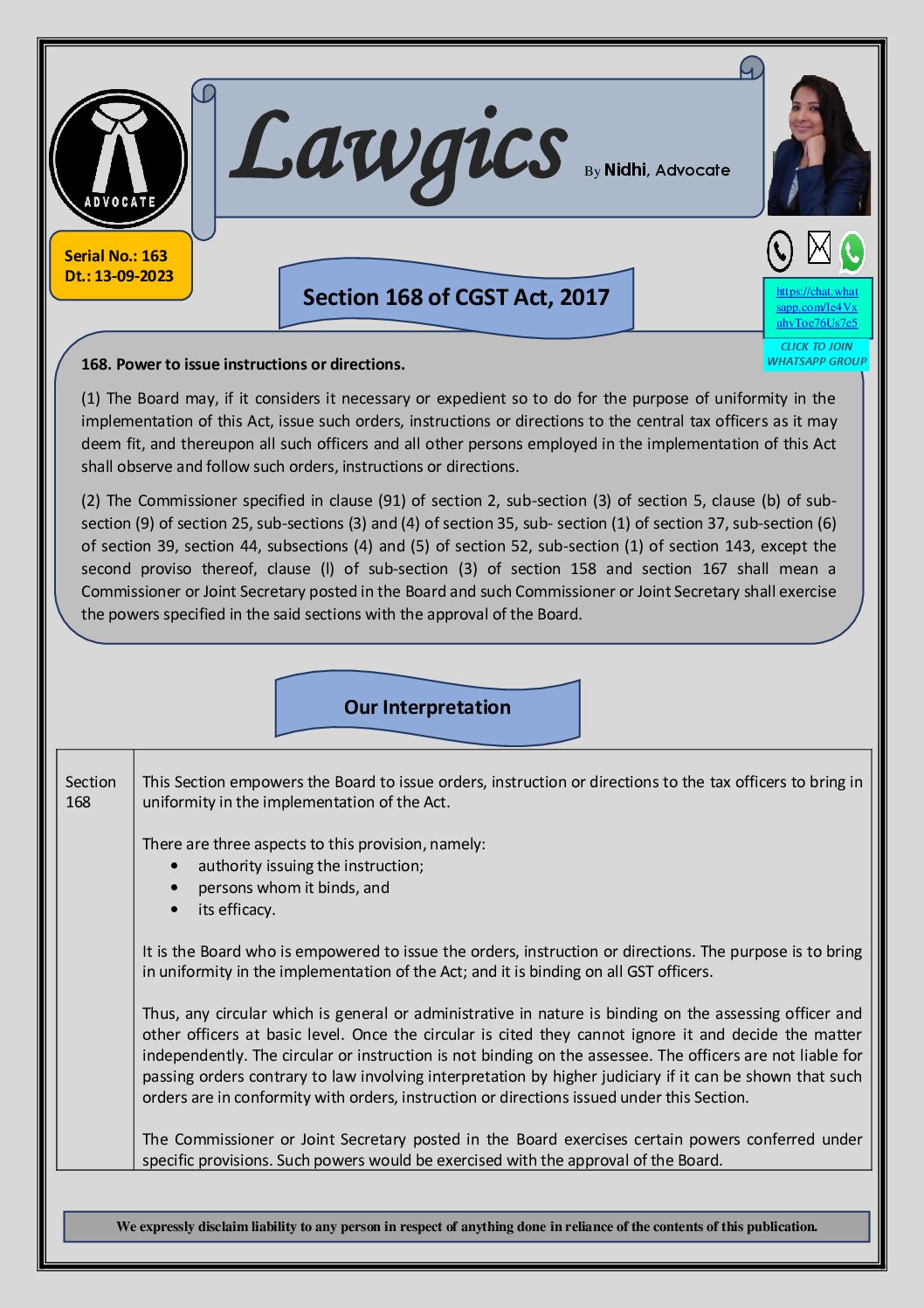
|
|
|
|
|
5. GST Notes by CMA Anil Sharma
1) Shri CMA Anil Sharma, Shri CMA Gurdev Singh Saini and Smt. CMA Bhawna Sharma posted Chapter-1 to 15 containing CGST Act in simple language in PPT format. This is to make dealers, professionals, academicians, students etc. understand the basics of GST laws. Each Chapter in CGST Act, 2017 is explained in the form of Slides as given below for easy understanding of the Act:
|
Chapter-15th slide is given below.
|
|
|
|
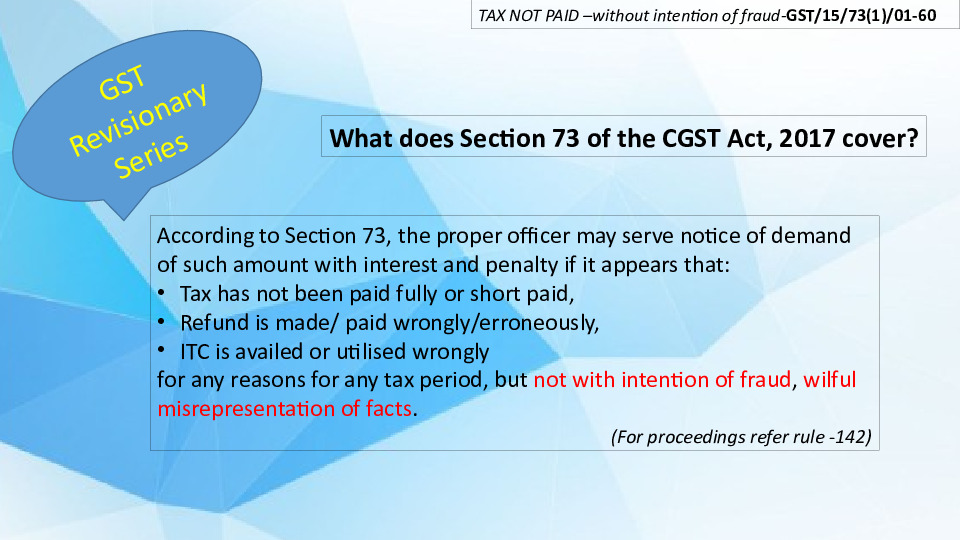
|
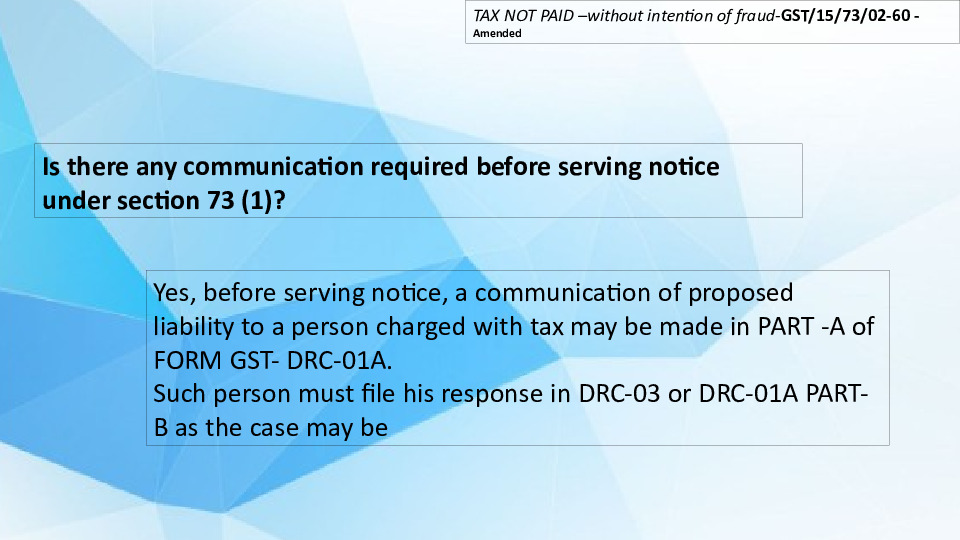
|
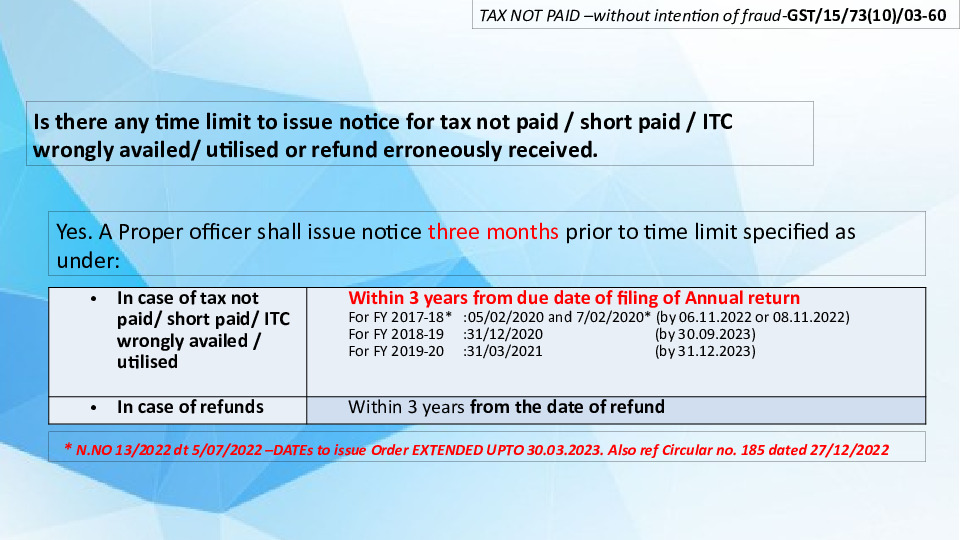
|
|
|
|
|
Do you wish to publish your Article?
If you wish to share your article with maximum readers then please send it at taxupdate.otu@gmail.com. We shall publish it with all due credit to you.
|
|
The topic can be on GST, Income Tax, Pre-GST laws, PPT, Notes etc. The article may contain 500 words to 1500 words or it may be more than that if the article demands.
|
|
|
|
|
|
|
If you wish to subscribe to weekly Newsletter at Rs. 149/- for one year, please subscribe. We shall send you the updates weekly.
|
|
|
|
|
|
|
Hope the above updates is of use to you. Please share your input and feedback at taxupdate.otu@gmail.com
|
|
|
|
|
|
 
|
Visit our website
|
OTU provides you
|
- Articles on various topics
|
|
- Media - GST, Income Tax & Press R.
|
|
- Notes / Newsletter at 149/ p.a.
|
|
|
|
|