|
|

|
|
|
|
This website contains information about recent changes mainly in GST laws. It also contains Articles on various topic in GST. Please visit the website and read more.
|
|
|
|
Book by CMA Anil Sharma
|
CMA Anil Sharma, B.Com (Honrs), M.Com, FCMA co-author of the book
|
|
Handbook on GST Audit by Tax Authorities has authored yet another book
|
|
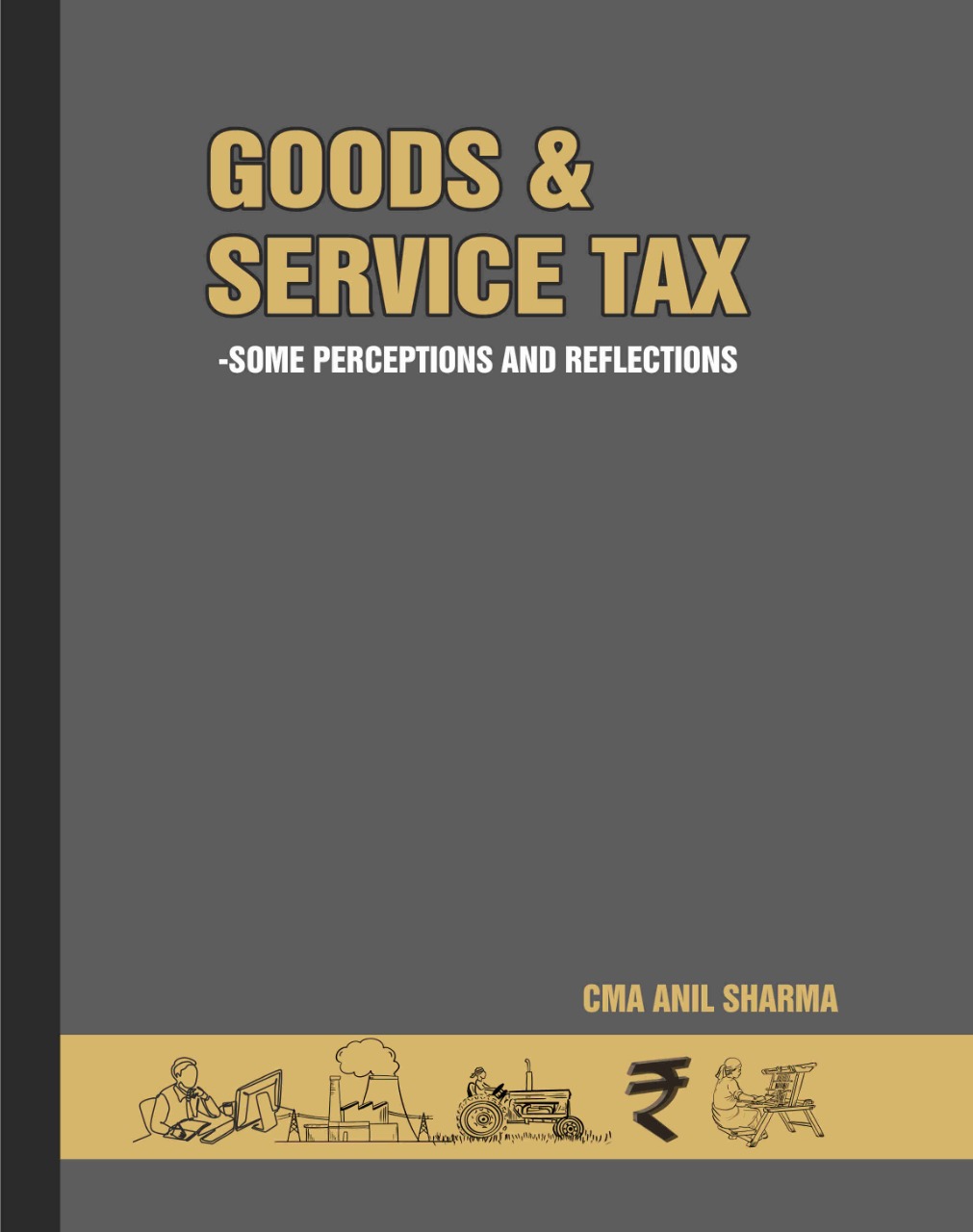
title Goods & Service Tax – Some Perceptions and Reflections. This book is a compilation of important GST article written by the author. Buy now at Price Rs.300/-.
|
|
|
|
|
|
|
Subscribe
|
Please subscribe "Newsletter for Rs. 149/- for one year".
|
|
|
|
|
|
Hi Reader,
|
Please find tax updates in Newsletter 66 dated 05.01.2023 as below:
|
|
|
|
Index
|
6. GST Notes by CMA Anil Sharma
|
|
|
|
1. Articles
|
|
|
|
|
The document to claim ITC on RCM is Self Invoice and not the invoice issued by the vendor. Self invoice is raised in the month of payment of GST under RCM. And the timeline for taking credit begins from the date of self invoice.
|
If the vendor invoice is dated March 2026 but the RCM at that expense is paid in September 2026 then the self invoice would be raised in September 2026 after making GST payment and ITC time limit would be counted from September 2026.
|
The above has been clarified by the CBIC vide Press release dated 03.07.2019.
|
The condition of payment to the vendor within 180 days is not applicable to RCM as the tax is paid by the recipient himself.
|
Payment to Air transporter, bus service provider through as an agent
|
I am taking this point again to touch upon the payment condition of 180 days to the Indigo , Akasa, Spicejet, Red bus , the actual service provider. Normally the agent Thomas Cook or other local agents book tickets for the passenger. They raise their invoice for service rendered. And another invoice is raised to claim the reimbursement of ticket cost. Now the provision u/s 16(2) of CGST Act requires a recipient to make payment to service provider within180 days. This condition is not fulfilled as the payment is not made to airlines or bus operators. The payment is in fact made to Thomas Cook. And they pay to the airline.
|
Also, there is no ledger or account in the books of the recipient for Indigo, Akasa or Red bus.
|
In this case, a correlation of payment made on reimbursement invoice to Thomas Cook needs to be done with the airline ticket invoice details given as a support to that reimbursement invoice. Also, the airline invoices populate in GSTR 2B. The same can also be compared with invoice listings given by agents to match and claim the credit.
|
ISD credit is populated in table 4(A)(3) of GSTR 3B of the recipient on the filing of GSTR 6 by the Input Service Distributor (ISD).
|
The credit so distributed is supported by an invoice issued by ISD. The ISD is an office of the same company in a different state or in the same state. It may be a Head office or branch office which receive common services I.e. services received for all the branches including the same branch. Classic example is Tax audit, GST audit services.
|
The credit allocation to respective branches is done on the basis of turnover. It may be the previous month or the previous year. Previous year turnover is generally considered for allocation as the financials are audited.
|
The recipient of the ISD credit need not go into the working of ISD distribution. It may rely upon the ISD invoice for taking ITC. The responsibility of correct allocation lies on the ISD.
|
The timeline to claim credit on the ISD invoice does not hit by section 16(4). This is because the credit is first claimed by ISD following the condition prescribed in section 16 and distribution is a subsequent activity of just distributing the credit.
|
The basis for claiming ITC on import of goods is the 'Bill of Entry ' (BOE). This document prepared by the importer is verified by the customs officer and the basis of the same customs duty is paid.
|
The Customs portal (ICEGATE) automatically transmits the BOE details to the GST Portal , more specific to table 4(A)(1) of 3B.
|
The timeline of section 16(4) does not apply to BOE ITC. But there is another view that BOE is equivalent to Invoice and therefore the timeline of section 16 (4) applies to BOE as well.
|
BOE ITC also appears in GSTR 2B. There are notices when the importer claims ITC basis BOE copy when the details are not populated into 2B. On submission of BOE copy officers do accept the same and waive off the notice.
|
However, to pull the details to 2B from icegate you may go to Services > User Services > Search BoE.
|
Office rent or godown rent is generally paid on the basis of an agreement. The owner does not raise a monthly invoice. However, he files GSTR 1 regularly. The details also populate into 2B of the recipient. Whether the absence of invoice fulfils the condition of section 16(2)(a) of CGST Act? The answer is No.
|
|
An education to the owner is required on the importance of actually issuing an invoice. Till then the ITC can be taken on the basis of 2B.
|
|
|
|
|
|
|
|
|
|
The Hon’ble Supreme Court in GVK Jaipur Expressway Pvt. Ltd. v. Deputy Commissioner of State Tax & Ors. issued notice in the Special Leave Petition filed by the Assessee challenging the judgment of the Hon’ble Rajasthan High Court, which had dismissed its writ petition against a total GST demand of Rs. 14,06,54,640/-, wherein the Assessee contended that neither the Show Cause Notice (“SCN”) nor the adjudication order was duly served upon it and that the service was allegedly effected by merely uploading the same on the GST Common Portal. Taking note of the submission that the Hon’ble Madras High Court and the Hon’ble Delhi High Court have viewed such portal-upload as incomplete service, particularly where the relevant notices/orders may be referable to two separate tabs, namely “View Additional Notices/Orders” and “View Notices and Orders”, the Hon’ble Supreme Court issued notice, returnable in four weeks.
|
GVK Jaipur Expressway Pvt. Ltd. (“the Petitioner”) was issued an order in FORM GST DRC-07 dated February 29, 2024, raising a demand of Rs. 3.39 crores, wherein it was specifically found that the Petitioner did not discharge its due GST liability through FORM GST DRC-13 for the FY 2018-19 and accordingly, the demand along with interest and penalty was imposed under Section 74 of the Rajasthan Goods and Services Tax Act, 2017 (“the RGST Act”)/ the Central Goods and Services Tax Act, 2017 (“the CGST Act”).
|
The said order was not challenged by the Petitioner in appeal. Consequently, vide order dated December 19, 2025, the bank account of the Petitioner was attached against the total demand, including tax and interest, of Rs. 14,06,54,640/-.
|
Aggrieved, the Petitioner filed a writ petition before the Hon’ble Rajasthan High Court contending that it did not come to know about the orders passed by the GST Authorities and that the SCN as well as the order in FORM GST DRC-07 were not properly communicated and placed on the GST Portal. The Petitioner further relied upon the judgment of the Hon’ble Rajasthan High Court in Eagle Trans Shipping and Logistics India Private Ltd. v. Union of India & Ors. , wherein the assessee therein was allowed to file an appeal on the ground that a person cannot be left remediless, if the time period for filing of appeal has expired and there are valid reasons for the delay in filing of the appeal.
|
However, the Hon’ble Rajasthan High Court in GVK Jaipur Expressway Pvt. Ltd. v. Deputy Commissioner of State Tax & Ors. dismissed the writ petition, holding that a deliberate ignorance had been shown towards the SCN and the order, since it is not possible for a company to remain unaware of an order passed under Section 74, more so, when it continues to hold its GST registration and would, therefore, be filing regular monthly and annual returns. The Court further noted that neither an appeal was filed nor any attempt was made to file an appeal, and instead, the Petitioner had merely moved a rectification application seeking rectification of the order. Holding that equity does not lie in favour of the Petitioner and distinguishing the judgment in Eagle Trans Shipping (supra), the writ petition was dismissed.
|
Aggrieved by the dismissal of the writ petition, the Petitioner filed the present Special Leave Petition before the Hon’ble Supreme Court.
|
Whether service of the SCN and the adjudication order by merely uploading the same on the GST Common Portal constitutes valid service, particularly where the relevant notices/orders may be referable to two separate tabs, namely “View Additional Notices/Orders” and “View Notices and Orders”?
|
The Hon’ble Supreme Court in SLP(C) No. 25965 of 2026 held as under:
|
- Noted that, the Petitioner had raised the issue of non-service of the notice as well as the order, and that the notice was allegedly served by uploading it on the Common Portal.
- Observed that, as per the Petitioner, the Hon’ble Madras High Court as well as the Hon’ble Delhi High Court have viewed service of notice by uploading on the portal as incomplete, particularly where the relevant information may be referable to two tabs, namely, “View Additional Notices/Orders” and “View Notices and Orders”, and that the Petitioner’s case is squarely covered by the said decisions.
- Accordingly, issued notice in the SLP, returnable in four weeks.
- The case is tentatively listed on September 11, 2026 (computer generated date).
Section 169 of the CGST Act prescribes the modes of service of any decision, order, summons, notice or other communication, namely: (a) by giving or tendering it directly or by a messenger/courier; (b) by registered post, speed post or courier with acknowledgement due; (c) by e-mail; (d) by making it available on the common portal; (e) by publication in a newspaper; or (f) by affixation. Further, Section 169(2) of the CGST Act provides that every such communication shall be deemed to have been served on the date on which it is tendered, published or affixed, as the case may be.
|
The moot question, which has divided the High Courts, is whether mere uploading of the SCN/order on the Common Portal under Section 169(1)(d) of the CGST Act, by itself, constitutes valid and effective service, especially in cases where such notices/orders were housed under the “View Additional Notices/Orders” tab, which was not readily visible to taxpayers, as against the regular “View Notices and Orders” tab. Notably, taking cognizance of this anomaly, the GSTN re-designed the portal in January 2024 to merge both the tabs under a single window, which itself is a tacit acknowledgment of the confusion caused by the twin-tab architecture.
|
A consistent line of decisions has favoured the taxpayer on this issue. The Hon’ble Madras High Court in East Coast Constructions and Industries Ltd. v. Assistant Commissioner (ST) and in Sabari Infra Pvt. Ltd. v. Assistant Commissioner (ST) set aside ex parte orders where the notices/orders were merely uploaded under the “View Additional Notices and Orders” tab without any effective communication to the taxpayer. Similarly, the Hon’ble Delhi High Court in Anhad Impex v. Assistant Commissioner held that uploading of the SCN under the “Additional Notices” tab did not amount to sufficient communication and remanded the matter for fresh adjudication. The Hon’ble Allahabad High Court in Ola Fleet Technologies Pvt. Ltd. v. State of U.P. also extended the benefit of doubt to the taxpayer where the order was reflected under the “Additional Notices and Orders” tab. Further, the Madurai Bench of the Hon’ble Madras High Court in Mrs. K. Balakrishnan, Balu Cables v. O/o. the Assistant Commissioner of GST (2024) went a step ahead to hold that where no response is forthcoming from the taxpayer to the notices uploaded on the portal, the Department ought to explore other effective modes of service prescribed under Section 169 of the CGST Act, such as RPAD, instead of mechanically completing the formality by portal upload.
|
Per contra, a contrary line of decisions, including that of the Hon’ble Madras High Court in Poomika Infra Developers v. State Tax Officer (January 2025), has taken the view that making a notice/order available on the Common Portal is itself a statutorily prescribed and independent mode of service under Section 169(1)(d) of the CGST Act, that the modes prescribed thereunder are alternative and not sequential, and hence, service stands complete upon such upload. The Hon’ble Rajasthan High Court, in the impugned judgment, has adopted a similar approach, albeit resting primarily on the conduct of the taxpayer in exhibiting “deliberate ignorance”.
|
The issuance of notice by the Hon’ble Supreme Court in the present SLP is, therefore, a significant development, as the verdict would authoritatively settle the divergence amongst the High Courts on the validity and sufficiency of portal-based service under Section 169 of the CGST Act. The outcome would have a direct bearing on a large number of ex parte adjudications, consequential recovery/attachment proceedings, and appeals barred by limitation under Section 107 of the CGST Act, where the taxpayers’ primary grievance is want of effective service. Until the issue is settled, taxpayers would be well-advised to regularly monitor all the tabs on the Common Portal and keep their e-mail and contact details updated, while the Department, on its part, should adopt supplementary modes of service where no response is received, so that adjudication does not get reduced to an empty formality in breach of the principles of natural justice.
|
|
|
|
|
|
|
|
|
|
The Preventive Wing of the Central Goods and Services Tax (CGST) Commissionerate, Shimla, has uncovered an alleged GST fraud involving input tax credit of around ₹5.55 crore in the Kala Amb industrial area of Sirmaur district. The investigation has also led to the arrest of Gaurav Jain, managing director of M/s Samay Pharma India Private Limited, Trilokpur.
|
How Was the Alleged GST Fraud Carried Out?
CGST officials alleged that Samay Pharma and M/s Dual Healthcare claimed input tax credit using fake invoices issued by several firms that either did not exist or were found to be non-genuine.
|
The investigation found that ITC worth around ₹5.55 crore was allegedly claimed through invoices linked to 10 such firms. Officials examined the transactions to determine whether the supplies mentioned in these invoices had actually taken place.
|
What Did Officials Find About the Goods?
Officials said the invoices showed the purchase of goods, but there was no evidence confirming that those goods were actually transported.
|
E-way bills and toll-plaza records also did not support the movement of goods mentioned in the invoices, raising questions about whether the transactions reflected genuine supplies.
|
How Were GST Refund Claims Allegedly Involved?
Officials further alleged that the fake input tax credit was later included in GST refund claims.
|
The suspected credit was allegedly used in an attempt to obtain money back from the government through the GST refund mechanism.
|
What Other Irregularities Were Found?
During the investigation, officials found several suspicious transactions, fake firms and invoices without actual movement of goods.
|
They also alleged that shell entities were being used to manipulate the GST credit and refund system.
|
What Evidence Did Investigators Examine?
The CGST team recorded statements from several people during the investigation and examined digital evidence.
|
The inquiry also looked at invoices, the firms connected to them and records relating to the alleged movement of goods.
|
Why Was the Managing Director Arrested?
Based on the evidence collected during the investigation, Gaurav Jain, managing director of M/s Samay Pharma India Private Limited, was arrested.
|
The arrest was made under Section 69(1) of the Central Goods and Services Tax Act, 2017.
|
Follow for daily updates on cybercrime, corporate fraud, DFIR, hacking, investigations, and digital forensics
|
|
|
|
|
|
|
|
|
|
GST officers have arrested a partner of a firm engaged in trading of iron and steel goods for fraudulently availing input tax credit of over Rs 15.78 crore.
|
Investigations by the Central Goods & Services Tax (CGST), Delhi South Commissionerate's anti-evasion branch revealed that the firm had availed inadmissible ITC on the basis of invoices issued by multiple firms, several of which were found to be non-existent, non-functional, suspended or cancelled.
|
Field verification also established that certain suppliers had no genuine business activity at their declared places of business.
|
In a statement, the Finance Ministry said, "CGST Delhi South Commissionerate have arrested a partner of the firm engaged in trading of iron and steel goods in a case involving fraudulent availment, utilisation and passing on of inadmissible ITC aggregating to over Rs 15.78 crore through bogus invoices of approximately Rs 87.67 crore."
|
Further inquiry established that ITC was availed without actual receipt of goods and was also passed on to various recipients through invoices issued without corresponding supply of goods.
|
Based on the evidence gathered during the investigation and statements recorded under Section 70 of the CGST Act, 2017, the accused was arrested on September 14 and produced before the Patiala House Court, which remanded him to judicial custody for 14 days.
|
|
|
|
|
|
|
|
3. GST Law
|
|
|
|
|
|
The Central Goods and Service Tax, 2017 updated as on 01.10.2022 is reproduced below for your easy reference and reading. Your suggestion / feedback is welcome at taxupdate.otu@gmail.com THE CENTRAL GOODS AND SERVICES TAX ACT, 2017 (OF 2017) AS AMENDED BY THE - THE CENTRAL GOODS AND SERVICES …
|
|
|
|
|
|
|
Free E-Book on CGST Act, 2017 updated upto Oct 2022 compiled by Sri Ghanshyam Upadhyay
|
|
|
|
|
|
4. Media/Press Release
|
|
|
|
|
The September 30, 2026 deadline for filing tax audit reports for assessment year (AY) 2026-27 is fast approaching, but the government has not announced any extension so far. Several Chartered Accountant (CA) associations have sought more time, citing the workload involved in completing audits, reconciliation issues and delays in getting audit-related information and utilities.
|
For taxpayers whose accounts are subject to audit, September 30 remains the applicable deadline unless the Central Board of Direct Taxes (CBDT) announces a change. Experts say taxpayers should continue working towards the existing deadline rather than wait for an extension.
|
CA associations seek more time
The demand for an extension has gained momentum as professional bodies have raised concerns over the time available to complete tax audits. The Chartered Accountants Association, Jalandhar has sought an extension of the tax audit deadline to October 31, while the Punjab Accountants Association and Rajasthan Consultants Association has also made a similar representation.
|
The associations have cited the delayed release of ITR forms and utilities, increased compliance requirements and the overlap between the August 31 non-audit ITR deadline and the September 30 tax audit deadline. They have argued that extending the audit deadline would provide CAs with more time for proper reconciliation and verification.
|
The request comes against the backdrop of a tax audit process that requires detailed reporting and verification across several financial and tax records.
|
Mohit Gupta, partner – direct & international taxation, PNAM & Co. LLP, said taxpayers and professionals should continue to work on the assumption that September 30 is the deadline unless the CBDT formally announces an extension.
|
“At present, taxpayers and professionals should proceed on the basis that September 30, 2026 remains the applicable deadline unless the CBDT issues a formal extension notification,” Gupta said.
|
He said the demand for additional time is not merely about getting more time to file the report. Auditors need to reconcile books of account with GST records, TDS/TCS data, AIS/TIS and other information before finalising the report.
|
“The demand for additional time is therefore primarily about ensuring quality and accuracy of compliance rather than merely seeking additional time for filing,” he said.
|
What are the biggest challenges?
The audit process has become increasingly data-intensive, with auditors required to examine information from multiple sources. Any mismatch between the books and tax records may need further investigation before the report can be finalised.
|
Dinesh K. Jain, managing partner, Dinesh Aarjav & Associates, said the pressure is coming from several issues at the same time.
|
“Three things are stacking up: a compressed working window, recurring portal issues — login failures, OTP delays, DSC errors, and glitches pulling AIS/TIS/Form 26AS data; and reconciliation friction,” Jain said.
|
Taxpayers may have to reconcile turnover with GST returns, verify TDS/TCS details, check AIS and TIS entries and match bank transactions with the books. Pending information from taxpayers can further delay the process.
|
Gupta said bank statements, fixed-asset details, loan schedules, related-party information, expense details and other supporting documents need to be available with the auditor before the report can be completed.
|
Another factor this year is the transition to the Income-tax Act, 2025. However, the tax audit relating to FY 2025-26 and AY 2026-27 continues under the Income-tax Act, 1961.
|
Will the government extend the deadline?
There is a precedent for extending the tax audit deadline. For FY 2024-25, the CBDT had extended the deadline for filing tax audit reports from September 30, 2025 to October 31, 2025.
|
However, last year's extension does not mean that the government will necessarily take a similar decision this year.
|
What should taxpayers do now?
With the deadline approaching, taxpayers whose accounts are subject to audit should start closing any pending gaps rather than wait for a government announcement.
|
The immediate priority should be to provide CAs with all outstanding documents and complete key reconciliations. This includes GST turnover, AIS/TIS and Form 26AS, bank and loan accounts, fixed assets, statutory dues, related-party transactions and expenses that may require tax-disallowance analysis.
|
Experts say taxpayers should work backwards from the deadline and ensure that their reports are not left for the final day.
|
“Work backward from September 30, not toward it,” Jain said.
|
Taxpayers should also remember that uploading the audit report is not the end of the process. The CA files the report electronically, after which the taxpayer has to approve it through their income-tax e-filing account.
|
Therefore, taxpayers should keep sufficient time for the approval step as well.
|
For now, September 30 remains the tax audit deadline for AY 2026-27. Unless the CBDT formally announces an extension, taxpayers and CAs should proceed on the basis that the existing deadline will apply.
|
|
|
|
|
|
|
|
|
|
The Union government has moved the Supreme Court against a Punjab and Haryana High Court ruling that declared Section 147A of the Income Tax Act unconstitutional, a decision that has raised questions over the validity of reassessment proceedings conducted by jurisdictional tax officers.
|
Additional Solicitor General N Venkataraman, appearing for the Centre, on Wednesday sought an urgent hearing of the Centre’s special leave petition (SLP) before Chief Justice of India Surya Kant. The CJI agreed to have the matter listed on an urgent basis.
|
Seeking an early hearing, Venkataraman told the court that the High Court ruling had created a “huge vacuum” in the law and that the issue was being closely followed by taxpayers.
|
The challenge concerns the statutory framework governing reassessment proceedings under Sections 148 and 148A of the Income Tax Act, particularly the respective roles of the jurisdictional assessing officer (JAO) and the National Faceless Assessment Centre (NFAC).
|
The dispute gained prominence after the introduction of the faceless assessment regime. A key question before the courts was whether jurisdictional officers retained the authority to independently issue reassessment notices under Section 148 and pass orders under Section 148A, or whether such functions were required to be routed through the faceless assessment mechanism.
|
The Punjab and Haryana High Court, in Income Tax Officer, Ward 2(1), Chandigarh v Tej Partap Singh, was among the courts that invalidated reassessment proceedings initiated by jurisdictional officers where the prescribed faceless procedure had not been followed. Some other High Courts, however, adopted a different interpretation of the statutory scheme.
|
Against this backdrop, Parliament retrospectively introduced Section 147A with effect from April 1, 2021. The provision stipulated that references to the “Assessing Officer” in Sections 148 and 148A would mean an assessing officer other than the National Faceless Assessment Centre.
|
The amendment effectively sought to preserve the jurisdiction of jurisdictional officers to undertake reassessment-related functions, notwithstanding the earlier judicial rulings concerning the faceless mechanism.
|
The Punjab and Haryana High Court subsequently examined the constitutional validity of Section 147A and struck it down. The court held that legislation could not retrospectively alter the legal position merely by declaring that a position contrary to earlier judicial findings was valid.
|
The High Court found that the provision attempted to overcome the effect of judicial decisions holding the earlier reassessment procedure legally defective rather than curing the underlying legal infirmity. It consequently held the retrospective legislative intervention to be impermissible.
|
The Centre’s challenge before the Supreme Court will now bring the validity and effect of Section 147A into focus, including the extent to which Parliament can retrospectively alter the statutory basis of reassessment proceedings following judicial pronouncements on the issue.
|
|
Source: Business Standard
|
|
|
|
|
|
|
|
|
|
The Customs, Excise and Service Tax Appellate Tribunal (CESTAT), Hyderabad, has upheld relief granted to the Northern Power Distribution Company of Telangana (NPDCL), holding that delayed payment surcharges and meter-testing charges collected from consumers are not liable to service tax.
A bench comprising technical member AK Jyotishi and judicial member Angad Prasad upheld a 2019 order of the commissioner of Central Tax and Central Excise, Secunderabad, which had dropped the demands raised against the state-run power distribution utility. The final order was pronounced on Sept 11.
|
₹50cr tax demand rejected
The dispute arose from a show-cause notice dated Oct 22, 2018, covering the period from April 2013 to June 2017.
|
The department alleged that delayed payment surcharges amounting to ₹374 crore, involving a service tax demand of around ₹50 crore, constituted consideration for “agreeing to tolerate an act or situation” under Section 66E(e) of the Finance Act, 1994.
It further argued that meter testing, for which a separate fee was collected, constituted an independent taxable service and was not covered by the exemption available for the transmission or distribution of electricity.
|
NPDCL argued that both the delayed payment surcharge and meter-testing charges were levied under tariffs and regulations prescribed by the Telangana State Electricity Regulatory Commission and were not negotiable charges.
|
Surcharge penal, not consideration
|
CESTAT held that the delayed payment surcharge was penal or compensatory in nature and intended to ensure timely payment. It could not be treated as consideration for an agreement by the utility to tolerate delayed payments.
|
The tribunal also held that meter testing was intrinsically linked to electricity distribution and was naturally bundled with the principal service. It therefore shared the same exempt status as electricity distribution.
|
CESTAT further rejected the invocation of the extended limitation period, noting that the department was already aware of the relevant facts through an earlier investigation and show-cause notice. Since no service tax was payable, the tribunal also found no basis for levying interest or penalties.
|
|
Source: The Times of India
|
|
|
|
|
|
|
|
|
|
The West Bengal Authority for Advance Ruling (AAR) has held that electricity charges recovered by a commercial building maintenance company from occupants at actual cost, without any markup or profit, will not attract Goods and Services Tax (GST).
|
The ruling was pronounced on September 1 in the case of DH Maintenance Ltd, which provides common-area maintenance and facility management services for a commercial building in Kolkata.
|
DH Maintenance pays electricity charges to distribution company CESC Ltd for electricity consumed in the building and recovers the cost from the occupants. The company sought clarity on whether such recovery could be treated as reimbursement in the capacity of a “pure agent” and excluded from the value of its maintenance services for GST purposes.
|
A pure agent under GST is a person who incurs costs or expenses on behalf of a client while providing a main service, and later claims reimbursement for the exact amount spent without adding any markup.
|
Under the proposed billing arrangement, electricity used in individual offices for normal consumption and heating, ventilation and air-conditioning (HVAC) would be charged according to sub-meter readings. The electricity cost for common areas would be distributed among the occupants based on the super-built-up area of their respective units. The company would recover the electricity cost without adding any profit or markup.
|
The issue was significant because electricity supplied along with maintenance services would ordinarily form part of a composite supply. In such a case, the GST rate applicable to the principal maintenance service would apply to the electricity component as well.
|
However, the AAR relied on Circular No. 206/18/2023-GST dated October 31, 2023. The circular provides that where electricity is supplied along with renting of immovable property or maintenance services, it generally forms part of a composite supply. But where electricity is recovered on an actual basis — at the same amount charged by the electricity distribution company — the supplier is deemed to be acting as a pure agent for the electricity supply.
|
Interestingly, the AAR observed that DH Maintenance did not strictly satisfy the normal pure-agent test. It noted that electricity was an integral part of the maintenance and management services provided by the company.
|
The authority, however, said the specific deeming provision in the 2023 circular would apply. Since DH Maintenance proposed to charge occupants the same amount as charged by CESC, without any markup or profit, the electricity recovery would be treated as pure-agent recovery.
|
The AAR also extended this treatment to electricity used in common areas. The balance amount of the CESC bill, after accounting for electricity consumed in individual offices and HVAC, would be apportioned among occupants according to their respective areas.
|
“This ruling reinstates the position under the Circular on the taxability of electricity charges recovered on a metered basis, i.e. HVAC and non-HVAC, and aligns with the position adopted by most industry players. A key aspect, however, is the ruling’s finding that electricity charges relating to common area are also non-taxable as recovered in the capacity of pure agent,” said Harpreet Singh, partner, Indirect Tax, Deloitte.
|
“While this is a welcome position, it remains contentious and is likely to be challenged by the tax authorities before the Appellate Authority,” he added.
|
For January 2026, the CESC bill was Rs 20.19 lakh for 196,520 kilowatt-hours (kWh) of consumption. Of this, Rs 10.24 lakh related to non-HVAC consumption in individual offices, Rs 6.35 lakh to HVAC consumption and Rs 3.61 lakh to common-area consumption.
|
The Revenue had pointed out that similar issues had arisen in earlier adjudication proceedings for 2018-19 and 2019-20. The AAR, however, distinguished those proceedings, saying they related to the company’s existing billing pattern, whereas the present ruling concerned the proposed billing pattern.
|
The AAR ultimately ruled that electricity charges recovered at actual cost, including charges relating to HVAC and common-area consumption, would be excluded from the value of the company’s supply and would not attract GST under the proposed arrangement.
|
|
Source: Business Standard
|
|
|
|
|
|
|
|
6. GST Notes by CMA Anil Sharma
1) CGST Act in Slides form: Respected Shri CMA Anil Sharma, Shri CMA Gurdev Singh Saini and Respected Smt. CMA Bhawna Sharma presenting CGST Act / IGST Act in simple language in PPTs to make dealers, professionals, academicians, students etc. understand the basics of GST laws. Each Chapter in CGST Act, 2017 is explained in the form of Slides as given below for easy understanding of the Act:
|
|
|
|

|
|
|
|
|
|
7) CMA Anil Sharma, B.Com (Honrs), M.Com, FCMA co-author of the book
|
|
Handbook on GST Audit by Tax Authorities has authored yet another book
|
|
title Goods & Service Tax – Some Perceptions and Reflections. Buy now at Price Rs.300/-.
|
|
|
|
|
|
You wish to publish your Article?
|
If you wish to share your article with maximum readers then please send them at taxupdate.otu@gmail.com. We shall publish it with all due credit to you.
|
|
|
|
|
|
|
Hope the above updates is of use to you. Please share your input and feedback at taxupdate.otu@gmail.com
|
|
|
|
|
|
 
|
Visit our website
|
OTU provides you
|
- Articles on various topics
|
|
- Media - GST, Income Tax & Press R.
|
|
- Notes / Newsletter etc.
|
|
|
|
|