|
|

|
Newsletter no. 68 dated 22.01.2023
|
|
|
|
|
|
This website contains information about recent changes mainly in GST laws. It also contains Articles on various topic in GST. Please visit the website and read more.
|
|
|
|
Index
|
6. GST Notes -Chapter 13 by CMA Anil Sharma
|
|
|
|
1. Notification
|
|
a) Notification No. 05/2023 - Customs (N.T.) dated 19.01.2023. This notification supersedes notification no. 02/2023 - customs (N.T.) dated 05.01.2023 to provide rate of exchanges of one unit of foreign currency equivalent to India rupees. Link to notification
|
|
|
|
2. Budget 2023
|
|
|
|
|
The following Act of Parliament received the assent of the President on the 31st March, 2023 and is hereby published for general information.
|
The Finance Act, 2023 (No. 8 of 2023) dated 31.03.2023.
|
|
This giving effect to the financial proposals of the Central Government for the financial year 2023-2024.
|
|
|
|
|
|
|
|
|
|
- No need to take registration for Specified category of persons exempted from obtaining GST registration:
- It has been proposed to amend Section 23(2) of the Central Goods and Services Tax Act, 2017 (“the CGST Act”) with a non-obstante clause, that too retrospectively applicable w.e.f July 1, 2017, so as to provide that, persons required to take registration in GST as per Section 22(1) of the CGST Act and compulsory registration required under Section 24 of the CGST Act, need not to register themselves, if they are exempted from taking the GST registration.
- There are certain specified persons already exempted from compulsory registration viz. person making outward supplies which are exclusively covered under RCM, person making supplies of services through E-Commerce Operator having aggregate turnover not exceeding INR 20L in a FY, person supplying handicraft goods having aggregate turnover not exceeding INR 20L in a FY, person making inter-state supplies of taxable services having aggregate turnover not exceeding INR 20 Lakhs in a FY, etc. need not to obtain GST registration.
- Time limit of 30 days withdrawn for moving application for Revocation of Cancellation of GST Registration:
- It has been proposed to amend Section 30(1) of the CGST Act i.e. revocation of cancellation of registration, in order to remove the restriction on the registered person to apply for revocation of cancellation of its GST registration within 30 days from the date of service of the cancellation order.
- Thus, now any registered person, whose registration is cancelled by the proper officer on his own motion, may apply to such officer for revocation of cancellation of the registration in such manner, within such time and subject to such conditions and restrictions as may be prescribed.
- Period to furnish Form GSTR 3B or Form GSTR 10 (Final Return) increased from 30 days to 60 days under Best Judgment Assessment:
- It has been proposed to amend Section 62(2) of the CGST Act i.e. Assessment of unregistered persons, so as to provide the time period of 60 days instead of 30 days, for furnishing return Form GSTR 3B or Form GSTR 10 (Final Return) where the proper officer has assessed tax liability on best judgment assessment basis.
- Moreover, where the registered person fails to furnish a valid return within 60 days of the service of the assessment order, he may furnish the same within a further period of 60 days on payment of an additional late fee of INR 100/- for each day of delay beyond 60 days of the service of the assessment order and in case he furnishes valid return within such extended period, the assessment order shall be deemed to have been withdrawn, but the liability to pay interest under Section 50(1) and late fee under Section 47 of the CGST Act shall continue.
- Constitution of GST Appellate Tribunal (GSTAT) and Benches thereof:
- It has been proposed to substitute Section 109 of the CGST Act, so as to provide that, the jurisdiction, powers and authority conferred on the GSTAT, shall be exercised by the Principal Bench and the State Benches instead of 'National Bench or Regional Bench’, which would be set up in every state, while there will be a Principal Bench in New Delhi, consisting of the President, a Judicial Member, a Technical Member (Centre) and a Technical Member (State), and the issue involved w.r.t. the place of supply would only be heard by the Principal Bench. Further the State Benches will consist of two Judicial Members, a Technical Member (Centre) and a Technical Member (State).
- Moreover, appeals, where the amount w.r.t. tax or Input tax credit (“ITC”) or the amount of fine, fee or penalty, does not exceed INR 50 lakh and which does not involve any question of law may be heard by a single Member, whereas, in all other cases, shall be heard together by one Judicial Member and one Technical Member.
- Accordingly, relevant amendments have been made in Section 110 (Appointment, qualification, conditions of GSTAT members), Section 114 (Administrative & Financial powers of President of GSTAT), Section 117 (Appeal to High Court), Section 118 (Appeal to Supreme Court), and Section 119 (Sums due to be paid notwithstanding appeal, etc.) of the CGST Act.
- Place of supply of services of transportation of goods, other than by way of mail or courier to be the location of the recipient of services:
- It has been proposed to omit Section 13(9) of the Integrated Goods and Services Tax Act, 2017(“the IGST Act”)i.e. ‘the place of supply of services of transportation of goods, other than by way of mail or courier, shall be the place of destination of such goods’.
- Thus, now the place of supply of services in case of transportation of goods, other than by way of mail or courier would be covered under default provision of Section 13(2) of IGST Act and would be the location of the recipient of services.
- Maximum rate at which GST Compensation Cess may be collected:
- It has been proposed to amend the Schedule of the GST (Compensation to States) Act, 2017 pertaining to the maximum rate at which GST Compensation Cess may be collected for items such as Pan Masala (from 135% ad valorem to 51% of the retail sale price/ unit), Tobacco and manufactured tobacco substitutes, including tobacco products (INR 4170/ 1000 sticks or 290% ad valorem or a combination thereof but not exceeding INR 4170/ 1000 sticks + 290% ad valorem or100% of retail sale price/ unit). Further, new Explanation has been proposed to be inserted, defining the scope of ‘retail sale price’.
|
DISCLAIMER: The views expressed are strictly of the author and A2Z Taxcorp LLP. The contents of this article are solely for informational purpose and for the reader’s personal non-commercial use. It does not constitute professional advice or recommendation of firm. Neither the author nor firm and its affiliates accepts any liabilities for any loss or damage of any kind arising out of any information in this article nor for any actions taken in reliance thereon. Further, no portion of our article or newsletter should be used for any purpose(s) unless authorized in writing and we reserve a legal right for any infringement on usage of our article or newsletter without prior permission.
|
|
|
|
|
|
|
|
|
|
The Goods and Services Tax Appellate Tribunal, Surat Bench (“GSTAT”) in Assistant Commissioner, CGST & Central Excise v. Filatex India Limited dismissed 46 appeals filed by the Revenue under Section 112(3) of the CGST Act, 2017 and upheld the refund of IGST paid under reverse charge mechanism (“RCM”) on ocean freight, on the ground that the declaration of the levy as unconstitutional in Union of India v. Mohit Minerals Private Limited operates retrospectively and that a taxpayer who was not a party to that litigation can also claim refund, without any separate order in its own name.
|
- Filatex India Limited (“the Respondent”), a registered manufacturer, imported goods and paid IGST under RCM on ocean freight in terms of Entry 10 of Notification No. 10/2017-Integrated Tax (Rate) read with Entry 9(ii) of Notification No. 8/2017-Integrated Tax (Rate), issued under Section 5(3) of the IGST Act, 2017.
- The Hon’ble Gujarat High Court in Mohit Minerals Pvt. Ltd. v. Union of India declared both the notifications ultra vires the IGST Act, 2017 and unconstitutional. The appeals of the Union of India were dismissed by the Hon’ble Supreme Court on May 19, 2022.
- In April 2023, the Respondent filed 46 refund claims for IGST paid on ocean freight. Show cause notices proposed rejection on two grounds: (i) the Supreme Court judgment does not mention retrospective effect and is therefore effective from May 19, 2022 only; and (ii) the Respondent had availed and utilised the IGST credit, so a simultaneous refund claim would amount to unjust enrichment.
- The Respondent replied that a provision declared ultra vires is deemed non-existent from inception, and that the credit was not utilised in substance since sufficient balance existed under CGST and SGST, the ITC balance having to be seen as a whole and IGST being exhausted first as per the prescribed method.
- The adjudicating authority rejected all the claims, holding that the judgment is not retrospective and that the balance of ITC could not be considered as a whole, the IGST balance having to remain in the electronic credit ledger for a refund. The judgments relied upon by the Respondent were brushed aside without discussion.
- The Additional Commissioner (Appeals), Vadodara vide common Order-in-Appeal No. VAD-CGST-002-APP-ADC-349-394-2023-24 dated March 28, 2024 set aside the orders. Relying on P.V. George v. State of Kerala and M.A. Murthy v. State of Karnataka, it held that a levy declared ultra vires is deemed never to have existed. Examining Sections 49A and 49B, Rule 88A and Circular No. 98/17/2019-GST dated April 23, 2019, it held that the Respondent was bound to exhaust IGST credit first and, applying the maxim lex non cogit ad impossibilia, rejected the utilisation objection.
- Pursuant to the Commissioner’s order dated December 5, 2024 under Section 112(3), the Revenue filed 46 appeals before the GSTAT.
- Rule 89(2) requires a copy of the order holding that refund is due; the Respondent, not being a party to Mohit Minerals, cannot treat that judgment as such an order.
- The Supreme Court judgment does not mention any retrospective effect and operates from May 19, 2022 onwards; benefits and notifications cannot be given retrospective effect unless specified, relying on Union of India v. C. Krishna Reddy, Commissioner v. Adani Exports Ltd. and CCE, Chennai v. Indian Organic Ltd.
- Drawing a parallel with Mafatlal Industries Ltd. v. Union of India , where the Central Duties of Excise (Retrospective Exemption) Act, 1986 enabled refunds, it was argued that no such notification has been issued for refund of GST paid on ocean freight. Reliance was also placed on M. Nagaraj v. Union of India for prospective application of judgments.
- Orally, the Authorised Representative argued that once IGST credit is utilised it cannot be refunded even if CGST and SGST credit remains, IGST being a separate pool, and that refund would amount to unjust enrichment. Reliance was placed on SN Tradelink Pvt. Ltd. v. State of Gujarat , where refund was allowed only after reversal of credit through Form GST DRC-03, which had not been done here.
- The Revenue pointed to no perversity, illegality or jurisdictional error in the Order-in-Appeal and merely sought to re-agitate issues; the utilisation and reversal issue was never raised in the appeal.
- A provision declared ultra vires is non-existent from inception and judgments declaring the law apply retrospectively unless expressly made prospective, relying on Kanishk Sinha v. State of West Bengal , M.A. Murthy v. State of Karnataka , Louis Dreyfus Company Pvt. Ltd. v. Union of India (Andhra Pradesh High Court, 2025) and Sunrise Timply Company Pvt. Ltd. v. Union of India (Calcutta High Court, 2026).
- A declaration by a constitutional court binds all authorities and the benefit is available to every person, whether or not a party; the judgment itself is the “order” under Rule 89(2); no further notification is needed for consequential refunds; and Krishna Reddy, Adani Exports and Indian Organic deal with retrospectivity of executive exemption notifications, while M. Nagaraj deals with a constitutional amendment.
- Whether the Authorised Representative of the Revenue can raise, before the GSTAT, the ground of utilisation of IGST credit when that ground was not specified by the Commissioner in his order under Section 112(3) of the CGST Act, 2017?
- Whether refund of IGST paid on ocean freight can be denied, or amounts to unjust enrichment, merely because the IGST credit was availed and utilised, when sufficient unutilised balance of CGST and SGST remained in the electronic credit ledger?
- Whether the judgment in Mohit Minerals, which is silent on its temporal operation, applies only prospectively from May 19, 2022?
- Whether a taxpayer who was not a party to Mohit Minerals can claim refund on the basis of that judgment, and whether the judgment constitutes the “order” contemplated under Rule 89(2) of the CGST Rules, 2017?
The GSTAT, Surat Bench inAppeal Nos. APL/11/SRT/2026 to APL/56/SRT/2026, Final Order No. GUJ/SRT/002 to 047/2026 held as under:
|
- Observed that the ground of utilisation of IGST credit is neither present in the appeal nor specified in the Commissioner’s order dated December 5, 2024 under Section 112(3). It was not that the issue escaped the Commissioner’s mind, as it was one of the grounds in the show cause notices, was replied to, was rejected by the adjudicating authority and was decided in favour of the Respondent by the Appellate Authority, yet the Commissioner did not find that part of the order to be “not correct, legal or proper”.
- Held that an officer filing an appeal under Section 112(3) cannot travel beyond the authorisation granted by the Commissioner, and that a ground which has been considered and dropped by the Commissioner cannot be raised by the Authorised Representative.
- Noted that, in any case, SN Tradelink does not support the Revenue. In that case the IGST credit had been utilised and the refund was allowed after reversal through Form GST DRC-03 by utilising the SGST balance. The judgment does not hold that refund is barred if IGST has been utilised.
- Held that holding a combined unutilised balance of CGST and SGST equivalent to the refund amount, and debiting the refund amount against it in the credit ledger, amounts to non-utilisation of the credit in substance. Accordingly, no double benefit or unjust enrichment arises.
- Observed that the Revenue is under an erroneous belief that judgments, like laws, operate prospectively. Unless otherwise specified, all laws are prospective and all judgments are retrospective, because courts interpret and declare the law and do not legislate. The levy did not become unconstitutional because of the judgments; it was always so. Prospective overruling, first applied in Golak Nath v. State of Punjab , is an exception available only where the Court itself so declares, and no such declaration exists in Mohit Minerals. Reliance was placed on Kanishk Sinha and Louis Dreyfus .
- Noted that M. Nagaraj does not help the Revenue, as it concerned constitutional amendments on reservation in promotions and the extract from Indra Sawhney only reinforces that where the Supreme Court wants its judgment to be prospective, it directs so. Hence, refund cannot be rejected on the ground that Mohit Minerals does not state that it has retrospective effect.
- Held that under Articles 265 and 300A of the Constitution, tax collected under a levy declared ultra vires and unconstitutional is without authority of law from inception, whether or not the taxpayer was a party to the writ petition. The nine-Judge Bench in Mafatlal excludes the category of “unconstitutional levy” from the proposition that “each one must fight his own battle”; the only exception is a person who himself unsuccessfully challenged the very provision and allowed that decision to attain finality. The Respondent never challenged the levy and lost.
- Held that the declaration that the levy is void ab initio is itself the legal foundation for refund and is the “order” contemplated under Rule 89(2). No further order in the name of the claimant is required, as the entitlement flows directly from Article 265 and does not depend on adjudication inter partes.
- Noted that the High Courts have allowed refund of IGST paid on ocean freight in identical facts, in Comsol Energy and Shree Mahesh Oil Products, and that limitation was not a ground of appeal before the GSTAT.
- Directed that the order of the Appellate Authority is upheld and the appeals filed by the Revenue are dismissed. The department shall process the refund claims and pay the refund amounts and interest to the Respondent, to the extent not already paid, with interest under Section 56 payable for the period of delay beyond 60 days from the date of the original application. For instance, for applications filed on April 22, 2023, interest would run from June 22, 2023 till the date of actual payment.
Section 5(3) of the IGST Act, 2017 empowers the Government, on the recommendation of the Council, to notify categories of supply on which tax is payable by the recipient under RCM. Entry 10 of Notification No. 10/2017-Integrated Tax (Rate) made the Indian importer liable for services of transportation of goods by vessel from outside India up to the customs station of clearance in India, with the rate prescribed by Entry 9(ii) of Notification No. 8/2017-Integrated Tax (Rate). The Gujarat High Court struck down both entries, inter alia on the footing of double taxation where ocean freight already forms part of the value of goods imported on CIF basis, and the Supreme Court upheld the decision.
|
Section 54 of the CGST Act, 2017 read with Rule 89(2) governs refund. Section 54(1) prescribes a two-year time limit and Section 54(8)(e) requires the amount to be credited to the Consumer Welfare Fund where the incidence of tax has been passed on, which is the statutory form of the unjust enrichment bar. Rule 89(2) requires a copy of the order resulting in the refund. The Tribunal has now clarified that, for an unconstitutional levy, the judgment declaring the levy void is itself such an order.
|
Sections 49A and 49B and Rule 88A prescribe that IGST credit is first utilised towards IGST liability, then CGST and then SGST. Since the utilisation of IGST credit first is mandatory and automatic, the Tribunal rightly looked at substance, namely the combined unutilised CGST and SGST balance, rather than treating each head of credit as a watertight silo.
|
Section 112(3) of the CGST Act, 2017 empowers the Commissioner to call for and examine the record of an order of the Appellate Authority or Revisional Authority and to direct a subordinate officer to apply to the Tribunal for determination of such points as may be specified in his order. The Tribunal has confined the officer’s authority strictly to those specified points. The Section 112(3) order of the Commissioner should therefore be obtained and examined in every Revenue appeal, as it limits the scope of the Revenue’s case.
|
Section 56 of the CGST Act, 2017 provides for interest where refund is not granted within 60 days from the date of receipt of the application. The Tribunal has directed interest from the 61st day of the original application. As Section 56 prescribes different rates depending on whether the refund arises from an order that has attained finality, the rate applicable should be verified while computing the claim.
|
- Union of India v. Mohit Minerals Private Limited (Supreme Court) – affirmed the Gujarat High Court’s decision declaring the RCM levy on ocean freight ultra vires and unconstitutional.
- Bharat Oman Refineries Ltd. v. Union of India and Comsol Energy Pvt. Ltd. v. State of Gujarat (Gujarat High Court) – refund of IGST paid on ocean freight directed; in Comsol Energy the deficiency memos were quashed and refund of Rs. 93.54 lakh was directed with simple interest at 6% per annum, and the Limitation Act, not Section 54, was held to govern an unconstitutional levy.
- Shree Mahesh Oil Products v. Union of India (Rajasthan High Court) – petition disposed of in terms of Mohit Minerals and Comsol Energy even though the Gujarat High Court judgment was then under challenge and not stayed.
- Louis Dreyfus Company Private Limited v. Union of India (Andhra Pradesh High Court) – the plea that Mohit Minerals operates prospectively was negated; a judgment declaring the law operates retrospectively unless the Supreme Court itself declares otherwise.
- Kanishk Sinha v. State of West Bengal (Supreme Court) – the judgment of a constitutional court is always retrospective unless the judgment itself states that it operates prospectively.
Contrary and distinguishable judgments
|
- SN Tradelink Pvt. Ltd. v. State of Gujarat – relied on by the Revenue. Refund was allowed there after the petitioner reversed the credit through Form GST DRC-03 using the SGST balance. The Tribunal distinguished it, observing that it does not lay down that refund is barred once IGST is utilised.
- Mafatlal Industries Ltd. v. Union of India – the principle that “each one must fight his own battle” and the exception for a person who has himself lost a challenge to the levy, which has attained finality, continue to apply. The Tribunal held that this exception does not reach a taxpayer who never litigated the levy.
- Union of India v. C. Krishna Reddy, Commissioner v. Adani Exports Ltd. and CCE, Chennai v. Indian Organic Ltd. – these deal with retrospective application of exemption notifications and circulars issued by the executive, and were held to have no application to the retrospective effect of a judicial declaration.
- M. Nagaraj v. Union of India and Golak Nath v. State of Punjab – the doctrine of prospective overruling applies only where the Court itself directs, and does not displace the default rule that judgments operate retrospectively.
This is a Tribunal ruling in a batch of 46 appeals and, being an order of a Bench of the Appellate Tribunal, it is appealable to the High Court under Section 117 of the CGST Act, 2017 on a substantial question of law. Until then it is a strong persuasive precedent for importers who paid IGST on ocean freight under RCM and for other taxpayers who paid tax under a levy that has been judicially declared void. Taxpayers should keep the following in view:
|
- Confirm that the taxpayer never itself challenged the levy and lost, as that is the only exception recognised in Mafatlal.
- Work out month-wise the combined unutilised CGST and SGST balance against the IGST refund claimed. Where the balance was not sufficient, the reversal route through Form GST DRC-03 followed in SN Tradelink may need to be considered.
- The Tribunal did not decide limitation, as it was not a ground of appeal. Taxpayers who have not yet filed claims should examine the limitation position carefully, keeping in view the Limitation Act, 1963 as applied in Comsol Energy and the date from which the mistake can be said to have been discovered.
- Where a refund is sanctioned late, claim interest under Section 56 from the 61st day of the original application, as directed by the Tribunal.
|
|
|
|
|
|
|
|
|
The GST Appellate Tribunal, State Bench Bengaluru (“GSTAT”) in Gopinath TM v. Mukand Limited partly allowed the Revenue's appeal and held that interest under Section 50 of the Central Goods and Services Tax Act, 2017 (“the CGST Act”) is payable on the differential tax discharged through debit notes/supplementary invoices issued under Section 142(2)(a) pursuant to a retrospective upward price revision under a pre-GST contract, since the enhanced value relates back to the original date of clearance; however, the Tribunal upheld the dropping of penalty under Section 122 as the default arose from a bona fide interpretation of the transitional provisions.
|
- Mukand Limited (“the Assessee”) cleared goods during April 2017 to June 2017 under the erstwhile pre-GST regime. The contracts contained price escalation clauses and the transaction values were subsequently revised upwards.
- Pursuant to the revision, the assessee issued debit notes/supplementary invoices under Section 142(2)(a) of the CGST Act on September 29, 2018 and October 15, 2018 and discharged the differential tax of Rs. 54,44,190 by reporting the same in GSTR-1 and paying through GSTR-3B of those months, without paying interest.
- The Assistant Commissioner, Hosapete Division vide Order-in-Original (OIO) dated March 28, 2022 confirmed the appropriation of tax and demanded interest of Rs. 13,85,623 under Section 50 along with penalty under Section 122 (Rs. 5,44,419).
- The Additional Commissioner (Appeals), Belagavi vide Order-in-Appeal (OIA) dated June 30, 2023 set aside the interest and the penalty, holding that the due date for discharging GST on supplementary invoices is the 20th of the month following their issuance.
- Aggrieved, the Revenue preferred an appeal before the GSTAT. The Revenue contended that whether tax is "due" depends on the time of supply under Section 12 and not on the date of the debit note; that Sections 39(7) and 34(4) are merely reporting machinery; and that penalty was wrongly dropped as tax was due from the date of the actual supplies.
- The assessee contended that declaring the debit notes in GSTR-1 and paying tax in GSTR-3B for the month of issuance is timely compliance under Sections 39(7) and 34(4); that Section 12 does not apply to pre-GST removals and Section 142(2)(a) deems the supplementary invoice to be an outward supply under the GST law with a 30-day window; that Steel Authority of India is inapplicable since its request for provisional assessment under the earlier regime was denied; and that penalty must fall if interest fails.
- Whether a retrospective upward price revision under a pre-existing contract, treated as a deemed outward supply under Section 142(2)(a) of the CGST Act, extinguishes the historical interest liability on delayed payment of tax, or whether the enhanced value relates back to the date of original clearance so as to attract interest under Section 50?
- Whether Sections 39(7) and 34(4) of the CGST Act shift the due date for payment of differential tax to the 20th of the month following the issuance of the debit note?
- Whether the ratio of the Supreme Court in Steel Authority of India Ltd. is inapplicable merely because the assessee was denied provisional assessment under the erstwhile regime?
- Whether penalty under Section 122 is imposable where the differential tax was voluntarily discharged under a bona fide understanding of the transitional provisions?
The GST Appellate Tribunal, State Bench Bengaluru inAPL/258/BUR/2026held as under:
|
- Observed that, in terms of the larger Bench ruling of the Hon'ble Supreme Court in Steel Authority of India Ltd. v. CCE (paragraph 63), where a price escalation operates retrospectively, the finalised price is the true value of the goods even at the time of original removal; treating tax as payable only when prices are finalised or supplementary invoices are raised does violence to the Act.
- Noted that the deeming fiction in Section 142(2)(a) is only a procedural and administrative gateway to report the differential transaction, issue a GST-compliant debit note and discharge tax through the portal. It neither creates a fresh charging event nor alters the original point at which the enhanced value accrued, and is not a "legal time-machine" that erases the time-value of money enjoyed by the assessee.
- Held that Sections 39(7) and 34(4) are purely procedural reporting mechanisms and do not shift the due date; the "fresh tax point" theory under Sections 12 and 142(2)(a) is untenable. As the differential tax relates back to the original clearance period, interest under Section 50 attaches automatically.
- Held that the Steel Authority ratio rests on the economic reality of price variation clauses and not on the label of "provisional assessment"; denial of provisional assessment is a distinction without a difference.
- Held that penalty under Section 122 is unwarranted as the differential tax arose from a contractual escalation during a complex legislative transition, without suppression or deliberate non-compliance, and was voluntarily discharged on finalisation of prices.
- Directed that the OIA be set aside to the extent it deleted interest, and that the interest demand of Rs. 13,85,623 under Section 50 be restored and upheld; the dropping of penalty is confirmed and the Revenue's appeal is partly allowed.
Provisions invoked: Section 142(2)(a) of the CGST Act is a transitional provision. Where, in pursuance of a contract entered into before the appointed day (July 01, 2017), the price of goods or services is revised upwards on or after that day, the registered person who removed or provided them must issue a supplementary invoice or debit note within thirty days of the price revision, and such document is deemed to have been issued in respect of an outward supply made under the GST law. Section 50(1) imposes an automatic and compensatory liability to pay interest, at the notified rate of 18% per annum, on tax not paid within the prescribed period, running from the day succeeding the due date till the date of payment. Section 39(7) requires payment of tax by the last date for furnishing the return, Section 34 requires a debit note to be declared in the return for the month of its issuance, and Section 12 governs the time of supply of goods. The real contest is whether the deeming fiction in Section 142(2)(a), read with Sections 34 and 39(7), moves the "due date" to the month of the debit note, or whether the due date remains anchored to the original supply.
|
Pari materia judgments: The Tribunal has transplanted the excise jurisprudence on price variation into the GST framework. The following rulings support the view taken:
|
- Steel Authority of India Ltd. v. Commissioner of Central Excise, Raipur - The Hon'ble Supreme Court (three-Judge Bench) held that where the price is revised retrospectively under an escalation clause, the revised price is the price even at the time of removal, and interest under Section 11AB of the Central Excise Act, 1944 is payable on the differential duty from the date of removal and not from the date of the supplementary invoice. The Tribunal read this as reaffirming CCE v. SKF India Ltd. and CCE v. International Auto Ltd. .
- Traco Cable Co. Ltd. v. Commissioner of Central Excise & Customs - CESTAT, applying Steel Authority, held that supplementary invoices relate to the date of original clearance and interest on the differential duty is payable, while setting aside the penalty for want of any violation. The approach on both interest and penalty is consistent with the present ruling.
Contrary views: Under the GST regime, a first appellate authority (Commissioner (Appeals), CGST, reported in February 2026) had taken a view in favour of taxpayers in a similar fact pattern. It held that a debit note for price escalation is a supplementary invoice, that its time of supply falls under the residuary clause of Section 12 (the date on which the return is due) and not on the original supply, and that Section 50(1) is attracted only on failure to pay within the prescribed period; interest and penalty were accordingly set aside. That reasoning is substantially the same as the OIA in the present case and now stands displaced by this Tribunal ruling, although an order of a State Bench is only persuasive outside its territorial jurisdiction. Before the larger Bench settled the law under the excise regime, certain CESTAT benches had also held that no interest is payable on supplementary invoices raised on a later-crystallised escalation ; that line of reasoning stands overtaken by Steel Authority.
|
Our view: The ruling brings welcome clarity for supply contracts with price variation clauses, but a few aspects deserve attention. First, the Tribunal treats Section 142(2)(a) as purely procedural, whereas the text deems the supplementary document to be an outward supply "made under this Act". Section 50 presupposes tax payable under the GST law, and for April 2017 to June 2017 clearances the original liability was under the earlier regime; the order does not examine how the interest period is reckoned for the pre-July 01, 2017 stretch and simply restores the OIO quantification. Second, the issue involves interpretation of a transitional provision and may well be a substantial question of law for an appeal to the High Court under Section 117 of the CGST Act, which can be filed within 180 days. Third, the penalty relief rests on the absence of suppression and on voluntary payment on finalisation of prices, which is fact-specific.
|
|
|
|
|
|
|
|
|
|
The Goods and Services Tax Appellate Tribunal (“GSTAT”), Chennai Bench in LTM Limited v. Commissioner of GST & Central Excise cured the registry defect relating to pre-deposit and directed admission of the appeal on the ground that the amount of Rs. 32,94,735 already deposited at the first appellate stage exceeded the cumulative pre-deposit of Rs. 10,78,084 required under Sections 107(6) and 112(8) of the Central Goods and Services Tax Act, 2017 (“the CGST Act”) on the tax surviving in dispute, and held that a fresh 10% payment cannot be insisted upon merely because Section 112(8)(b) uses the words “in addition to the amount paid under sub-section (6) of section 107”.
|
- LTM Limited (“the Appellant”) was served with Order-in-Original No. 02/2021-GST-JC dated October 29, 2021 confirming a tax demand of Rs. 3,29,47,353 along with interest and penalty.
- The Appellant deposited Rs. 32,94,735 (being 10% of the tax in dispute) through FORM GST DRC-03 dated January 28, 2022 and filed the first appeal under Section 107 of the CGST Act.
- By Order-in-Appeal No. 16/2023 dated March 31, 2023, the First Appellate Authority (“FAA”) remanded the demand of Rs. 2,75,56,933 and upheld the demand of Rs. 53,90,420 (transitional credit of Rs. 17,965 and input tax credit of Rs. 53,72,455). The remanded demand, since reduced to Rs. 17,43,997 vide de novo order dated August 13, 2024, is the subject of separate proceedings.
- The Appellant filed an appeal before the GSTAT confined to the upheld demand of Rs. 53,90,420. The Registry raised a defect on pre-deposit under Section 112(8) and, by Defect Notice dated August 06, 2026, called for the Electronic Liability Register reflecting adjustment of the pre-deposit against the relevant demand ID.
- Appellant: The aggregate pre-deposit required under Sections 107(6) and 112(8) on the disputed tax of Rs. 53,90,420 is only Rs. 10,78,084, against which Rs. 32,94,735 already stands deposited. No demand ID/FORM GST APL-04 had been generated on the portal for the impugned order, making an adjustment through FORM GST DRC-03A impossible. Reliance was placed on Manoranjan Dash (GSTAT, Cuttack), Ashirwad Food Industries (Jharkhand High Court), CBIC Circular No. 224/18/2024-GST and the recommendations of the 53rd GST Council.
- Revenue: While confirming the deposit of Rs. 32,94,735 (FORM GST DRC-04 issued), it was contended that Section 112(8)(b) requires payment of 10% of the remaining tax in dispute “in addition to” the amount paid under Section 107(6), and hence Rs. 5,39,042 must be separately paid notwithstanding that the earlier deposit is in excess.
- Whether, where the amount deposited under Section 107(6) of the CGST Act exceeds the cumulative pre-deposit under Sections 107(6) and 112(8) computed on the tax surviving in dispute before the Tribunal, a further deposit of 10% is required for maintaining the appeal before the GSTAT?
- Whether an amount already lying with the Revenue against the same demand can be reckoned towards the pre-deposit under Section 112(8)(b) without a fresh challan being paid after the first appellate order?
The GSTAT, Chennai Bench in Filing No. 2626059101000236 held as under:
|
- Observed that, the measure of pre-deposit under Section 112(8)(b) is the tax in dispute “arising from the said order” and “in relation to which the appeal has been filed”, i.e. Rs. 53,90,420 and not the much larger original demand; the remanded demand is not before the Tribunal.
- Observed that, the words “in addition to the amount paid under sub-section (6) of section 107” fix a cumulative quantum of 20% of the tax in dispute (10% at the first appellate stage plus a further 10% at the Tribunal stage), and the opening words “has paid” only require that the requisite amount stands paid on the date of filing. The Act neither requires the further 10% to be paid by a fresh challan after the first appellate order nor bars reckoning an amount already lying with the Revenue against the same demand.
- Noted that, even on the Revenue’s reading of “in addition to”, the requirement is met: out of Rs. 32,94,735 already deposited, Rs. 5,39,042 is attributable to the first appeal under Section 107(6)(b) and a further Rs. 5,39,042 to the present appeal under Section 112(8)(b), together making the aggregate of Rs. 10,78,084.
- Observed that, pre-deposit is not a separate levy but a portion of the disputed tax itself, adjusted against the demand if the appellant fails and refunded with interest under Section 115 read with Section 56 if the appellant succeeds. Requiring the Revenue to first refund the excess with interest and the Appellant to then re-deposit out of the very same money is a circular exercise that serves no revenue purpose, and a construction leading to such an anomalous result must be avoided. Section 112(8) being a procedural condition for access to the appellate remedy and not a charging provision, a literal reading does not require a meaningless double payment.
- Noted that, the view is supported by Ashirwad Food Industries v. Union of India (Jharkhand High Court), Manoranjan Dash v. Commissioner, CT & GST, Odisha (GSTAT, Cuttack – affirmed on the Revenue’s review application) and MMTC-PAMP India (P.) Ltd. v. Deputy Commissioner (Madras High Court), and that no contrary decision was cited by the Revenue.
- Noted that, para 7.2 and para 8.2 of CBIC Circular No. 224/18/2024-GST dated July 11, 2024 permit amounts paid through the Electronic Liability Register or FORM GST DRC-03 to be adjusted towards pre-deposit under Sections 107 and 112, and such circulars bind the departmental officers. The Revenue’s own verification report dated September 07, 2026 proved the deposit.
- Noted that, the Finance (No. 2) Act, 2024 reduced the pre-deposit under Section 112(8) from 20% to 10% and the cap from Rs. 50 crore to Rs. 20 crore to ease the working-capital burden of appellants, and insisting on a fresh deposit when three times the required amount already lies with the Revenue would defeat this object.
- Held that, the pre-deposit requirement under Section 112(8) of the CGST Act stands satisfied, no further pre-deposit is required and the defect stands cured.
- Directed that, (i) out of Rs. 32,94,735, an amount of Rs. 10,78,084 shall stand appropriated for this appeal and shall not be reckoned for any other proceeding (the deposits of Rs. 20,40,200 dated June 12, 2026 relating to the separate appeal against Order-in-Appeal No. 332/2025 and Rs. 1,74,399 relating to the remanded demand were not reckoned); (ii) the jurisdictional proper officer shall map Rs. 10,78,084 against the demand in the Electronic Liability Register as and when the demand ID is generated and the Appellant shall file FORM GST DRC-03A in terms of the Circular; (iii) the FAA shall electronically generate FORM GST APL-04 within one month, which the Revenue’s Authorised Representative shall upload on the GSTAT portal immediately upon generation; and (iv) the Appellant shall upload an undertaking that the 10% pre-deposit already made shall not be utilised or adjusted against any other demand.
- Hence, the Registry is directed to admit the appeal after compliance of the above directions.
Statutory scheme. Section 107(6) of the CGST Act makes payment of the admitted amount in full and 10% of the remaining amount of tax in dispute (subject to the prescribed cap) a pre-condition for filing an appeal before the FAA. Section 112(8) similarly provides that no appeal shall be filed before the GSTAT unless the appellant has paid the admitted amount in full and a sum equal to 10% of the remaining amount of tax in dispute, “in addition to the amount paid under sub-section (6) of section 107”, subject to a maximum of Rs. 20 crore. Before the Finance (No. 2) Act, 2024, the Tribunal-stage deposit was 20% with a cap of Rs. 50 crore. The cumulative deposit across both stages is thus 20% of the tax in dispute, and a successful appellant is entitled to refund of the pre-deposit with interest under Section 115 read with Section 56.
|
The controversy. The Revenue’s stand has been that the words “in addition to” create a separate, fresh liability of 10% at the Tribunal stage, irrespective of the amount lying in the Electronic Liability Register. The difficulty arises most acutely where the first-stage deposit was made against a large original demand which was thereafter substantially reduced or remanded by the FAA, so that the earlier deposit already exceeds 20% of the surviving demand. The Bench has rightly held that the yardstick is the tax in dispute in the appeal being filed and that the earlier deposit, being part of the disputed tax and not a separate levy, must be given credit. The ruling also underlines that Section 112(8) is a procedural gateway to the appellate remedy, and must receive a purposive construction.
|
Illustration of the computation adopted by the Bench:
|
CBIC Circular No. 224/18/2024-GST dated July 11, 2024. The Circular, issued under Section 168(1) of the CGST Act, clarifies the mechanism for adjustment of amounts paid through the Electronic Liability Register or FORM GST DRC-03 (and adjusted through FORM GST DRC-03A) towards pre-deposit under Sections 107 and 112. The Bench has used it to show that the Board itself treats the stage and mode of payment as immaterial so long as the amount stands deposited against the disputed demand.
|
Pari materia provisions. The erstwhile indirect tax laws contained a similar pre-deposit regime in Section 35F of the Central Excise Act, 1944 and Section 129E of the Customs Act, 1962. CBEC Circular No. 984/08/2014-CX dated September 16, 2014 recognised that amounts paid during investigation or audit, before filing of the appeal, count towards the mandatory pre-deposit. The Bench drew on this position to hold that GST law, which was aligned with the erstwhile regime by the 2024 amendment, cannot be read more harshly.
|
- Ashirwad Food Industries v. Union of India – the Hon’ble Jharkhand High Court held that where Rs. 23.85 lakh was deposited at the first stage against a demand of about Rs. 2.38 crore, later reduced to about Rs. 40 lakh, there was no question of making any further pre-deposit before the Tribunal.
- Manoranjan Dash v. Commissioner, CT & GST, Odisha – the GSTAT, Cuttack Bench held that no further pre-deposit is required. On the Revenue’s application seeking reconsideration of the expression “in addition to”, the Bench affirmed its view by order dated September 21, 2026 , holding that pre-deposit is not a payment towards any separate or independent liability and that a literal insistence would give an anomalous or unworkable result.
- MMTC-PAMP India (P.) Ltd. v. Deputy Commissioner [ 164 taxmann.com 37] – the Hon’ble Madras High Court computed the Section 112(8) requirement cumulatively, giving credit for amounts already remitted and directing payment only of the shortfall.
Contrary view. No decision taking a contrary view was cited by the Revenue before the Bench. The Revenue’s contention rests on a literal reading of Section 112(8)(b) and on the settled principle that the right of appeal is a creature of statute which can be exercised only on fulfilment of the conditions attached to it, pre-deposit being one such condition (Vijay Prakash D. Mehta v. Collector of Customs (Preventive) ). However, that principle only requires the condition to be satisfied; it does not answer whether an amount already lying with the Revenue against the same demand satisfies it. Where the deposit actually falls short of 20% of the surviving tax, the shortfall must still be paid, as in MMTC-PAMP.
|
Practical takeaways. (i) The pre-deposit is to be tested against the tax surviving in dispute in the appeal and not the original demand; (ii) keep the DRC-03/DRC-04 and Electronic Liability Register records ready to answer a Registry defect notice; (iii) ensure that the FAA generates FORM GST APL-04 so that a demand ID is available for adjustment through FORM GST DRC-03A; (iv) where the same deposit could serve several proceedings, earmark it carefully, as the Bench has directed that the amount appropriated to one appeal cannot be reckoned again elsewhere, and an undertaking to that effect is required; and (v) Revenue may yet carry the issue further, but this order, read with the Odisha and Jharkhand rulings and the Circular, gives taxpayers a strong footing against a demand for a second 10%.
|
|
|
|
|
|
|
|
|
|
The Goods and services tax (GST) authorities are planning to electronically record details of invoices issued by shops and businesses to retail consumers under a pilot project covering select sectors from April 1, 2027, to improve tax compliance, two officials told Business Standard.
|
The move will enable tax officials to access the large volume of retail transactions in sectors prone to tax evasion and assess whether businesses are correctly reporting their sales and paying the appropriate amount of GST, they said.
|
Currently, businesses with annual sales of more than ₹5 crore have to electronically register invoices issued to other businesses on a government-designated portal, subject to certain exemptions. Extending this reporting requirement, known as e-invoicing, to sales to end consumers is the next logical step towards enhancing tax compliance.
|
Businesses currently report their aggregate sales through GST returns rather than individual retail transactions. E-invoicing at the retail level is expected to help tax officials match these transactions with the sales reported by businesses in their tax returns, one of the officials said.
|
The GST Council, at its 54th meeting in September 2024, had recommended a voluntary trial of electronic recording of consumer bills in select sectors and states.
|
The Council proposed introducing the system on a voluntary basis initially and subsequently making it mandatory in sectors prone to tax evasion, according to the minutes of the meeting, which are publicly available. Restaurants were cited as one of the sectors where retail e-invoicing could be introduced.
|
The Council had identified several potential benefits, including better tax compliance, environmental gains from avoiding physical invoices and lower costs. Consumers would receive e-invoices on their mobile phones.
|
Officials said the government was now keen to take the pilot project forward.
|
An email sent to the Ministry of Finance on October 23 seeking comments for the story remained unanswered till press time.
|
Banks, insurers and non-banking financial companies (NBFCs) are among those currently exempt from e-invoicing for transactions with other businesses. However, the Centre and state governments are also considering bringing their business-to-business invoices under the requirement, the first official said. This is not part of the proposed pilot project.
|
Managing retail sales data
A third official, who also spoke on condition of anonymity, said the idea of electronically capturing retail invoices had been discussed for years, but implementation was delayed by the challenge of processing the enormous volume of small-value transactions taking place every day.
|
Storing and processing such volumes would require substantial server capacity, and the earlier technology infrastructure was not equipped to handle that scale, the official said.
|
Retail e-invoicing could also help foreign tourists claim GST refunds on purchases made in India before taking the goods back to their home countries, as customs officers would be able to verify the tax paid more easily, the official said.
|
Another government official said the GST Network (GSTN), which manages the technology backbone of the GST system, awarded Infosys a fresh seven-year contract in 2025 after the original arrangement, which had already been extended beyond its initial five-year term, ended.
|
Officials believe the new arrangement has factored in the need for higher storage and processing capacity.
|
They said storing invoices in a common system could reduce compliance costs by enabling more efficient invoice matching and audits, instead of relying on separate statements and manual checks.
|
Digital records carrying timestamps could also improve transparency and make subsequent changes to invoices easier to track, they said.
|
The government is also studying how countries such as Brazil and Chile operate their e-invoicing systems. Both have long used electronic invoices for business and consumer transactions, officials said.
|
Experts said the impact of e-invoicing in retail could be significant. “E-invoicing could be leveraged by the government to incentivise customers who seek GST valid invoice for their purchases, thereby encouraging the unorganised sector moving to the organised,” an tax expert said.
|
Experts also welcomed the possibility of withdrawing the business-to-business (B2B) exemption for financial sector entities. Another tax expert said e-invoicing in sectors such as banking, NBFCs and insurance would bring all B2B transactions in the economy under the system.
|
“Customers of these sectors would also benefit. It would be important to give sufficient time to these sectors as they have very high volumes of B2B transactions, and also use several custom/bespoke billing systems,” he said.
|
“Overall, it is a positive change and the GST Policy wing can collaborate with the sector associations to make this a success,” he said.
|
On B2C e-invoicing, he said it could enable better integration of digital payment and invoicing systems, supporting automated reconciliation and reporting.
|
Another tax expert said banks and NBFCs handle millions of small charges every day.
|
“Keeping the B2C pilot focused on technology-enabled sectors such as organised retail, e-commerce, quick commerce and online gaming while moving financial institutions only on the B2B side first, is a practical approach,” he said.
|
|
Source: Business Standard
|
|
|
|
|
|
|
|
|
|
Under the current GST returns framework, taxpayers are required to furnish details of their outward supplies in FORM GSTR-1. Based on such details, a statement of input tax credit (ITC) is made available to the recipients in FORM GSTR-2B for availment of input tax credit. To aid furnishing of return in FORM GSTR-3B of a tax period, tax liability of a supplier is being auto-populated on the portal based on the details furnished in his FORM GSTR-1, and available input tax credit is being autopopulated in his FORM GSTR-3B on the portal based on his FORM GSTR-2B. Currently, taxpayers can edit such auto-populated tax liability and available input tax credit in FORM GSTR-3B, before filing the same. Such editing may result in discrepancies between
|
a. tax liability reported in FORM GSTR-1 and tax paid in FORM GSTR-3B; and
|
b. ITC available in FORM GSTR-2B and ITC availed in FORM GSTR-3B.
|
2. These discrepancies often lead to issuance of demand notices by tax officers and system generated intimations to taxpayers. In view of reducing the mismatches between the tax liability reported in FORM GSTR-1 and the tax paid in FORM GSTR3B, and between the ITC available in FORM GSTR-2B and the ITC availed in FORM GSTR-3B, various facilities have been introduced on the portal in the past. These facilities enable correct reporting of tax liability and ITC details in FORM GSTR-3B, including correction of such details, wherever required, in the source statements i.e. FORM GSTR-1 and FORM GSTR-2B, rather than direct editing in FORM GSTR-3B. These facilities include:
|
a. FORM GSTR-1A, to enable taxpayers to amend their FORM GSTR-1 details before filing FORM GSTR-3B;
|
b. Invoice Management System (IMS), to facilitate reconciliation of ITC available in FORM GSTR-2B with the ITC availed in FORM GSTR-3B;
|
c. Electronic Credit Reversal and Re-claimed Statement, to facilitate accurate reporting of reversal and re-claim of ITC; and
|
d. RCM Ledger/ITC Statement, to facilitate accurate reporting of ITC availment in respect of supplies liable to reverse charge
|
3. The above-mentioned facilities though made available on the portal, have, except for FORM GSTR-1A, not been notified in CGST Rules, 2017. It is seen that some taxpayers are either not using or not properly using these facilities and continue to manually edit auto-populated details in FORM GSTR-3B, resulting in continued issuance of demand notices by tax officers and system generated intimations to taxpayers on account of mismatches in tax liability and ITC, causing inconvenience to taxpayers while also weakening the ITC chain integrity.
|
4. Accordingly, there is a need to further strengthen the return-filing framework, so as to provide an improved alternate mechanism of amendment of tax liability and ITC details in return in FORM GSTR-3B, which reconciles with the details of outward supplies furnished in FORM GSTR-1 and the details of available ITC in FORM GSTR2B, thereby minimizing mismatches. Such a framework will improve the accuracy of tax liability and ITC reporting, enhance compliance, and strengthen the foundation for the effective implementation of other process reforms recommended by the GST Council.
|
GST Council recommendations
5. In view of the above, the GST Council in its 57th meeting held on 8th October, 2026, took note of the various scenarios which require the taxpayers to edit autopopulated values in FORM GSTR-3B and recommended an Alternate mechanism of amendment of tax liability and ITC details in return in FORM GSTR-3B, building on the existing facilities and recommending certain new facilities as follows:
|
- i. Enhancement of FORM GSTR-1/1A/IFF for better reconciliation with FORM GSTR-3B and other statements
- The absence of supply-type-wise granularity in FORM GSTR-1/1A/IFF may lead to incorrect auto-population of the corresponding tables in FORM GSTR-3B, requiring manual correction by taxpayers. For instance, credit notes, debit notes, advances received, and advances adjusted are not categorised by the nature of supply, such as regular outward supplies, supplies under section 9(5), or zero-rated supplies. As a result, they may be reported under the table for taxable outward supplies in FORM GSTR- 3B, instead of the appropriate relevant table.
- Further, the existing format of FORM GSTR-1 does not enable taxpayers to reconcile supplies made through electronic commerce operators with the corresponding details furnished by the ECOs in FORM GSTR-8 and made available on the common portal.
- Accordingly, enhancements to FORM GSTR-1/1A/IFF have been recommended to enable identification of the nature of the underlying supply in respect of credit notes, advances, and similar documents. This would ensure correct auto-population of tax liability in FORM GSTR-3B and obviate the need for amending the auto-populated liability in FORM GSTR-3B.
- Further, to facilitate the taxpayers in furnishing details in FORM GSTR1/1A/IFF on the portal, user interface improvements, such as tool tips and guided navigational paths on the portal have been suggested.
- ii. Expanding the scope of rectifications to be made through FORM GSTR-1A
- At present, FORM GSTR-1A cannot be used to add or amend details relating to earlier tax periods, or to correct the GSTIN of the recipient. This restricts taxpayers from rectifying any error regarding the earlier tax period or relating to change in GSTIN of the recipient before filing FORM GSTR-3B. Accordingly, it has been recommended that this restriction may be removed.
- iii. Rectification of details furnished in FORM GSTR-3B of an earlier tax period
- It was observed that certain taxpayers rectify tax liability for outward supplies of an earlier tax period directly in FORM GSTR-3B, without correcting the underlying details in FORM GSTR-1/1A. Accordingly, it has been recommended that such rectification be made only through the amendment tables of FORM GSTR-1/1A, instead of amending the autopopulated liability detail in FORM GSTR-3B, directly. However, rectification of reverse-charge tax liability may be made directly through adjustments in the FORM GSTR-3B of a subsequent tax period.
- iv. Reporting of details of outward supplies in FORM GSTR-1 where tax had been discharged through FORM GST DRC-03
- Where any amount of tax has been paid through FORM GST DRC-03 in pursuance of a proceeding such as the audit, inspection, scrutiny or enforcement activity by the tax authorities, and the taxpayer intends to pass on the ITC in respect of the same to the recipient, then if he reports the invoice or debit note details in FORM GSTR-1/1A, the liability gets auto-populated in FORM GSTR-3B. As the taxpayer has already paid the tax liability through FORM GST DRC-03, he may be resorting to editing liability in FORM GSTR-3B, so as to avoid duplication of payment of said tax liability.
- To prevent such duplication, it has been recommended that FORM GST DRC-03 be enhanced to enable the taxpayer to declare, within seven days of payment, the details of the underlying invoice(s) or debit note(s). In such cases, when the said invoice or debit note details are reported in FORM GSTR-1/1A, the corresponding tax liability for the said invoice or debit note will not be added to the auto-populated liability in FORM GSTR-3B, thus avoiding any duplication of payment of tax. The details of such invoice or debit note will also be made available in corresponding FORM GSTR-2B of the recipient for availment of ITC.
- v. Correct reporting of reverse charge liability in FORM GSTR-3B
- To facilitate the taxpayers in correct reporting of tax liability and input tax credit in respect of supplies liable to reverse charge, RCM Liability and ITC Statement was introduced on the portal from August 2024 period onwards for monthly filers and July-September 2024 period onwards for quarterly filers. A facility was also provided to report cumulative closing balance, if any, upto that period.
- To further streamline correct reporting of such tax liability and ITC, it has been recommended to notify the said statement in CGST Rules, 2017 and to require that ITC claimed on inward supplies under reverse charge (other than import of goods) in FORM GSTR-3B of a tax period should not exceed the tax liability under RCM declared in the said FORM GSTR-3B and the closing balance available in the said statement.
- Accordingly, an Electronic Statement of tax paid on Reverse charge basis and input tax credit claimed has been recommended in FORM GST PMT-02B. Also, amendment has been recommended in FORM GST PMT-04, so as to allow a taxpayer to report discrepancies, if any, in the said statement.
- vi. Mandating and clarifying the usage of Invoice Management System (IMS) for better reconciliation of input tax credit details in FORM GSTR-3B
- IMS has been available on the portal since October 2024. It allows recipients to accept, reject, or keep pending inward supply details communicated by supplier. The salient features of IMS are as follows:
- The taxpayer may keep documents pending on IMS, in respect of which the conditions of eligibility of ITC under section 16(2) of CGST Act are presently not fulfilled, but which may get fulfilled subsequently. Upon fulfillment of the requisite conditions, such documents may be subsequently accepted by the recipient on IMS.
- The taxpayer may reject a document on IMS, if any discrepancy in the document communicated on IMS is noticed or where the document is found to not pertain to him.
- If no action is taken on a document communicated on IMS for generation of FORM GSTR-2B of a tax period before filing of FORM GSTR-3B for the said tax period, the same is considered to have been accepted by the recipient on IMS.
- ITC pertaining to accepted or deemed accepted documents is made available in FORM GSTR-2B and accordingly autopopulated in Table 4(A) of FORM GSTR-3B for the corresponding tax period. Conversely, the ITC pertaining to documents kept pending or rejected in IMS is not made available in FORM GSTR2B and accordingly not auto-populated in Table 4(A) of FORM GSTR-3B for the corresponding tax period.
- An action taken on any document on IMS by the recipient can be revised any number of times upto the filing of his FORM GSTR3B for the tax period for which FORM GSTR-2B is being generated. Based on the revised action taken on IMS, FORM GSTR-2B can be also revised, which will also revise the autopopulated ITC in FORM GSTR 3B.
- These above-mentioned features of IMS improve the reconciliation between ITC available in FORM GSTR-2B and ITC availed in FORM GSTR-3B.
- With a view to facilitate ease of taking action on IMS, offline tool has been made available on GST Portal, to enable taxpayers to undertake actions on both individual as well as bulk invoices in an efficient manner.
- To reduce inadvertent rejections or premature acceptance of credit notes, it has been recommended to extend the period for which a credit note may be kept pending on IMS:
a) By Monthly filers: Until filing of FORM GSTR-3B for next-to-next month, to the month in which the credit note was communicated to the taxpayer, but not later than the end of the month in which the due date for filing of the return in FORM GSTR-3B for the said next to next month falls. Thereafter, the credit note will be deemed accepted.
|
Example: Say a credit note was communicated by the supplier in his FORM GSTR-1 filed on 11th May, 2026, for the month of April 2026, to the recipient “A”. The same shall reflect in the IMS of “A” for the month April 2026. This credit note can be kept pending on the IMS by “A” till the date of filing of FORM GSTR-3B for the month of June, 2026 (which is next to next month of April 2026). However, if FORM GSTR-3B of June 2026 is not filed by “A” upto 31st July 2026 (which is the last date of the month in which the return for the month June 2026 was due), then the said credit note shall be deemed to have been accepted by “A” on IMS.
|
b) By Quarterly filers: Until filing of FORM GSTR-3B for the next quarter after the quarter in which the credit note was communicated to the taxpayer, but not later than the end of the month in which the due date for filing of the return in FORM GSTR-3B for the said next quarter falls. Thereafter, the credit note will be deemed accepted.
|
Example: Say a credit note was communicated by the supplier in his FORM GSTR-1 filed on 11th May, 2026 for the month of April 2026, to a recipient “A”,. The same shall reflect in the IMS of “A” for the quarter April–June 2026. This credit note can be kept pending on the IMS by “A” till the date of filing of FORM GSTR-3B for the quarter of July–September 2026 (which is next quarter to April–June 2026). However, if FORM GSTR-3B of July–September 2026 is not filed by “A” upto 31st October 2026 (which is the last date of the month in which the return for the quarter July–September 2026 was due), then the said credit note shall be deemed to have been accepted by “A” on IMS.
|
-
- It has further been recommended to provide an option for the suppliers to link credit notes and debit notes with the underlying invoices in FORM GSTR-1/1A/IFF, on a purely voluntary basis, to help recipients take informed decisions and to reduce the need of keeping credit notes pending or rejecting them on IMS.
- Since acceptance, rejection, and keeping documents pending on IMS improve ITC reconciliation, the GST Council has recommended that management of available ITC in FORM GSTR-3B should be carried through IMS instead of directly amending auto-populated ITC in FORM GSTR-3B. GST Council has also recommended notifying relevant amendment in GST Rules and FORMS for the same purpose.
- The Council also recommended issuance of a circular to guide the taxpayers in correct manner of taking action on IMS.
- vii. Facilitating taxpayers in correct reporting of reversal and reclaim of ITC in FORM GSTR-3B:
- In order to facilitate the taxpayers in correct and accurate reporting of reversal and reclaim of input tax credit, a statement namely, Electronic Credit Reversal and Reclaim Statement was introduced on the GST portal from August 2023 return period onwards, with a facility to report their cumulative closing balance of input tax credit, if any, which had been reversed but not re-availed upto that time.
- To further streamline correct reporting, it has been recommended to notify the said statement in CGST Rules, 2017 and to require that reclaimed input tax credit in FORM GSTR-3B shall not exceed the balance available in the said statement.
- Accordingly, an Electronic Credit Reversal and Reclaim Statement has been recommended in FORM GST PMT-02A. Also, amendment has been recommended in FORM GST PMT-04, so as to allow a taxpayer to report discrepancies, if any, in the said statement.
- Further, amendment has been recommended in Table 4 of FORM GSTR3B to provide for a separate Table 4(AA) in FORM GSTR-3B for reporting reclaimed ITC, so as to obviate the need for amending the auto-populated ITC details in Table 4(A)(5) of FORM GSTR-3B.
- viii. Streamlining the manner of rectification of errors made in reporting input tax credit in FORM GSTR-3B
- After suppliers furnish outward supply details, recipients act on IMS to generate FORM GSTR-2B and are generally required to manually report RCM ITC, ITC reversals, and ITC re-claims in FORM GSTR-3B. Such manual interventions are prone to errors and omissions.
- As the temporary reversals made in Table 4(B)(2) of FORM GSTR-3B are credited to the Electronic Credit Reversal and Re-claim Statement, any excess temporary reversal done in Table 4(B)(2) can be rectified by reclaiming the excess amount so reversed in a subsequent return. However, no such systematic mechanism exists to rectify any excess reversal of ITC, reversed permanently in Table 4(B)(1) of FORM GSTR3B.
- Accordingly, it has been recommended to provide a systemic mechanism, by way of a new form, FORM GST PMT-10 to undertake rectifications of such excess reversals of permanent nature reported in Table 4(B)(1) of FORM GSTR-3B of an earlier tax period, on the basis of self-assessment.
- ix. Enhancement in FORM GSTR-2B in respect of ITC distributed by ISD
- ITC distributed by an Input Service Distributor (ISD) as ineligible in FORM GSTR-6 does not currently flow as available ITC in FORM GSTR2B and is therefore not auto-populated in Table 4(A)(4) of FORM GSTR3B.
- Accordingly, enhancements have been recommended in FORM GSTR2B and FORM GSTR-3B, to provide that ITC distributed by an ISD as ineligible need not be reversed again by recipients in Table 4(B)(1) of FORM GSTR-3B as such ITC will be auto-populated as ineligible ITC in Table 4(D)(2) of FORM GSTR-3B.
- Currently, ITC attributable to an ineligible ISD credit note is reduced from eligible ITC on the portal. Since such a credit note relates to ineligible ITC, its impact should instead flow to the ineligible ITC section, i.e., Table 4(D)(2) of FORM GSTR-3B.
- Accordingly, enhancements have been recommended in FORM GSTR2B to ensure that ITC relating to ineligible credit notes distributed by an ISD is not adjusted against eligible ITC distributed by the ISD.
6. Besides the above, the GST Council also recommended issuance of a circular to clarify the correct manner of reporting ITC availment and its reversal in FORM GSTR3B, in the context of IMS, the Electronic Credit Reversal and Re-claimed Statement, and the Electronic Statement of tax paid on reverse charge basis and ITC claimed.
|
7. The Council recommended that, with the above proposed measures, there may not be any need for directly rectifying/amending the details of liability (autopopulated from FORM GSTR 1/1A/IFF) and details of ITC (auto-populated from FORM GSTR-2B) in FORM GSTR-3B. Thus, any amendment/correction of liability will be done through FORM GSTR-1/1A/IFF instead of directly amending auto-populated values in FORM GSTR-3B. Further, any management of ITC will be done through IMS, Electronic Credit Reversal and Re-claimed Statement, and the Electronic Statement of tax paid on reverse charge basis and ITC claimed, FORM GST PMT-04 and FORM GST PMT-10, instead of directly amending the auto-populated details in FORM GSTR-3B. To allow stakeholders sufficient time to align their systems and practices, the Council recommended that this proposed Alternate mechanism of amendment of tax liability and ITC details in return in FORM GSTR-3B, and corresponding amendments to the CGST Rules, 2017, may be brought into force from the return period of April, 2027.
|
Public consultation
8. Furthermore, the Council recommended that the proposed measures be placed in the public domain for a time-bound consultation to provide an opportunity to taxpayers, tax practitioners, industry associations, and other stakeholders to submit comments and suggestions on the proposed measures. In this regard, the amendments recommended by the Council in CGST Rules, 2017 and in the CGST FORMs are placed at Annexure A* and Annexure B*, respectively. The circular recommended by the Council for clarifying the correct manner of reporting ITC availment and its reversal in FORM GSTR-3B is placed at Annexure C*.
|
9. Accordingly, all the stakeholders are invited to examine the proposed measures and submit their comments, suggestions, and inputs by Monday, 30th November. The same shall be examined and duly considered before finalisation of the amendments to the said Forms and Rules.
|
* Kindly note that the amendments proposed in the CGST Rules, 2017 and CGST Forms placed in Annexure A and Annexure B respectively, have been highlighted in red.
|
|
|
|
|
|
|
|
|
|
India’s ambition to become a Viksit Bharat requires an economy in which enterprises of every size can grow, wherever they begin. Over the past twelve years, our government has worked to create those conditions. The introduction of the goods and services tax (GST) in 2017 established a common national framework for indirect taxation. Next-Gen GST carries that effort forward, drawing on nine years of implementation and the experience of taxpayers and states.
|
Under Prime Minister Narendra Modi’s vision, Next-Gen GST was conceived with two connected purposes: To reduce and rationalise rates, and to make compliance easier. The rate changes took effect on September 22, 2025. The next phase of process reforms will come before the GST Council shortly. Together, these efforts seek to give households relief, businesses greater certainty and taxpayers a system in which they can fulfil their obligations without avoidable difficulty.
|
The states have been partners throughout. They brought their priorities and experience to the Council, helped shape the decisions and undertook their implementation. I thank them for that commitment. GST’s progress rests on this willingness to pursue a shared national purpose while respecting each government's responsibilities.
|
The results provide grounds for confidence. Between October 2025 and July 2026, the value of reported taxable supplies grew by 25.8 per cent over the corresponding period a year earlier. A lighter rate structure has been accompanied by a substantial expansion in reported economic activity. This is an encouraging foundation for a reform intended to support both enterprise and public finances.
|
That resilience is visible in the latest revenue figures. Gross GST collections reached ₹12.46 trillion during April-September 2026, up 11.6 per cent over the corresponding period last year. Every month from June through September recorded double-digit annual growth; together, collections for these four months accelerated by nearly 15 per cent. Net collections, after refunds, also grew by 10.4 per cent over the half year. Taxpayer relief has coexisted with growth in the resources available for development.
|
The breadth of the expansion matters as much as its scale. Reported taxable supplies grew across all 11 sector groups and all major states. In an economy as diverse as India’s, this spread is significant. Growth across sectors and regions creates opportunities for more businesses to participate in expanding markets, and for more communities to benefit from the demand, investment and employment that follow.
|
Reported sales to consumers (B2C) also rose by 26.7 per cent in the post-reform comparison. When tax relief is reflected in prices, families have more room to meet other needs or save. Consumer relief and enterprise growth are closely connected: The purchasing power of households sustains demand for the goods and services that businesses provide. The benefits can extend from the household to the retailer, the supplier and the producer.
|
For small and medium enterprises, a national market is valuable when it opens a practical route to customers beyond their immediate surroundings. Businesses in Tier-II and Tier-III towns should be able to build those relationships while continuing to invest and employ people locally. Enterprises expanding into these towns, in turn, can create opportunities for local suppliers and distributors. GST’s common framework supports these connections; simpler administration must make them easier to sustain.
|
Participation in that framework is substantial. GST registrations across Central and state jurisdictions stood at approximately 17.1 million at the end of August, up nearly 15 per cent from a year ago. For the April–July 2026 tax periods, GSTR-3B returns filed by their due dates were 12.6 per cent higher than for the same periods last year. These improvements place a corresponding responsibility on the administration: Regular compliance must be supported by reliable service, clear guidance and timely resolution of difficulties.
|
The functioning of input tax credit is another important part of this experience. The post-reform figures show that the share of tax liability discharged through credits rose, while accumulated credit declined relative to taxable supplies. This is encouraging for businesses that depend on the effective use of eligible credit. For a smaller firm, working capital determines how readily it can purchase inputs, fulfil an order and take on the next one.
|
Refunds are equally relevant. Approximately ₹1.80 trillion was refunded during April-September. Returning amounts due to businesses is part of a well-functioning tax system. Greater predictability in this process would help enterprises plan purchases and production with more confidence. The taxpayer’s experience of receiving an eligible refund is an important measure of administrative performance.
|
The states also have a stronger revenue position. Their aggregate SGST (state GST) receipts, including their share of IGST (integrated GST) settlements, grew by about 16 per cent during April-September this year. These resources support investment in infrastructure and public services, which improve the conditions in which families and enterprises pursue their aspirations. The gains can therefore reinforce one another: Household relief supports demand, enterprise strengthens economic activity, and public revenues help sustain development.
|
The experience also points to the work ahead. A growing system must remain attentive to the costs it imposes on smaller participants. Their time and resources are limited. Each improvement in filing, credit or refunds should allow more of those resources to be devoted to running and expanding a business.
|
The proposals before the Council on October 7 have been developed through sustained work with the states. They address registration, returns, refunds, disputes and improved flow of input tax credit, with the aim of reducing the time and cost of compliance. Taxpayer experience must continue to guide implementation.
|
The GST’s growing maturity gives us a stronger foundation for the next stage of reform. The same commitment to clarity, certainty and respect for the taxpayer guides our work on direct taxes. A dependable tax system enables enterprises to plan beyond their immediate obligations and invest in opportunities that take time to mature. Giving them that confidence, wherever they operate, helps build the economic strength of a Viksit Bharat as envisioned by Prime Minister Narendra Modi.
|
The writer is the Union Minister of Finance and Corporate Affairs
|
|
Source: Business Standard
|
|
|
|
|
|
|
|
|
|
The Preventive Wing of the Central Goods and Services Tax (CGST) Commissionerate, Shimla, has uncovered an alleged GST fraud involving input tax credit of around ₹5.55 crore in the Kala Amb industrial area of Sirmaur district. The investigation has also led to the arrest of Gaurav Jain, managing director of M/s Samay Pharma India Private Limited, Trilokpur.
|
How Was the Alleged GST Fraud Carried Out?
CGST officials alleged that Samay Pharma and M/s Dual Healthcare claimed input tax credit using fake invoices issued by several firms that either did not exist or were found to be non-genuine.
|
The investigation found that ITC worth around ₹5.55 crore was allegedly claimed through invoices linked to 10 such firms. Officials examined the transactions to determine whether the supplies mentioned in these invoices had actually taken place.
|
What Did Officials Find About the Goods?
Officials said the invoices showed the purchase of goods, but there was no evidence confirming that those goods were actually transported.
|
E-way bills and toll-plaza records also did not support the movement of goods mentioned in the invoices, raising questions about whether the transactions reflected genuine supplies.
|
How Were GST Refund Claims Allegedly Involved?
Officials further alleged that the fake input tax credit was later included in GST refund claims.
|
The suspected credit was allegedly used in an attempt to obtain money back from the government through the GST refund mechanism.
|
What Other Irregularities Were Found?
During the investigation, officials found several suspicious transactions, fake firms and invoices without actual movement of goods.
|
They also alleged that shell entities were being used to manipulate the GST credit and refund system.
|
What Evidence Did Investigators Examine?
The CGST team recorded statements from several people during the investigation and examined digital evidence.
|
The inquiry also looked at invoices, the firms connected to them and records relating to the alleged movement of goods.
|
Why Was the Managing Director Arrested?
Based on the evidence collected during the investigation, Gaurav Jain, managing director of M/s Samay Pharma India Private Limited, was arrested.
|
The arrest was made under Section 69(1) of the Central Goods and Services Tax Act, 2017.
|
Follow for daily updates on cybercrime, corporate fraud, DFIR, hacking, investigations, and digital forensics
|
|
|
|
|
|
|
|
|
|
GSTN issued Advisory no. 689 dated 20.11.2026
|
In accordance with Notification No. 05/2026–Central Tax dated 26.10.2026, effective from 01.11.2026, Metro Rail has been included under Rule 138(2A) of the CGST Rules, 2017, for the transportation of goods.
|
Accordingly, Metro Rail has been introduced as an additional mode of transport in the E-Way Bill system. Taxpayers and transporters can now select Metro Rail as the mode of transportation while generating E-Way Bills or updating Part-B details.
|
1. Availability of the Facility
|
The new transport mode has been enabled for the following functionalities through Web, Excel and API interfaces:
|
- E-Way Bill Generation
- Part-B Update
- Vehicle Update
- Consolidated E-Way Bill Generation
- Consolidated E-Way Bill Re-generation
Current Deployment Status:
|
•Web Users: The facility is currently available in the Production environment.
|
•API Users: The functionality has been released in the Sandbox environment to facilitate integration and testing. API users are advised to undertake the necessary changes and complete testing before its rollout in Production.
|
2. Important Instructions
|
a) Taxpayers and transporters transporting goods through Metro Rail are required to select Metro Rail as the mode of transportation.
|
b) Entry of the Transport Document Number is mandatory when Metro Rail is selected.
|
c) The correct Transport Document Number and other relevant transportation details must be furnished before submission.
|
Taxpayers and transporters are advised to select Metro Rail as the appropriate mode of transport while generating E-Way Bills or updating Part-B details for goods transported through Metro Rail.
|
API users are advised to make the necessary changes in their systems and validate the functionality in the Sandbox environment. The availability of the facility in the API Production environment will be communicated separately.
|
All stakeholders are requested to take note of the above changes.
|
|
|
|
|
|
|
|
|
|
GSTN Advisory no. 688 dated 17.11.2026
|
This is in continuation of the earlier advisory dated 16 October 2026 regarding the introduction of e-Invoicing for recipient-generated self-invoices under the Reverse Charge Mechanism (RCM) for domestic supplies received from unregistered persons (RCMDOM) and import of services (RCMIMP).
|
The Government, vide Notification No. 04/2026-Central Tax dated 26 October 2026, has extended the applicability of e-Invoicing to the above two categories of supplies with effect from 1 January 2027. The corresponding amendments to the CGST Rules and e-Invoice schema have also been notified vide Notification No. 05/2026-Central Tax dated 26 October 2026. In this regard, taxpayers and other stakeholders are informed of the following:
|
The functionality for RCMDOM and RCMIMP has already been made available in the sandbox environments of all six authorised Invoice Registration Portals (IRPs), as communicated through the earlier advisory. Taxpayers, GST Suvidha Providers, Application Service Providers, ERP providers and other integration partners are advised to complete the necessary development and testing using the respective IRP sandbox environments.
|
2. Production Rollout and Voluntary Early Adoption
|
As a measure of facilitation and for smooth transition, the functionality is proposed to be enabled in the production environments of IRPs from 15 December 2026. During the period from 15 December to 31 December 2026, eligible taxpayers may voluntarily generate IRN for domestic supplies received from unregistered persons (RCMDOM) and import of services (RCMIMP) in the production environment to facilitate early adoption and integration readiness.
|
It may be noted that mandatory e-Invoicing for these two supply types would take effect from 1 January 2027 only, in accordance with the notified provisions. Taxpayers, GSPs, ASPs, ERP providers and other integration partners are advised to use the sandbox environments for testing with sample data. The production environment should be used only for genuine transactions.
|
3. For the new supply types RCMDOM and RCMIMP, the system will accept documents dated 15 December 2026 or later, for IRN generation in the production environment.
|
4. Technical Specifications and Release Notes
|
Detailed technical specifications, business validations, validation codes and other implementation requirements for RCMDOM and RCMIMP are available through the NIC e-Invoice API Developer Portal: https://einv-apisandbox.nic.in/
|
Taxpayers, GSPs, ASPs, ERP providers and other integration partners are advised to refer to the relevant NIC IRP-1 release notes and technical documentation while implementing the changes.
|
5. Readiness for Implementation
|
Taxpayers, GSPs, ASPs, ERP providers and other integration partners are requested to complete the necessary system development, integration and testing activities well before 1 January 2027. Stakeholders are also requested to sensitise their wider ecosystem partners and ensure readiness for the implementation of the new reporting requirements.
|
For all other matters relating to applicability, scope, exemptions and compliance requirements, taxpayers are advised to refer to Notification No. 04/2026-Central Tax, Notification No. 05/2026-Central Tax and the relevant circulars issued by the Government. For further updates, taxpayers may visit the official e-Invoice portal at https://einvoice.gst.gov.in.
|
|
|
|
|
|
|
|
6. GST Notes by CMA Anil Sharma
1) Shri CMA Anil Sharma, Shri CMA Gurdev Singh Saini and Smt. CMA Bhawna Sharma already posted Chapter-13 containing CGST Act in simple language in PPT format. This is to make dealers, professionals, academicians, students etc. understand the basics of GST laws. Each Chapter in CGST Act, 2017 is explained in the form of Slides as given below for easy understanding of the Act:
|
Chapter-13 slides given below:-
|
|
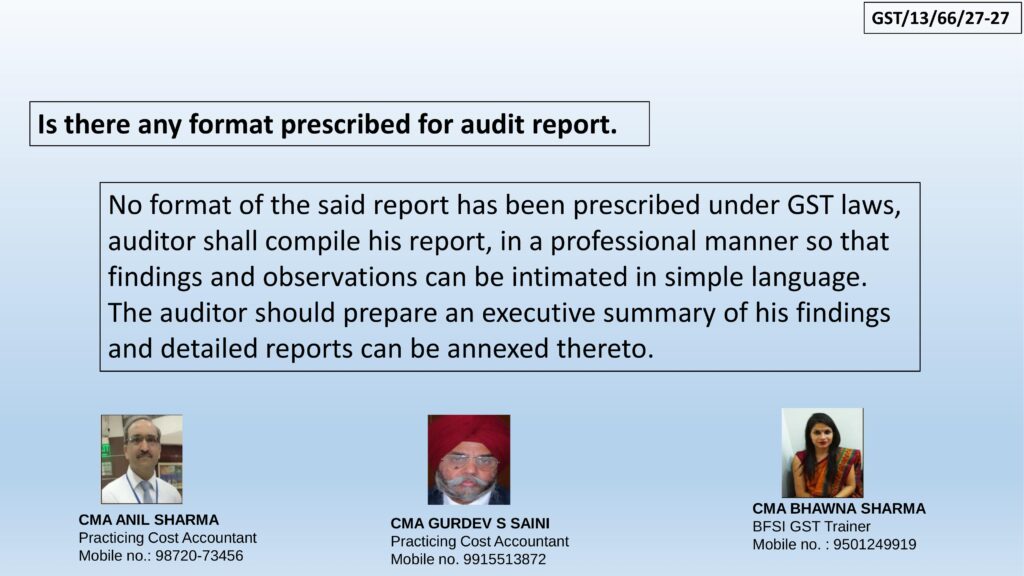
|
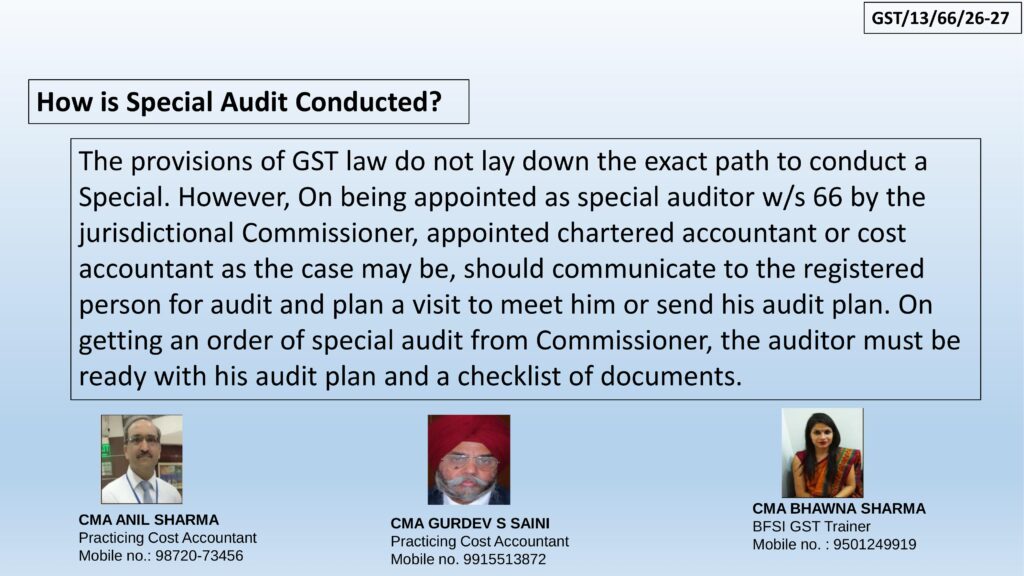
|
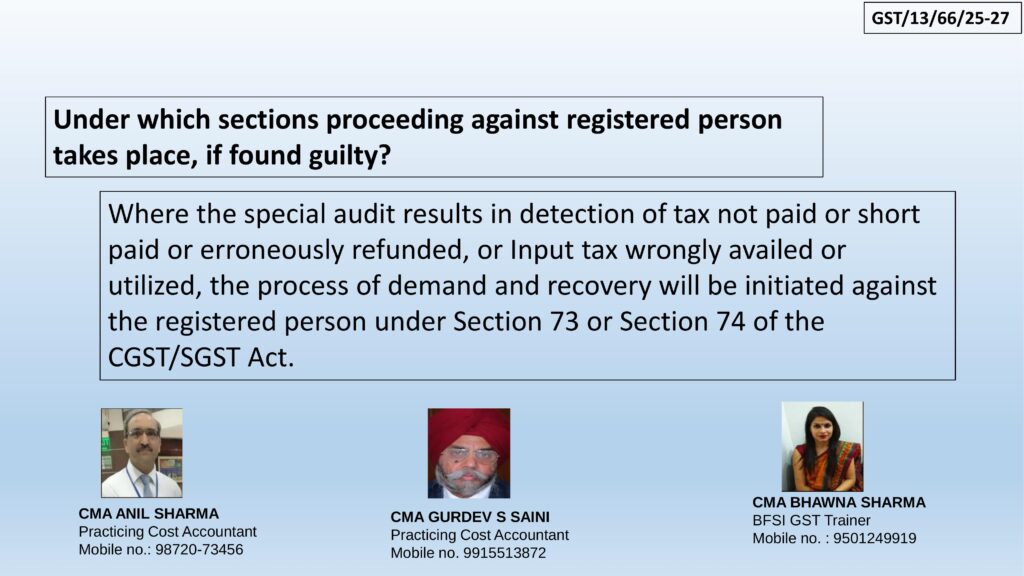
|
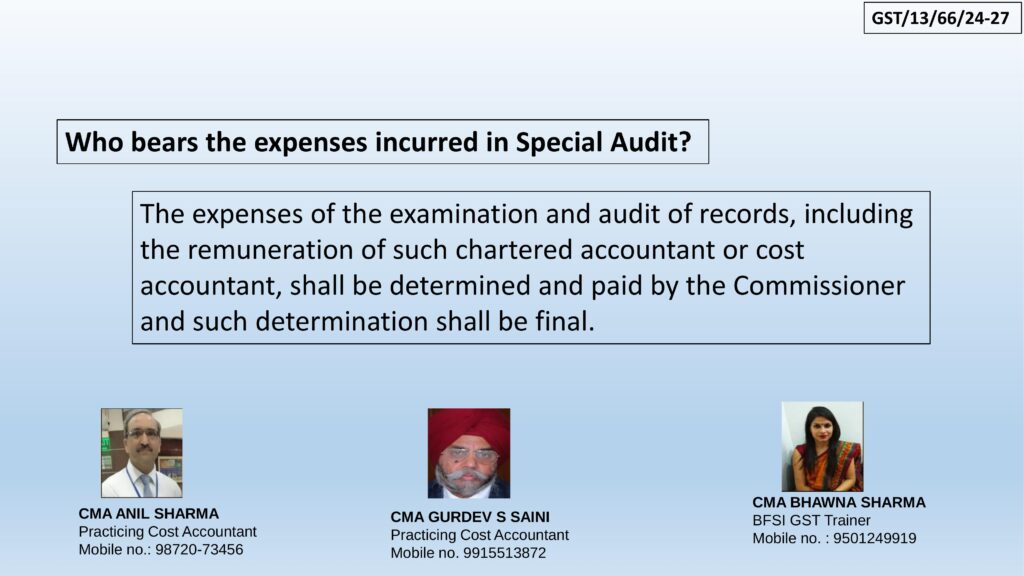
|
|
|
|
|
|
|
7) CMA Anil Sharma, B.Com (Honrs), M.Com, FCMA co-author of the book
|
|
Handbook on GST Audit by Tax Authorities has authored yet another book
|
|
title Goods & Service Tax – Some Perceptions and Reflections. Buy now at Price Rs.300/-.
|
|
|
|
|
|
You wish to publish your Article?
|
If you wish to share your article with maximum readers then please send them at taxupdate.otu@gmail.com. We shall publish it with all due credit to you.
|
|
|
|
|
|
|
Hope the above updates is of use to you. Please share your input and feedback at taxupdate.otu@gmail.com
|
|
|
|
|
|
 
|
Visit our website
|
OTU provides you
|
- Articles on various topics
|
|
- Media - GST, Income Tax & Press R.
|
|
- Notes / Newsletter etc.
|
|
|
|
|