|
onlinetaxupdate team wish to express sincere thanks to all the readers, authors, subscribers for the support extended to us. Please share your feedback at
|
taxupdate.otu@gmail.com or 7738647904
|
Newsletter 136 dated 23.09.2024
|
|
|
|
|
|
|
|
|
Dear Reader,
|
Please find newsletter for your reading and reference.
|
|
Index of the Newsletter
- Recent updates
- GST Council - 54th meet proposed
- Article
- Lawgics by Ms.Nidhi Aggarwal
- GST Notes by CMA Anil Sharma
- GST Daily by CA Pradeep Modi
- PPT/Handbook
- GST/IT/Customs in media
- Latest Update - Recap
|
|
|
|
|
|
|
GSTN Advisory no. 672 dated 19.09.2026
|
This is an advance information to the all users – Taxpayers and Tax Officers, of GST System who use Digital Certificate Signature on the GST Portal.
|
A new version of emSigner (v3.3) is being made available for download for the purpose of providing compatibility with tokens (USB dongles) that are issued on or after 21-September-2026.
|
A. Users with valid certificates: There is no change for the users having existing valid digital certificates and their existing token (USB Dongle) are working, as of 21-Sep-2026. If your existing DSC works normally, you may continue using your current emSigner version.
|
If you encounter signing failures or if your certificate does not appear for selection despite correctly installed token drivers, upgrade to the emSigner version 3.3 by following steps given under point-B below. The emSigner version 3.3 is backward compatible to support the existing tokens (USB dongles).
|
B. Users with newly issued tokens: The users who have been issued a new token (USB Dongle) on or after 21-Sep-2026, either due to issuance of new certificate and dongle, or renewal of certificate in a new dongle, shall have to upgrade to version 3.3 of emSigner by following below steps:
|
Step-1. Please ensure that your system – desktop / laptop / AIO which on which the DSC is used for the GST System, meets the following minimum system requirements:
|
1.1 Operating system and hardware
|
Step-2.Download & install the version 3.3 of emSigner from the GST Portal by navigating to https://www.gst.gov.in/help/docsigner - the older versions of emSigner will not work for such new DSC dongles issued from 21 September 2026 onwards.
|
C. Validity and future renewal: Under CCA’s advisory, DSCs downloaded onto FIPS 140-2 dongles on or before 21 September 2026 can continue to be used until the DSC expires. That date does not automatically invalidate existing DSCs. Subsequent renewal or fresh issuance generally requires a FIPS 140-3 dongle, subject to CCA’s specified exceptions. The CCA migration advisory may be referred for more details on this aspect by navigating to https://cca.gov.in/sites/files/pdf/news/Advisory_on_Migration_from_FIPS_140- 2_to_FIPS_140-3.pdf
|
Please create a ticket on the GST Helpdesk if you need any assistance while upgrading to the emSigner version 3.3 and our teams shall get in touch for resolution.
|
|
|
|
|
|
|
|
GSTN is taking downtime to enhance its services on the GST Portal on 18.09.2026 from 12:00 AM onwards until 2:00 am of 18.09.2026.
|
|
We shall be enhancing services on the GST portal on : 18th Sept’26 12:00 AM onwards. GST Portal services will not be available until 18th Sept’26 02:00 AM. The inconvenience caused is regretted.
|
|

|
|
|
|
|
|
|
|
|
GSTN is taking downtime to enhance its services on the GST Portal on 17.09.2026 from 03:00 AM onwards until 4:30 am of 17.09.2026.
|
|
We shall be enhancing services on the GST portal on : 17th Sept’26 03:00 AM onwards. GST Portal services will not be available until 17th Sept’26 04:30 AM. The inconvenience caused is regretted.
|
|

|
|
|
|
|
|
|
CBIC issued Notification No. 75 /2026-Customs (N.T.) dated 15.09.2026 regarding Fixation of Tariff Value of Edible Oils, Brass Scrap, Areca Nut, Gold and Silver
|
|
|
|
|
|
Central Board of Indirect Taxes and Customs (CBIC) issued Circular no. 41/2026-Customs dated 03.09.2026 regarding National Assessment Centre (NAC) Portal for Trade and department for effective dissemination of information
|
|
|
|
|
|
|
|
Central Board of Indirect Taxes and Customs (CBIC) issued Circular no. 40/2026-Customs dated 03.09.2026 regarding Checklists for mandatory compliance for Cosmetics/Drugs/Medical Devices to be verified by the Customs officer before granting out-of-charge in case of PGA facilitated Bills of Entry
|
|
|
|
|
|
Directorate General of Foreign Trade (DGFT) issued Trade Notice 28/2026-27 dated 16.09.2026 regarding Revision in Timeline for Issuance of PSIC and One-time Relaxation for Issuance of Backlog PSICs
|
Kind attention is invited to earlier Trade Notice No. 22/2026-27 dated 25.08.2026 regarding enhancements in the Pre-Shipment Inspection Agency (PSIA)/Pre Shipment Inspection Certificate (PSIC) process.
|
2. In order to facilitate smooth implementation of the revised PSIA/PSIC module, the following relaxations are hereby made to the provisions contained in the aforesaid Trade Notice:
|
i. One-time transitional arrangement for issuance of PSICs
|
A one-time relaxation of seven days from the date of issuance of this trade notice is hereby provided to the recognized PSIAs for clearing the backlog PSICs pertaining to inspections conducted prior to 25.08.2026, where such certificates could not be issued due to system restrictions introduced pursuant to the aforesaid Trade Notice.
|
ii. Revision in timeline for issuance of PSIC
|
Para 2(ii) of Trade Notice No. 22/2026-27 dated 25.08.2026 shall stand substituted with the following:
|
"The PSIC shall be generated and issued within 2 days from the date of inspection. The system shall permit generation and issuance of the PSIC only within the prescribed timeline. The PSIC uploading shall be done from the same geographical location/country where inspection is carried out."
|
3. All other provisions of Trade Notice No. 22/2026-27 dated 25.08.2026 shall remain unchanged.
|
This issues with the approval of the DG, DGFT.
|
|
|
|
|
|
|
|
The Directorate of Revenue Intelligence (DRI) seized more than 362 metric tonnes of Pakistan-origin dry dates under 'Operation Deep Manifest' during an enforcement drive targeting illicit trade conduits.
|
Acting on specific actionable intelligence, operational teams intercepted 13 cargo containers carrying the consignments at CFS Ahmad in Nashik , which a Mumbai-based commercial entity imported.
|
According to the Ministry of Finance, the shipments arrived via Jebel Ali in the United Arab Emirates, accompanied by import clearance paperwork that falsely declared the UAE as the sovereign country of origin.
|
Official findings revealed that the commercial consignment moved through a deliberate routing network designed to mask its true origin. The cargo started its maritime transit from Karachi Port in Pakistan, reaching Jebel Ali Port in the UAE abroad an initial vessel.
|
"Preliminary investigation revealed a carefully orchestrated transshipment arrangement designed to conceal the Pakistan-origin of the goods," the Ministry stated.
|
The operational breakdown showed that the illicit cargo underwent minimal physical handling in the Gulf transit hub to obscure the paper trail.
|
"The dry dates were initially shipped from Karachi Port, Pakistan, to Jebel Ali Port, UAE, in one set of containers aboard one vessel," the official statement noted.
|
Handlers in the transit zone then re-routed the shipment onto another carrier line, it state.
|
"At Jebel Ali, the goods were merely transshipped and transferred to another set of containers and loaded onto a different vessel for onward shipment to India through entities operated by Pakistani nationals," the Ministry confirmed.
|
Border and port enforcement tightened following regulatory revisions enacted by the Directorate General of Foreign Trade (DGFT) in mid-2025.
|
The Ministry mentioned that following the Pahalgam terror attack, the Government of India, in the interest of national security, imposed a complete prohibition on the direct or indirect import or transit of all goods originating in or exported from Pakistan, with effect from 02.05.2025, vide DGFT notification no. 06/2025-26 dated 02.05.2025.
|
To counter non-compliant import tactics across container terminals, central enforcement authorities launched structured surveillance protocols targeting third-party trade jurisdications.
|
"In response, DRI, under 'Operation Deep Menifest", has been consistently identifying, intercepting and seizing Pakistan-origin goods attempted to be imported into India through third-country routing," the Ministry said.
|
Customs and intelligence officials continue to track intermediate entities connected to commercial paper falsification, fraudulent routing manifests, and proxy transshipment nodes.
|
"The seizure underscores (DRI's sustained resolve to identify, disrupt and dismantle sophisticated networks seeking to circumvent trader prohibitions through misdeclaration , transshipment and manipulation of documentation, thereby safeguard national security and straightening supply chain integrity," the Ministry added.
|
|
|
|
|
|
|
|
Directorate General of Foreign Trade (DGFT) issued Notification No. 36/2026-27 dated 15.09.2026 regarding De minimis exemption from Registration-cum-Membership Certificate (RCMC) requirements for low-value exports
|
|
|
|
|
|
Central Board of Direct Taxes (CBDT) issued notification no. 120/2026 dated 17.09.2026 to hereby make following rules further to amend the Income tax Rules, 2026 , namely -
|
These rules may be called the Income-tax (Fourth Amendment) Rules, 2026
|
|
|
|
|
|
|
|
Directorate of Income Tax (Systems) of Central Board of Direct Taxes (CBDT) issued notification no. 3/2026 dated 15.09.2026 to prescribe Procedure for registration of reporting person/entity and submission of Form No. 98 as per rule 160 of the Income tax Rules, 2026.
|
Rule 160 of the Income-tax Rules, 2026 (hereinafter, "the Rules") specifies that every person referred to in clauses (a) and (b) of sub-rule (2), who has received any declaration in Form No. 97 in relation to a transaction specified in column 2 of Table in rule 159, shall furnish a statement in Form No. 98.
|
2. As per rule 160, the statement in Form No. 98 shall be furnished through online transmission of electronic data to a server designated for this purpose. As per sub-rule 3 of rule 160, the statement in Form No. 98 shall:
|
(a) where the declarations are received by the 30th September, be furnished by the 31st
October of that year; and
|
(b) where the declarations are received by the 31st March, be furnished by the 30th April
of the financial year immediately following the financial year in which the form is
received.
|
3. In exercise of the powers under rule 332 of the Income-tax Rules, 2026, the Director General of lncome-tax (Systems) hereby lays down the following procedure:.
|
(a) Registration and Generation of Income Tax Department Reporting Entity Identification Number (ITDREIN): The reporting person/entity is required to get registered with the Income Tax Department by logging in to the e-filing website (https://eportal.incometax.gov.in) with the log-in ID used for the purpose of filing the Income Tax Return of the reporting person/entity. The reporting person/entity needs to click on "Reporting Portal" link under "Pending Actions" tab at e-filing portal to access "Reporting Portal" for first time registration. The reporting person/entity will mandatorily be required to enter the details of form type, category and address of reporting person/entity along with the details of the principal officer.
|
On successful submission, the ITDREIN is generated and the principal officer will receive a confirmation e-mail on his/her registered e-mail address and SMS at his/her registered mobile number. There will be no option to deactivate ITDREIN, once it is generated.
|
The reporting person/entity already registered for compliance of erstwhile Form No: 61 are not required to register for Form No. 98 and the existing ITDREIN as well as the respective principal officers shall continue to remain valid. For the purpose of verification of Form No. 98, the principal officer will act as "Designated Director".
|
(b) Submission of Form No. 98: As per rule 160, a statement in Form No. 98 is required to be furnished by the reporting person/entity. The prescribed Schema, Report Generation and Validation Utility for Form No. 98 and Generic Submission Utility can be downloaded from the Reporting Portal under "Resources" tab. The prepared Statement to be filed is required to be digitally signed by and uploaded at the Reporting Portal or through Generic Submission Utility through the login credentials (PAN and password) of the principal officer.
|
(c) Submission of correction statement: In case the reporting person/entity comes to know or discovers any inaccuracy in the information provided in the statement or the defects have been communicated to the reporting person/entity through Data Quality Report (DQR) after submission of Statement, it is required to remove the defects by submitting a correction statement. The number of "Reports Requiring Correction (RRC)" will be visible against the original statement on Reporting Portal. The user can download the DQR file from the DQR column under "Statements" Tab of Reporting Portal, which can then be opened on the Report Generation Utility to find and fix the errors. The reporting person/entity needs to rectify all the defects till the number of "Reports Requiring Correction (RRC)" becomes zero within the specified period.
|
(d) Deletion of Submitted Reports in a statement: In case the reporting person/entity wishes to delete the inadvertently filed reports within a statement, it can choose the statement type as "Deletion Statement" and file all such reports within a single statement to be deleted with exact previously filed values against each field. The manner of filing Deletion Statement shall be similar to submission of correction statement.
|
(e) Security, archival and retrieval policies: The reporting person/entity is required to document and implement appropriate information security policies and procedures with clearly defined roles and responsibilities to ensure security of submitted information and related information/documents. The reporting person/entity is also required to document and implement appropriate archival and retrieval policies and procedures with clearly defined roles and responsibilities to ensure that submitted information and related information/documents are available promptly to the competent authorities.
|
This notification shall come into force with effect from /5~f September 2026. The Reporting for F.Y. 2025-26 and earlier years (including correction/ deletion) will continue as per the provisions of the Income-tax Act, 1961 and the Income-tax Rules, 1962, through Form No. 61 as per Notification No. 2 of 2018 dated 05.04.2018.
|
|
|
|
|
|
Central Board of Direct Taxes issued Guidelines dated 13.06.2025 vide F. No. 225/37/2025/ITA-II, regarding compulsory selection of returns for Complete Scrutiny during the Financial Year 2025-26 - procedure for compulsory selection in such cases.
|
2. The parameters for compulsory selection of returns for Complete Scrutiny during Financial Year 2025-26 and procedure for compulsory selection in such cases are prescribed as under:
|
3. Clarification: It is clarified that where return has been furnished in response to notice u/s 142(1) of the Act and such notice u/s 142(1) of the Act was issued due to the information contained in NMS Cycle/AIS/Statement of Financial Transactions (SFT)/ CPC-TDS information / information received from Directorate of I&CI, such return will not be taken up for compulsory scrutiny. Selection of such cases for scrutiny will be done through the CASS cycle.
|
4. Issuance of notice u/s 143(2) in certain cases:
|
4.1 Jurisdictional Assessing Officers (JAOs) shall upload the underlying documents for access by NaFAC in the following cases which are to be completed by NaFAC on or before 31.03.2026 and Notice u/s 143(2)/142(1) of the Act calling for information shall be served on the assess through NaFAC in these caes:
|
(a) Cases (other than search & seizures/survey) in which notices u/s 148 of the Act have been issued where return is either furnished or not furnished in response to notice u/s 148 of the Act.
|
(b) Cases in which notices u/s 142(1) of the Act calling for return, have been issued & no returns have been furnished.
|
4.2 Cases, where notices u/s 148 of the Act have been issued pursuant to search & seizure/survey actions conducted on or after the 01.04.2021 but before 01.09.2024, if lying outside Central Charges,
|
(i) where return is furnished, the Jurisdictional Assessing Officer (JAO) concerned shall serve the Notice u/s 143(2) of the Act and Pr.CIT/Pr.DIT/CIT/DIT concerned shall ensure that such cases transfer these cases to central charges u/s 127 of the Act.
|
(ii) where return is not furnished, these cases shall be transferred to central charges for further necessary action.
|
4.3 During the course of Search & Seizure action, information relating to some other persons, who may have one-off/very few or limited financial transaction(s) with the main assessee group covered in the search u/s 132/ 132A of the Act, may be found. Such persons are not integrally connected with the core business of the main assessee searched and do not belong to the same business group. Often such persons are also not residing in the same city as that of the main assesssee. In such cases, the relevant information is generally passed on to the jurisdictional AO for assessing them u/s 148 (for searches conducted/requisition made after 01.04.2021) of the Income-tax Act, 1961. It is clarified that such non-search cases selected u/s 148 of the Act are not required to be transferred to the Central Charges unless covered by the Board's guidelines under F.No. 299/107/2013-IT (Inv.III)/1568 dated 25.04.2014.
|
5. For Assessing Officers in International Taxation and Central Circle charges:
|
5.1 The cases shall be selected for compulsory scrutiny by the International Taxation and Central Circle charges following the above prescribed parameter at Para 2 with prior administrative approval of Pr.CIT/Pr.DIT/CIT/DIT concerned and these selected cases for compulsory scrutiny shall continue to be handled by International Taxation and Central Circle charges respectively, as earlier.
|
5.2 It is further clarified that communication to NaFAC for access and/or further action after selection for Compulsory Scrutiny will not apply to the International taxation and Central charges.
|
6. Time limit: As per the proviso to section 143(2) of the Act, the time limit for service of notice u/s 143(2) of the Act for the ITRs filed in the Financial Year (FY) 2024-25 which are selected for Compulsory Scrutiny is 30.06.2025.
|
7. These instructions may be brought to the notice of all concerned for necessary compliance.
|
|
|
|
|
|
Central Board of Direct Taxes issued Circular no. 6 of 2026 dated 02.07.2026 regarding Condonation of delay in filing Form No. 10AB electronically for approval under clause (ii) of the first proviso to section 80G(5) of the Income tax Act, 1961
|
|
|
|
|
|
Press release no. 2300883 dated 18.08.2026
|
Top Tax Officials Deliberate on Key Issues Concerning the Income Tax Department at Conclave
|
The two-day conclave of Principal Chief Commissioners of Income Tax and Principal Directors General of Income Tax, organized by the Income Tax Department, concluded today, August 18, in Jaipur. The conclave was chaired by Shri Ravi Agrawal, Chairman, Central Board of Direct Taxes (CBDT).
|
The event was attended by Members of the CBDT—Shri Pankaj Kumar Mishra, Shri Sanjay Bahadur, Shri Prasenjit Singh, Ms. G. Aparna Rao, Ms. Pallavi Agrawal and Shri Sunil Kumar Singh—along with Principal Chief Commissioners, Principal Directors General, Commissioners of Income Tax (Administration) and other senior officers from across the country.
|
The conclave witnessed extensive deliberations on key issues concerning the Income Tax Department, including e-HRMS, service matters, litigation, reservation policy, taxpayer services, future projects, the Systems Directorate, capacity building, infrastructure, expenditure budget, TDS administration and inter-agency coordination. Senior officers also shared their views and suggestions on the challenges and future priorities of the Department. A documentary produced by the Media Cell of the CBDT was also screened during the programme.
|
Shri Ravi Agrawal, Chairman, CBDT, held open and interactive discussions with senior officers on the future direction and functioning of the Department and emphasized the need for an actionable roadmap based on the suggestions received. Detailed discussions were also held on infrastructure requirements and essential facilities for Income Tax offices across the country.
|
The programme was organized under the guidance of Shri Ravi Agrawal, Chairman, CBDT, and under the leadership of Shri Sumeet Kumar, Principal Chief Commissioner of Income Tax, Rajasthan. Shri Anil Kumar Bhardwaj, Commissioner of Income Tax (Administration & TPS), Jaipur; Shri Gautam Singh Chaudhary, Additional Commissioner of Income Tax (Administration); Shri Surendra Yadav, Deputy Commissioner of Income Tax (Headquarters); and other officers and staff made significant contributions towards the successful conduct of the conclave.
|
At the conclusion of the programme, Ms. G. Aparna Rao, Member (TPS&R), CBDT, delivered the valedictory address. Shri Anil Kumar Bhardwaj, Commissioner of Income Tax (Administration & TPS), Jaipur, thereafter extended a vote of thanks to the Chairman, CBDT, Members of the Board, senior officers and all officers and staff associated with the successful organization of the conclave.
|
The conclave concluded on a positive and forward-looking note, with a shared commitment to translating the deliberations and suggestions into concrete action towards strengthening the Department and enhancing taxpayer services.
|
|
|
|
|
|
|
|
The GST Council on Sunday constituted a 13-member Group of Ministers (GoM) to suggest GST rate on premiums of various health and life insurance products and submit its report by October 30.
|
Bihar Deputy Chief Minister Samrat Choudhary is the convenor of the GoM. The members of the panel include members from Uttar Pradesh, Rajasthan, West Bengal, Karnataka, Kerala, Andhra Pradesh, Goa, Gujarat, Meghalaya, Punjab, Tamil Nadu and Telangana.
|
The 54th GST Council meeting on September 9 decided to set up a GoM to examine and review the present tax structure of GST on life and medical insurance. A final call by the Council on the taxation of insurance premiums is likely to be taken in the next meeting in November based on the GoM report.
|
Currently, 18 per cent of Goods and Services Tax (GST) is levied on insurance premiums.
|
The Terms of Reference (ToR) of the panel also include suggesting tax rate of health/medical insurance including individual, group, family floater and other medical insurance for various categories like senior citizens, middle class, persons with mental illness. Also, suggest tax rates on life insurance, including term insurance, life insurance with investment plans whether individual or group and re-insurance.
|
"The GoM is to submit its report by October 30," 2024," said the Office Memorandum issued by the GST Council Secretariat on the Constitution of GoM on Life and Health insurance.
|
Some opposition-ruled states, including West Bengal, had demanded complete exemption of GST on health and life insurance premiums, while some other states were in favour of lowering the tax to 5 per cent. Even Transport Minister Nitin Gadkari had in July written to Finance Miniter Nirmala Sitharaman on the issue saying "levying GST on life insurance premium amounts to levying tax on the uncertainties of life."
|
In 2023-24, the centre and states collected Rs 8,262.94 crore through GST on health insurance premiums, while Rs 1,484.36 crore was collected on account of GST on health reinsurance premiums.
|
Sitharaman in her reply to a discussion on the Finance Bill in the Lok Sabha in August had said that 75 per cent of the GST collected goes to states and the Opposition members should ask their state finance ministers to bring the proposal to the GST Council.
|
|
|
|
|
|
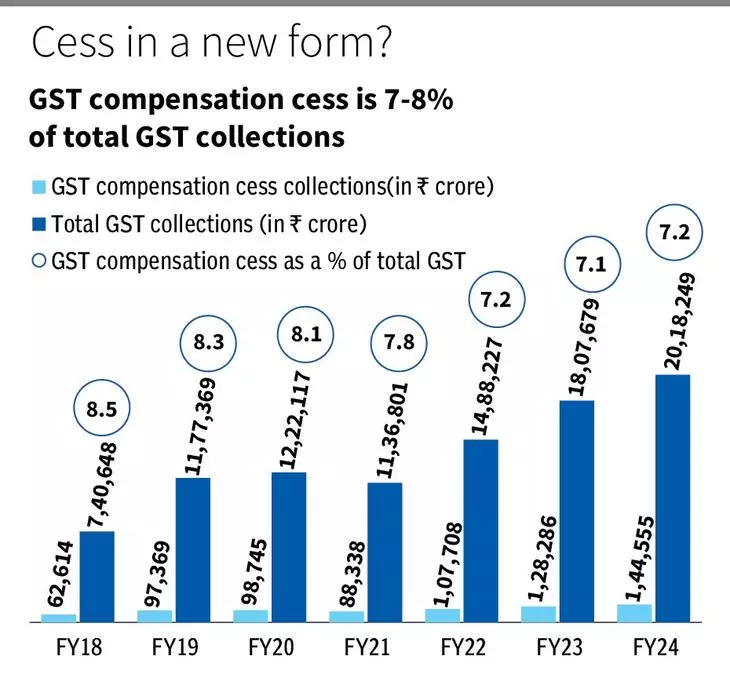
As the 54th GST Council Meeting last week formed a Group of Ministers (GoM) to decide the future of the GST compensation cess, data show that the tax component contributes substantially to the government coffers and merits continuation in new form once its levy ends in March 2026.
|
|
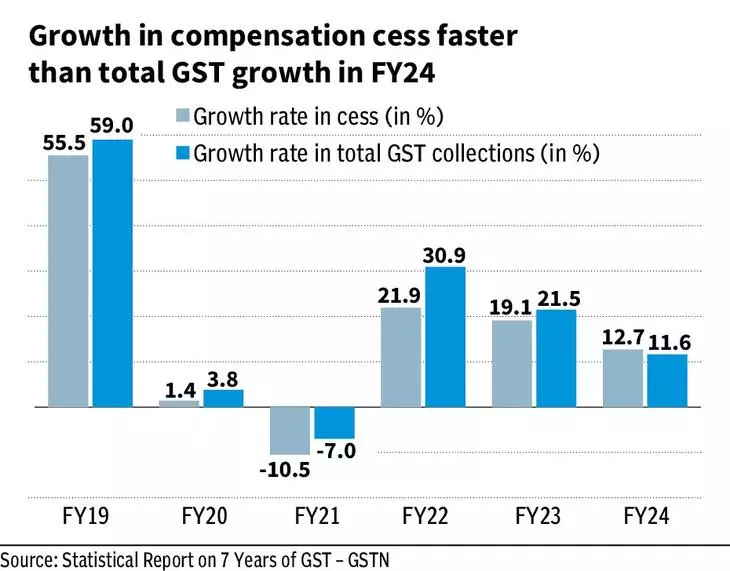
businessline analysis of the annual GST compensation cess collections from FY18 to FY24 shows that the tax contributed average 8 per cent to the total GST collections during the said years, and has been growing at almost the same rate as rise in overall GST collections. In fact, in FY24, the growth in cess outpaced that of total GST collections.
|
|
|
The GST compensation cess grew around 22 per cent in FY22 at ₹1.07 lakh crore, 19 per cent in FY23 to come in at ₹1.28 lakh crore, and 12.7 per cent in FY24 (₹1.44 lakh crore). Overall GST collections grew at 31 per cent, 21.5 per cent and 11.6 per cent during the same post-Covid years. The growth rate in Central Goods and Services Tax (CGST) is at 29 per cent, 19.7 per cent and 16 per cent in the period.
|
The cess is levied on supply of select so-called sin goods, luxury products and those with adverse environmental or health impacts. The list includes items such as tobacco, Pan Masala, carbonated beverages and also on products such as motor vehicles beyond certain capacity and coal products. It is also chargeable on certain goods imported to India.
|
|
“Industries like automobile, aerated beverages and others affected by the compensation levy were hoping for its discontinuation after the five-year period and then again after its extension for covering up the previous shortfall,” Abhishek Jain, Indirect Tax Head & Partner, KPMG, said. “The GoM is faced with a tough balancing act between industry expectations and the government’s interest in maintaining this key revenue source in some form,” he added.
|
|
|
While the levy on tobacco and related products helps in influencing consumer behaviour towards purchase of such goods, analysts also note that given the rising demand for large motor vehicles and redefinition of luxury goods, the GoM should also review items on which the cess is currently levied and rationalise it.
|
GST compensation cess was brought in as a measure by the Centre to meet its promise to the States to offer a 14 per cent CAGR in tax revenue for five years from the date of GST rollout. The payout to States ended in June 2022, but subsequently it was extended till March 2026, to repay the loan of around ₹2.7 lakh crore that the Centre borrowed during the pandemic period to meet the deficit.
|
Finance Minister Nirmala Sitharaman at the 54th Council meet said that government will likely clear the back-to-back loan and the interest thereon by January 2026 itself, and thus two months of compensation cess collections (February and March 2026) totalling to roughly ₹40,000 crore is likely to be surplus. “It shall no longer be ‘compensation cess’ post March 2026, but what is to be done with it, it will be decided by the GoM,” she said.
|
|
|
|
|
|
|
|
Author: R.SRIVATSAN, IRS, NACIN, Chennai
|
Automobile dealers using demonstration vehicles or demo cars for promoting sales can claim input tax credit (ITC) under the GST law.
|
However, no ITC would be available if demo cars are used by dealers for their own purpose during the course of the business.
|
The Central Board of Indirect Taxes and Customs (CBIC) said authorised dealers are required to maintain demo vehicles at their sales outlet as per dealership norms which are used for providing trial runs and for demonstrating features of the vehicle to the potential buyers.
|
These vehicles are purchased by the authorised dealers from the vehicle manufacturers against tax invoices and are typically reflected as capital assets in books of account of the authorized dealers.
|
As per dealership norms, these vehicles may be required to be held by the authorized dealers as demo vehicles for certain mandatory period and may, thereafter, be sold by the dealer at a written down value and applicable tax is payable at that point of time.
|
The demo vehicles are actually used by the authorized dealers to promote further sale of motor vehicles of the similar type and therefore, such vehicles appear to be used in the course or furtherance of business of the authorized dealers.
|
Obviously these vehicles should not be used for transportation of its employees or other passengers or for personal use.
|
Where such vehicles are capitalized in the books of accounts by the authorized dealer, the said vehicle falls in the definition of 'capital goods. ITC is available when no depreciation is claimed under Income Tax.
|
R.SRIVATSAN, IRS
NACIN, Chennai
|
|
|
|
|
|
Author: R.SRIVATSAN, IRS, NACIN, Chennai
|
The 54th GST Council meeting has recommended rectification processes related to the ITC for demands under section 73, 74, 107 and 108 of the CGST Act, 2017.
|
The Council recommended that section 118 and 150 of the Finance (No.2) Act, 2024, which provides for insertion of sub-section (5) and sub-section (6) in Section 16 of CGST 2017 retrospectively w.e.f 01.07.2017 may be notified at the earliest.
|
Issues related to wrong availment of Input Tax Credit (ITC) by the taxpayers.
|
Special procedure for rectification of orders u/s 148 of the CGST Act, 2017 will be followed by the class of taxable persons, against whom any order u/s 73 or 74 or section 107 or 108 of CGST Act has been issued confirming demand for wrong availment of ITC on account of contravention of provisions of sub-section (4) of section 16 of the CGST Act, but where such ITC is now available as per newly inserted provisions of sub-section (5) or sub-section (6) of section 16 of CGST Act 2017.
|
The wrong availment of ITC due to non-filing of returns by the sellers has caused a lot of trouble for the buyers.
|
In fact, section 16(4), CGST Act 2017 has succeeded in reducing these issues in related to the availment of ITC to an extent but still in many cases recipient of supply were being issued with the notice u/s 73, 74, 107 and 108 of CGST Act 2017, for no fault of them.
|
Therefore, the introduction of 16(5) and 16(6) of CGST Act, 2017 will resolve the issues on availment of ITC.
|
According to Section 16(5) and 16(6) CGST Act :
|
Notwithstanding anything contained in sub-section (4), in respect of an invoice or debit note for supply of goods or services or both pertaining to the Financial Years 2017-18, 2018-19, 2019-20 and 2020-21, the registered person shall be entitled to take input tax credit in any return under section 39 which is filed up to the thirtieth day of November, 2021.
|
Where registration of a registered person is canceled under section 29 and subsequently the cancellation of registration is revoked by any order, either under section 30 or pursuant to any order made by the Appellate Authority or the Appellate Tribunal or court and where availment of input tax credit in respect of an invoice or debit note was not restricted under sub-section (4) on the date of order of cancellation of registration, the said person shall be entitled to take the input tax credit in respect of such invoice or debit note for supply of goods or services or both, in a return under section 39,– (i) filed up to thirtieth day of November following the financial year to which such invoice or debit note pertains or furnishing of the relevant annual return, whichever is earlier; or (ii) for the period from the date of cancellation of registration or the effective date of cancellation of registration, as the case may be, till the date of order of revocation of cancellation of registration, where such return is filed within thirty days from the date of order of revocation of cancellation of registration, whichever is later.] The Council also recommended issuance of a circular to clarify the procedure and issues related to the implementation of the provision of 16(5) and 16(6) of CGST Act, 2017.
|
Lot of disputes, appeals, refunds and pre-deposit, refund of pre-deposits and similar obligations causing financial stresses on the business and procedural compliances by tax administration will get resolved by this progressive move.
|
|
|
|
|
|
Author: R.SRIVATSAN, IRS, NACIN, Chennai
|
by R.SRIVATSAN, IRS, NACIN, Chennai
|
RCM on Commercial Rent refers to the Reverse Charge Mechanism, where the recipient (tenant) is liable to pay GST on commercial rent.
|
Here is a comprehensive analysis of how RCM impacts commercial rent for discharging GST liabilities, taking case by case.
|
A: For Registered Landlords:-
|
If the landlord is registered under GST, they charge GST on the rent to the tenant and the tenant pays the GST to the landlord along with the rent, while the registered landlord discharges the GST liability.
|
B: For Unregistered Landlords:-
|
If the landlord is not registered under GST, the RCM applies, and the tenant (if registered) is responsible for paying the GST directly to the government.
|
C: Tenant Composition Optee:-
|
If the tenant is a GST composition taxpayer, the RCM will apply on the registered tenant liability becomes an extra cost because they cannot claim Input Tax Credit (ITC).
|
If the tenant is a GST regular taxpayer, they can claim the RCM liability as ITC reducing their tax burden.
|
RCM liability must be paid in cash only. ITC adjustment is not permissible.
|
The FCM does not apply to small landlords whose aggregate turnover is below the GST registration threshold (₹20 lakhs for most states, ₹10 lakhs for some special category states).
|
Additionally, if the tenant is unregistered under GST, RCM does not apply, and no GST is payable on the rent.
|
E: ITC (Input Tax Credit) for Tenants:-
|
Tenants paying GST under RCM can avail of Input Tax Credit (ITC) on the GST paid under RCM, provided they are using the property in the course or furtherance of business purposes.
|
Tax Rate on Commercial Rent
GST on commercial rent is currently taxed at 18% on the rent amount under the services category. This applies in all cases whether GST is paid by the landlord or under RCM by the tenant under direct charge.
|
The SAC code for renting of immovable property is 997212. This SAC code also applies to all forms of rental agreements such as long-term leases and short-term rentals.
|
The application of RCM on commercial rent has broad implications for tenants, landlords, and the overall real estate sector. While it shifts the tax burden from landlords to tenants, it ensures that GST is collected on rental transactions, even when landlords are unregistered.
|
For tenants, especially businesses, RCM means added responsibilities in terms of compliance and cash flow management, but the availability of ITC can help offset the GST paid under RCM.
|
|
The table summarises the essence of RCM on commercial renting.
|
|

|
|
|
|
|
|
|
Author: R.SRIVATSAN, IRS, NACIN, Chennai
|
The Hon'ble Guwahati High Court has quashed the validity of Notification No. 56/2023, CT, dt:23-12-2023, in the case of Shree Shyam Steel Vs UOI regarding the extension of time for passing orders under Section 73(9) of the CGST Act for the financial years 2018-19 and 2019-20.
|
The Government, exercising its authority under section 168A of the CGST Act, 2017, in conjunction with IGST Act 2017 has through Notification 56/2023 specifically extend the time limits as outlined below:
|
For the Financial Year 2018-19:
|
The deadline to issue orders related to tax recovery for this fiscal year was extended until April 30, 2024.
|
For the Financial Year 2019-20:
|
The deadline for orders regarding tax recovery in this fiscal year was extended until August 31, 2024.
|
This order of the Honourable Guwahati High court has answered several critical issues in terms of statutory interpretation, constitutional principles, and GST governance.
|
The bench noted that prima facie the notification bearing No. 56/2023 does not align with the provisions of Section 168(A) of the Central GST Act, 2017.
|
Section 168A, with its non-obstante clause grants the government overriding authority to extend due dates for completing proceedings and taking measures.
|
But without a proposal/ recommendation from GSTC, the government cannot issue the notification for extending the period u/s 168A of the CGST Act, 2017 and as such, the notification bearing No. 56/2023 on 28.12.2023 is ultra vires without legislative validity.
|
The notification cannot stand the scrutiny of law because the power to notify u/s 168A is granted exclusively when there is a force majeure.
|
The Court’s declaration that the notification is ultra vires Section 168A signifies that the Central Government exceeded its powers under this section.
|
Section 168A was introduced as a special provision to deal with extraordinary situations such as force majeure (e.g., COVID-19) and allows the Government to extend statutory time limits.
|
However, it must be based on recommendations from the GST Council.
|
In fact, in the 49th Meeting of the GST Council, the GSTC made a recommendation for extending the time limit for passing the order u/s 73(9) of the CGST Act, 2017 for the
|
FY 2017-2018 up to 31.12.2023
|
FY 2018-2019 up to 31.03.2024
|
FY 2019-2020 up to 30.06.2024.
|
According to the recommendation of the GST Council, a notification bearing No. 9/2023-CE was issued dated 31.03.2023 by the Central Board of Indirect Taxes and Customs.
|
However, GST Council has not made any proposal to date, and despite that, the CBIC has issued a Notification bearing No. 56/2023-CE on 28.12.2023 by extending the period to pass the order Under Section 73(9) of the CGST Act, 2017 for the Financial Year 2018-2019 and for the FY 2019-2020 which has been held unlawful.
|
The judgment emphasizes that executive decisions cannot supersede statutory requirements, especially in the absence of GST Council's recommendations.
|
This ruling is a direct reaffirmation of the importance of the GST Council's role as a constitutional body that balances federal interests in GST matters.
|
Section 168A stipulates that any relaxation of timelines must be in consonance with the recommendations of the GST Council.
|
The judgment thus underscores the principle that executive discretion is not absolute in GST matters and must be subject to the constitutional framework, wherein the GST Council plays a pivotal role in shaping policy.
|
This decision will obviously have significant implications for taxpayers who were caught in the disputes under Section 73(9) for the financial years 2018-19 & 2019&20.
|
The quashing of the notification implies that the statutory limitation periods for passing orders may not stand extended leaving the fate of numerous cases in uncertainty, a potential relief for taxpayers too, as any delay in proceedings beyond the statutory limits could invalidate the actions of tax officers.
|
This judgment could serve as a precedent/guidance for future litigation surrounding notifications or executive actions that seek to bypass statutory procedures or constitutional mandates under the GST regime.
|
|
|
|
|
|
Yes, the Honorable High Court of Madras in the case of Global Hardware vs. The State Tax Officer (W.P. (MD) No. 13164 of 2024 dated 21.06.2024) granted liberty to the Petitioner to file a statutory appeal before the Deputy Commissioner (GST-Appeal) within 30 days from the receipt of the court's order. The Honorable Court noted that the petitioner received an order dated 01.12.2023 for the assessment year 2022-23 and has approached WRIT Court long after the expiry of the Time limit for filing an Appeal u/s 107. The Honorable Court provided a procedural remedy while not addressing the substantive arguments, focusing on facilitating the appeal process despite the lapse in the statutory timeline. The Respondent was further directed to consider and dispose of the appeal on its merits within three months.
|
If the appeal is filed after the period of condonation permitted in section 107(4) (3+1 months), the Appellate Authority does not have statutory authority to condone the delay, not even if the reasons are ample and deserve to be entertained. The appeal must be dismissed for being fatally belated because the legislature has allowed Appellate authority this much authority and not more.
|
The Honorable Supreme Court has decided in Singh Enterprises v. CCE 2008 (221) ELT 163 that where the period of limitation is specifically provided in the statute, admitting appeals albeit for 'sufficient cause' would render statutory provisions impossible. And Appellate Authority thus being the denuded of authority to condone (due to lapse of maximum time permitted) is barred from examining the cause and condone the delays even for a 'good and sufficient' reason.
|
The Honorable Allahabad High Court in the case of M/s. Yadav Steels v. Additional Commissioner and Anr. and in the case of M/s. Abhishek Trading Corporation v. Commissioner (Appeals) and Anr. has decided that the Central Goods and Services Tax Act, 2017 is a special statute and a self-contained code in itself and Section 5 of the Limitation Act is no applicable to give power to First Appellate authority to condone the delay beyond statutory time limit allowed.
|
|
|
|
|
|
No, the Honorable Madras High Court in the case of Murugan Metals vs. The State Officer (ST) (W.P.No.16582 of 2024 dated 25.06.2024) set aside the impugned assessment order dated 28.12.2023 on the condition that the petitioner remits 5% of the disputed tax demand within two weeks from the date of receipt of a copy of the order. The Honorable Court observed that the petitioner's reply dated 11.01.2023 included the GSTR-3B returns for the assessment period 2017-18, along with a comparison statement between the GSTR-2A and GSTR-3B returns. However, the assessing officer did not appear to have considered these documents while confirming the tax proposal. Additionally, the petitioner failed to participate in subsequent proceedings or file the reconciliation statement in GSTR-9C. Considering these circumstances, the Honorable Court deemed it necessary to reconsider the case but also to impose conditions on the petitioner. The Honorable Court directed the respondent to provide the petitioner a reasonable opportunity, including hearing, and to issue a fresh order within three months from the date of receipt of the remittance. Consequently, the bank statement was raised.
|
Whether to celebrate such an order that remands back the case to the Proper Officer for another round of adjudication (re-adjudication) is a matter of choice and strategy. In the author's considered opinion, such orders are unable to fetch the desired relief because SCN is not vacated, only a short-term relief (at a cost) is provided in this long battle. The petitioner could have disputed the cause of action (2A v 3B) invoked, and the burden to proof would have been on the revenue to prove their case. Important to mention that mismatch/linear comparison of two data sets (GSTR-2A whose authorship is not with taxpayer v GSTR-3B) is meaningless in GST. Yes, it could raise suspicion, but without evidence, it is impossible to bring home the allegations levelled against the taxpayer.
|
|
|
|
|
|
Yes, the Honorable High Court of Allahabad in case of M/s. Anil Rice Mill vs. State of UP and 2 Others (WRIT TAX No. - 886 of 2023 dated 14.08.2024) dismissed the writ petition filed by the petitioner stating that the primary responsibility of claiming the benefit is upon the dealer to provide and establish the actual physical movement of goods, genuineness of transactions, etc. and if the dealer fails to prove the actual physical movement of goods, the benefit of ITC cannot be granted. The Honorable Court relied on the judgment of the Honorable Supreme Court in the case of State of Karnataka vs. M/s Ecom Gill Coffee Trading Private Limited (2023), which reinforces the principle that the burden of proving the legitimacy of an ITC claim lies with the purchasing dealer. The Honorable Court observed that the petitioner has only brought on record the tax invoices, e-way bills, and payment through the banking channel, but no such details such as payment of freight charges, acknowledgment of taking delivery of goods, toll receipts and payment thereof has been provided. Thus in the absence of these documents, the actual physical movements of goods and genuineness of transportation as well as the transaction cannot be established and in such circumstances, further no proof of filing of GSTR-2A has been brought on record, consequently, the authorities rightly initiated proceedings against the petitioner. In view of the facts as stated above, no interference is called for by this Court in the impugned orders.
|
Where self-assessment is challenged, the burden rests on the Revenue making the allegation and not on the registered person-suffering the allegation. The Burden of proof is not discharged by making the allegation. The Burden of proof is discharged only when a mountain of evidence commensurate with the nature of the allegation made is produced and appended to notice. Allegations of severe wrong-doing require proportionately substantial evidence. Evidence is not extracted of books of accounts or statements taken on-oath. Evidence is that proves something. Section 155 of the CGST Act places the burden to prove regarding "eligibility to credit" only on the taxpayer. Once, it is shown that all the conditions of section 16 are fulfilled, the taxpayer's burden is discharged and onus shifts on the department to prove their case
|
In the instance case, the petitioner could have disputed the allegation stating that being a trader, if the outward supplies are accepted to be genuine then inward supplies have to be genuine. And if inward supplies are in genuine and outward supplies are accepted to be genuine, then the allegation is deeply rooted in incomplete investigation, surmise and conjecture only. The Revenue cannot approbate and reprobate on the same issue. The taxpayer must have allowed the revenue to prove their case and in the absence of evidence in support of allegations, allegations are self-defeating.
|
This is classic case of poor strategy by the petitioner and in coming times, other taxpayers will have to face the heat of this order.
|
|
|
|
|
|
Recently, the Hon'ble Supreme Court directed the disposal of around 199 appeals based on monetary limits prescribed by the Revenue as a step towards reducing litigation.
|
This initiative will undoubtedly bring much-needed relief to both taxpayers and the department. But why stop there?
|
— Expanding the Initiative:
The same exercise should be carried out for all pending cases before High Courts, CESTAT, and the soon-to-be-constituted GSTAT to multiply the benefits.
|
— Identifying Covered Cases:
It's also worth identifying all cases where the point of law has been settled by the Hon’ble Supreme Court. Both the department and taxpayers can proactively withdraw such appeals, freeing up judicial resources to focus on new and unresolved issues and saving legal costs for all parties involved.
|
Ref. C.C.E. AND S.T., SURAT I vs BILFINDER NEO STRUCTO CONSTRUCTION LTD.
|
|
|
|
|
|
Blessed, that the recent ruling by Hon’ble Kerala High Court in the case of M/S. MUTHOOT FINANCE LIMITED ruled on 03.09.2024 aligns closely with the views I expressed in my article long ago (see screen shot below).
|
The court has reiterated that the Education Cess (EC), Secondary and Higher Education Cess (SHEC), and Krishi Kalyan Cess (KKC) can only be utilized for their specific purposes and not for any other tax payments. This decision also confirms that there cannot be any transitioning of these cesses under the CGST Act.
|
The court’s decision underscores that cesses, while levied similarly to taxes, are not given the same treatment.
|
|
Let’s wait for the final law on this!!
|
|

|
|
|
|
|
|
|
4. Lawgics by Ms.Nidhi Aggarwal
|
Ms. Nidhi Aggarwal is delighted to present judgment with a great vision to spread complex GST law in a simple manner amongst the taxpayers, tax professionals, students and knowledge seeker.
|
|
Recently added notes are listed below:
|
|
|
|
|
|
Synopsis: The Delhi High Court dismissed the writ petition involving fraudulent ITC claims, directing the petitioner to pursue appellate remedy u/s 107 of the CGST Act.
|
Caste name: Banson Enterprises & Anr. vs Assistant Commissioner CGST & Ors.
|
Citation: W.P. (C) 6503/2025 dated 15.05.2025
|
Authority: Delhi High Court
|
The petition challenges the Order-in-Original dated 02.02.2025 based on a Show Cause Notice (SCN) dated 03.08.2024 A search was conducted, and statements were recorded including that of one Director admitting to the issuance of fake invoices during the Central Excise period. It was alleged that the Petitioner issued goods-less invoices to enable fraudulent Input Tax Credit (ITC) claims amounting to Rs. 1.85 crore.
|
Contentions of the Petitioner:
|
SCN was issued by unauthorized officer, thus, violates Rule 142(1)(a) of CGST Rules. No pre-consultation as required under Rule 142(1A) of CGST Rules was issued. Consolidated SCN for multiple financial years was issued and challenge to such consolidated action is pending in a separate matter (Quest Infotech case).
|
Contentions of the Department:
The impugned order is appealable, hence writ is not maintainable. The Petitioner’s Director admitted to allegations. Natural justice was followed as the Petitioner received the SCN, filed a reply, and availed of personal hearing. Reliance must be made on SC judgments and Allahabad HC rulings emphasizing alternate remedy u/s 107 CGST Act.
|
Findings and Decision of the Court:
The Court refused to interfere under writ jurisdiction, citing:
|
- No breach of fundamental rights or principles of natural justice.
- Availability of a statutory remedy (appeal) under Section 107 CGST Act.
The Court noted that the Allegations involve serious misuse of ITC, requiring fact-based adjudication, not suited for writ jurisdiction. Thus, the Petitioner was granted liberty to file appeal, and if filed with pre deposit, the appeal shall not be dismissed on limitation.
|
|
|
|
|
|
|
|
Synopsis: GST RC cancellation is not justified as petitioner was not given fair opportunity to respond.
|
Case Name: M/s. Genius Orthos Industries VS Union of India & Ors.
|
Citation: WRIT TAX No. 542 of 2023 dated 24.04.2025
|
Authority: Allahabad High Court
|
The petitioner was engaged in the business of surgical goods and its GST registration was cancelled on 19.12.2022 after a physical verification of its premises allegedly found no inputs, finished goods, or workers. A show cause notice was issued prior to cancellation, but the petitioner claimed they were not informed of the specific material findings leading to the cancellation. The appeal against the cancellation was also dismissed.
|
Contentions of the Petitioner:
|
The principles of natural justice were violated, as no proper notice of the specific material against them was given. Cancellation was based on vague grounds, and the watchman at the premises had confirmed that business activities were conducted, albeit irregularly. Rule 25 of the CGST Rules and Form GST REG 30 was not referenced in actual SCN.
|
Contentions of the Department:
|
The petitioner had due knowledge of the discrepancies found during physical verification and failed to provide a satisfactory explanation. Claimed that the cancellation order was justified due to absence of business activity at the registered premises.
|
Findings and Decision of the Court:
|
The High Court found that the cancellation was done without due process, especially considering that:
|
- The material used for cancellation was never properly shared with the petitioner.
- The statement of the watchman indicating occasional business activity was ignored.
- The physical verification report (GST REG-30) was not referenced in the show cause notice.
Thus, impugned cancellation and appellate orders were quashed and the matter was remanded to the proper authority for fresh adjudication within three months, ensuring that a reasoned and speaking order is passed after an Opportunity of hearing is granted. The petitioner may submit relevant evidence.
|
|
|
|
|
|
|
|
Synopsis: Rejection of appeal on ground that appeal was not filed electronically under Rule 108 of CGST Rules, 2017 is invalid in case of non availability of order–in–original on GST portal and Appeal being filed manually.
|
Case Name: M/s Appolo Sesame Industries & Anr. VS Assistant Commissioner of CGST, Division X, Nadiad & Ors
|
Citation: R/Special Civil Application No. 571 of 2025 dated 24.04.2025
|
Authority: Gujarat High Court
|
The petitioners challenged the rejection of their appeal against an Order-in-Original dated 30.10.2023. They had filed the appeal manually in Form GST APL-01, as the order was not available on the GST portal, making electronic filing impossible. Despite this, the Appellate Authority rejected the appeal on 27.09.2024, stating it was not filed electronically, as required under Rule 108(1) of the CGST Rules, 2017.
|
Contentions of the Petitioner:
|
The order-in-original was not available on the portal, so manual filing was the only viable option. A pre-deposit of 10% of the disputed dues was paid. The Appellate Authority ignored the proviso to Rule 108(1), which allows manual filing if the order is unavailable electronically. The Appellate Authority failed to issue the mandatory provisional acknowledgment, despite receiving the appeal.
|
Contentions of the Department:
|
The appeal was filed offline without fulfilling electronic filing requirements. The Appellate Authority argued that procedural rules were not followed, hence the rejection was valid.
|
Findings and Decision of the Court:
|
The High Court found that the Appellate Authority failed to apply its mind to the facts. It held that the rejection of the appeal violated Rule 108(1) of the CGST Rules, as manual filing is permitted when the order is not available on the portal. The impugned rejection order was set aside and the matter was remanded to the Appellate Authority to hear and decide the appeal on merits.
|
|
|
|
|
|
|
|
Synopsis: The demand order was quashed on the ground that the hearing notices must not be merely uploaded on portal but also e-mailed to petitioner.
|
Case Name: Shri Krishna Sales VS Commissioner of Delhi Goods and Service Tax & Ors.
|
Citation: W.P. (C) 5524/2025 dated 29th April, 2025
|
Authority: Delhi High Court
|
Brief facts of the case:
The petitioner challenged the Show Cause Notice (SCN) dated 26.09.2023 and demand order dated 25.12.2023, issued by the Delhi GST authorities. The challenge also extended to Notification No. 09/2023 Central Tax dated 31.03.2023, which extended the time limits for adjudication under Section 73 of the CGST Act. The SCN was only uploaded under the "Additional Notices and Orders" tab on the GST portal and did not come to the petitioner’s notice. The petitioner filed a rectification application, which was considered time-barred.
|
Contentions of the Petitioner:
The SCN and subsequent hearing notices were not properly served, being uploaded in a location on the portal that made them easy to miss. The notification extending limitation was issued improperly under Section 168A without valid GST Council approval and is under challenge before the Supreme Court (SLP No. 4240/2025).The demand order was passed ex parte without giving a fair opportunity to respond.
|
Contentions of the Department:
The SCN was uploaded properly as per current GST portal functionality. The notification extending time limits is valid and backed by GST Council recommendation (in some cases), with related petitions already under consideration in the Supreme Court. The petitioner’s application for rectification was rightly rejected due to limitation bar.
|
Findings and Decision of the Court:
The demand order dated 25.12.2023 was set aside. The Court allowed the petitioner to file a reply to the SCN within 30 days. The hearing notice must be communicated not just through the portal but also via email. The adjudication order shall be passed afresh, after granting a personal hearing. The outcome of this case will be subject to the final decision of the Supreme Court in the pending SLP on the validity of the notifications.
|
|
|
|
|
|
|
|
Synopsis: Notification dated 11.03.2022 & 25.11.2024 confers power to Principal Commissioner Delhi North and Delhi West to issue notices under Section 73 & 74 of CGST Act, 2017.
|
The petitioner challenged a Show Cause Notice (SCN) dated 24.07.2024 and Order-in-Original dated 02.02.2025, issued for alleged fraudulent availment of Input Tax Credit (ITC) through fictitious and non existent firms. The case was based on an extensive investigation involving over 87 entities, and a criminal complaint was also filed under Section 132(1)(b) of the CGST Act, 2017. The petitioner participated in the proceedings and submitted a reply to the SCN but later objected to the jurisdiction of the adjudicating authority.
|
Contentions of the Petitioner:
The personal hearing was improper, and the order was passed without following due process. The authority that adjudicated the matter (CGST Commissionerate Delhi North) lacked jurisdiction. The correct authority was claimed to be CGST Delhi West. A Corrigendum, issued on 28.01.2025 (after the hearing), was alleged to be backdated and manipulated to rectify the jurisdiction issue.
|
Contentions of the Department:
|
The department cited two notifications: Notification dated 11.03.2022 granted jurisdiction to Principal Commissioner, Delhi North and Notification dated 25.11.2024 extended jurisdiction to both Delhi North and Delhi West. The department argued that the adjudicating authority had valid jurisdiction and that due opportunity of hearing was provided to the petitioner. Petitioner’s challenge to jurisdiction was unfounded, and their remedy lies in filing an appeal under Section 107 of the CGST Act.
|
Findings and Decision of the Court:
The High Court held that jurisdiction was validly established via the cited notifications. The petitioner was directed to file an appeal before the Appellate Authority under Section 107. The court clarified that if the appeal is filed within 30 days, along with mandatory pre-deposit, it shall not be dismissed on limitation grounds and shall be heard on merits.
|
|
|
|
|
|
5. GST Notes by CMA Anil Sharma
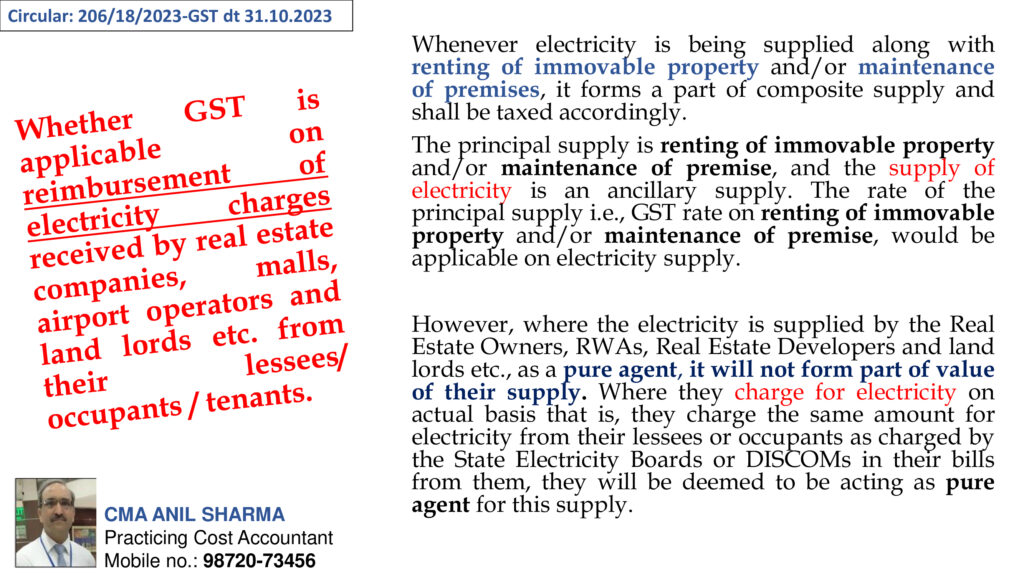
1) New slides on GST Circulars is added in the Notes section titled as "Capsules".
|
- Total 25 slides in capsule-01 is added
|
|
|
|
|
|
|
|
6. GST Daily by CA Pradeep Modi
CA Pradeep Modi is presenting judgment analysis under title 'GST Daily - Stay yourself updated'
|
|
|
|
|
|
|
Recap of Latest updates posted on 27.08.2026
|
CBIC issued Notification No. 30/2026-Customs dated 21.08.2026 regarding Seeks to exempt 10 lakh MT of raw sugar falling under tariff heading 1701 from the whole of the customs duty leviable thereon under …
|
GSTN is taking downtime to enhance its services on the GST Portal on 26.08.2026 from 12:00 AM onwards until 6:30 am of 26.08.2026.
|
The Hon’ble Supreme Court in M/s G.R. Infra Projects Limited set aside the Show Cause Notice dated June 13, 2025 issued under Section 74 of the CGST Act read with the MPGST Act for the FY 2018-19, and held that a bland and mechanical recital of the words ‘fraud or concealment of facts’,
|
Indian Railway Finance Corporation Ltd received a show cause notice from the GST Authority demanding ₹549.32 crore. The notice, issued under Section 73 of the Central Goods and Services Tax Act, 2017, cites excess input tax credit claims for FY23.
|
The Anti-Corruption Bureau (ACB) on Monday arrested a state tax officer and a senior assistant in Nirmal district for demanding and accepting a bribe of ₹50,000 in connection with a GST audit.
|
CBIC issued Notification No. 71/2026-Customs (N.T.) dated 25.08.2026 regarding Fixation of Tariff Value of Edible Oils, Brass Scrap, Areca Nut, Gold and Silver
|
CBIC issued Notification no. 21/2026-Customs (ADD) dated 21.08.2026 that Seeks to continue applicability of anti-dumping duty on imports of Natural Mica based Pearl Industrial Pigments ..
|
CBDT issued notification no. 115/2026 dated 21.08.2026 to hereby approves deduction under section 45(3)(a)(i) of the Income tax Act, 2025 to the International Institute of Bio Technology and Toxicology , Tamil Nadu for Scientific Research
|
I request the views of tax professionals and TDS experts on the following issue under the Income-tax Act, 2025, regarding reporting in Form 140.
|
|
|
|
|
|
7. PPT/Handbook on GST
|
|
|
|
8. GST/Income Tax in Media
|
|
|
|
|
|
|
|
|
|
|
|
|
|
|
|
This is an advance information to the all users – Taxpayers and Tax Officers, of GST System who use Digital Certificate Signature on the GST Portal.
|
CBIC issued Instruction no. 16/2026-Customs dated 18.09.2026 regarding Authorised Officers under Section 25 read with Section 47 (5) of Food Safety Standards (FSS) Act, 2006 and Regulation 13 (1) of FSS (Import) Regulation, 2017 .
|
CBIC issued Instruction no. 17/2026-Customs dated 21.09.2026 giving Clarification in respect of difficulties being faced by field formations in adjudication of cases where Show Cause Notices have been issued under Section 28AAA of the Customs Act, 1962
|
CBDT issued notification no. 120/2026 dated 17.09.2026 to hereby make following rules further to amend the Income tax Rules, 2026 , namely –
|
Input Tax Credit (ITC) as a concept is easy to understand, but it pose challenges when we want to claim the credit.
|
The Hon'ble Supreme Court in M/s Nageen Traders and Molding India Pvt. Ltd. issued notice and stayed the operation of the judgment of the Hon'ble Allahabad High Court, Lucknow Bench, in M/s Nageen Traders and Molding India Pvt. Ltd.
|
Input tax Credit (ITC) should be correctly recorded in the books of accounts. Timely recording in books is of great advantage. It helps in working capital management.
|
Let us see some scenario where Input tax credit claim need critical thinking -
|
The Hon’ble Supreme Court in GVK Jaipur Expressway Pvt. Ltd. issued notice in the Special Leave Petition filed by the Assessee challenging the judgment of the Hon’ble Rajasthan High Court, which had dismissed its writ petition against a total GST demand of Rs. 14,06,54,640/-,
|
|
|
|
|
|
|
|
|
Recap of Latest updates posted on 17.09.2026
|
CBIC will conduct outreach programmes and handhold MSMEs to encourage them to opt for the Eligible Manufacturer Importer (EMI) scheme, a senior official said on Wednesday.
|
The Superintendent of Central GST, Mohit Pratap Singh, was caught while allegedly accepting a bribe of Rs 8 lakh through a mediator, the Lokayukta said.
|
Keeping track of provident fund and pension-related announcements could become easier for millions of EPFO subscribers, with the Employees’ Provident Fund Organisation (EPFO) launching an official WhatsApp channel.
|
Tax officer imposed a 200% penalty of Rs. 4.85 lakh, but ITAT cut it to Rs. 1.21 lakh.
|
Hon'ble Delhi High Court in case of M/s. Katyani Exports and connected matters decided on 16.09.2026 that the Jurisdiction stood vested by way of the statute and the notifications thereof.
|
The principal issue was framed as ‘Whether the classification should be merely based on the textual entry under Heading 8421 or whether the ‘sole or principal use test’ should be applied?’.
|
The Union government has moved the Supreme Court against a Punjab and Haryana High Court ruling that declared Section 147A of the Income Tax Act unconstitutional, a decision that has raised questions over the validity of reassessment proceedings conducted by jurisdictional tax officers.
|
The September 30, 2026 deadline for filing tax audit reports for assessment year (AY) 2026-27 is fast approaching, but the government has not announced any extension so far.
|
GST officers have arrested a partner of a firm engaged in trading of iron and steel goods for fraudulently availing input tax credit of over Rs 15.78 crore.
|
The Preventive Wing of the Central Goods and Services Tax (CGST) Commissionerate, Shimla, has uncovered an alleged GST fraud involving input tax credit of around ₹5.55 crore in the Kala Amb industrial area of Sirmaur district.
|
GSTN is taking downtime to enhance its services on the GST Portal on 18.09.2026 from 12:00 AM onwards until 2:00 am of 18.09.2026.
|
First of all the taxpayer must ascertain the eligibility of the Input Tax Credit (ITC) on his purchases, expenses and capital goods.
|
The Hon’ble Delhi High Court in Rohit Garg disposed of a batch of writ petitions assailing the SCN and Orders-in-Original (“OIO”) passed under Section 122 of the the CGST Act
|
The Hon’ble Supreme Court in M/s PVCON Engineering Co. issued notice on the question whether the mandatory pre-deposit for preferring an appeal before the Goods and GSTAT in penalty-only matters
|
|
|
|
|
|
|
|
|
DGFT issued Trade Notice 28/2026-27 dated 16.09.2026 regarding Revision in Timeline for Issuance of PSIC and One-time Relaxation for Issuance of Backlog PSICs
|
Systems of Central Board of Direct Taxes (CBDT) issued notification no. 3/2026 dated 15.09.2026 to prescribe Procedure for registration of reporting person/entity and submission of Form No. 98 as per rule 160 of the Income tax Rules, 2026.
|
Fixation of Tariff Value of Edible Oils, Brass Scrap, Areca Nut, Gold and Silver
|
GSTN is taking downtime to enhance its services on the GST Portal on 17.09.2026 from 03:00 AM onwards until 4:30 am of 17.09.2026.
|
CESTAT, Hyderabad, has upheld relief granted to the Northern Power Distribution Company of Telangana (NPDCL), holding that delayed payment surcharges and meter-testing charges collected from consumers are not liable to service tax.
|
|
|
|
|
|
|
|
|
Recap of Latest updates posted on 14.09.2026
|
DGFT issued Notification No. 36/2026-27 dated 15.09.2026 regarding De minimis exemption from Registration-cum-Membership Certificate (RCMC) requirements for low-value exports
|
CBDT issued notification no. 119/2026 dated 14.09.2026 to hereby approve the Indian Institute of Technology , Roorkee for Scientific Research under the category of University, college or other institution , for the purposes of Section 45(a)(i) of the Income tax Act, 2025, and rules 32 and 34 of the Income tax Rules, 2026.
|
Central Board of Indirect Taxes and Customs (CBIC) issued Notification no. 22/2026-Customs (ADD) dated 14.09.2026 that Seeks to amend Notification No. 73/2021-Customs dated 17.12.2021 to extend the anti-dumping duty on imports of “Calcined Gypsum Powder” originating in or..
|
GSTN is taking downtime to enhance its services on the GST Portal on 16.09.2026 from 12:00 AM onwards until 2:00 am of 16.09.2026.
|
The Hon’ble Madras High Court (Division Bench) in Principal Commissioner of Customs set aside the order of the Learned Single Judge directing return of the seized currency and held that Indian currency seized during the investigation of fraudulent claims under the Amnesty Scheme of the DGFT, where such currency constituted evidence of Hawala transactions and illegal gratification, is liable to be treated as a “thing” under Section 110(3) of the Customs Act, 1962
|
The Directorate of Revenue Intelligence (DRI) seized more than 362 metric tonnes of Pakistan-origin dry dates under 'Operation Deep Manifest' during an enforcement drive targeting illicit trade conduits.
|
The tax department is increasingly using artificial intelligence (AI), data analytics and information from multiple government databases to identify anomalies, detect potential tax risks and sharpen scrutiny of taxpayers.
|
The Telangana Commercial Taxes Department has issued detailed guidelines governing the use of Artificial Intelligence tools and other third party online platforms by its officers, making individual officers personally accountable for any unauthorised sharing of taxpayer information through such platforms.
|
Punjab’s excise and taxation officials detained 170 vehicles carrying goods suspected to be in violation of GST provisions, officials said on Monday.
|
|
|
|
|
|
|
|
|
Recap of Latest updates posted on 14.09.2026
|
DGFT issued Trade Notice 27/2026-27 dated 14.09.2026 Inviting comments/suggestions on Amendment in Para 2.93 of the Handbook of Procedures, 2023 – Rules of Origin (Non-Preferential).
|
DGFT issued Public Notice 30/2026-27 dated 14.09.2026 regarding Extension of timeline for surrender of unutilised TRQ quantity allocated for import of 10 Lakh MT of Raw Sugar
|
The Hon’ble Allahabad High Court (Lucknow Bench) in M/s VosslohCogifer Turnouts India Pvt. Ltd. directed the Revenue to disburse the sanctioned refund of Rs. 1,10,72,753/-, which was earlier directed to be re-credited as ITC in the E Cr. L, in cash/ in the bank account of the assessee
|
GSTAT Delhi Bench passed an order on 07.09.2026 directing Registry to conduct the scrutiny of the appeal within three weeks from today.
|
An international passenger was caught trying to smuggle nearly 1.6 kg of gold worth about Rs 2.4 crore by concealing it in his undergarment at Delhi's Indira Gandhi International Airport, officials said.
|
The law may prescribe the limits of liberty; but a judge hearing the bail plea of a prisoner above 75 –who is suffering from health issues – must have the “spine to do justice”.
|
The Preventive Wing of the Central Goods and Services Tax (CGST) Commissionerate, Shimla, has unearthed an Rs 6.55-crore fraud involving fake invoices and fraudulent claims of input tax credit (ITC)
|
Amid the growing use of artificial intelligence in tax administration, the state commercial taxes department has imposed strict safeguards on the use of AI tools by its officials, making them personally accountable for any unauthorised disclosure of taxpayer information through such platforms.
|
The Central Bureau of Investigation (CBI) has arrested Superintendent, Land and Building Section at office of Commissioner of CGST and Central Excise, Raigad and a CGST consultant, in a bribery case.
|
|
|
|
|
|
|
|
|
Recap of Latest updates posted on 13.09.2026
|
CBDT has issued Notification No. 114/2026 dated 14.08.2026, notifying the rules and prescribed forms under the Foreign Assets of Small Taxpayers Disclosure Scheme, 2026.
|
The tax department cannot tax rental income in the hands of individual landowners if the commercial building was constructed under a joint development agreement (JDA) and the earnings from it have already been disclosed and assessed in the hands of a genuine partnership firm, the Income Tax Appellate Tribunal (ITAT) Bangalore has recently ruled.
|
The app-based mobility industry has pitched for exemption from the 5% goods and services tax (GST), arguing that the levy is being imposed on platforms that often do not collect fares from passengers.
|
State Bank of India, India’s largest lender, is developing a lending solution that will use UPI transaction data as a proxy for sales to extend loans to small businesses that do not have Goods and Services Tax registration
|
The Gujarat assembly on Thursday passed two bills, one amending the Gujarat GST Act to bring it in line with decisions of the GST Council and other seeking to regulate the manufacture, storage, distribution, sale and quality control of livestock and poultry feed.
|
The European Commission has proposed that the European Union approve and conclude its free-trade agreement with India, bringing the long-awaited pact closer to taking effect.
|
Commercial Taxes Department Chief Commissioner Babu A has said that the State is leveraging GST and related commercial tax data to develop a real-time mechanism for assessing economic activity and estimating Gross Value Added (GVA) across key sectors.
|
Two income-tax officials and two others were arrested Thursday for allegedly conducting a fake raid on a Chakala company and demanding Rs 1 crore, taking the total arrests in the case to 10. It was masterminded by a driver sacked by the company three months ago, said police.
|
HDFC Life Insurance Company Ltd on Friday (September 11) said that the Commissioner (Appeals-III), CGST & Central Excise, Mumbai, has confirmed the total Goods and Services Tax (GST) demand, including interest and penalty, in a case involving the period from July 1, 2017 to March 31, 2022.
|
Haryana State Vigilance and Anti-Corruption Bureau (SV&ACB) on Thursday arrested a State GST excise and taxation officer (ETO) and a chartered accountant from Jind as they were caught accepting a cash bribe in connection with a pending tax notice.
|
The Act modernises the legal framework for use of banking records as evidence.
|
The West Bengal Authority for Advance Ruling (AAR) has held that electricity charges recovered by a commercial building maintenance company from occupants at actual cost, without any markup or profit, will not attract Goods and Services Tax (GST).
|
|
|
|
|
|
|
|

|
Recap of Latest updates posted on 12.09.2026
|
B Venkateswaran, IRS , Central GST (Retired), GST Consultant has listed all the practical difficulties, procedural issues and give suggestions for the GST Council to consider.
|
DGFT issued Trade Notice 25/2026-27 dated 07.09.2026 regarding Introduction of Open API Integration for Certificate of Origin (CoO) through Trade Connect e-Platform
|
DGFT issued Trade Notice 26/2026-27 dated 07.09.2026 regarding Comments/views on proposed suspension of 544 Standard Input Output Norms (SIONs) remaining unutilized during the last three financial years
|
CBDT issued notification no. 118/2026 dated 09.09.2026 to hereby specify Secretary , ITE&C , Government of Andhra Pradesh for the purpose of sharing of information regarding income-tax payers for identifying eligible beneficiaries under various welfare schemes being implemented by Government of Andhra Pradesh.
|
DGIT prescribes the Format, Procedure and Guidelines for submission of State of Financial Transaction (SFT-2517) for Depository Transactions under section 508(1) of the Income-tax Act, 2025
|
DGIT of CBDT issued notification no. 2/2026 dated 10.09.2026 to prescribe Format, Procedure and Guidelines for submission of Statement of Financial Transaction (SFT-2518) for Mutual Fund Transactions under section 508(1) of the Income-tax Act, 2025 read with sub-rule 6 of rule 237 of the Income-tax Rules, 2026 by Registrar and Share Transfer Agent.
|
CBIC issued Instruction no. 15/2026-Customs dated 09.09.2026 regarding Registration of Importers under Centralized EPR Portal for Plastic Packaging as per Plastic Waste Management Rules, 2016 (as amended) and verification of registration
|
The GSTAT, Kolkata Bench in the case of Commissioner, CGST & CX, Kolkata North Commissionerate partially allowed the appeals filed by the Revenue and held that the benefit of exclusion of the value of Duty Credit Scrips from the aggregate value of exempt supplies, introduced by insertion of clause (d) in Explanation 1 to Rule 43 of the Central Goods and Services Tax Rules, 2017
|
The Hon’ble Delhi High Court in A V International & Anr. declined to interfere with the Order-in-Original passed pursuant to the First SCN and held that two SCNs arising out of a common investigation conducted by the DRI retain their independent legal identity, notwithstanding interconnected facts, a…
|
The Hon’ble Supreme Court in M/s. Goodluck India Limited & Anr. dismissed the appeals filed by the Revenue and declined to interfere with the judgment of the Hon’ble Gujarat High Court in Addwrap Packaging Pvt. Ltd. &A nr. , thereby affirming that the omission of Rule 96(10) of the CGST Rules vide Notification No. 20/2024-Central Tax dated October 08, 2024, without any saving clause, applies squarely to ..
|
The Hon'ble Karnataka High Court in Abdul Majid & Ors. granted anticipatory bail to three registered purchasers who were apprehending arrest under Section 132 of the CGST Act on the allegation of availing bogus ITC from allegedly fictitious suppliers..
|
|
|
|
|
Hope the above updates is of use to you. Please share your input and feedback at taxupdate.otu@gmail.com
|
|
|
|
|
|
|
|
 
|
Visit our website
|
OTU provides you
|
- Articles on various topics
|
|
- Media - GST, Income Tax & Press R.
|
|
|
|
|
