|
onlinetaxupdate team wish to express sincere thanks to all the readers, authors, subscribers for the support extended to us. Please share your feedback at
|
taxupdate.otu@gmail.com or 7738647904
|
Newsletter 128 dated 29.07.2024
|
|
|
|
|
|
|
|
|
Dear Reader,
|
Please find newsletter for your reading and reference.
|
|
Index of the Newsletter
- Recent updates
- Budget Posts
- Article
- Lawgics by Ms.Nidhi Aggarwal
- GST Notes by CMA Anil Sharma
- GST Daily by CA Pradeep Modi
- PPT/Handbook
- GST/IT/Customs in media
- Latest Update - Recap
|
|
|
|
|
|
|
GSTN is taking downtime to enhance its services on the GST Portal on 27.06.2026 from 12:00 AM onwards until 2:30 am of 27.06.2026.
|
|
We shall be enhancing services on the GST portal on : 27th June’26 12:00 AM onwards. GST Portal services will not be available until 27th June’26 02:30 AM. The inconvenience caused is regretted.
|
|

|
|
|
|
|
|
|
|
|
GSTN is taking downtime to enhance its services on the GST Portal on 12.06.2026 from 11:30 AM onwards until 7:30 am of 13.06.2026.
|
We shall be enhancing services on the GST portal on : 12th June’26 11:30 PM onwards. GST Portal services will not be available until 13th June’26 07:30 AM. The inconvenience caused is regretted.
|
|
|
|
|
|
|
|
GSTN Advisory no. 664 dated 17.06.2026
|
Reference is invited to the GSTN Advisory dated 20.05.2026 regarding enhancements in the e-Way Bill system, wherein it was informed that “Ship-to GSTIN” shall be mandatorily captured in Bill-to/Ship-to transactions. It was also clarified that where the consignee is an unregistered person, the value “URP” shall be entered in the Ship-to GSTIN field.
|
In this regard, representations have been received from trade, ERP vendors, GSPs, ASPs, private IRPs and other stakeholders seeking clarification on the applicability of the said requirement in cases where e-Way Bill is generated along with e-Invoice or by using IRN. Representations have also been received regarding the Voluntary Closure of e-Way Bill facility and its impact on portal-based and API-based operations.Accordingly, an advisory has been issued to apprise stakeholders of the corresponding changes introduced in the e-Invoice API, e-Way Bill by IRN API and EWB Closure API. It has also been informed that the aforesaid changes have been made available in the Sandbox environment for testing and system preparedness. The changes are scheduled to be implemented in the Production environment with effect from 1st August, 2026.
|
All concerned stakeholders may accordingly be advised to access the advisory through the link given below and undertake necessary testing, system changes and preparedness within the prescribed timeline.
|
|
|
|
|
|
|
|
GSTN Advisory no. 663 dated 09.06.2026
|
Reference is invited to the GSTN Advisory dated 20.05.2026, wherein it was informed that the following functionalities would be implemented in the E-Way Bill system with effect from 15th June, 2026:
|
- Mandatory capture of "Ship To GSTIN" in Bill-To/Ship-To transactions; and
- Voluntary Closure of E-Way Bill functionality.
Representations have been received from trade and industry seeking extension of the implementation timeline, citing the requirement of system changes, testing, API/ERP readiness and master data updation across the taxpayer ecosystem.
|
In view of the above, and to facilitate smooth transition and adequate preparedness by taxpayers, GSPs, ERP providers and other stakeholders, it has been decided to extend the implementation timeline for both the above functionalities.
|
Accordingly, the mandatory capture of "Ship To GSTIN" in Bill-To/Ship-To transactions and the Voluntary Closure of E-Way Bill functionality shall be implemented with effect from 1st August, 2026, instead of 15th June, 2026.
|
Taxpayers, GSPs, ERP providers and other stakeholders are advised to complete the necessary system changes, testing and operational preparedness before the revised implementation date.Thank you,
Team GSTN
|
|
|
|
|
|
Export consignments to West Asia will continue to receive enhanced insurance cover against payment defaults until September 30, the Directorate General of Foreign Trade (DGFT) said in a notification on Monday.
|
Earlier, the enhanced cover for exporters taking credit risk insurance from Export Credit Guarantee Corporation (ECGC) was available for shipments to West Asia sent between March 16 and June 15.
|
The enhanced risk cover announced on March 19 was part of the Resilience and Logistics Intervention for Export Facilitation (RELIEF) scheme under the Export Promotion Mission (EPM) to support exports to West Asia in view of the Iran war.
|
"The eligibility timelines under Component II of the EPM RELIEF intervention are extended up to September 30, 2026 to support Indian exporters and mitigate logistics challenges arising out of the continuing West Asia Crisis," the DGFT said.
|
Source: The Economic Times
|
|
|
|
|
|
|
|
Directorate General of Foreign Trade (DGFT) issued Public Notice No. 17/2026-27 dated 04.06.2026 regarding Enlistment under Appendix 2E of FTP, 2023-Agency Authorised to issue Certificate of Origin (Non-Preferential)
|
|
|
|
|
|
|
|
Directorate General of Foreign Trade (DGFT) issued Trade Notice 07/2026-27 dated 03.06.2026 regarding request for comments on alignment of Schedule-II (Export Policy) of ITC (HS), 2022 consequent to amendments introduced under the Finance Act, 2026
|
|
|
|
|
|
|
|
Index:
- Amendments to the Central Goods and Services Tax Act, 2017 (CGST Act):
- Amendments to the Integrated Goods and Services Tax Act, 2017 (IGST Act):
- Amendments to the Union Territory Goods and Services Tax Act, 2017 (UTGST Act):
- Amendments to the Goods and Services Tax (Compensation to States) Act, 2017:
Amendments to the Central Goods and Services Tax Act, 2017 (CGST Act):
- Section 9 Amendment: Sub-section (1) of Section 9 is amended to include the words "and un-denatured extra neutral alcohol or rectified spirit used for manufacture of alcoholic liquor, for human consumption "after" alcoholic liquor for human consumption."
- Section 10 Amendment: Sub-section (5) of Section 10 is amended to add the reference to "section 74A" after "section 73 or section 74."
- Insertion of Section 11A :A new Section 11A is inserted, allowing the Government, upon being satisfied that a prevalent practice regarding the levy or non-levy of central tax on any supply of goods or services was or is in place, to issue a notification directing that the central tax payable on such supplies, or the excess central tax collected, shall not be required to be paid.
- Section 13 Amendment: Sub-section (3) of Section 13 is amended:
- Clause (b) is modified to clarify that the supplier needs to issue the invoice only in cases where it is required.
- A new clause (c) is inserted, providing that the date of issue of the invoice by the recipient shall be considered where the recipient is required to issue the invoice.
- The first proviso is amended to include a reference to the newly inserted clause(c).
- Section 16 Amendment:
- A new sub-section (5) is inserted, allowing registered persons to take input tax credit (ITC) for invoices or debit notes pertaining to Financial Years 2017-18 to 2020-21in any return filed by November 30, 2021.
- A new sub-section (6) is inserted, specifying that if a registration is cancelled and later revoked, the person shall be entitled to ITC for relevant invoices or debit notes in a return filed within specific timelines after the revocation order.
- Section 17 Amendment: Sub-section (5), clause (i) is amended to restrict the applicability of Section 74 for the period up to the Financial Year 2023-24, excluding references to Sections 129 and 130.
- Section 21: Amendment to include reference to the newly introduced Section 74A, in addition to Sections 73 and 74.
- Section 30: Introduces a new proviso in subsection (2) which states that revocation of cancellation of registration shall be subject to conditions and restrictions as may be prescribed.
- Section 31:
- Amendment to sub section (3)(f) to mandate that the period within which the tax must be paid shall be prescribed.
- Insertion of an explanation under clause (g) to clarify that a "supplier who is not registered" includes those registered solely for tax deduction under Section 51.
- Section 35: Amendment to include reference to Section 74A along with Sections 73 and 74 in sub section (6).
- Section 39: Substitution of subsection (3) to require registered persons who deduct tax at source under Section 51 to file monthly returns in a prescribed form and manner, regardless of whether any deductions have been made during that month.
- Section 49: Amendment to include reference to Section 74A in subsection (8)(c).
- Section 50: Amendment to include reference to Section 74A in the proviso of subsection (1).
- Section 51: Amendment to include reference to Section 74A in subsection (7).
- Section 54: Removal of the second proviso in subsection (3).
- Insertion of a new subsection (15) disallowing refunds of unutilized input tax credit or integrated tax paid on zero-rated supplies of goods if those goods are subject to export duty.
- Section 61: Amendment to include reference to Section 74A in subsection (3).
- Section 62: Amendment to include reference to Section 74A in subsection (1).
- Section 63: Amendment to include reference to Section 74A.
- Section 64: Amendment to include reference to Section 74A in subsection (2).
- Section 65: Amendment to include reference to Section 74A in subsection (7).
- Section 66: Amendment to include reference to Section 74A in subsection (6).
- Section 70: Insertion of a new subsection (1A) mandating that all persons summoned must attend as directed and truthfully provide statements or documents during examination.
- Section 73: Amendment to marginal heading to specify that the determination of tax applies to periods up to FY 2023-24.
- Insertion of a new subsection (12) to confirm that the provisions of this section apply only to tax determination up to FY 2023-24.
- Section 74: Amendment to marginal heading to specify that the determination of tax applies to periods up to FY 2023-24.
- Insertion of a new subsection (12) to confirm that the provisions of this section apply only to tax determination up to FY 2023-24.
- Omission of Explanation 2.
- Insertion of Section 74A: Introduces provisions for tax determination, refunds, and penalties for the period starting from FY 2024-25 onwards.
- Specifies the process and timelines for issuing notices, determining tax, and the applicable penalties.
- Provides different penalty structures depending on whether the non-payment or short payment of tax was due to fraud or other reasons.
- Clarifies the process for concluding proceedings and defines the term "suppression" in the context of this section.
- Section 75: Sub-section (1): The applicability of Section 75(1) is extended to include references to sub-sections (2) and (7) of Section 74A.
- Insertion of Sub-section (2A): A new provision is added where, if an Appellate Authority, Appellate Tribunal, or court finds that the penalty under Section 74A(5)(ii) is not sustainable due to the absence of fraud, willful misstatement, or suppression of facts, the person shall be liable to pay a penalty under Section 74A(5)(i).
- Sub-section (10): Substituted to clarify that adjudication proceedings shall be deemed concluded if the order is not issued within the prescribed time limits in Section 73(10), Section 74(10), or Section 74A(7).
- Sub-sections (11), (12), and (13): Expanded to include references to Section 74A in addition to Sections 73 and 74.
- Section 104: The Explanation in sub-section (1) is amended to include references to sub- sections (2) and (7) of Section 74A.
- Section 107:
- Sub-section (6)(b): The term "twenty-five" is replaced with "twenty."
- Sub-section (11): References to Section 74A are added in the second proviso.
- Section 109:
- Sub-section (1): Expanded to allow the Principal Bench to conduct examinations or adjudicate cases referred to in Section 171(2), if notified.
- Sub-section (5): Added provisos that specify certain cases to be adjudicated only by the Principal Bench.
- Sub-section (6): Amended to make the President’s powers subject to the provisions of sub-section (5).
- Section 112:
- Sub-sections (1) and (3): Amendments effective from August 1, 2024, allowing the filing of appeals or applications withinthe prescribed period or withinthree months after the date notified by the Government, whichever is later.
- Sub-section (6): Added provisions allowing applications to be filed within three months after the expiry of the period specified in sub-section (3).
- Sub-section (8)(b): The terms "twenty percent" and "fifty crore rupees" are replaced with "ten per cent" and "twenty crore rupees," respectively.
- Section 122: Sub-section (1B): The term "Any electronic commerce operator who" is substituted with "Any electronic commerce operator, who is liable to collect tax at source under section 52."
- Section 127: The section is amended to include references to Section 74A in addition to Sections 73 and 74.
- Insertion of Section 128A: A new section providing for the waiver of interest and penalty under specific conditions where a person pays the full amount of tax for periods from July 1, 2017, to March 31, 2020, as specified in Section 128A(1). Conditions for the conclusion of proceedings, as well as exceptions, are also detailed.
- Section 140: Sub-section (7): Amended retrospectively from July 1, 2017, to include invoices received prior to, on, or after the appointed day.
- Section 171: Sub-section (2): Adds a proviso allowing the Government to specify a date from which the Authority shall not accept requests for examination regarding the reduction of tax rates or input tax credits. The section also clarifies the definition of "Authority" to include the "Appellate Tribunal."
- Schedule III: New paragraphs are added, specifically addressing the treatment of co- insurance premiums and reinsurance commissions in GST, clarifying the responsibilities of the lead insurer and reinsurer regarding tax payments.
- Section 150: Provides that no refund will be made for taxes paid or input tax credits reversed under circumstances where such payments or reversals would not have been required if Section 118 had been in force at all relevant times.
Amendments to the Integrated Goods and Services Tax Act, 2017 (IGST Act):
- Section 5(1): A new clause is hereby inserted, bringing within the ambit of goods subject to integrated tax, "un-denatured extra neutral alcohol or rectified spirit used for the manufacture of alcoholic liquor for human consumption.
- New Section 6A: A mechanism is introduced whereby the Government may, upon being satisfied that a general practice of non-levy or short-levy of integrated tax was prevalent, exempt the payment of integrated tax (or excess tax) on certain supplies.
- Section 16(4): This section is clarified to ensure that claims for refunds of integrated tax paid on zero-rated supplies are to be governed in accordance with the provisions of the Central Goods and Services Tax Act, 2017.
- Section 16(5): It is stipulated that no refund of unutilized input tax credit shall be permitted on zero-rated supplies of goods if such goods are subject to export duty.
- Section 20 (Proviso): A proviso is added to cap the maximum amount payable for each appeal to the Appellate Authority or Tribunal at ₹40 crore.
Amendments to the Union Territory Goods and Services Tax Act, 2017 (UTGST Act):
- Section 7(1): A clause similar to that inserted in the IGST Act, includes "un-denatured extra neutral alcohol or rectified spirit used for the manufacture of alcoholic liquor for human consumption" under the goods subject to Union Territory tax.
- New Section 8A: A provision analogous to Section 6A of the IGST Act is introduced, allowing the Government to waive the Union Territory tax (or excess tax) if it is satisfied that a general practice of non-levy or short levy of tax was prevalent.
Amendments to the Goods and Services Tax (Compensation to States) Act, 2017:
- New Section 8A: This new section authorizes the Government to waive the cess (or excess cess) payable on certain supplies, provided it is satisfied that a general practice of non-levy or short levy of cess was prevalent.
|
|
|
|
|
|
|
The Parliament received the assent of the President on the 16th August, 2024 and the Finance Bill is now 'The Finance (No. 2) Act, hereby published for general information.
|
|
|
|
|
|
|
|
Parliamentary approval for the 2024-25 Budget was completed Thursday with Rajya Sabha returning the relevant pieces of legislation to Lok Sabha.
|
Rajya Sabha returned the appropriation and finance Bills for 2024-2025 after Finance Minister Nirmala Sitharaman responded to the Opposition’s attack that the Budget was anti-middle class, saying the government had reduced the burden on the middle class.
|
The Upper House returned the Appropriation (No. 2) Bill, 2024, the Jammu and Kashmir Appropriation (No. 3) Bill, 2024 and the Finance (No. 2) Bill, 2024, which were passed by the Lok Sabha on Wednesday.
|
This completes the Budgetary exercise for 2024-25.
|
Replying to the discussion on the three Bills, the Finance Minister said the effective capital expenditure this year would be `15.02 lakh crore, an increase of 18% from 2023-2024. She said the increasing capital expenditure since 2020 had a bearing on private investment, consumption and exports.
|
She added that the Centre was not doing that alone, but was giving states 50-year interest-free loans, “which eventually will be treated probably as grants”.
|
She said allocations of `22.91 lakh crore were estimated for states in 2024-2025, an increase of `2.49 lakh crore from last year.
|
She said the government has simplified taxation.
|
“Compared with very many developed economies, which have actually increased the tax rates, despite the pressure from Covid times, we have actually reduced the burden on the middle class substantially,” the Minister said.
|
Responding to demands from Opposition MPs, including TMC MP Dola Sen and DMK MP Dr. Kanimozhi NVN Somu, to withdraw 18% GST on health insurance premiums, Sitharaman asked if the MPs had raised the issue with the Finance Ministers of their states who are members of the GST Council.
|
|
|
|
|
|
|
|
On the withdrawal of 18% goods and services tax (GST) on life and health insurance premiums, Finance Minister Nirmala Sitharaman said on August 7, 2024, that tax had been there on medical insurance even before the introduction of GST. During her reply to the amendments of Finance Bill, 2024, Sitharaman said, "I want to raise two important points - tax has been there on medical insurance even before the introduction of GST. There was already a pre-GST tax on medical insurance before the GST was introduced. This is not a new issue, it was already there in all the states. Those protesting here... did they discuss regarding the removal of this tax in their states?"
|
A GST of 18% on life or health insurance policies pinches policyholders and discourages citizens from taking a new or higher insurance cover. The pain of policyholders gets amplified as insurance is a product where most beneficiaries will get the benefit only when they face an eventuality like death or hospitalisation. What this means is that in some cases, they would pay the premium and high tax but not get the benefit.
|
Around Rs 24,000 crore was collected from GST on health and life insurance in the last three financial years. Sitharaman said, "73-74% of the amount collected under the GST goes to the states."
|
The finance minister highlighted that states had two-thirds share in GST Council and they were capable of taking a decision.
|
“Several suggestions have come up and I shall take up with the GST Council,” Sitharaman said.
|
While the insurance industry has been raising its voice against this, the issue of 18% goods and services tax (GST) on life and health insurance premiums has again come to the forefront now. The political parties of the INDIA bloc have recently protested the high tax outside the Parliament building and demanded that the central government withdraw this GST. A few days ago, Union Minister of Road Transport and Highways Nitin Gadkari wrote to Finance Minister Nirmala Sitharaman urging her to roll back the 18% GST on such financial products. After Gadkari's letter, West Bengal Chief Minister Mamata Banerjee has also urged Sitharaman to remove GST on insurance premiums.
|
GST on insurance: 'Levying GST on life insurance premiums amounts to levying tax on the uncertainties of life' says Nitin Gadkari's letter to FM
Gadkari has said it concisely in his letter. “Levying GST on life insurance premiums amounts to levying tax on the uncertainties of life,” said the letter dated July 28, 2024. The minister has highlighted the concerns outlined in a memorandum submitted by the Nagpur Division Life Insurance Corporation Employees Union about matters affecting the insurance industry. Referring to the memo, the minister said: “The union feels that the person who covers the risk of life’s uncertainties to give protection to the family should not be levied tax on the premiums to purchase cover against this risk. Similarly, the 18% GST on medical insurance premiums is proving to be a deterrent for the growth of this segment of business, which is socially necessary.”
|
Banerjee argued that the imposition of GST on insurance premiums increases the financial burden on the common people. "This additional burden may be acting as a deterrent for many individuals from taking new policies or continuing their existing insurance coverage, thereby leaving them vulnerable to unforeseen financial distress," her letter read.
|
'Insurance is a basic necessity, can't levy GST on premiums'
Insurance industry players have been actively advocating for the removal of this tax, arguing that it significantly increases the cost of insurance coverage for policyholders.
|
Sumit Rai, MD & CEO, of Edelweiss Life Insurance, says, "It is indisputable that insurance is a basic necessity, given its role of providing financial protection to households during adversities like death, disease or disability. It, therefore, cannot be categorised with luxury items like perfumes, chocolates, etc, which currently attract the same 18% GST. Other necessities like food, clothing, and medicines, attract 5-12% GST. Given its longer-term assets, the insurance sector also plays a key role in the country’s advancement by supporting longer-term projects like infrastructure development. It is, therefore, critical that GST on insurance is rationalised to bring down the tax burden and make the product attractive to the consumer. Not only will it support the regulator’s vision of ‘Insurance for all by 2047’, but also will be aligned with the government’s development agenda."
|
It's high time govt removes GST from health insurance premiums
A GST of Rs 24,500 crore has been collected on health insurance and reinsurance premiums in the past three years, according to the Ministry of Finance’s data. Certain schemes like Rashtriya Swasthya Bima Yojana (RSBY), Universal Health Insurance Scheme, Jan Argoya Bima Policy, and Niramaya Health Insurance Scheme are exempt from GST.
|
With premiums surging rapidly, it is even more crucial now to not add any tax on insurance premiums, especially in medical insurance. According to a survey published in May 2024, health insurance premiums have risen significantly for many policyholders. Over half (52% of the respondents) reported a premium increase of more than 25% in the past year, while 21% experienced a hike of 50% or more. Around 31% of the respondents saw their health insurance premiums rise by 25-50%.
|
Pankaj Nawani, CEO of CarePal Secure, says, "Reconsidering the 18% GST on insurance is crucial because health insurance acts as a public good. The government subsidises these costs, but the top 50% are equally vulnerable to catastrophic health expenses. Despite this, health insurance coverage has stagnated at just 1% for over two decades. To ensure broader coverage and foster economic stability, we must encourage insurance uptake across all income levels. Without adequate health insurance, the top income brackets face financial strain that impacts their ability to contribute to the economy and support the government’s social initiatives."
|
Will the Centre remove 18% GST on the insurance premiums?
On the Opposition’s accusation that the Centre has collected Rs 24,500 crore from health insurance GST, Amit Malviya, in-charge of the Bharatiya Janata Party's information and technology department, says, "Of the total collection of Rs 24,529 crore from health insurance (18%), half of it, i.e. Rs 12,264 crore, goes straight to the states (SGST 9%). It doesn't even come to the Centre. Of the Centre's share of collection, roughly 41% is devolved back to the States again as part of Tax Devolution as per Finance Commission's formula!"
|
On the demand to remove the 18% GST, he tweeted: "On cutting GST Rates, Govt of India alone can’t cut the GST rates on health insurance. That decision lies with the GST Council, where states hold 2/3rd power to bring changes."
|
|
|
|
|
|
|
|
The Lok Sabha on Wednesday passed the Finance Bill 2024 after the central government relaxed the freshly-introduced new capital gains tax on real estate, allowing taxpayers an option to switch to a new lower tax rate or stay with the old regime that had higher rate with indexation benefit.
|
Union Finance Minister Nirmala Sitharaman in her Budget speech for 2024-25 proposed to lower the long-term capital gains tax on real estate to 12.5 per cent from 20 per cent but without the indexation benefit. Today, she moved an amendment to the bill to give the option.
|
The amendment came after the new provision was criticised for raising tax incidence and disincentivizing investments in the real estate.
|
What is Indexation benefit?
Indexation benefit allows taxpayers to arrive at the cost price of the property after adjusting for inflation.
|
What does the new amendment say?
The major amendment in the Bill relates to restoration of indexation benefit on sale of properties bought prior to July 23, 2024. Now, individuals or HuFs who purchased houses before July 23, 2024, can opt to pay LTCG tax under the new scheme at the rate of 12.5 per cent without indexation or claim the indexation benefit and pay 20 per cent tax.
|
The Lower House later approved the bill with 45 official amendments by voice vote.
|
Sitharaman on taxes and middle class:
Sitharaman also said that the FY25 Budget proposals were aimed at promoting investment and benefiting the middle class.
|
She said that the hike in tax exemption limit on long-term capital gains in listed equities and bonds to Rs 1.25 lakh from Rs 1 lakh will benefit the middle class investing in stock markets.
|
The Modi government, she said, has brought in a simplified taxation regime and eased compliance without drastically increasing taxes. The reduction in customs duty on various goods will promote trade and investment and generate employment, she added.
|
Bill to now go to Rajya Sabha:
The Finance Bill 2024 will now go to the Rajya Sabha for discussion but the Upper House does not have powers, as per the Constitution, to reject a money bill. It only can return such bills and if they don't do so within the stipulated 14 days, the legislation is considered as approved.
|
Responding to demands for the removal of GST on health and life insurance premiums, Sitharaman said that 75 per cent of the GST collected goes to states.
|
Prior to levying 18 per cent GST on health insurance (premium), all states used to levy tax on insurance premiums. So when GST was rolled out, the tax automatically got subsumed into GST, Sitharaman said.
|
|
|
|
|
|
|
|
Following outrage and concerns from certain quarters over the Budget proposal to remove indexation benefits on long-term capital gains (LTCG), the government Tuesday decided to offer taxpayers a choice to pay 20 per cent LTCG tax with indexation benefit on sale of property acquired before July 23, 2024.
|
The other option introduced in the Budget to pay the tax on LTCG at a reduced rate of 12.5 per cent without indexation will also be available to taxpayers, as per the list of amendments moved by the government in the Finance Bill. Taxpayers can pay the lower tax amount of the two options.
|
These amendments are being seen as a major rollback of the LTCG-related announcements pertaining to the real estate sector in the Budget. While the government had defended the new LTCG tax regime saying indexation benefit back for property bought before Budget that the removal of indexation was more than made up for by the lower tax rate of 12.5 per cent in a vast majority of transactions, the proposals had led to a backlash with calls for relief coming from various sections, including real estate investors and property owners.
|
The amendment, however, makes it clear that for purchases of property after the cut-off date of July 23, 2024, only the new regime with LTCG tax at the rate of 12.5 per cent without indexation will be applicable.
|
Indexation is the process of adjusting the original purchase price of an asset or investment; it allows a taxpayer to neutralise the impact of inflation while paying tax on capital gains. It involves revising upwards the cost of acquisition of an asset based on the inflation over the period for which it was held.
|
Without indexation, particularly in cases where the asset was held for an extended period, the gains may appear extremely high, but they may not paint a realistic picture.
|
With these amendments, effectively all properties purchased before the Budget presentation date — July 23 — have been grandfathered. In the original proposal, there was no grandfathering for properties bought after April 1, 2001. For properties purchased before that date, the fair market value as on April 1, 2001 was to be taken as the cost of acquisition. Put simply, grandfathering is a provision that allows an old rule or law to be applicable to some or all situations up to a certain date, while the new rule or law is applicable to all situations after that date.
|
It may be noted that the amendments provide for a choice between the old and the new LTCG tax regimes only for properties acquired before July 23.
|
“In the case of transfer of a long-term capital asset, being land or building or both, by an individual or HUF (Hindu Undivided Family), which is acquired before the 23rd day of July, 2024, the taxpayer can compute his taxes under the new scheme (at the rate of 12.5 per cent without indexation) and old scheme (at the rate of 20 per cent with indexation) and pay such tax which is lower of the two,” a source said, explaining the key amendment.
|
Notably, the amendments have brought back the indexation benefit for immovable property only and not other unlisted assets like gold. For unlisted securities or shares, the capital gains would be taxed at 10 per cent for transfers before July 23 and 12.5 per cent on or after July 23.
The biggest fear around the Budget proposal on LTCG taxations was that the changes would result in a jump in LTCG tax liability for those looking to sell property. Sensing the anxiety, the Finance Ministry and the Income Tax Department issued multiple clarifications in a bid to assure taxpayers. According to the government, the new LTCG tax regime, even without the benefit of indexation, would be beneficial in a vast majority of cases, as nominal real estate returns are generally in the region of 12-16 per cent per annum, much higher than inflation.
|
Only where returns are low—less than about 9-11 per cent per annum—the earlier tax rate would be beneficial, the Income Tax Department had said, adding that such low returns in real estate are “unrealistic and rare”. The government had also clarified that rollover benefits had not been touched, which means that if capital gains are invested in Section 54EC bonds or used for buying or constructing residential real estate up to specified limits, LTCG would continue to be exempt from tax.
|
Notwithstanding the government’s claims that the new simplified LTCG tax regime shall be beneficial in a majority of cases, concerns persisted. The other major criticism was the absence of grandfathering for purchases made over the past 24 years. There was a clamour for all properties purchased before the Budget presentation date to be grandfathered, and the government has now given into that demand with the amendments to the Finance Bill.
|
There have also been apprehensions that the new regime without the indexation benefit is likely to result in higher frequency of secondary market real estate sales as people would not want to hold on to assets beyond three to five years. Another concern that has been flagged by some industry watchers and even Opposition lawmakers is that the new regime may incentivise use of more cash in property transactions, as sellers will be tempted to deflate the actual transaction value on paper in order to pay less tax.
|
Among the other amendments to the Finance Bill, the Finance Ministry has also amended the definition of undisclosed income for block assessments. Yogesh Kale, Executive Director, Nangia Andersen LLP said, “For the purpose of block assessment provisions, the definition of “undisclosed income” is proposed to be amended to include incorrect claim of exemption within its purview. Originally, the definition included incorrect claims only of expense, deduction or allowance, among other things.”
|
|
|
|
|
|
|
|
The government on Tuesday sought to address a significant concern stemming from the 2024-25 Budget announcement by introducing flexibility in the computation of long-term capital gains (LTCG) tax on unlisted assets, including properties.
|
For any assets, such as land or buildings, sold before July 23, taxpayers can choose between the new and old regimes, opting for whichever results in a lower tax liability.
|
Under the new LTCG regime, the tax rate is set at 12.5 per cent without the benefit of indexation. Conversely, the old regime imposes a 20 per cent tax but allows for indexation benefits. This flexibility effectively serves as a grandfathering provision for all property transactions completed before the Budget's presentation in Parliament on July 23.
|
This adjustment is among the key amendments proposed in the Finance Bill, 2024, regarding the taxation of immovable properties.
|
About 25 additional amendments have been proposed in the Bill. Of these 19 pertain to direct taxes and the remaining to indirect tax laws including customs.
|
Finance Minister Nirmala Sitharaman is expected to present this amendment, along with others, in the Lok Sabha on Wednesday following her response to the debate on the Finance Bill 2024.
|
Commenting on the tweak, Sudhir Kapadia, a senior advisor at EY, said: "With this proposed change to the original Finance Bill, the government has clearly heeded the legitimate concerns of many taxpayers. Without indexation, the tax outgo could have been higher for those selling older properties." He further said what is now proposed gives “the best of both worlds”.
|
The 2024-25 Budget outlines an overhaul of the capital gains tax regime, including lowering the LTCG rate from 20 per cent to 12.5 per cent and eliminating indexation benefits for homes purchased on or after April 1, 2001.
|
This proposal has sparked concerns regarding real estate transactions, as indexation has historically allowed homeowners to account for inflation in tax calculations.
|
Under the originally proposed rule, homeowners would not have been able to adjust for inflation, potentially leading to substantial taxes, especially on older properties with lower selling prices.
|
Indexation is a method used to adjust the purchase price of an asset, such as property, for inflation over time, reducing the taxable capital gains upon sale. By removing indexation, the government aims to simplify the tax calculation process.
|
However, this change has led to higher tax liabilities for property owners, as the original purchase price is now used for calculating capital gains without adjustment for inflation.
|
|
|
|
|
|
|
|
The Association of Mutual Funds of India has urged the government to reconsider tax proposals on capital gains in equities and debt instruments in the Union budget 2024 introduced last week. The budget has proposed to increase short-term capital gains tax from 15% to 20% and long-term capital gains tax from 10% to 12.5%. AMFI has asked for reinstatement of the earlier capital gains taxation rates as the percentage hike is large.
|
"Increasing tax rates on both short-term and long-term gains will deter common investors from choosing mutual funds. Any change in taxation will hamper the efforts to move people from traditional savings to investments," the association said.
|
Moreover, AMFI requested the securities and transaction tax on futures and options be reinstated to the earlier rates, as arbitrage funds and equity savings funds mainly use derivatives for hedging as the underlying assets.
|
"The available arbitrage has now been reduced due to an increase in short-term capital gains tax. Further, the increased STT on futures will add to the cost of these funds," AMFI said.
|
The lobby group has also sought a relook into the proposed removal of indexation benefits from debt mutual funds or provide for holding costs of debt mutual funds to be indexed till July 23, 2024.
|
"We request grandfathering to be permitted for investments made in the respective categories (equities and debt) of funds," AMFI said, explaining the application of new tax rates on a retrospective basis can be detrimental to investor confidence and deter new investors from entering the capital markets.
|
On Section 50AA
The definition of what qualifies as a debt mutual fund has been changed under Section 50AA of the Income Tax Act.
|
The budget proposed to amend the definition of 'Specified Mutual Funds' under Section 50AA of the Income Tax Act that refers to: a) funds investing more than 65% in debt or money market instruments; or b) funds that invest more than 65% in units of funds referred to in (a).
|
Post-amendment, a debt mutual fund is considered a short-term capital asset irrespective of the holding period and will be taxed at applicable rates, whereas for listed bonds, the long-term tax rate is 12.5% and the holding period is kept at 12 months for these securities to be qualified for long-term tax.
|
"With the proposed definition, investors will lose out on long-term capital gains applicability at a much lower threshold of debt/money market investments than envisaged under Clause (a).
|
"AMFI has sought that the definition of Clause (b) be redefined to funds that invest more than 90% in units of funds investing in debt/money market instruments, and the amendment be implemented with immediate effect rather than the proposed April 1, 2026.
|
It has called for capital gains on the redemption of units of debt-oriented mutual funds held for more than one year to be taxed at a rate of 12.5%.
|
|
|
|
|
|
|
|
Expert CMA Anil Sharma, an TIOL Awardee (2021) deliberated on Decoding Indirect Tax in Budget 2024
|
|
|
|
|
|
|
|
Speaker CMA Anil Sharma, an TIOL Awardee (2021) deliberated on Decoding Direct Tax in Budget 2024 at Bhilai Steel Plant, Bhilai on 28.07.2024.
|
|
|
|
|
|
|
|
Budget 2024 increased the Securities Transaction Tax (STT) on all futures and options (F&O) contracts traded on recognised stock exchanges. However, this is not applicable to cryptocurrency F&O transactions. Added to this, some crypto exchanges have taken the stance that no tax deducted on source (TDS) is to be levied on crypto F&O transactions. Investors might find crypto F&O transactions attractive because they might not be subject to the 30% flat crypto gains tax, there is no TDS in certain exchanges, and there is also no STT.
|
While the Budget 2024 introduced changes to the STT rates for F&O transactions in securities, these changes do not apply to crypto transactions. "While the Budget 2024 introduced changes to the STT rates for F&O transactions in securities, these changes do not apply to crypto transactions, as crypto transactions are categorised as commodities. Therefore, the rules for crypto F&O transactions regarding TDS and section 115BBH tax rate remain the same, and no STT is charged on these transactions," says CA Abhishek Soni, co-founder, Tax2Win.
|
When is TDS required to be deducted from crypto, VDA transactions
According to Section 194S, 1% TDS is deducted on all VDA transactions from July 1, 2022.
|
"A new section 194S was introduced in relation to TDS on payment while transferring VDAs via the Finance Act, 2022. By virtue of the said provision, any person making payments (exceeding the prescribed threshold) to any resident for transfer of VDAs shall be responsible for deduction tax at source at the rate of 1% of the value of the VDAs," says Deepa Sheth, Partner, Corporate Tax, Tax & Regulatory Services, BDO India.
|
However, there is an ambiguity in interpreting the law about TDS deduction on crypto F&O transactions. As per Nithin Kamanth's social media post on July 10, 2024, "On one side, SEBI is working on restricting F&O, but on the other side, this crypto F&O ad is on the front page (of a newspaper). By the way, all these platforms have taken the stance that the 1% TDS rule doesn't apply to crypto F&O. For regular crypto transactions, 1% of the transaction is deducted as TDS. Something for @nsitharaman and @FinMinIndia to check out."
|
"Crypto FNO is not allowed in India and if crypto FNO is taking place on a platform, trading platform, which is not based in India , is totally illegal as per RBI and will require penal action sooner or later," says chartered accountant Manoj Dembla who has over 30 years of experience in finance, accounting, taxation, and insolvency.
|
What is the possible reason behind TDS not being deducted from crypto F&O transactions?
"Derivatives (i.e., Futures and Options) are financial instruments with no intrinsic value and thereby derive their value from the performance of other financial assets such as index, interest rate, equity shares, cryptocurrency etc. Crypto derivatives does not fall within the purview of Virtual Digital Assets (VDAs) as it is not accompanied with a promise or representation of having inherent value, or functions as a store of value or a unit of account and the settlement is done by means other than actual delivery. As such, the provisions of section 115BBH as well as 194S may not apply. However, it is pertinent to note that such opinion is not supported by any clarification from the Income Tax Department and is based on the interpretation of the bare provisions as aforementioned," says CA (Dr.) Suresh Surana.
|
Sheth explains how a F&O crypto transaction works and why the specific some exchanges adopt no TDS stance. "TDS is applicable on transfer of VDAs. However, in the case of F&O, the trader speculates on the price movements of an underlying VDA without actually owning it and therefore some platforms have adopted a view that crypto F&O transactions, perpetual contract transactions or otherwise, are not subject to TDS," she says.
|
According to CA Amit Kumar Baid, Head of Tax, BTG Advaya, "The Indian tax landscape for crypto futures is quite nuanced. Currently, most of the exchanges across the world are taking a view that crypto futures (including perpetual futures), being a derivative instrument, should not be classified as VDAs. Crypto futures are financial contracts that reference VDAs and derive their value from them; they themselves are not classified as VDAs. Consequently, the 1% TDS applicable on transfer of cryptos under Indian regulations is not applied to crypto futures (including perpetual futures) by the exchanges."
|
Baid further explains the reason behind this stance of crypto exchanges. "Most exchanges that offer futures trading require margin payments to be made in USDT (a stable coin) rather than in cash. This means that transferring USDT for margin payments does attract TDS liability."
|
Crypto F&O are taxed as per business income, while normal crypto income is taxed at par with speculative income tax rate
The new ITR forms for FY 2023-24 consist of a separate section called Schedule - Virtual Digital Assets (VDA). This schedule must be used to report your gains from all virtual digital assets. However, crypto F&O transactions might not be classified as VDA, as per experts.
|
According to Nishant Shah, Partner, Economic Laws Practice (ELP):
|
- A transaction in crypto is taxable at 30% rate pursuant to Section 115BBH if "any income is earned from transfer of VDAs".
- Since, F&O does not involve transfer of crypto assets, gains from crypto F&O will be taxed as regular business income under the current slabs applicable for income tax.
"Section 115BBH imposes a flat 30% tax on income from transfer of VDAs (including cryptos). However, crypto futures are being distinguished from VDAs. Additionally, perpetual crypto futures involve only the exchange of initial and variable margins without the relinquishment or extinguishment of rights, which means they do not meet the transfer criteria outlined in Section 115BBH. As a result, crypto futures (including perpetual futures) may fall outside the scope of the stringent tax obligations such as the 1% TDS, the flat 30% tax rate, and the inability to offset losses," says Baid from BTG Advaya.
|
"Tax rate of 30% plus applicable surcharge and 4% cess was introduced by the Finance Act 2022 for taxpayers having any income from transfer of VDAs. The same may not include crypto F&O transactions since settlement in crypto F&O occurs through methods other than actual delivery. Consequently, the crypto F&O transactions may be categorised as business income," says Sheth from BDO India.
|
|
|
|
|
|
|
|
The Union Budget has been a subject of intense scrutiny this year, with particular focus on the government's approach to stimulating consumption. While there was no explicit, large-scale consumption boost, the Finance Minister argued that the tax reforms introduced in the budget indirectly serve this purpose.
|
At the India Today-Business Today Budget Round Table 2024, Ravi Agarwal, Chairman, CBDT, was questioned about examining the government's rationale and the potential impact of the changes on consumer spending.
|
The chairman explained, from a tax perspective, the new tax regime offers several benefits to taxpayers. By simplifying the tax slabs and eliminating many deductions, individuals have more disposable income. This increased liquidity provides taxpayers with greater flexibility to choose how to spend or invest their money.
|
Additionally, the government forgoes a significant amount of revenue due to these changes. For instance, taxpayers earning around 15 lakhs annually benefit from a tax reduction of approximately 10,000 rupees. When considering additional deductions available to salaried individuals, the government's revenue loss increases to about 25,000 rupees per taxpayer.
|
Ravi Agarwal, Chairman, CBDT, said, "Well, if you refer it from a tax point of view, the revenue forgone on the context of those tweaking the slab rates and consequential benefit of tax, that is, extra liquidity that is available to the taxpayer."
|
"The new tax regime gives taxpayers more freedom over their money. They can choose how to spend or invest their income without needing to make specific investments just to save on taxes," he added further.
|
In conclusion, while the Union Budget did not feature a direct consumption stimulus, the government's tax reforms aim to indirectly boost consumer spending. By providing taxpayers with increased disposable income, the budget seeks to stimulate economic activity.
|
|
|
|
|
|
|
|
The Union Budget 2024 has introduced an important change in the taxation of rental income from residential property. To curb tax evasion, Finance Minister Nirmala Sitharaman has mandated that such income can only be declared under the 'Income from House Property' (IHP) head and not under the 'Profits and Gains from Business or Profession' (PGBP) category.
|
The deductions available under "Income from House Property" are different from those under "Profits and Gains from Business or Profession." Under IFHP, you can claim a standard deduction of 30 percent of rental income, property tax and interest on a home loan. Under PGBP, you can claim all expenses related to renting and managing the property, such as maintenance, electricity bills, employee costs and upkeep, without any limit
|
Previously, some taxpayers were exploiting a loophole by declaring their rental income as business income, which allowed them to claim additional deductions like repairs and depreciation, thereby reducing their taxable income. This practice has now been explicitly prohibited.
|
Understanding rental income taxation in India:
- If you own a property and rent it out, the rental income is generally taxed under the head "Income from House Property". This means there are specific rules and deductions applicable to this type of income.
- You can claim deductions like standard deduction (30% of gross rental income), municipal taxes, and interest on home loan against this income.
- If you run a business from your property (like a hostel), the income from the business is taxed under "Profits and Gains from Business or Profession." However, any residential portion of the property would still be taxed under "Income from House Property."
"Earlier, few taxpayers reported their income from residential property as business income instead of income from house property. Key difference being, tax regime for income from house property provides for fixed set of deductions as against business income, wherein one can claim any amount of expenses as deductions (so long as it can be justified). This leads to revenue loss for the government on account of higher deductions available to taxpayer offering such income as business income," said Kunal Savani, Partner, Cyril Amarchand Mangaldas.
|
"When a tax payer has income from house property, then he is subject to some specific fewer deductions such as municipal taxes , a fixed percentage of standard deduction and interest on borrowed capital. However, for such rental income if the taxpayer uses the business income schedule, he could even benefit by taking some other additional deduction from this income such as repairs undertaken or even depreciation on furniture , fixtures etc, thereby reducing their taxable income," said Ritika Nayyar, Partner, Singhania & Co.
|
The amendment is effective from April 1, 2025, and will apply to the assessment year 2025-26 and subsequent years. Such income will only be allowed to be taxed only under the head of income from house property. As a consequence, taxpayers would be eligible for lesser deductions such as municipal taxes, standard deduction and eligible interest payment of loans.
|
This step, similar to an anti-avoidance measure, aims at reducing tax disputes arising from complexities and brings more clarity for individuals in adopting simplified tax treatments.
|
While this move aims to ensure fair taxation, it could lead to higher tax outgo for property owners as deductions under 'Income from House Property' are limited compared to those available under 'Profits and Gains from Business or Profession'.
|
|
|
|
|
|
|
|
|
The Finance Bill, 2024 has been tabled in Parliament and is likely to get passed without amendments, honouring the recommendations of the GST Council. Below are the important features of this bill that taxpayers should be aware of:
|
EXEMPTION TO UN-DENATURED ENA OR RS:
|
Un-denatured extra neutral alcohol (ENA) or rectified spirit (RS) used for manufacturing alcoholic liquor for human consumption will not be taxed under GST. Since denatured ENA or RS is not usable for liquor manufacturing. It will now be taxed under the VAT Acts of the States. Distilleries will benefit from Input Tax Credit (ITC) and will pay taxes and duties after ITC adjustments. A notification is likely to clarify that previous practices adopted by taxpayers will be accepted, bringing certainty to the tax rate and potentially leading to a decrease in liquor prices.
|
POWER TO WAIVE TAX RECOVERY:
|
The government will gain the power to waive the recovery of taxes (Section 11A) where it was a general practice not to collect tax.
|
DEFINITE TIME LIMITES FOR ISSUING INVOICES:
|
Previously, there was confusion regarding the time limit for issuing invoices under the Reverse Charge Mechanism (RCM). The law will now stipulate a clear time limit. Taxpayers must issue such invoices within the specified timeframe; otherwise, they may lose ITC benefits even after paying tax and interest.
|
REVISED ITC CLAIM DEADLIE:
|
Taxpayers were previously required to claim ITC for a financial year before November 30 of the following year (e.g., for FY 2017-18, the deadline was November 30, 2018). For the initial GST years (2017-18 to 2020-21), claims made until November 30, 2021 will now be accepted, provided the taxpayer has filed returns before this date.
|
ITC FOR REVOKED REGISTRATION:
|
In cases where a taxpayer's registration was cancelled and subsequently revoked, they may claimed ITC if they were eligible at the time of cancellation. This can be done by:
|
Filing up to November 30 of the financial year for which the invoice pertains, or
|
Claiming for the period between the cancellation of registration and the revocation order, as long as the return is filed within thirty days of the revocation.
|
MANDATORY FILING OF TDS RETURNS: Previously, TDS deductors were exempt from filing NIL returns. Now, they must file monthly TDS returns, regardless of whether there is any TDS to report.
|
APPEARANCE FOR SUMMONS: Previously, individuals were required to attend summons personally as per Section 70. Under the revised section 70. Under the revised section 70 (IA), they may now be represented by an authorized representative.
|
MERGINING OF CHARGING SECTIONS: Until now, there were two separate charging sections for creating demands - Section 73 for non fraud cases with a 3-year time limit and lower penalties and Section 74 for fraud cases with a 5-year limit and heavier penalties. Starting in 2025, both sections will merge into Section 74A, ensuring that non-fraud cases cannot be converted into fraud cases. The new common time limits will be 42 months for notice issuance and 12 months for order issuance.
|
EXTENDED DEADLINE FOR SECOND APPEALS:
|
The time limit for filing second appeals at the Tribunal, previously set for August 5, 2024 will now be extended, with a new date to be notified.
|
WAIVER OF INTEREST AND PENALTY: A complete waiver of interest and penalty has been provided for non-fraud cases (section 73) for periods from 2017-18 to 2019-20, if the due tax is paid by March 31, 2025.
|
These measure are expected to be highly favourable for trade.
|
|
|
|
|
|
|
|
The term ‘waiver’ is typically understood as a voluntary relinquishment or abandonment of a known existing legal right.
|
Section 128A introduced under the GST law entails non levy of interest and penalty in certain cases if tax demand is paid before a specified date. Is this a waiver of interest and penalty??
|
I don’t think, neither the revenue nor the taxpayer were barred from litigating the said tax assessment, hence, there is no relinquishment per se.
|
One crucial aspect of the new provision is the ‘deemed closure of proceedings.’ Once the tax is paid as required, both the revenue and the taxpayer cannot challenge the assessment further. This aspect can indeed be considered a form of waiver, as both parties surrender their legal right to challenge a notice or order they are aggrieved with.
|
So the endeavour of the legislature is to curtail litigation giving up interest and penalty and safeguarding tax, even in cases where the taxpayer had a fair chance to succeed before the courts.
|
Once it is so, the restriction under section 128A from refund of interest and penalty already paid seems unsustainable to my view.
|
|
|
|
|
|
|
|
Section 128A, proposed in the budget today, waives interest and penalty on the payment of tax and is made effective from July 2017.
|
Does this mean that if any tax was paid along with interest and penalty at a time when the said provision did not exist, it can now be subjected to review?
|
We have seen amnesty schemes in the past, both under central and state laws. To my understanding, hardly any such scheme had a retrospective application. These schemes covered past periods but were applicable prospectively.
|
It will be interesting to wait and watch how the rules turn out to be.
|
|
|
|
|
|
|
|
Corporate restructuring and reorganisations often involve transactions where assets such as shares of another company are transferred without consideration, typically regarded as 'gifts'. These transactions have historically enjoyed tax exemptions for the donating entity under section 47(iii) of the Income Tax Act, ToI reported. However, the recipient of the gift has been taxed under section 56(2)(x) of the Act. A new budget proposal seeks to limit these exemptions starting April 1, 2024, to only individuals and Hindu undivided families.
|
Currently, companies, firms, and trusts could give away assets without facing capital gains tax, considering these actions as gifts. However, the budget proposal changes this by specifying that the exemption under section 47(iii) will no longer apply to non-individual entities, such as companies and firms.
|
Deepak Joshi, an advocate at the Supreme Court, commented on the shift in the legal landscape. "The revenue authorities had typically held a view that a gift is made out of personal love and affection, hence legal entities like a company should be subject to capital gains tax on transfer of assets. However, several high court rulings were in favor of the transfer company, as section 47(iii) was silent on the nature of the person who makes the gift. The Budget has now carved out exclusions."
|
With the proposed changes, companies and other non-individual entities giving a gift will no longer qualify for an exemption under section 47(iii). However, taxation might still not arise in many cases, as Pranav Sayta, partner and transactions tax leader at EY-India, explains. "In the light of the Budget proposal, companies (and even limited liability partnerships, firms, etc.) giving a gift will henceforth not qualify for exemption under section 47(iii). However, in the absence of any consideration (which may typically be the case in situations of gift), the company giving a gift may not have any gain at all and hence the question of being taxed should not arise at all."
|
Sayta further notes that there are specific situations where the Act prescribes a "deemed consideration." "However, there are certain situations in which the Act prescribes a 'deemed consideration,' for instance, in the case of gift of unlisted shares (section 50CA) or immovable properties (section 50C) or business transfers (section 50B). In such cases, the company may now be taxable on capital gains computed on the basis of such deemed consideration."
|
Girish Vanvari, Founder of Transaction Square, believes the amendment clarifies existing practice. "This amendment is more clarificatory in nature. With Section 56(2)(x) already in place, which does not exempt corporate gifts, many companies were already dissuaded from gifting assets. With this change, such arrangements will completely stop."
|
Family settlements, according to Abhishek Goenka, founding partner at Aeka Advisors, are not likely to be affected by the amendment. "As regards family settlements, according to Abhishek Goenka, founding partner at Aeka Advisors, these should not be impacted by the amendment. In a family settlement, it is not the gift exemption that is relied on, but rather the fact that members of the family are only re-arranging what already belongs to them." Goenka points out that the amendment does not specify that the recipient of the gift has to be an individual or a Hindu undivided family.
|
In essence, while the proposal aims to close a loophole for non-individual entities giving gifts, it retains the ability of individuals and Hindu undivided families to make tax-exempt gifts. Family re-arrangements should remain unaffected, ensuring clarity and fairness in the gift taxation landscape.
|
|
|
|
|
|
|
|
Notes on Clauses issued by Income Tax Department
|
|
|
|
|
|
|
|
by Parveen Kumar Mahajan, Advocate, 9811067944
|
|
|
|
|
|
|
|
This is one budget proposal that may disappoint taxpayers. Not only has the period of withholding of tax refund been extended, but you may also lose out on interest paid for a delayed refund.
|
Currently, if you file an Income Tax return claiming a refund, and assessment proceedings are pending for any earlier year, the Income tax officer can withhold the refund till the completion of earlier year's assessment if they think that the 'interest of the revenue will be adversely affected'.
|
But, the officer has to obtain the commissioner's nod.
|
The interest on refund at 6% per annum is not computed for the period beginning the date on which the refund was withheld and ending with the date on which the assessment / reassessment for the earlier year is made. The explanatory memorandum points out that the period of withholding the refund up to the date of assessment was found to be inadequate, as may tax demand becomes due only 30 days from the close of the assessment or reassessment. Thus, the budget proposes to extend the period of withholding of refund up to 60 days from date on which assessment or reassessment of the earlier years is made.
|
|
|
|
|
|
|
|
The Union Minister of Finance and Corporate Affairs Smt. Nirmala Sitharaman introduce the Union Budget 2024-25 in Parliamenton July 23, 2024. Highlights of the changes under GST Law are as follows are under:
|
- Amendment in Section 9 of the CGST Act 2017:Excludes undenatured extra neutral alcohol or rectified spirit used for the manufacture of alcoholic liquor for human consumption from the purview of GST.
- Insertion of Section 11A:Empowers the government to regularize past discrepancies in tax practices by issuing notifications, ensuring businesses are not unduly penalized for following a generally accepted but incorrect tax practice.
- Insertion of Sub-section (5) in Section 16, with retrospective effect from 01.07.2017:
- Extends the deadline for claiming Input Tax Credit (ITC) for invoices or debit notes under Section 16(4) of the CGST Act to 30th November 2021, for Financial Years 2017-18, 2018-19, 2019-20, and 2020-21. This extension applies to returns filed in FORM GSTR-3B.
- Conditionally relaxes deadlines for cases where returns from the date of registration cancellation to revocation are filed within 30 days of the revocation order.
- Amendment in Section 39 of the CGST Act, 2017: Requires registered persons who need to deduct tax under Section 51 to file returns in FORM GSTR-7 monthly, even if no tax has been deducted.
- Amendment in Section 54 of the CGST Act and Section 16 of the IGST Act: Restricts IGST refunds for goods subject to export duty, including those exported or supplied to SEZs, regardless of whether tax was paid or not.
- Schedule III to the CGST Act (No Supply): Co-insurance premium apportioned by the lead insurer to the co-insurer for the supply of insurance service and transactions of ceding commission/re-insurance commission between insurer and re-insurer.
- Amendment in Sections 73 and 74 of the CGST Act, 2017: Different time limits for issuance of demand notices and orders will pertain to the period up to the Financial Year 2023-24.
- Insertion of New Section 74A in the CGST Act: A common time limit for issuance of demand notices and orders, irrespective of fraud, suppression, or willful misstatement, will apply for the period pertaining to the Financial Year 2024-25 onwards.
- Amendment in Section 107 of the CGST Act, 2017, and Section 20 of the IGST Act: Reduces the amount of pre-deposit required to be paid for filing an appeal under GST.
- Amendment in Section 112 of the CGST Act, 2017:
|
Allows a 3-month period for filing appeals before the GST Appellate Tribunal (GSTAT) to start from a date to be notified by the Government, effective from 01.08.2024. Reduces the amount of pre-deposit required to be paid for filing GSTAT appeals.
|
- Amendment in Section 122 of the CGST Act: Relates to penalty provisions on E-commerce operators.
- Insertion of Section 128A: Waives interest and penalty for demand notices issued under Section 73 if full tax is paid by 31.03.2025.
- Amendment in Section 140 of the CGST Act: Allows transitional credit for service invoices received by the IGST before the appointed date, with retrospective effect from 01.07.2017.
- Amendment in Section 171 of the CGST Act: Introduces a sunset clause for Anti-Profiteering measures and aligns these cases to the GSTAT (GST Tribunal).
|
|
|
|
|
|
|
Global pharmaceutical giant AstraZeneca is expected to benefit following Finance Minister Nirmala Sitharaman’s announcement of the exemption of customs duties on three key cancer drugs in the Union Budget 2024-25 on Tuesday.
|
These drugs --Trastuzumab Deruxtecan, Osimertinib, and Durvalumab -- are manufactured by AstraZeneca plc, a British-Swedish multinational pharmaceutical and biotechnology company, and supplied in India by its subsidiary, AstraZeneca Pharma India Limited, based in Bengaluru.
|
Previously, a 10% customs duty on these drugs had significantly impacted their cost. With the new exemption, prices are likely to decrease, potentially increasing AstraZeneca's market share and sales.
|
Cheering the announcement, shares of AstraZeneca Pharma India rallied 13% to 7064.65 on July 23, 2024. On a year-to-date basis, the scrip has gained nearly 28%. Meanwhile, it scaled a 52-week high of Rs 7,550 on July 4, 2024.
|
Trastuzumab, effective in treating breast cancer, is listed on the National List of Essential Medicines (NLEM) 2022, with a ceiling price of ₹54,725.21 per vial set by the National Pharmaceutical Pricing Authority (NPPA). Not all Trastuzumab variants fall under this price ceiling, leading to an annual turnover of over ₹276 crore.
|
Osimertinib and Durvalumab, regulated under the Drug Price Control Order (DPCO) 2013, are classified as non-scheduled medicines. This allows the NPPA to cap their maximum retail prices and limit price increases to no more than 10% annually. For the 2023-24 period, Durvalumab had an annual turnover of ₹28.8 crore, while Osimertinib, crucial for lung cancer treatment, reported an annual turnover of ₹52.26 crore, according to NPPA data.
|
“The request was forwarded by the Ministry of Health and Family Welfare to the Ministry of Finance in view of the 27 lakh cancer patients in the country. To improve the affordability of these drugs, Ministry of Finance has exempted them from the customs duty,” said a statement from the union health ministry.
|
This reform aims to make cancer treatment more affordable and may enhance AstraZeneca's position in the Indian market, pharmaceutical analysts said. “AstraZeneca is likely to benefit from this move, which should help make drugs more affordable and increase access. The company is the only multinational introducing its complete drug pipeline from its parent portfolio in India,” said Vishal Manchanda, Senior Vice President–Institutional Research at Systematix.
|
"The National Cancer Registry Programme (NCRP) report estimates that one in nine people are likely to develop cancer in his/her lifetime in India. The pivotal announcement by the government, to fully exempt three more medicines from customs duties to provide relief to cancer patients, is a welcome step," Dr. Sanjeev Panchal, Managing Director & Country President AstraZeneca Pharma India Limited told BT.
|
"We deeply appreciate the decision and are now working on how the benefit can be passed to the patients in our country that will help expand access to innovative medicines. At AstraZeneca, we are thankful and proud to be a part of the government’s movement to tackle cancer, putting patients first," he said.
|
Trastuzumab Deruxtecan, branded as Enhertu, was launched in India on 3 January 2024, for treating specific types of advanced breast and gastric cancers. It was approved for use in treating breast cancer with low HER2 levels and advanced stomach cancer.
|
Durvalumab, marketed as Imfinzi, received approval from the Central Drugs Standard Control Organisation (CDSCO) on 17 February 2022. It is used with chemotherapy to treat advanced biliary tract cancer.
|
Osimertinib, known as Tagrisso, was approved by the Drug Controller General of India (DCGI) on 9 August 2018, for first-line treatment of advanced NSCLC with specific genetic mutations. It is also effective for patients with brain metastases.
|
|
|
|
|
|
|
|
India is growing at an accelerated pace and people are undertaking multiple financial transactions. The Income Tax Department has established a robust framework of reporting of taxpayers' transactions.
|
The provisions of Finance (No. 2) Bill, 2024 (hereafter referred to as ‘the Finance Bill’) ,relating to direct taxes seek to amend the Income-tax Act, 1961 (hereafter referred to as 'the Act'), to continue reforms in direct tax system through tax reliefs, removing difficulties faced by taxpayers and rationalisation of various provisions.
|
With a view to achieving the above, the various proposals for amendments are organized under the following heads:—
|
Measures to promote investment and employment;
|
Simplification and Rationalisation;
|
Widening and deepening of tax base and Anti-Avoidance;
|
Following amendments have been proposed under Income Tax Laws in the Finance Bill, 2024 vide Clauses 2 to 87, which shall, save as otherwise provided in the Finance (No. 2) Act, 2024, be deemed to have come into forceon April 01, 2024 as per Clause 1(2)(a) of the Finance Bill, 2024:
|
- Revision of Tax Slabs for Personal Income Tax in New Tax Regime u/s 115 BAC
The current tax rates in New Tax Regime u/s 115 BAC are as follows:
|
With effect from assessment year 2025-26, it is proposed that the following rates provided under the proposed clause (ii) of sub-section (1A) of section 115BAC of the Act shall be the rates applicable:
|
As a result of these changes, a salaried employee in the new tax regime stands to save up to ₹ 17,500/- in income tax.
|
- Increase of Standard Deduction for salaried person from Rs. 50,000/- to Rs. 75,000/-
The existing provision of clause (ia) of section 16 of the Act provides that adeduction of fifty thousand rupees or the amount of the salary, whichever is less,shall be made before computing the income under the head “Salaries”.
|
It is proposed to insert a proviso after clause (ia) of section 16 to provide that in a case where income-tax is computed under clause (ii) of sub-section (1A) of section 115BAC of the Act, the provisions of this clause shall have effect as if for the words “fifty thousand rupees”, the words “seventy five thousand rupees” had been substituted.
|
This amendment will take effect from the April 1, 2025, and willaccordingly apply to assessment year 2025-26 and subsequent assessment years.
|
- Increase in Deduction from family pension for taxpayers from Rs. 15,000/- to Rs. 25,000/-
The existing provision of clause (iia) of section 57 of the Act providesthat in the case of income in the nature of family pension, a deduction of a sumequal to thirty-three and one-third per cent of such income or fifteen thousandrupees, whichever is less, shall be made before computing the income chargeableunder the head "Income from other sources".
|
It is proposed to insert a proviso in clause (iia) of section 57 to provide that in a case where income-tax is computed under clause (ii) of sub-section (1A) of section 115BAC of the Act, the provisions of this clause shall have effect as if for the words “fifteen thousand rupees”, the words “twenty five thousand rupees” had been substituted.
|
This amendment will take effect from the April 1, 2025, and willaccordingly apply to assessment year 2025-26 and subsequent assessment years.
|
- Increase in amount allowed as deduction to non-government employers and their employees for employer contribution to a Pension Scheme referred to in Section 80CCD from 10% to 14%
Clause (iva) of sub-section (1) of Section 36 states that any sum paid by the assessee as an employer by way of contribution towards a pension scheme, as referred to in section 80CCD of the Act, on account of an employee, to the extent it does not exceed ten per cent of the salary of the employee in the previous year, shall be allowed as a deduction to the employer.
|
It is proposed to amend clause (iva) of sub-section (1) of section 36 of theAct, to increase the amount of employer contribution allowed as deduction to theemployer, from the extent of 10% to the extent of 14% of the salary of the employee in the previous year.
|
Further, Section 80CCD deals with deduction in respect of contribution to pension scheme of Central Government. Sub-section (2) of section 80CCD states that any contribution by the Central Government or State Government or any other employer to the account of an employee referred to in sub-section (1), shall be allowed as a deduction as does not exceed ––
|
(a) 14% (where such contribution is made by the Central Government or State Government); and
|
(b) 10% (where such contribution is made by any other employer) of the employees’ salary in previous year.
|
It is proposed to amend sub-section (2) of section 80CCD of the Act, to provide that where such contribution has been made by any other employer (not being Central Government or State Government), the employee shall be allowed as a deduction an amount not exceeding 14% of the employee’s salary.
|
This is beingincreased only in the case where the employee’s salary is chargeable to tax undersub-section (1A) of section 115BAC of the Act.
|
These amendments will take effect from the April 1, 2025 and will accordingly apply from assessment year 2025-2026 onwards.
|
- Reduction of Corporate Tax Rate applicable on Foreign Companies from 40% to 35%
In the case of a company other than a domestic company, it is proposed that the rates of tax shall be reduced from 40% to 35%, on income other than income chargeable at special rates, specified in respective sections of Chapter XII of the Act.
|
- Angel Tax to be abolished w.e.f April 1, 2025
Vide Finance Act, 2012, a new clause (viib) was inserted in sub-section (2) of section 56 to provide that where a company, not being a company in which the public are substantially interested, receives, in any previous year, from any person being a resident, any consideration for issue of shares, if the consideration received for issue of shares exceeds the face value of such shares, the aggregate consideration received for such shares exceeding such fair market value shall be charge able to income tax under the head “Income from other sources”.
|
It has been decided by the Government to sun-set the provisions of clause (viib) of sub-section (2) of section 56 of the Act. Consequent to the said decision, amendment to clause (viib) of sub-section (2) of section 56 of the Act is being carried out to provide that the provisions of this clause shall not apply from the assessment year 2025-26.
|
This amendment is proposed to be made effective from the April 1,2025, and shall accordingly apply from assessment year 2025-26.
|
- Promotion of Domestic Cruise Ship Operations by Non Residents
Certain amendments have been proposed to promote the cruise-shipping industry in India. The aim is to make India an attractive cruise tourism destination, to attract global tourists to cruise shipping in India and to popularise cruise shipping with Indian tourists. Participation of international cruise-ship operators in this sector will encourage development of this sector and enable access to international best practices.
|
- Charitable Trust - Merger of trusts under first regime with the second regime
The Act puts in place two main regimes for trusts or funds or institutions to claim exemption. As both the regimes intend to grant similar benefit, the procedure and conditions across the two regimes have been aligned, over the last few years, vide
|
successive Finance Acts. In order to take forward the process of simplification of procedures and to reduce administrative burden, it is proposed that the first regime be sunset and trusts, funds or institutions be transited to the second regime in a gradual manner.
|
These amendments will take effect from the October 1, 2024.
|
- Rationalization and Simplification of taxation of Capital Gains Holding Period
It has been proposed that there will only be two holding periods, 12 months and 24 months, for determining whether the capital gains is short-term capital gains or long term capital gains.
|
- For all listed securities, the holding period is proposed to be 12 months and for all other assets, it shall be 24 months. Accordingly, amendment is proposed in clause (42A) of section2 of the Act.
- Thus units of listed business trust will now be at par with listed equity shares at 12 months instead of earlier 36 months.
- The holding period for bonds, debentures, gold will reduce from 36 months to 24 months.
- For unlisted shares and immovable property it shall remain at 24 months.
These proposals are proposed to be given effect immediately i.e. with effectfrom the July 23, 2024.
|
- Rationalization and Simplification of taxation of Short Term Capital Gains
The rate for short term capital gain under provisions of section 111A of the Act on STT paid equity shares, units of equity oriented mutual fund and unit of a business trust is proposed to be increased to 20% from the present rate of 15%.
|
Other short-term capital gains shall continue to be taxed at applicable rate.
|
These proposals are proposed to be given effect immediately i.e. with effect from the July 23, 2024.
|
- Rationalization and Simplification of taxation of Long Term Capital Gains
The rate of long-term capital gains under provisions of various sections of the Act is proposed to be 12.5% in respect of all category of assets. This rate earlier was 10% for STT paid listed equity shares, units of equity-oriented fund and business trust under section 112A and for other assets it was 20% with indexation undersection 112.
|
However, an exemption of gains upto 1.25 lakh (aggregate) is proposed for long-term capital gains under section 112A on STT paid equity shares, units of equity oriented fund and business trust, thus, increasing the previously available exemption which was upto 1 lakh of income from long term capital gains on such assets.
|
For bonds and debentures, rate for taxation of long-term capital gains was20% without indexation. For listed bonds and debentures, the rate shall be reduced to 12.5%. Unlisted debentures and unlisted bonds are of the nature of debt instruments and therefore any capital gains on them should be taxed at applicable rate, whether short-term or long-term.
|
Thus, unlisted debentures and unlisted bonds are proposed to be brought to
|
tax at applicable rates by including them under provisions of section 50AA of the Act. This amendment in section 50AA shall come into effect from the July 23,2024.
|
Indexation Benefit will no longer be available:
|
Simultaneously with rationalisation of rate to 12.5%, indexation available under second proviso to section 48 is proposed to be removed for calculation of any long-term capital gains, which is presently available for property, gold and other unlisted assets. This will ease computation of capital gains for the taxpayer and the tax administration.
|
These proposals are proposed to be given effect immediately i.e. with effect from the July 23, 2024.
|
- Revision of Rates of Securities Transaction Tax (“STT”)
Presently, the rate of levy of STT on sale of an option in securities is 0.0625 % of the option premium, while the rate of levy of STT on sale of a future insecurities is 0.0125 % of the price at which such “futures” are traded.
|
The rate of levy of STT on delivery trades in equity shares is 0.1 % on both purchase and sale transactions, while in the case of sale of an option in securities where option is exercised, the rate of levy is 0.125% of the intrinsic price (i.e the difference between the settlement price and the strike price) and is payable by the purchaser.
|
There has been an exponential growth of derivative (future and option) markets in recent times and trading in such derivatives accounts for a large proportion of trading in stock exchanges. In view of this exponential growth of the derivative markets, it is proposed to increase the said rates of securities transaction tax on sale of an option in securities from 0.0625 % to 0.1 % of the option premium, and on sale of a futures in securities from 0.0125 % to 0.02 % of the price at which such “futures” are traded.
|
This amendment is proposed to be made effective from the October 1, 2024.
|
- Rationalization of Tax Deducted at Source (“TDS”) Rates:
To improve ease of doing business and better compliance by taxpayers, the following TDS rates are proposed to be reduced –
|
- Ease in claiming credit for TCS collected/TDS deducted by salaried employees
Section 192 of the Act provides for deduction of tax at source on salary income.Further, sub-section (2B) of section 192 of the Act provides for consideration ofincome under any other head and tax, if any, deducted thereon to be taken intoaccount for the purposes of making the deduction under sub- section (1) of theaforesaid section, subject to certain conditions.
|
Representations have been received that credit of TCS paid should be allowed while computing the amount of tax to be deducted on salary income of the employees as this will help in avoiding cash flow issues for employees. Similarly, all TDS may be taken into account for the purpose of deduction of tax from the salary income of employees. Moreover when the TCS etc is not taken into account, the same is required to be claimed as a refund by the employee which adds to the compliance process.
|
In order to ease compliance, it is proposed that sub-section (2B) of section192 may be amended to expand the scope of the said sub-section to include any tax deducted or collected under the provisions of Chapter XVII-B or Chapter XVII-BB, as the case may be, to be taken into account for the purposes of making the deduction under sub-section (1) of section 192.
|
The amendments will take effect from the October 1, 2024.
|
- Increase in limit of remuneration to working partners of a firm allowed as deduction
Section 40 of the Act provides for amounts that shall not be deducted in computing the income chargeable under the head "Profits and gains of business or profession”.
|
Sub-clause (v) of clause (b) of the said section provides for disallowance of any payment of remuneration to any partner who is working partner which is authorized by and is in accordance with the terms of the partnership deed and relates to any period falling after the date of such partnership deed in so far as the amount of such payment to all partners during the previous year exceeds the aggregate amount computed as hereunder:
|
This limit was put in place on the statute w.e.f AY 2010-11. It is now proposed to amend the limit of remuneration to working partners in a partnership firm, which is allowed as deduction as follows:
|
The amendments to sub-clause (v) of clause (b) of section 40 of the Act will take effect from the April 1, 2025 and will, accordingly, apply in relation to assessment year 2025-2026 and subsequent years.
|
- Tax on Recipient on distributed income of domestic company for buy-back of shares
The sum paid by a domestic company for purchase of its own shares shall be treated as dividend in the hands of shareholders, who received payment from such buy-back of shares and shall be charged to income-tax at applicable rates.
|
No deduction for expenses shall be available against such dividend income while determining the income from other sources.
|
The cost of acquisition of the shares which have been bought back would generate a capital loss in the hands of the shareholder as these assets have been extinguished.
|
Therefore when the shareholder has any other capital gain from sale of shares or otherwise subsequently, he would be entitled to claim his original cost of acquisition of all the shares (i.e. the shares earlier bought back plus shares finally sold). It shall be computed as follows:
|
(i) deeming value of consideration of shares under buy-back (for purposes of computing capital loss) as nil;
|
(ii) allowing capital loss on buy-back, computed as value of consideration (nil)less cost of acquisition;
|
(iii) allowing the carry forward of this as capital loss, which may subsequently beset-off against consideration received on sale and thereby reduce the capital gains to this extent.
|
These amendments will take effect from the October 1, 2024, and will accordingly apply to any buy-back of shares that takes place on or after this date.
|
- TDS u/s 194T @ 10% on payment of salary, remuneration, interest, bonus or commission of more than Rs. 20,000/- by partnership firm to partners
It is proposed that a new TDS section 194T may be inserted to bring payments such as salary, remuneration, commission, bonus and interest to any account (including capital account) of the partner of the firm under the purview of TDS for aggregate amounts more than Rs 20,000 in the financial year.
|
ApplicableTDS rate will be 10%.
|
The provisions of section 194T of the Act will take effect from the April 1, 2025.
|
- TCS under sub-section (1F) of Section 206 on luxury goods
The existing provisions of section 206C of the Act provide, inter alia, for thecollection of tax at source on business of trading in alcoholic liquor, forest produce,scrap etc. Sub-section (1F) provides that every person, being a seller, who receivesany amount as consideration for sale of a motor vehicle of the value exceeding tenlakh rupees, shall, at the time of receipt of such amount, collect from the buyer, asum equal to one per cent. of the sale consideration as income-tax.
|
It is proposed to amend sub-section (1F) of section206C to also levy TCS on any other goods of value exceeding ten lakh rupees, asmay be notified by the Central Government in this behalf. Such goods would be inthe nature of luxury goods.
|
The amendment will take effect from the January 1, 2025.
|
- Exclusion of Certain sums under Section 194J (Payment to Professionals) from Section 194C (Payment to Contractors)
Section 194C of the Act provides for TDS on payments to contractors at the rate of1% when the payment is being made or credit is being given to an individual or HUFand 2% in other cases.
|
Section 194J of the Act relates to TDS on fees forprofessional or technical services wherein the applicable TDS rates are 2% or 10%depending on the nature of payment being made.
|
Clause (iv) of the Explanation of section 194C defines “work” to specifywhich all activities would attract TDS under section 194C. However, there is noexplicit exclusion of assessees who are required to deduct tax under section 194Jfrom requirement or ability to deduct tax under section 194C of the Act. Thereforesome deductors are deducting tax under section 194C of the Act when in fact theyshould be deducting tax under section 194J of the Act.
|
In view of the above, it is proposed to explicitly state that any sum referred toin sub-section (1) of section 194J does not constitute “work” for the purposes ofTDS under section 194C.
|
The amendment will take effect from October 1, 2024.
|
- Direct Tax Vivad Se Vishwas Scheme to be launched
The provisions pertaining to The Direct Tax Vivad se Vishwas Scheme, 2024 are covered under clauses 88 to 99 of the Finance Bill, 2024.
|
The pendency of litigation at various levels has been on the rise due to larger number of cases going for appeal than the number of disposals. Keeping in view the success of the previous Vivaad Se Vishwas Act, 2020 and the mounting pendency of appeals at CIT(A) level, introduction of a Direct Tax Vivad se Vishwas Scheme, 2024 is proposed with the objective of providing a mechanism of settlement of disputed issues, thereby reducing litigation without much cost to the exchequer.
|
The Direct Tax Vivad se Vishwas Scheme, 2024 is envisaged to provide relief to the taxpayer with respect to his disputed tax arrears if such disputed tax arrears are paid under the manner specified in the scheme. The scheme seeks to provide relief by granting immunity frominitiation ofproceedings inrespect of tax offences andimposition ofpenalty incertain cases.
|
It is proposed that this Scheme shall come into force from the date to benotified by the Central Government. The last date for the Scheme is also proposedto be notified.
|
- Withdrawal of Equalization Levy
The scope of 2% equalisation levy is ambiguous and leads to compliance burden. Therefore, it is proposed that this equalisation levy at the rate of 2% shall not be applicable to consideration received or receivable for e-commerce supply or services, on or after the 1st day of August, 2024.
|
Any service which was liable to equalisation levy was exempt in sub-section (50) of section 10 subject to certain conditions.
|
Consequently as the 2% levy is being made inapplicable, it is proposed that income arising from ecommerce supply or services made or provided or facilitated on or after the 1st day of April, 2020 but before the 1st day of August, 2024 only, shall fall in the ambit of clause (50) of section 10 of the Act.
|
These amendments will take effect from the August 1, 2024.
|
- Amendment in Section 276B of the Act w.r.t Decriminalization of provisions
Section 276B of the Act provides for prosecution in case of failure to pay tax to the credit of Central Government under Chapter XII-D or XVII-B. The provisions of the said section state that, inter-alia, if a person fails to pay to the credit of the Central Government, the tax deducted at source by him as required by or under the provisions of Chapter XVII-B, he shall be punishable with rigorous imprisonment for a term which shall not be less than three months but which may extend to seven years and with fine.
|
It is proposed to amend section 276B of the Act to provide for exemption from prosecution to a person covered under clause (a) of the said section, if the payment of tax deducted in respect of a quarter has been made to the credit of the Central Government at any time on or before the time prescribed for filing the statement of such quarter under sub-section (3) of section 200 of the Act.
|
This amendment will take effect from the October 1, 2024.
|
- Introduction of Block Assessment Provisions in cases of search under Section 132 and requisition under Section 132A
In order to make the procedure of assessment of search cases cost-effective, efficient and meaningful, it is proposed to introduce the scheme of block assessment for the cases in which search under section 132 or requisition undersection 132A has been initiated or made. The main objectives for the introduction of this scheme are early finalization of search assessments, coordinated investigation during search assessments and reduction in multiplicity of proceedings.
|
This amendment will take effect from the September 1, 2024.
|
- Rationalisation of provisions relating to assessment and reassessment under the Act
It is proposed to thoroughly simplify the provisions for reopening and reassessment. An assessment can be reopened beyond three years from the end of the assessment year only if the escaped income is Rs. 50 lakh or more, up to a maximum period of five years from the end of the assessment year.
|
Even in search cases, a time limit of six years before the year of search, as against the existing time limit of ten years, is proposed.
|
This amendment will take effect from the September 1, 2024.
|
|
|
|
|
|
|
|
The Finance Minister introduced the Finance (No.2) Bill, 2024 in Lok Sabha today, 23rdJuly 2024. Changes in Customs, Central Excise and rates have been proposed through the Finance (No.2) Bill, 2024.
|
To prescribe changes in customs duty rates, the following notifications are being issued:
|
Unless otherwise stated, all the amendments in rates of duty will take effect on midnight of 23rd/24th July, 2024. A declaration has been made under the Provisional Collection of Taxes Act, 2023 in respect of clause 107 (a) of the Finance (No.2) Bill, 2024 so that changes proposed therein take effect from23rd/24th July, 2024. The remaining legislative changes would come into effect only upon the enactment of the Bill or the date specified in the Finance (No.2) Bill, 2024.
|
This document summarises the changes made/proposed under the Customs and Excise – Section wise in a comparative manner for easy digest.
|
Highlights of Important Changes in Customs
|
- A comprehensive review of Customs duty rates has been made to support domestic manufacturing, enhance local value addition, promote export competitiveness, and simplify taxation, all while prioritizing the interests of the general public and consumers.
- This review of the rate structure will be held over the next six months to rationalize and simplify customs duty rates for ease of trade, elimination of duty inversion, and reduction of disputes.
- Review of Exemptions: A comprehensive review also has been undertaken for 188 conditional exemptions/concessional rates (150 entries in Notification No. 50/2017-Customs dated June 30, 2017 and 38 exemptions/concessional rates are standalone Notifications),while continuing the exemptions/concessional rates, some entries have also been reduced or modified. Please refer to Annexure A for detailed changes in the customs duty rate.
- Retrospective amendment is made in Notification No. 37/2023- Customs dated May 10, 2023to validate for the period from April 01, 2023 up to and inclusive of May 10,2023 to provide an exemption from Basic Customs Duty (“BCD”) and Agricultural Industrial Development Cess (“AIDC”) on imports of crude soyabean oil and crude sunflower seed oil subject to availability of unutilized quota in Tariff Rate Quota (“TRQ”) authorization for FY 2022-23 allotted by DGFT and Bill of lading issued on or before March 31,2023.The person can claim refund in accordance with the provisions of sub-section (2) of Section 27 of the Customs Act, for any duty and cess collected that would not have been collected by the customs department.
- Based on the recommendations of the GST Council in its 53rd meeting, GST Compensation Cess is being exempted with effect from July 01, 2017 on imports in Special Economic Zone (“SEZ”) by SEZ units or developers for authorized operations.
- For trade facilitation measures, Notification No. 45/2017-Customs dated June 30, 2017 has been amended to increase the time-period of duty free re-import of goods (other than those under export promotion schemes) exported under warranty from 3 years to 5 years, further extendable by 2 years.
- Similarly, Notification No. 153/94-Customs dated July 13, 1994 has been amended to extend the time limit for export from 6 months to 1 year, further extendable by 1 year, in the case of aircraft and vessels imported for maintenance, repair and overhauling.
- Custom tariff structure is being simplified by rationalizing tariff rates.
Important changes in respect of Customs duty rates areas detailed below:
|
i) Basic Customs Duty (BCD) rates are being revised. The sector-specific applicable BCD rates are as follows:
|
(ii) Legislative changes in the Customs Act, Customs Tarff Act and Rules made thereunder:
|
- The procedure regarding the claim of a preferential rate of duty is being amended to enable the acceptance of different types of proof of origin provided in trade agreements in order to align the said section with new trade agreements which provide for self-certification.
- To empower the Central Government a new proviso is inserted to specify certain manufacturing and other operations in relation to a class of goods that shall not be permitted in a warehouse.
- Amended is being made to substitute the expression “a class of importers or exporters” with “a class of importers or exporters or any other persons” to facilitate the trade.
Proposed Amendments in the Customs Act, 1962 (“the Customs Act”)
|
Proposed Amendments in the Customs Tariff Act, 1975(“the Customs Tariff Act”)
|
Changes in the Customs Rules
|
The Customs Tariff (Identification, Assessment and Collection of Countervailing Duty on Subsidized Articles and for Determination of Injury) Rules, 1995 have been amended to insert a provision for New Shipper Review which would be effective from July 24, 2024 vide Notification No. 51/2024-Customs (N.T.) dated July 23, 2024.
|
CHANGES IN CENTRAL EXCISE
|
Highlights of Important Changes in Central Excise
|
- Amendment has been undertaken in Notification No 12/2012-Central Exice dated March 17, 2012 to extend the time period for submission of the final Mega Power Project certificate from 120 months to 156 months.
- Clean Environment Cess is being exempted on excisable goods lying in stock as of June 30, 2017 subject to payment of appropriate GST Compensation Cess on supply of such goods on or after July 01, 2017.
Proposed changes in the Central Excise Act, 1944 (“the Central Excise Act”)
|
Following are the gist of the notifications, which made amendment in the Central Excise Act
|
AMENDMENTS TO THE FIRST SCHEDULE TO THE CUSTOMS TARIFF ACT, 1975
|
OTHER PROPOSALS INVOLVING CHANGES IN BASIC CUSTOMS DUTYRATES IN NOTIFICATIONS
|
|
|
|
|
|
|
|
Author: Adv Minakshi Jain
|
A Case Analysis of M/s Faiveley Transport Rail Technologies India Private Limited
|
M/s Faiveley Transport Rail Technologies India Private Limited (the Appellant) filed an appeal under Section 100 (1) of the TNGST/CGST Act against an Advance Ruling No.125/AAR/2023 dated 20.12.2023 by the Tamil Nadu State Authority for Advance Ruling (AAR). The Appellant is a Private Limited company engaged in manufacturing, supplying, and exporting equipment for the Rolling Stock industry, including railway door systems, train coach grills, braking systems, and pantographs.
|
The Appellant sought an Advance Ruling on GST applicability and ITC eligibility. The AAR ruled that GST is applicable on the facility of a car extended to employees in the course of employment. Aggrieved, the Appellant appealed, arguing that car lease provided to employees under the employment contract qualifies as a perquisite under the Income Tax Act and should be exempt from GST as per Entry 1 of Schedule III of the CGST Act, 2017.
|
Appellant’s Arguments
The company proposes to provide car facilities to employees, with the lease premium paid directly to the leasing company and deducted from employees' salaries. The Appellant cited CBIC Circular No. 172/04/2022-GST, which states that perquisites provided by the employer to employees under a contractual agreement are not subject to GST. The facility of car lease, being a perquisite, should not attract GST.
|
Ground of appeal
The car lease qualifies as a perquisite under the Income Tax Act. Eligibility criteria for availing the car lease are irrelevant in determining if it is a perquisite. Salary, including perquisites under employment contracts, is covered under Entry 1 of Schedule III of the CGST Act and is not subject to GST. The car lease policy was not in existence during the AAR filing and was submitted later. Ownership of the car is irrelevant to determining if it is a perquisite.
|
Arguments by AR
Non-universal extension of car facility is not a valid ground for taxation. Ownership lies with the company, but employees have physical possession and options post-lease. The company is not in the business of leasing cars; the service is exclusive to employees. Though the lease amount is fully recovered, the company incurs some expenses like Road Tax.
|
Held
In this case, the Appellant-Company pays the car lease premium directly to the leasing company and deducts the same amount from the salaries of the employees who use the car for office purposes. The company argues that this arrangement is a "perquisite" and thus not subject to GST according to the CBIC Circular dated 06.07.2022. However, the authorities opine that merely extending a facility does not qualify as a perquisite; it must have a monetary value, as reflected in Form 12BA.
|
Since the company owns the cars and provides this service directly, it amounts to a "supply" of services. Only actual monetary benefits provided to employees are considered perquisites and fall under entry No. 1 of Schedule III of the CGST/TNGST Acts, 2017. The car lease amount recovered from employees is not considered a perquisite and is subject to GST.
|
|
|
|
|
|
Author: Adv Minakshi Jain
|
The Union Minister of Finance and Corporate Affairs Smt. Nirmala Sitharaman introduce the Union Budget 2024-25 in Parliamenton July 23, 2024. Highlights of the changes under GST Law are as follows are under:
|
- Amendment in Section 9 of the CGST Act 2017:Excludes undenatured extra neutral alcohol or rectified spirit used for the manufacture of alcoholic liquor for human consumption from the purview of GST.
- Insertion of Section 11A:Empowers the government to regularize past discrepancies in tax practices by issuing notifications, ensuring businesses are not unduly penalized for following a generally accepted but incorrect tax practice.
- Insertion of Sub-section (5) in Section 16, with retrospective effect from 01.07.2017:
- Extends the deadline for claiming Input Tax Credit (ITC) for invoices or debit notes under Section 16(4) of the CGST Act to 30th November 2021, for Financial Years 2017-18, 2018-19, 2019-20, and 2020-21. This extension applies to returns filed in FORM GSTR-3B.
- Conditionally relaxes deadlines for cases where returns from the date of registration cancellation to revocation are filed within 30 days of the revocation order.
- Amendment in Section 39 of the CGST Act, 2017: Requires registered persons who need to deduct tax under Section 51 to file returns in FORM GSTR-7 monthly, even if no tax has been deducted.
- Amendment in Section 54 of the CGST Act and Section 16 of the IGST Act: Restricts IGST refunds for goods subject to export duty, including those exported or supplied to SEZs, regardless of whether tax was paid or not.
- Schedule III to the CGST Act (No Supply): Co-insurance premium apportioned by the lead insurer to the co-insurer for the supply of insurance service and transactions of ceding commission/re-insurance commission between insurer and re-insurer.
- Amendment in Sections 73 and 74 of the CGST Act, 2017: Different time limits for issuance of demand notices and orders will pertain to the period up to the Financial Year 2023-24.
- Insertion of New Section 74A in the CGST Act: A common time limit for issuance of demand notices and orders, irrespective of fraud, suppression, or willful misstatement, will apply for the period pertaining to the Financial Year 2024-25 onwards.
- Amendment in Section 107 of the CGST Act, 2017, and Section 20 of the IGST Act: Reduces the amount of pre-deposit required to be paid for filing an appeal under GST.
- Amendment in Section 112 of the CGST Act, 2017:
|
Allows a 3-month period for filing appeals before the GST Appellate Tribunal (GSTAT) to start from a date to be notified by the Government, effective from 01.08.2024. Reduces the amount of pre-deposit required to be paid for filing GSTAT appeals.
|
- Amendment in Section 122 of the CGST Act: Relates to penalty provisions on E-commerce operators.
- Insertion of Section 128A: Waives interest and penalty for demand notices issued under Section 73 if full tax is paid by 31.03.2025.
- Amendment in Section 140 of the CGST Act: Allows transitional credit for service invoices received by the IGST before the appointed date, with retrospective effect from 01.07.2017.
- Amendment in Section 171 of the CGST Act: Introduces a sunset clause for Anti-Profiteering measures and aligns these cases to the GSTAT (GST Tribunal).
|
|
|
|
|
by Parveen Kumar Mahajan, Advocate, 9811067944
|
|
|
|
|
|
Section 128A, proposed in the budget today, waives interest and penalty on the payment of tax and is made effective from July 2017.
|
Does this mean that if any tax was paid along with interest and penalty at a time when the said provision did not exist, it can now be subjected to review?
|
We have seen amnesty schemes in the past, both under central and state laws. To my understanding, hardly any such scheme had a retrospective application. These schemes covered past periods but were applicable prospectively.
|
It will be interesting to wait and watch how the rules turn out to be.
|
|
|
|
|
|
|
Hon’ble Kerala HC Upholds Tax on supplies by Clubs and Associations to its Members; Mutuality not a bar under GST
|
The Hon’ble Kerala High Court upheld the amendment that imposes tax on services provided by clubs and associations to their members.
|
The court held that the Parliament and the State Legislatures have the power to make laws to tax the supply of goods and services, regardless of the principle of mutuality.
|
However, the court upheld the challenge to the retrospective application of the above and held its application prospective.
|
reference - WP 21297/2023
|
|
|
|
|
|
The term ‘waiver’ is typically understood as a voluntary relinquishment or abandonment of a known existing legal right.
|
Section 128A introduced under the GST law entails non levy of interest and penalty in certain cases if tax demand is paid before a specified date. Is this a waiver of interest and penalty??
|
I don’t think, neither the revenue nor the taxpayer were barred from litigating the said tax assessment, hence, there is no relinquishment per se.
|
One crucial aspect of the new provision is the ‘deemed closure of proceedings.’ Once the tax is paid as required, both the revenue and the taxpayer cannot challenge the assessment further. This aspect can indeed be considered a form of waiver, as both parties surrender their legal right to challenge a notice or order they are aggrieved with.
|
So the endeavour of the legislature is to curtail litigation giving up interest and penalty and safeguarding tax, even in cases where the taxpayer had a fair chance to succeed before the courts.
|
Once it is so, the restriction under section 128A from refund of interest and penalty already paid seems unsustainable to my view.
|
|
|
|
|
|
|
|
The Finance Bill, 2024 has been tabled in Parliament and is likely to get passed without amendments, honouring the recommendations of the GST Council. Below are the important features of this bill that taxpayers should be aware of:
|
EXEMPTION TO UN-DENATURED ENA OR RS:
|
Un-denatured extra neutral alcohol (ENA) or rectified spirit (RS) used for manufacturing alcoholic liquor for human consumption will not be taxed under GST. Since denatured ENA or RS is not usable for liquor manufacturing. It will now be taxed under the VAT Acts of the States. Distilleries will benefit from Input Tax Credit (ITC) and will pay taxes and duties after ITC adjustments. A notification is likely to clarify that previous practices adopted by taxpayers will be accepted, bringing certainty to the tax rate and potentially leading to a decrease in liquor prices.
|
POWER TO WAIVE TAX RECOVERY:
|
The government will gain the power to waive the recovery of taxes (Section 11A) where it was a general practice not to collect tax.
|
DEFINITE TIME LIMITES FOR ISSUING INVOICES:
|
Previously, there was confusion regarding the time limit for issuing invoices under the Reverse Charge Mechanism (RCM). The law will now stipulate a clear time limit. Taxpayers must issue such invoices within the specified timeframe; otherwise, they may lose ITC benefits even after paying tax and interest.
|
REVISED ITC CLAIM DEADLIE:
|
Taxpayers were previously required to claim ITC for a financial year before November 30 of the following year (e.g., for FY 2017-18, the deadline was November 30, 2018). For the initial GST years (2017-18 to 2020-21), claims made until November 30, 2021 will now be accepted, provided the taxpayer has filed returns before this date.
|
ITC FOR REVOKED REGISTRATION:
|
In cases where a taxpayer's registration was cancelled and subsequently revoked, they may claimed ITC if they were eligible at the time of cancellation. This can be done by:
|
Filing up to November 30 of the financial year for which the invoice pertains, or
|
Claiming for the period between the cancellation of registration and the revocation order, as long as the return is filed within thirty days of the revocation.
|
MANDATORY FILING OF TDS RETURNS: Previously, TDS deductors were exempt from filing NIL returns. Now, they must file monthly TDS returns, regardless of whether there is any TDS to report.
|
APPEARANCE FOR SUMMONS: Previously, individuals were required to attend summons personally as per Section 70. Under the revised section 70. Under the revised section 70 (IA), they may now be represented by an authorized representative.
|
MERGINING OF CHARGING SECTIONS: Until now, there were two separate charging sections for creating demands - Section 73 for non fraud cases with a 3-year time limit and lower penalties and Section 74 for fraud cases with a 5-year limit and heavier penalties. Starting in 2025, both sections will merge into Section 74A, ensuring that non-fraud cases cannot be converted into fraud cases. The new common time limits will be 42 months for notice issuance and 12 months for order issuance.
|
EXTENDED DEADLINE FOR SECOND APPEALS:
|
The time limit for filing second appeals at the Tribunal, previously set for August 5, 2024 will now be extended, with a new date to be notified.
|
WAIVER OF INTEREST AND PENALTY: A complete waiver of interest and penalty has been provided for non-fraud cases (section 73) for periods from 2017-18 to 2019-20, if the due tax is paid by March 31, 2025.
|
These measure are expected to be highly favourable for trade.
|
|
|
|
|
|
4. Lawgics by Ms.Nidhi Aggarwal
|
Ms. Nidhi Aggarwal is delighted to present judgment with a great vision to spread complex GST law in a simple manner amongst the taxpayers, tax professionals, students and knowledge seeker.
|
|
Recently added notes are listed below:
|
|
|
|
|
|
Synopsis: The Delhi High Court dismissed the writ petition involving fraudulent ITC claims, directing the petitioner to pursue appellate remedy u/s 107 of the CGST Act.
|
Caste name: Banson Enterprises & Anr. vs Assistant Commissioner CGST & Ors.
|
Citation: W.P. (C) 6503/2025 dated 15.05.2025
|
Authority: Delhi High Court
|
The petition challenges the Order-in-Original dated 02.02.2025 based on a Show Cause Notice (SCN) dated 03.08.2024 A search was conducted, and statements were recorded including that of one Director admitting to the issuance of fake invoices during the Central Excise period. It was alleged that the Petitioner issued goods-less invoices to enable fraudulent Input Tax Credit (ITC) claims amounting to Rs. 1.85 crore.
|
Contentions of the Petitioner:
|
SCN was issued by unauthorized officer, thus, violates Rule 142(1)(a) of CGST Rules. No pre-consultation as required under Rule 142(1A) of CGST Rules was issued. Consolidated SCN for multiple financial years was issued and challenge to such consolidated action is pending in a separate matter (Quest Infotech case).
|
Contentions of the Department:
The impugned order is appealable, hence writ is not maintainable. The Petitioner’s Director admitted to allegations. Natural justice was followed as the Petitioner received the SCN, filed a reply, and availed of personal hearing. Reliance must be made on SC judgments and Allahabad HC rulings emphasizing alternate remedy u/s 107 CGST Act.
|
Findings and Decision of the Court:
The Court refused to interfere under writ jurisdiction, citing:
|
- No breach of fundamental rights or principles of natural justice.
- Availability of a statutory remedy (appeal) under Section 107 CGST Act.
The Court noted that the Allegations involve serious misuse of ITC, requiring fact-based adjudication, not suited for writ jurisdiction. Thus, the Petitioner was granted liberty to file appeal, and if filed with pre deposit, the appeal shall not be dismissed on limitation.
|
|
|
|
|
|
|
|
Synopsis: GST RC cancellation is not justified as petitioner was not given fair opportunity to respond.
|
Case Name: M/s. Genius Orthos Industries VS Union of India & Ors.
|
Citation: WRIT TAX No. 542 of 2023 dated 24.04.2025
|
Authority: Allahabad High Court
|
The petitioner was engaged in the business of surgical goods and its GST registration was cancelled on 19.12.2022 after a physical verification of its premises allegedly found no inputs, finished goods, or workers. A show cause notice was issued prior to cancellation, but the petitioner claimed they were not informed of the specific material findings leading to the cancellation. The appeal against the cancellation was also dismissed.
|
Contentions of the Petitioner:
|
The principles of natural justice were violated, as no proper notice of the specific material against them was given. Cancellation was based on vague grounds, and the watchman at the premises had confirmed that business activities were conducted, albeit irregularly. Rule 25 of the CGST Rules and Form GST REG 30 was not referenced in actual SCN.
|
Contentions of the Department:
|
The petitioner had due knowledge of the discrepancies found during physical verification and failed to provide a satisfactory explanation. Claimed that the cancellation order was justified due to absence of business activity at the registered premises.
|
Findings and Decision of the Court:
|
The High Court found that the cancellation was done without due process, especially considering that:
|
- The material used for cancellation was never properly shared with the petitioner.
- The statement of the watchman indicating occasional business activity was ignored.
- The physical verification report (GST REG-30) was not referenced in the show cause notice.
Thus, impugned cancellation and appellate orders were quashed and the matter was remanded to the proper authority for fresh adjudication within three months, ensuring that a reasoned and speaking order is passed after an Opportunity of hearing is granted. The petitioner may submit relevant evidence.
|
|
|
|
|
|
|
|
Synopsis: Rejection of appeal on ground that appeal was not filed electronically under Rule 108 of CGST Rules, 2017 is invalid in case of non availability of order–in–original on GST portal and Appeal being filed manually.
|
Case Name: M/s Appolo Sesame Industries & Anr. VS Assistant Commissioner of CGST, Division X, Nadiad & Ors
|
Citation: R/Special Civil Application No. 571 of 2025 dated 24.04.2025
|
Authority: Gujarat High Court
|
The petitioners challenged the rejection of their appeal against an Order-in-Original dated 30.10.2023. They had filed the appeal manually in Form GST APL-01, as the order was not available on the GST portal, making electronic filing impossible. Despite this, the Appellate Authority rejected the appeal on 27.09.2024, stating it was not filed electronically, as required under Rule 108(1) of the CGST Rules, 2017.
|
Contentions of the Petitioner:
|
The order-in-original was not available on the portal, so manual filing was the only viable option. A pre-deposit of 10% of the disputed dues was paid. The Appellate Authority ignored the proviso to Rule 108(1), which allows manual filing if the order is unavailable electronically. The Appellate Authority failed to issue the mandatory provisional acknowledgment, despite receiving the appeal.
|
Contentions of the Department:
|
The appeal was filed offline without fulfilling electronic filing requirements. The Appellate Authority argued that procedural rules were not followed, hence the rejection was valid.
|
Findings and Decision of the Court:
|
The High Court found that the Appellate Authority failed to apply its mind to the facts. It held that the rejection of the appeal violated Rule 108(1) of the CGST Rules, as manual filing is permitted when the order is not available on the portal. The impugned rejection order was set aside and the matter was remanded to the Appellate Authority to hear and decide the appeal on merits.
|
|
|
|
|
|
5. GST Notes by CMA Anil Sharma
|
1) Chapter-7 of IGST Act containing 12 slides is added in the Notes section'. It covers POS for inter state transactions including export.
|
Authored by CMA Anil Sharma Sir, with a vision to simply the complex GST Law for taxpayer, professional, taxmen etc.
|
|
|
|
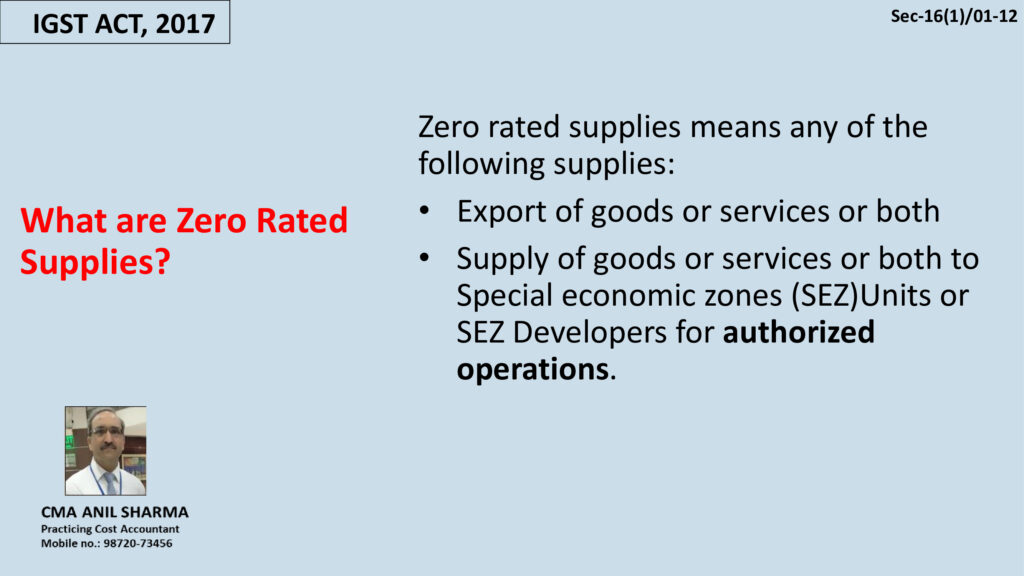
|
|
|
|
|
6. GST Daily by CA Pradeep Modi
CA Pradeep Modi is presenting judgment analysis under title 'GST Daily - Stay yourself updated'
|
|
|
|
|
|
THE HON'BLE ALLAHABAD HIGH COURT IN THE CASE OF Vibhuti Tyres V/s State of U.P., decided on 7-5-2025
|
✔️ Is it justified that GST order with higher demand than show-cause notice?
|
👉 The Hon'ble High Court Judgement:-
|
✔️ Where in show-cause notice amount representing tax, interest and penalty was indicated as Rs. 8,81,080, but in order, much higher demand was raised at Rs. 32,97,336, same was in violation of section 75(7); matter was to be remanded back.
|
Section 75 of Central Goods and Services Tax Act, 2017
|
|
|
|
|
|
|
|
THE HON'BLE JHARKHAND HIGH COURT IN THE CASE OF Sadanand Prasad Barnwal V/s State of Jharkhand, decided on 8-5-2025
|
✔️ Is it valid if SCN and order under section 73 for lack of digital signature of issuing authority?
|
👉 The Hon'ble High Court Judgement:-
|
✔️ Where both summary of SCN in Form GST DRC-01 and order under section 73 did not bear digital signature of concerned authority, both SCN and order were to be quashed.
|
Section 161, read with section 73 of Central Goods and Services Tax Act, 2017
|
|
|
|
|
|
|
|
THE HON'BLE CALCUTTA HIGH COURT IN THE CASE OF Edelweiss Rural & corporate Services Ltd. V/s Deputy Commissioner of Revenue, decided on 5-5-2025
|
✔️ What would be Refund if business stood closed and registration was cancelled?
|
👉 The Hon'ble High Court Judgement:-
|
✔️ Where Refund sanction order had itself observed that assessees business was closed down, its registration was cancelled and it had no tax dues refund claim was already allowed, direction to credit refund amount to credit ledger instead of bank account of assessee was self-contradictory since there was no business for assessee to take benefit of refund credited to assessees credit ledger.
|
Section 54 of Central Goods and Services Tax Act, 2017
|
|
|
|
|
|
7. PPT/Handbook on GST
|
|
|
|
8. GST/Income Tax in Media
|
|
|
|
|
|
|
|
|
|
|
|
|
|
Hope the above updates is of use to you. Please share your input and feedback at taxupdate.otu@gmail.com
|
|
|
|
|
|
|
|
 
|
Visit our website
|
OTU provides you
|
- Articles on various topics
|
|
- Media - GST, Income Tax & Press R.
|
|
|
|
|