|
onlinetaxupdate team wish to express sincere thanks to all the readers, authors, subscribers for the support extended to us. Please share your feedback at
|
taxupdate.otu@gmail.com or 7738647904
|
Newsletter 140 dated 21.10.2024
|
|
|
|
|
|
|
|
|
Dear Reader,
|
Please find newsletter for your reading and reference.
|
|
Index of the Newsletter
- Recent updates
- Portal updates
- Article
- Lawgics by Ms.Nidhi Aggarwal
- GST Notes by CMA Anil Sharma
- GST Daily by CA Pradeep Modi
- PPT/Handbook
- GST/IT/Customs in media
|
|
|
|
|
|
|
Central Board of Indirect Taxes and Customs (CBIC) issued Circular no. 256/02/2026-GST dated 25.07.2026 to provide Clarification regarding filing of appeal by department before the Goods and Services Appellate Tribunal (GSTAT) against order of appellate authority (where Orders-in-Original have been passed by a Common Adjudicating Authority in DGGI cases)
|
Government of India
Ministry of Finance
Department of Revenue
Central Board of Indirect Taxes and Customs
GST Policy Wing
F. No. CBIC-20010/12/2026-GST
|
Circular No. 256/02/2026-GST dated 25.07.2026
|
The Principal Chief Commissioners/ Chief Commissioners (All)
|
The Principal Directors General/ Directors General (All)
|
Subject: Clarification regarding filing of appeal by department before the Goods and Services Appellate Tribunal against order of appellate authority (where Orders-in-Original have been passed by a Common Adjudicating Authority in DGGI cases) – reg.
|
Kind attention is drawn to notification No. 02/2022-Central Tax dated 11th March, 2022 wherein para 3A and Table V were inserted in notification No. 02/2017-Central Tax dated 19th June, 2017 (and further amended by notification No. 27/2024- Central Tax, dated 25th November, 2024), to empower Additional/ Joint Commissioners of Central Tax of specified Central Tax Commissionerates (hereinafter referred to as “Common Adjudicating Authority” or “CAA”), with all India Jurisdiction for the purpose of adjudication of the show cause notices issued by the officers of the Directorate General of Goods and Services Tax Intelligence (herein after referred as “DGGI”).
|
2. Attention is further drawn to circular No. 169/01/2022-GST dated 12th March 2022 and circular No. 239/33/2024-GST dated 4th December 2024 wherein guidelines were issued with respect to assignment of show cause notices for adjudication and passing of order by a CAA, in respect of cases investigated by the officers of the DGGI.
|
3. Further, vide circular No. 250/07/2025-GST dated 24th June 2025, guidelines were issues with respect to reviewing and revisional authority and appeal by department before the appellate authority against orders passed by a CAA.
|
4. References have been received from field formations seeking clarification regarding filing of appeal by the department before the Goods and Services Tax Appellate Tribunal (hereinafter referred to as ‘GSTAT’), against an order of appellate authority (where Order-in-Original has been passed by a Common Adjudicating Authority in respect of DGGI cases). Clarifications are being sought as to:
|
(a) who will be the reviewing authority in respect of such orders of appellate authority in CAA cases?;
|
(b) which jurisdictional authority will be required to file an appeal before the GSTAT in such CAA cases?; and
|
(c) whether appeal before the GSTAT, in such CAA cases, is required to be filed before the bench of GSTAT having territorial jurisdiction over the location of the taxable person/ noticee or is to be filed before the bench of GSTAT having jurisdiction over Commissionerate of the CAA.
|
5. The GSTAT has been constituted under section 109 of the CGST Act, 2017. The territorial jurisdiction of the benches of the GSTAT has been notified through, the notification S.O. 3048(E) [F. NO. A-50050/150/2008-CESTAT-DOR dated the 31st July, 2024 (as amended from time to time), issued by the Central Government under the said section on the recommendations of the GST Council. Appeals to the GSTAT are governed by the provisions of section 112 of the CGST Act, 2017.
|
6. The matter has been examined in consultation with the Union Ministry of Law and Justice. In order to ensure uniformity in the procedure of filing of departmental appeals before the GSTAT in such cases (where Orders-in-Original have been passed by a CAA in DGGI cases), the Central Board of Indirect Taxes and Customs, hereby issues the following clarifications in respect of procedure to be followed for the purposes of review of orders passed by the appellate authority in such CAA cases and for filing of appeal by department against such order of appellate authorities:
|
(a). Communication of order by the appellate authority: The appellate authority, upon passing of an order-in-appeal, under section 107 of the CGST Act, in respect of an appeal arising from an order-in-original passed by the Common Adjudicating Authority, shall upload the order-in-appeal on the common portal, and shall also send a copy of the said order to the Pr. Commissioner/ Commissioner of CGST Commissionerate having jurisdiction over Common Adjudication Authority, through email, along with a with a physical copy.
|
(b). The Pr. Commissioner/ Commissioner of CGST Commissionerate having jurisdiction over the Common Adjudication Authority, shall examine the said order-in-appeal passed by the appellate authority in such cases, after seeking comments and inputs from DGGI (if required) at the earliest, and he shall, forward such comments to the jurisdictional CGST Pr. Commissioner/ Commissioners of all the taxable persons/ noticees involved in the said order-in-original, with his recommendations.
|
(c). Reviewing authority: The jurisdictional CGST Pr. Commissioner/ Commissioner of a particular taxable person/ noticee shall be the reviewing authority under sub-section (3) of section 112 of CGST Act, 2017 in respect of the order passed by the appellate authority in such CAA cases, in respect of the said taxable person/ notice under his jurisdiction. The said reviewing authority (including the Pr. Commissioner/ Commissioner having jurisdiction over the Common Adjudication Authority) shall, examine the matter regarding the legality and propriety of the order of appellate authority in such CAA cases after taking into consideration, inter alia, the comments and recommendations referred to in para (b) above in accordance with provisions of sub-section (3) of section 112 of CGST Act, 2017. Where the reviewing authority is of the opinion that an appeal is required to be filed by the department against order of the appellate authority in such CAA cases, he may for the purpose of satisfying himself as to the legality or propriety of the said order and for determination of such points arising out of the said order, as may be specified him, may, by order, appoint and direct any officer subordinate to him for filing and pursuing the appeal by the department before the GSTAT.
|
(d). Separate appeals have to be filed in respect of each of the taxable person/ noticee, against the order of appellate authority in such CAA cases, by the jurisdictional CGST Commissionerate of the taxable person/ noticee, before the concerned Bench of the GSTAT having territorial jurisdiction over such taxable person/ noticee.
|
(e). After such application to the GSTAT has been made, the jurisdictional CGST Pr. Commissioner/ Commissioner shall also intimate the Pr. Commissioner/ Commissioner of CGST Commissionerate having jurisdiction over the Common Adjudication Authority, along with a copy of the appeal filed in this respect. Where the reviewing authority is of the opinion that no appeal by the department is required to be filed against the order of the appellate authority in CAA cases, he shall intimate the same to Pr. Commissioner/ Commissioner of CGST Commissionerate having jurisdiction over the Common Adjudication Authority.
|
7. Difficulty, if any, in implementation of the above instructions may please be brought to the notice of the Board.
|
(Gaurav Singh)
Commissioner (GST)
|
|
|
|
|
|
|
|
Central Board of Indirect Taxes and Customs (CBIC) issued Circular no. 255/01/2026-GST dated 25.06.2026 to provide Clarification regarding jurisdiction in cases involving migration/ transfer of taxable persons from one jurisdiction to another jurisdiction.
|
|
|
|
|
|
Central Board of Indirect Taxes and Customs (CBIC) issued Instruction no. 20/2026-Customs dated 07.10.2026 regarding Amendment to Electronics and Information Technology Goods (Requirement for Compulsory Registration) Order, 2021 – inclusion of Screen Protectors for smartphones
|
|
|
|
|
|
|
|
Central Board of Indirect Taxes and Customs (CBIC) issued Instruction no. 19/2026-Customs dated 05.10.2026 regarding Authentication and forwarding of Export Declaration Forms (EDFs) at Non-EDI Customs locations.
|
|
|
|
|
|
CBIC issued Notification No. 81 /2026-Customs (N.T.) dated 07.10.2026 regarding "Substitution in notification of Dabhol Port, Maharashtra" and it was issued under Section 7(1)(a) of Customs Act, 1962.
|
|
|
|
|
|
OFFICE OF THE PRINCIPAL COMMISSIONER OF CUSTOMS (AIR CARGO), AIR CARGO COMPLEX, MEENAMBAKKAM, CHENNAI 600 016 issued PUBLIC NOTICE No : 15/2025 dated 29.07.2025 regarding Enablement of Voluntary Payment electronically on ICEGATE e-Payment Platform
|
Attention of all the Importers, Exporters, General Trade, Other stakeholders, members of trade and Officers of Air Cargo Commissionerate, Chennai is invited to CBIC's circular No. 27/2024- customs dated 23.12.2024 on above mentioned subject.
|
2. In line with Government's commitment to digitize all the services and to make it paperless, ICEGATE e-Payment Platform has been enabled with electronic collection of Voluntary/Self-Initiated Payments (SIP).
|
3. This new functionality has been envisaged to replace the existing TR6 payments which are currently being done manually at various Customs Stations. This functionality shall enable the users to generate a self-initiated challan for voluntary payments and then make payments through the ICEGATE e-payment platform without any further approval by officers of Customs.
|
4. While using the voluntary payment Facility at ICEGATE, the users may take note of the below-mentioned aspects:
|
- a. The Voluntary Payment module will be accessible as a post login functionality. Users must be registered on ICEGATE to access this feature;
- b. This facility is enabled with payments which are primarily meant for imports/exports cleared in the past. In other words, the facility is not a replacement for challans generated by ICES/ECCS/SEZ online/ACES applications. Therefore, it should not be used for payment of customs duties for clearance of any live consignments;
- c. The various purposes, for which the payment can be made are provided in Annexure-A, wherein, it is advised to select the same carefully while making payment.
- d. The proof of payment may be submitted to the concerned sections/field formations for taking further action,
- The officer may verify the payment details using https://foservices.icegate.gov.in/#/epayment/enquiry
5.1 Currently, ICEGATE users can make voluntary payments as a debit from the Electronic Cash Ledger (only available for IEC holders and Customs Brokers).
|
5.2 In case, users wish to initiate challan-wise payment, the ICEGATE platform also allows user to make transaction-wise payment on the platform, whereby the systems design takes care of routing the payment instantaneously through Electronic Cash Ledger before accounting for duty payment. On completion of testing for voluntary payment acceptance, at present, following modes are enabled for such challan wise payments:
|
- a. Nine (9) banks under internet banking through authorized bank mode, as per Annexure-B
- b. NEFT/RTGS through RBI
- Payment Aggregator mode
5.3 Remaining banks shall be enabled as and when the testing is complete. In all other modes, users already have an option to deposit the amount in the Electronic Cash Ledger through remaining authorized modes and use the same for making voluntary payment using Electronic Cash Ledger
|
6. Since the above facility is aimed at replacing the current procedure of making Over The-Counter (OTC) payment using TR-6 Challan, all the officers in Air Cargo Complex, Chennai are not to accept any payments through manual TR-6 challan after 19 JULY, 2025, unless the same is approved by the concerned Pr. Commissioner/Commissioner of Customs. The approval must clearly spell out the reasons for resorting to the manual method of payment. The field officers can view the voluntary challans through 'Payment Status - Voluntary Payment' option available in 'Service' section of ICEGATE portal (http://www.icegate.gov.in)
|
7. An user manual on the Voluntary/Self-Initiated Payment (SIP) facility to handhold and onboard the users has been uploaded (http://www.icegate.gov.in/guidelines/voluntary-payment) on the ICEGATE platform
|
8. Difficulties faced, if any, may be brought to the notice of Joint Commissioner/Additional Commissioner designated as Systems manager in Air Cargo Complex Chennai for necessary action or e-mail the difficulties faced to the following e-mail ID, pcommr7acc-cuschn@gov.in.
|
9. All the stakeholders including the trade and concerned associations are requested to take note of the above. All officers to treat this as Standing instruction.
|
This is issued with the approval of Principal Commissioner of Customs, Air Cargo Commissionerate
|
To,
All Concerned
Copy submitted to:
The Principal Chief Commissioner of Customs,
Chennai Customs Zone .
Copy to:
|
- The Principal Commissioner/Commissioner of Chennai Customs ZoneChennai- I/Chennai–II/ Chennai-III/Chennai-IV/ Chennai Audit.
- The Additional / Joint Commissioners of Customs, Chennai VII
Commissionerate
- All Dy. /Asst Commissioners of Customs, Chennai VII Commissionerate.
- The D.C. (EDI), ACC, Chennai, for uploading on website of Chennai–VII
Commissionerate.
- The Supdt. CHS for notice board display purpose
- Hindi Cell
Annexure-A
One of the following purposes to be selected while using Voluntary
Payment Facility at ICEGATE:
|
- i. Payment pursuant to an Investigation:
- ii. Payment pursuant to Audit;
- iii. Payment pursuant to Internal Compliance; EPCG (Payment of Duty,
- interest. penalty);
- iv. EODC (Payment of Duty, interest, penalty);
- v. Advanced License/Authorization (Payment of Duty):
- vi. IGCR (Payment of Duty, interest, penalty);
- vii. Payment at the time of Pre-Notice Consultation;
- viii. Payment for notices under section 28(2) and 28(4) of Customs Act,
- 1962;
- ix. Payment for closure of proceedings in terms of section 28(5) of the
- Customs Act. 1962:
- x. Payment of interest:
- xi. Payment of penalty:
- xii. Pre-Deposit against appeals:
- xiii. Amounts arising out of proceedings before Settlement Commission:
- xiv. Fines imposed by any order;
- xv. Payment of outstanding demands/ Arrear payments:
- xvi. Amounts arising out of disposal of Uncleared/Unclaimed Goods:
- xvii. Amounts arising out of disposal of seized goods;
- xviii. Amounts arising out of disposal of confiscated goods:
- xix. Amounts arising out of Court Attachment orders;
- xx. Advance ruling (CAAR) fees;
- xxi. Cost recovery charges;
- xxii. Transshipment fees;
- xxiii. Merchant overtime charges;
- xxiv. Bill of Entry (BE) amendment fees;
- xxv. Shipping Bill (SB) amendment fees;
- xxvi. Payments not mentioned above;
- Punjab National Bank (PNB)
- Kotak Mahindra Bank
- IDBI Bank
- Karnataka Bank
- Canara Bank
- Karur Vysya Bank (KVB)
- South Indian Bank (SIB)
- Federal Bank
- IndusInd Bank
|
|
|
|
|
Union Commerce and Industry Minister Piyush Goyal on Wednesday set March 31, 2027 , as the deadline for complete digitisation of services provided by the Directorate General of Foreign Trade (DGFT), aiming to eliminate the need for physical visits to its offices from 01.04.2027, according to a statement by the Ministry of Commerce and industry.
|
The announcement came as Goyal virtually inaugurated Vanijya Bhawan and Udyog Bhawan in Jaipur, making Rajasthan the first state to bring offices of the Ministry and its associated organisations under one roof.
|
Congratulating the Department of Commerce and the Department for Promotion of Industry and Internal Trade (DPITT) on the initiative, Goyal called replicating the model across the country, particularly in all state capitals. He said the proposed centres would serve as one-stop hubs for promoting exports, investments, international trade and industrial development, while supporting businesses in contributing to the vision of Viksit Bharat 2047.
|
"Goyal said that the co-location of offices, digitisation and introduction of faceless assessments would enhance transparency, accountability and public confidence. A unified presence of the Ministry of Commerce and Industry in each State would assure businesses and stakeholders that they could access support and guidance through a single location," the release said.
|
He further emphasised that the initiative should go beyond bringing government offices under once roof and focus on improving service delivery, simplifying procedures and enhancing ease of doing business. He also called for greater participation from government departments, state representatives, exports, importers, investors and industry stakeholders to ensure effective implementation, the Ministry said in the release.
|
Setting March 31, 2027, as the deadline for complete digitisation, Goyal directed that all services, including applications for licenses, permits and Special Chemicals, Organisms, Materials, Equipment and Technologies (SCOMET) approvals, be made available entirely online.
|
He further directed the digitisation of historical data and records maintained by Regional Authorities (RAs) of the Directorate General of Foreign Trade (DGFT) across the country.
|
The Minister said that April 1, 2027 , applicants should no longer be required to physically visits government offices to access these services.
|
For cases requiring verification of original documents, Goyal suggested setting up dedicated counters and installing computers at office entrances to facilitate document verification and uploading.
|
He also advocated greater reliance on self-certification and a trust-based approach towards citizens and businesses, emphasising the need to reduce unnecessary procedural requirements.
|
"Goyal also called for the simplification of processes, formats, and forms, and urged the departments to break organisational silos and work collectively to deliver better outcomes for businesses and citizens. He said that improved coordination between the two departments and the various organisations under the Ministry would be essential to achieving the objectives of the initiative," the release added. (ANI)
|
|
|
|
|
|
Central Board of Direct Taxes (CBDT) issued notification no. 134/2026 dated 08.10.2026 to hereby make following rules to amend the income tax rules, namely -
|
These rules may be called the Income tax (Sixth Amendment) Rules, 2026
|
They shall come into force on the date of their publication in the official gazette
|
|
|
|
|
|
|
|
Central Board of Direct Taxes (CBDT) issued notification no. 132/2026 dated 28.09.2026 to hereby make the following further amendments to the Notification no. S.O.359 dated 30.03.1988 -
|
|
|
|
|
|
|
|
Central Board of Direct Taxes (CBDT) issued notification no. 132/2026 dated 28.09.2026 to hereby approve the Jai Research Foundation, Valsad, Gujarat for Scientific Research under the category of Research Association, for the purposes of section 45(3)(a)(i) of the said Act of 2025 and rules 32 and 33 of the Income-tax Rules, 2026.
|
|
|
|
|
|
|
|
Central Board of Direct Taxes (CBDT) issued notification no. 131/2026 dated 28.09.2026 to hereby approve the Santhigiri Ashram, Thiruvananthapuram for Scientific Research under category of University, college or other institution, for the purposes of section 45(3)(a)(i) of the said Act of 2025 and rules 32 and 34 of the Income-tax Rules, 2026.
|
|
|
|
|
|
|
|
Central Board of Direct Taxes (CBDT) issued notification no. 130/2026 dated 28.09.2026 to hereby approve the Institute for Financial Management and Research, Chennai for Research in Social Science or Statistical Research as other Institution under the category of University, college or other institution, for the purposes of section 45(3)(a)(ii) of the said Act of 2025 and rules 32 and rules, 34 of the Income tax rules, 2026.
|
|
|
|
|
|
|
|
Central Board of Direct Taxes (CBDT) issued notification no. 129/2026 dated 28.09.2026 to hereby approves UPASI Tea Research Foundation, Tamil Nadu for Scientific Research as 'Other Institution' under the category of 'University, college or other institution, for the purposes of section 45(3)(a)(i) of the said Act of 2025 and rules 32 and rules 34 of the Income tax rules, 2026.
|
|
|
|
|
|
|
|
Central Board of Direct Taxes (CBDT) issued notification no. 128/2026 dated 28.09.2026 to hereby approves the Santhigiri Ashram, Thiruvananthapuram for Research in Social Science or Statistical Research under the category of University, college or other institution, for the purposes of section 45(3)(a)(ii) of the said Act, 2025 and rules 32 and 34 of the Income tax rules, 2025.
|
|
|
|
|
|
|
|
Central Board of Direct Taxes (CBDT) issued notification no. 127/2026 dated 28.09.2026 to hereby approve the Indian Institute of Health Management Research, Jaipur for Scientific Research under the category of University, college or other institution, for the purposes of section 45(3)(a)(i) of the Act, of 2025 and rules 32 and 34 of the Income tax rules, 2026.
|
|
|
|
|
|
|
|
Central Board of Direct Taxes (CBDT) issued notification no. 126/2026 dated 28.09.2026 to hereby give approve the Bharatiya Sanskriti Darshan Trust, Pune for Scientific Research under the category of University, college or other institution, for the purpose of section 45(3)(a)(i) of the said Act of 2025 rule 32 and 34 of the Income tax rules, 2025.
|
|
|
|
|
|
|
|
CBDT issued notification no. 08/2026 dated 28.09.2026 regarding order under section 45(3)(b) of the income tax at income tax act , 2026.
|
In exercise of the powers conferred by section 45(3)(h) of the income tax act, 2025 read with Rule 35 of the Income tax Rules, 2026, the Pr. Chief Commissioner of Income tax (Exemption), Delhi hereby accords approval to the company M/s. GCS Foundation (Formerly known as The Gujarat Cancer Society , Ahmedabad), Nr. Chamunda Bridge, Opp., DRM Office, Ahmedabad City, Civil Hospital SO, Ahmedabad , Gujarat - 380016, for 'Scientific Research' for the purpose of the section 45(3)(b) of the Income tax Act, 2025 read with rule 35 of the Income tax Rules, 2026.
|
This Notification shall be applicable for five Tax Years from Tax Year 2026-27 to 2030-31.
|
|
|
|
|
|
|
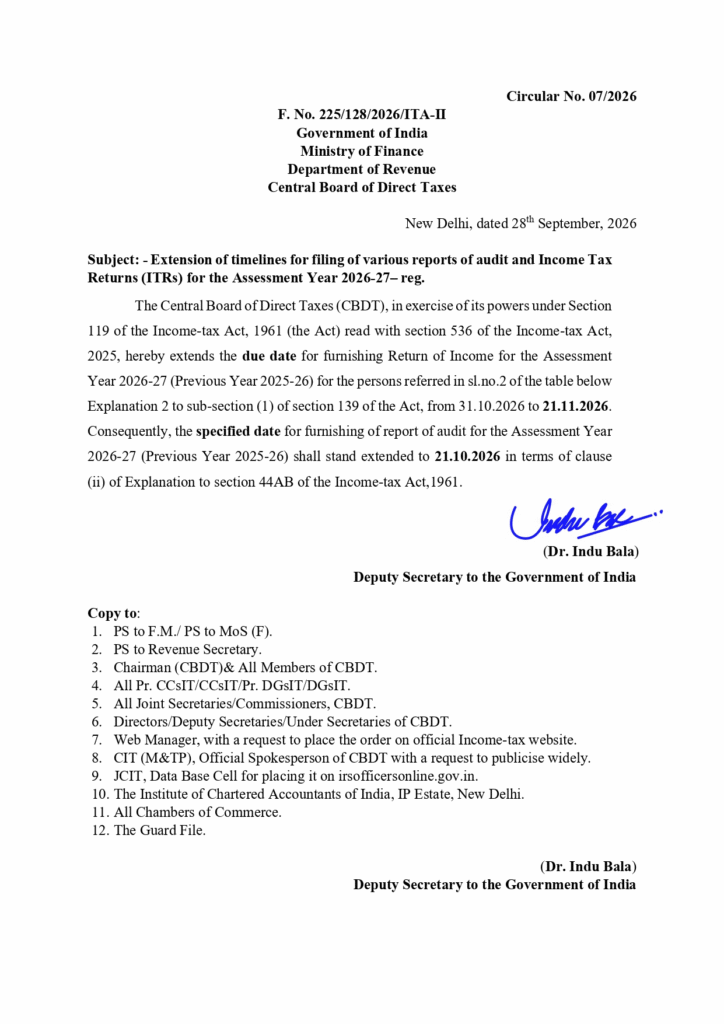
Central Board of Direct Taxes issued Circular no. 7 of 2026 dated 28.09.2026 regarding Extension of timelines for filing of various reports of audit and Income tax Returns (ITRs) for the Assessment Year 2026-27
|
|
|
|
|
|
|
|
|
GST Council recommends removal of arrest provisions under GST
|
GST Council recommends raising prosecution threshold from ₹1 crore to ₹5 crore
|
GST Council recommends reduction in general penalty from ₹25,000 to ₹10,000
|
GST Council recommends wider eligibility for input tax credit and refunds
|
GST Council recommends further simplification of registration and compliance processes
|
GST Council recommends faster refunds to improve working capital for businesses
|
GST Council recommends common standards for GST notices and proceedings
|
GST Council recommends measures for smoother movement of goods across states
|
GST Council recommends intelligence-based and authorised interception of goods
|
GST Council recommends simplified GST registration for small sellers on e-commerce platforms
|
GST Council recommends measures to facilitate export of services
|
GST Council approves in-principle optional scheme for small consumer-facing businesses with turnover up to ₹5 crore
|
Press release ID 2320934 dated 08.10.2026
|
The 57th Meeting of the GST Council was held today in New Delhi, under the chairpersonship of the Union Finance & Corporate Affairs Minister Smt. Nirmala Sitharaman.
|
The participants included Chief Ministers of Delhi, Goa, Haryana, Jammu & Kashmir, Karnataka, Kerala, Maharashtra, and Meghalaya; Deputy Chief Ministers of Manipur and Telangana; the Finance Ministers and senior members of States/Union Territories with Legislative Assembly, Secretary, Department of Revenue; Chairman and Members of Central Board of Indirect Taxes & Customs and senior officials of the Ministry of Finance.
|
Next-Gen reforms made as per recommendations of the GST Council in its 56th meeting last year had focussed on rate rationalisation and reduction of rates. In the 57th meeting today, GST Council made recommendations relating to process reforms primarily covering registration, returns, refund and adjudication; clarifications regarding applicability of GST on supply of certain goods and services; and other measures for trade facilitation and streamlining compliances in GST. FAQs are being issued for clarification of doubts. Major recommendations made in the 57th GST Council meeting are as below:
|
A1. Registration related reforms
|
1. Streamlining registration process with clear guidelines on filing and processing
|
1.1 As per recommendations of GST Council made in 56th meeting, automatic registrations, without officer intervention, are being granted by the portal under rule 14A of the CGST Rules, 2017, in cases where the applicant does not intend to pass on ITC more than ₹2.5 lakh per month. To streamline processing of registration applications in remaining cases, the GST Council made the following recommendations in the 57th meeting:
|
- issuance of a comprehensive circular specifying the documents and information required for GST registration, along with frequently asked questions (FAQs), to simplify the filing and processing of registration applications.
- amendment in the registration application in FORM GST REG-01, to provide for drop boxes for selection of prescribed documents/information, so that both the taxpayer and the tax officer have clarity regarding the documents/information to be furnished.
- The GST portal to provide user-friendly interface, for filing registration application with clear navigational paths, drop-down lists, tool-tips and contextual guidance to facilitate correct filing of such applications.
1.2 This will reduce rejections and queries raised in respect of registration applications on account of lack of correct information/details and will expedite processing of registration applications by the tax officers.
|
2. Rationalization of Procedure for Amendment in GST registration:
|
2.1 The GST Council recommended an amendment to rule 19 of the CGST Rules, 2017, to provide for automatic acceptance of amendments to all registration particulars on the portal, except those relating to the Principal Place of Business (PPoB). Further, for taxpayers registered under rule 14A of the CGST Rules, 2017 (automatic route), amendments of all registration particulars, including those relating to the PPoB, will be accepted automatically on the portal.
|
2.2 This will facilitate easy and almost real time updation of registration details on the portal in such cases, without interface with the tax officers.
|
3. Rationalization of registration cancellation process under GST:
|
3.1 The GST Council recommended amendments in the CGST Act, 2017 and the CGST Rules, 2017, to simplify the registration cancellation process, as follows:
|
3.1.1 Automatic cancellation of registration on the application of the taxpayer
|
Phase 1: The applications for cancellation of registration in FORM GST REG-16 will be accepted automatically by the system, once all pending returns are filed and all dues are paid, in the following cases:
|
- where the taxpayer has not passed on ITC exceeding ₹2.5 lakh in any of the months since registration;
- where the taxpayer has passed on ITC exceeding ₹2.5 lakh in a month, but has filed the final return in FORM GSTR-10 within specified time period.
Phase 2: All the applications for cancellation of registration will be accepted automatically by the system, once all pending returns are filed and all dues are paid. FORM GST REG-16 will be amended so that the details of FORM GSTR-10 can be furnished in the said application itself.
|
3.1.2 Suo-moto cancellation of registration
|
- Amendment in rule 21 of the CGST Rules, 2017, to omit certain grounds of cancellation of registration by the tax officers.
- Amendment in rule 21A and rule 22 of the CGST Rules, 2017 and insertion of rule 23A in CGST Rules, 2017, to provide for a mechanism of system based cancellation and revocation of registration based on non-compliance and subsequent compliance of the defaults of non-filing return or non-furnishing of the details of the bank account, within specified time period.
3.2 These measures will simplify and expedite the process of cancellation of registration and will reduce officer interface and bring more transparency to the cancellation process.
|
4. Simplified GST registration mechanism for small sellers on the Electronic Commerce Operators (ECO) platform:
|
4.1 The GST Council, in its 56th meeting had given an in-principle approval to provide a Simplified GST registration mechanism for small sellers on the Electronic Commerce Operators (ECO) platform. In continuity of the same, the Council in the 57th meeting recommended insertion of rule 14B in the CGST Rules, 2017, to provide for a simple mechanism for registration for small suppliers making supplies of goods through ECOs, in States/UTs, where they do not have physical presence, and where they intend to pass on ITC not more than₹2.5 lakh per month, excluding stock transfers between distinct persons, by declaring the warehouse of an ECO in that State/UT, as their Principal Place of Business (PPoB). Registration in such cases will be granted automatically by the system, subject to certain conditions.
|
4.2 This will enable small sellers to expand their business to other States through e-commerce platforms without having to set up a place of business in each State and will give a significant boost to ease of doing business.
|
A2. Return related reforms
|
5. Alternate mechanism for making amendment of liabilities and input tax credit in returns to minimize mismatches and reduction of notices/intimations on account thereof:
|
5.1 The GST Council recommended inter-alia the following measures to streamline return filing process, so as to minimize mismatches in liability and input tax credit (ITC) in returns:
|
- Enhancements in FORM GSTR-1/1A/IFF to enable better reconciliation of the details furnished in these forms with the details reported in the return in FORM GSTR-3B.
- Insertion of a rule 86D in the CGST Rules, 2017, to provide for a facility namely, “Electronic Statement of tax paid on Reverse charge basis and input tax credit claimed” on the portal, to facilitate the taxpayers in correct reporting of tax liability and ITC on supplies liable to RCM in returns.
- Insertion of sub-rule (1A) in rule 61 of the CGST Rules, 2017 to provide a mechanism of correct reporting and correction/rectification of liability in the return, so that liability in the return in FORM GSTR-3B aligns with the details of liability furnished in FORM GSTR-1/1A/IFF.
- Amendment in FORM GST DRC-03, to declare the details of the underlying invoice for which payment has been made.
- Insertion of sub-rule (6A) in the rule 60 of the CGST Rules, 2017, in respect of the facility namely, Invoice Management System (IMS), to allow a recipient to accept, reject or keep pending a document pertaining to inward supply received on the portal, for the purpose of generation of statement of ITC in FORM GSTR-2B, subject to certain conditions, including the period for which a credit note can be kept pending on IMS.
- Insertion of rule 86C in the CGST Rules, 2017 to provide for a facility namely, “Electronic Credit Reversal and Reclaim Statement” on the portal, to facilitate the taxpayers in correct reporting of ITC reversed and reclaimed in FORM GSTR-3B.
- Insertion of sub-rule (1B) in the rule 61 of the CGST Rules, 2017, to provide a mechanism of correct reporting and correction/rectification of ITC in the return, so that ITC availed in the return in FORM GSTR-3B aligns with the details of ITC made available in FORM GSTR-2B.
- Issuance of a circular to clarify the manner of furnishing correct and proper information of ITC and reversal thereof in return in FORM GSTR-3B, in the context of IMS, Electronic Credit Reversal and Reclaim Statement and Electronic Statement of tax paid on Reverse charge basis and input tax credit.
5.2 The Council recommended that the provisions regarding alternate mechanism for amendment of liability and ITC in the GST return, may be brought into force from the return of April, 2027.These measures will considerably reduce mismatches in liability and ITC in returns, thus not only reducing demand notices and system generated intimations on account of such mismatches, but also improving the integrity of ITC across the supply chain, thereby facilitating taxpayers.
|
5.3 Further, the Council recommended placing the proposed revised mechanism in the public domain for a time-bound consultation. Union Finance Minister was authorized to approve requisite changes/modifications, as may be necessary, based on feedback received from the stakeholders.
|
A3. Refunds related reforms
|
6. Faster, system-based automated processing of refunds
|
6.1. The GST Council recommended amendments in section 54 of the CGST Act, 2017 and the relevant CGST Rules, 2017, to provide for system-based processing and sanctioning of refund claims, pertaining to excess balance in electronic cash ledger, zero-rated supplies, and inverted duty structure, in the following two phases.
|
- Full refund claim of excess balance in the electronic cash ledger will be sanctioned automatically by the system, without officer intervention.
- Time limit for issuance of acknowledgement or deficiency memo to be reduced from 15 days to 10 days. Deemed acknowledgement by the system, where such acknowledgement or deficiency memo is not issued by the proper officer within 10 days of the application.
- For refund claims on account of zero-rated supplies and inverted duty structure, 90% of the amount claimed will be sanctioned on provisional basis automatically by the system, without officer intervention, on the basis of identification and evaluation of risk by the system.
- System-based automated acknowledgment (without officer intervention) on due verification of the refund application by the system.
- In such acknowledged cases, automated sanction of full refund claim by the system (without officer intervention), in respect of claims pertaining to zero rated supplies, after adjusting pending dues, if any, on the basis of identification and evaluation of risk by the system.
6.2 For expediting and streamlining the refund process, the Council further recommended amendments in the CGST Act, 2017 and the CGST Rules, 2017, to inter-alia provide for:
|
- Amendment in refund application in FORM GST RFD-01, to capture the details in the said application in a system-readable format and dispense with the requirement of uploading scanned documents in case of refund claims pertaining to zero rated supply and inverted duty structure.
- Amendment in rule 89(4)(C) of the CGST Rules, 2017, to remove the restriction for maximum amount of turnover of zero-rated supply of goods, as 1.5 times the value of like goods domestically supplied.
- Amendment in section 54(14) of the CGST Act, 2017, to add an explanation that the threshold of Rs. 1000 shall be applicable in respect of total refund amount, i.e. the amount under CGST, SGST/UTGST and IGST taken together.
6.3 With a view to ensuring greater clarity and certainty on the interest payable on refund of pre-deposit paid for filing appeals, the Council recommended, -
|
- amendment in section 115 of the CGST Act, 2017, to make it a standalone provision in respect of the rate of interest applicable for the refund of such pre-deposit amount, and
- issuance of a circular to clarify issues regarding rate of interest on refund of pre-deposit.
6.4. These measures will streamline and expedite refund processing through greater automation and reduced manual intervention, thereby facilitating timely sanction of eligible refunds and reducing compliance burden for taxpayers as well as interface with the department. Introduction of automation will ensure transparency, certainty, and uniformity and will also improve cash flows for taxpayers.
|
A4. Reforms related to dispute resolution
|
7.1 The GST Council recommended issuance of a circular to provide comprehensive guidelines to the tax officers to streamline process of issuance of demand notices, adjudication orders and appeal orders, inter alia, covering issues relating to, quality of demand notices and adjudication/appeal orders, timely issuance such notices/orders, proper invocation of grounds of fraud, wilful misstatement or suppression of facts only based on merits in each case, adherence to the principles of natural justice including the conduct of personal hearings.
|
7.2 Further, to reduce compliance burden and litigation, the Council further recommended amendment in section 73, section 74 and section 74A of the CGST Act, 2017, to inter-alia provide:
|
- minimum threshold of Rs. 10,000/- (CGST + SGST + IGST + Cess) for issuance of show cause notices. Thus, no notices will be issued if the tax amount involved is less than Rs. 10,000/-. The Council also recommended for a statutory provision to provide that any notices and appeals, involving an amount less than Rs. 10,000, and pending on date of the provision for the said minimum threshold coming into force, will be decided as if the said threshold of Rs. 10,000/- had been in force when the notice was issued.
- for deeming penalty amount as ‘charge’, where full tax amount is voluntarily paid, alongwith interest and penalty, within the specified time limit.
- for a reduced penalty of 5% in non-fraud cases, where tax along with interest is discharged within 30 days (under section 73) or 60 days (under section 74A) of the adjudication order.
- removal of condition of minimum penalty of Rs. 10,000/-, in non-fraud cases.
7.3 The GST Council recommended reducing the maximum general penalty under section 125 of the CGST Act, 2017 from Rs. 25,000/- to Rs. 10,000/-.
|
7.4 The Council recommended amendment in the provisos to section 107(6) and section 112(8) of the CGST Act, 2017 to provide an upper limit of ₹40 crore (Rs. 20 crore under CGST and Rs. 20 crore under SGST/UTGST) on the pre-deposit payable for filing an appeal before the Appellate Authority or the Appellate Tribunal, respectively, in cases where the order involves only penalty and no demand of tax. This will ease the financial burden on taxpayers and make it easier for them to access appellate remedies in such cases.
|
B. Other major reforms under GST
|
B1. Reforms for improving seamless flow of Input Tax Credit (ITC)
|
8. Refund of accumulated ITC on account of capital goods and input services:
|
8.1 The Council recommended amendment in clause (ii) of proviso to section 54(3) of the CGST Act, 2017, and in the CGST Rules, 2017, to provide for refund of accumulated ITC on account of capital goods in case of refund pertaining to zero-rate supplies, and of accumulated ITC on account of input services and capital goods in case of refund pertaining to inverted duty structure.
|
8.2 The Council recommended that the refund of accumulated ITC on input services for refunds pertaining to inverted duty structure shall be available in respect of ITC availed on input services on or after 1st November, 2026.
|
8.3 In respect of refund of ITC on capital goods in refunds pertaining to zero rated supplies and inverted duty structure, the Council recommended that refund of ITC on capital goods will be spread over 60 months, and shall be available in respect of ITC availed on capital goods on or after 1st April, 2027.
|
8.4 This will ease working capital constraints for taxpayers and remove blockage of ITC on account of input services and capital goods in such cases.
|
9. Rationalization of blocked ITC by amendment in section 17(5) of the CGST Act, 2017: The Council recommended amendment in section 17(5) of the CGST Act, 2017 to remove the restrictions on availment of ITC inter-alia on the supplies of outdoor catering, health and life insurance, telecommunication towers, pipelines laid outside factory premises, free samples, goods destroyed or written off on expiry of shelf life as required by law. This will reduce the cascading of taxes and ensure a smoother flow of ITC across the supply chain.
|
B2. Reforms relating to exports/zero rating of supplies of goods and services
|
10. The GST Council recommended:
|
- omission of sub-clause (v) of clause (6) of section 2 of the IGST Act, 2017, so as to remove the condition of supplier and recipient of services not being establishments of a distinct person, under Explanation 1 to section 8 of the IGST Act, 2017, for a supply of services to qualify as an “export of services”. This will facilitate refunds for Indian services providers in respect of services supplied to/through their foreign offices/branches and thus will promote export of services from India.
- issuance of a circular to clarify various issues related to receipt of payment in foreign exchange or Indian rupees as permissible, for export of goods and services.
- omission of clause (a) of section 13(3) of IGST Act, 2017, so that the place of supply for services in cases where goods are made physically available by the recipient of services to the supplier, will be determined as per the default provision under section 13(2) of the IGST Act, 2017 i.e. the location of the recipient of such services. This will facilitate access to export-related benefits under GST for Indian service providers providing such services to foreign recipients.
- insertion of an explanation to section 16(1) of the IGST Act, 2017 to provide that in the cases where goods are supplied to an overseas buyer, but the delivery of goods is made to the said buyer in an SEZ/FTWZ, and the payment for such supply is received in convertible foreign exchange or in Indian Rupees wherever permitted by the RBI, then such a supply will be deemed to be supply of goods to an SEZ/FTWZ. This will provide certainty regarding zero rating benefit to Indian manufacturers making supply of goods for overseas buyers by making delivery to them in an SEZ/FTWZ for warehousing or further processing.
B3. Ease of living and doing business
|
11. Rationalization of provisions relating to arrest and prosecution
|
11.1 The Council has recommended complete withdrawal of arrest powers under GST by omission of section 69 of CGST Act, 2017.
|
11.2 With a view to further strengthening a progressive and trust-based tax regime, while retaining effective deterrence against fraud and evasion, the Council recommended the following measures:
|
- The monetary threshold for prosecution to be raised from ₹1 crore to ₹5 crore.
- Omission of clause (i) of section 132(1) of the CGST Act, 2017, deletion of the words "evades tax" in clause (e) of section 132(1) and deletion of words "or in any other manner deals with" in clause (h) of section 132(1) of the CGST Act, 2017.
- Amendment in clause (c) of section 132(1) of the CGST Act, 2017, to cover only offence of fraudulent availment of ITC without receipt of goods or services or without invoice or bill.
- Rationalizing the amount of punishment for various offences under section 132 of the CGST Act, 2017.
12. Rationalization of provisions relating to E-way Bill
|
12.1 The GST Council recommended amendments in section 68, section 129 and section 130 of the CGST Act, 2017 so as to inter-alia provide that, -
|
- a conveyance carrying goods can be intercepted only on specific intelligence and with the authorisation of an officer not below the rank of Joint Commissioner.
- Inspection and further action for detention or seizure can be taken when either the supplier, or the recipient, is located or registered in the State where interception is being made. No interception in the transit States.
- Where no e-way bill has been generated, or the conveyance is not carrying any document to show the origin or destination of the goods, as the case may be, the goods can be inspected, detained or seized, irrespective of the jurisdiction.
- Provision of confiscation of goods/conveyances under section 130 of CGST Act not applicable in respect of goods/conveyances in transit.
12.2 This will enable smooth movement of goods and conveyances and will improve businesses supplies and transportation efficiency.
|
13. Treatment of transfer of title in Intellectual Property Rights (IPR): The Council recommended amendment in Schedule-II of CGST Act, 2017 to provide that transfer of title in IPRs, whether temporary or permanent, will be uniformly treated as supply of services. This will ease GST compliances and will facilitate smoother cross border transactions involving IPR.
|
14. Amendment in rule 86A of the CGST Rules, 2017 to provide for opportunity of being heard to the taxpayer: The GST Council recommended amendment in rule 86A of the CGST Rules, 2017 to provide a mechanism for enabling a taxpayer to file an objection against blocking of any amount in electronic credit ledger and to avail a personal hearing before the proper officer takes a decision on such objection.
|
15. Extending relief for small taxpayers on late fees: The GST Council recommended waiver of late fee on delayed filing of return under section 39(1) of the CGST Act, 2017, for taxpayers with an annual turnover up to Rs. 5 crore in the preceding financial year, if the said delayed return is filed by the end of the month in which it was due.
|
16. Clarification in respect of various issues through circulars: The GST Council recommended issuance of circulars to provide clarity and to remove ambiguities arising due to varied interpretations by the field formations, in respect of the following issues:
|
- Issues relating to Input Service Distributor (ISD) mechanism for distribution of input service credit.
- Availment of input tax credit by banking companies and financial institutions including NBFCs who opt for section 17(4) of the CGST Act, 2017.
- Various issues relating to payment of pre-deposits.
- Admissibility of input tax credit in respect of demonstration vehicles in certain situations.
- Omission of rule 96 (10) of the CGST Rules, 2017 to be effective from 23.10.2017, in accordance with the Hon’ble Supreme Court decision.
17. Concept note for an optional scheme for Annual Return Quarterly Payment (ARQP): The GST Council approved in-principle a concept note for an optional Annual Return Quarterly Payment (ARQP) scheme for taxpayers having an aggregate turnover equal to or less than Rs. 5 Crore in the preceding financial year and engaged exclusively in supplies to unregistered persons (B2C supplies).
|
18. The Council also made the following recommendations to streamline compliances in GST:
|
- amendment in section 16, section 37 and section 39 of the CGST Act, 2017, to align provisions relating to furnishing of statement of outward supply under section 37 and the return under section 39 of the CGST Act, 2017 with the provisions relating to time limit for availment of input tax credit under section 16(4) of the CGST Act, 2017.
- amendment in section 9(5) of the CGST Act, 2017, to provide clarity regarding liability of the ECO to pay tax for the notified services, irrespective of the business models being followed by him.
- introduction of a validation clause in CGST Act, 2017, for validation of notices which have been held invalid by various courts on the ground of having been issued for multiple financial years.
- extending e-invoicing to domestic supplies received from an unregistered person where the tax is payable under reverse charge mechanism, as well as to the import of services, for taxpayers having aggregate annual turnover of Rs. 5 crore and above.
19. The Council approved various amendments to the CGST Act, 2017 and the GSTAT (Appointment and Conditions of Service of President and Members) Rules, 2023 to align the provisions in respect of the GST Appellate Tribunal with the relevant provisions of the Tribunals Reforms Act, 2026 and the National Tribunals Commission and Qualification, Selection and Conditions of Service of Chairpersons and Members of Tribunals Rules, 2026.
|
C. Changes/ Clarifications in relation to GST rates on Goods and Services:
|
C1. Recommendations relating to goods
|
1. To clarify that sublimation paper is classified under heading 4809. It has also been decided to regularise the past cases on “as is where is” basis.
|
2. To clarify that the notification entries related to toys in the GST Rate Schedules also covers all other categories of toys (such as dolls, puzzles and other toys) mentioned in heading 9503 in the Customs Tariff Act, 1975 and is not restricted to tricycles, scooters, pedal cars only (Sr. No. 497 of Schedule I and Sr. No. 616 of Schedule II of notification No. 09/2025-CTR dated 17.09.2025).
|
3. To provide clarity that sea-weed extract based bio-stimulants, which are registered under Schedule VI to the Fertiliser (Inorganic, Organic or Mixed) (Control) Order, 1985, are classifiable under heading 3101 as fertilisers. Further, it has been decided to regularise the past cases on “as is where is” basis (Explanation to be inserted in Sr. No. 237 of Schedule I of notification No. 09/2025-CTR).
|
4. To clarify that the suppliers of second-hand vehicles, under the GST margin scheme, are allowed to avail Input Tax Credit (ITC) on various inputs (other than second-hand vehicles) or input services such as spares, repair and maintenance services, technology services, rent, marketing and advertisement services, etc. The restriction on availment of ITC under the said scheme applies only on the tax paid on the procured second-hand vehicles. .
|
5. To bring waste and scrap of plastics, electrical and electronics waste and scrap, waste and scrap of tyres, and used cooking oil under Reverse Charge Mechanism (RCM) when the said waste and scrap is supplied by unregistered person to registered person provided that the supplier shall take registration as and when it crosses threshold limit and the recipient who is liable to pay under RCM shall pay tax even if supplier is under threshold. Further Tax Deducted at Source (TDS) @ 2% has been introduced when the said specified waste and scrap is supplied by registered person to registered person (B to B).
|
6. To provide clarity on the tax treatment of supply of Psyllium seeds (Isobgul/ Isabgol) by prescribing NIL rate of GST on the same, irrespective of whether the seeds are fresh, chilled, frozen or dried.
|
7. To correct the anomaly of GST treatment on re-treaded tractor tyres by aligning the GST rate thereon with that applicable on new tractor tyres.
|
8. To exempt the Compensation Cess not levied by the Canteen Stores Department (CSDs) on two and four wheelers for the period 01.07.2017 to 30.09.2022, and by CSDs and Unit Run Canteens on aerated drinks for the period 01.07.2017 to 31.03.2022.
|
C2. Recommendations relating to services
|
1. Passenger transport and rental of motor vehicles using Electric Vehicles
|
- To provide an option to pay GST at the rate of 5%, with restricted input tax credit, on passenger transport services and rental services of motor vehicles with operators, where the service is supplied using an electric vehicle, and the cost of battery charging is included in the consideration.
2. Transportation and delivery services supplied through Electronic Commerce Operators
|
- To bring delivery services, other than courier and postal, supplied through an ECO under Section 9 (5) of CGST Act, 2017, where the person supplying such services is not liable for registration under Section 22 (1) of the CGST Act, 2017 and to prescribe GST rate of 5% without ITC for such delivery services;
- To prescribe a GST rate of 5% without ITC for delivery services in relation to goods where such goods are supplied/ordered through an ECO;
- To exclude the GST exemption on the services of transportation of goods to unregistered persons by GTA under Entry 21A of Notification No. 12/2017-Central Tax (Rate), where such services are in relation to goods which are supplied/ordered through an ECO.
3. Motor vehicle leasing transactions
|
- To clarify the GST treatment of certain statutory and ancillary recoveries such as registration charges, road tax, insurance and FASTag charges incurred by the lessor which are subsequently recovered from the lessee in connection with the leasing of motor vehicles.
4. Input Tax Credit in the same line of business
|
- To allow limited input tax credit in the same line of business, for the supply of restaurant/outdoor catering services, hotel accommodation services for value up to Rs. 7500 per unit per day, and gym/fitness services in the same manner as is currently available for passenger transportation services, tour operator services and renting of motor vehicles services.
5. Transport of passengers by Helicopters from/to specified states
|
- To exempt from GST, the services of passenger transportation by helicopter on seat-sharing basis from/to airports/helipads located in north-eastern states, Sikkim and Bagdogra in West Bengal.
6. Storage or warehousing of seeds meant for sowing:
|
- To exempt from GST, the services by way of storage or warehousing of seeds meant for sowing.
- To exempt from GST, the agricultural support services of curing coffee provided by the coffee curers to the cultivators.
8. Taxability of the services of Seamen’s Provident Fund Organisation
|
- To exempt from GST, the services provided by Seamen’s Provident Fund Organisation (SPFO) to persons governed by the Seamen’s Provident Fund Act, 1966.
9. Research & Development Services
|
- To provide for a simple mechanism of self-certification by the head of institution/organization undertaking research and development services, certifying that the activity is in the nature of research and development and not consultancy, for the purpose of determining eligibility for exemption under Entry 44A of Notification 12/2017 – Central Tax (Rate).
10. Import of services by Indian establishments of foreign shipping lines
|
- To exempt the import of services by an establishment of a foreign shipping company in India from a related person or any of its establishment outside India, when made without consideration;
- To regularize the past period on “as is where is” basis.
11. Upfront/concession amount paid to NHAI under Toll Operate Transfer Model for highway projects
|
- To exempt from GST, the services of the grant of exclusive right, license and authority by the Government including local Authority, governmental authority and government entity to the concessionaire for highway projects to demand, collect and appropriate toll fee.
12. Operation and Maintenance services for highway projects under TOT model
|
- To provide a special procedure regarding the valuation and time of payment of GST on Operation and Maintenance (O&M) services provided by concessionaires to the concessioning authority for highway projects in TOT model.
13. Fund Transfer Pricing mechanism in banks
|
- To clarify that the notional amount regarded as “interest” in the books of accounts for the activity of notional transfer of funds between the branches of the banks by the head office as part of Funds Transfer Pricing transactions is covered by the definition of “interest”, given in Notification No. 12/2017-Central Tax (Rate).
Note: The recommendations of the GST Council have been presented in this release containing major item of decisions in simple language for information of the stakeholders. The same would be given effect through the relevant circulars/ notifications/ law amendments which alone shall have the force of law.
|
|
|
|
|
|
|
|
GSTN issued Advisory no. 689 dated 20.11.2026
|
In accordance with Notification No. 05/2026–Central Tax dated 26.10.2026, effective from 01.11.2026, Metro Rail has been included under Rule 138(2A) of the CGST Rules, 2017, for the transportation of goods.
|
Accordingly, Metro Rail has been introduced as an additional mode of transport in the E-Way Bill system. Taxpayers and transporters can now select Metro Rail as the mode of transportation while generating E-Way Bills or updating Part-B details.
|
1. Availability of the Facility
|
The new transport mode has been enabled for the following functionalities through Web, Excel and API interfaces:
|
- E-Way Bill Generation
- Part-B Update
- Vehicle Update
- Consolidated E-Way Bill Generation
- Consolidated E-Way Bill Re-generation
Current Deployment Status:
|
•Web Users: The facility is currently available in the Production environment.
|
•API Users: The functionality has been released in the Sandbox environment to facilitate integration and testing. API users are advised to undertake the necessary changes and complete testing before its rollout in Production.
|
2. Important Instructions
|
a) Taxpayers and transporters transporting goods through Metro Rail are required to select Metro Rail as the mode of transportation.
|
b) Entry of the Transport Document Number is mandatory when Metro Rail is selected.
|
c) The correct Transport Document Number and other relevant transportation details must be furnished before submission.
|
Taxpayers and transporters are advised to select Metro Rail as the appropriate mode of transport while generating E-Way Bills or updating Part-B details for goods transported through Metro Rail.
|
API users are advised to make the necessary changes in their systems and validate the functionality in the Sandbox environment. The availability of the facility in the API Production environment will be communicated separately.
|
All stakeholders are requested to take note of the above changes.
|
|
|
|
|
|
|
|
GSTN Advisory no. 688 dated 17.11.2026
|
This is in continuation of the earlier advisory dated 16 October 2026 regarding the introduction of e-Invoicing for recipient-generated self-invoices under the Reverse Charge Mechanism (RCM) for domestic supplies received from unregistered persons (RCMDOM) and import of services (RCMIMP).
|
The Government, vide Notification No. 04/2026-Central Tax dated 26 October 2026, has extended the applicability of e-Invoicing to the above two categories of supplies with effect from 1 January 2027. The corresponding amendments to the CGST Rules and e-Invoice schema have also been notified vide Notification No. 05/2026-Central Tax dated 26 October 2026. In this regard, taxpayers and other stakeholders are informed of the following:
|
The functionality for RCMDOM and RCMIMP has already been made available in the sandbox environments of all six authorised Invoice Registration Portals (IRPs), as communicated through the earlier advisory. Taxpayers, GST Suvidha Providers, Application Service Providers, ERP providers and other integration partners are advised to complete the necessary development and testing using the respective IRP sandbox environments.
|
2. Production Rollout and Voluntary Early Adoption
|
As a measure of facilitation and for smooth transition, the functionality is proposed to be enabled in the production environments of IRPs from 15 December 2026. During the period from 15 December to 31 December 2026, eligible taxpayers may voluntarily generate IRN for domestic supplies received from unregistered persons (RCMDOM) and import of services (RCMIMP) in the production environment to facilitate early adoption and integration readiness.
|
It may be noted that mandatory e-Invoicing for these two supply types would take effect from 1 January 2027 only, in accordance with the notified provisions. Taxpayers, GSPs, ASPs, ERP providers and other integration partners are advised to use the sandbox environments for testing with sample data. The production environment should be used only for genuine transactions.
|
3. For the new supply types RCMDOM and RCMIMP, the system will accept documents dated 15 December 2026 or later, for IRN generation in the production environment.
|
4. Technical Specifications and Release Notes
|
Detailed technical specifications, business validations, validation codes and other implementation requirements for RCMDOM and RCMIMP are available through the NIC e-Invoice API Developer Portal: https://einv-apisandbox.nic.in/
|
Taxpayers, GSPs, ASPs, ERP providers and other integration partners are advised to refer to the relevant NIC IRP-1 release notes and technical documentation while implementing the changes.
|
5. Readiness for Implementation
|
Taxpayers, GSPs, ASPs, ERP providers and other integration partners are requested to complete the necessary system development, integration and testing activities well before 1 January 2027. Stakeholders are also requested to sensitise their wider ecosystem partners and ensure readiness for the implementation of the new reporting requirements.
|
For all other matters relating to applicability, scope, exemptions and compliance requirements, taxpayers are advised to refer to Notification No. 04/2026-Central Tax, Notification No. 05/2026-Central Tax and the relevant circulars issued by the Government. For further updates, taxpayers may visit the official e-Invoice portal at https://einvoice.gst.gov.in.
|
|
|
|
|
|
|
|
GSTN is taking downtime to enhance its services on the GST Portal on 26.11.2026 from 12:00 AM onwards until 7:00 pm of 26.11.2026.
|
|
We shall be enhancing services on the GST portal on : 26th November’26 12:00 AM onwards.GST Portal services will not be available until 26th November’26 07:00 AM.The inconvenience caused is regretted.
|
|

|
|
|
|
|
|
|
|
|
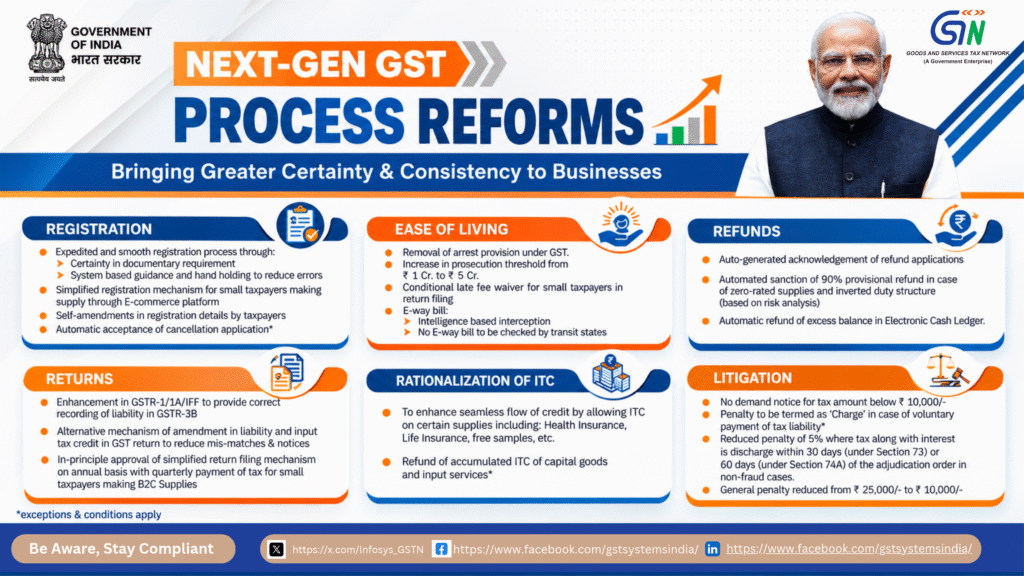
Government of India taken following decisions for process reforms
|
- GST Registrations
- Ease of Living
- Refunds
- Returns
- Rationalisation of ITC
- Litigation
|
|
|
|
|
|
|
|
CBDT has issued Notification No. 114/2026 dated 14.08.2026, notifying the rules and prescribed forms under the Foreign Assets of Small Taxpayers Disclosure Scheme, 2026.
|
|
|
|
|
|
|
|
The Income Tax e-Filing Portal has enabled a dedicated grievance facility for taxpayers to report complaints relating to corruption, misbehaviour, harassment and sexual harassment.
|
Under the grievance mechanism, complainants can select the relevant category and provide details including the name and designation of the officer concerned, along with a description of the grievance. The portal specifically provides categories for “Corruption” and “Mis-behaviour/harassment/sexual harassment.”
|
The facility is expected to strengthen transparency, accountability and taxpayer grievance redressal by providing an online mechanism for reporting serious complaints relating to official conduct.
|
|
|
|
|
|
|
|
Common offline utility for Form 3CA-3CD and 3CB-3CD
Form 3CA-3CD: Audit report under section 44AB of the Income -tax Act, 1961, in a case where the accounts of the business or profession of a person have been audited under any other law and Statement of Particulars required to be furnished under Section 44AB of the Income-tax Act, 1961
|
Form 3CB-3CD: Audit report under section 44AB of the Income -tax Act 1961, in the case of a person referred to in clause (b) of sub - rule (1) of rule 6G and Statement of Particulars required to be furnished under Section 44AB of the Income-tax Act, 1961
|
Edge browser installation is required before installing the utility.
|
|

|
Date of first release of Form Utility 10-Sep-2021
|
Date of Latest release of Form Utility 02-Apr-2026
|
|
|
|
Date of first release of Form Schema 26-Oct-2021
|
Date of latest release of Form Schema 01-Apr-2026
|
|

|
Form 10B (A.Y. 2023-24 Onwards)
Audit Report under clause (b) of the tenth proviso to section 10(23C) and section 12A(1)(b)(ii) of Income tax act,1961, in the case of a fund or trust or institution or any university or other educational institution or any hospital or other medical institution.
|
|
|
|
Date of first release of Form Utility 24-Aug-2023
|
Date of Latest release of Form Utility 01-Apr-2026
|
|
|
|
Date of first release of Form Schema 08-Sep-2023
|
Date of latest release of Form Schema 01-Apr-2026
|
|
|
|
Form 10B (Upto A.Y. 2022-23)
Audit report under section 12A(b) of the Income-tax Act, 1961, in the case of charitable or religious trusts or institutions
|
|
|
|
(Version PR3.1) (1.19 MB)
|
Date of first release of Form Utility 06-Sep-2022
|
Date of Latest release of Form Utility 04-Oct-2022
|
|
|
|
Date of first release of Form Schema 19-Aug-2022
|
Form 10BB (A.Y. 2023-24 Onwards)
Audit report under clause (b) of the tenth proviso to clause (23C) of section 10 and sub-clause (ii) of clause (b) of sub-section (1) of section 12A of the Income-tax Act, 1961, in the case of a fund or trust or institution or any university or other educational institution or any hospital or other medical institution which is required to be furnished under clause (b) of the tenth proviso to clause (23C) of section 10 or a trust or institution which is required to be furnished under sub-clause (ii) of clause (b) of section 12A
|
|
|
|
Date of first release of Form Utility 11-Oct-2023
|
Date of Latest release of Form Utility 01-Apr-2026
|
|
|
|
Date of first release of Form Schema 21-Sep-2023
|
Date of latest release of Form Schema 01-Apr-2026
|
|
|
|
Form 10BB (Upto A.Y. 2022-23)
Audit report under section 10(23C) of the Income-tax Act, 1961, in the case of any fund or trust or institution or any university or other educational institution or any hospital or other medical institution referred to in sub-clause (iv) or sub-clause (v) or sub-clause (vi) or sub-clause (via) of section 10(23C)
|
|
|
|
Date of first release of Form Utility 02-Sep-2022
|
|
|
|
Date of first release of Form Schema 17-Aug-2022
|
Form 15CA
Information to be furnished for payments to a non-resident not being a company, or to a foreign company.
|
|
|
|
|
|
|
|
Date of first release of Form Schema 02-Oct-2021
|
Form 15CB
Certificate of an accountant.
|
|
|
|
|
|
|
|
Date of first release of Form Schema 02-Oct-2021
|
Form 29B
Report under section 115JB of the Income-tax Act, 1961 for computing the book profits of the company.
|
|
|
|
Date of first release of Form Schema 09-Aug-2022
|
Date of latest release of Form Schema 01-Apr-2026
|
|
|
|
Form 29C
Report under section 115JC of the Income-tax Act, 1961 for computing Adjusted Total Income and Alternate Minimum Tax of the person other than a company.
|
|
|
|
Date of first release of Form Schema 09-Aug-2022
|
Date of latest release of Form Schema 01-Apr-2026
|
|
|
|
Form 3CEB
Report from an accountant to be furnished under section 92E relating to international transaction(s) and specified domestic transaction(s).
|
|
|
|
Date of first release of Form Utility 04-Oct-2022
|
Date of Latest release of Form Utility 01-Apr-2026
|
|
|
|
Date of first release of Form Schema 02-Sep-2022
|
Date of latest release of Form Schema 23-Dec-2025
|
|
|
|
Source: Income tax portal
|
|
|
|
|
|
|
|
Yes, the Honorable Punjab and Haryana High Court in the case of Vishal Chauhan v. Haryana State GST (Intelligence Unit) granted bail to the Petitioner, where the Petitioner was arrested for alleged wrongful availment of Input Tax Credit by showing purchases from non-existent or fraudulent suppliers. The petitioner was granted regular bail as trial was likely to be prolonged; the Show Cause Notice under Section 74(1) was yet to be adjudicated and the exact liability of the Petitioner was yet to be fixed.
|
The Honorable Punjab and Haryana High Court noted that the Petitioner was in custody since February 20, 2024, and he had no criminal antecedents and had a permanent abode. There was no likelihood of the Petitioner's fleeing from the country. He was also ready to surrender his passport. Further noted that the sentence to be awarded in this case was directly linked with the quantum of evasion of tax and the prosecution of the Petitioner was also linked with the determination of evasion of tax because if there is no evasion of tax, there cannot be any criminal liability. The determination of tax liability is subject to the challenge before tribunals and courts and does not fall within the realm of criminal courts.
|
The Honorable Court relied on the Division bench judgment of this Court in the case of Akhil Krishan Maggu & another vs. Deputy Director, Directorate General of GST Intelligence & others : 2020 (77) GST 279 and Jayachandran Alloys (P) Ltd. vs. Superintendent of GST & Central Excise : (2019) 105 Taxmann.com 245 (Madras,) and observed that the provisions of Sections 69 and 132 of HGST Act which empower Proper Officer to arrest a person who has committed any offense involving evasion of tax more than Rs.5 Crores and prescribe maximum sentence of 5 years which fell within the purview of Section 41A of Cr. P.C., the power of arrest should not be exercised at the whims and caprices of any officer or for the sake of recovery or terrorizing any businessman or creating an atmosphere of fear, whereas it should be exercised in exceptional circumstances during the investigation.
|
The Honorable Court ordered that the Petitioner to be released on regular bail, subject to his executing personal bonds with two solvent sureties each in the sum of Rs. 50 Lakhs to the satisfaction of the Trial Court and further subject to the condition that he will surrender his passport before the trial Court and shall not leave the country during trial without prior permission of the Court.
|
Author’s Comments
Where self-assessment is challenged, the burden rests on the Revenue making the allegation and not on the Registered Person-suffering the allegation. The Burden of proof is not discharged by making the allegation. The Burden of proof is discharged only when a mountain of evidence commensurate with the nature of the allegation made is produced and appended to notice. Allegations of severe wrong-doing require proportionately substantial evidence. Evidence is not a extract of books of accounts or statements taken on-oath. Evidence is that proves something.
|
Further, Arrest is not the commencement of a sentence. Pre-trial detention is subject to enlargement (or to be released) on bail. Pre-trial detention is subject to bail as a matter of right under section 167 of the Code of Criminal Procedure (Section 187 of Bharatiya Nagarik Suraksha Sanhita 2023). Statutory bail even in case of the offense charged attracts transportation for life or death is set at ninety (90) days. A Delay in filing a charge-sheet is good ground to enlarge on bail. Pre-trail remand, under the custody of the investigating officer or judicial custody, is only until the preliminary investigation is completed in so far as collection of evidence or securing deposition of material witnesses is secured. While the risk of inducement to witnesses may be good grounds to seek remand but this risk cannot last the entire duration of the trial. As soon as necessary evidence from witnesses is secured, this risk stands de-risked and bail must be granted.
|
|
|
|
|
|
Yes, the Honorable Orissa High Court in the case of Atulya Minerals v. Commissioner of State Tax dismissed the writ petition interalia stating that the Circular issued by the Central Government would be binding on the officers of Central GST officers only. The Honorable Orissa High Court stated as it appears, the orders impugned relates to State GST and the same having been passed by the Deputy Commissioner of the State Taxes, the Contention raised that he has no jurisdiction to pass the order, cannot be a justifiable ground in view of Rule 86 A(1) of the OGST Rules, 2017.
|
Rule 86 (A)(1) makes clear that the Commissioner or an officer authorized by him in this behalf, not below the rank of an Assistant Commissioner, can pass the order and in the instant case, the impugned orders having been passed by the Deputy Commissioner, who is higher in rank to Assistant Commissioner, it is well within his jurisdiction to pass such orders. The Honorable Court further stated that in so far as the contention raised with regard to the Circular issued by CBIC dated 02.11.2021 is concerned, that ipso facto can only be applicable to the Central GST and not to the State GST unless the said circular is adopted by the State Government by making a declaration. Nothing has been placed on record to show that the said circular has been adopted by the State Government for State GST.
|
Webinar on 22.10.2024 - topic - Safari Retreats - Hon'ble SC Verdict Analysis by CA Mohit Gupta at 2:30 pm to 3:30 pm (Tuesday). Fees Rs.100/-. Registration link -https://zcmp.in/n5QV
|
Therefore, the Honorable Court ruled that the claim of the petitioner that Impugned orders have been passed by an officer having no jurisdiction cannot be sustained in eyes of law. So far as compliance of principle of natural justice is concerned the same has already been set at rest by this Court in the case of M/s. Bizzare Ispat Pvt. Ltd. and M/s. Innojet Projects Pvt. Ltd., Khordha, and accordingly writ petition is disposed of.
|
Author’s Comments
Rule 86(A)(1) clearly states that the Commissioner or an officer authorized by him in this behalf, not below the rank of Assistant Commissioner has the power to block the electronic credit ledger for reasons to be recorded in writing. In this case, power has been exercised by the Deputy Commissioner, who is higher in rank to the Assistant Commissioner. And challenge to jurisdiction lacks persuasive value.
|
There are only five (5) reasons for which this pre-emptive and emergency power under Rule 86A can be invoked. And if there are any other reasons, not falling with these, the use of this exceptional power would be contrary to law. Blocking the use of input tax credit, which is a vested and indefeasible right in the nature of the property of a Registered Person, would be institutionalized theft. Passion to protect the interests of Revenue does not authorize bypassing the law. The petitioner should have called reasons to believe by the Authorized officer for this preemptive action and in case of any lapses, approaching Writ court would have been a better strategy. Moreover, the decision by the Commissioner or any other authorized officer under Rule 86 to block ECL is a non-appealable decision, although not specified u/s 121 of the Act.
|
|
|
|
|
|
4. Lawgics by Ms.Nidhi Aggarwal
|
Ms. Nidhi Aggarwal is delighted to present judgment with a great vision to spread complex GST law in a simple manner amongst the taxpayers, tax professionals, students and knowledge seeker.
|
|
Recently added notes are listed below:
|
|
|
|
|
|
Synopsis: The Delhi High Court dismissed the writ petition involving fraudulent ITC claims, directing the petitioner to pursue appellate remedy u/s 107 of the CGST Act.
|
Caste name: Banson Enterprises & Anr. vs Assistant Commissioner CGST & Ors.
|
Citation: W.P. (C) 6503/2025 dated 15.05.2025
|
Authority: Delhi High Court
|
The petition challenges the Order-in-Original dated 02.02.2025 based on a Show Cause Notice (SCN) dated 03.08.2024 A search was conducted, and statements were recorded including that of one Director admitting to the issuance of fake invoices during the Central Excise period. It was alleged that the Petitioner issued goods-less invoices to enable fraudulent Input Tax Credit (ITC) claims amounting to Rs. 1.85 crore.
|
Contentions of the Petitioner:
|
SCN was issued by unauthorized officer, thus, violates Rule 142(1)(a) of CGST Rules. No pre-consultation as required under Rule 142(1A) of CGST Rules was issued. Consolidated SCN for multiple financial years was issued and challenge to such consolidated action is pending in a separate matter (Quest Infotech case).
|
Contentions of the Department:
The impugned order is appealable, hence writ is not maintainable. The Petitioner’s Director admitted to allegations. Natural justice was followed as the Petitioner received the SCN, filed a reply, and availed of personal hearing. Reliance must be made on SC judgments and Allahabad HC rulings emphasizing alternate remedy u/s 107 CGST Act.
|
Findings and Decision of the Court:
The Court refused to interfere under writ jurisdiction, citing:
|
- No breach of fundamental rights or principles of natural justice.
- Availability of a statutory remedy (appeal) under Section 107 CGST Act.
The Court noted that the Allegations involve serious misuse of ITC, requiring fact-based adjudication, not suited for writ jurisdiction. Thus, the Petitioner was granted liberty to file appeal, and if filed with pre deposit, the appeal shall not be dismissed on limitation.
|
|
|
|
|
|
|
|
Synopsis: GST RC cancellation is not justified as petitioner was not given fair opportunity to respond.
|
Case Name: M/s. Genius Orthos Industries VS Union of India & Ors.
|
Citation: WRIT TAX No. 542 of 2023 dated 24.04.2025
|
Authority: Allahabad High Court
|
The petitioner was engaged in the business of surgical goods and its GST registration was cancelled on 19.12.2022 after a physical verification of its premises allegedly found no inputs, finished goods, or workers. A show cause notice was issued prior to cancellation, but the petitioner claimed they were not informed of the specific material findings leading to the cancellation. The appeal against the cancellation was also dismissed.
|
Contentions of the Petitioner:
|
The principles of natural justice were violated, as no proper notice of the specific material against them was given. Cancellation was based on vague grounds, and the watchman at the premises had confirmed that business activities were conducted, albeit irregularly. Rule 25 of the CGST Rules and Form GST REG 30 was not referenced in actual SCN.
|
Contentions of the Department:
|
The petitioner had due knowledge of the discrepancies found during physical verification and failed to provide a satisfactory explanation. Claimed that the cancellation order was justified due to absence of business activity at the registered premises.
|
Findings and Decision of the Court:
|
The High Court found that the cancellation was done without due process, especially considering that:
|
- The material used for cancellation was never properly shared with the petitioner.
- The statement of the watchman indicating occasional business activity was ignored.
- The physical verification report (GST REG-30) was not referenced in the show cause notice.
Thus, impugned cancellation and appellate orders were quashed and the matter was remanded to the proper authority for fresh adjudication within three months, ensuring that a reasoned and speaking order is passed after an Opportunity of hearing is granted. The petitioner may submit relevant evidence.
|
|
|
|
|
|
|
|
Synopsis: Rejection of appeal on ground that appeal was not filed electronically under Rule 108 of CGST Rules, 2017 is invalid in case of non availability of order–in–original on GST portal and Appeal being filed manually.
|
Case Name: M/s Appolo Sesame Industries & Anr. VS Assistant Commissioner of CGST, Division X, Nadiad & Ors
|
Citation: R/Special Civil Application No. 571 of 2025 dated 24.04.2025
|
Authority: Gujarat High Court
|
The petitioners challenged the rejection of their appeal against an Order-in-Original dated 30.10.2023. They had filed the appeal manually in Form GST APL-01, as the order was not available on the GST portal, making electronic filing impossible. Despite this, the Appellate Authority rejected the appeal on 27.09.2024, stating it was not filed electronically, as required under Rule 108(1) of the CGST Rules, 2017.
|
Contentions of the Petitioner:
|
The order-in-original was not available on the portal, so manual filing was the only viable option. A pre-deposit of 10% of the disputed dues was paid. The Appellate Authority ignored the proviso to Rule 108(1), which allows manual filing if the order is unavailable electronically. The Appellate Authority failed to issue the mandatory provisional acknowledgment, despite receiving the appeal.
|
Contentions of the Department:
|
The appeal was filed offline without fulfilling electronic filing requirements. The Appellate Authority argued that procedural rules were not followed, hence the rejection was valid.
|
Findings and Decision of the Court:
|
The High Court found that the Appellate Authority failed to apply its mind to the facts. It held that the rejection of the appeal violated Rule 108(1) of the CGST Rules, as manual filing is permitted when the order is not available on the portal. The impugned rejection order was set aside and the matter was remanded to the Appellate Authority to hear and decide the appeal on merits.
|
|
|
|
|
|
|
|
Synopsis: The demand order was quashed on the ground that the hearing notices must not be merely uploaded on portal but also e-mailed to petitioner.
|
Case Name: Shri Krishna Sales VS Commissioner of Delhi Goods and Service Tax & Ors.
|
Citation: W.P. (C) 5524/2025 dated 29th April, 2025
|
Authority: Delhi High Court
|
Brief facts of the case:
The petitioner challenged the Show Cause Notice (SCN) dated 26.09.2023 and demand order dated 25.12.2023, issued by the Delhi GST authorities. The challenge also extended to Notification No. 09/2023 Central Tax dated 31.03.2023, which extended the time limits for adjudication under Section 73 of the CGST Act. The SCN was only uploaded under the "Additional Notices and Orders" tab on the GST portal and did not come to the petitioner’s notice. The petitioner filed a rectification application, which was considered time-barred.
|
Contentions of the Petitioner:
The SCN and subsequent hearing notices were not properly served, being uploaded in a location on the portal that made them easy to miss. The notification extending limitation was issued improperly under Section 168A without valid GST Council approval and is under challenge before the Supreme Court (SLP No. 4240/2025).The demand order was passed ex parte without giving a fair opportunity to respond.
|
Contentions of the Department:
The SCN was uploaded properly as per current GST portal functionality. The notification extending time limits is valid and backed by GST Council recommendation (in some cases), with related petitions already under consideration in the Supreme Court. The petitioner’s application for rectification was rightly rejected due to limitation bar.
|
Findings and Decision of the Court:
The demand order dated 25.12.2023 was set aside. The Court allowed the petitioner to file a reply to the SCN within 30 days. The hearing notice must be communicated not just through the portal but also via email. The adjudication order shall be passed afresh, after granting a personal hearing. The outcome of this case will be subject to the final decision of the Supreme Court in the pending SLP on the validity of the notifications.
|
|
|
|
|
|
5. GST Notes by CMA Anil Sharma
1) New slides on GST Circulars is added in the Notes section titled as "Capsules".
|
- Total 25 slides in capsule-01 is added
|
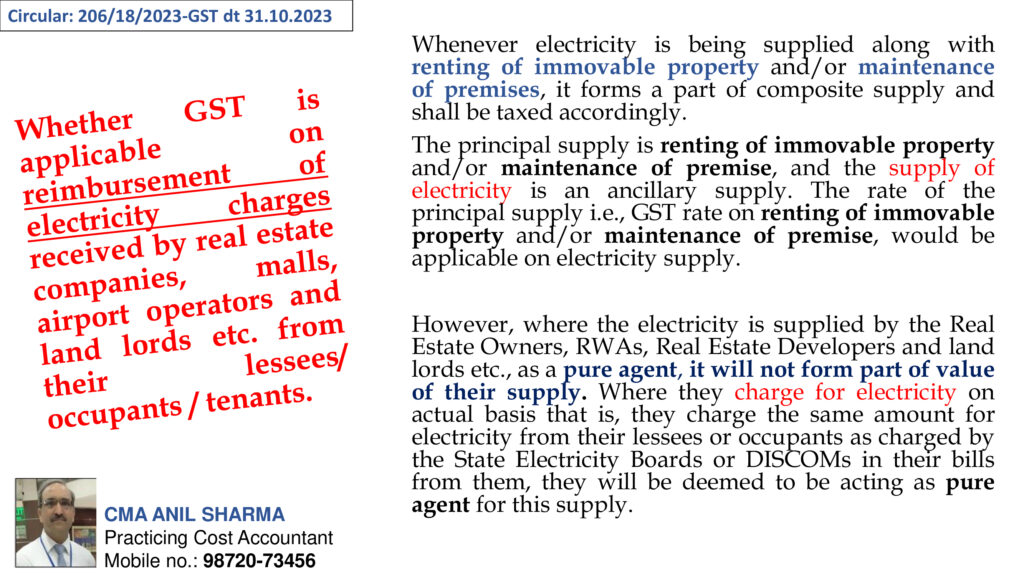
|
|
|
|
|
|
|
6. GST Daily by CA Pradeep Modi
CA Pradeep Modi is presenting judgment analysis under title 'GST Daily - Stay yourself updated'
|
|
|
|
|
|
|
Recap of Latest updates posted on 27.08.2026
|
CBIC issued Notification No. 30/2026-Customs dated 21.08.2026 regarding Seeks to exempt 10 lakh MT of raw sugar falling under tariff heading 1701 from the whole of the customs duty leviable thereon under …
|
GSTN is taking downtime to enhance its services on the GST Portal on 26.08.2026 from 12:00 AM onwards until 6:30 am of 26.08.2026.
|
The Hon’ble Supreme Court in M/s G.R. Infra Projects Limited set aside the Show Cause Notice dated June 13, 2025 issued under Section 74 of the CGST Act read with the MPGST Act for the FY 2018-19, and held that a bland and mechanical recital of the words ‘fraud or concealment of facts’,
|
Indian Railway Finance Corporation Ltd received a show cause notice from the GST Authority demanding ₹549.32 crore. The notice, issued under Section 73 of the Central Goods and Services Tax Act, 2017, cites excess input tax credit claims for FY23.
|
The Anti-Corruption Bureau (ACB) on Monday arrested a state tax officer and a senior assistant in Nirmal district for demanding and accepting a bribe of ₹50,000 in connection with a GST audit.
|
CBIC issued Notification No. 71/2026-Customs (N.T.) dated 25.08.2026 regarding Fixation of Tariff Value of Edible Oils, Brass Scrap, Areca Nut, Gold and Silver
|
CBIC issued Notification no. 21/2026-Customs (ADD) dated 21.08.2026 that Seeks to continue applicability of anti-dumping duty on imports of Natural Mica based Pearl Industrial Pigments ..
|
CBDT issued notification no. 115/2026 dated 21.08.2026 to hereby approves deduction under section 45(3)(a)(i) of the Income tax Act, 2025 to the International Institute of Bio Technology and Toxicology , Tamil Nadu for Scientific Research
|
I request the views of tax professionals and TDS experts on the following issue under the Income-tax Act, 2025, regarding reporting in Form 140.
|
|
|
|
|
|
7. PPT/Handbook on GST
|
|
|
|
8. GST/Income Tax in Media
|
|
|
|
|
|
|
|
|
|
Hope the above updates is of use to you. Please share your input and feedback at taxupdate.otu@gmail.com
|
|
|
|
|
|
|
|
 
|
Visit our website
|
OTU provides you
|
- Articles on various topics
|
|
- Media - GST, Income Tax & Press R.
|
|
|
|
|
