|
|

|
Newsletter no. 74 dated 06.03.2023
|
|
|
|
|
|
This website contains information about recent changes mainly in GST laws. It also contains Articles on various topic in GST. Please visit the website and read more.
|
|
|
|
Index
|
5. Book by CMA Anil Sharma
|
|
|
|
|
|
|
|
GSTN issued Advisory no. 689 dated 20.11.2026
|
In accordance with Notification No. 05/2026–Central Tax dated 26.10.2026, effective from 01.11.2026, Metro Rail has been included under Rule 138(2A) of the CGST Rules, 2017, for the transportation of goods.
|
Accordingly, Metro Rail has been introduced as an additional mode of transport in the E-Way Bill system. Taxpayers and transporters can now select Metro Rail as the mode of transportation while generating E-Way Bills or updating Part-B details.
|
1. Availability of the Facility
|
The new transport mode has been enabled for the following functionalities through Web, Excel and API interfaces:
|
- E-Way Bill Generation
- Part-B Update
- Vehicle Update
- Consolidated E-Way Bill Generation
- Consolidated E-Way Bill Re-generation
Current Deployment Status:
|
•Web Users: The facility is currently available in the Production environment.
|
•API Users: The functionality has been released in the Sandbox environment to facilitate integration and testing. API users are advised to undertake the necessary changes and complete testing before its rollout in Production.
|
2. Important Instructions
|
a) Taxpayers and transporters transporting goods through Metro Rail are required to select Metro Rail as the mode of transportation.
|
b) Entry of the Transport Document Number is mandatory when Metro Rail is selected.
|
c) The correct Transport Document Number and other relevant transportation details must be furnished before submission.
|
Taxpayers and transporters are advised to select Metro Rail as the appropriate mode of transport while generating E-Way Bills or updating Part-B details for goods transported through Metro Rail.
|
API users are advised to make the necessary changes in their systems and validate the functionality in the Sandbox environment. The availability of the facility in the API Production environment will be communicated separately.
|
All stakeholders are requested to take note of the above changes.
|
|
|
|
|
|
|
|
Central Board of Direct Taxes (CBDT) issued notification no. 134/2026 dated 08.10.2026 to hereby make following rules to amend the income tax rules, namely -
|
These rules may be called the Income tax (Sixth Amendment) Rules, 2026
|
They shall come into force on the date of their publication in the official gazette
|
|
|
|
|
|
|
|
Central Board of Direct Taxes (CBDT) issued notification no. 132/2026 dated 28.09.2026 to hereby make the following further amendments to the Notification no. S.O.359 dated 30.03.1988 -
|
|
|
|
|
|
|
|
Central Board of Direct Taxes (CBDT) issued notification no. 132/2026 dated 28.09.2026 to hereby approve the Jai Research Foundation, Valsad, Gujarat for Scientific Research under the category of Research Association, for the purposes of section 45(3)(a)(i) of the said Act of 2025 and rules 32 and 33 of the Income-tax Rules, 2026.
|
|
|
|
|
|
|
|
Central Board of Direct Taxes (CBDT) issued notification no. 131/2026 dated 28.09.2026 to hereby approve the Santhigiri Ashram, Thiruvananthapuram for Scientific Research under category of University, college or other institution, for the purposes of section 45(3)(a)(i) of the said Act of 2025 and rules 32 and 34 of the Income-tax Rules, 2026.
|
|
|
|
|
|
|
|
Central Board of Direct Taxes (CBDT) issued notification no. 130/2026 dated 28.09.2026 to hereby approve the Institute for Financial Management and Research, Chennai for Research in Social Science or Statistical Research as other Institution under the category of University, college or other institution, for the purposes of section 45(3)(a)(ii) of the said Act of 2025 and rules 32 and rules, 34 of the Income tax rules, 2026.
|
|
|
|
|
|
|
|
Central Board of Direct Taxes (CBDT) issued notification no. 129/2026 dated 28.09.2026 to hereby approves UPASI Tea Research Foundation, Tamil Nadu for Scientific Research as 'Other Institution' under the category of 'University, college or other institution, for the purposes of section 45(3)(a)(i) of the said Act of 2025 and rules 32 and rules 34 of the Income tax rules, 2026.
|
|
|
|
|
|
|
|
Central Board of Direct Taxes (CBDT) issued notification no. 128/2026 dated 28.09.2026 to hereby approves the Santhigiri Ashram, Thiruvananthapuram for Research in Social Science or Statistical Research under the category of University, college or other institution, for the purposes of section 45(3)(a)(ii) of the said Act, 2025 and rules 32 and 34 of the Income tax rules, 2025.
|
|
|
|
|
|
|
|
Central Board of Direct Taxes (CBDT) issued notification no. 127/2026 dated 28.09.2026 to hereby approve the Indian Institute of Health Management Research, Jaipur for Scientific Research under the category of University, college or other institution, for the purposes of section 45(3)(a)(i) of the Act, of 2025 and rules 32 and 34 of the Income tax rules, 2026.
|
|
|
|
|
|
|
|
Central Board of Direct Taxes (CBDT) issued notification no. 126/2026 dated 28.09.2026 to hereby give approve the Bharatiya Sanskriti Darshan Trust, Pune for Scientific Research under the category of University, college or other institution, for the purpose of section 45(3)(a)(i) of the said Act of 2025 rule 32 and 34 of the Income tax rules, 2025.
|
|
|
|
|
|
|
|
CBDT issued notification no. 08/2026 dated 28.09.2026 regarding order under section 45(3)(b) of the income tax at income tax act , 2026.
|
In exercise of the powers conferred by section 45(3)(h) of the income tax act, 2025 read with Rule 35 of the Income tax Rules, 2026, the Pr. Chief Commissioner of Income tax (Exemption), Delhi hereby accords approval to the company M/s. GCS Foundation (Formerly known as The Gujarat Cancer Society , Ahmedabad), Nr. Chamunda Bridge, Opp., DRM Office, Ahmedabad City, Civil Hospital SO, Ahmedabad , Gujarat - 380016, for 'Scientific Research' for the purpose of the section 45(3)(b) of the Income tax Act, 2025 read with rule 35 of the Income tax Rules, 2026.
|
This Notification shall be applicable for five Tax Years from Tax Year 2026-27 to 2030-31.
|
|
|
|
|
|
|
|
Central Board of Direct Taxes (CBDT) issued notification no. 125/2026 dated 28.09.2026 to hereby approves The Voluntary Health Services, Chennai (PAN: AAAAT0017H) for Scientific Research as "other institution" under the category of "University, college or other institution" , for the purposes of section 45(3)(a)(i) of the said Act of 2025 and rules 32 and 34 of the Income tax Rules, 2026.
|
|
|
|
|
|
|
|
The Goods and services tax (GST) authorities are planning to electronically record details of invoices issued by shops and businesses to retail consumers under a pilot project covering select sectors from April 1, 2027, to improve tax compliance, two officials told Business Standard.
|
The move will enable tax officials to access the large volume of retail transactions in sectors prone to tax evasion and assess whether businesses are correctly reporting their sales and paying the appropriate amount of GST, they said.
|
Currently, businesses with annual sales of more than ₹5 crore have to electronically register invoices issued to other businesses on a government-designated portal, subject to certain exemptions. Extending this reporting requirement, known as e-invoicing, to sales to end consumers is the next logical step towards enhancing tax compliance.
|
Businesses currently report their aggregate sales through GST returns rather than individual retail transactions. E-invoicing at the retail level is expected to help tax officials match these transactions with the sales reported by businesses in their tax returns, one of the officials said.
|
The GST Council, at its 54th meeting in September 2024, had recommended a voluntary trial of electronic recording of consumer bills in select sectors and states.
|
The Council proposed introducing the system on a voluntary basis initially and subsequently making it mandatory in sectors prone to tax evasion, according to the minutes of the meeting, which are publicly available. Restaurants were cited as one of the sectors where retail e-invoicing could be introduced.
|
The Council had identified several potential benefits, including better tax compliance, environmental gains from avoiding physical invoices and lower costs. Consumers would receive e-invoices on their mobile phones.
|
Officials said the government was now keen to take the pilot project forward.
|
An email sent to the Ministry of Finance on October 23 seeking comments for the story remained unanswered till press time.
|
Banks, insurers and non-banking financial companies (NBFCs) are among those currently exempt from e-invoicing for transactions with other businesses. However, the Centre and state governments are also considering bringing their business-to-business invoices under the requirement, the first official said. This is not part of the proposed pilot project.
|
Managing retail sales data
A third official, who also spoke on condition of anonymity, said the idea of electronically capturing retail invoices had been discussed for years, but implementation was delayed by the challenge of processing the enormous volume of small-value transactions taking place every day.
|
Storing and processing such volumes would require substantial server capacity, and the earlier technology infrastructure was not equipped to handle that scale, the official said.
|
Retail e-invoicing could also help foreign tourists claim GST refunds on purchases made in India before taking the goods back to their home countries, as customs officers would be able to verify the tax paid more easily, the official said.
|
Another government official said the GST Network (GSTN), which manages the technology backbone of the GST system, awarded Infosys a fresh seven-year contract in 2025 after the original arrangement, which had already been extended beyond its initial five-year term, ended.
|
Officials believe the new arrangement has factored in the need for higher storage and processing capacity.
|
They said storing invoices in a common system could reduce compliance costs by enabling more efficient invoice matching and audits, instead of relying on separate statements and manual checks.
|
Digital records carrying timestamps could also improve transparency and make subsequent changes to invoices easier to track, they said.
|
The government is also studying how countries such as Brazil and Chile operate their e-invoicing systems. Both have long used electronic invoices for business and consumer transactions, officials said.
|
Experts said the impact of e-invoicing in retail could be significant. “E-invoicing could be leveraged by the government to incentivise customers who seek GST valid invoice for their purchases, thereby encouraging the unorganised sector moving to the organised,” an tax expert said.
|
Experts also welcomed the possibility of withdrawing the business-to-business (B2B) exemption for financial sector entities. Another tax expert said e-invoicing in sectors such as banking, NBFCs and insurance would bring all B2B transactions in the economy under the system.
|
“Customers of these sectors would also benefit. It would be important to give sufficient time to these sectors as they have very high volumes of B2B transactions, and also use several custom/bespoke billing systems,” he said.
|
“Overall, it is a positive change and the GST Policy wing can collaborate with the sector associations to make this a success,” he said.
|
On B2C e-invoicing, he said it could enable better integration of digital payment and invoicing systems, supporting automated reconciliation and reporting.
|
Another tax expert said banks and NBFCs handle millions of small charges every day.
|
“Keeping the B2C pilot focused on technology-enabled sectors such as organised retail, e-commerce, quick commerce and online gaming while moving financial institutions only on the B2B side first, is a practical approach,” he said.
|
Source: Business Standard
|
|
|
|
|
|
|
|
Under the current GST returns framework, taxpayers are required to furnish details of their outward supplies in FORM GSTR-1. Based on such details, a statement of input tax credit (ITC) is made available to the recipients in FORM GSTR-2B for availment of input tax credit. To aid furnishing of return in FORM GSTR-3B of a tax period, tax liability of a supplier is being auto-populated on the portal based on the details furnished in his FORM GSTR-1, and available input tax credit is being autopopulated in his FORM GSTR-3B on the portal based on his FORM GSTR-2B. Currently, taxpayers can edit such auto-populated tax liability and available input tax credit in FORM GSTR-3B, before filing the same. Such editing may result in discrepancies between
|
a. tax liability reported in FORM GSTR-1 and tax paid in FORM GSTR-3B; and
|
b. ITC available in FORM GSTR-2B and ITC availed in FORM GSTR-3B.
|
2. These discrepancies often lead to issuance of demand notices by tax officers and system generated intimations to taxpayers. In view of reducing the mismatches between the tax liability reported in FORM GSTR-1 and the tax paid in FORM GSTR3B, and between the ITC available in FORM GSTR-2B and the ITC availed in FORM GSTR-3B, various facilities have been introduced on the portal in the past. These facilities enable correct reporting of tax liability and ITC details in FORM GSTR-3B, including correction of such details, wherever required, in the source statements i.e. FORM GSTR-1 and FORM GSTR-2B, rather than direct editing in FORM GSTR-3B. These facilities include:
|
a. FORM GSTR-1A, to enable taxpayers to amend their FORM GSTR-1 details before filing FORM GSTR-3B;
|
b. Invoice Management System (IMS), to facilitate reconciliation of ITC available in FORM GSTR-2B with the ITC availed in FORM GSTR-3B;
|
c. Electronic Credit Reversal and Re-claimed Statement, to facilitate accurate reporting of reversal and re-claim of ITC; and
|
d. RCM Ledger/ITC Statement, to facilitate accurate reporting of ITC availment in respect of supplies liable to reverse charge
|
3. The above-mentioned facilities though made available on the portal, have, except for FORM GSTR-1A, not been notified in CGST Rules, 2017. It is seen that some taxpayers are either not using or not properly using these facilities and continue to manually edit auto-populated details in FORM GSTR-3B, resulting in continued issuance of demand notices by tax officers and system generated intimations to taxpayers on account of mismatches in tax liability and ITC, causing inconvenience to taxpayers while also weakening the ITC chain integrity.
|
4. Accordingly, there is a need to further strengthen the return-filing framework, so as to provide an improved alternate mechanism of amendment of tax liability and ITC details in return in FORM GSTR-3B, which reconciles with the details of outward supplies furnished in FORM GSTR-1 and the details of available ITC in FORM GSTR2B, thereby minimizing mismatches. Such a framework will improve the accuracy of tax liability and ITC reporting, enhance compliance, and strengthen the foundation for the effective implementation of other process reforms recommended by the GST Council.
|
GST Council recommendations
5. In view of the above, the GST Council in its 57th meeting held on 8th October, 2026, took note of the various scenarios which require the taxpayers to edit autopopulated values in FORM GSTR-3B and recommended an Alternate mechanism of amendment of tax liability and ITC details in return in FORM GSTR-3B, building on the existing facilities and recommending certain new facilities as follows:
|
- i. Enhancement of FORM GSTR-1/1A/IFF for better reconciliation with FORM GSTR-3B and other statements
- The absence of supply-type-wise granularity in FORM GSTR-1/1A/IFF may lead to incorrect auto-population of the corresponding tables in FORM GSTR-3B, requiring manual correction by taxpayers. For instance, credit notes, debit notes, advances received, and advances adjusted are not categorised by the nature of supply, such as regular outward supplies, supplies under section 9(5), or zero-rated supplies. As a result, they may be reported under the table for taxable outward supplies in FORM GSTR- 3B, instead of the appropriate relevant table.
- Further, the existing format of FORM GSTR-1 does not enable taxpayers to reconcile supplies made through electronic commerce operators with the corresponding details furnished by the ECOs in FORM GSTR-8 and made available on the common portal.
- Accordingly, enhancements to FORM GSTR-1/1A/IFF have been recommended to enable identification of the nature of the underlying supply in respect of credit notes, advances, and similar documents. This would ensure correct auto-population of tax liability in FORM GSTR-3B and obviate the need for amending the auto-populated liability in FORM GSTR-3B.
- Further, to facilitate the taxpayers in furnishing details in FORM GSTR1/1A/IFF on the portal, user interface improvements, such as tool tips and guided navigational paths on the portal have been suggested.
- ii. Expanding the scope of rectifications to be made through FORM GSTR-1A
- At present, FORM GSTR-1A cannot be used to add or amend details relating to earlier tax periods, or to correct the GSTIN of the recipient. This restricts taxpayers from rectifying any error regarding the earlier tax period or relating to change in GSTIN of the recipient before filing FORM GSTR-3B. Accordingly, it has been recommended that this restriction may be removed.
- iii. Rectification of details furnished in FORM GSTR-3B of an earlier tax period
- It was observed that certain taxpayers rectify tax liability for outward supplies of an earlier tax period directly in FORM GSTR-3B, without correcting the underlying details in FORM GSTR-1/1A. Accordingly, it has been recommended that such rectification be made only through the amendment tables of FORM GSTR-1/1A, instead of amending the autopopulated liability detail in FORM GSTR-3B, directly. However, rectification of reverse-charge tax liability may be made directly through adjustments in the FORM GSTR-3B of a subsequent tax period.
- iv. Reporting of details of outward supplies in FORM GSTR-1 where tax had been discharged through FORM GST DRC-03
- Where any amount of tax has been paid through FORM GST DRC-03 in pursuance of a proceeding such as the audit, inspection, scrutiny or enforcement activity by the tax authorities, and the taxpayer intends to pass on the ITC in respect of the same to the recipient, then if he reports the invoice or debit note details in FORM GSTR-1/1A, the liability gets auto-populated in FORM GSTR-3B. As the taxpayer has already paid the tax liability through FORM GST DRC-03, he may be resorting to editing liability in FORM GSTR-3B, so as to avoid duplication of payment of said tax liability.
- To prevent such duplication, it has been recommended that FORM GST DRC-03 be enhanced to enable the taxpayer to declare, within seven days of payment, the details of the underlying invoice(s) or debit note(s). In such cases, when the said invoice or debit note details are reported in FORM GSTR-1/1A, the corresponding tax liability for the said invoice or debit note will not be added to the auto-populated liability in FORM GSTR-3B, thus avoiding any duplication of payment of tax. The details of such invoice or debit note will also be made available in corresponding FORM GSTR-2B of the recipient for availment of ITC.
- v. Correct reporting of reverse charge liability in FORM GSTR-3B
- To facilitate the taxpayers in correct reporting of tax liability and input tax credit in respect of supplies liable to reverse charge, RCM Liability and ITC Statement was introduced on the portal from August 2024 period onwards for monthly filers and July-September 2024 period onwards for quarterly filers. A facility was also provided to report cumulative closing balance, if any, upto that period.
- To further streamline correct reporting of such tax liability and ITC, it has been recommended to notify the said statement in CGST Rules, 2017 and to require that ITC claimed on inward supplies under reverse charge (other than import of goods) in FORM GSTR-3B of a tax period should not exceed the tax liability under RCM declared in the said FORM GSTR-3B and the closing balance available in the said statement.
- Accordingly, an Electronic Statement of tax paid on Reverse charge basis and input tax credit claimed has been recommended in FORM GST PMT-02B. Also, amendment has been recommended in FORM GST PMT-04, so as to allow a taxpayer to report discrepancies, if any, in the said statement.
- vi. Mandating and clarifying the usage of Invoice Management System (IMS) for better reconciliation of input tax credit details in FORM GSTR-3B
- IMS has been available on the portal since October 2024. It allows recipients to accept, reject, or keep pending inward supply details communicated by supplier. The salient features of IMS are as follows:
- The taxpayer may keep documents pending on IMS, in respect of which the conditions of eligibility of ITC under section 16(2) of CGST Act are presently not fulfilled, but which may get fulfilled subsequently. Upon fulfillment of the requisite conditions, such documents may be subsequently accepted by the recipient on IMS.
- The taxpayer may reject a document on IMS, if any discrepancy in the document communicated on IMS is noticed or where the document is found to not pertain to him.
- If no action is taken on a document communicated on IMS for generation of FORM GSTR-2B of a tax period before filing of FORM GSTR-3B for the said tax period, the same is considered to have been accepted by the recipient on IMS.
- ITC pertaining to accepted or deemed accepted documents is made available in FORM GSTR-2B and accordingly autopopulated in Table 4(A) of FORM GSTR-3B for the corresponding tax period. Conversely, the ITC pertaining to documents kept pending or rejected in IMS is not made available in FORM GSTR2B and accordingly not auto-populated in Table 4(A) of FORM GSTR-3B for the corresponding tax period.
- An action taken on any document on IMS by the recipient can be revised any number of times upto the filing of his FORM GSTR3B for the tax period for which FORM GSTR-2B is being generated. Based on the revised action taken on IMS, FORM GSTR-2B can be also revised, which will also revise the autopopulated ITC in FORM GSTR 3B.
- These above-mentioned features of IMS improve the reconciliation between ITC available in FORM GSTR-2B and ITC availed in FORM GSTR-3B.
- With a view to facilitate ease of taking action on IMS, offline tool has been made available on GST Portal, to enable taxpayers to undertake actions on both individual as well as bulk invoices in an efficient manner.
- To reduce inadvertent rejections or premature acceptance of credit notes, it has been recommended to extend the period for which a credit note may be kept pending on IMS:
a) By Monthly filers: Until filing of FORM GSTR-3B for next-to-next month, to the month in which the credit note was communicated to the taxpayer, but not later than the end of the month in which the due date for filing of the return in FORM GSTR-3B for the said next to next month falls. Thereafter, the credit note will be deemed accepted.
|
Example: Say a credit note was communicated by the supplier in his FORM GSTR-1 filed on 11th May, 2026, for the month of April 2026, to the recipient “A”. The same shall reflect in the IMS of “A” for the month April 2026. This credit note can be kept pending on the IMS by “A” till the date of filing of FORM GSTR-3B for the month of June, 2026 (which is next to next month of April 2026). However, if FORM GSTR-3B of June 2026 is not filed by “A” upto 31st July 2026 (which is the last date of the month in which the return for the month June 2026 was due), then the said credit note shall be deemed to have been accepted by “A” on IMS.
|
b) By Quarterly filers: Until filing of FORM GSTR-3B for the next quarter after the quarter in which the credit note was communicated to the taxpayer, but not later than the end of the month in which the due date for filing of the return in FORM GSTR-3B for the said next quarter falls. Thereafter, the credit note will be deemed accepted.
|
Example: Say a credit note was communicated by the supplier in his FORM GSTR-1 filed on 11th May, 2026 for the month of April 2026, to a recipient “A”,. The same shall reflect in the IMS of “A” for the quarter April–June 2026. This credit note can be kept pending on the IMS by “A” till the date of filing of FORM GSTR-3B for the quarter of July–September 2026 (which is next quarter to April–June 2026). However, if FORM GSTR-3B of July–September 2026 is not filed by “A” upto 31st October 2026 (which is the last date of the month in which the return for the quarter July–September 2026 was due), then the said credit note shall be deemed to have been accepted by “A” on IMS.
|
-
- It has further been recommended to provide an option for the suppliers to link credit notes and debit notes with the underlying invoices in FORM GSTR-1/1A/IFF, on a purely voluntary basis, to help recipients take informed decisions and to reduce the need of keeping credit notes pending or rejecting them on IMS.
- Since acceptance, rejection, and keeping documents pending on IMS improve ITC reconciliation, the GST Council has recommended that management of available ITC in FORM GSTR-3B should be carried through IMS instead of directly amending auto-populated ITC in FORM GSTR-3B. GST Council has also recommended notifying relevant amendment in GST Rules and FORMS for the same purpose.
- The Council also recommended issuance of a circular to guide the taxpayers in correct manner of taking action on IMS.
- vii. Facilitating taxpayers in correct reporting of reversal and reclaim of ITC in FORM GSTR-3B:
- In order to facilitate the taxpayers in correct and accurate reporting of reversal and reclaim of input tax credit, a statement namely, Electronic Credit Reversal and Reclaim Statement was introduced on the GST portal from August 2023 return period onwards, with a facility to report their cumulative closing balance of input tax credit, if any, which had been reversed but not re-availed upto that time.
- To further streamline correct reporting, it has been recommended to notify the said statement in CGST Rules, 2017 and to require that reclaimed input tax credit in FORM GSTR-3B shall not exceed the balance available in the said statement.
- Accordingly, an Electronic Credit Reversal and Reclaim Statement has been recommended in FORM GST PMT-02A. Also, amendment has been recommended in FORM GST PMT-04, so as to allow a taxpayer to report discrepancies, if any, in the said statement.
- Further, amendment has been recommended in Table 4 of FORM GSTR3B to provide for a separate Table 4(AA) in FORM GSTR-3B for reporting reclaimed ITC, so as to obviate the need for amending the auto-populated ITC details in Table 4(A)(5) of FORM GSTR-3B.
- viii. Streamlining the manner of rectification of errors made in reporting input tax credit in FORM GSTR-3B
- After suppliers furnish outward supply details, recipients act on IMS to generate FORM GSTR-2B and are generally required to manually report RCM ITC, ITC reversals, and ITC re-claims in FORM GSTR-3B. Such manual interventions are prone to errors and omissions.
- As the temporary reversals made in Table 4(B)(2) of FORM GSTR-3B are credited to the Electronic Credit Reversal and Re-claim Statement, any excess temporary reversal done in Table 4(B)(2) can be rectified by reclaiming the excess amount so reversed in a subsequent return. However, no such systematic mechanism exists to rectify any excess reversal of ITC, reversed permanently in Table 4(B)(1) of FORM GSTR3B.
- Accordingly, it has been recommended to provide a systemic mechanism, by way of a new form, FORM GST PMT-10 to undertake rectifications of such excess reversals of permanent nature reported in Table 4(B)(1) of FORM GSTR-3B of an earlier tax period, on the basis of self-assessment.
- ix. Enhancement in FORM GSTR-2B in respect of ITC distributed by ISD
- ITC distributed by an Input Service Distributor (ISD) as ineligible in FORM GSTR-6 does not currently flow as available ITC in FORM GSTR2B and is therefore not auto-populated in Table 4(A)(4) of FORM GSTR3B.
- Accordingly, enhancements have been recommended in FORM GSTR2B and FORM GSTR-3B, to provide that ITC distributed by an ISD as ineligible need not be reversed again by recipients in Table 4(B)(1) of FORM GSTR-3B as such ITC will be auto-populated as ineligible ITC in Table 4(D)(2) of FORM GSTR-3B.
- Currently, ITC attributable to an ineligible ISD credit note is reduced from eligible ITC on the portal. Since such a credit note relates to ineligible ITC, its impact should instead flow to the ineligible ITC section, i.e., Table 4(D)(2) of FORM GSTR-3B.
- Accordingly, enhancements have been recommended in FORM GSTR2B to ensure that ITC relating to ineligible credit notes distributed by an ISD is not adjusted against eligible ITC distributed by the ISD.
6. Besides the above, the GST Council also recommended issuance of a circular to clarify the correct manner of reporting ITC availment and its reversal in FORM GSTR3B, in the context of IMS, the Electronic Credit Reversal and Re-claimed Statement, and the Electronic Statement of tax paid on reverse charge basis and ITC claimed.
|
7. The Council recommended that, with the above proposed measures, there may not be any need for directly rectifying/amending the details of liability (autopopulated from FORM GSTR 1/1A/IFF) and details of ITC (auto-populated from FORM GSTR-2B) in FORM GSTR-3B. Thus, any amendment/correction of liability will be done through FORM GSTR-1/1A/IFF instead of directly amending auto-populated values in FORM GSTR-3B. Further, any management of ITC will be done through IMS, Electronic Credit Reversal and Re-claimed Statement, and the Electronic Statement of tax paid on reverse charge basis and ITC claimed, FORM GST PMT-04 and FORM GST PMT-10, instead of directly amending the auto-populated details in FORM GSTR-3B. To allow stakeholders sufficient time to align their systems and practices, the Council recommended that this proposed Alternate mechanism of amendment of tax liability and ITC details in return in FORM GSTR-3B, and corresponding amendments to the CGST Rules, 2017, may be brought into force from the return period of April, 2027.
|
Public consultation
8. Furthermore, the Council recommended that the proposed measures be placed in the public domain for a time-bound consultation to provide an opportunity to taxpayers, tax practitioners, industry associations, and other stakeholders to submit comments and suggestions on the proposed measures. In this regard, the amendments recommended by the Council in CGST Rules, 2017 and in the CGST FORMs are placed at Annexure A* and Annexure B*, respectively. The circular recommended by the Council for clarifying the correct manner of reporting ITC availment and its reversal in FORM GSTR-3B is placed at Annexure C*.
|
9. Accordingly, all the stakeholders are invited to examine the proposed measures and submit their comments, suggestions, and inputs by Monday, 30th November. The same shall be examined and duly considered before finalisation of the amendments to the said Forms and Rules.
|
* Kindly note that the amendments proposed in the CGST Rules, 2017 and CGST Forms placed in Annexure A and Annexure B respectively, have been highlighted in red.
|
|
|
|
|
|
|
|
India’s ambition to become a Viksit Bharat requires an economy in which enterprises of every size can grow, wherever they begin. Over the past twelve years, our government has worked to create those conditions. The introduction of the goods and services tax (GST) in 2017 established a common national framework for indirect taxation. Next-Gen GST carries that effort forward, drawing on nine years of implementation and the experience of taxpayers and states.
|
Under Prime Minister Narendra Modi’s vision, Next-Gen GST was conceived with two connected purposes: To reduce and rationalise rates, and to make compliance easier. The rate changes took effect on September 22, 2025. The next phase of process reforms will come before the GST Council shortly. Together, these efforts seek to give households relief, businesses greater certainty and taxpayers a system in which they can fulfil their obligations without avoidable difficulty.
|
The states have been partners throughout. They brought their priorities and experience to the Council, helped shape the decisions and undertook their implementation. I thank them for that commitment. GST’s progress rests on this willingness to pursue a shared national purpose while respecting each government's responsibilities.
|
The results provide grounds for confidence. Between October 2025 and July 2026, the value of reported taxable supplies grew by 25.8 per cent over the corresponding period a year earlier. A lighter rate structure has been accompanied by a substantial expansion in reported economic activity. This is an encouraging foundation for a reform intended to support both enterprise and public finances.
|
That resilience is visible in the latest revenue figures. Gross GST collections reached ₹12.46 trillion during April-September 2026, up 11.6 per cent over the corresponding period last year. Every month from June through September recorded double-digit annual growth; together, collections for these four months accelerated by nearly 15 per cent. Net collections, after refunds, also grew by 10.4 per cent over the half year. Taxpayer relief has coexisted with growth in the resources available for development.
|
The breadth of the expansion matters as much as its scale. Reported taxable supplies grew across all 11 sector groups and all major states. In an economy as diverse as India’s, this spread is significant. Growth across sectors and regions creates opportunities for more businesses to participate in expanding markets, and for more communities to benefit from the demand, investment and employment that follow.
|
Reported sales to consumers (B2C) also rose by 26.7 per cent in the post-reform comparison. When tax relief is reflected in prices, families have more room to meet other needs or save. Consumer relief and enterprise growth are closely connected: The purchasing power of households sustains demand for the goods and services that businesses provide. The benefits can extend from the household to the retailer, the supplier and the producer.
|
For small and medium enterprises, a national market is valuable when it opens a practical route to customers beyond their immediate surroundings. Businesses in Tier-II and Tier-III towns should be able to build those relationships while continuing to invest and employ people locally. Enterprises expanding into these towns, in turn, can create opportunities for local suppliers and distributors. GST’s common framework supports these connections; simpler administration must make them easier to sustain.
|
Participation in that framework is substantial. GST registrations across Central and state jurisdictions stood at approximately 17.1 million at the end of August, up nearly 15 per cent from a year ago. For the April–July 2026 tax periods, GSTR-3B returns filed by their due dates were 12.6 per cent higher than for the same periods last year. These improvements place a corresponding responsibility on the administration: Regular compliance must be supported by reliable service, clear guidance and timely resolution of difficulties.
|
The functioning of input tax credit is another important part of this experience. The post-reform figures show that the share of tax liability discharged through credits rose, while accumulated credit declined relative to taxable supplies. This is encouraging for businesses that depend on the effective use of eligible credit. For a smaller firm, working capital determines how readily it can purchase inputs, fulfil an order and take on the next one.
|
Refunds are equally relevant. Approximately ₹1.80 trillion was refunded during April-September. Returning amounts due to businesses is part of a well-functioning tax system. Greater predictability in this process would help enterprises plan purchases and production with more confidence. The taxpayer’s experience of receiving an eligible refund is an important measure of administrative performance.
|
The states also have a stronger revenue position. Their aggregate SGST (state GST) receipts, including their share of IGST (integrated GST) settlements, grew by about 16 per cent during April-September this year. These resources support investment in infrastructure and public services, which improve the conditions in which families and enterprises pursue their aspirations. The gains can therefore reinforce one another: Household relief supports demand, enterprise strengthens economic activity, and public revenues help sustain development.
|
The experience also points to the work ahead. A growing system must remain attentive to the costs it imposes on smaller participants. Their time and resources are limited. Each improvement in filing, credit or refunds should allow more of those resources to be devoted to running and expanding a business.
|
The proposals before the Council on October 7 have been developed through sustained work with the states. They address registration, returns, refunds, disputes and improved flow of input tax credit, with the aim of reducing the time and cost of compliance. Taxpayer experience must continue to guide implementation.
|
The GST’s growing maturity gives us a stronger foundation for the next stage of reform. The same commitment to clarity, certainty and respect for the taxpayer guides our work on direct taxes. A dependable tax system enables enterprises to plan beyond their immediate obligations and invest in opportunities that take time to mature. Giving them that confidence, wherever they operate, helps build the economic strength of a Viksit Bharat as envisioned by Prime Minister Narendra Modi.
|
The writer is the Union Minister of Finance and Corporate Affairs
|
Source: Business Standard
|
|
|
|
|
|
|
|
The Hon’ble Delhi High Court in M/s. Spinns International v. Pr. Commissioner of Goods and Service Tax, has set aside the Show Cause Notice (“SCN”) and the consequential order for cancellation of GST Registration of the assessee, on the grounds that the SCN was bereft of any reasons and was issued in a mechanical manner without any application of mind. Held that, the purpose of a SCN is to enable the noticee to meet the allegations, on the basis of which an adverse action is proposed. Further, the procedure adopted by the Revenue Department is flawed and the order for cancellation of GST Registration of the assessee was passed in violation of principles of natural justice.
|
M/s. Spinns International (“the Petitioner”) had applied for the amendment of certain particulars in the GST Registration, which were accepted by the Revenue Department (“the Respondent”) dated May 27, 2022. A SCN dated September 29, 2022 (“the Impugned SCN”) was issued by the Respondent proposing to cancel the Petitioner’s Registration and called upon the Petitioner to appear before it.
|
The Petitioner stated that the Impugned SCN did not specify any reasons and was incapable of being responded to. Consequently, the Petitioner’s GST Registration was cancelled vide the order dated October 11, 2022 (“the Impugned Order”) on the grounds that the Petitioner had neither appeared for a personal hearing nor submitted any reply.
|
The Petitioner, then filed an application seeking the revocation of the Impugned Order, which is pending, but the Respondent stated that a NOC from Anti-Evasion Head-Quarter must be obtained in order to proceed with the revocation application.
|
Being aggrieved this Petition has been filed.
|
Whether the Impugned SCN and the Impugned Order passed for cancellation of GST Registration without specifying the reasons is maintainable?
|
The Hon’ble Delhi High Court in W.P.(C) 1989/2023 held as under:
|
- Noted that, it is settled law that the purpose of a SCN is to enable the noticee to meet the allegations on the basis of which an adverse action is proposed.
- Observed that, the Impugned SCN did not specify any allegation, which was capable of being responded to and was issued in a mechanical manner without any application of mind.
- Opined that, the Impugned SCN cannot be considered as a SCN at all.
- Noted that, there is no statutory provision that requires a taxpayer to seek a NOC from any authority for moving an application for revocation of cancellation of its GST Registration.
- Stated that, the procedure adopted by the Respondent for cancellation of the GST Registration is flawed.
- Held that, the Impugned Order has been passed in violation of principles of natural justice.
- Set aside the Impugned SCN and the Impugned Order.
- Permitted the Respondent to initiate any fresh action in accordance with law.
Section 29 of the Central Goods and Services Tax Act, 2017 (“the CGST Act”):
|
“Cancellation or suspension of registration.
|
29. (1) The proper officer may, either on his own motion or on an application filed by the registered person or by his legal heirs, in case of death of such person, cancel the registration, in such manner and within such period as may be prescribed, having regard to the circumstances where,––
|
(a) the business has been discontinued, transferred fully for any reason including death of the proprietor, amalgamated with other legal entity, demerged or otherwise disposed of; or
|
(b) there is any change in the constitution of the business; or
|
(c) the taxable person is no longer liable to be registered under section 22 or section 24 or intends to optout of the registration voluntarily made under sub-section (3) of section 25:
|
Provided that during pendency of the proceedings relating to cancellation of registration filed by the registered person, the registration may be suspended for such period and in such manner as may be prescribed.
|
(2) The proper officer may cancel the registration of a person from such date, including any retrospective date, as he may deem fit, where,––
|
(a) a registered person has contravened such provisions of the Act or the rules made thereunder as may be prescribed; or
|
(b) a person paying tax under section 10 has not furnished the return for a financial year beyond three months from the due date of furnishing the said return; or
|
(c) any registered person, other than a person specified in clause (b), has not furnished returns for such continuous tax period as may be prescribed; or
|
(d) any person who has taken voluntary registration under sub-section (3) of section 25 has not commenced business within six months from the date of registration; or
|
(e) registration has been obtained by means of fraud, wilful misstatement or suppression of facts:
|
Provided that the proper officer shall not cancel the registration without giving the person an opportunity of being heard.
|
Provided further that during pendency of the proceedings relating to cancellation of registration, the proper officer may suspend the registration for such period and in such manner as may be prescribed.
|
(3) The cancellation of registration under this section shall not affect the liability of the person to pay tax and other dues under this Act or to discharge any obligation under this Act or the rules made thereunder for any period prior to the date of cancellation whether or not such tax and other dues are determined before or after the date of cancellation.
|
(4) The cancellation of registration under the State Goods and Services Tax Act or the Union Territory Goods and Services Tax Act, as the case may be, shall be deemed to be a cancellation of registration under this Act.
|
(5) Every registered person whose registration is cancelled shall pay an amount, by way of debit in the electronic credit ledger or electronic cash ledger, equivalent to the credit of input tax in respect of inputs held in stock and inputs contained in semi-finished or finished goods held in stock or capital goods or plant and machinery on the day immediately preceding the date of such cancellation or the output tax payable on such goods, whichever is higher, calculated in such manner as may be prescribed:
|
Provided that in case of capital goods or plant and machinery, the taxable person shall pay an amount equal to the input tax credit taken on the said capital goods or plant and machinery, reduced by such percentage points as may be prescribed or the tax on the transaction value of such capital goods or plant and machinery under section 15, whichever is higher.
|
(6) The amount payable under sub-section (5) shall be calculated in such manner as may be prescribed.”
|
DISCLAIMER: The views expressed are strictly of the author and A2Z Taxcorp LLP. The contents of this article are solely for informational purpose and for the reader’s personal non-commercial use. It does not constitute professional advice or recommendation of firm. Neither the author nor firm and its affiliates accepts any liabilities for any loss or damage of any kind arising out of any information in this article nor for any actions taken in reliance thereon. Further, no portion of our article or newsletter should be used for any purpose(s) unless authorized in writing and we reserve a legal right for any infringement on usage of our article or newsletter without prior permission.
|
|
|
|
|
|
|
|
The Hon’ble Madras Court in M/s. Engineering Aids v. State Tax Officer and Ors. has quashed the demand order passed by the Revenue Department, on the grounds that the reply filed by the assessee to the Show Cause Notice (“SCN”) was not considered even though the same was received by the Revenue Department. Remanded the matter back for fresh consideration on merits and in accordance with the law. Further, directed the Revenue Department to pass final orders, after adhering to the principles of natural justice and providing the opportunity of hearing to assessee.
|
This petition has been filed by M/s. Engineering Aids (“the Petitioner”) challenging the summary order in Form GST DRC-07 dated April 5, 2022 (“the Impugned Order”) passed by the Revenue Department (“the Respondent”) under Section 74 of the Central Goods and Services Tax Act, 2017 (“the CGST Act”) for demand and recovery of tax, on the grounds of violation of principles of natural justice, contending that only the Impugned Order was served and not the detailed order nor has it been uploaded on the GST portal. Further, the reply in Form GST DRC-06 dated February 25, 2022 (“the Reply”) to the SCN issued in Form GST DRC-01 dated February 17, 2022 (“the SCN”) was not considered by the Respondent while passing the Impugned Order.
|
Whether the Impugned Order can be passed without considering the Reply to the SCN?
|
The Hon’ble Madras High Court in W.P. No.28124 of 2022 held as under:
|
- Noted that, the Petitioner has also filed Form GST DRC-06, dated February 25, 2022 which confirms that the Reply sent by the Petitioner was received by the Respondent.
- Observed that, there was no reference of the Reply in the Impugned Order and the Reply was not considered by the Respondent while passing the Impugned Order.
- Held that, the respondents have not considered the Reply even though the same was received by them hence the Impugned Order has to be quashed.
- Quashed the Impugned Order.
- Remanded the matter back to the Respondent for fresh consideration on merits and in accordance with the law.
- Directed the Respondent to pass final orders within 12 weeks, after adhering to the principles of natural justice and providing the opportunity of hearing to the Petitioner.
DISCLAIMER: The views expressed are strictly of the author and A2Z Taxcorp LLP. The contents of this article are solely for informational purpose and for the reader’s personal non-commercial use. It does not constitute professional advice or recommendation of firm. Neither the author nor firm and its affiliates accepts any liabilities for any loss or damage of any kind arising out of any information in this article nor for any actions taken in reliance thereon. Further, no portion of our article or newsletter should be used for any purpose(s) unless authorized in writing and we reserve a legal right for any infringement on usage of our article or newsletter without prior permission.
|
|
|
|
|
|
|
|
The AAR, West Bengal in the matter of Shopinshop Franchise Pvt. Ltd. has ruled that ‘Bouquets’ made with dry parts of plants, foliage, flower buds, grasses, and branches of plants which dried, bleached, dyed, and coloured and sold with plastic foil packaging will be classifiable under Tariff Item No. 06039000 or 06049900 of the Customs Tariff Act, 1975 (“the Customs Tariff Act”), and would be exempted from GST as per the SI No. 34 of the Notification No. 02/2017-Central Tax (Rate) dated June 28, 2017 (“the Goods Exemption Notification”).
|
Shopinshop Franchise Pvt. Ltd. (“the Applicant”) is a company engaged in manufacturing and processing of dry parts of plants, foliage, flower buds, grasses and branches of plant which are dried, bleached, dyed and coloured for decorative and ornamental purposes and sold as ‘Bouquets’ made with dried parts of plants and packed in plastic foil packaging (“the Impugned Product”).
|
The Applicant submitted that the Impugned Product will be classified under HSN Code 0604 as per Chapter 6 of the First Schedule of the Customs Tariff Act and is exempted from GST as per SI No. 34 of the Goods Exemption Notification.
|
The Applicant filed this application seeking the classification and applicable GST rates on the Impugned Product.
|
Whether the supply of the Impugned Product will be classified under HSN Code 0604 as per Chapter 6 of the First Schedule of the Customs Tariff Act and covered under the SI. No 34 of the Goods Exemption Notification?
|
The AAR, West Bengal in 27/WBAAR/2022-23 held as under:
|
- Observed that, the raw materials used in making the Impugned Product are plant products and they undergo some sort of processing before packing with a simple plastic foil packaging.
- Noted that, the Bouquet, made with “Dried and/or Dyed” flower buds will be classifiable as “Other” under Tariff Item No. 06039000 and Bouquet, made with “Dried and/or Dyed” parts of plants, foliage, grasses and branches of plant, will be classifiable as “Other” under Tariff Item No. 06049000.
- Further noted that, as per SI. No. 34 of the Goods Exemption Notification, the whole of Chapter 6 of the Customs Tariff Act which deals with “Live trees and other plants; bulbs, roots and the like; cut flowers and ornamental foliage” is exempted from GST.
- Held that, the Impugned Product will be classifiable under Tariff Item Nos. 06039000 or 06049900, whether individually or in combination, and supply of the Impugned Product is exempted from payment of tax vide SI. No. 34 of Goods Exemption Notification.
SI. No. 34 of the Goods Rate Notification:
|
DISCLAIMER: The views expressed are strictly of the author and A2Z Taxcorp LLP. The contents of this article are solely for informational purpose and for the reader’s personal non-commercial use. It does not constitute professional advice or recommendation of firm. Neither the author nor firm and its affiliates accepts any liabilities for any loss or damage of any kind arising out of any information in this article nor for any actions taken in reliance thereon. Further, no portion of our article or newsletter should be used for any purpose(s) unless authorized in writing and we reserve a legal right for any infringement on usage of our article or newsletter without prior permission.
|
|
|
|
|
|
|
|
The Hon’ble Allahabad High Court in M/s. Radha Fragnance v. Union of India and Others affirmed the order of detention of goods and imposition of tax and penalty, on the grounds that the assessee was transporting huge quantity of goods without e-way bill by reducing the value of goods below the threshold limit. Held that, it is only to protect small trade where the value is minimal that the necessity of downloading e-way bill is dispensed, however, the same does not allow the assessee to undervalue goods so as to escape it from bringing to the notice of the Revenue Department by uploading the same on the Web-Portal.
|
M/s. Radha Fragnance(“the Petitioner”) is in the business of manufacturing and sale of Pan Masala and Chewing Tobacco (“the Goods”), who had received orders for supply of the Goods from two registered dealers namely M/s ASP Enterprises and M/s Alliance Trading Company and was sending the goods through four tax invoices.
|
The goods in transit from State of Haryana to Jharkhand were intercepted on February 4, 2019 by Revenue Department (“the Respondent”) wherein, the tax invoices were produced by the driver of the vehicle for the Goods and during verification it was found that goods were not accompanied with E-way Bill as per Rule 138 of the Central Goods and Services Tax Rules, 2017 (“the CGST Rules”), as the value of goods were claimed to be below INR 50,000/. The Respondent, on inspection, found that the total value of the Goods came to INR 15,36,000/- and after allowing discount of 25% and excluding tax and Cess, the basic value came to INR 6,12,766/- while the value on both the invoices was declared collectively INR 69,600/-.
|
Subsequently, a Show Cause Notice in Form MOV-07 was issued on February 6, 2019 (“the Impugned SCN”), for which a reply was filed on February 13, 2019 mentioning that, tax invoices in respect of tobacco were misplaced by the driver and could not be produced at the time of interception of goods. However, an Order-in-Original dated February 14, 2019 (“the OIO”) under Section 129 of the Central Goods and Services Tax Act, 2017 (“the CGST Act”) read with Section 20 of the Integrated Goods and Services Tax Act, 2017 (“the IGST Act”) was passed, rejecting the explanation submitted by the Petitioner and directed the Petitioner to deposit Integrated Goods and Services Tax (“IGST”) to the extent of Rs.7,27,235/- and penalty of the same amount. Consequently, the Petitioner filed an appeal wherein, the OIO was confirmed vide Order-in-Appeal dated March 2, 2019 (“the OIA”).
|
Being aggrieved, this petition has been filed.
|
Whether in the garb of certain protection given under Rule 138 dispensing requirement of E-Way bill for goods valuing below Rs.50,000/-, a dealer who is a manufacturer, can be allowed to send his goods to different consignees undervaluing the goods and the Tax Authorities not to proceed taking action under the Act?
|
The Hon’ble Allahabad High Court in Writ Tax No. 427 of 2019 held as under:
|
- Observed that, the Respondent, on fair valuation, found that the Goods, which were in transit accounted for INR 7,12,766/- while the proper disclosure was not made by the Petitioner and it was on this undervaluation of goods that the Respondent proceeded and imposed IGST and penalty.
- Stated that, the very purpose of downloading e-way bill is that every goods, which are in transit, is recorded in the Web Portal and the Respondent has a clear picture of the goods which are manufactured and sold by the dealers either Inter-State or Intra-State.
- Further stated that, it is only to protect small trade where the value is minimal that the necessity of downloading e-way bill is dispensed, however, the same does not allow the Petitioner to undervalue goods, so as to escape it from bringing to the notice of the Respondent by uploading the same on the Web-Portal.
- Noted that, the Petitioner had started its business in 2018, and had carried 11 transactions and none of the transactions were ever reported on the Web Portal and no E-Way bill was downloaded. Meaning thereby that all the transactions made by the Petitioner was below INR 50,000/-.
- Opined that, if the Petitioner is permitted, it will harm the business world and lead to a parallel economy and the very purpose of enactment of GST would be frustrated.
- Further noted that, one of the consignee of the Petitioner was actually registered as ‘Works Contract and Suppliers of Services’ and not in the business of trading. In the garb of technicalities, no benefit can be given to a dealer who has intentionally undervalued its goods to escape from the eyes of law.
- Held that, the Petitioner had grossly undervalued the Goods to avoid downloading e-way bill and bringing the transaction on record so as to escape payment of due tax.
- Further held that, the actions of the Respondent in detaining the Goods and imposing tax and penalty, needed no interference as the Petitioner cannot be permitted to take shelter of the fact that no e-way bill is required in case of goods valued less than INR 50,000/-.
Section 129 of the CGST Act:
|
“Detention, seizure and release of goods and conveyances in transit-
|
(1) Notwithstanding anything contained in this Act, where any person transports any goods or stores any goods while they are in transit in contravention of the provisions of this Act or the rules made thereunder, all such goods and conveyance used as a means of transport for carrying the said goods and documents relating to such goods and conveyance shall be liable to detention or seizure and after detention or seizure, shall be released,––
|
(a) on payment of penalty equal to two hundred per cent. of the tax payable on such goods and, in case of exempted goods, on payment of an amount equal to two per cent. of the value of goods or twenty-five thousand rupees, whichever is less, where the owner of the goods comes forward for payment of such penalty;
|
(b) on payment of penalty equal to fifty per cent. of the value of the goods or two hundred per cent. of the tax payable on such goods, whichever is higher, and in case of exempted goods, on payment of an amount equal to five per cent. of the value of goods or twenty-five thousand rupees, whichever is less, where the owner of the goods does not come forward for payment of such penalty;
|
(c) upon furnishing a security equivalent to the amount payable under clause (a) or clause (b) in such form and manner as may be prescribed:
|
Provided that no such goods or conveyance shall be detained or seized without serving an order of detention or seizure on the person transporting the goods.
|
(3) The proper officer detaining or seizing goods or conveyance shall issue a notice within seven days of such detention or seizure, specifying the penalty payable, and thereafter, pass an order within a period of seven days from the date of service of such notice, for payment of penalty under clause (a) or clause (b) of sub-section (1).
|
(4) No penalty shall be determined under sub-section (3) without giving the person concerned an opportunity of being heard.
|
(5) On payment of amount referred in sub-section (1), all proceedings in respect of the notice specified in sub-section (3) shall be deemed to be concluded.
|
(6) Where the person transporting any goods or the owner of such goods fails to pay the amount of penalty under sub-section (1) within fifteen days from the date of receipt of the copy of the order passed under sub-section (3), the goods or conveyance so detained or seized shall be liable to be sold or disposed of otherwise, in such manner and within such time as may be prescribed, to recover the penalty payable under sub-section (3):
|
Provided that the conveyance shall be released on payment by the transporter of penalty under sub-section (3) or one lakh rupees, whichever is less:
|
Provided further that where the detained or seized goods are perishable or hazardous in nature or are likely to depreciate in value with passage of time, the said period of fifteen days may be reduced by the proper officer.”
|
Rule 138(1) of the CGST Rules:
|
“138. Information to be furnished prior to commencement of movement of goods and generation of e-way bill.-
|
(1) Every registered person who causes movement of goods of consignment value exceeding fifty thousand rupees-
|
(i) in relation to a supply; or
|
(ii) for reasons other than supply; or
|
(iii) due to inward supply from an unregistered person,
|
shall, before commencement of such movement, furnish information relating to the said goods as specified in Part A of FORM GST EWB-01, electronically, on the common portal along with such other information as may be required on the common portal and a unique number will be generated on the said portal:
|
Provided that the transporter, on an authorization received from the registered person, may furnish information in Part A of FORM GST EWB-01, electronically, on the common portal along with such other information as may be required on the common portal and a unique number will be generated on the said portal:
|
Provided further that where the goods to be transported are supplied through an ecommerce operator or a courier agency, on an authorization received from the consignor, the information in Part A of FORM GST EWB-01 may be furnished by such e-commerce operator or courier agency and a unique number will be generated on the said portal:
|
Provided also that where goods are sent by a principal located in one State or Union territory to a job worker located in any other State or Union territory, the e-way bill shall be generated either by the principal or the job worker, if registered, irrespective of the value of the consignment:
|
Provided also that where handicraft goods are transported from one State or Union territory to another State or Union territory by a person who has been exempted from the requirement of obtaining registration under clauses (i) and (ii) of section 24, the e-way bill shall be generated by the said person irrespective of the value of the consignment.
|
Explanation 1. – For the purposes of this rule, the expression “handicraft goods” has the meaning as assigned to it in the Government of India, Ministry of Finance, notification No. 56/2018-Central Tax, dated the 23rd October, 2018, published in the Gazette of India, Extraordinary, Part II, Section 3, Sub-section (i), vide number G.S.R 1056 (E), dated the 23rd October, 2018 as amended from time to time.
|
Explanation 2.- For the purposes of this rule, the consignment value of goods shall be the value, determined in accordance with the provisions of section 15, declared in an invoice, a bill of supply or a delivery challan, as the case may be, issued in respect of the said consignment and also includes the central tax, State or Union territory tax, integrated tax and cess charged, if any, in the document and shall exclude the value of exempt supply of goods where the invoice is issued in respect of both exempt and taxable supply of goods.”
|
DISCLAIMER: The views expressed are strictly of the author and A2Z Taxcorp LLP. The contents of this article are solely for informational purpose and for the reader’s personal non-commercial use. It does not constitute professional advice or recommendation of firm. Neither the author nor firm and its affiliates accepts any liabilities for any loss or damage of any kind arising out of any information in this article nor for any actions taken in reliance thereon. Further, no portion of our article or newsletter should be used for any purpose(s) unless authorized in writing and we reserve a legal right for any infringement on usage of our article or newsletter without prior permission.
|
|
|
|
|
|
|
|
The Hon’ble Orissa High Court in M/s. Y. B. Constructions Pvt. Ltd. v. Union of India and others has permitted the assessee to rectify the error of mentioning B2C instead of B2B in Form GSTR-1 at the time of filing of returns, holding that the assessee would be prejudiced if it is not allowed to avail the benefits of Input Tax Credit (“ITC”). Directed the Respondent to receive the corrected Form GSTR-1 manually and upload the details on the web portal within 4 weeks.
|
M/s. Y. B. Constructions Pvt. Ltd. (“the Petitioner”) had committed a mistake while filing the GST Return under Form GSTR-1 for the period 2017-18 dated October 16, 2017 and November 25, 2017 and for the period 2018-19 dated January 30, 2018 and March 30, 2019, wherein, B2C instead of B2B was mentioned. The Petitioner sought to correct the error in order to receive the ITC benefit from the principal contractor. The last date for rectifying the return was April 13, 2019. The Revenue Department (“the Respondent”) stated that once the deadline for rectification of the Forms was crossed, then no further indulgence would be granted to the Petitioner.
|
Being aggrieved, this Petition has been filed.
|
The Petitioner contended that the error came to be noticed when the principal contractor held up the legitimate running bill amount of the Petitioner by informing it about the above error and thereafter it has been making requests to the Respondent to permit it to make the corrections.
|
Whether the Petitioner be allowed to rectify the error committed in Form GSTR-1?
|
The Hon’ble Orrisa High Court in W.P.(C) No.12232 of 2021 held as under:
|
- Noted that, allowing the Petitioner to rectify the mistake in its GST Returns will not cause any loss to the Respondent, as there will be no escapement of tax, however, denying the request will prejudice the Petitioner, who is entitled to receive the ITC benefit.
- Relied on the judgment of the Hon’ble Madras High Court in the matter of M/s. Sun Dye Chem v. The Assistant Commissioner ST , wherein, the plea of the assessee was accepted and it was permitted to file the corrected Form.
- Permitted the Petitioner to resubmit the corrected Form GSTR-1.
- Directed the Respondent to receive the corrected Form GSTR-1 manually and facilitate the uploading of the details on the web portal within 4 weeks.
The above judgment brings up a significant issue concerning whether the assessee would be allowed to rectify the error while filing its Form GSTR-1.
|
In this regard, recently, in a similar matter, the Hon’ble Orissa High Court in M/s. Shiva Jyoti Construction v. The Chairperson, Central Board of Excise &Customs and others had permitted the assessee to rectify its Form GSTR-1 filed for the months of September 2017 and March 2018, in order to claim ITC benefit by the recipient, wherein B2C was erroneously mentioned, instead of B2B. It was held that, the assessee will be unnecessarily prejudiced if it is not allowed to avail the benefits of ITC.
|
To know more, kindly watch our video “Legal Jurisprudence: B2B Supply wrongly shown as B2C - Credit denied to Buyers” || CA (Adv) Bimal Jain - https://youtu.be/MuYeNW510E8
|
Further, the Hon’ble Karnataka High Court in M/s. Wipro Limited India v. the Assistant Commissioner of Central Taxes and Ors. had allowed the assessee to rectify the errors committed at the time of filing of Forms and submitting GST Returns for FY 2017-2020. It was held that, the error committed by the assessee in showing the wrong Goods and Services Tax Identification Number (“GSTIN”) in the invoices, which was carried forward in the relevant forms is a bonafide error, which has occurred due to bonafide reasons, unavoidable circumstances and sufficient cause. Hence, Circular No. 183/15/2022-GST dated December 27, 2022 (“the Circular”), which allows rectification of such bonafide and inadvertent mistakes, would be directly and squarely applicable.
|
To know more, kindly watch our video “Karnataka HC: Relevance of Circular on Difference of Credit in GSTR 2A vs. GSTR 3B” || CA (Adv) Bimal Jain - https://youtu.be/cl0Isfns-Oo
|
DISCLAIMER: The views expressed are strictly of the author and A2Z Taxcorp LLP. The contents of this article are solely for informational purpose and for the reader’s personal non-commercial use. It does not constitute professional advice or recommendation of firm. Neither the author nor firm and its affiliates accepts any liabilities for any loss or damage of any kind arising out of any information in this article nor for any actions taken in reliance thereon. Further, no portion of our article or newsletter should be used for any purpose(s) unless authorized in writing and we reserve a legal right for any infringement on usage of our article or newsletter without prior permission.
|
|
|
|
|
|
|
|
The Hon’ble Gujarat High Court in M/s. Devi Products v. State of Gujarat has set aside the Show Cause Notice (“SCN”) issued to the assessee and the consequential order for cancellation of GST Registration, on the grounds that they were passed without recording any reasons and without determining the tax demand and thus, are cryptic in nature. Held that, cancellation of GST Registration without any determination of the amount payable by the assessee is not valid and sustainable.
|
M/s Devi Products (“the Petitioner”) is a sole proprietor engaged in the business of trading of brass articles. The Petitioner had filed its return till June, 2020, however due to prevalent circumstances during Covid-19 pandemic the Petitioner had no business subsequent to June, 2020 and due to the financial hardship suffered, the Petitioner was of bonafide belief that there was no requirement to file GST returns.
|
Subsequently, a SCN dated March 15, 2021 (“the Impugned SCN”) was issued by the Revenue Department (“the Respondent”) under Rule 22(1) of the Central Goods and Services Tax Rules, 2017 (“the CGST Rules”) read with Section 29 of the Central Goods and Services Tax Act, 2017 (“the CGST Act”) whereby, the Petitioner was informed that its GST Registration was liable to be cancelled for not filing returns for a continuous period of six months. The GST Registration of the Petitioner was also suspended on March 15, 2021 under Rule 21A of the CGST Rules without recording any reasons. Thereafter, the GST Registration of the Petitioner was cancelled by the Respondent with effect from July 1, 2017 vide Order dated March 24, 2021 (“the Impugned Order”) without recording any particulars or the reasons or the grounds for cancellation and without determining the tax demand.
|
Being aggrieved, this petition has been filed.
|
Whether Impugned SCN and the Impugned Order without recording the grounds for cancellation of GST Registration and without determining the tax demand are sustainable?
|
The Hon’ble Gujarat High Court in R/Special Civil Application No. 2288 of 2023 held as under:
|
- Relied on the judgment of the Hon’ble Supreme Court in Krani Associates vs. Masood Ahmed wherein, it was held that recording of reasons is meant to serve the vital principle that justice must not only be done but it must also appear to be done and it would also operate as valid restraint on any possible arbitrary exercise of judicial and quasi-judicial or even administrative power. Further, it reassures that discretion has been exercised by the decision maker on relevant grounds and by disregarding extraneous considerations and facilitates the process of judicial review by the superior Court.
- Noted that, the Respondent ought to have at least incorporated the specific details of the contents of the Impugned SCN which any prudent person can respond to as otherwise it would fail to respond to such SCN which is bereft of details thereby making the mechanism of issuing SCN only a formality.
- Stated that, the very nature of the Impugned SCN and the Impugned Order was cryptic and unsustainable under law, as while cancelling the GST Registration, the Respondent had not even determined the amount payable pursuant to such cancellation.
- Held that, cancellation of GST Registration without any determination of the amount payable by the Petitioner is hardly sustainable and such action cannot be ratified in any manner.
- Quashed the Impugned SCN and the Impugned Order.
- Permitted the Respondent to issue fresh SCN with the particular reasons incorporating the details and directed to provide reasonable opportunity of hearing to the Petitioner.
Section 29 of the CGST Act:
|
“Cancellation or suspension of registration.
|
29. (1) The proper officer may, either on his own motion or on an application filed by the registered person or by his legal heirs, in case of death of such person, cancel the registration, in such manner and within such period as may be prescribed, having regard to the circumstances where,––
|
(a) the business has been discontinued, transferred fully for any reason including death of the proprietor, amalgamated with other legal entity, demerged or otherwise disposed of; or
|
(b) there is any change in the constitution of the business; or
|
(c) the taxable person is no longer liable to be registered under section 22 or section 24 or intends to optout of the registration voluntarily made under sub-section (3) of section 25:
|
Provided that during pendency of the proceedings relating to cancellation of registration filed by the registered person, the registration may be suspended for such period and in such manner as may be prescribed.
|
(2) The proper officer may cancel the registration of a person from such date, including any retrospective date, as he may deem fit, where,––
|
(a) a registered person has contravened such provisions of the Act or the rules made thereunder as may be prescribed; or
|
(b) a person paying tax under section 10 has not furnished 5; or
|
(c) any registered person, other than a person specified in clause (b), has not furnished returns for 6; or
|
(d) any person who has taken voluntary registration under sub-section (3) of section 25 has not commenced business within six months from the date of registration; or
|
(e) registration has been obtained by means of fraud, wilful misstatement or suppression of facts:
|
Provided that the proper officer shall not cancel the registration without giving the person an opportunity of being heard.
|
Provided further that during pendency of the proceedings relating to cancellation of registration, the proper officer may suspend the registration for such period and in such manner as may be prescribed.
|
(3) The cancellation of registration under this section shall not affect the liability of the person to pay tax and other dues under this Act or to discharge any obligation under this Act or the rules made thereunder for any period prior to the date of cancellation whether or not such tax and other dues are determined before or after the date of cancellation.
|
(4) The cancellation of registration under the State Goods and Services Tax Act or the Union Territory Goods and Services Tax Act, as the case may be, shall be deemed to be a cancellation of registration under this Act.
|
(5) Every registered person whose registration is cancelled shall pay an amount, by way of debit in the electronic credit ledger or electronic cash ledger, equivalent to the credit of input tax in respect of inputs held in stock and inputs contained in semi-finished or finished goods held in stock or capital goods or plant and machinery on the day immediately preceding the date of such cancellation or the output tax payable on such goods, whichever is higher, calculated in such manner as may be prescribed:
|
Provided that in case of capital goods or plant and machinery, the taxable person shall pay an amount equal to the input tax credit taken on the said capital goods or plant and machinery, reduced by such percentage points as may be prescribed or the tax on the transaction value of such capital goods or plant and machinery under section 15, whichever is higher.
|
(6) The amount payable under sub-section (5) shall be calculated in such manner as may be prescribed.”
|
DISCLAIMER: The views expressed are strictly of the author and A2Z Taxcorp LLP. The contents of this article are solely for informational purpose and for the reader’s personal non-commercial use. It does not constitute professional advice or recommendation of firm. Neither the author nor firm and its affiliates accepts any liabilities for any loss or damage of any kind arising out of any information in this article nor for any actions taken in reliance thereon. Further, no portion of our article or newsletter should be used for any purpose(s) unless authorized in writing and we reserve a legal right for any infringement on usage of our article or newsletter without prior permission.
|
|
|
|
|
|
|
|
The Hon’ble Bombay High Court in Survival Technologies Pvt. Ltd. v. the Deputy Commissioner of Income Tax has set aside the notice issued under Section 148 of the Income Tax Act (“the IT Act”) seeking to reopen the assessment of the assessee and the consequential order rejecting the objections of the assessee for reopening such assessment proceedings, on the grounds that the notice was issued without any tangible material with the Revenue Department. Held that, mere change of opinion does not provide jurisdiction to the Revenue Department to re-open assessment.
|
Survival Technologies Pvt. Ltd. (“the Petitioner”) filed its return of income for the Assessment Year (“A.Y.”) 2015-16 which was subsequently selected for scrutiny assessment and notices were issued under Section 143(2) of the IT Act on March 17, 2016 and under Section 142(1) of the IT Act on January 23, 2017 by the Revenue Department (“the Respondent”). The Petitioner furnished necessary information and details pursuant to such notices including its claim for deduction under Section 35(2AB) of the IT Act.
|
Subsequently, an order of assessment dated June 13, 2017 was passed under Section 143(3) of the IT Act, assessing the total income at INR 8,48,00,190/-, by disallowing INR 32,70,724/- being excess deduction claimed under Section 35(2AB) of the IT Act. However, the disallowance was reduced to INR 16,35,262/- as per rectification order dated June 23, 2017 passed under Section 154 of the IT Act.
|
Thereafter, a Notice dated March 30, 2021 (“the Impugned Notice”) was issued under Section 148 of the IT Act seeking to reopen assessment for the A.Y. 2015-16 on the ground that income chargeable to tax had escaped assessment. The Petitioner objected such proposed reopening of assessment but the objections were rejected vide Order dated February 21, 2022 (“the Impugned Order”).
|
Being aggrieved, this petition has been filed.
|
Whether the reassessment proceedings could be initiated on account of change of opinion, after the expiry of period of four years unless any income chargeable to tax has escaped assessment?
|
The Hon’ble Bombay High Court in Writ Petition No. 3035 of 2022 held as under:
|
- Analyzed Section 147 of the IT Act which empowers the Assessing Officer (“AO”) to assess or re-assess an income if it has reasons to believe that such income has escaped assessment, however, no action shall be taken after the expiry of period of four years from the end of the relevant assessment year unless any income chargeable to tax has escaped assessment.
- Observed that, since this is a case of reopening beyond the period of four years, the Respondent had to satisfy the jurisdictional conditions on both counts, i.e. ‘reason to believe’ and ‘failure to disclose fully and truly the material facts’. Further, it is a settled principle of law that the jurisdiction exercised under Section 147 of the IT Act by an AO has to be tested on the touchstone of the reasons recorded, which can neither be improved subsequently nor added in the reply or in the subsequent pleadings.
- Relied on the earlier judgment in Hindustan Lever Ltd. v. Rb. Wadkar, Assistant Commissioner of Income-Tax and Others wherein, the AO was obliged to disclose as to which fact or material was not disclosed by the assessee fully and truly, for the purposes of assessment of that A.Y., so as to establish a vital linkage between the reasons and the evidence while noting that, the jurisdictional condition has not been satisfied by the Respondent, except having made a bald statement that the material facts were not disclosed fully and truly.
- Opined that, the Respondent has failed to establish that there was any failure on the part of the Petitioner to disclose fully and truly any material fact.
- Further observed that, the Impugned Notice has been issued without there being any tangible material with the Respondent as he clearly relied upon the material which was already on record.
- Relied on the judgment of Hon’ble Delhi High Court in Jindal Photo Films Ltd. v. Deputy Commissioner of Income-Tax and Another wherein, it was held that, if materials for reason to believe is available, the writ court will not exercise its power of judicial review to go into the sufficiency or adequacy of the material available.
- Held that, mere ‘change of opinion’ does not provide jurisdiction to the Respondent to initiate proceedings under Section 147 of the IT Act.
- Set aside the Impugned Notice and Impugned Order.
The above judgment brings up a significant issue concerning whether the assessment proceedings could be initiated merely on the ground of change of opinion.
|
Recently, a similar view was taken up by the Hon’ble Bombay High Court in Court inthe matter of Punia Capital Pvt. Ltd. v. the Assistant Commissioner of Income Tax and Ors. wherein, it was held that, the Revenue Department could only re-open an assessment beyond four years, if there was a failure on the part of the assessee to disclose material facts fully and truly and not on the basis of “reason to believe” without satisfying the jurisdictional condition required under the provisions of Section 147 of the IT Act.
|
Section 147 of the IT Act:
|
“Income escaping assessment.
|
If any income chargeable to tax, in the case of an assessee, has escaped assessment for any assessment year, the Assessing Officer may, subject to the provisions of sections 148 to 153, assess or reassess such income or recompute the loss or the depreciation allowance or any other allowance or deduction for such assessment year (hereafter in this section and in sections 148 to 153 referred to as the relevant assessment year).
|
Explanation-For the purposes of assessment or reassessment or re-computation under this section, the Assessing Officer may assess or reassess the income in respect of any issue, which has escaped assessment, and such issue comes to his notice subsequently in the course of the proceedings under this section, irrespective of the fact that the provisions of section 148A have not been complied with.”
|
DISCLAIMER: The views expressed are strictly of the author and A2Z Taxcorp LLP. The contents of this article are solely for informational purpose and for the reader’s personal non-commercial use. It does not constitute professional advice or recommendation of firm. Neither the author nor firm and its affiliates accepts any liabilities for any loss or damage of any kind arising out of any information in this article nor for any actions taken in reliance thereon. Further, no portion of our article or newsletter should be used for any purpose(s) unless authorized in writing and we reserve a legal right for any infringement on usage of our article or newsletter without prior permission.
|
|
|
|
|
|
5. GST Notes by CMA Anil Sharma
1) Shri CMA Anil Sharma, Shri CMA Gurdev Singh Saini and Smt. CMA Bhawna Sharma posted Chapter-14 containing CGST Act in simple language in PPT format. This is to make dealers, professionals, academicians, students etc. understand the basics of GST laws. Each Chapter in CGST Act, 2017 is explained in the form of Slides as given below for easy understanding of the Act:
|
Chapter-14 slides given below:-
|
|
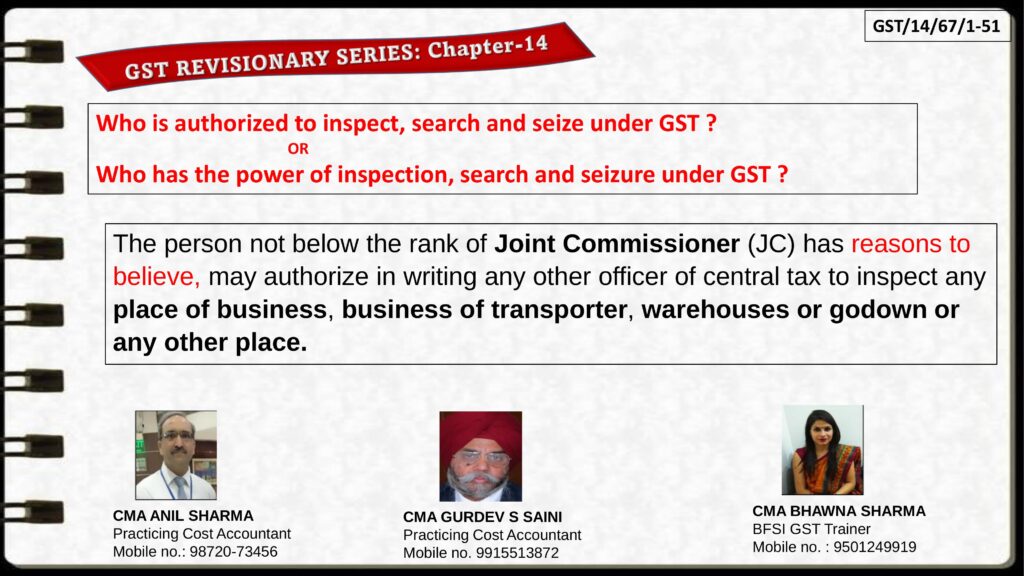
|
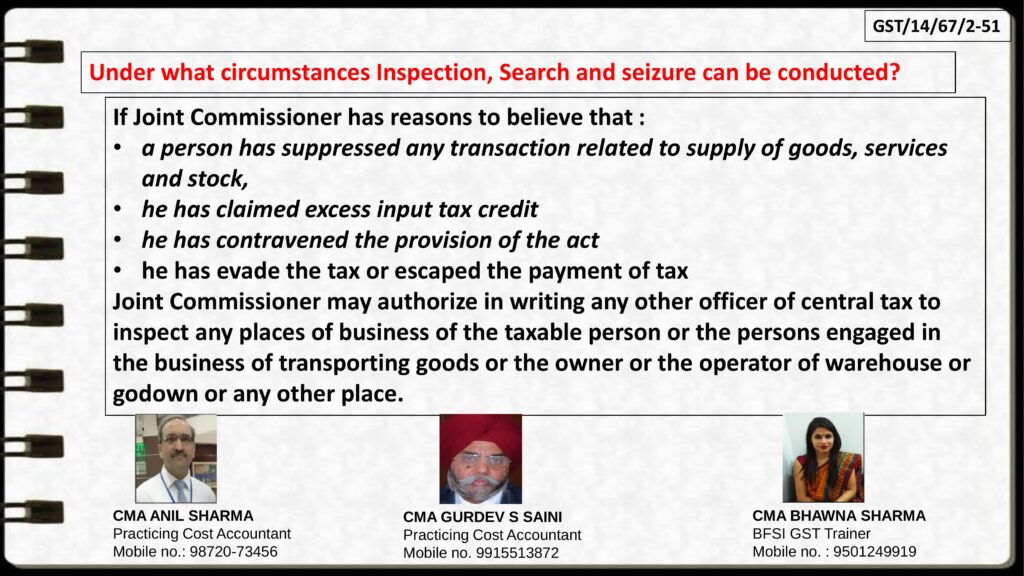
|
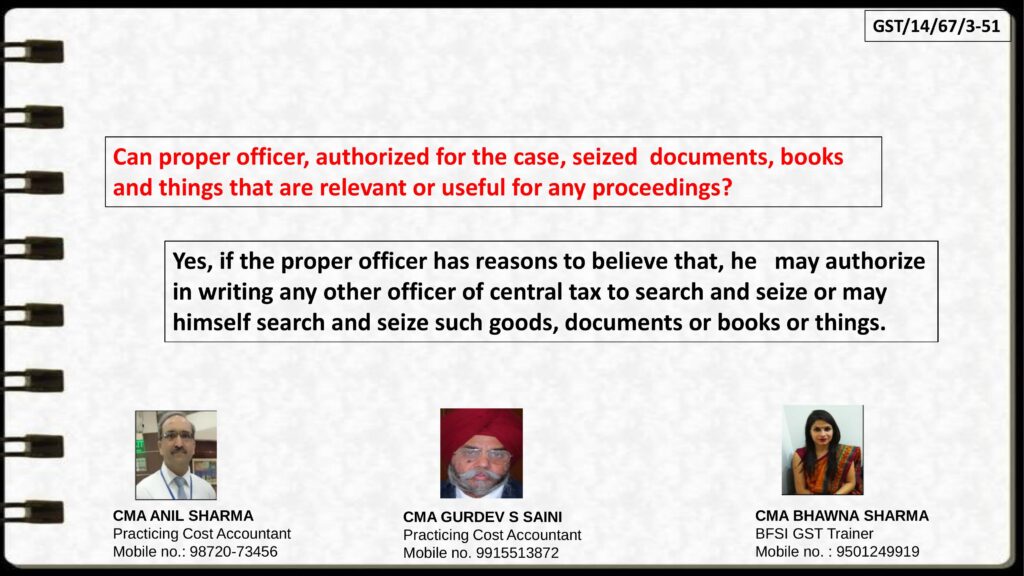
|
|
|
|
|
|
6) Book by CMA Anil Sharma, B.Com (Honrs), M.Com, FCMA co-author of the book
|
|
Handbook on GST Audit by Tax Authorities has authored yet another book
|
|
title Goods & Service Tax – Some Perceptions and Reflections. Buy now at Price Rs.300/-.
|
|
|
|
|
|
You wish to publish your Article?
|
If you wish to share your article with maximum readers then please send them at taxupdate.otu@gmail.com. We shall publish it with all due credit to you.
|
|
|
|
|
|
|
Hope the above updates is of use to you. Please share your input and feedback at taxupdate.otu@gmail.com
|
|
|
|
|
|
 
|
Visit our website
|
OTU provides you
|
- Articles on various topics
|
|
- Media - GST, Income Tax & Press R.
|
|
- Notes / Newsletter etc.
|
|
|
|
|