|
|

|
|
|
|
|
Happy Gokulashtami !
to all the readers, authors, subscribers etc.
onlinetaxupdate team wish to express sincere thanks to all the readers, authors, subscribers for the support extended to us. A special thanks to authors mentioned below for contributing their article for this 100th newsletter.
|
- Mr. CA Bimal Jain
- Mr. CA Nitin Bhuta
- Shri Seethapati Rao
- Mr. Rameshchandra Jena
- Mr. M.S. Vijayakumar
- Mr. Akshay Hiregange
- Ms. Aanchal Kapoor
- Mr. CA Nihal Jain
|
|
|
Dear Reader,
|
Please find newsletter for your reading and reference.
|
|
Newsletter no.100 dated 07.09.2023
|
|
|
Index of the Newsletter
- Recent updates
- GST in media
- Article
- Lawgics by Ms. Nidhi Aggarwal
- GST notes by CMA Anil Sharma
|
|
|
|
|
|
|
GSTN Advisory no. 672 dated 19.09.2026
|
This is an advance information to the all users – Taxpayers and Tax Officers, of GST System who use Digital Certificate Signature on the GST Portal.
|
A new version of emSigner (v3.3) is being made available for download for the purpose of providing compatibility with tokens (USB dongles) that are issued on or after 21-September-2026.
|
A. Users with valid certificates: There is no change for the users having existing valid digital certificates and their existing token (USB Dongle) are working, as of 21-Sep-2026. If your existing DSC works normally, you may continue using your current emSigner version.
|
If you encounter signing failures or if your certificate does not appear for selection despite correctly installed token drivers, upgrade to the emSigner version 3.3 by following steps given under point-B below. The emSigner version 3.3 is backward compatible to support the existing tokens (USB dongles).
|
B. Users with newly issued tokens: The users who have been issued a new token (USB Dongle) on or after 21-Sep-2026, either due to issuance of new certificate and dongle, or renewal of certificate in a new dongle, shall have to upgrade to version 3.3 of emSigner by following below steps:
|
Step-1. Please ensure that your system – desktop / laptop / AIO which on which the DSC is used for the GST System, meets the following minimum system requirements:
|
1.1 Operating system and hardware
|
Step-2.Download & install the version 3.3 of emSigner from the GST Portal by navigating to https://www.gst.gov.in/help/docsigner - the older versions of emSigner will not work for such new DSC dongles issued from 21 September 2026 onwards.
|
C. Validity and future renewal: Under CCA’s advisory, DSCs downloaded onto FIPS 140-2 dongles on or before 21 September 2026 can continue to be used until the DSC expires. That date does not automatically invalidate existing DSCs. Subsequent renewal or fresh issuance generally requires a FIPS 140-3 dongle, subject to CCA’s specified exceptions. The CCA migration advisory may be referred for more details on this aspect by navigating to https://cca.gov.in/sites/files/pdf/news/Advisory_on_Migration_from_FIPS_140- 2_to_FIPS_140-3.pdf
|
Please create a ticket on the GST Helpdesk if you need any assistance while upgrading to the emSigner version 3.3 and our teams shall get in touch for resolution.
|
|
|
|
|
|
|
|
GSTN is taking downtime to enhance its services on the GST Portal on 18.09.2026 from 12:00 AM onwards until 2:00 am of 18.09.2026.
|
|
We shall be enhancing services on the GST portal on : 18th Sept’26 12:00 AM onwards. GST Portal services will not be available until 18th Sept’26 02:00 AM. The inconvenience caused is regretted.
|
|

|
|
|
|
|
|
|
|
|
GSTN is taking downtime to enhance its services on the GST Portal on 17.09.2026 from 03:00 AM onwards until 4:30 am of 17.09.2026.
|
|
We shall be enhancing services on the GST portal on : 17th Sept’26 03:00 AM onwards. GST Portal services will not be available until 17th Sept’26 04:30 AM. The inconvenience caused is regretted.
|
|

|
|
|
|
|
|
|
|
|
GSTN is taking downtime to enhance its services on the GST Portal on 16.09.2026 from 12:00 AM onwards until 2:00 am of 16.09.2026.
|
|
We shall be enhancing services on the GST portal on : 16th Sept’26 12:00 AM onwards. GST Portal services will not be available until 16th Sept’26 02:00 AM. The inconvenience caused is regretted.
|
|

|
|
|
|
|
|
|
|
|
GSTN is taking downtime to enhance its services on the GST Portal on 12.09.2026 from 01:30 AM onwards until 3:30 am of 12.09.2026.
|
|
We shall be enhancing services on the GST portal on : 12th Sept’26 1:30 AM onwards. GST Portal services will not be available until 12th Sept’26 03:30 AM. The inconvenience caused is regretted.
|
|

|
|
|
|
|
|
|
|
|
GSTN Advisory no. 671 dated 07.09.2026
|
In cases where a dispute regarding liability exists but the demand amount is reflected as "NIL" or "Zero" in the demand order, and payment has been made by the taxpayer prior to the issuance of the demand order, the previous validation restricting the filing of an appeal against such demand orders has been removed from the GST Portal. Accordingly, taxpayers are now enabled to file an appeal in Form GST APL-01 against demand orders reflecting a NIL or Zero demand amount.
|
Taxpayers facing the above issue may now file an appeal in Form GST APL-01 against such demand orders.
|
In case of any query or difficulty while filing the appeal, taxpayers may raise a ticket with the GST Helpdesk for assistance.
|
|
|
|
|
|
|
|
GSTN is taking downtime to enhance its services on the GST Portal on 04.09.2026 from 12:00 AM onwards until 6:30 am of 04.09.2026.
|
|
We shall be enhancing services on the GST portal on : 4th September’26 12:00 AM onwards. GST Portal services will not be available until 4th September’26 06:30 AM. The inconvenience caused is regretted.
|
|

|
|
|
|
|
|
|
|
|
|
|
The Preventive Wing of the Central Goods and Services Tax (CGST) Commissionerate, Shimla, has uncovered an alleged GST fraud involving input tax credit of around ₹5.55 crore in the Kala Amb industrial area of Sirmaur district. The investigation has also led to the arrest of Gaurav Jain, managing director of M/s Samay Pharma India Private Limited, Trilokpur.
|
How Was the Alleged GST Fraud Carried Out?
CGST officials alleged that Samay Pharma and M/s Dual Healthcare claimed input tax credit using fake invoices issued by several firms that either did not exist or were found to be non-genuine.
|
The investigation found that ITC worth around ₹5.55 crore was allegedly claimed through invoices linked to 10 such firms. Officials examined the transactions to determine whether the supplies mentioned in these invoices had actually taken place.
|
What Did Officials Find About the Goods?
Officials said the invoices showed the purchase of goods, but there was no evidence confirming that those goods were actually transported.
|
E-way bills and toll-plaza records also did not support the movement of goods mentioned in the invoices, raising questions about whether the transactions reflected genuine supplies.
|
How Were GST Refund Claims Allegedly Involved?
Officials further alleged that the fake input tax credit was later included in GST refund claims.
|
The suspected credit was allegedly used in an attempt to obtain money back from the government through the GST refund mechanism.
|
What Other Irregularities Were Found?
During the investigation, officials found several suspicious transactions, fake firms and invoices without actual movement of goods.
|
They also alleged that shell entities were being used to manipulate the GST credit and refund system.
|
What Evidence Did Investigators Examine?
The CGST team recorded statements from several people during the investigation and examined digital evidence.
|
The inquiry also looked at invoices, the firms connected to them and records relating to the alleged movement of goods.
|
Why Was the Managing Director Arrested?
Based on the evidence collected during the investigation, Gaurav Jain, managing director of M/s Samay Pharma India Private Limited, was arrested.
|
The arrest was made under Section 69(1) of the Central Goods and Services Tax Act, 2017.
|
Follow for daily updates on cybercrime, corporate fraud, DFIR, hacking, investigations, and digital forensics
|
|
|
|
|
|
|
|
GST officers have arrested a partner of a firm engaged in trading of iron and steel goods for fraudulently availing input tax credit of over Rs 15.78 crore.
|
Investigations by the Central Goods & Services Tax (CGST), Delhi South Commissionerate's anti-evasion branch revealed that the firm had availed inadmissible ITC on the basis of invoices issued by multiple firms, several of which were found to be non-existent, non-functional, suspended or cancelled.
|
Field verification also established that certain suppliers had no genuine business activity at their declared places of business.
|
In a statement, the Finance Ministry said, "CGST Delhi South Commissionerate have arrested a partner of the firm engaged in trading of iron and steel goods in a case involving fraudulent availment, utilisation and passing on of inadmissible ITC aggregating to over Rs 15.78 crore through bogus invoices of approximately Rs 87.67 crore."
|
Further inquiry established that ITC was availed without actual receipt of goods and was also passed on to various recipients through invoices issued without corresponding supply of goods.
|
Based on the evidence gathered during the investigation and statements recorded under Section 70 of the CGST Act, 2017, the accused was arrested on September 14 and produced before the Patiala House Court, which remanded him to judicial custody for 14 days.
|
|
|
|
|
|
|
|
The Superintendent of Central GST, Mohit Pratap Singh, was caught while allegedly accepting a bribe of Rs 8 lakh through a mediator, the Lokayukta said.
|
Lokayukta sleuths trapped the Central government officer while he was allegedly accepting the bribe at Kendriya Sadan in Koramangala here, according to a statement.
|
According to the Lokayukta, Singh had demanded the money to "close a false complaint" filed against the complainant, Syed Zameer, in connection with pending Central GST dues. PTI GMS SSK
|
|
|
|
|
|
|
|
Punjab’s excise and taxation officials detained 170 vehicles carrying goods suspected to be in violation of GST provisions, officials said on Monday.
|
The operation, carried out jointly by all State Investigation and Preventive Units with special focus on Mandi Gobindgarh and Khanna, led to the seizure of iron scrap and finished iron/steel goods valued at more than Rs 5 crore.
|
Excise and Taxation Minister Harpal Singh Cheema described the drive as “a wake-up call for those who think they can get away with it.” He emphasised that the government is determined to plug every loophole and ensure that tax compliance becomes the rule of the day rather than the exception.
|
A substantial number of vehicles were found without proper invoices and prescribed documents, a clear violation of the GST law.
|
Punjab will not allow tax evasion to eat into the state’s revenue. Every legitimate rupee must reach the public exchequer, for it is the lifeblood of development, Cheema said in a statement.
|
The minister further informed that the detained consignments are undergoing detailed verification, which is expected to be completed within a week. PTI CHS MPL MPL
|
|
|
|
|
|
|
|
The Telangana Commercial Taxes Department has issued detailed guidelines governing the use of Artificial Intelligence tools and other third party online platforms by its officers, making individual officers personally accountable for any unauthorised sharing of taxpayer information through such platforms.
|
Circular No. 1/2026, issued by the department, allows officers to use AI for generic research, drafting and administrative efficiency, but makes it clear that such use cannot come at the cost of taxpayer confidentiality, data security or the independent application of mind by officers.
|
The circular prohibits officers and staff from typing, pasting, uploading, scanning, photographing, dictating, transcribing or otherwise transmitting taxpayer related information into any public or commercial AT tool, chatbot, generative AI platform, document analyster, summariser translation or transcription service, or cloud based analytical software, unless the platform has been expressly authorised in writing by the Commissioner of Commercial Taxes or the Government of Telangana.
|
CA Jitendra Patel, Partner, Indirect Tax, N.A.Shah Associates LLP, said the circular was a significant and welcome step towards the responsible use of AI by tax officers.
|
"The Telangana commercial taxes department's circular No. 1/2026 is a significant and welcome step towards the responsible use of Artificial Intelligence (AI) by tax officers. While the circular encourages the use of AI for research, drafting and administrative efficiency, it rightly emphasises that taxpayers' confidentiality and the independent application of mind by officers cannot be compromised and liable to penal action," Patel said.
|
Officers face personal accountability
The restrictions cover a wide range of taxpayer information, including GSTIN, PAN, legal name or trade name, address and contact particulars, bank account details, returns and annexures, financial statements, invoices, e way bill data, discrepancy reports, notices, assessment, adjudication or appellate orders, audit material, refund applications, inspection , search and investigation records, statements recorded during proceedings, and internal notes or legal opinions relating to an identifable taxpayer.
|
The circular also makes clear that the responsibility for protecting such information rests with the officer concerned. Unauthorised transmission of taxpayer information to an external AI platform can therefore expose the officer to disciplinary, legal and data protection consequences.
|
Ikesh Nagpal, Lead, Indirect Tax, AKM Global, said the circular strikes a balance between the use and AI and the need to protect taxpayer confidentialy.
|
"The Telangana Commercial Taxes Department's circular strikes a pragmatic balance between embracing AI and safeguarding taxpayer confidentiality. Rather than prohibiting AI, it permits its responsible use while drawing a firm boundary against sharing identifiable taxpayer information on unauthorised platforms. This is particularly relevant for tax administration, where officers routinely handle highly sensitive financial and transactional data," Nagpal said.
|
"More importantly, the circular reinforces that AI may assist but cannot replace the officers' independent application of mind. Every AI generated legal proposition or case citation must be independently verified, and the final order must reflect the officer's own reasoning. This approach places accountability where it belongs with the decision make while still allowing technology to improve efficiency in tax administration," he added.
|
AI cannot replace tax officer's judgment
The department has also stressed that AI cannot replace the independent judgment required from officers, particularly while issuing notices, assessments, adjudication orders and other quasi judicial decisions.
|
Manoj Mishra, Partner and Tax controversy Management leader, Grand Thornton Bharat, said the circular comes at a time when AI is becoming increasingly embedded in legal and tax workflows.
|
"As AI becomes increasingly embedded in legal and tax workflows, the focus has rightly shifted from whether AI should be used to ensuring it is used responsibly and within the boundaries of law. Recent judicial interventions, where courts have cautioned against mechanical reliance on AI generated content and even set aside orders lacking independent application of mind, underscore that technology cannot substitute statutory decision making. Recent Telangana's Circular on AI use is therefore a timely and pragmatic intervention. It reinforces that taxpayers information remains confidential under the GST framework and the Digital Personal Data Protection Act, and that unauthorised disclosure on public AI platforms can trigger disciplinary, legal and data protection consequences. By permitting AI for generic research and drafting while mandating human verification, confidentiality safeguards and independent judgment, the circular offers and balanced governance framework that could serve as a useful precedent for tax administrations across the country , "Mishra said.
|
"The circular makes one point unmistakably clear: custodianship of taxpayer data carries personal accountability. Any unauthorised disclosure through public AI platforms may expose the officer to disciplinary action, criminal and data protection consequences, while also jeopardising the validity of the underlying tax proceedings. AI may improve administrative efficiency, but responsibility for data security, legal accuracy and independent decision making cannot be delegated to an algorithm," he added.
|
Public AI platforms treated as third party transmission
Aravind Srivatsan, Partner and India Tax Leader, Nangia Global, described the framework as what could be termed a first of its kind detailed code governing the use of AI tools by tax department staff.
|
He said the Telangana Government has acknowledged that officers are increasingly using AI based tools to improve the speed, consistency and quality of their work, while making it clear that such use cannot compromise taxpayer confidentiality, data security of the officer's independent judgment.
|
Srivatsan pointed out that large language models, generative AI platforms, chatbots, document analysers, summarisers, translators, transcription services and coding assistants may process information on private servers, frequently outside India. Information entered into such platforms may also be logged, retained , reviewed or used for model training, he said.
|
According to Srivatsan , typing , pasting, uploading, scanning, photographing or dictating departmental material into an external AI platform amounts to electronic transmission of information to a third party and can create risks of data leakage, misuse and subsequent litigation.
|
He said that where an officer transmits taxpayer particulars to an external AI engine without authority of law or taxpayer consent, the act can attract personal accountability.
|
Disciplinary, criminal and data protection consequences
The circular provides for consequences where taxpayer information is disclosed without authorisation. These can include disciplinary action under the applicable Telangana Civil Services rules, possible criminal consequences under applicable law and data protection consequences under the Digital Personal Data Protection Act, 2023.
|
The circular also addresses the potential impact on tax proceedings where AI generated material is used without proper verification. An officer remains responsible for the accuracy of statutory provisions, legal propositions and judicial precedents relied upon in an official proceeding.
|
Aditya Singhania, Founder of Trackase, said the guidelines could address the unauthorised and unconscious sharing of taxpayer data through general AI applications while also establishing individual responsibility for breaches.
|
He said the framework draws a clear distinction between the role of humans and machines in proceedings where tax officers exercise quasi judicial authority. He also pointed to instances where courts have taken cognisance of non existent. AI generated citations and said the Telangana framework provides detailed guidance for responsible use of AI by tax officials.
|
Officers told to delete past taxpayer data
The department has also addressed information that may already have been entered into AI platforms.
|
Officers and staff have been directed, to the extent technically feasible, to delete taxpayer related information previously entered into AI platforms, along with associated chat histories and stored files.
|
The restrictions also extend to the use of personal mobile phones, tablets, laptops, personal email accounts and personal cloud storage for processing departmental material through AI tools.
|
At the same time, the circular does not prohibit AI use altogether. Officers can use AI for generic research, drafting assistance and language related tasks, provided identifiable taxpayer information is not shared and AI generated material is independently verified before being relied upon.
|
The framework effectively places a clear boundary around the use of AI in tax administration. AI can be used as an efficiency tool, but the responsibility for taxpayer confidentiality, data security, legal accuracy and independent decision making remains with the tax officer.
|
Source: cfo economictimes
|
|
|
|
|
|
|
|
The tax department is increasingly using artificial intelligence (AI), data analytics and information from multiple government databases to identify anomalies, detect potential tax risks and sharpen scrutiny of taxpayers.
|
According to tax officials and chartered accountants TNIE spoke to, the approach is moving beyond checking individual tax returns to analysing patterns across Income Tax Returns, GST returns, e-invoices, e-way bills, registrations and historical taxpayer behaviour. The objective is to make scrutiny more targeted and improve voluntary compliance.
|
The Income-Tax department already processes information available through systems such as the Annual Information Statement (AIS), which gives taxpayers details of financial transactions and income-related information available with the tax authorities. More sophisticated AI tools could help identify patterns across these datasets and flag cases requiring closer examination.
|
Jigar Doshi, country head - Indirect Tax, Ascentium India, said the department's scrutiny and audit process was no longer limited to information submitted in a particular return.
|
“Increasingly, the department is able to run data-driven simulations across multiple sources — including Income Tax Returns, GST returns, e-invoices, e-way bills, registrations and historical taxpayer behaviour — to identify anomalies and potential tax risks,” he said.
|
GST audits go deeper
GST administration is also making greater use of centralised analytics to identify suspicious transactions and taxpayers. Platforms such as DGRAM are used to flag fake registrations, suspicious input tax credit (ITC) chains and potential tax-evasion patterns, while BIFA (Business Intelligence and Fraud Analytics) acts as a risk and exception-reporting engine using the all-India GST database.
|
At the state level, tax administrations are also developing their own analytical capabilities. Maharashtra's Business Intelligence & Data Warehouse (BIDW), for instance, combines a data warehouse with an analytics layer to help identify cases for scrutiny and audit.
|
“Manual audits and sample testing alone may not be sufficient against AI-enabled regulatory scrutiny,” says Rajat Mohan, managing partner at AMRG Associates, adding that businesses are facing greater scrutiny of historical transaction data and cross-period discrepancies.
|
GST audits can involve reconciliation across GSTR-1, GSTR-3B, GSTR-2B, e-way bills and e-invoices. Automated systems can identify differences in ITC, outward supplies and turnover, as well as claims involving suppliers whose registrations were subsequently cancelled or who failed to discharge their tax liabilities.
|
The scale of information available to tax authorities is significant. India had more than 1.65 crore GST taxpayers as of May 2026, generating millions of invoices and returns that can be analysed alongside income-tax information.
|
This allows authorities to identify issues such as unusual refund claims, short payment of GST, excessive ITC claims and inconsistencies between sales and purchases.
|
The growing ability to combine information from GST, income tax, customs and other government systems could allow tax authorities to build a wider financial profile of taxpayers.
|
According to experts, this means for businesses conventional reconciliation of books with tax returns may no longer be sufficient. Companies may increasingly need to identify potential risks before they are flagged by the department.
|
AI could also allow the department to alert taxpayers to potential discrepancies, seek clarification digitally and escalate cases for formal scrutiny where required.
|
However, AI is likely to remain an aid rather than a substitute for human judgment. Officers would still have to verify facts and take responsibility for assessment decisions.
|
“AI is an enabler,” one tax official said, stressing that the taxpayer or professional taking the final tax position would continue to be accountable. AI cannot be treated as a substitute for human judgment, particularly in complex tax matters.
|
Source: The New Indian Express
|
|
|
|
|
|
|
|
The Central Bureau of Investigation (CBI) has arrested Superintendent, Land and Building Section at office of Commissioner of CGST and Central Excise, Raigad and a CGST consultant, in a bribery case.
|
The CBI registered the instant case on 09.09.2026 against the accused Superintendent and unknown others based on a complaint by the Project Head of a private realty company at New Panvel. The realty company had undertaken a redevelopment project of two Buildings at Sector 17, New Panvel. A total of 24 of these flats are owned by the CGST & Central Excise, Raigad Commissionerate for which the necessary approvals from the local authority have already been received. It was alleged in the complaint that the accused Superintendent demanded Rs. 1 Crore for the NOC and handing over of the flats for redevelopment. During the verification of the complaint, the accused officer demanded Rs. 10 Lakh in cash on 10.09.2026, Rs. 20 Lakh as downpayment of a flat purchased by the accused public servant and Rs. 70 Lakh on later stage for other officers of DG HRD CGST, New Delhi.
|
The CBI laid a trap on 10.09.2026 while the accused Superintendent directed the complainant to handover Rs. 10 Lakh undue advantage to a CGST consultant, who was present there. Both the accused persons have been arrested on 10.09.2026 and were produced before the competent court on 11.09.2026 which has granted two days of police custody of both the accused persons.
|
Further investigation is being undertaken.
|
|
|
|
|
|
|
|
Amid the growing use of artificial intelligence in tax administration, the state commercial taxes department has imposed strict safeguards on the use of AI tools by its officials, making them personally accountable for any unauthorised disclosure of taxpayer information through such platforms.
In circular No. 1/2026, the department allowed the use of AI for generic research, drafting and administrative tasks, but underscored that taxpayer confidentiality, data security and independent decision-making by officers cannot be compromised for convenience.
|
The guidelines prohibit officers and staff from typing, pasting, uploading, scanning, photographing, dictating, transcribing or otherwise transmitting taxpayer-related information to any public or commercial AI tool, chatbot, generative AI platform, document analyser, summariser, translation or transcription service, or cloud-based analytical software.
|
Such platforms may be used for taxpayer-related information only if they have been expressly authorised in writing by the commissioner of commercial taxes or the Telangana govt.
|
The move comes at a time when the department is increasingly deploying AI-driven systems for taxpayer monitoring, risk assessment, and scrutiny. While AI is being leveraged to detect anomalies and improve tax administration, the circular seeks to ensure that sensitive taxpayer data does not flow into unauthorised external platforms during the process.
|
The department has also cautioned officials against relying on AI-generated outputs as a substitute for their own judgement.
|
Officials remain responsible for independently examining facts, interpreting the relevant tax laws and arriving at decisions based on their own assessment.
|
The circular makes it clear that responsibility for compliance rests with individual officers. It warns that any unauthorised sharing, disclosure or transmission of taxpayer information through AI tools or other third party platforms could attract penal action, reinforcing accountability as the department expands the use of technology in tax administration.
|
Source: The Times of India
|
|
|
|
|
|
|
|
The Preventive Wing of the Central Goods and Services Tax (CGST) Commissionerate, Shimla, has unearthed an Rs 6.55-crore fraud involving fake invoices and fraudulent claims of input tax credit (ITC) and GST refunds in the Kala Amb industrial area of Sirmaur district and arrested the managing director (MD) of a pharma company. The accused has been identified as Gaurav Jain, MD of M/s Samay Pharma India Private Limited, Trilokpur, Sirmaur. According to officials, the investigation revealed that Samay Pharma and M/s Dual Healthcare had allegedly availed ITC on the basis of invoices issued by several fake and non-existent supplier firms.
|
It was found that ITC amounting to Rs 5.55 crore had allegedly been claimed through invoices linked to 10 non-existent firms. The officials also found that the invoices showed supplies for which the actual movement of goods could not be verified through e-way bills and toll-plaza data.
|
The alleged fraudulent ITC was subsequently included in the GST refund claims, with an attempt reportedly made to obtain cash refunds from the government exchequer.
|
The investigating officials found the alleged use of fake firms, invoices without actual movement of goods, suspicious accounting entries and shell entities to manipulate the GST input-credit and refund mechanism.
|
The officials recorded the statements of various people and examined digital evidence, based on which Jain was arrested under Section 69(1) of the Central GST Act, 2017.
|
|
|
|
|
|
|
|
The West Bengal Authority for Advance Ruling (AAR) has held that electricity charges recovered by a commercial building maintenance company from occupants at actual cost, without any markup or profit, will not attract Goods and Services Tax (GST).
|
The ruling was pronounced on September 1 in the case of DH Maintenance Ltd, which provides common-area maintenance and facility management services for a commercial building in Kolkata.
|
DH Maintenance pays electricity charges to distribution company CESC Ltd for electricity consumed in the building and recovers the cost from the occupants. The company sought clarity on whether such recovery could be treated as reimbursement in the capacity of a “pure agent” and excluded from the value of its maintenance services for GST purposes.
|
A pure agent under GST is a person who incurs costs or expenses on behalf of a client while providing a main service, and later claims reimbursement for the exact amount spent without adding any markup.
|
Under the proposed billing arrangement, electricity used in individual offices for normal consumption and heating, ventilation and air-conditioning (HVAC) would be charged according to sub-meter readings. The electricity cost for common areas would be distributed among the occupants based on the super-built-up area of their respective units. The company would recover the electricity cost without adding any profit or markup.
|
The issue was significant because electricity supplied along with maintenance services would ordinarily form part of a composite supply. In such a case, the GST rate applicable to the principal maintenance service would apply to the electricity component as well.
|
However, the AAR relied on Circular No. 206/18/2023-GST dated October 31, 2023. The circular provides that where electricity is supplied along with renting of immovable property or maintenance services, it generally forms part of a composite supply. But where electricity is recovered on an actual basis — at the same amount charged by the electricity distribution company — the supplier is deemed to be acting as a pure agent for the electricity supply.
|
Interestingly, the AAR observed that DH Maintenance did not strictly satisfy the normal pure-agent test. It noted that electricity was an integral part of the maintenance and management services provided by the company.
|
The authority, however, said the specific deeming provision in the 2023 circular would apply. Since DH Maintenance proposed to charge occupants the same amount as charged by CESC, without any markup or profit, the electricity recovery would be treated as pure-agent recovery.
|
The AAR also extended this treatment to electricity used in common areas. The balance amount of the CESC bill, after accounting for electricity consumed in individual offices and HVAC, would be apportioned among occupants according to their respective areas.
|
“This ruling reinstates the position under the Circular on the taxability of electricity charges recovered on a metered basis, i.e. HVAC and non-HVAC, and aligns with the position adopted by most industry players. A key aspect, however, is the ruling’s finding that electricity charges relating to common area are also non-taxable as recovered in the capacity of pure agent,” said Harpreet Singh, partner, Indirect Tax, Deloitte.
|
“While this is a welcome position, it remains contentious and is likely to be challenged by the tax authorities before the Appellate Authority,” he added.
|
For January 2026, the CESC bill was Rs 20.19 lakh for 196,520 kilowatt-hours (kWh) of consumption. Of this, Rs 10.24 lakh related to non-HVAC consumption in individual offices, Rs 6.35 lakh to HVAC consumption and Rs 3.61 lakh to common-area consumption.
|
The Revenue had pointed out that similar issues had arisen in earlier adjudication proceedings for 2018-19 and 2019-20. The AAR, however, distinguished those proceedings, saying they related to the company’s existing billing pattern, whereas the present ruling concerned the proposed billing pattern.
|
The AAR ultimately ruled that electricity charges recovered at actual cost, including charges relating to HVAC and common-area consumption, would be excluded from the value of the company’s supply and would not attract GST under the proposed arrangement.
|
Source: Business Standard
|
|
|
|
|
|
|
|
Haryana State Vigilance and Anti-Corruption Bureau (SV&ACB) on Thursday arrested a State GST excise and taxation officer (ETO) and a chartered accountant from Jind as they were caught accepting a cash bribe in connection with a pending tax notice.
|
The accused have been identified as ETO Divesh Sahu of the SGST department and CA Ajay Sharma. According to the vigilance bureau they were taken into custody following a trap laid by the bureau’s Jind unit.
|
Officials said Sahu had allegedly demanded ₹5 lakh from the proprietor of a private company of Jind to refrain from taking strict action on a notice issued under Section 74 of the SGST and CGST Act, 2017. The notice related to alleged tax evasion of ₹75 lakh.
|
According to the complaint Sahu used Sharma as an intermediary to collect the money. The first instalment of ₹3 lakh was to be paid on Thursday, with the balance to follow later. The complainant approached the Anti-Corruption Bureau office in Jind. After verifying the allegation, a vigilance team laid a trap and caught Sharma accepting the bribe at his office on Bhiwani Road. The entire amount of ₹3 lakh was recovered from him.
|
An FIR has been registered at Police Station SV&ACB, Karnal, under Sections 7 and 7A of the Prevention of Corruption Act, 1988. Both accused are being questioned and further investigation is underway, the bureau said.
|
|
|
|
|
|
|
|
HDFC Life Insurance Company Ltd on Friday (September 11) said that the Commissioner (Appeals-III), CGST & Central Excise, Mumbai, has confirmed the total Goods and Services Tax (GST) demand, including interest and penalty, in a case involving the period from July 1, 2017 to March 31, 2022.
|
"This is with reference to the intimation dated February 06, 2025, disclosing the details of the GST Order (Period involved - July 1, 2017 to March 31, 2022, Tax Demand – ₹942.18 crore, Interest as applicable and Penalty – ₹2,422.97 crore) received from the Additional Commissioner, CGST & Central Excise, Palghar Commissionerate, Maharashtra on February 05, 2025," HDFC Life Insurance Company said in a regulatory filing.
|
The original order, received in February 2025, involved a tax demand of ₹942.18 crore and a penalty of ₹2,422.97 crore, along with applicable interest.
|
HDFC Life said it received the appeal order on September 10, 2026. The order confirms the total tax demand, including interest and penalty, as mentioned in the original GST order issued by the Additional Commissioner, CGST & Central Excise, Palghar Commissionerate, Maharashtra.
|
The company said the order will have no adverse material impact on its financial operations. HDFC Life will further contest the matter by filing an appeal before the GST Appellate Tribunal.
|
|
|
|
|
|
|
|
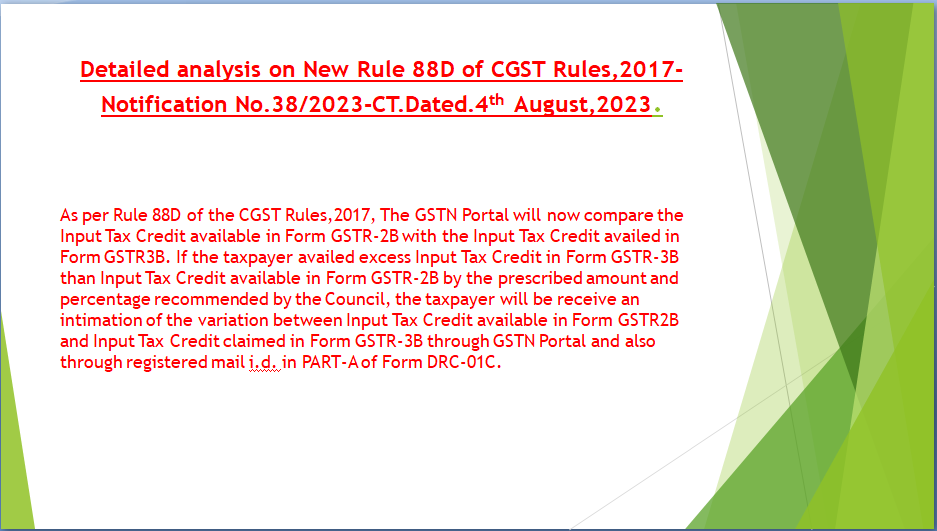
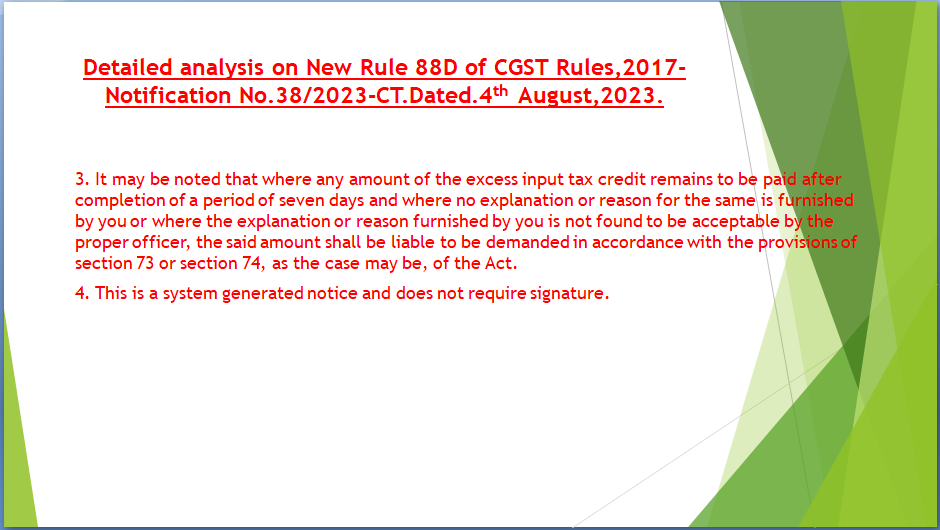
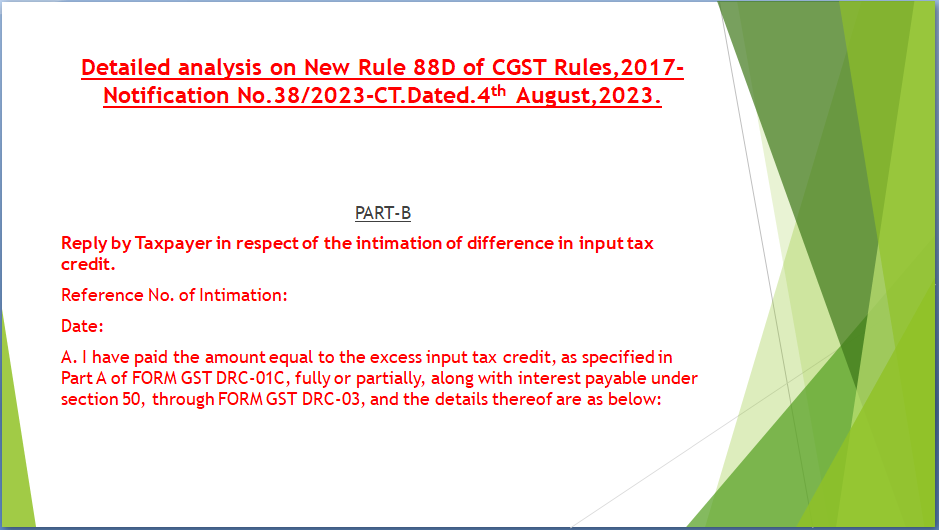
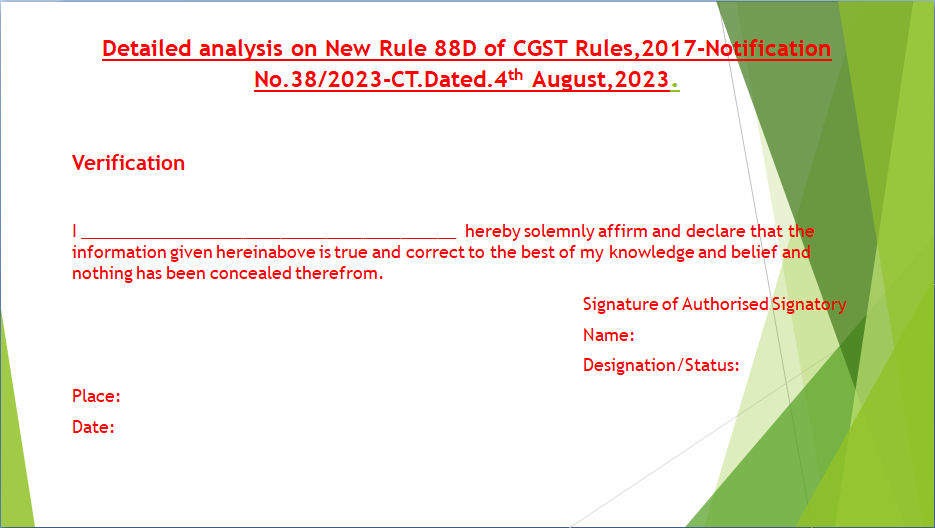
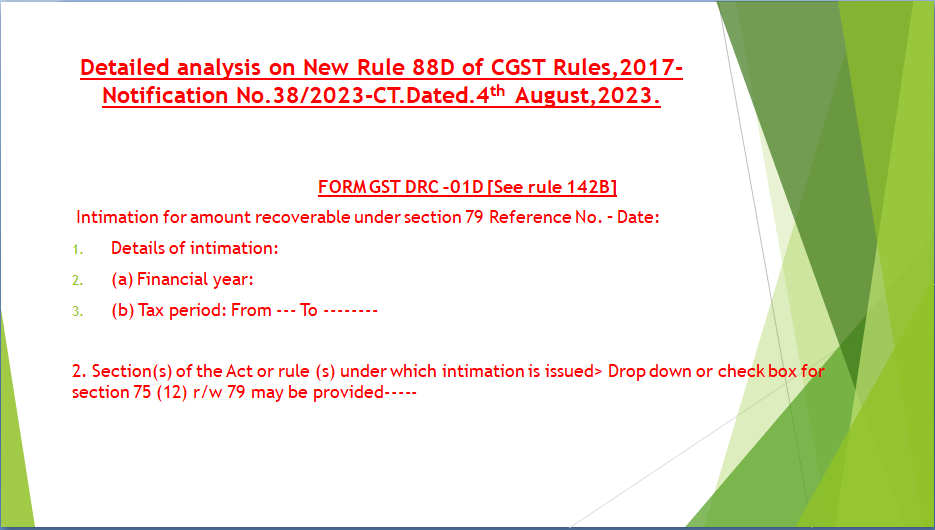
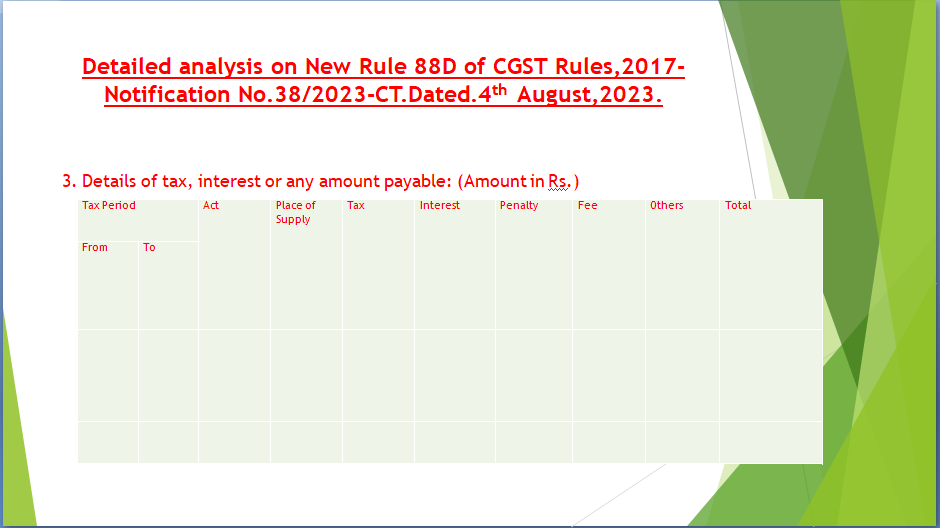
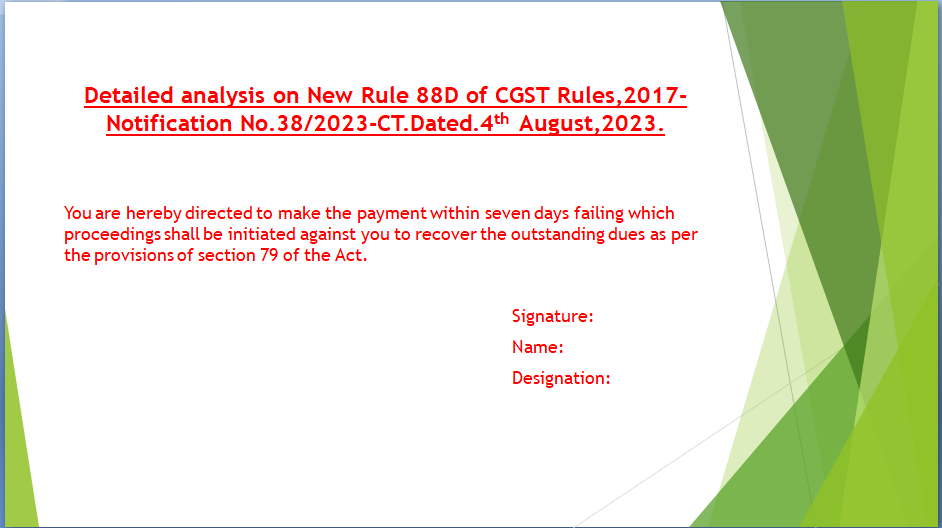
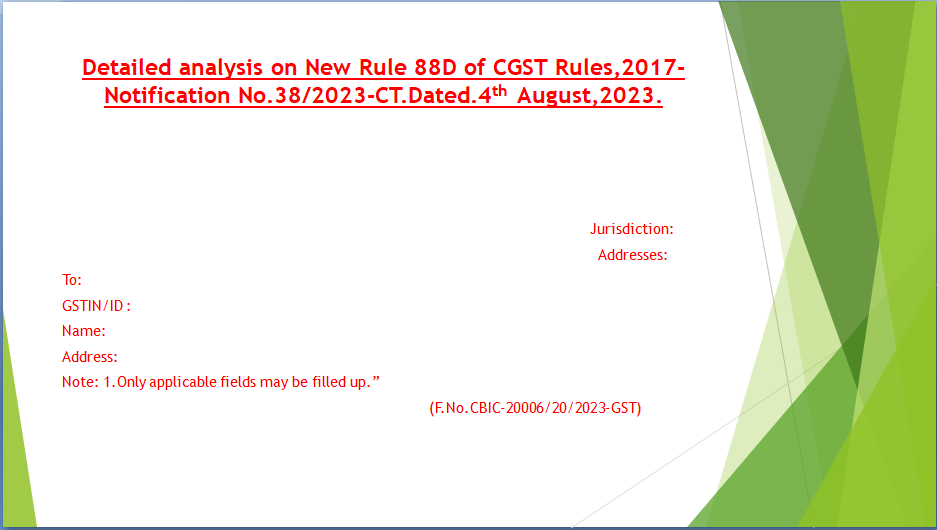
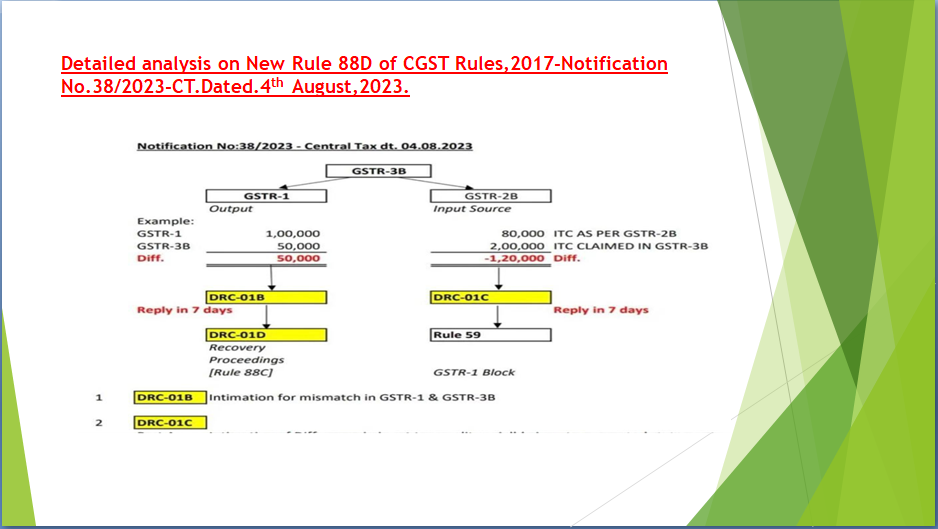
Recent changes in GST Rules has been captured in the slides format by the author.
|
|
Author: CA Nihalchand J Jain
|
|
|
|
|
|
|
|
|
|
Clause 44 in Form 3CD under Section 44AB of the Income Tax Act 1961.– Updated FAQs
|
(Note: Views expressed are my personal views and they are based on my understanding of the subject as dealt by this article and views shared may be acceptable or may not be acceptable to the readers of this article. All readers are requested to take their considered views based on their own study to reach any suitable conclusions. There can be many other situations under the law but through this article I have tried to sow the seed of thought in the minds of readers. Suggestions to improve the article are always welcome with folded hands).
|
|
Table 1- Clause 44 – GST Reporting Information
|
|

|
|
Table 2- Clause 44 – GST Reporting Information – Detailed
|
|

|
|
|
|
|
|
|
|
|
|
|
Provisional attachment of property including Bank account of a taxable person to protect Government revenue in certain cases has been prescribed under Section 83 of the CGST Act, 2017 read with Rule 159 of the CGST Rules, 2017. The adjudicating authority initiate the recovery of tax during pendency of any proceedings under Section 59 to 64 of the CGST Act, 2017, Section 67 to 72 of the CGST Act, 2017 & Section 73 / Section 74 of the CGST Act, 2017 by way of provisional attachment of property including bank account.
|
Statutory provisions for attachment of Bank Account:
|
Section 83 of the CGST Act empowers the Commissioner to provisionally attach the any property including bank account belonging to a taxable person or any person specified in sub-section (1A) of section 122 of the CGST Act. The attachment can be made where, after initiation of any proceedings, the Commissioner is of the opinion that for the purpose of protecting the interest of the Government revenue.
|
No attachment of property can be initiated by the proper officer unless an order in FORM GST DRC-22 pass by the Commissioner under Rule 159 of the CGST Rules, 2017 read with Section 83 of the CGST Act, 2017. Rule 159(6) of the CGST Act, the Commissioner may, upon being satisfied that the property was or is no longer liable for attachment, release such property by issuing an order in FORM GST DRC-23.
|
Provisional attachment lapses after one year:
|
Section 83 (2) of the CGST Act, provides that every provisional attachment shall cease to have effect after the expiry of a period of one year from the date of order made under sub-section (1) of section 83 of the CGST Act,2017.
|
The Hon’ble Supreme Court in the case of Radha Krishan Industries vs. State of Himachal Pradesh, reported in 2021 (48) G.S.T.L113 (S.C), held that the Provisional attachment is draconian power exercised before finalization of assessment or raising of demand It has to be exercised with due caution. It is provisional as in aid of something else and its purpose is to protect revenue. Its validity depends on strict observance of statutory pre-conditions. Formation of Commissioner’s opinion must have proximate and live nexus to protection of revenue interest and it is not left to unguided subjective discretion. The Commissioner’s opinion must be based on tangible material regarding statutory requirements.
|
Therefore, the Hon’ble Supreme Court has issued the following mandatory guidelines to be followed while ordering for provisional attachment of property including bank account of the taxable person.
|
- The power to order a provisional attachment of the property of the taxable person including a bank account is draconian in nature and the conditions which are prescribed by the statute for a valid exercise of the power must be strictly fulfilled;
- The exercise of the power for ordering a provisional attachment must be preceded by the formation of an opinion by the Commissioner that it is necessary so to do for the purpose of protecting the interest of the government revenue. Before ordering a provisional attachment the Commissioner must form an opinion on the basis of tangible material that the assessee is likely to defeat the demand, if any, and that therefore, it is necessary so to do for the purpose of protecting the interest of the government revenue.
- The expression “necessary so to do for protecting the government revenue” implicates that the interests of the government revenue cannot be protected without ordering a provisional attachment;
- The formation of an opinion by the Commissioner under Section 83(1) must be based on tangible material bearing on the necessity of ordering a provisional attachment for the purpose of protecting the interest of the government revenue;
- In the facts of the present case, there was a clear non-application of mind by the Joint Commissioner to the provisions of Section 83, rendering the provisional attachment illegal;
- Under the provisions of Rule 159(5), the person whose property is attached is entitled to dual procedural safeguards :
(a) An entitlement to submit objections on the ground that the property was or is not liable to attachment; and
|
(b) An opportunity of being heard;
|
- The Commissioner is duty bound to deal with the objections to the attachment by passing a reasoned order which must be communicated to the taxable person whose property is attached;
- A final order having been passed under Section 74(9), the proceedings under Section 74 are no longer pending as a result of which the provisional attachment must come to an end.
The Hon’ble High Court of Madras in the case of Senior Intelligence officer, DGGI, vs. KPN Travels India Ltd, reported in 2021(49) G.S.T.L.338( Mad.), held that “In the considered view of this Court, an order of attachment of the first respondent’s bank account, which are stated to be 14 in number, should be for the purpose of protecting the interest of the Government Revenue and the Commissioner should be of the opinion, it is for such purposes and he is required to pass an order in writing attaching provisionally any property including bank account. The procedure is in terms of Rule 159 of the CGST Rules. Thus, if the first respondent is able to explain to the satisfaction of the officer that the provisional attachment is not warranted, it goes without saying that the Commissioner can exercise powers and lift the order of provisional attachment or otherwise confirm the provisional attachment. Admittedly, the investigation is yet to be completed and therefore, time is yet to come for issuance of show cause notice for recovery of alleged tax due or for that matter to crystallize the alleged liability, the first appellant shall consider and pass appropriate interim orders, if found tenable, considering the lifting of the provisional attachment in respect of a few bank accounts to enable the first respondent to carry on its business activities.”
|
The Hon’ble High Court of Bombay in the case of Chotu Lal vs. Union of India, reported in 2023 (72) G.S.T.L. 167(Bom), held that the petitioner to approach the concerned authority under Rule 159(5) of the GST Rules for revocation of the attachment, the authority will make endeavour to take a decision thereupon as per law, within three weeks of filing of such application for revocation of bank attachment.
|
The High Court of Madras in the case of Federal Bank Ltd, vs. Sub Registrar , reported in 2023(72) G.S.T.L.40 (Mad.), held that “Section 83(2) of GST Rule make it clear that every such provisional attachment shall cease to have effect after expiry of a period of one year from the date of the order made under sub-section(1),. Therefore, provisional attachment made by the second respondent vide order dated 18.12.2021 has ceased to have effect, after expiry of a period of one year. There is no material to show any final order of attachment, or any subsequent order passed by the second respondent pursuant to the aforesaid order. Therefore, this court is of view that the impugned order dated 17-10-2022 is liable to be quashed.
|
The Hon’ble High Court of Madras in the case of Sree Minakshi Industries vs. Commissioner of commercial tax, reported in 2022 (65) G.S.T.L. 457 (Mad.), held that” It is made clear that, this order, setting aside the provisional attachment order and the consequential bank communication in respect of these two cases, shall not stand in the way for the respondent/Revenue to invoke Section 83 once again, if they have reasons with tangible materials and records to form an opinion that in the interest of Revenue, such an invocation of Section 83 become inevitable and after recording such reasons that kind of invocation could be possible at the hands of the Revenue. Insofar as the assessment is concerned, it is open to the Revenue to complete the assessment at the earliest with utmost co-operation of the petitioners”
|
The Hon’ble High Court of Delhi in the case of Karmatji Jaiswal vs. Commissioner of Central Tax, reported in 2022(66) G.S.T.L. 333 ( Del.), held that Admittedly, every provisional order ceases to have effect after the expiry of a period of one year from the date of the order made under Section 83(1) of the CGST Act. After the issuance of the impugned orders, no fresh attachment order has been issued. Consequently, this Court directs the Respondent to defreeze the bank account and release the immovable properties of the Petitioner not later than three days from the date of uploading the order.
|
The Hon’ble High Court of Telangana in the case of Rahul Aggarwal vs. Commissioner of Central Tax, reported in 2022(64) G.S.T.L. 290 (Telangana), held that in the instant case, provisional attachment was ordered on 9-2-2021. Thus, the period of one year has expired. Though a statement has been made in the counter affidavit that the provisional attachment was reviewed by the Commissioner on 11-3-2022 where after such attachment for further period was approved, no such order has been placed on record. In any case, sub-section (2) of Section 83 of the CGST Act is very clear. Every provisional attachment made under sub-section (1) of Section 83 of the CGST Act shall cease to have effect after expiry of a period of one year from the date of the order made under sub-section (1) of Section 83 of the CGST Act. That being the position, we are of the considered opinion that continuance of the impugned order of provisional attachment dated 9-2-2021 cannot be sustained. The same is accordingly set aside and quashed. Respondents are directed to forthwith de-attach the aforesaid bank account of the petitioners. The Hon’ble High Court of Gujarat in the case of Mahavir Enterprise vs. State of Gujarat, reported in 2022(62) G.S.T.L.166 (Guj.) held that “The plain reading of the above referred provision would indicate that if any amount of tax, interest or penalty like the one in our case is payable by a person to the Government under
|
any of the provision of this Act or the Rule then such amount can be recovered by a proper Officer of State Tax or the Union Territory as the case may be, as if it were an arrear of State Tax or the Union Territory Tax. In other words, this provision can be interpreted or can be understood as recovery of any debts, interest or penalty by way of revenue measures. Its like recovery under the Bombay Land Revenue Code. This is possible or rather permissible only after proper attachment of any property of the assessee. This attachment which we are talking about has nothing to do with the provisional attachment under Section 83 of the Act. For the purpose of sub-clause (3), the attachment is permissible even under the provisions of the Bombay Land Revenue Code. In such circumstances referred to above, the impugned order of provisional attachment purported to have been passed under Section 83 of the Act could be said to be without jurisdiction. The same is hereby quashed and set aside. We leave it open to the respondents to initiate appropriate proceedings in accordance with law, if they intend to do so.”
|
The Hon’ble High Court of Orissa in the case of Shri Radha Raman Alloys Pvt.Ltd, vs. Union of India, reported in 2021(52) G.S.T.L.5 (Ori.), held that Rule 159 of the OGST Rules, 2017 sets out the procedure to be adopted for issuing a provisional attachment order. Under Rule 159(5) a person whose property is attached may, within seven days of such attachment, file an objection to the effect that the property attached was or is not liable to attachment. After such objection is filed, the Commissioner is required to offer the person objecting an opportunity of being heard and thereafter pass an appropriate order in FORM GST DRC-23, if he is of the view that the property is required to be released from attachment.
|
Conclusion: The provision of attachment property including bank account is the weapon in the hands of the adjudicating authority for recovery of revenue under Section 83 of the CGST Act, 2017, but it should be supported by judicious opinion of the Commissioner by issuance of Order in FORM GST DRC-22. Section 83 of the CGST Act, 2017 empowers the Commissioner to initiate proceeding of attachment property including bank account under Section 83 of the Act, if he satisfied that it is genuine reason and fit case of attachment of bank account of any registered person to protect the revenue of the Government. The Commissioner may authorize his subordinate officer to initiate proceedings of bank attachment giving an opportunity of heraing to the taxable person as per the direction of the Hon’ble Supreme Court decision in the case of Radha Krishan Industries (supra). The taxable person also an opportunity is available under Rule 159(5) of the CGST Rules, 2017 to approach the GST authority filing an objection application for the de-attachment of bank account in case he is not liable to pay any tax or his property is not liable for attachment.
|
|
|
|
|
|
|
|
|
|

|
|
|
|
|
|

|
|
|

|
|
|

|
|
|

|
|
|
|
|
|
|
|
|

|
|
|

|
|
|
|
|
|

|
|
|
|
|
|
|
|
|
|
|
|
|
|
|
|
|
|
|
|
Author: Subrahmanya Seethapathi Rao Bharatam
|
|
|
|
|
|
|
|
|
|
The Indirect tax regime in India provides for a complex tax environment due to multiplicity of taxes, complicated compliance obligations and tax cascading. Under the GST regime, all the key Indirect tax legislations would be subsumed except for few taxes such as duty on Electricity, Royalty on the extraction of minerals from mines, etc. In Goods and Service Tax Act the tax is levied on the supply of goods and supply of services which is different from the taxable events of the current regime that is manufactured, sale or provisions of service. The mineral sector in India is the most taxed among all countries with effective tax rate between 60%-64%, surpassing all other mining territories.
|
The minerals and mining sector in India is governed by the Mines Act, 1952 along with the Mines and Minerals Development and Regulation Act (MMDR), 1957. The mines and minerals development and regulation are undertaken as per the MMDR Act under the control of the union. As per Section 9 of the MMDR Act, 1957 the holder of a mining lease granted before or after the commencement of this act shall pay royalty in respect of any minerals removed or consumed. The Mines Act,1952 lays down the rules and regulation in relation to the safety of the labour, regulation for carrying out mining activities and the management of mines.
|
India currently produces around 89 minerals under different groups, with fuel minerals, metallic minerals, non-metallic minerals, atomic minerals and minor minerals. The country has immense potential for mining resources and reserves and is currently among the top 10 global producers of many minerals.
|
India's global position in mineral production
|
Taxation system on Mining
|
Under the GST regime, all the key Indirect tax legislations would be subsumed (except for few taxes such as duty on Electricity, Royalty on the extraction of minerals from mines, etc.).
|
|
As per Section 9 of the MMDR Act, 1957 the holder of a mining lease granted before or after the commencement of this act shall pay royalty in respect of any minerals removed or consumed.
|
|

|
whether royalty itself is in the nature of tax. This question fundamentally exerts influence on tax implications, which has been at stretch for a long time,as there cannot be levy of tax on tax which cannot be attached to the value of the goods/services. Although various judicial decisions are there and explored the matter's clear position in law, yet its tax implication still remains unclear with the taxpayers and the tax levying authority. The Supreme Court in India Cement Ltd. vs. State of Tamil Nadu case has held that royalty is not a tax and its payment is for the user of the land. Royalty on mineral rights is not a tax on land but a payment for the user of land. Although the intent and the missive were clear as set out in the judgement determining that royalty is a "tax" though not a "tax on land" as this was the question before them that whether Royalty is tax on land.
|
The mining sector incurs service tax and royalty as the procurement costs:
|
1. The mining companies may attract service tax for the services relevant to the mining industry such as exploration, mineral production, handling, transportation etc. A manufacturer and/or service provider paying service tax on procurement of services are allowed to take credit of same and it is set off against their Service tax or Excise liability. However, no credits are available to primary producers or miners, who are neither service providers nor manufacturers but simply a trader.
|
2. Exporters are allowed to claim a refund of tax paid on procurement in various forms.
|
3. Royalty on mining is collected by the State Government from the business entities in relation to the lease of the mines granted to them.
|
The Supreme Court, in India, Cement Ltd. v. State of Tamil Nadu and others (AIR 1990 SC 85) had held that royalty is a tax and its payment is for the use of land. The judgment had relied on the concept that royalty was attributed to the extracted mineral created due to interaction among land, capital and labour, each of which possesses some definite intrinsic economic value. In this sense, royalty was viewed as a kind of tax linked either directly or indirectly to the intrinsic economic value of a mineral realised through sale by the lessee. Though the Hon'ble Supreme Court subsequently doubted the correctness of the above referred judgements and referred the case as to “whether royalty is tax or not” to a larger bench of nine judges and the same is yet to be pronounced and therefore the judgement of India Cement Limited can be considered as the law as on date. If the Supreme Court decides that royalty is in nature of tax then both excise duty and service tax cannot be levied, since there cannot be taxed on tax.
|
a. The grant for the mining lease rights is one of the methods of assignment of rights to use any natural resources and the consideration that is paid by the leaseholder is royalty as fixed by the State Government at the time of grant of lease. This royalty which is in the nature of the annual amount payable to the state government are seemingly subject to service tax.
|
b. The mining industry incurs an excise duty; value added tax and central sales tax as the output tax liability:
|
c. In case of merchant miners as the extraction does not amount to manufacture there is no excise duty liability as output tax. In case of mining cum manufacturing sector if any further processing of the minerals so extracted from the mines is undertaken in order to remove the impurities from the minerals or any other value addition process are being undertaken then the same would attract excise duty.
|
d. The Value Added Tax (VAT) is levied on the sale of goods within the state. The mines output is subject to VAT, miners are allowed to take the credit of the vat paid on their inputs if any. The VAT cost flows from the mining company to the manufacturer and then to the distributor and reseller.
|
Analysis under the Goods and Service Tax:
|
|
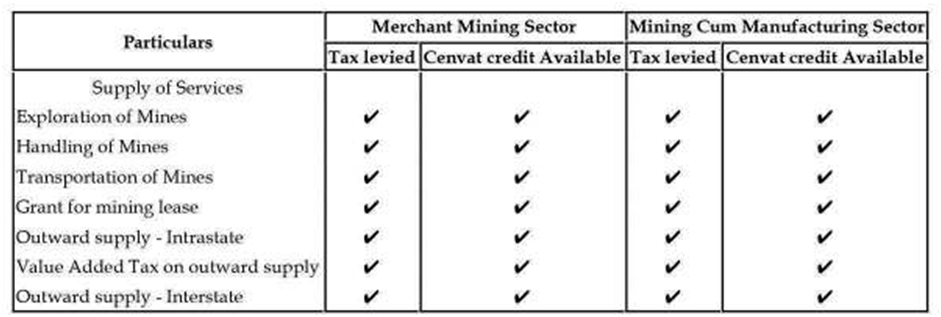
The Constitutional Amendment Bill has deleted only the VAT, Entry Tax and Entertainment Tax from the state lists and Excise duty and Service Tax from the union list. As per Section 3, of the GST Model Law, 2016 the Goods and Service Tax is levied on the supply of goods and services. Various supplies of services such as exploration, mineral production, handling, transportation and the supply of the minerals to consumers would attract GST. Under GST there would be output taxes at the time of supply of output of the mines, but at the same time the input tax cost incurred by the miners would be allowed as credit.
|
|
|
As per schedule IV of the Goods and Service Tax Act, the consideration paid by the lease holder to the State Government for the grant of the lease of the mines in form of royalty would be chargeable to GST. However, as explained earlier, the matter is to be decided by nine-member bench of Hon'ble Supreme Court as to whether royalty is a tax or not. Thus, if it concluded that is it in the nature of tax, GST on same cannot be levied. Thus, as far as GST laws are concerned, there would be GST on the amount of Royalty paid but since Royalty itself is not within the frame work of GST, credit of royalty paid to the State Government becomes a cost of miner, whether merchant or manufacturer.
|
Royalty on Minerals excavated from Mines Whether liable to GST Constitutional Validity of entry No. 5 of notification 13/2017-CT(R) dated 28.6.2017 (HSN code 9973). Recently, Rajasthan HC, dismissed on 27.9.2022, a Number of writ petitions, seeking relief in payment of GST, on reverse charge basis, on ‘Royalty” in respect of Minerals excavated from Mines: Sudarshan Lal Gupta Contractor & Ors. v. Union of India & Ors.(2022) 38 J.K. Jain’s GST & VR 288 (issue dated 9.10.2022). It resulted into initiation of proceedings for levy of GST on Royalty.
|
A five-member bench in the case of State of West Bengal vs. Kesoram Industries Limited and Others were of the view that in the decision of India Cement, it was a typographical error in drafting the judgement either attributable to the stenographer's devil or to sheer inadvertence. It held that what the actual meaning and intent of the statement was that royalty was not a tax on land as it was not directly related to the land as required by Entry 49 but a different kind of tax that is to say, a tax on mineral extracted by individual which would be indirectly related to land. The five-member bench in Kesoram Industries Ltd. subsequently, to examine whether royalty is a tax or otherwise, referred the matter of Mineral Area Development Authority etc. vs. Union of India and Ors. to a nine-member bench of the Supreme Court. Further, the Supreme Court in the matter of Mineral Area Development Authority etc. vs. UOI and Ors. held that royalty paid may not be tax under common parlance but going by the definition of 'taxation' under Article 366(28) of the Constitution, royalty payable on extraction of minerals being in the nature of statutory impost comes under the purview of taxation.
|
The mining sector in India has been opposed for levying of tax on royalty paid on mining operations. In the Service Tax Regime after introduction of negative list regime, all services provided by the government were brought under the tax net and were subjected to reverse charge. This issue continued into the GST regime as well since the statutory liability for payment of tax on such government services fell on the recipient of such services under reverse charge mechanism (RCM) in terms of Entry 5 of Notification 13/2017-CT(R) dated 28.06.2017. The applicable rate on services by way of grant of mineral exploration and mining rights is 18% in terms of entry 17 (viii) (Leasing or rental services, without operator) of Notification No. 11/20171 w.e.f. January 1, 2019.
|
However, dispute arose whether royalty can be classified under entry 17 (viia) of Notification No. 11/2017 wherein any transfer of right in goods or of undivided share in goods without the transfer of title thereof attracts same GST rate as the supply of like goods prior to January 01, 2019, due to divergent rulings passed by various advance rulings authorities.
|
The Central Board of Indirect Taxes and Customs vide Circular dated 06.10.20212 has clarified that the intention of the government has always been to levy tax services by way of grant of mineral exploration and mining rights @18% and therefore, cannot be considered as leasing or renting of goods in terms of entry 17(viia) of Notification No. 11/2017 as mining rights is entirely different activity. Hence, the department's stand was clarified that there was no separate rate of tax specified under GST for service provided by way of grant of mineral exploration and mining rights, and that such service remained taxable @18% during period July 1, 2017, to December 31, 2018.
|
The clarification issued vide the Circular was challenged by the industry and consequently the Supreme Court has given a stay on GST on royalty paid to the States for mining rights in the matter of Lakhwinder Singh Vs UOI.
|
VALIDITY OF TAX LEVY, ULTIMATUM AND WAY FORWARD
|
Relying upon the judicial decisions under the erstwhile regime, royalty cannot be termed as a consideration received by the government to grant rights over for mineral extraction. Further, it cannot also be said that State Government has provided any service of granting rights for mineral extraction to bring it under the ambit of supply and thus no GST can be levied on royalty, dead rent and DMF charges paid towards mineral rights. It is a settled position of law that Royalty paid under a mining lease is in the nature of tax and thus, the contention that GST could not be imposed on royalty since royalty itself is a tax becomes very strong.
|
1. Notification No. 11/2017-CT(R) dated June 28, 2017
|
2. Circular No. 164/20/2021-GST dated 6.10.2021
|
Question: As per standard practice, the service tax/GST department called for information from mining department of state (Gujarat) which in turned provided list of firms (quarries) in whose name royalty is paid. Accordingly, the service tax/GST department issued SCN and passed order levying SERVICE TAX ON RCM on royalty paid as per list provided by mining department.
|
In given case, department had issued SCN and passed order in the name of “A” quarry who had taken land on lease for quarry business from mining department of the state.
|
But in actual “A” quarry had sub-leased the whole land to “B” quarry who had paid royalty directly to mining department and also claimed royalty expenditure. “A” quarry had neither paid any royalty nor claimed such royalty expense in books.
|
Only because “A” quarry had originally leased land from mining department, there name was forwarded to service tax/GST department.
|
What stand should be taken by “A” quarry to avoid service tax demand. As per information that whether royalty is tax or not question is pending before 9 judge benches of SC. What other stand can be taken in given facts?
|
Royalty is a fee or payment made against the license to use minerals including its exploration and evaluation. In other words, royalty is a fee or consideration paid to the property owner for the right to use the property or patentee for the use of a patent or property against money obtained on sold of each patent or value of extract resources during the licensed period.
|
Royalties are agreed upon as a percentage of gross or net revenues obtained from the use of an asset so authorised by the party assets owns.
|
In terms of Section 9 of the Mines and Minerals (Development and Regulation) Act, 1957 the holder of mining lease shall pay royalty in respect of any mineral removed / consumed.
|
The Hon’ble Supreme Court in the case of State of Orissa and others v. M/s Steel Authority of India Ltd. (AIR 1998 SC 3052), the Apex Court opined that Section 9(1) of the MMDR Act, 1957 also contemplates the levy of royalty on the mineral consumed by the holder of a mining lease in the leased area, hence processing of mineral amounts to consumption and, therefore, the entire mineral is eligible to levy of royalty.
|
Thus, levy and applicability of tax on royalty was disputed in the erstwhile Service tax regime. But in GST regime the applicability is not the matter of dispute rather applicable rate of GST on royalty is the matter of litigation, which has been clarified by the CBIC vide Notification No. 27/2018-C.T. (Rate), dated 31-12.2018 as amended and rate of GST on royalty shall be chargeable to 18% on amount of royalty so collected from the license holders of mines under RCM.
|
Further, it is clarified vide Sectoral FAQ’s by CBEC, is that “ The Government provides license to various companies including public sector undertakings for exploration of natural resources like oil, hydrocarbons, iron ore, manganese, etc. For having assigned the right to use the natural resources, the licensee companies are required to pay consideration in the form of annual license fee, lease charge, royalty, etc to the Government. The activity of assignment of rights to use natural resources is treated as supply of service and the licensee is required to pay GST on the amount of consideration paid in the form of royalty or any other form under reverse charge mechanism”.
|
In the given case since lease is in the name of “A” ,it is his duty for payment of royalty on lease and not of “B”. In may be considered that the royalty may be paid by “B” in the name of “A”. The liability of payment of GST on royalty will fall on “A” through RCM.
|
Let’s consider that “B” has also not paid the royalty and GST on RCM, then it is liability of “A” to pay GST on RCM. On other hand if “B” has paid the same then there is not liability of “A” for payment of GST or Service Tax, since double taxation on the same matter cannot be paid.
|
If such facts exist then reliance can also be made on the judgment of Hon. Bombay High Court in case of United Spirits Ltd. vs. State of Maharashtra (Writ Petition (L) no.10092 of 2020 dt.29.4.2022) wherein High Court has held that when buyer has paid tax, vendor is not liable to pay tax. The factual position be seen accordingly.
|
The other fact appearing from query is that there is sub-lease. Therefore, on consideration received by A from B, there may be GST liability on A. This aspect should also be examined.
|
FAQ on GST for Mining sector of India
|
Question: Can small mining leaseholders with a turnover less than Rs.75 lacs operate under composition scheme
|
Answer: As per Sec. 10(1) of the CGST Act, 2017, a registered person whose aggregate turnover in the preceding FY did not exceed Rs.75 lakhs, would be eligible for paying GST under the composition scheme.
|
Question: What is the GST rate for minerals and ores in Composition Scheme
|
Answer: In a case where the process amounts to manufacture, the rate of tax will be 1% (CGST) and 1%(SGST/UTGST). In any other case, the rate will be %(CGST) and % (SGST/UTGST).
|
Question: Will they have to deposit GST under SGST/CGST heads separately
|
Answer: Yes. GST has to be paid separately under CGST and SGST/UTGST by generating a single challan through the common portal under a single return.
|
Question: Can a small Mine Lease holder undertakeinter-State supply if it avails composition scheme
|
Answer: No. If a supplier chooses to avail of composition scheme, he shall not undertake inter-State supply.
|
Question: What is the IGST rate for minerals and ores in case of inter State supply
|
Answer: At present, the IGST rate is the sum of CGST and SGST/ UTGST rate. These rates have been notified and are available in public domain.
|
Question: Can the buyer get input credit on the supply of minerals from a mine owner in composition scheme
|
Answer: No, the buyer cannot avail of the credit of tax paid by the supplier who is under the composition scheme as the person paying tax under composition scheme cannot issue a tax invoice and collect taxes on his supplies.
|
Question: Will the recipient have to pay tax under reverse charge.
|
Answer: GST on reverse charge mechanism is payable under section 9(4) of the CGST Act, 2017 only in case of purchases from unregistered suppliers. As the mine owner who is paying tax under composition scheme is registered, the recipients need not pay GST on reverse charge mechanism.
|
Question: What is the threshold limit and conditions when a small mine owner/lease holder under Composition Scheme has to migrate into full GST System
|
Answer: As per section 10(3) of the CGST Act, 2017, the option availed of by the small mine owner/ leaseholder shall lapse with effect from the day on which his aggregate turnover during a financial year exceeds Rs. 75lakhs. For details regarding other conditions, section 10 of the CGST Act, 2017 and the rules framed there under maybe referred to.
|
Question: Is the Return filing and compliance simpler under composition scheme
|
Answer: Yes, return filing and compliance is simpler under the composition scheme. The registered person has to file only one return on a quarterly basis in FormGSTR-4.
|
Question: Will the basic exemption limit from GST be applicable to the tiny & micro segment in mining
|
Answer: Yes, the basic exemption limit of Rs. 20 lakhs (Rs.10 lakhs in the case of special category States) is applicable to the tiny and micro segment even in mining. However, a person engaged in making taxable supply and having aggregate annual turnover (more than Rs.20 lakhs in any State other than the special category States) would be liable to obtain registration under GST. The return has to be filed on monthly basis by regular taxable persons and on quarterly basis by the taxable persons registered under the composition scheme.
|
Question: What is aggregate turnover
|
Answer: As per section 2(6) of the CGST Act, 2017, aggregate turnover means the aggregate value of all taxable supplies (excluding the value of inward supplies on which tax is payable by a person on reverse charge basis), exempt supplies, exports of goods or services or both and inter-State supplies of persons having the same Permanent Account Number, to be computed on all India basis but excludes Central tax, State tax, Union territory tax, integrated tax and compensation cess.
|
Question: Will the buyer of goods from unregistered person pay reverse tax
|
Answer: A registered person receiving taxable goods or services from a supplier who is not registered, would be liable to pay GST under reverse charge mechanism. However, in terms of notification no. 8/2017-Central Tax (rate) dated 28th June, 2017, aggregate value of supplies of goods and/or service received by a registered person from any or all the suppliers, who is or are not registered, up to five thousand rupees in a day is exempt from tax under reverse charge mechanism. This exemption will not apply if the value exceeds Rs.5000/-.
|
Question: Can a buyer of goods and services pay the value of services / goods to the supplier and deposit theGST component of the invoice in the suppliers account so that when the buyer claims input credit, he may get the same cross entry tallied from the suppliers account
|
Answer: No. This option is not available under GST Law.
|
Question: In case there are disputes regarding quality, weight, etc. between the buyer and the supplier and the goods are returned fully or partially, as found unfit for use, can the excess paid tax component be adjusted from future tax liability
|
Answer: In such cases, the supplier may issue a credit note to the recipient in accordance with the provisions of section 34(1) of the CGST Act, 2017.
|
Question: Whether deduction of Liquidity Damage (LD)/Penalty deduction from contractor’s bills and charging Penalty for non-lifting of coal till targeted minimum level to Annual Contractual Quantity (ACQ) will attract GST
|
Answer: Yes, it is a service being tolerating an act as per Schedule II of the CGST Act,2017 thus GST shall apply.
|
Question: Will GST be payable at the time of raising an invoice for supply of goods from a mining lease holder or it will be applicable on the amount of advance received by the mining company for booking the order
|
Answer: No. As per the provisions of section 12(2) of the CGST Act, 2017 the time of supply of goods shall be the date of issue of invoice or the date of receipt of payment, whichever is earlier. Accordingly, GST would be payable on advance payment received prior to issuance of the invoice.
|
Question: Will the supplier have to issue receipt voucher against each advance received
|
Answer: Yes, as per section 31(3)(d) of the CGST Act, 2017the supplier has to issue a receipt voucher for every advance received.
|
Question: How do I show the advance received in GSTR 1
|
Answer: Where against an advance the invoice is issued in the same tax period, the advance need not be shown separately in Form GSTR-1 but the specified details of invoice itself can be directly uploaded on the system. Details of all advances against which the invoices have not been issued till the end of the tax period shall have to be reported on a consolidated basis in Table 11 of FormGSTR-1. As and when the invoices against these advances are issued, they have to be declared in Form GSTR-1 and the adjustment of the tax paid on advances against the tax payable on the invoices uploaded in Form GSTR-1 shall have to be done in Table 11 of Form GSTR-1.
|
Question: In case no supplies are made against an advance, will the dealer have to issue a refund voucher only for the advance or for advance including GST
|
Answer: Refund voucher has to be made for the fullvalue of advance, including the amount of GST.
|
Question: It will be difficult to link between Advance Receipt Voucher and invoices in case of sales billing on Cash Sale (Rail/Road)/e-Auction etc., especially in case of Rail Cash sale, where purchasers deposit money in advance to the tune of many crores for which lifting of coal has to be made from various loading point and time. In such situation how will the billing person at one point realize how much balance advance is available for adjustment while raising invoice at his end at a specific point of time
|
Answer: Under GST gross amount of advance is to be reported and tax has to be paid. Advance can be adjusted in totality. While raising the invoice subsequent to receipt of advance, the tax payable will get reduced by the amount of tax paid on the advance and balance amount of advance may be adjusted against future supplies.
|
Question: Will GST charged on purchase of all earthmoving machinery including JCB, tippers, dumpers by a mining company be allowed as input credit
|
Answer: The provision of Sec. 17(5) (a) of the CGST Act, 2017 restricts credit on motor vehicle for specified purposes listed therein. Further, in terms of the provision of Section2(76) of the CGST Act, 2017 the expression motor vehicle shall have the same meaning as assigned to it in Clause (28) of Section 2 of the Motor Vehicle Act, 1988, which does not include the mining equipment, viz., tippers, dumpers. Thus, as per present provisions, the GST charged on purchase of earth moving machinery including tippers, dumpers used for transportation of goods by a mining company will be allowed as input credit.
|
Question: Whether GST is payable on royalty (to be paid to Government) for Mining Lease granted by State Government.
|
Answer: Yes, on royalty GST will apply under reverse charge mechanism. Further, such payment of GST under reverse charge mechanism would be eligible as ITC in the hands of the recipient of supply for payment of GST.
|
Question: Is ITC available on hiring of immovable properties (land, office, warehouse, processing unit, stock yards) for facilitation of mining operations
|
Answer: Yes. GST paid on hiring of land, office, warehouse, processing unit, stock yards when these are used in the course or furtherance of business, would be allowed as ITC.
|
Question: What is the time limit for availing input credit under GST
|
Answer: As per provisions of Section 16(4) of the CGST Act, 2017 the ITC is not available after the due date of furnishing the return for the month of September of the next year or furnishing of the annual return, whichever is earlier.
|
Question: Would the net outstanding amount of unutilized input credit be refunded by the Government
|
Answer: In terms of the provision of Section 54(3) of the CGST Act, 2017 subject to conditions, refund of unutilized input tax credit would be available in respect of zero-rated supply or where ITC has accumulated on account of rate of tax on inputs being higher than the rate of tax on the output supply. However, such refund of ITC would not be available if export duty is payable on the goods so exported out of India.
|
Question: Will GST charged by tax consultants, advocates, Chartered Accountants, environmental consultants, canteen service providers and other service providers to mining companies be allowed as input credit
|
Answer: ITC on any input service/ inputs used in the course of furtherance of business would be available subject to restrictions and other conditions as per the provisions of Chapter-V of the CGST Act, 2017. However, tax paid in respect of canteen service providers shall not be available as credit.
|
Question: Whether free issue of coal to employees paid in course of employment and on the basis of wage agreement with value below Rs.50, 000/- per employee will attract GST
|
Answer: Gifts not exceeding fifty thousand rupees in value in a financial year by an employer to an employee shall not be treated as supply of goods or services or both (as per Schedule 1 of the CGST Act, 2017). Free issue of coal based on the wage agreement is not a gift. Therefore, free issue of coal in this case will attract GST.
|
Question: Can GST charged as per transport billon movement of mineral from mine to the buyer be allowed as ITC to the buyer irrespective of the ownership of the transporting vehicle
|
Answer: In case of an FOR contract for supply of mineral from the mine to the buyer, it is a composite supply where the consideration will be inclusive of the transportation cost. Therefore, GST on forward charge will be payable by the supplier of the mineral and credit will be available to the buyer if otherwise available. The supplier of the mineral will also pay tax on reverse charge basis on the freight charged by the GTA and the credit of the same will be available to the supplier of the mineral. In case of an ex-works contract of supply, where the GTA service has been booked by the supplier at the instance of the buyer and the service is billed by the GTA to the buyer and the minerals are billed by the supplier of the mineral to the buyer, then GTA on reverse charge shall be paid by the buyer who shall be entitled to take credit of the same. The tax on the mineral will be paid on forward charge by the supplier of the mineral and credit will be available to the buyer if otherwise available.
|
Question: Will the situation as mentioned above be different if the value of mineral is less than the cost of freight in long distance consignments
|
Answer: In the aforesaid example relating to FOR contract, the supply under the contract shall be classified as composite supply where there is a principal supply and other supplies are naturally bundled and supplied in conjunction with each other in the ordinary course of business. The GST rate of principal supply shall be applicable in this case i.e. GST rate as applicable to the mineral.
|
Question: Exploration companies undertake exploration activities for preparing mining blocks for auction in different States in the country. They use rigs for exploration. CENVAT credit was available on rig operations under the existing law. Will the company be eligible to take ITC under GST
|
Answer: Rigs, capitalized in the books of accounts as capital goods are used in the course or furtherance of business. Hence, it will be eligible as capital goods and ITC will be available under GST.
|
Question: Will ITC be available for holding Environmental Clearance (EC) and Forestry Clearance (FC) meetings and for obtaining consent to operate the Mines
|
Answer: Yes, ITC on expenses incurred in the course or furtherance of business shall be available.
|
Question: Will the mining companies be eligible to take ITC for construction of townships, hospitals and schools
|
Answer: No. Mining companies will not be eligible for ITCon such activities even if used in course or furtherance of business. In this connection, the provisions contained in section 17(5) (c) of the CGST Act, 2017 refer.
|
Question: Are minerals sent for export in processed or raw form fully exempted from payment of GST or IGST
|
Answer: In terms of the provision of Section 16(1) of the IGST Act, 2017 export of goods is considered as zero-rated supply. Further, in terms of the provision of Section 16(3) of the IGST Act, 2017 a registered person may export goods (i) without payment of IGST against bond/letter of undertaking and claim refund of unutilized ITC, or (ii) on payment of IGST, utilizing eligible ITC and claim refund of such IGST.
|
Question: What is the procedure for return of goods under GST Answer: In terms of Section 34(1) of the CGST Act, 2017in case of return of goods on which GST was paid at the time of supply, the supplier of such goods may issue a credit note for the full value, including the amount of GST in favour of the recipient, and will be entitled to reduce his output tax liability subject to the condition that the recipient of such supply has not availed credit of such GST and if availed, has reversed his ITC on the same.
|
Question: How can we take support during filing of returns, as huge mines are located throughout the districts in the country, especially in rural and backward areas, and the problem will be aggravated as the huge number of mines are operating without any IT infrastructure
|
Answer: Returns may be filed from the central office of the Company which are usually located in areas with infrastructure required for filing such returns.
|
Question: Whether GST TDS will be applicable on Works Contract Jobs (to be renamed as Supply of Services) in case of PSUs, since such GST TDS U/s 51 (1) of CGST Act. 2017is applicable on: a) Dept. or establishment of the Central Govt. or State Govt.; or b) Local authority; or c) Govt. agencies; or d) Such persons or category of persons as maybe notified by the Govt. on the recommendations of the Council.
|
Answer: TDS, under section 51 (1) of the CGST Act, 2017will apply to supplies made to such agencies as may be mandated by the Government for TDS. As of now, this section has not been notified and therefore TDS is not applicable on any supplies.
|
Question: What is the requirement for E-way bill for companies operating in the sector?
|
Answer: As per rule 138 of the CGST Rules, 2017, till such time as final rules are issued, the government may, by notification, specify the documents that the person in charge of a conveyance shall carry while the goods are in movement or in transit storage. As and when the new e-way bill rules are notified, the person transporting the goods shall carry the said e-way bill generated from the common portal along with the invoice (challan in the case of movement other than by way of supply).
|
Question: Whether an Input Service Distributor (ISD)will be eligible to distribute the ITC in respect of services received during April 17 to June 17 even if the invoices are raised and submitted by contractors after appointed date i.e. in July 17.
|
Answer: In terms of section 140(7) of the CGST Act, 2017the ISD will be able to distribute the available credit even if the invoices are received after the appointed day.
|
Question: In Table 5(b) of GST-TRAN-1, the details of Form C, F and H/I are to be given for the period April 15 to June 17 (i.e. for 27 months) which would be a voluminous task. Reasons of furnishing the details for last 27 months may please be clarified
|
Answer: In cases where sales were covered by Forms C,F,H and I, the input tax credit has remained in the account of the taxpayer because the taxpayer has availed of the benefit of concessional rate/nil rate of tax on the sale/stock transfer under CST Act. The benefit of concessional rate/nil rate is available conditional upon production of the statutory forms. Therefore, allowing migration of the credit that has accrued on account of sale/stock transfer having been made on concessional rate/nil rate should be given only on production of the statutory forms. Even otherwise, the taxpayer would have claimed refund of this ITC and such refund would have been given only on production of the statutory forms. It has been presumed that forms for periods before April 15 would have either been presented or the State would have recovered the additional tax payable on account of non-production of statutory forms. Production of these forms is a statutory liability and the taxpayers have already availed the benefit.
|
Question: Education Cess and S&H Education Cess carried forward in ER-1 whether eligible for ITC under the CGST Act, 2017
|
Answer: No. Credit of Education Cess and SH Education Cess cannot be carried forward.
|
Question: What will happen to the balance available in the current account (PLA) under Central excise, deposited in cash in advance by any assessee.
|
Answer: Balance in PLA will not be under transition to GST since that has not been appropriated to the Government account which will be determined post completion of the pending assessment. The same can be claimed as refund under the Central Excise Law.
|
Question: Whether credit of Green Cess (Clean Energy Cess) paid on coal and available at the time of transition be eligible for being carried over
|
Answer: No.Credit of Clean Energy Cess cannot be carried forward on transition.
|
Question: Whether stock held by mining companies on which Clean Energy Cess has been paid be chargeable to compensation cess in GST regime
|
Answer: Yes. Compensation cess will be charged on supply of such stock.
|
Question: Can supplies of coal under a particular order or under FSA (Fuel Supply Agreement) be eligible under the definition of continuous supply of goods
|
Answer: Such supplies are in the nature of continuous supply as the invoices are raised periodically. The individual dispatches may be covered under delivery challans and invoice may be issued for the supplies made during a period as per the contract.
|
Question: In case of coal, the applicable Compensation Cess is a Fixed Amount of Rs.400/- per MT. Under above situation, how such apportionments possible since in case of FSA Sale, supply of different grade of coal as per availability of stock against single bulk receipt of Advance is to be adjusted
|
Answer: If tax rate is not determinable, the tax rate may be determined and paid on the amount of advance at 18%.
|
Question: Whether Railway siding in mining industry exclusively utilized for effecting dispatch of taxable goods viz. coal (i.e., directly used in the course of furtherance of business) will be treated as Plant and Machinery and ITC under GST will be allowed or treated as civil structure and ITC will be denied
|
Answer: ITC will not be available as railway siding is not plant and machinery as defined in section 17 of the CGST Act, 2017.
|
Question: According to HSN Code 2516 calcareous building stone comes under 5% tax rate, but simultaneously under HSN Code 6802 it comes under28% tax rate. Clarity on the same may be provided by the Government
|
Answer: Chapter 68 covers value added articles of sandstone etc. which are further worked other than byway of roughly trimmed or merely cut into blocks or slabs.
|
Question: Whether supply of HSD free of cost for mining operation would attract GST and whether the input tax credit would be available for GST so charged by the Service provider
|
Answer: HSD is outside GST and therefore, input tax credit would not be admissible.
|
Question: Will ITC be available on steel, timber and sometimes cement which are used in the underground mines to provide a protective device for security purpose
|
Answer: Credit will not be available if these goods are supplied for construction of an immovable property. But if these are temporarily placed for protective purposes; credit will be available.
|
Question: As per Section 54 (3), it is clear that no refund of ITC will be available for export in the cases where product is subject to export duty. Iron Ore export is subjected to export duty. In the earlier regime, the exporters were allowed to take refund of service tax paid on exports. Will not our exports become noncompetitive as no refund of ITC will be available
|
Answer: The refund of ITC credit is not admissible in view of the second proviso to section 54(3) of the CGST Act, 2017.
|
Rulings under GST on mining
|
The AAR, Chhattisgarh in the matter of M/s Shanti Enggicon Private Limited has ruled that the Royalty amount is includable while arriving at the transaction value for payment of applicable Goods and Services Tax (“GST”) on the supply of services rendered by the assessee to the main contractor under Section 15 of the Central Goods and Services Tax Act, 2017 (“the CGST Act”) and 18% GST is applicable on Royalty amount under the Reverse Charge Mechanism (“RCM”).
|
M/s Shanti Enggicon Private Limited (“the Applicant”) was awarded the mining work on back-to-back basis by the M/s KCC-MBBL (“Main Contractor”) with all the terms and conditions and specifications mentioned in the tender allotted to the Main Contractor by M/s NTPC Ltd. All the purchases and execution work were done by the Applicant.
|
The Government of Chhattisgarh Mining Department vide Notification No. F7-29/2012/12 dated March 5, 2018 (“NN. 29”) imposed royalty on soil used in earthwork and also charged the royalty rate structures of certain minerals to be applicable from April 1, 2018.
|
The Applicant paid the royalty to State Government from his bank account by selecting the taxpayer’s name of Main Contractor. Further, the Applicant paid all the cost of royalty clearance from the Mining office and also the royalty challan from his bank account and accordingly, the Applicant contended that it is Applicant who has received services from the Government and GST should be paid under RCM by them on the royalty charges to be reimbursed by the Main Contractor. Further, the Applicant stated that the royalty on soil is levied under Chhattisgarh Mining Act which will be recovered from the Main Contractor thus, it should be added in the value of supply of service as per Section 15 of the CGST Act and liable for payment of GST.
|
Whether the GST is applicable on the royalty amount paid by the Applicant under RCM?
|
Whether the royalty amount is includable in the value of supply of service as per Section 15 of the CGST Act and liable for payment of GST?
|
The AAR, Chhattisgarh in Advance Ruling No. STC/AAR/09/2020 held as under: Noted that, the service received by the Applicant from the State Government is covered under the Service Accounting Code-997337-Licensing Services for the right to use minerals including its exploration and evaluation, as the State Government has been providing the licensing service for the right to use minerals after its exploration and evaluation.
|
Observed that, as per Sl. No. 5 of the Notification No. 13/2017- Central Tax (Rate) dated June 28, 2017 (“the Services RCM Notification”), services provided by the Government to a business entity attracts GST under RCM by the recipient of those services.
|
Further stated that, the applicability of GST rate for the service is to be based on the classification of service under the sub heading 997337, covered under Entry No. 17 of the Notification No. 11/2017- Central Tax (Rate) dated June 28, 2017 (“the Services Rate Notification”) attracting the same rate as applicable supply of goods involving transfer of title in goods.
|
Held that, the business entities availing mining rights including its exploration and evaluation shall be charged to GST at the rate of tax as applicable on supply of like goods being mined i.e. at the rate of 18% under RCM. Further held that, the royalty amount paid by the Applicant is includible while arriving at the transaction value for payment of applicable GST on the supply of services rendered by the Applicant to the Main Contractor as stipulated under Section 15 of the CGST Act.
|
The CBIC vide Circular No. 164/20/2021-GST dated October 06, 2021 has provided clarification regarding GST rates & classification based on the recommendations of the GST Council in its 45th meeting held on September 17, 2021.
|
Services by way of grant of mineral exploration and mining rights:
|
Representations have been received requesting for clarification as to the rate of GST applicable on supply of services by way of granting mineral exploration and mining rights during the period from July 01, 2017 to December 31, 2018. With effect from January 01, 2019, the rate schedule has been specifically amended and it is undisputed since then that such service attracts GST at the rate of 18%.
|
For the disputed period , divergent rulings have been issued by Authorities for Advance Ruling (AAR) and Appellate Authorities for Advance Ruling (AAAR) of various States on the GST rate applicable on the same. AAR, Haryana in case of M/s Pioneer Partners and AAR, Chhattisgarh in case of M/s NMDC have ruled that the service of grant of mining leases is classifiable under Service Code 997337 (licensing services for the right to use minerals including its exploration and evaluation) and attracted, prior to January 01, 2019, the same rate of GST as applicable to minerals, that is, 5% as prescribed against Sl. No. 17, item (viii) of Notification No. 11/2017-Central Tax (Rate). The rate prescribed against this entry prior to January 01, 2019 was “the same rate as applicable on supply of like goods involving transfer of title in goods”.
|
In certain other advance rulings, a view has been taken that grant of rights for mineral exploration and mining would be covered under heading 9991 and would attract GST at the rate of 18%.AAAR, Odisha, on the other hand has ruled vide Order dated November 05, 2019 in the case of M/s Penguin Trading and Agencies Limited that grant of mining lease was taxable @ 18% prior to January 01, 2019. The Appellate Authority in this case observed that GST rate applicable against Sl. No. 17 item (viii) of Notification No. 11/2017-Central Tax (Rate) prior to January 01, 2019 was not implementable. Unlike leasing or renting of goods, there are no underlying goods in case of leasing of mining area. The rate prescribed for goods cannot be made applicable to leasing of mining area, which confers the right to extract and appropriate minerals. The mining lease by Government, not being a lease of any goods, cannot attract the rate applicable to sale of like goods. Appellate Authority for Advance Ruling, Odisha has further held that the amendment carried out vide
|
Notification No. 27/2018-Central Tax (Rate), dated December 31, 2018, which restricted the “same rate as applicable to supply of goods involving transfer of title in goods” only to leasing or renting of goods was to clarify the legislative intent as well as to resolve the unintended interpretation. It is a settled law that interpretation which defeats the intention of legislature cannot be adopted. It accordingly upheld that “licensing services for the right to use minerals including its exploration and evaluation” falling under service code 997337 were taxable @ 18% during July 01, 2017 to December 31, 2018.
|
It may be noted that the expression “same rate of tax as applicable on supply of like goods involving transfer of title in goods” applies in case of leasing or renting of goods. In case of grant of mining rights, there is no leasing or renting of goods. Hence, the said entry does not extend to grant of mining rights which is an entirely different activity.
|
The issue was place before the GST Council in its 45th meeting held on September 17, 2021.
|
As regards classification of service, it was recommended by the Council that service by way of grant of mineral exploration and mining rights most appropriately fall under service code 997337, i.e. “licensing services for the right to use minerals including its exploration and evaluation”
|
As regards the applicable rate for the period from July 01, 2017 to December 31, 2018, the council took note of the following facts, namely, -
|
(i) GST Council in its 4th meeting held on 3rd & 4th November, 2016 had decided that supply of services shall be generally taxed at the rate of 18%.
|
(ii) More importantly, the GST Council in its 14th meeting held on 18th & 19th May, 2019, while recommending the rate schedules of services (5%, 12%, 18% and 28%), specifically recommended that all the residuary services would attract GST at the rate of 18%.
|
(iii) The rate applicable on the service of grant of mineral exploration license and mining lease under Service Tax was also the standard rate of 15.5%. Services under this category have been standard rated in GST at 18%
|
(iv) Therefore, the intention has always been to tax this activity / supply at standard rate of 18%
|
Accordingly, as recommended by the Council, it is clarified that even if the rate schedule did not specifically mention the service by way of grant of mining rights, during the period July 01, 2017 to December 31, 2018, it was taxable at 18% in view of principle laid down in the 14th meeting of the Council for residuary GST rate. Post, January 01, 2019 no dispute remains as stated above.
|
The various activities of mining which is chargeable to service tax under the current regime would attract tax at the rate of 15%, whereas the supply of these services under GST would be taxed at the rate of around 18% which is higher than the current tax rate on the same. Thus, there would be additional cash from of 3%, however, with seamless credit available all across the net tax cost forming part of the final product should decrease.
|
Royalty paid on mineral is not subsumed under the GST, thus same shall be an additional cost for the business entity. Thus, it is advisable that the Royalty shall be considered as part & parcel of GST enabling business entity to claim its set off against their GST liability to avoid cascading effect.
|
|
|
|
|
|
|
|
|
|
The taxability of Intermediary services has always had conflicting views. The point of taxation for intermediary services was the default – recipient based in service tax as is the common practice across the world in place of supply. In 2014 the CBEC took a “U-turn” based on some overzealous officer which was not having tax neutrality with other countries. GST continued the confusion in the place of supply provisions. In this article we understand the implications of the larger bench decision of Dharmendra M. Jani in the Hon’ble Bombay High Court and the way forward for such service providers.
|
1. Section 13(8)(b) IGST Act – Place of supply is location of supplier of service
|
2. Section 7(5)(a) IGST Act – Inter-State Supply transaction - when the supplier is located in India and the place of supply is outside India.
|
3. Section 8(2) IGST Act - Intra-State Supply transaction - Subject to the provisions of section 12, supply of services where the location of the supplier and the place of supply of services are in the same State or same Union territory shall be treated as intra-State supply.
|
4. Section 2(6) – ‘Export of Service’ definition – Supplier being within India, Recipient being outside India and the place of supply of service is outside India, etc.
|
The issue is raised on the fact that by way of reading Section 2(6) & 7 of IGST Act the transaction is an inter-State supply, but due to section 13(8)(b) it is being colored as an intra-State supply thereby attracting tax.
|
In 2021 one Judge held the provisions to be ultra-vires, however another Judge dissented which led to this larger bench decision.
|
Findings on recent HC ruling
|
a. The High Court is inclined to read the provisions harmoniously so that they work. They acknowledge there is a dichotomy. The intention of the provisions cannot be to generate disputes and litigation but to have a smooth and definite flow under a robust taxing system. They finally consider the transaction to be an inter-State supply.
|
b. Petitioner prays that sec 13(8)(b) of IGST Act cannot be read into CGST Act or State GST Act by implicitly making export of services taxable. The High Court finds that section 13(8)(b) and Section 8(2) of IGST Act are constitutionally valid.
|
c. The taxation of intermediary services is extra-territorial in nature is unacceptable due to Article 245(2) of the Constitution of India considering sec 13(8)(b) is an inter-State supply.
|
d. Section 13(8)(b) and 8(2) of IGST Act are not violative of Article 14, 19(1)(g), 245, 246, 246A, 265, 269A and 286 of the Constitution of India. Section 13(8)(b) must operate in the confines of the IGST Act only and must not be deemed to have an application under CGST & State GST law.
|
e. “Department-Related Parliamentary Standing Committee On Commerce” in its 139th Report on GST made an observation that place of supply against intermediary services must be under residuary clause of section 13(2) of IGST Act to enable export of servics and bring about global parity. The High Court observed that this would have been considered by the Parliament
|
f. Material Recycling Associations of India – Guj HC decided intermediary services to attract CGST & SGST. This decision was concluded to not being identical and would not support the Revenue’s stand.
|
The Hon’ble High Court considers the transaction to be an export of service which is a supply in the course of inter-State trade or commerce. This is not in line with the provision of export of service which requires the place of supply to be outside India, wherein, under Sec 13(8)(b) the place of supply is the location of the service provider.
|
Several countries such as Thailand, Sri Lanka, European Union have given effect to the destination-based taxation leading to an export of service and avoiding double taxation. Many businesses have shifted base out of India to avoid additional taxes which is in-turn
impacting our international competitiveness & CFE.
|
Way Forward – Intermediary services
|
The issue on validity is more or less argued and dealt with.
|
Although, for those persons who were paying taxes under CGST & SGST need not pay IGST against their past transactions.
Section 77(1) of CGST Act read with Section 19(2) of IGST Act, informs that where CGST & SGST has been paid inadvertently on a transaction considered to be an intra-State supply, but was an inter-State supply attracting IGST, the refund of tax wrongly paid will be provided once correct IGST taxes are paid. Interest would not apply in such scenarios.
It can further be interpreted that only once it is held (by way of notice/dept. audit) to fall into such a scenario by the department does the payment and refund need to be processed
|
Considering that this would now move into the domain of the Supreme Court, and there is no interest cost implication, taxpayers may await such final decision before taking action. Those who have not paid on intermediary service may do so under protest after consulting with an expert providing specific details.
|
Anticipated changes in the GST law (author’s view):
|
i. Omit section 13(8)(b) and link it to residuary provision, i.e. section 13(2) of IGST Act
|
ii. Provide a notification under section 13(13) of IGST Act to prevent double taxation (tax in India as well as in the foreign country) by treating place of supply to be recipient location.
|
Principal-to-Principal basis services
|
Services provided on a principal basis and not as an intermediary would not fall under such category of services and are export of services covered under section 13(2) of the IGST Act and not section 13(8)(b).
|
CBIC Circular 159/15/2021-GST dated 20th September 2021 also provides clarification on the characteristics of intermediary services and the differences when services are supplied on own account or on sub-contract basis.
|
Some useful case laws for such scenarios:
|
a. McDonald's India Pvt Ltd – Delhi HC - W.P.(C) 11430/2022
|
b. Ernst and Young Ltd – Delhi HC - W.P.(C) 8600/2022
|
c. Universal Services India Pvt Ltd 2016 (42) STR 585
|
7. GoDaddy India Web Services Pvt Ltd 2016 (46) STR 806
|
The High Court decision appears to have got some confusion based on the manner in which the conclusion was drawn. Although, it would be pre-mature to make any business decisions based on the same and one may await the Supreme Court ruling and follow best practices as
mentioned in paragraphs (above).
|
Also, classification of services is key and contract structuring vis-à-vis actual service must be appropriately done keeping in mind tax provisions.
|
Suggestions or feedback can be sent to akshay@hnaindia.com
|
This article was first published in KSCAA journal July 2023.
|
|
Author: CA Akshay Hiregange
|
|
|
|
|
|
|
|
|
|
A stich in time saves nine! In this present landscape where distrust begets distrust, it is better than the taxpayer has ensured his compliance well in advance of possible departmental interventions in the future which could ultimately lead to a SCN or harassment.
|
In this article we have highlighted 50+ GST checkpoints that one may consider for the financial year end, i.e. March 2023 as a safeguard.
|
1. Outward supplies as per books and GST returns (Books vs GSTR-1 vs GSTR-3B). This may help indicate if any amendments are required to be made in GST returns.
|
2. Rate wise reconciliations – Books Vs GSTR 1 (incl. tax ledgers vs 3B for RCM)
|
3. Reconciliation of balance of credit and cash as per GST portal with balance appearing in books. Variance indicates monthly entry error, or possible missed out/excess claimed ITC
|
4. GSTR 2B Vs ITC Register (books) - Invoice-level tracking of eligible and ineligible ITC in books of accounts and reconciliation to ITC disclosures in GSTR 3B for the FY. Spill over transactions to be specifically tracked.
|
5. RCM paid matches to RCM ITC claimed? (other than ineligible ITC)
|
6. HSN consolidated thru GSTR 1 Vs Books value
|
7. E-way bill reconciliation with GSTR 1. In case EWB not required against supply can be specifically confirmed.
|
8. Books inventory Vs physical inventory - assess if ITC reversal to be required, or may indicate accounting lapse + missed out ITC.
|
Most of the above would also prove useful while preparing Form GSTR 9 & 9C due in December 2023.
|
9. Verify if any GST DN / CN should be issued for any value short/excess charged or any sales returns by the customer. Time limit applicable only for CN (latest by 31st October). Verify agreement clauses on discounts to be provided and requirement to issue CN.
|
10.Verify compliance of section 18(6) for transfers/sale of Plant & Machinery (P&M). Consider valuation check in case of related party transactions.
|
11. Review of tax utilization entries passed in books of accounts vis a vis electronic liability ledger.
|
12. Reviewing the debtors ageing report - Tax implication on customers, i.e. their ITC would not be eligible until payment + MSME non-compliance (useful for realization)
|
13. Amendments to GSTR 1 – Changing the outward supplies from B2C to B2B or the type of tax – Passing on the credit to the customers before time limit. (can issue standard instruction - changes not accepted beyond FY end)
|
14. Ensure tax liability against receipt of advances (services) and adjustment thereof to derive at unadjusted advances
|
15. Cross charge to distinct person and related parties for supply of common services
|
16. Verify CGST/SGST paid instead of IGST and vice-versa. Understand if sec 77 (CGST Act) / sec 19 (IGST Act) would be applicable (no interest implication).
|
17. Verify Income from other sources – if any liable/not liable under GST. Tax position to be clear
|
18. Reconciliation of E-Invoices issued during the year viz a viz tax invoices generated.
|
19. Standard terms in contracts to avoid future disputes:
|
20. ITC w.r.t Credit note (if any) issued would be considered as reversed
|
21. We are in compliance with GST laws.
|
22. To verify whether ITC has been reversed on entries passed due to writing off inventories, assets, theft, samples, destruction, obsolete, etc.
|
23. Rule 37 – Check for ITC reversal required on account of non-payment within 180 days or reclaim of any ITC in respect of supplies for which payment has been made.
|
24. Timing of availing credit - receipt of goods/service+ Sec 16, RCM credits, credit on advances ineligible etc.
|
25. Expense + ITC not accounted – identified through GSTR 2B.
|
26. Accounting of credit where details are not reflecting in GSTR 2B – Deferred input account – re-evaluate before October of coming year and consider charge to vendor and passing of as expenses.
|
27. Rule 42 – Impact of annualized ITC reversal in case of exempted as well as taxable supplies to be considered (re-computation)
|
28. Rule 43 computation for capital goods as per formula. If performed like r42 impact to be analysed.
|
29. To verify the correctness of accounting treatment of capital assets prior to closure of books, in order to optimize input tax credits.
|
30. Check if any reversal required against purchased goods rejected and returned or other credits to the expense ledgers (ensure the impact of the same has been considered in GST returns)
|
31. Verify compliance with ISD provisions. Where not done, whether cross charge can be complied to ensure procedural lapse only can be examined.
|
32. Credit - CGST/SGST availed as IGST or vice-versa
|
33. Credit availed in a different GSTIN of the same assessee (PAN)
|
34. Eligibility of ITC – re-verify ITC masters and conditions used for classification
|
35. Vendors credit note reflected in GSTR 2B requiring reversal of Input tax credits
|
36. Import of goods-BOE Vs ICEGATE Vs GSTR 2B – Check periodically to ensure no missed out.
|
37. Accounting of entries passed for transactions covered under reverse charge. Some systems do not allow compound entry in direct expenses (Ex: Freight RCM).
|
38. RCM liability on foreign associated enterprises based on provision entry in books.
|
39. Analyze GST provisions by verifying expenses:
|
a. Freight & transportation Payments (recently FCM @ 5% allowed)
|
b. Residential dwelling by commercial entities w.e.f 18.7.22 (48th Council meet – personal not liable)
|
c. Advocate Payments - Legal Expenses
|
d. Security services (not applicable when provider is body corporate)
|
e. Renting of motor vehicle from non-body corporates (refer sl 15 in GST Circular 177/09/2022 for clarity)
|
f. Import of services (with or without consideration) (useful sources - Form 27Q & Form 15CA/CB)
|
g. Sponsorship/Advertisement & marketing
|
h. Fees & licences to various Governments (by CG/SG/LA only, various exemptions available in NN 12/2017-CTR)
|
40. Analyze GST on Section 9(4) expenses – Real estate sector only
|
Note – GST returns for a FY can be amended with above corrections/deletions or modification latest by 30th November 2023, i.e. October 2023 GST returns.
|
41. File application for / renewal of LUT for FY 2023-24
|
42. Any person who wishes to opt for composition scheme for financial year 2023-24 should file form CMP-02 on the common portal on or before 31st March 2023
|
43. A registered person who has opted for composition scheme for FY 22-23 should file FORM GSTR-4 on or before 30th April 2023.
|
44. Time limits to apply for QRMP scheme to opt-in or opt-out by 30th April 2023
|
45. Exports proceeds e-BRC receipt within 9 months can be verified (linked to FEMA). If not eligibility of ‘zero-rated supply’ questionable.
|
46. Filing of application for refund claims. Time limit to be considered for the purpose of filing of refund application in view of SC decision on extension of time limit
|
47. Track status of goods sent on job work or goods sent on approval whether all the goods have been received back within the due time period. (1+1 yr inputs/ 3+2 years CG). If not received in time, invoice must be raised appropriately.
|
48. Verify year-end accrual/provision entries for transactions with related parties and evaluate the GST implications. (import of service possibility)
|
49. HSN 6 digit level – mandatory requirement from 01.04b.2021. Ensure correctness and display in tax invoice. (T/o > Rs. 5 cr)
|
50. Obtaining GST registration in other States where supplies are made. Compliance with concept of fixed establishment, supply, etc.
|
51. Interest to be paid on utilisation of ITC only, that too at 18% p.a. (applicable tax head wise)
|
52. Tax paid under protest (pre-notice/dept. visit); ITC reversed under protest – ensure documentation of letter of protest
|
53. Documentation of notices, letter cover, replies/responses (mail + RPAD) in a separate correspondence file.
|
54. Maintain data of inward, outward, RCM, EWB, documents (tax invoice, e-inv, vouchers, etc.) for 6 years from annual return due date of FY (ex: for FY 22-23 6 years from 31-12-2023).
|
GST compliance now, more than ever before requires a higher level of attention. Taxpayers are expected to ensure their vendor compliances alongside their own. This would require
|
implementing strong internal controls, implementation of technology, introduction of an indirect tax SOP and regular training and update to the GST compliance team.
|
Acknowledgement – This article was first published in KSCAA journal
|
Suggestions or feedback can be sent to akshay@hiregange.com
|
|
Author: CA Akshay Hiregange
|
|
|
|
|
|
|
|
|
|
In the last few months, the number of departmental audits under GST has skyrocketed. 50,000 notices have been raised after scrutinising 1,00,000 taxpayers for the period ranging between FY 2017 to 2021. This is one more broken promise of trusting the taxpayer with promise of audits percentage coming down. This has increased!! The compliant industries need to represent on basis of promissory estoppel.
|
We of course expected this earlier, a useful and brief article was written and published in the KSCAA journal of May 2022 titled “GST Notices & Possible Solutions” (link - https://kscaa.com/news-bulletin-may-2022/ ). In this article we will speak about specific and repeated issues being raised by the department and possible responses/positions taxpayers could undertake.
|
Some other common issues raised which can be legally disputed:
|
1. RCM demand on GTO services - Specifically exempt vide NN 12/2017-CT(R). Important document – consignment note.
|
2. General penalty for 9C late filing – Late fee u/s 47(2) not being disputed, although penalty u/s 125 being considered incorrectly. Waiver can be requested based on s.126.
|
3. Disallowing credits on employee related expenses – Other than specifically ineligible ITC u/s17(5) other eligible credits being disputed incorrectly such as accommodation, travel expenses, etc..
|
4.Considering the target-based as service provided by the recipient - Must first satisfy ‘supply’ definition. Schedule II of CGST Act is not applicable as supply cannot be established. Discounts in any form, must not be construed as an income liable to GST. An in-depth research paper written by Hiregange team on ‘Discounts’ - https://www.linkedin.com/feed/update/urn:li:activity:7007578653689618432.
|
5. Denial of ITC availed where such places are not added as additional place of business - Procedural lapse cannot create such liability. Various ST regime cases can be cited as basis under GST.
|
6. RCM on payment to the Government services – Whether the service provider is falling under 'CG/SG/LA' must first be verified. Various exemptions available under NN 12/2017- CT(R) must first be verified. Other grounds of dispute – whether there is a supply, i.e. can quid pro quo be established.
|
Reply on Equity held in Subsidiary:
|
Department Observation: The activity of holding the equity capital by a Holding Company in a subsidiary company to gain control over the affairs of the subsidiary Company is treated as a supply of services.
|
a. Equity shares fall under the terminology of securities.
|
b. Securities is specifically excluded from the definition of ‘goods’ and ‘services’ under GST
|
c. The contention that it is a deemed supply under Schedule I also would not hold good as section 7 specifically requires there to be a ‘supply of goods or services or both’.
|
d. Companies Act considers security as movable property (in this case goods) although in GST classification considered is HSN 997171 – Services of holding equity of subsidiary companies. GST is being demanded under RCM which can be disputed that the following service is not specifically listed in the notifications.
|
e. Assuming a 5% of total value as Valuation under GST is inappropriate. As there is no open market value against the same, Value of Supply would fail eventually leading to a lack of ‘supply under GST’.
|
f. Article 265 of the Constitution does not allow the State to make unlawful levy or collecting tax unlawfully.
|
Appeal on variance b/w GSTR 2A Vs GSTR 3B (July 17 to Sep 2019):
|
Department Observation: The ITC claimed in Form GSTR-3B for the period MMM-YYYY to MMM-YYYY is more than ITC in GSTR-2A
|
i. Dispute the values disclosed in GSTR 2A as per notice and GST portal. Proposed merely based on surmises and assumption and reconciliation from source of an external data, which is not sustainable as per the decision of the Supreme Court in the case of Oudh Sugar Mills v. UOI, 1978 (2) ELT 172 (SC). (Generally, variance detected).
|
ii. Dispute applicability of Rule 36(4) itself, which was made effective from 9th October 2019 prospectively.
|
iii. Dispute applicability of Rule without an authorizing Section in the GST Act. Section 16(2)(aa) was introduced w.e.f 1st January 2022 prospectively.
|
iv. Judgements passed by various High Courts stating that a bonafide taxpayer could not be penalized in any way for a default on part of the supplier to remit tax.
|
v. Emphasize of availability of valid tax invoices against eligible ITC and proof of payments made to such vendors.
|
vi. Circular 183/2022 provides for means of proving the validity of ITC by obtaining declarations and CA certification for certain value of transactions for FY 2017-18 & 2018-19. Although, this Circular can be tested as it does not have a clear basis in the GST Act/Rules.
|
Appeal on variance b/w GSTR 2A Vs GSTR 3B (Oct 2019 to Dec 2021):
|
Department Observation: The ITC claimed in Form GSTR-3B for the period MMM-YYYY to MMM-YYYY is more than ITC in GSTR-2A
|
a. Dispute the values disclosed in GSTR 2A as per notice and GST portal. Proposed merely based on surmises and assumption and reconciliation from source of an external data, which is not sustainable as per the decision of the Supreme Court in the case of Oudh Sugar Mills v. UOI, 1978 (2) ELT 172 (SC). (Generally, variance detected).
|
b. Emphasize adherence to ITC claimed being within ad-hoc limits allowed. (20%/ 10%/ 5%) prescribed as per Rule 36(4) and availability of valid tax invoices leading to eligible input tax credit.
|
c. Dispute applicability of Rule without an authorizing Section in the GST Act. Section 16(2)(aa) was introduced w.e.f 1st January 2022 prospectively.
|
d. Maharashtra State Circular on obtaining CA certification of the supplier certifying the output transactions and tax paid thereon complies with the provision of section 16. One may argue that it cannot be said to be applicable and is also not sound as there are no provisions in the law supporting such clarification from the government.
|
Grounds for ITC claimed under wrong tax head:
|
Department Observation: IGST ITC as disclosed by supplier, incorrectly claimed as CGST & SGST by recipient
|
- Rule 92(1A) allows for adjustment of pending demand against eligible refund application
- Section 77 although pertains to outward supply, similar logic if applied along with above Rule, there would not be a need to follow SCN process.
- Being revenue neutral and will only result in unnecessary utilization of resources of the revenue & yield nothing in return.
- Without enabling IGST credit before demanding tax payments under CGST+SGST would tantamount to double taxation without authority of law. (Article 265 relied upon)
- As there is no unjust enrichment, a demand of this nature would affect the fundamental right to do trade, commerce, or business as per Article 19(1)(g) of the Constitution of India upon)
Reply against tax demanded under RCM from employee directors:
|
Department Observation: CBIC’s Circular No. 140/10/2020 bases RCM liability against those TDS payments made u/s 194J of Income Tax Act, considering it to be a supply of service subject to GST
|
- Non-applicability of GST on remuneration paid to whole-time/executive directors as they are employees of the entity as provided in form DIR-12 filed with the MCA. They are not non-executive directors. Sch III clause 1 specifically considers such activity as not a supply of service.
- Non-executive directors not performing in the capacity of a ‘director’ would not be liable to RCM under GST
- Amrish Rameshchandra Shah Vs. UOI 2021-TIOL-583-HC-MUM-ST wherein the Hon’ble HC stayed the show cause notice demanding service tax based on ITR data. The basis for proposing the demand on third party data is not proper and is liable to be set aside.
- Alternate plea - in case of Jet airways India Ltd vs Commissioner of Service Tax, Mumbai – 2016 (44) S.T.R.465 (Tri-Mumbai), wherein the entire demand of service tax was set aside on the grounds of revenue neutrality, including the interest and penalty. The said judgement has been affirmed by Hon’ble Supreme Court .
Reply against tax demanded under RCM u/S 9(4):
|
Department Observation: RCM unpaid for July to October 2017 u/s 9(4)
|
- Section 9(4) was exempted vide Notification 38/2017-CT(Rate). Therefore, the omission of the said exemption, mentioned in the original notification, has been deleted by the amending Notification No. 38/2017, dated 13.10.2017 and is therefore effective from the date of original notification dated 28.6.2017.
- Hon’ble Supreme Court in the case of Vatika Township (2014-TIOL-78-SC-IT-CB) wherein it was held that any beneficial amendment to the statute may be given benefit retrospectively.
- Alternate plea – As ITC would be eligible upon RCM payment, the observations is revenue neutral. Accordingly plead to drop such point.
Some common terminologies that can be considered in replies:
|
- Specifically deny the allegations and substantiate your claim
- Notice issued does not contain DIN and thereby the notice is not valid.
- Non-speaking order - Jay Jay Mills (India) Pvt Ltd Vs State Tax Officer 2020 (41) GSTL 304(Mad), wherein it was held that the statutory authority is bound to consider the claim made and pass a reasoned order.
- Where pre-consultation is mandated as per CBIC master circular and not followed, this can be highlighted. Reliance can be placed on Gujarat High Court Decision in case of L and T Hydrocarbon Engineering Ltd (TS-146-HC-2022 (GUJ)-EXC).
We hope this article having specific issues would help the taxpayers as a whole and reduce the quantum and issues converting into a show cause notice.
|
The various issues highlighted above display various methods by which the department officials are unclear of tax laws, and some take it to the level of harassing genuine taxpayers. To ensure this trend does not back “rent seeking” the criterion for selection need necessarily to have reasonable reason to take up audit of any assessee.
|
Taxpayers unclear of erstwhile laws and jurisprudence may approach experts for their services to avoid high value SCNs and amounts being blocked through pre-deposits for years to come. Those professionals who understood the basics, may choose to get in depth knowledge to be able to provide valuable – well paid litigation services in GST.
|
Suggestions or feedback can be sent to madhukar@hiregange.com or akshay@hiregange.com
|
This article (partially amended thereafter) was published in the KSCAA journal of January 2023.
|
|
Author: CA Akshay Hiregange
|
|
|
|
|
|
|
|
|
|
Form 3CD Tax Audit Report has clauses where GST information requires to be furnished. Clause 4 requires disclosure of GST registration number. Clause 41 requires reporting of taxes demanded and refunded. Likewise the author has presented the clauses in tax audit report where GST information is required to be furnished in the PPT.
|
|
Author: CA AANCHAL KAPOOR
|
|
|
|
|
|
|
|
4 Lawgics by Ms.Nidhi Aggarwal
|
Ms. Nidhi Aggarwal is delighted to present GST Notes/Law in a simplified manner under the title “ Lawgics ”. The note is prepared in a series of PDFs encompassing GST Law and the interpretations thereof in simple manner. The author with a great vision to spread complex GST law in a simple manner amongst the taxpayers, tax professionals, students and knowledge seeker is presenting the Lawgics in piecemeal at regular interval.
|
|
Lawgics 154 to 157 is added for your reading
|
|
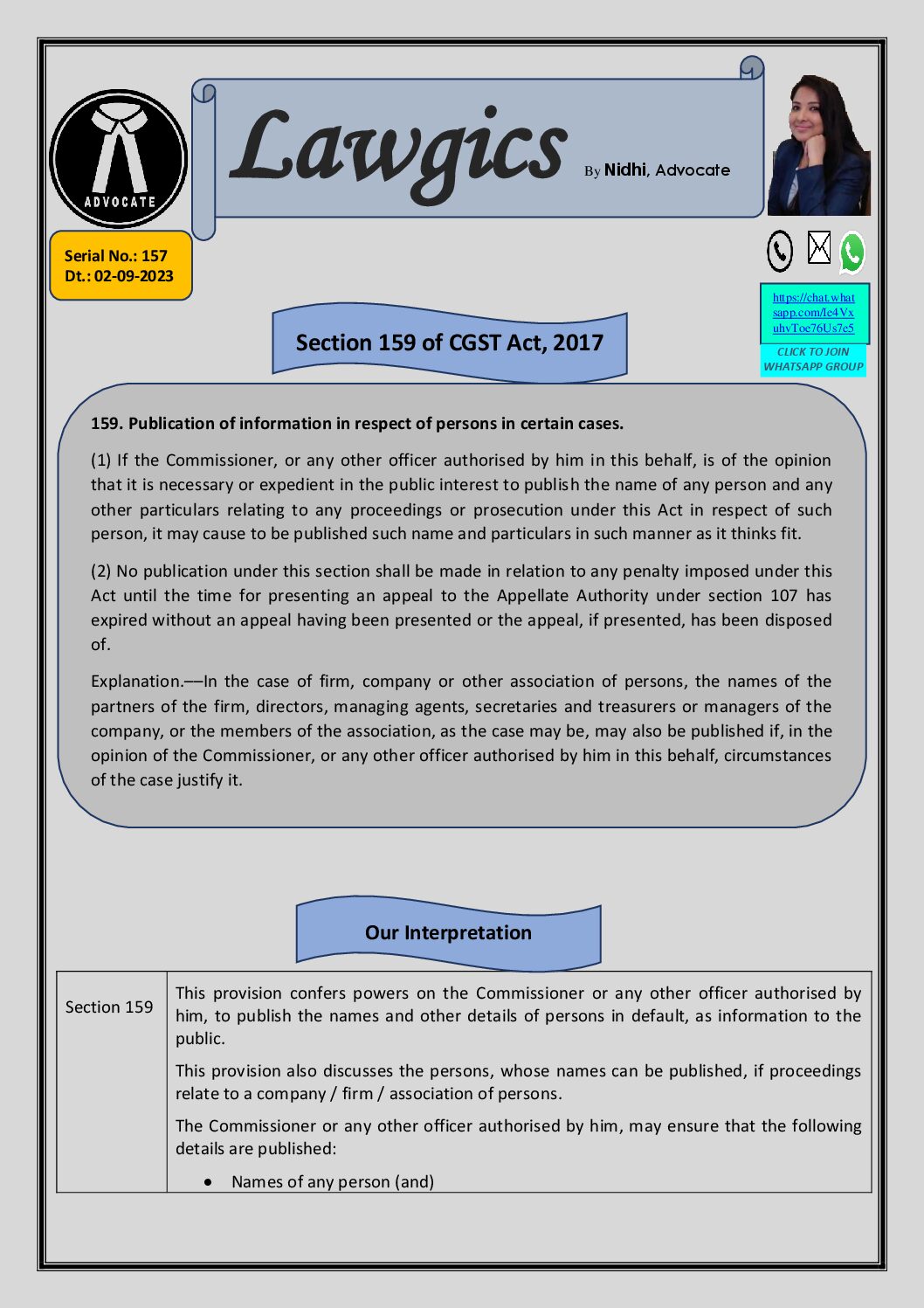
|
|
|
|
|
5. GST Notes by CMA Anil Sharma
1) Shri CMA Anil Sharma, Shri CMA Gurdev Singh Saini and Smt. CMA Bhawna Sharma posted Chapter-1 to 15 containing CGST Act in simple language in PPT format. This is to make dealers, professionals, academicians, students etc. understand the basics of GST laws. Each Chapter in CGST Act, 2017 is explained in the form of Slides as given below for easy understanding of the Act:
|
Chapter-15th slide is given below.
|
|
|
|
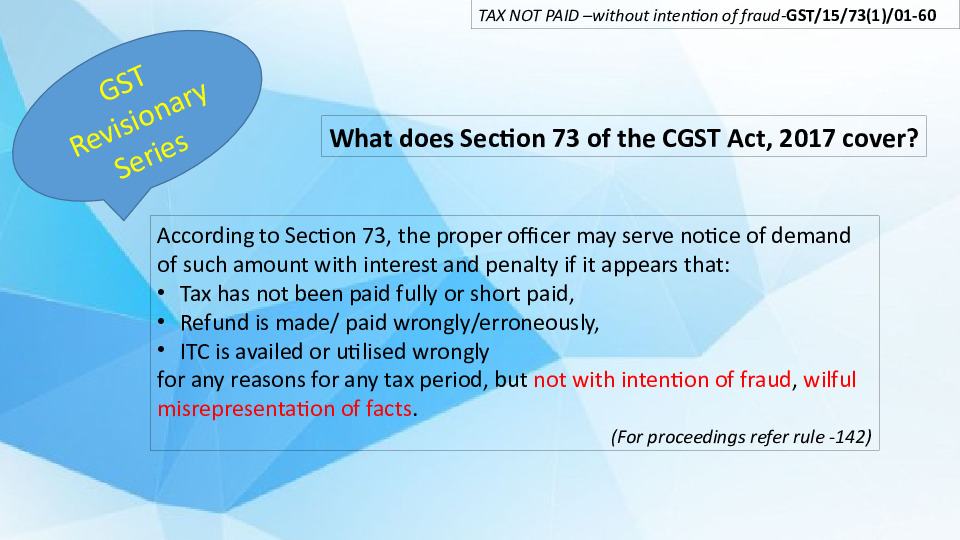
|
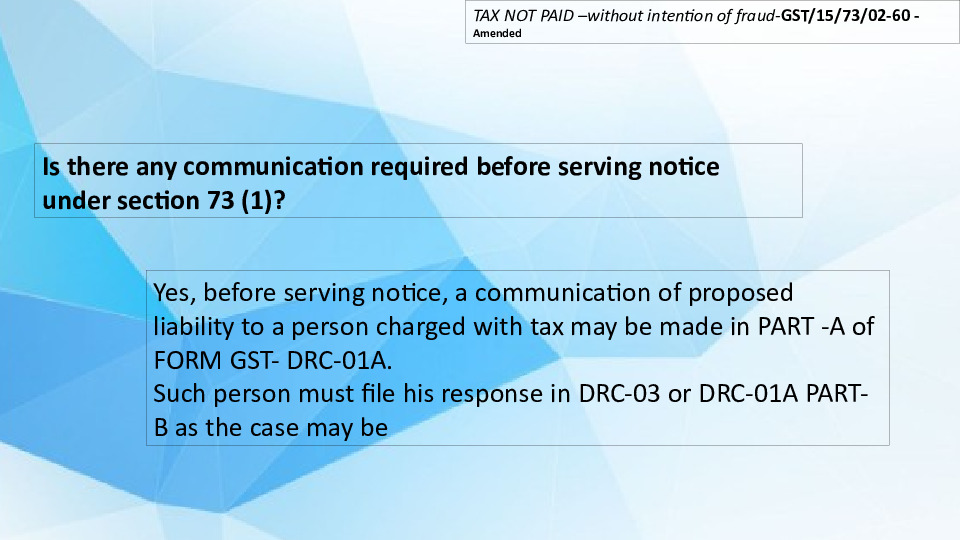
|
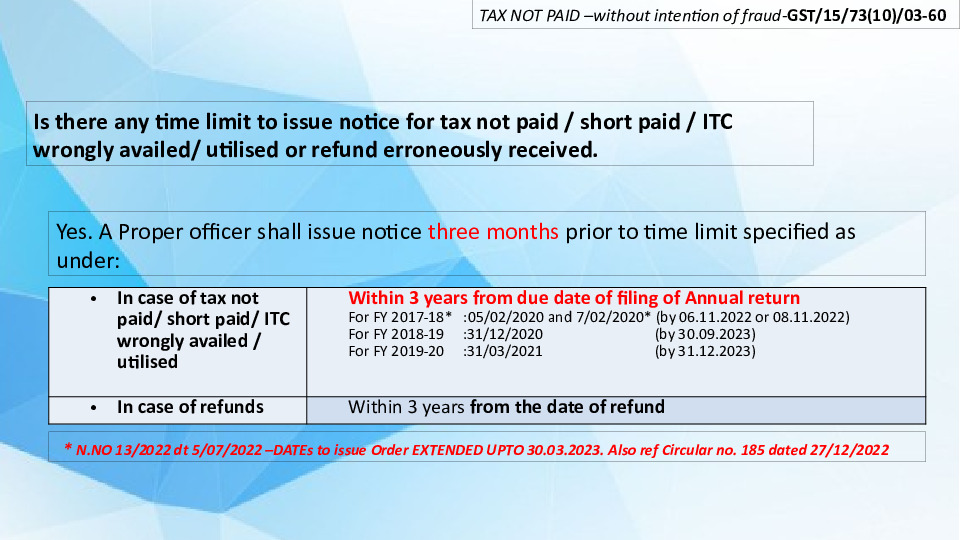
|
|
|
|
|
Do you wish to publish your Article?
If you wish to share your article with maximum readers then please send it at taxupdate.otu@gmail.com. We shall publish it with all due credit to you.
|
|
The topic can be on GST, Income Tax, Pre-GST laws, PPT, Notes etc. The article may contain 500 words to 1500 words or it may be more than that if the article demands.
|
|
|
|
|
|
|
If you wish to subscribe to weekly Newsletter at Rs. 149/- for one year, please subscribe. We shall send you the updates weekly.
|
|
|
|
|
|
|
Hope the above updates is of use to you. Please share your input and feedback at taxupdate.otu@gmail.com
|
|
|
|
|
|
4 Lawgics by Ms.Nidhi Aggarwal
|
Ms. Nidhi Aggarwal is delighted to present GST Notes/Law in a simplified manner under the title “ Lawgics ”. The note is prepared in a series of PDFs encompassing GST Law and the interpretations thereof in simple manner. The author with a great vision to spread complex GST law in a simple manner amongst the taxpayers, tax professionals, students and knowledge seeker is presenting the Lawgics in piecemeal at regular interval.
|
|
Lawgics 154 to 157 is added for your reading
|
|
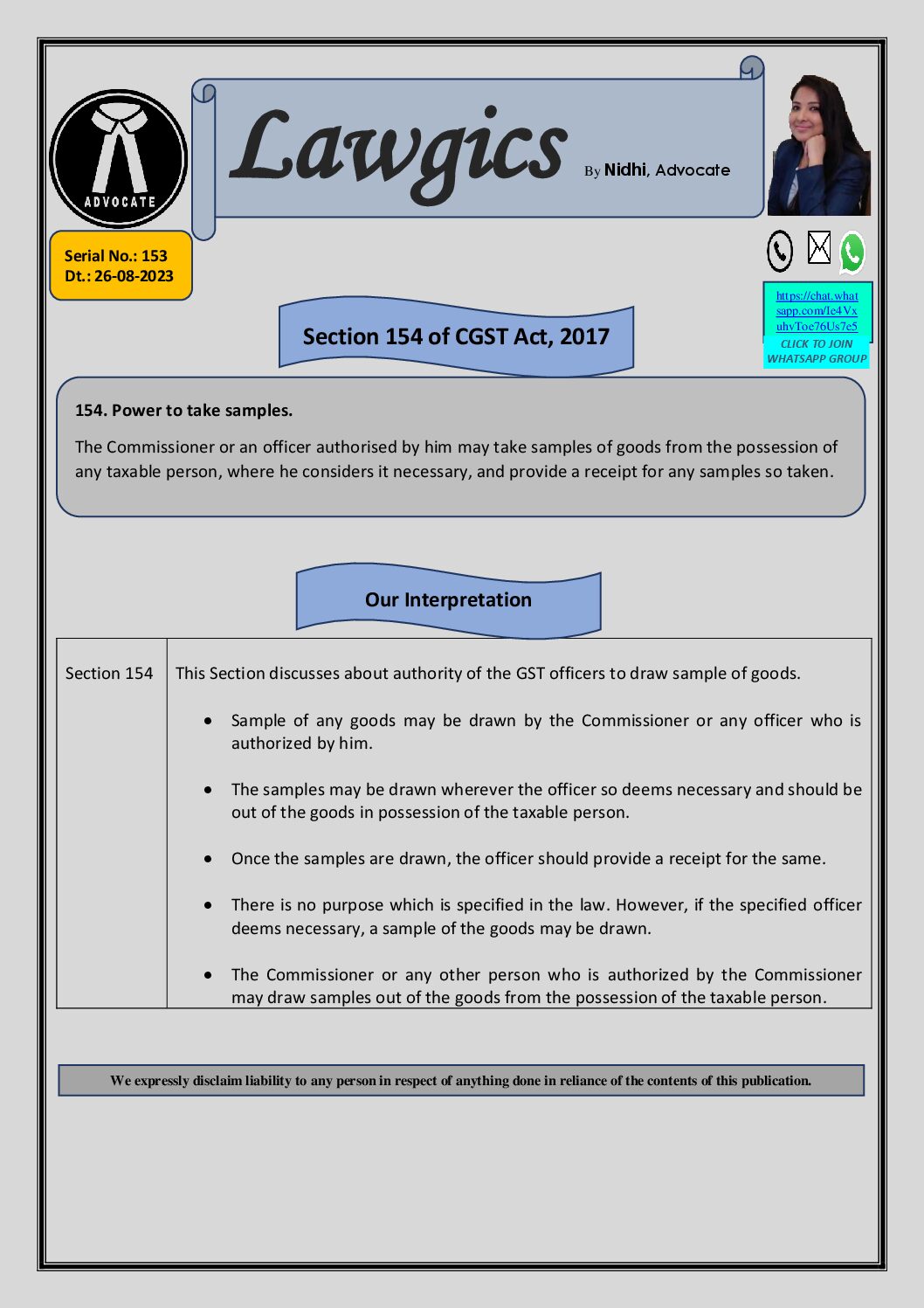
|
|
|
|
|
5. GST Notes by CMA Anil Sharma
1) Shri CMA Anil Sharma, Shri CMA Gurdev Singh Saini and Smt. CMA Bhawna Sharma posted Chapter-1 to 15 containing CGST Act in simple language in PPT format. This is to make dealers, professionals, academicians, students etc. understand the basics of GST laws. Each Chapter in CGST Act, 2017 is explained in the form of Slides as given below for easy understanding of the Act:
|
Chapter-15th slide is given below.
|
|
|
|
|
|
|
|
|
|
|
|
|
|
Do you wish to publish your Article?
If you wish to share your article with maximum readers then please send it at taxupdate.otu@gmail.com. We shall publish it with all due credit to you.
|
|
The topic can be on GST, Income Tax, Pre-GST laws, PPT, Notes etc. The article may contain 500 words to 1500 words or it may be more than that if the article demands.
|
|
|
|
|
|
|
If you wish to subscribe to weekly Newsletter at Rs. 149/- for one year, please subscribe. We shall send you the updates weekly.
|
|
|
|
|
|
|
Hope the above updates is of use to you. Please share your input and feedback at taxupdate.otu@gmail.com
|
|
|
|
|
|
 
|
Visit our website
|
OTU provides you
|
- Articles on various topics
|
|
- Media - GST, Income Tax & Press R.
|
|
- Notes / Newsletter at 149/ p.a.
|
|
|
|
|