|
|

|
Newsletter no. 67 dated 14.01.2023
|
|
|
|
|
|
This website contains information about recent changes mainly in GST laws. It also contains Articles on various topic in GST. Please visit the website and read more.
|
|
|
|
Index
|
5. GST Notes by CMA Anil Sharma
|
|
|
|
1. Circular-CGST
|
|
|
|
|
Central Board of Indirect Taxes and Customs (CBIC) issued Circular no. 256/02/2026-GST dated 25.07.2026 to provide Clarification regarding filing of appeal by department before the Goods and Services Appellate Tribunal (GSTAT) against order of appellate authority (where Orders-in-Original have been passed by a Common Adjudicating Authority in DGGI cases)
|
Government of India
Ministry of Finance
Department of Revenue
Central Board of Indirect Taxes and Customs
GST Policy Wing
F. No. CBIC-20010/12/2026-GST
|
Circular No. 256/02/2026-GST dated 25.07.2026
|
The Principal Chief Commissioners/ Chief Commissioners (All)
|
The Principal Directors General/ Directors General (All)
|
Subject: Clarification regarding filing of appeal by department before the Goods and Services Appellate Tribunal against order of appellate authority (where Orders-in-Original have been passed by a Common Adjudicating Authority in DGGI cases) – reg.
|
Kind attention is drawn to notification No. 02/2022-Central Tax dated 11th March, 2022 wherein para 3A and Table V were inserted in notification No. 02/2017-Central Tax dated 19th June, 2017 (and further amended by notification No. 27/2024- Central Tax, dated 25th November, 2024), to empower Additional/ Joint Commissioners of Central Tax of specified Central Tax Commissionerates (hereinafter referred to as “Common Adjudicating Authority” or “CAA”), with all India Jurisdiction for the purpose of adjudication of the show cause notices issued by the officers of the Directorate General of Goods and Services Tax Intelligence (herein after referred as “DGGI”).
|
2. Attention is further drawn to circular No. 169/01/2022-GST dated 12th March 2022 and circular No. 239/33/2024-GST dated 4th December 2024 wherein guidelines were issued with respect to assignment of show cause notices for adjudication and passing of order by a CAA, in respect of cases investigated by the officers of the DGGI.
|
3. Further, vide circular No. 250/07/2025-GST dated 24th June 2025, guidelines were issues with respect to reviewing and revisional authority and appeal by department before the appellate authority against orders passed by a CAA.
|
4. References have been received from field formations seeking clarification regarding filing of appeal by the department before the Goods and Services Tax Appellate Tribunal (hereinafter referred to as ‘GSTAT’), against an order of appellate authority (where Order-in-Original has been passed by a Common Adjudicating Authority in respect of DGGI cases). Clarifications are being sought as to:
|
(a) who will be the reviewing authority in respect of such orders of appellate authority in CAA cases?;
|
(b) which jurisdictional authority will be required to file an appeal before the GSTAT in such CAA cases?; and
|
(c) whether appeal before the GSTAT, in such CAA cases, is required to be filed before the bench of GSTAT having territorial jurisdiction over the location of the taxable person/ noticee or is to be filed before the bench of GSTAT having jurisdiction over Commissionerate of the CAA.
|
5. The GSTAT has been constituted under section 109 of the CGST Act, 2017. The territorial jurisdiction of the benches of the GSTAT has been notified through, the notification S.O. 3048(E) [F. NO. A-50050/150/2008-CESTAT-DOR dated the 31st July, 2024 (as amended from time to time), issued by the Central Government under the said section on the recommendations of the GST Council. Appeals to the GSTAT are governed by the provisions of section 112 of the CGST Act, 2017.
|
6. The matter has been examined in consultation with the Union Ministry of Law and Justice. In order to ensure uniformity in the procedure of filing of departmental appeals before the GSTAT in such cases (where Orders-in-Original have been passed by a CAA in DGGI cases), the Central Board of Indirect Taxes and Customs, hereby issues the following clarifications in respect of procedure to be followed for the purposes of review of orders passed by the appellate authority in such CAA cases and for filing of appeal by department against such order of appellate authorities:
|
(a). Communication of order by the appellate authority: The appellate authority, upon passing of an order-in-appeal, under section 107 of the CGST Act, in respect of an appeal arising from an order-in-original passed by the Common Adjudicating Authority, shall upload the order-in-appeal on the common portal, and shall also send a copy of the said order to the Pr. Commissioner/ Commissioner of CGST Commissionerate having jurisdiction over Common Adjudication Authority, through email, along with a with a physical copy.
|
(b). The Pr. Commissioner/ Commissioner of CGST Commissionerate having jurisdiction over the Common Adjudication Authority, shall examine the said order-in-appeal passed by the appellate authority in such cases, after seeking comments and inputs from DGGI (if required) at the earliest, and he shall, forward such comments to the jurisdictional CGST Pr. Commissioner/ Commissioners of all the taxable persons/ noticees involved in the said order-in-original, with his recommendations.
|
(c). Reviewing authority: The jurisdictional CGST Pr. Commissioner/ Commissioner of a particular taxable person/ noticee shall be the reviewing authority under sub-section (3) of section 112 of CGST Act, 2017 in respect of the order passed by the appellate authority in such CAA cases, in respect of the said taxable person/ notice under his jurisdiction. The said reviewing authority (including the Pr. Commissioner/ Commissioner having jurisdiction over the Common Adjudication Authority) shall, examine the matter regarding the legality and propriety of the order of appellate authority in such CAA cases after taking into consideration, inter alia, the comments and recommendations referred to in para (b) above in accordance with provisions of sub-section (3) of section 112 of CGST Act, 2017. Where the reviewing authority is of the opinion that an appeal is required to be filed by the department against order of the appellate authority in such CAA cases, he may for the purpose of satisfying himself as to the legality or propriety of the said order and for determination of such points arising out of the said order, as may be specified him, may, by order, appoint and direct any officer subordinate to him for filing and pursuing the appeal by the department before the GSTAT.
|
(d). Separate appeals have to be filed in respect of each of the taxable person/ noticee, against the order of appellate authority in such CAA cases, by the jurisdictional CGST Commissionerate of the taxable person/ noticee, before the concerned Bench of the GSTAT having territorial jurisdiction over such taxable person/ noticee.
|
(e). After such application to the GSTAT has been made, the jurisdictional CGST Pr. Commissioner/ Commissioner shall also intimate the Pr. Commissioner/ Commissioner of CGST Commissionerate having jurisdiction over the Common Adjudication Authority, along with a copy of the appeal filed in this respect. Where the reviewing authority is of the opinion that no appeal by the department is required to be filed against the order of the appellate authority in CAA cases, he shall intimate the same to Pr. Commissioner/ Commissioner of CGST Commissionerate having jurisdiction over the Common Adjudication Authority.
|
7. Difficulty, if any, in implementation of the above instructions may please be brought to the notice of the Board.
|
(Gaurav Singh)
Commissioner (GST)
|
|
|
|
|
|
|
|
|
|
Central Board of Indirect Taxes and Customs (CBIC) issued Circular no. 255/01/2026-GST dated 25.06.2026 to provide Clarification regarding jurisdiction in cases involving migration/ transfer of taxable persons from one jurisdiction to another jurisdiction.
|
|
|
|
|
|
|
|
|
|
The Goods and services tax (GST) authorities are planning to electronically record details of invoices issued by shops and businesses to retail consumers under a pilot project covering select sectors from April 1, 2027, to improve tax compliance, two officials told Business Standard.
|
The move will enable tax officials to access the large volume of retail transactions in sectors prone to tax evasion and assess whether businesses are correctly reporting their sales and paying the appropriate amount of GST, they said.
|
Currently, businesses with annual sales of more than ₹5 crore have to electronically register invoices issued to other businesses on a government-designated portal, subject to certain exemptions. Extending this reporting requirement, known as e-invoicing, to sales to end consumers is the next logical step towards enhancing tax compliance.
|
Businesses currently report their aggregate sales through GST returns rather than individual retail transactions. E-invoicing at the retail level is expected to help tax officials match these transactions with the sales reported by businesses in their tax returns, one of the officials said.
|
The GST Council, at its 54th meeting in September 2024, had recommended a voluntary trial of electronic recording of consumer bills in select sectors and states.
|
The Council proposed introducing the system on a voluntary basis initially and subsequently making it mandatory in sectors prone to tax evasion, according to the minutes of the meeting, which are publicly available. Restaurants were cited as one of the sectors where retail e-invoicing could be introduced.
|
The Council had identified several potential benefits, including better tax compliance, environmental gains from avoiding physical invoices and lower costs. Consumers would receive e-invoices on their mobile phones.
|
Officials said the government was now keen to take the pilot project forward.
|
An email sent to the Ministry of Finance on October 23 seeking comments for the story remained unanswered till press time.
|
Banks, insurers and non-banking financial companies (NBFCs) are among those currently exempt from e-invoicing for transactions with other businesses. However, the Centre and state governments are also considering bringing their business-to-business invoices under the requirement, the first official said. This is not part of the proposed pilot project.
|
Managing retail sales data
A third official, who also spoke on condition of anonymity, said the idea of electronically capturing retail invoices had been discussed for years, but implementation was delayed by the challenge of processing the enormous volume of small-value transactions taking place every day.
|
Storing and processing such volumes would require substantial server capacity, and the earlier technology infrastructure was not equipped to handle that scale, the official said.
|
Retail e-invoicing could also help foreign tourists claim GST refunds on purchases made in India before taking the goods back to their home countries, as customs officers would be able to verify the tax paid more easily, the official said.
|
Another government official said the GST Network (GSTN), which manages the technology backbone of the GST system, awarded Infosys a fresh seven-year contract in 2025 after the original arrangement, which had already been extended beyond its initial five-year term, ended.
|
Officials believe the new arrangement has factored in the need for higher storage and processing capacity.
|
They said storing invoices in a common system could reduce compliance costs by enabling more efficient invoice matching and audits, instead of relying on separate statements and manual checks.
|
Digital records carrying timestamps could also improve transparency and make subsequent changes to invoices easier to track, they said.
|
The government is also studying how countries such as Brazil and Chile operate their e-invoicing systems. Both have long used electronic invoices for business and consumer transactions, officials said.
|
Experts said the impact of e-invoicing in retail could be significant. “E-invoicing could be leveraged by the government to incentivise customers who seek GST valid invoice for their purchases, thereby encouraging the unorganised sector moving to the organised,” an tax expert said.
|
Experts also welcomed the possibility of withdrawing the business-to-business (B2B) exemption for financial sector entities. Another tax expert said e-invoicing in sectors such as banking, NBFCs and insurance would bring all B2B transactions in the economy under the system.
|
“Customers of these sectors would also benefit. It would be important to give sufficient time to these sectors as they have very high volumes of B2B transactions, and also use several custom/bespoke billing systems,” he said.
|
“Overall, it is a positive change and the GST Policy wing can collaborate with the sector associations to make this a success,” he said.
|
On B2C e-invoicing, he said it could enable better integration of digital payment and invoicing systems, supporting automated reconciliation and reporting.
|
Another tax expert said banks and NBFCs handle millions of small charges every day.
|
“Keeping the B2C pilot focused on technology-enabled sectors such as organised retail, e-commerce, quick commerce and online gaming while moving financial institutions only on the B2B side first, is a practical approach,” he said.
|
|
Source: Business Standard
|
|
|
|
|
|
|
|
|
|
Under the current GST returns framework, taxpayers are required to furnish details of their outward supplies in FORM GSTR-1. Based on such details, a statement of input tax credit (ITC) is made available to the recipients in FORM GSTR-2B for availment of input tax credit. To aid furnishing of return in FORM GSTR-3B of a tax period, tax liability of a supplier is being auto-populated on the portal based on the details furnished in his FORM GSTR-1, and available input tax credit is being autopopulated in his FORM GSTR-3B on the portal based on his FORM GSTR-2B. Currently, taxpayers can edit such auto-populated tax liability and available input tax credit in FORM GSTR-3B, before filing the same. Such editing may result in discrepancies between
|
a. tax liability reported in FORM GSTR-1 and tax paid in FORM GSTR-3B; and
|
b. ITC available in FORM GSTR-2B and ITC availed in FORM GSTR-3B.
|
2. These discrepancies often lead to issuance of demand notices by tax officers and system generated intimations to taxpayers. In view of reducing the mismatches between the tax liability reported in FORM GSTR-1 and the tax paid in FORM GSTR3B, and between the ITC available in FORM GSTR-2B and the ITC availed in FORM GSTR-3B, various facilities have been introduced on the portal in the past. These facilities enable correct reporting of tax liability and ITC details in FORM GSTR-3B, including correction of such details, wherever required, in the source statements i.e. FORM GSTR-1 and FORM GSTR-2B, rather than direct editing in FORM GSTR-3B. These facilities include:
|
a. FORM GSTR-1A, to enable taxpayers to amend their FORM GSTR-1 details before filing FORM GSTR-3B;
|
b. Invoice Management System (IMS), to facilitate reconciliation of ITC available in FORM GSTR-2B with the ITC availed in FORM GSTR-3B;
|
c. Electronic Credit Reversal and Re-claimed Statement, to facilitate accurate reporting of reversal and re-claim of ITC; and
|
d. RCM Ledger/ITC Statement, to facilitate accurate reporting of ITC availment in respect of supplies liable to reverse charge
|
3. The above-mentioned facilities though made available on the portal, have, except for FORM GSTR-1A, not been notified in CGST Rules, 2017. It is seen that some taxpayers are either not using or not properly using these facilities and continue to manually edit auto-populated details in FORM GSTR-3B, resulting in continued issuance of demand notices by tax officers and system generated intimations to taxpayers on account of mismatches in tax liability and ITC, causing inconvenience to taxpayers while also weakening the ITC chain integrity.
|
4. Accordingly, there is a need to further strengthen the return-filing framework, so as to provide an improved alternate mechanism of amendment of tax liability and ITC details in return in FORM GSTR-3B, which reconciles with the details of outward supplies furnished in FORM GSTR-1 and the details of available ITC in FORM GSTR2B, thereby minimizing mismatches. Such a framework will improve the accuracy of tax liability and ITC reporting, enhance compliance, and strengthen the foundation for the effective implementation of other process reforms recommended by the GST Council.
|
GST Council recommendations
5. In view of the above, the GST Council in its 57th meeting held on 8th October, 2026, took note of the various scenarios which require the taxpayers to edit autopopulated values in FORM GSTR-3B and recommended an Alternate mechanism of amendment of tax liability and ITC details in return in FORM GSTR-3B, building on the existing facilities and recommending certain new facilities as follows:
|
- i. Enhancement of FORM GSTR-1/1A/IFF for better reconciliation with FORM GSTR-3B and other statements
- The absence of supply-type-wise granularity in FORM GSTR-1/1A/IFF may lead to incorrect auto-population of the corresponding tables in FORM GSTR-3B, requiring manual correction by taxpayers. For instance, credit notes, debit notes, advances received, and advances adjusted are not categorised by the nature of supply, such as regular outward supplies, supplies under section 9(5), or zero-rated supplies. As a result, they may be reported under the table for taxable outward supplies in FORM GSTR- 3B, instead of the appropriate relevant table.
- Further, the existing format of FORM GSTR-1 does not enable taxpayers to reconcile supplies made through electronic commerce operators with the corresponding details furnished by the ECOs in FORM GSTR-8 and made available on the common portal.
- Accordingly, enhancements to FORM GSTR-1/1A/IFF have been recommended to enable identification of the nature of the underlying supply in respect of credit notes, advances, and similar documents. This would ensure correct auto-population of tax liability in FORM GSTR-3B and obviate the need for amending the auto-populated liability in FORM GSTR-3B.
- Further, to facilitate the taxpayers in furnishing details in FORM GSTR1/1A/IFF on the portal, user interface improvements, such as tool tips and guided navigational paths on the portal have been suggested.
- ii. Expanding the scope of rectifications to be made through FORM GSTR-1A
- At present, FORM GSTR-1A cannot be used to add or amend details relating to earlier tax periods, or to correct the GSTIN of the recipient. This restricts taxpayers from rectifying any error regarding the earlier tax period or relating to change in GSTIN of the recipient before filing FORM GSTR-3B. Accordingly, it has been recommended that this restriction may be removed.
- iii. Rectification of details furnished in FORM GSTR-3B of an earlier tax period
- It was observed that certain taxpayers rectify tax liability for outward supplies of an earlier tax period directly in FORM GSTR-3B, without correcting the underlying details in FORM GSTR-1/1A. Accordingly, it has been recommended that such rectification be made only through the amendment tables of FORM GSTR-1/1A, instead of amending the autopopulated liability detail in FORM GSTR-3B, directly. However, rectification of reverse-charge tax liability may be made directly through adjustments in the FORM GSTR-3B of a subsequent tax period.
- iv. Reporting of details of outward supplies in FORM GSTR-1 where tax had been discharged through FORM GST DRC-03
- Where any amount of tax has been paid through FORM GST DRC-03 in pursuance of a proceeding such as the audit, inspection, scrutiny or enforcement activity by the tax authorities, and the taxpayer intends to pass on the ITC in respect of the same to the recipient, then if he reports the invoice or debit note details in FORM GSTR-1/1A, the liability gets auto-populated in FORM GSTR-3B. As the taxpayer has already paid the tax liability through FORM GST DRC-03, he may be resorting to editing liability in FORM GSTR-3B, so as to avoid duplication of payment of said tax liability.
- To prevent such duplication, it has been recommended that FORM GST DRC-03 be enhanced to enable the taxpayer to declare, within seven days of payment, the details of the underlying invoice(s) or debit note(s). In such cases, when the said invoice or debit note details are reported in FORM GSTR-1/1A, the corresponding tax liability for the said invoice or debit note will not be added to the auto-populated liability in FORM GSTR-3B, thus avoiding any duplication of payment of tax. The details of such invoice or debit note will also be made available in corresponding FORM GSTR-2B of the recipient for availment of ITC.
- v. Correct reporting of reverse charge liability in FORM GSTR-3B
- To facilitate the taxpayers in correct reporting of tax liability and input tax credit in respect of supplies liable to reverse charge, RCM Liability and ITC Statement was introduced on the portal from August 2024 period onwards for monthly filers and July-September 2024 period onwards for quarterly filers. A facility was also provided to report cumulative closing balance, if any, upto that period.
- To further streamline correct reporting of such tax liability and ITC, it has been recommended to notify the said statement in CGST Rules, 2017 and to require that ITC claimed on inward supplies under reverse charge (other than import of goods) in FORM GSTR-3B of a tax period should not exceed the tax liability under RCM declared in the said FORM GSTR-3B and the closing balance available in the said statement.
- Accordingly, an Electronic Statement of tax paid on Reverse charge basis and input tax credit claimed has been recommended in FORM GST PMT-02B. Also, amendment has been recommended in FORM GST PMT-04, so as to allow a taxpayer to report discrepancies, if any, in the said statement.
- vi. Mandating and clarifying the usage of Invoice Management System (IMS) for better reconciliation of input tax credit details in FORM GSTR-3B
- IMS has been available on the portal since October 2024. It allows recipients to accept, reject, or keep pending inward supply details communicated by supplier. The salient features of IMS are as follows:
- The taxpayer may keep documents pending on IMS, in respect of which the conditions of eligibility of ITC under section 16(2) of CGST Act are presently not fulfilled, but which may get fulfilled subsequently. Upon fulfillment of the requisite conditions, such documents may be subsequently accepted by the recipient on IMS.
- The taxpayer may reject a document on IMS, if any discrepancy in the document communicated on IMS is noticed or where the document is found to not pertain to him.
- If no action is taken on a document communicated on IMS for generation of FORM GSTR-2B of a tax period before filing of FORM GSTR-3B for the said tax period, the same is considered to have been accepted by the recipient on IMS.
- ITC pertaining to accepted or deemed accepted documents is made available in FORM GSTR-2B and accordingly autopopulated in Table 4(A) of FORM GSTR-3B for the corresponding tax period. Conversely, the ITC pertaining to documents kept pending or rejected in IMS is not made available in FORM GSTR2B and accordingly not auto-populated in Table 4(A) of FORM GSTR-3B for the corresponding tax period.
- An action taken on any document on IMS by the recipient can be revised any number of times upto the filing of his FORM GSTR3B for the tax period for which FORM GSTR-2B is being generated. Based on the revised action taken on IMS, FORM GSTR-2B can be also revised, which will also revise the autopopulated ITC in FORM GSTR 3B.
- These above-mentioned features of IMS improve the reconciliation between ITC available in FORM GSTR-2B and ITC availed in FORM GSTR-3B.
- With a view to facilitate ease of taking action on IMS, offline tool has been made available on GST Portal, to enable taxpayers to undertake actions on both individual as well as bulk invoices in an efficient manner.
- To reduce inadvertent rejections or premature acceptance of credit notes, it has been recommended to extend the period for which a credit note may be kept pending on IMS:
a) By Monthly filers: Until filing of FORM GSTR-3B for next-to-next month, to the month in which the credit note was communicated to the taxpayer, but not later than the end of the month in which the due date for filing of the return in FORM GSTR-3B for the said next to next month falls. Thereafter, the credit note will be deemed accepted.
|
Example: Say a credit note was communicated by the supplier in his FORM GSTR-1 filed on 11th May, 2026, for the month of April 2026, to the recipient “A”. The same shall reflect in the IMS of “A” for the month April 2026. This credit note can be kept pending on the IMS by “A” till the date of filing of FORM GSTR-3B for the month of June, 2026 (which is next to next month of April 2026). However, if FORM GSTR-3B of June 2026 is not filed by “A” upto 31st July 2026 (which is the last date of the month in which the return for the month June 2026 was due), then the said credit note shall be deemed to have been accepted by “A” on IMS.
|
b) By Quarterly filers: Until filing of FORM GSTR-3B for the next quarter after the quarter in which the credit note was communicated to the taxpayer, but not later than the end of the month in which the due date for filing of the return in FORM GSTR-3B for the said next quarter falls. Thereafter, the credit note will be deemed accepted.
|
Example: Say a credit note was communicated by the supplier in his FORM GSTR-1 filed on 11th May, 2026 for the month of April 2026, to a recipient “A”,. The same shall reflect in the IMS of “A” for the quarter April–June 2026. This credit note can be kept pending on the IMS by “A” till the date of filing of FORM GSTR-3B for the quarter of July–September 2026 (which is next quarter to April–June 2026). However, if FORM GSTR-3B of July–September 2026 is not filed by “A” upto 31st October 2026 (which is the last date of the month in which the return for the quarter July–September 2026 was due), then the said credit note shall be deemed to have been accepted by “A” on IMS.
|
-
- It has further been recommended to provide an option for the suppliers to link credit notes and debit notes with the underlying invoices in FORM GSTR-1/1A/IFF, on a purely voluntary basis, to help recipients take informed decisions and to reduce the need of keeping credit notes pending or rejecting them on IMS.
- Since acceptance, rejection, and keeping documents pending on IMS improve ITC reconciliation, the GST Council has recommended that management of available ITC in FORM GSTR-3B should be carried through IMS instead of directly amending auto-populated ITC in FORM GSTR-3B. GST Council has also recommended notifying relevant amendment in GST Rules and FORMS for the same purpose.
- The Council also recommended issuance of a circular to guide the taxpayers in correct manner of taking action on IMS.
- vii. Facilitating taxpayers in correct reporting of reversal and reclaim of ITC in FORM GSTR-3B:
- In order to facilitate the taxpayers in correct and accurate reporting of reversal and reclaim of input tax credit, a statement namely, Electronic Credit Reversal and Reclaim Statement was introduced on the GST portal from August 2023 return period onwards, with a facility to report their cumulative closing balance of input tax credit, if any, which had been reversed but not re-availed upto that time.
- To further streamline correct reporting, it has been recommended to notify the said statement in CGST Rules, 2017 and to require that reclaimed input tax credit in FORM GSTR-3B shall not exceed the balance available in the said statement.
- Accordingly, an Electronic Credit Reversal and Reclaim Statement has been recommended in FORM GST PMT-02A. Also, amendment has been recommended in FORM GST PMT-04, so as to allow a taxpayer to report discrepancies, if any, in the said statement.
- Further, amendment has been recommended in Table 4 of FORM GSTR3B to provide for a separate Table 4(AA) in FORM GSTR-3B for reporting reclaimed ITC, so as to obviate the need for amending the auto-populated ITC details in Table 4(A)(5) of FORM GSTR-3B.
- viii. Streamlining the manner of rectification of errors made in reporting input tax credit in FORM GSTR-3B
- After suppliers furnish outward supply details, recipients act on IMS to generate FORM GSTR-2B and are generally required to manually report RCM ITC, ITC reversals, and ITC re-claims in FORM GSTR-3B. Such manual interventions are prone to errors and omissions.
- As the temporary reversals made in Table 4(B)(2) of FORM GSTR-3B are credited to the Electronic Credit Reversal and Re-claim Statement, any excess temporary reversal done in Table 4(B)(2) can be rectified by reclaiming the excess amount so reversed in a subsequent return. However, no such systematic mechanism exists to rectify any excess reversal of ITC, reversed permanently in Table 4(B)(1) of FORM GSTR3B.
- Accordingly, it has been recommended to provide a systemic mechanism, by way of a new form, FORM GST PMT-10 to undertake rectifications of such excess reversals of permanent nature reported in Table 4(B)(1) of FORM GSTR-3B of an earlier tax period, on the basis of self-assessment.
- ix. Enhancement in FORM GSTR-2B in respect of ITC distributed by ISD
- ITC distributed by an Input Service Distributor (ISD) as ineligible in FORM GSTR-6 does not currently flow as available ITC in FORM GSTR2B and is therefore not auto-populated in Table 4(A)(4) of FORM GSTR3B.
- Accordingly, enhancements have been recommended in FORM GSTR2B and FORM GSTR-3B, to provide that ITC distributed by an ISD as ineligible need not be reversed again by recipients in Table 4(B)(1) of FORM GSTR-3B as such ITC will be auto-populated as ineligible ITC in Table 4(D)(2) of FORM GSTR-3B.
- Currently, ITC attributable to an ineligible ISD credit note is reduced from eligible ITC on the portal. Since such a credit note relates to ineligible ITC, its impact should instead flow to the ineligible ITC section, i.e., Table 4(D)(2) of FORM GSTR-3B.
- Accordingly, enhancements have been recommended in FORM GSTR2B to ensure that ITC relating to ineligible credit notes distributed by an ISD is not adjusted against eligible ITC distributed by the ISD.
6. Besides the above, the GST Council also recommended issuance of a circular to clarify the correct manner of reporting ITC availment and its reversal in FORM GSTR3B, in the context of IMS, the Electronic Credit Reversal and Re-claimed Statement, and the Electronic Statement of tax paid on reverse charge basis and ITC claimed.
|
7. The Council recommended that, with the above proposed measures, there may not be any need for directly rectifying/amending the details of liability (autopopulated from FORM GSTR 1/1A/IFF) and details of ITC (auto-populated from FORM GSTR-2B) in FORM GSTR-3B. Thus, any amendment/correction of liability will be done through FORM GSTR-1/1A/IFF instead of directly amending auto-populated values in FORM GSTR-3B. Further, any management of ITC will be done through IMS, Electronic Credit Reversal and Re-claimed Statement, and the Electronic Statement of tax paid on reverse charge basis and ITC claimed, FORM GST PMT-04 and FORM GST PMT-10, instead of directly amending the auto-populated details in FORM GSTR-3B. To allow stakeholders sufficient time to align their systems and practices, the Council recommended that this proposed Alternate mechanism of amendment of tax liability and ITC details in return in FORM GSTR-3B, and corresponding amendments to the CGST Rules, 2017, may be brought into force from the return period of April, 2027.
|
Public consultation
8. Furthermore, the Council recommended that the proposed measures be placed in the public domain for a time-bound consultation to provide an opportunity to taxpayers, tax practitioners, industry associations, and other stakeholders to submit comments and suggestions on the proposed measures. In this regard, the amendments recommended by the Council in CGST Rules, 2017 and in the CGST FORMs are placed at Annexure A* and Annexure B*, respectively. The circular recommended by the Council for clarifying the correct manner of reporting ITC availment and its reversal in FORM GSTR-3B is placed at Annexure C*.
|
9. Accordingly, all the stakeholders are invited to examine the proposed measures and submit their comments, suggestions, and inputs by Monday, 30th November. The same shall be examined and duly considered before finalisation of the amendments to the said Forms and Rules.
|
* Kindly note that the amendments proposed in the CGST Rules, 2017 and CGST Forms placed in Annexure A and Annexure B respectively, have been highlighted in red.
|
|
|
|
|
|
|
|
|
|
India’s ambition to become a Viksit Bharat requires an economy in which enterprises of every size can grow, wherever they begin. Over the past twelve years, our government has worked to create those conditions. The introduction of the goods and services tax (GST) in 2017 established a common national framework for indirect taxation. Next-Gen GST carries that effort forward, drawing on nine years of implementation and the experience of taxpayers and states.
|
Under Prime Minister Narendra Modi’s vision, Next-Gen GST was conceived with two connected purposes: To reduce and rationalise rates, and to make compliance easier. The rate changes took effect on September 22, 2025. The next phase of process reforms will come before the GST Council shortly. Together, these efforts seek to give households relief, businesses greater certainty and taxpayers a system in which they can fulfil their obligations without avoidable difficulty.
|
The states have been partners throughout. They brought their priorities and experience to the Council, helped shape the decisions and undertook their implementation. I thank them for that commitment. GST’s progress rests on this willingness to pursue a shared national purpose while respecting each government's responsibilities.
|
The results provide grounds for confidence. Between October 2025 and July 2026, the value of reported taxable supplies grew by 25.8 per cent over the corresponding period a year earlier. A lighter rate structure has been accompanied by a substantial expansion in reported economic activity. This is an encouraging foundation for a reform intended to support both enterprise and public finances.
|
That resilience is visible in the latest revenue figures. Gross GST collections reached ₹12.46 trillion during April-September 2026, up 11.6 per cent over the corresponding period last year. Every month from June through September recorded double-digit annual growth; together, collections for these four months accelerated by nearly 15 per cent. Net collections, after refunds, also grew by 10.4 per cent over the half year. Taxpayer relief has coexisted with growth in the resources available for development.
|
The breadth of the expansion matters as much as its scale. Reported taxable supplies grew across all 11 sector groups and all major states. In an economy as diverse as India’s, this spread is significant. Growth across sectors and regions creates opportunities for more businesses to participate in expanding markets, and for more communities to benefit from the demand, investment and employment that follow.
|
Reported sales to consumers (B2C) also rose by 26.7 per cent in the post-reform comparison. When tax relief is reflected in prices, families have more room to meet other needs or save. Consumer relief and enterprise growth are closely connected: The purchasing power of households sustains demand for the goods and services that businesses provide. The benefits can extend from the household to the retailer, the supplier and the producer.
|
For small and medium enterprises, a national market is valuable when it opens a practical route to customers beyond their immediate surroundings. Businesses in Tier-II and Tier-III towns should be able to build those relationships while continuing to invest and employ people locally. Enterprises expanding into these towns, in turn, can create opportunities for local suppliers and distributors. GST’s common framework supports these connections; simpler administration must make them easier to sustain.
|
Participation in that framework is substantial. GST registrations across Central and state jurisdictions stood at approximately 17.1 million at the end of August, up nearly 15 per cent from a year ago. For the April–July 2026 tax periods, GSTR-3B returns filed by their due dates were 12.6 per cent higher than for the same periods last year. These improvements place a corresponding responsibility on the administration: Regular compliance must be supported by reliable service, clear guidance and timely resolution of difficulties.
|
The functioning of input tax credit is another important part of this experience. The post-reform figures show that the share of tax liability discharged through credits rose, while accumulated credit declined relative to taxable supplies. This is encouraging for businesses that depend on the effective use of eligible credit. For a smaller firm, working capital determines how readily it can purchase inputs, fulfil an order and take on the next one.
|
Refunds are equally relevant. Approximately ₹1.80 trillion was refunded during April-September. Returning amounts due to businesses is part of a well-functioning tax system. Greater predictability in this process would help enterprises plan purchases and production with more confidence. The taxpayer’s experience of receiving an eligible refund is an important measure of administrative performance.
|
The states also have a stronger revenue position. Their aggregate SGST (state GST) receipts, including their share of IGST (integrated GST) settlements, grew by about 16 per cent during April-September this year. These resources support investment in infrastructure and public services, which improve the conditions in which families and enterprises pursue their aspirations. The gains can therefore reinforce one another: Household relief supports demand, enterprise strengthens economic activity, and public revenues help sustain development.
|
The experience also points to the work ahead. A growing system must remain attentive to the costs it imposes on smaller participants. Their time and resources are limited. Each improvement in filing, credit or refunds should allow more of those resources to be devoted to running and expanding a business.
|
The proposals before the Council on October 7 have been developed through sustained work with the states. They address registration, returns, refunds, disputes and improved flow of input tax credit, with the aim of reducing the time and cost of compliance. Taxpayer experience must continue to guide implementation.
|
The GST’s growing maturity gives us a stronger foundation for the next stage of reform. The same commitment to clarity, certainty and respect for the taxpayer guides our work on direct taxes. A dependable tax system enables enterprises to plan beyond their immediate obligations and invest in opportunities that take time to mature. Giving them that confidence, wherever they operate, helps build the economic strength of a Viksit Bharat as envisioned by Prime Minister Narendra Modi.
|
The writer is the Union Minister of Finance and Corporate Affairs
|
|
Source: Business Standard
|
|
|
|
|
|
|
|
|
|
The Hon’ble Himachal Pradesh High Court in Hindustan Construction Company Limited vs Union of India and Others held that the matter required reconsideration on factual and legal aspects and remitted it to the Assistant Commissioner, State Taxes and Excise, Dharamshala, directing a fresh decision by September 30, 2025, after affording opportunity of hearing.
|
Hindustan Construction Company Limited (“the Petitioner”) was undertaking a works contract in Himachal Pradesh and challenged the demand order on the ground that no notice in Form GST ASMT‑10 was issued upon scrutiny of returns under Section 61 of the CGST Act, nor was any pre‑show cause notice in Form GST DRC‑01A issued.
|
The Union of India and others, including Respondent No. 4 – the Assistant Commissioner, State Taxes and Excise, Dharamshala (“the Respondents”), were the authorities responsible for passing the impugned orders. The Petitioner submitted that while its returns were selected for scrutiny, no notice in Form GST ASMT‑10 was served as required under Section 61. Moreover, though proceedings under Section 74 were initiated, no Show Cause Notice in Form GST DRC‑01 was issued, which is a statutory prerequisite for raising a tax demand.
|
The Petitioner further contended that no GST could be levied on “unbilled revenue” as GST liability arises only upon the occurrence of a taxable supply, and not on notional or accrued income merely reflected in the books. It was contended that while “unbilled revenue” may have relevance under income tax law, it has no application in the GST regime, which is governed by a different set of taxability conditions. Therefore, the Petitioner challenged the assessment order and the recovery notice on several legal and factual grounds. During the hearing, both parties agreed that instead of adjudicating the matter in writ proceedings, it would be appropriate for the competent authority, i.e., Respondent No. 4, to re‑examine the issues afresh.
|
Whether the assessment and recovery proceedings could be sustained without reconsideration of factual and legal issues?
|
The Hon’ble Himachal Pradesh High Court in CWP No. 1827 of 2024 held as under:
|
- Observed that, the parties were ad idem that the matter required reconsideration on both factual and legal aspects by the proper authority.
- Directed that, the petition be disposed of with a direction to Assistant Commissioner, State Taxes and Excise, Dharamshala (Respondent No. 4), to examine the matter afresh on both legal and factual issues and quashed & set aside the assessment order dated December 31, 2023 and the recovery notice dated February 20, 2024.
- Further directed that, since the proceedings relate to FY 2017–18, the Respondent must expedite and conclude the hearing by September 30, 2025.
- Held that, the proceedings must be conducted after affording the Petitioner an opportunity to file replies and supporting documents.
The High Court ensured that the matter is adjudicated afresh by the proper authority, particularly when the parties themselves conceded the need for such reconsideration. By setting aside the impugned order and ensuring time-bound disposal with opportunity of hearing, the Court has protected the taxpayer’s rights under principles of natural justice.
|
Section 61. Scrutiny of returns.- CGST Act, 2017
|
“(1) The proper officer may scrutinize the return and related particulars furnished by the registered person to verify the correctness of the return and inform him of the discrepancies noticed, if any, in such manner as may be prescribed and seek his explanation thereto.
|
(2) In case the explanation is found acceptable, the registered person shall be informed accordingly and no further action shall be taken in this regard.
|
(3) In case no satisfactory explanation is furnished within a period of thirty days of being informed by the proper officer or such further period as may be permitted by him or where the registered person, after accepting the discrepancies, fails to take the corrective measure in his return for the month in which the discrepancy is accepted, the proper officer may initiate appropriate action including those under section 65 or section 66 or section 67, or proceed to determine the tax and other dues under section 73 or section 74 or section 74A”
|
|
DISCLAIMER: The views expressed are strictly of the author and A2Z Taxcorp LLP. The contents of this article are solely for informational purpose and for the reader’s personal non-commercial use. It does not constitute professional advice or recommendation of firm. Neither the author nor firm and its affiliates accepts any liabilities for any loss or damage of any kind arising out of any information in this article nor for any actions taken in reliance thereon. Further, no portion of our article or newsletter should be used for any purpose(s) unless authorized in writing and we reserve a legal right for any infringement on usage of our article or newsletter without prior permission.
|
|
|
|
|
|
|
|
|
|
The Hon’ble Calcutta High Court in DYS Impex Private Limited vs. Assistant Commissioner of Revenue, State Tax, Refund Unit & Ors held that refund denial based on Section 16(4) of the CGST/ WBGST Act could not be sustained in light of the retrospective insertion of Section 16(5), which extended the timeline for availing input tax credit (ITC) for initial 4 FYs, starting from 2017-18 to 2020-21 up to November 30, 2021.
|
DYS Impex Private Limited (“the Petitioner”), filed a writ petition challenging the order dated February 21, 2024, which rejected its appeal against partial refund rejection (Form GST RFT-06) for the tax period July 2019 to September 2019.
|
Assistant Commissioner of Revenue, State Tax, Refund Unit (“the Respondent”), rejected the refund claim by relying on the proviso to Section 16(4) of the CGST/ WBGST Act, 2017, stating that ITC relating to FY 2017–18 was availed beyond the prescribed time limit.
|
The Petitioner contended that, pursuant to the retrospective insertion of Section 16(5) in the Act, ITC for FYs 2017–18 to 2020–21 could be availed in any return filed up to November 30, 2021.
|
The Respondent contended that the refund was rightly disallowed under the unamended Section 16(4), which barred ITC beyond the specified deadline for FY 2017–18.
|
Aggrieved by this, the Petitioner approached the Court under Article 226, seeking relief against rejection of refund on the basis of a retrospective statutory amendment.
|
Whether, in view of the retrospective insertion of Section 16(5) in the CGST/ WBGST Act, the Petitioner was entitled to claim ITC and refund for FY 2017–18 through returns filed up to November 30, 2021?
|
The Hon’ble Calcutta High Court in WPA 2980 of 2025 held as under:
|
- Observed that, both the refund sanctioning authority and the appellate authority rejected refund by invoking the proviso to Section 16(4).
- Noted that, Section 16(5) was inserted retrospectively from July 1, 2017, and allowed filing of returns for FYs 2017–18 to 2020–21 by November 30, 2021 for availing ITC.
- Held that, the authorities failed to consider the extended timeline introduced by Section 16(5), rendering the orders unsustainable.
- Further set aside both the refund rejection order dated April 14, 2023 and the appellate order dated February 21, 2024.
- Directed the proper officer to re-adjudicate the refund claim in light of Section 16(5), and to conclude proceedings within 12 weeks of receiving the order.
This judgment affirms that refund claims involving ITC for the initial GST years must be adjudicated in light of Section 16(5), which was inserted retrospectively by the Finance Act, 2025. The Calcutta High Court correctly held that Section 16(5) overrides the earlier limitation under Section 16(4), allowing ITC for FYs 2017–18 to 2020–21 in returns filed up to November 30, 2021.
|
A similar approach was adopted by the Hon’ble Gauhati High Court in ITI Ltd. v. Union of India [ 172 taxmann.com 59 (Gauhati)], where the petitioner’s grievance regarding ITC availment became largely academic after the retrospective insertion of Section 16(5). The Gauhati High Court set aside the impugned order and remanded the matter for fresh consideration in accordance with the amended law. The Court there emphasized that refund or demand adjudication must reflect the legal position post-amendment, especially when such amendment cures a statutory limitation.
|
Section 16(4) and Section 16(5) of the CGST/WBGST Act, 2017
|
“16. Eligibility and conditions for taking input tax credit.-
|
(4)A registered person shall not be entitled to take input tax credit in respect of any invoice or debit note for supply of goods or services or both after the thirtieth day of November following the end of financial year to which such invoice or debit note pertains or furnishing of the relevant annual return, whichever is earlier.
|
(5) Notwithstanding anything contained in sub-section (4), in respect of an invoice or debit note for supply of goods or services or both pertaining to the Financial Years 2017-18, 2018-19, 2019-20 and 2020-21, the registered person shall be entitled to take input tax credit in any return under section 39 which is filed up to the thirtieth day of November, 2021.
|
Provided that the registered person shall be entitled to take input tax credit after the due date of furnishing of the return under section 39 for the month of September, 2018 till the due date of furnishing of the return under the said section for the month of March, 2019 in respect of any invoice or invoice relating to such debit note for supply of goods or services or both made during the financial year 2017-18, the details of which have been uploaded by the supplier under sub-section (1) of section 37 till the due date for furnishing the details under sub-section (1) of said section for the month of March, 2019.”
|
|
DISCLAIMER: The views expressed are strictly of the author and A2Z Taxcorp LLP. The contents of this article are solely for informational purpose and for the reader’s personal non-commercial use. It does not constitute professional advice or recommendation of firm. Neither the author nor firm and its affiliates accepts any liabilities for any loss or damage of any kind arising out of any information in this article nor for any actions taken in reliance thereon. Further, no portion of our article or newsletter should be used for any purpose(s) unless authorized in writing and we reserve a legal right for any infringement on usage of our article or newsletter without prior permission.
|
|
|
|
|
|
|
|
|
|
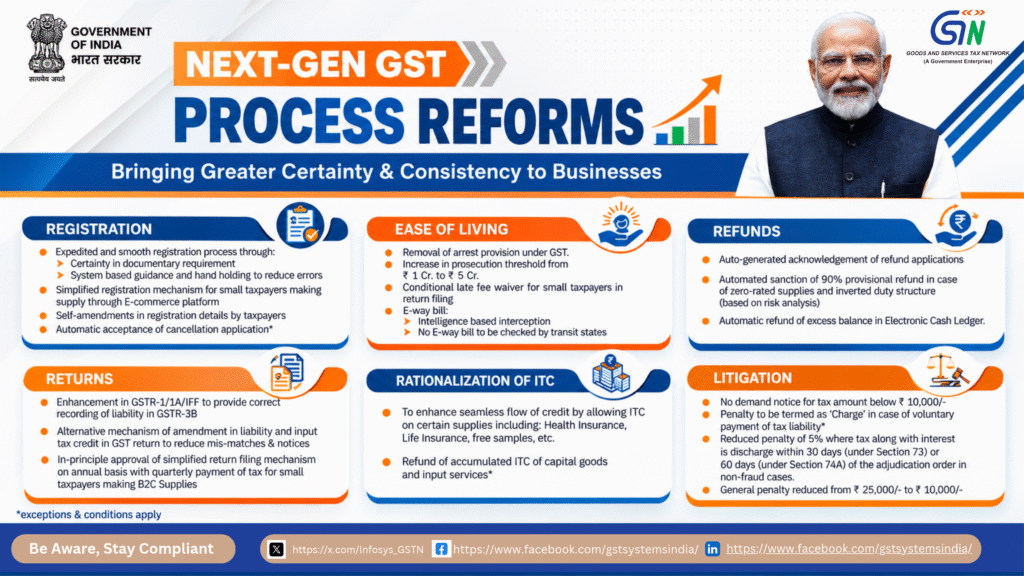
Government of India taken following decisions for process reforms
|
- GST Registrations
- Ease of Living
- Refunds
- Returns
- Rationalisation of ITC
- Litigation
|
|
|
|
|
|
|
|
|
|
GSTN Advisory no. 687 dated 04.11.2026
|
It is hereby informed that, in view of the substantial volume of E-Way Bills generated, the existing numbering capacity is expected to be exhausted. Accordingly, the following revisions in the numbering formats are proposed with effect from 1 January 2027
|
It is hereby informed that, in view of the substantial volume of E-Way Bills generated, the existing numbering capacity is expected to be exhausted. Accordingly, the following revisions in the numbering formats are proposed with effect from 1 January 2027
|
All stakeholders, including taxpayers, GSPs, ERP/software providers and API integrators, are advised to make necessary modifications to their applications, APIs, database schemas and validation rules to accommodate the revised numbering formats.
|
The changes will be released in the Sandbox environment shortly for testing, and the relevant details will be published on the E-Way Bill Portal. Stakeholders are requested to ensure system readiness well before 1 January 2027 to facilitate a seamless transition and avoid any disruption to E-Way Bill-related operations.
|
|
|
|
|
|
|
|
5. GST Notes by CMA Anil Sharma
1) CGST Act in Slides form: Respected Shri CMA Anil Sharma, Shri CMA Gurdev Singh Saini and Respected Smt. CMA Bhawna Sharma presenting CGST Act / IGST Act in simple language in PPTs to make dealers, professionals, academicians, students etc. understand the basics of GST laws. Each Chapter in CGST Act, 2017 is explained in the form of Slides as given below for easy understanding of the Act:
|
|
|
|

|
|
|
|
|
|
7) CMA Anil Sharma, B.Com (Honrs), M.Com, FCMA co-author of the book
|
|
Handbook on GST Audit by Tax Authorities has authored yet another book
|
|
title Goods & Service Tax – Some Perceptions and Reflections. Buy now at Price Rs.300/-.
|
|
|
|
|
|
You wish to publish your Article?
|
If you wish to share your article with maximum readers then please send them at taxupdate.otu@gmail.com. We shall publish it with all due credit to you.
|
|
|
|
|
|
|
Hope the above updates is of use to you. Please share your input and feedback at taxupdate.otu@gmail.com
|
|
|
|
|
|
 
|
Visit our website
|
OTU provides you
|
- Articles on various topics
|
|
- Media - GST, Income Tax & Press R.
|
|
- Notes / Newsletter etc.
|
|
|
|
|