|
|

|
|
|
|
|
|
This website contains information about recent changes mainly in GST laws. It also contains Articles on various topic in GST. Please visit the website and read more.
|
|
|
|
Dear Reader,
|
Please find newsletter for your reading and reference.
|
|
Newsletter no. 95 dated 01.08.2023
|
|
|
Index of the Newsletter
- Recent updates
- GST in media
- Income Tax in media
- Articles
- Lawgics by Ms.Nidhi Aggarwal
- GST notes by CMA Anil Sharma
|
|
|
|
|
|
|
Central Board of Indirect Taxes and Customs (CBIC) issued Notification no. 02/2026 – Central Tax dated 07.05.2026.
|
GOVERNMENT OF INDIA
MINISTRY OF FINANCE
DEPARTMENT OF REVENUE
|
Notification No. 02/2026 – Central Tax dated 07.05.2026
|
S.O. 2286(E).— In exercise of the powers conferred by sub-section (1A) of section 101A of the Central Goods and Services Tax Act, 2017 (12 of 2017) (hereinafter referred to as the said Act), the Central Government, on the recommendations of the Council, hereby empowers the Principal Bench of the Appellate Tribunal, New Delhi constituted under sub-section (3) of section 109 of the said Act, to hear appeals made under section 101B of the said Act.
|
This notification shall be deemed to have come into force on the 1st day of April, 2026.
|
BALASUBRAMANIAN KRISHNAMURTHY,
Joint Secretary
|
|
|
|
|
|
|
|
Central Board of Indirect Taxes and Customs (CBIC) issued Notification no. 01/2026 – Central Tax dated 21.04.2026 that Seeks to extends the due date for furnishing the return in FORM GSTR-3B for the month of March, 2026 till the twenty-first day of April, 2026.
|
GOVERNMENT OF INDIA
MINISTRY OF FINANCE
DEPARTMENT OF REVENUE
CENTRAL BOARD OF INDIRECT TAXES AND CUSTOMS
Notification No. 01 /2026 Central Tax dated 21.04.2026
|
G.S.R (E)… ( In exercise of the powers conferred by sub section (6) of section 39 of the Central Goods and Services Tax Act, 2017 (12 of 2017), the Commissioner, on the recommendations of the GST Council, hereby extends the due date for furnishing the return in FORM GSTR 3B for the month of March, 2026 till the twenty first day of April, 2026, for the registered persons who are required to furnish return under sub section (1) of section 39 read with clause (i) of sub rule (1) of rule 61 of the Central Goods and Services Tax Rules, 2017.
|
2. This notification shall come into effect from 20th day of April, 2026.
|
(Kangale Shrunkhala Motiram)
Director
|
|
|
|
|
|
|
|
Central Board of Indirect Taxes and Customs (CBIC) issued Notification no. 20/2025 – Central Tax dated 31.12.2025 which Seeks to notify Central Goods and Services Tax (Fifth Amendment) Rules, 2025
|
1. These rules may be called as the Central Goods and Services Tax (Fifth Amendment) Rules, 2025. They shall come into force from 1st day of February, 2026.
|
2. In the Central Goods and Services Tax Rules, 2017 (hereinafter referred to as the said rules), after rule 31C, the following rule shall be inserted, namely: —
|
"31D. Value of supply of goods on basis of retail sale price. -(1) Notwithstanding anything contained in the provisions of this Chapter, the value of supply of goods bearing the description specified in column (3), falling under the corresponding Chapter/ heading/ sub-heading/ tariff item specified in column (2), of the Table below, shall be deemed to be the retail sale price declared on such goods, less the amount of tax as applicable, namely: -
|
(2) The amount of applicable tax referred to in sub-rule (1) shall be determined in the following manner, namely: —
|
Tax amount = (Retail sale price X tax rate in % of applicable taxes) / (100+ sum of applicable tax rate).
|
Explanation. — For the purposes of this rule, —
|
(a) “applicable tax” means IGST or CGST or SGST or UTGST as the case may be.
|
(b) "retail sale price" means the maximum price declared on goods at which such goods in packaged
form may be sold to the ultimate consumer and includes all taxes, duties, surcharge or cess by
whatever name called;
|
(c) where on the package of any specified goods more than one retail sale price is declared, the
maximum of such retail sale price shall be deemed to be the retail sale price;
|
(d) where the retail sale price declared on packages of any specified goods is altered to increase the
retail sale price at any stage before, during, or after the supply, such altered retail sale price shall be
deemed to be the retail sale price;
|
(e) where different retail sale prices are declared on different packages for the sale of any specified
goods above in packaged form in different areas, each such retail sale price shall be the retail sale
price for the purposes of valuation of the specified goods intended to be sold in the area to which
the retail sale price relates.".
|
3. In the said rules, in rule 86B, in the first proviso, after clause (e), the following clause shall be inserted, namely: —
|
"(f) the registered person other than a manufacturer shall be exempted from the provisions of this rule only in respect of goods specified under rule 31D, on which the tax has been paid by the supplier on the basis of retail sale price:".
|
Note: The principal rules were published in the Gazette of India, Extraordinary, Part II, Section 3, Sub section (i) vide notification No. 3/2017-Central Tax, dated the 19th June, 2017, published vide number G.S.R. 610(E), dated the 19th June, 2017 and were last amended, vide notification No. 18/2025– Central Tax, dated the 31st October, 2025, vide number G.S.R. 805(E), dated the 31st October, 2025
|
|
|
|
|
|
|
|
Central Board of Indirect Taxes and Customs (CBIC) issued Notification no. 19/2025 – Central Tax dated 31.12.2025 which Seeks to notify supplies under section 15(5) of CGST Act for valuation based on Retail sale price (RSP)
|
|
|
|
|
|
|
|
Central Board of Indirect Taxes and Customs (CBIC) issued Notification no. 18/2025 – Central Tax dated 31.10.2025 that Seeks to notify the Central Goods and Services Tax (Fourth Amendment) Rules 2025
|
|
|
|
|
|
|
|
Central Board of Indirect Taxes and Customs (CBIC) issued Notification no. 17/2025 – Central Tax dated 18.10.2025 Seeking to extend date of filing GSTR-3B.
|
|
|
|
|
|
|
|
Central Board of Indirect Taxes and Customs (CBIC) issued Notification no. 16/2025 – Central Tax dated 17.09.2025 that Seeks to notify clauses (ii), (iii) of section 121, section 122 to section 124 and section 126 to 134 of Finance Act, 2025 to come into force.
|
|
|
|
|
|
Income tax department issued FAQs on the Taxation and Other laws (Amendment) Bill, 2026.
|
|
|
|
|
|
|
|
The Central Board of Indirect Taxes vide F. No.225/56/2026/ITA-II dated 04.06.2026 issued Guidelines for Compulsory Selection of returns for Complete Scrutiny during the financial year 2026-27 - procedure for compulsory selection in such cases.
|
The Guidelines for Compulsory Selection of returns filed during the financial year 2025-26 under the Income-tax, Act 1961 are hereby issued in pursuance of Section 536(2)(c) of the Income-tax Act, 2025. The parameters for compulsory selection of returns for complete scrutiny during Financial Year 2026-27 and procedure for compulsory selection in such cases are prescribed as under:
|
3. For Assessing Officers in International Taxation and Central charges: Cases may be selected for compulsory scrutiny by the International Taxation and Central Charges following the above prescribed parameters at Para 2 with prior administrative approval of Pr.CIT/Pr.DIT/CIT/DIT concerned and these selected cases shall continue to be handled by International Taxation and Central Circle charges respectively, as earlier. It is further clarified that communication to NaFAC for access and /or further action after selection for Compulsory Scrutiny will not apply to the International Taxation and Central charges.
|
4. Time limit: As per the proviso to section 143(2) of the Income tax Act, 1961 and in terms of section 536(2)(c) of the Income-tax Act, 2025, the time limit for service of notice u/s 143(2) of the Income-tax Act, 1961 for the ITRs filed in the Financial Year (FY) 2025-26 is 30.06.2026.
|
5. These instructions may be brought to the notice of all concerned for necessary compliance.
|
|
|
|
|
|
Directorate of Commercial Taxes, Kolkatta issued Order No. 4302CT dated 04.07.2025 regarding Extension of period for completion of Audit as per the proviso to sub-section (4) of section 65 of the WBGST Act, 2017 for the period starting on or after 1st day of April, 2021 and ending on or before 31st day of March, 2022 or part thereof.
|
WHEREAS Audit of selected registered persons under section 65 of the West Bengal Goods and Services Tax Act, 2017 (hereinafter referred to as the said Act) for the period starting on or after 1st day of April, 2021 and ending on or before 31st day of March, 2022 or part thereof has commenced;
|
AND WHEREAS sub-section (4) of section 65 of the said Act stipulates that Audit has to be completed within a period of three (03) months from the date of commencement;
|
AND WHEREAS the progress of audit in all these cases got delayed due to requests received from various auditees for further time for production of books of accounts as required for completion of audit;
|
AND WHEREAS I am satisfied that such Audit cases cannot be completed within three months from the individual date of their commencement;
|
NOW THEREFORE, in exercise of the power conferred by proviso to sub-section (4) of section 65 of the said Act, I hereby extend the period for completion of Audit cases for the period starting on or after 1st day of April, 2021 and ending on or before 31st day of March, 2022 or part thereof, for a further period till the 22nd day of August, 2025 or three months from the actual date of commencement whichever is later.
|
This order shall come into force with immediate effect.
|
|
|
|
|
|
The GST Council meeting, originally scheduled for September 12, has been postponed to October 7 due to the BRICS summit being hosted by India in New Delhi.
|
India is hosting the annual BRICS summit in New Delhi on September 12 and 13, which is expected to deliberate on a number of pressing global challenges, including the economic consequences of the West Asia crisis.
|
BRICS, originally comprising Brazil, Russia, India, China, and South Africa, expanded in 2024 to include Egypt, Ethiopia, Iran, and the United Arab Emirates, with Indonesia joining in 2025.
|
Sources said to news agency PTI that, in view of the BRICS summit, the 57th GST Council meeting has been rescheduled for October 7. The meeting will be preceded by an officers' meeting on October 5 and 6.
|
The council, chaired by Finance Minister Nirmala Sitharaman and comprising state finance ministers, would be meeting after a gap of over a year. The 56th GST Council meeting had taken place on September 3-4, 2025, during which the Centre and states decided on a major restructuring of Goods and Services Tax (GST) rates and slabs.
|
Effective September 22, 2025, GST became a two-tier structure of 5 and 18 per cent, and a highest 40 per cent rate only for ultra luxury and sin goods, replacing the four slabs of 5, 12, 18 and 28 per cent which was in place since July 1, 2017.
|
At its 57th meeting on October 7, 2026, the GST Council is likely to discuss simplification in GST registration of businesses that pass on tax credit of over Rs 2.5 lakh a month.
|
Also, automation and other changes in GST registration cancellation is also expected to be taken up by the council.
|
Currently, there is no uniformity in the procedure followed by the central GST formation and various state formations in granting GST registration to large businesses who pass on credit over Rs 2.5 lakh/month and this creates uncertainty in the minds of taxpayers.
|
The GST Council in its September 2025 meeting had already approved a simplified GST registration scheme for small and low-risk biz and the same was rolled out from November 1.
|
Small and low-risk businesses applicants whom the GST system identifies based on data analysis, or those applicants who self-assess that their output tax liability does not exceed Rs 2.5 lakh per month (inclusive of CGST, SGST/UTGST and IGST) can opt for the scheme.
|
About 1.68 crore businesses are currently registered under GST.
|
|
|
|
|
|
|
|
The 57th meeting of the Goods and Services Tax (GST) Council is scheduled to be held in New Delhi on September 12, while an officers’ meeting is scheduled for September 11, according to the official notice issued by the GST Council Secretariat.
|
Sources said the Council is likely to consider easing restrictions on input tax credit (ITC) blocked under Section 17(5) of the Central Goods and Services Tax (CGST) Act, which covers specified goods and services on which credit is currently not available.
|
The provision covers several categories, including motor vehicles and certain other conveyances, food and beverages, outdoor catering, beauty treatment, health services, club memberships and certain travel-related benefits, subject to specified exceptions. ITC is also restricted on goods and services used for construction of immovable property, subject to the conditions prescribed under the law.
|
Industry has argued that some of these restrictions can result in tax costs being embedded in business expenditure, particularly where the goods or services are used for business purposes. Any easing of Section 17(5) could therefore reduce such credit blockages and lower the working-capital burden on businesses.
|
The Council is also expected to examine the issue of refund of accumulated ITC under the inverted duty structure, where the tax rate on inputs is higher than the rate applicable to outward supplies. Another proposal concerns refund of unutilised inter-state transfer of unutilised ITC, sources said.
|
The measures, if approved, could provide relief to businesses facing accumulated tax credits and working-capital blockages under the GST regime, according to experts.
|
According to Vivek Jalan, partner with Tax Connect Advisory Services, key areas awaiting deliberation include legal and technology amendments and enhancements to safeguard bona fide recipients of input tax credit (ITC) when suppliers default — an issue underscored in the Maruti Enterprises ruling and affirmed by the Supreme Court in Bhandari Scrap Traders. Similarly, reforms in GST refunds under the inverted duty structure, particularly for input services, are vital to ease industry costs and benefit consumers.
|
"The Council is also expected to consider mechanisms for seamless transfer of ITC across states for multi-state taxpayers, and rationalisation of blocked credits on construction and works contracts, as highlighted in the Safari Retreats case. These reforms, once taken up, will further strengthen the GST regime, enhance fairness, and improve competitiveness — reflecting the government’s commitment to progressive and industry-friendly taxation," said Jalan.
|
Source: Business Standard
|
|
|
|
|
|
|
|
The 57th meeting of the GST Council could mark an important phase in the evolution of India's indirect tax regime, with the focus expected to move beyond rate rationalisation towards reducing litigation, strengthening input tax credit protections, resolving legacy credit issues and using technology to create a more predictable compliance framework, a report said on Saturday.
|
According to Manoj Mishra, Partner and Tax Controversy Management Leader at Grant Thornton Bharat, the meeting assumes significance as the Goods and Services Tax enters its tenth year. He said the GST Council's next phase of reforms should focus less on expanding the tax base and more on building trust, certainty and simplicity into the system.
|
One of the key areas requiring attention is the reduction of GST litigation. The Supreme Court's decision in the Gameskraft case has become a major point of concern for the online gaming industry, with demands estimated at nearly Rs 2.5 lakh crore following the court's treatment of online gaming, fantasy sports and casino activities as betting and gambling and its decision to sustain GST on the full-face value retrospectively from July 1, 2017.
|
While review petitions have been filed against the judgement, the issue has also raised a wider policy question for the GST Council. The industry had for years paid GST on platform fees at 18 per cent, relying on the prevailing legal interpretation that distinguished games of skill from games of chance.
|
Mishra said Section 11A of the CGST Act could provide a mechanism to regularise tax positions arising from generally prevalent trade practices.
|
Another major reform area is input tax credit. Under the existing framework, a recipient's eligibility for ITC can be linked to whether the supplier has deposited the tax with the government. This has become a contentious issue because a compliant purchaser has limited ability to monitor or control a supplier's tax compliance.
|
The Council could consider a legislative safe harbour for recipients who hold valid tax invoices, have actually received goods or services, have made payments through banking channels and have acted without collusion. Such protection could help reduce disputes and reinforce the seamless credit mechanism that is central to GST.
|
The transition from compensation cess is another issue likely to require a clear resolution. Following the recommendation to discontinue compensation cess on specified goods from February 1, 2026, businesses are looking towards clarity on credits accumulated under the earlier regime.
|
The meeting could also revive discussions around bringing petroleum products under GST. Petrol, diesel, aviation turbine fuel and natural gas remain outside the GST framework, resulting in multiple layers of taxation and embedded costs across manufacturing, logistics and transportation.
|
The rapidly changing digital economy is another area where businesses are seeking greater clarity. The application of Section 9(5) of the CGST Act to app-based passenger transportation has generated uncertainty as platform-based business models evolve.
|
The GST Council could consider establishing a clear functional test based on the actual degree of control and involvement exercised by a platform. Clarity is also needed on whether such operators must obtain GST registration in every state where drivers operate or whether a centralised compliance mechanism can be permitted.
|
Source: The Free Press Journal
|
|
|
|
|
|
CBIC issued Notification No. 35/2026-Customs dated 24.08.2026 regarding Amendment in the Export Policy of Wheat
|
|
|
|
|
|
Central Board of Indirect Taxes and Customs (CBIC) issued Notification no. 01/2026-Central Tax (Rate) dated 30.04.2026 that Seeks to amend Notification No 9/2025 - Central tax (Rate) to align them with changes made vide Finance Act, 2026
|
|
|
|
|
|
Central Board of Direct Taxes issued Circular no. 6 of 2026 dated 02.07.2026 regarding Condonation of delay in filing Form No. 10AB electronically for approval under clause (ii) of the first proviso to section 80G(5) of the Income tax Act, 1961
|
|
|
|
|
|
Press release no. 2300883 dated 18.08.2026
|
Top Tax Officials Deliberate on Key Issues Concerning the Income Tax Department at Conclave
|
The two-day conclave of Principal Chief Commissioners of Income Tax and Principal Directors General of Income Tax, organized by the Income Tax Department, concluded today, August 18, in Jaipur. The conclave was chaired by Shri Ravi Agrawal, Chairman, Central Board of Direct Taxes (CBDT).
|
The event was attended by Members of the CBDT—Shri Pankaj Kumar Mishra, Shri Sanjay Bahadur, Shri Prasenjit Singh, Ms. G. Aparna Rao, Ms. Pallavi Agrawal and Shri Sunil Kumar Singh—along with Principal Chief Commissioners, Principal Directors General, Commissioners of Income Tax (Administration) and other senior officers from across the country.
|
The conclave witnessed extensive deliberations on key issues concerning the Income Tax Department, including e-HRMS, service matters, litigation, reservation policy, taxpayer services, future projects, the Systems Directorate, capacity building, infrastructure, expenditure budget, TDS administration and inter-agency coordination. Senior officers also shared their views and suggestions on the challenges and future priorities of the Department. A documentary produced by the Media Cell of the CBDT was also screened during the programme.
|
Shri Ravi Agrawal, Chairman, CBDT, held open and interactive discussions with senior officers on the future direction and functioning of the Department and emphasized the need for an actionable roadmap based on the suggestions received. Detailed discussions were also held on infrastructure requirements and essential facilities for Income Tax offices across the country.
|
The programme was organized under the guidance of Shri Ravi Agrawal, Chairman, CBDT, and under the leadership of Shri Sumeet Kumar, Principal Chief Commissioner of Income Tax, Rajasthan. Shri Anil Kumar Bhardwaj, Commissioner of Income Tax (Administration & TPS), Jaipur; Shri Gautam Singh Chaudhary, Additional Commissioner of Income Tax (Administration); Shri Surendra Yadav, Deputy Commissioner of Income Tax (Headquarters); and other officers and staff made significant contributions towards the successful conduct of the conclave.
|
At the conclusion of the programme, Ms. G. Aparna Rao, Member (TPS&R), CBDT, delivered the valedictory address. Shri Anil Kumar Bhardwaj, Commissioner of Income Tax (Administration & TPS), Jaipur, thereafter extended a vote of thanks to the Chairman, CBDT, Members of the Board, senior officers and all officers and staff associated with the successful organization of the conclave.
|
The conclave concluded on a positive and forward-looking note, with a shared commitment to translating the deliberations and suggestions into concrete action towards strengthening the Department and enhancing taxpayer services.
|
|
|
|
|
|
India's E-way bill generation under the Goods and Services Tax (GST) in June this year registered a robust 14.5 per cent increase to 136.77 million from 119.46 million in the same month of the previous year, reflecting the rising level of economic activity in the country.
|
On a sequential basis, e-way bill generation increased 0.5 per cent from 136.08 million in the previous month.
|
E-way bills are mandatory for the transportation of consignments valued at more than Rs 50,000 and are widely tracked as a high-frequency indicator of domestic trade activity, supply chain movement, and GST compliance.
|
"The E-way bill numbers for June point to sustained resilience in goods movement and steady GST compliance. The fact that generation stayed near record highs suggests that domestic trade activity remains healthy, while also reflecting the growing formalisation of the economy," said Harpreet Singh, Partner, Deloitte.
|
On June 15, the GST Council’s updated E-Way Bill regulations came into force for logistics operations. These changes collectively tighten the E-Way Bill system at both ends of every shipment from the moment a bill is generated to the moment goods are confirmed delivered. The tightening of regulations is aimed at eliminating fake billing, stopping ITC fraud, and creating an unbroken digital audit trail from supplier to end-consumer.
|
Meanwhile, the government’s Goods and Services Tax (GST) revenue grew 13.9 per cent to Rs 1.95 lakh crore in June 2026, the highest growth rate in 13 months.
|
According to provisional data released by the Ministry of Finance, net GST collections, after adjusting for refunds, rose 11.2 per cent to Rs.1.62 lakh crore from Rs 1.46 lakh crore in June 2025. Growth was primarily driven by a 34.6 per cent increase in GST revenues from imports, which reached Rs 60,038 crore, while GST collections from domestic transactions rose 6.5 per cent to Rs 1.35 lakh crore. Refund disbursements also increased 29.1 per cent to Rs 32,436 crore, supporting business liquidity while maintaining robust revenue growth.
|
During April-June FY27, gross GST collections reached Rs 6.32 lakh crore, registering an 8.4 per cent increase over the corresponding period of the previous financial year. Domestic GST collections stood at Rs 4.54 lakh crore, while GST revenue from imports grew 26.2 per cent to Rs 1.77 lakh crore. Net GST collections for the period amounted to Rs 5.40 lakh crore after refunds of Rs 91,482 crore.
|
|
|
|
|
|
GSTN Advisory no. 672 dated 19.09.2026
|
This is an advance information to the all users – Taxpayers and Tax Officers, of GST System who use Digital Certificate Signature on the GST Portal.
|
A new version of emSigner (v3.3) is being made available for download for the purpose of providing compatibility with tokens (USB dongles) that are issued on or after 21-September-2026.
|
A. Users with valid certificates: There is no change for the users having existing valid digital certificates and their existing token (USB Dongle) are working, as of 21-Sep-2026. If your existing DSC works normally, you may continue using your current emSigner version.
|
If you encounter signing failures or if your certificate does not appear for selection despite correctly installed token drivers, upgrade to the emSigner version 3.3 by following steps given under point-B below. The emSigner version 3.3 is backward compatible to support the existing tokens (USB dongles).
|
B. Users with newly issued tokens: The users who have been issued a new token (USB Dongle) on or after 21-Sep-2026, either due to issuance of new certificate and dongle, or renewal of certificate in a new dongle, shall have to upgrade to version 3.3 of emSigner by following below steps:
|
Step-1. Please ensure that your system – desktop / laptop / AIO which on which the DSC is used for the GST System, meets the following minimum system requirements:
|
1.1 Operating system and hardware
|
Step-2.Download & install the version 3.3 of emSigner from the GST Portal by navigating to https://www.gst.gov.in/help/docsigner - the older versions of emSigner will not work for such new DSC dongles issued from 21 September 2026 onwards.
|
C. Validity and future renewal: Under CCA’s advisory, DSCs downloaded onto FIPS 140-2 dongles on or before 21 September 2026 can continue to be used until the DSC expires. That date does not automatically invalidate existing DSCs. Subsequent renewal or fresh issuance generally requires a FIPS 140-3 dongle, subject to CCA’s specified exceptions. The CCA migration advisory may be referred for more details on this aspect by navigating to https://cca.gov.in/sites/files/pdf/news/Advisory_on_Migration_from_FIPS_140- 2_to_FIPS_140-3.pdf
|
Please create a ticket on the GST Helpdesk if you need any assistance while upgrading to the emSigner version 3.3 and our teams shall get in touch for resolution.
|
|
|
|
|
|
|
|
GSTN is taking downtime to enhance its services on the GST Portal on 18.09.2026 from 12:00 AM onwards until 2:00 am of 18.09.2026.
|
|
We shall be enhancing services on the GST portal on : 18th Sept’26 12:00 AM onwards. GST Portal services will not be available until 18th Sept’26 02:00 AM. The inconvenience caused is regretted.
|
|

|
|
|
|
|
|
|
2. GST in Media - Council meeting
|
|
|
|
|
GSTN is taking downtime to enhance its services on the GST Portal on 17.09.2026 from 03:00 AM onwards until 4:30 am of 17.09.2026.
|
|
We shall be enhancing services on the GST portal on : 17th Sept’26 03:00 AM onwards. GST Portal services will not be available until 17th Sept’26 04:30 AM. The inconvenience caused is regretted.
|
|

|
|
|
|
|
|
|
|
|
GSTN is taking downtime to enhance its services on the GST Portal on 16.09.2026 from 12:00 AM onwards until 2:00 am of 16.09.2026.
|
|
We shall be enhancing services on the GST portal on : 16th Sept’26 12:00 AM onwards. GST Portal services will not be available until 16th Sept’26 02:00 AM. The inconvenience caused is regretted.
|
|

|
|
|
|
|
|
|
|
|
GSTN is taking downtime to enhance its services on the GST Portal on 12.09.2026 from 01:30 AM onwards until 3:30 am of 12.09.2026.
|
|
We shall be enhancing services on the GST portal on : 12th Sept’26 1:30 AM onwards. GST Portal services will not be available until 12th Sept’26 03:30 AM. The inconvenience caused is regretted.
|
|

|
|
|
|
|
|
|
|
|
GSTN Advisory no. 671 dated 07.09.2026
|
In cases where a dispute regarding liability exists but the demand amount is reflected as "NIL" or "Zero" in the demand order, and payment has been made by the taxpayer prior to the issuance of the demand order, the previous validation restricting the filing of an appeal against such demand orders has been removed from the GST Portal. Accordingly, taxpayers are now enabled to file an appeal in Form GST APL-01 against demand orders reflecting a NIL or Zero demand amount.
|
Taxpayers facing the above issue may now file an appeal in Form GST APL-01 against such demand orders.
|
In case of any query or difficulty while filing the appeal, taxpayers may raise a ticket with the GST Helpdesk for assistance.
|
|
|
|
|
|
|
|
GSTN is taking downtime to enhance its services on the GST Portal on 04.09.2026 from 12:00 AM onwards until 6:30 am of 04.09.2026.
|
|
We shall be enhancing services on the GST portal on : 4th September’26 12:00 AM onwards. GST Portal services will not be available until 4th September’26 06:30 AM. The inconvenience caused is regretted.
|
|

|
|
|
|
|
|
|
|
|
GSTN Advisory no. 670 dated 01.09.2026
|
Please click on the link below to view the gross and net GST revenue collections for the month of August, 2026.
|
|
|
|
|
|
|
|
GSTN is taking downtime to enhance its services on the GST Portal on 02.09.2026 from 12:00 AM onwards until 6:30 am of 02.09.2026.
|
|
We shall be enhancing services on the GST portal on : 2nd September’26 12:00 AM onwards. GST Portal services will not be available until 2nd September’26 06:30 AM. The inconvenience caused is regretted.
|
|

|
|
|
|
|
|
|
|
|
GSTN is taking downtime to enhance its services on the GST Portal on 01.09.2026 from 01:00 AM onwards until 7:30 am of 01.09.2026.
|
|
We shall be enhancing services on the GST portal on : 1st September’26 01:00 AM onwards. GST Portal services will not be available until 1st September’26 07:30 AM. The inconvenience caused is regretted.
|
|

|
|
|
|
|
|
|
|
|
GSTN is taking downtime to enhance its services on the GST Portal on 28.08.2026 from 12:00 AM onwards until 6:30 am of 28.08.2026.
|
|
We shall be enhancing services on the GST portal on : 28th August'26 12:00 AM onwards. GST Portal services will not be available until 28th August'26 06:30 AM. The inconvenience caused is regretted.
|
|

|
|
|
|
|
|
|
|
|
GSTN is taking downtime to enhance its services on the GST Portal on 26.08.2026 from 12:00 AM onwards until 6:30 am of 26.08.2026.
|
|
We shall be enhancing services on the GST portal on : 26th August’26 12:00 AM onwards. GST Portal services will not be available until 26th August’26 06:30 AM. The inconvenience caused is regretted.
|
|

|
|
|
|
|
|
|
|
|
GSTN is taking downtime to enhance its services on the GST Portal on 12.08.2026 from 12:30 AM onwards until 3:00 am of 12.08.2026.
|
|
We shall be enhancing services on the GST portal on : 12th August’26 12:30 AM onwards. GST Portal services will not be available until 12th August’26 03:00 AM. The inconvenience caused is regretted.
|
|

|
|
|
|
|
|
|
The September 30, 2026 deadline for filing tax audit reports for assessment year (AY) 2026-27 is fast approaching, but the government has not announced any extension so far. Several Chartered Accountant (CA) associations have sought more time, citing the workload involved in completing audits, reconciliation issues and delays in getting audit-related information and utilities.
|
For taxpayers whose accounts are subject to audit, September 30 remains the applicable deadline unless the Central Board of Direct Taxes (CBDT) announces a change. Experts say taxpayers should continue working towards the existing deadline rather than wait for an extension.
|
CA associations seek more time
The demand for an extension has gained momentum as professional bodies have raised concerns over the time available to complete tax audits. The Chartered Accountants Association, Jalandhar has sought an extension of the tax audit deadline to October 31, while the Punjab Accountants Association and Rajasthan Consultants Association has also made a similar representation.
|
The associations have cited the delayed release of ITR forms and utilities, increased compliance requirements and the overlap between the August 31 non-audit ITR deadline and the September 30 tax audit deadline. They have argued that extending the audit deadline would provide CAs with more time for proper reconciliation and verification.
|
The request comes against the backdrop of a tax audit process that requires detailed reporting and verification across several financial and tax records.
|
Mohit Gupta, partner – direct & international taxation, PNAM & Co. LLP, said taxpayers and professionals should continue to work on the assumption that September 30 is the deadline unless the CBDT formally announces an extension.
|
“At present, taxpayers and professionals should proceed on the basis that September 30, 2026 remains the applicable deadline unless the CBDT issues a formal extension notification,” Gupta said.
|
He said the demand for additional time is not merely about getting more time to file the report. Auditors need to reconcile books of account with GST records, TDS/TCS data, AIS/TIS and other information before finalising the report.
|
“The demand for additional time is therefore primarily about ensuring quality and accuracy of compliance rather than merely seeking additional time for filing,” he said.
|
What are the biggest challenges?
The audit process has become increasingly data-intensive, with auditors required to examine information from multiple sources. Any mismatch between the books and tax records may need further investigation before the report can be finalised.
|
Dinesh K. Jain, managing partner, Dinesh Aarjav & Associates, said the pressure is coming from several issues at the same time.
|
“Three things are stacking up: a compressed working window, recurring portal issues — login failures, OTP delays, DSC errors, and glitches pulling AIS/TIS/Form 26AS data; and reconciliation friction,” Jain said.
|
Taxpayers may have to reconcile turnover with GST returns, verify TDS/TCS details, check AIS and TIS entries and match bank transactions with the books. Pending information from taxpayers can further delay the process.
|
Gupta said bank statements, fixed-asset details, loan schedules, related-party information, expense details and other supporting documents need to be available with the auditor before the report can be completed.
|
Another factor this year is the transition to the Income-tax Act, 2025. However, the tax audit relating to FY 2025-26 and AY 2026-27 continues under the Income-tax Act, 1961.
|
Will the government extend the deadline?
There is a precedent for extending the tax audit deadline. For FY 2024-25, the CBDT had extended the deadline for filing tax audit reports from September 30, 2025 to October 31, 2025.
|
However, last year's extension does not mean that the government will necessarily take a similar decision this year.
|
What should taxpayers do now?
With the deadline approaching, taxpayers whose accounts are subject to audit should start closing any pending gaps rather than wait for a government announcement.
|
The immediate priority should be to provide CAs with all outstanding documents and complete key reconciliations. This includes GST turnover, AIS/TIS and Form 26AS, bank and loan accounts, fixed assets, statutory dues, related-party transactions and expenses that may require tax-disallowance analysis.
|
Experts say taxpayers should work backwards from the deadline and ensure that their reports are not left for the final day.
|
“Work backward from September 30, not toward it,” Jain said.
|
Taxpayers should also remember that uploading the audit report is not the end of the process. The CA files the report electronically, after which the taxpayer has to approve it through their income-tax e-filing account.
|
Therefore, taxpayers should keep sufficient time for the approval step as well.
|
For now, September 30 remains the tax audit deadline for AY 2026-27. Unless the CBDT formally announces an extension, taxpayers and CAs should proceed on the basis that the existing deadline will apply.
|
|
|
|
|
|
|
|
Manner of issuance of invoice
|
Rule 48 of the Central Goods and Services Tax Rules, 2017 (CGST Rules) provides for the ‘manner of issuing invoice’.
|
Sub-rule (1) of rule 48 states that the invoice should be raised in triplicate on supply of goods and as per sub-rule (2) the invoice should be raised in duplicate on supply of services.
|
On 13th of December, 2019 sub-rule (4), (5) and (6) was inserted to rule 48 providing the additional condition for the manner of issuance of invoice. The newly inserted sub-rules are re-produced below:
|
“(4) The invoice shall be prepared by such class of registered persons as may be notified by the Government, on the recommendations of the Council, by including such particulars contained in FORM GST INV-01 after obtaining an Invoice Reference Number by uploading information contained therein on the Common Goods and Services Tax Electronic Portal in such manner and subject to such conditions and restrictions as may be specified in the notification.
|
(5) Every invoice issued by a person to whom sub-rule (4) applies in any manner other than the manner specified in the said sub-rule shall not be treated as an invoice.
|
(6) The provisions of sub-rules (1) and (2) shall not apply to an invoice prepared in the manner specified in sub-rule (4).”.
|
Sub-rules (1) and (2) is re-produced below:
|
Sub-rule (1) The invoice shall be prepared in triplicate, in the case of supply of goods, in the following manner, namely,-
|
(a) the original copy being marked as ORIGINAL FOR RECIPIENT;
|
(b) the duplicate copy being marked as DUPLICATE FOR TRANSPORTER; and
|
(c) the triplicate copy being marked as TRIPLICATE FOR SUPPLIER.
|
Sub-rule (2) The invoice shall be prepared in duplicate, in the case of the supply of services, in the following manner, namely,-
|
(a) the original copy being marked as ORIGINAL FOR RECIPIENT; and
|
(b) the duplicate copy being marked as DUPLICATE FOR SUPPLIER.
|
As per above stated rules, the Government will select certain class of registered persons on the recommendations of the GST Council who shall be uploading the information of the invoice in Form GST INV-01 in the common electronic portal subject to certain conditions and restrictions and get invoice reference number and shall incorporate it in the invoice.
|
In the event the selected class of registered person fails to upload the information in the common electronic portal then the invoice raised shall not be treated as an invoice. In other words, the invoice raised by certain class of registered person, not having invoice reference number incorporated on it shall not be considered as a valid invoice. If this be the case then one of the condition prescribed u/s 16(2)(a) to claim input tax credit by the recipient person will not get fulfilled and as a reason his claim of input tax credit would be rejected. .
|
The selected class of registered person who meets the compliance of sub-rule (4) are not required to fulfill the requirement of sub-rule (1) and (2) i.e. invoice need not be prepared in triplicate or duplicate on the supply of goods or services as the case may be.
|
Selected class of registered persons
|
CBIC has notified the class of registered person vides Notification no. 70/2019 – Central Tax dated 13.12.2019 that shall be generating invoice reference number. As prescribed in the notification, the registered persons whose aggregate turnover in a financial year exceeds one hundred crore rupees shall do the compliance of rule 48(4) effective from 01.04.2020.
|
In the month of March, 2020 a Notification no. 13/2020 – Central Tax dated 21.03.2020 was published superseding notification no. 70/2019 supra, and extending the date of implementation of rule 48(4) to 01.10.2020.
|
E-invoicing: 500 crore turnover- 01.10.2020
|
On 30.07.2020 the said threshold limit was increased to 500 crores vide notification no. 61/2020 – Central Tax.
|
On 30th September, 2020 Notification no. 70/2020 – Central Tax was published to amend the Notification no. 13/2020 – Central dated 21.03.2020 so as to substitute, - a) ‘financial year’ with ‘any preceding financial year from 2017-18 onwards and b) ‘goods or services or both to a registered person’, the words ‘’or exports’ shall be inserted.
|
E-invoicing was implemented on 01.10.2020. As a first time relief a special procedure was prescribed for period from 01.10.2020 to 31.10.2020 whereby it was allowed to generate e-invoice within thirty days from the date of such invoice.
|
E-invoicing: 100 crore turnover- 01.01.2021
|
On 10th November, 2020, notification no. 88/2020 – Central Tax was published to lower the threshold to 100 crore effective from 01.01.2021.
|
E-invoicing: 50 crore turnover- 01.04.2021
|
On 8th March, 2021, notification no. 05/2021 – Central Tax was published to lower the threshold to 50 crore effective from 01.04.2021.
|
A notification no. 23/2021 – Central Tax dated 01.06.2021 was published to amend first para of the notification no. 13/2020 – Central Tax dated 21.03.2020. After the words “notified registered person, other than” the words “a government department, a local authority,’
|
E-invoicing: 20 crore turnover- 01.04.2022
|
On 24th February, 2022 a notification no. 01/2022 – Central Tax was published to lower the threshold limit to 20 crore effective from 01.04.2022.
|
E-invoicing: 10 crore turnover- 01.10.2022
|
On 01st August, 2022 a notification no. 17/2022 – Central Tax was published to lower the threshold limit to 10 crore effective from 01.10.2022.
|
E-invoicing: 5 crore turnover- 01.08.2023
|
On 10th May, 2023 a notification no. 10/2023 – Central Tax was published to lower the threshold limit to 5 crore effective from 01.08.2023
|
Summary of the date-wise change in the e-invoice compliance
|
Few important points given below :
|
Threshold / Aggregate turnover for the purpose of checking if you fall under the compliance of rule 48(4)
|
- Aggregate value of all taxable suppliers,
- exempt suppliers
- exports of goods or services or both
- interstate supplies of persons having same PAN
To be computed on all India basis.
|
- value of inward supplies on which reverse charge applies
- all taxes viz IGST, CGST, SGST, UTGST
It is 64 character hash algorithm containing GSTIN of supplier, invoice number, document type and financial year.
|
Quick Reference code consist of
|
- GSTIN of supplier
- GSTIN of buyer
- Invoice number,
- Invoice date
- Invoice value
- Number of line items
- HSN of major commodity as per value
- Unique IRN (Hash)
Applicability of e-invoicing
|
- B2B invoices
- Export invoices
- Credit notes
- Debit notes
Non- applicability of e-invoice
|
- B2C supplies
- Bill of entry /imports
- SES Units
- Insurer or a banking company or a financial institution, including a non-banking financial company.
- Goods transporter agency supplying services in relation to transportation of goods by road in a goods carriage.
- Suppliers of passenger tra nsportation service
- Suppliers of services by way of submission to exhibition of cinematograph films in multiplex screens
Modes of generation of e-invoice
|
- Through GST System – Invoice Registration Portal (IRP) – Machine to Machine
- Small Taxpayers – NIC –GePP – On System, & GePP-off System
- API Based, SMS Based, Mobile App based, offline tool (JSON file).
- GSP Based & Web Based
Cancellation of E-invoice
|
- IRN generated on the portal can be cancelled within 24 houres
- IRN cannot be cancelled, if valid E-Way Bills exists for that IRN
- Once e-invoice (IRN) is cancelled, then one more IRN cannot be generated on same invoice number
|
|
|
|
|
|
|
Issuing demand notice on the account of mismatch between GST Returns (GSTR) are daily routine practice for the Revenue Officers, which can be settled/argued by reverting it with proper reconciliation along with its proper documentary evidences. Especially, after the 50th meeting of GST Council and issuance of eight new circulars; present matter is in the spotlight nowadays. Elaborating on this issue, present write-up shall attempt to analyze the legal sustainability of such situation affecting the substantial right of ITC of the any taxpayer/assessee. Before that, it also provides, brief glimpses of department’s intention, practical aspects and judicial perspective.
|
Background with Legal Interpretation
|
Going beyond the diminishing limits of Input Tax Credit (ITC) claims; Central Board of Indirect Taxes and Customs (CBIC) has nought down the bottleneck by restricting the same as per the figures showing in static GSTR-2B i.e., auto-drafted ITC statements. Accordingly, w.e.f. 01 January 2022, ITC can be availed up to the extent it is reflected in GSTR-2B only. Therefore, while filing GSTR-3B i.e., details of outward & inward supplies with its payment of taxes; a taxpayer/assessee is eligible to claim ITC in terms of values communicated in GSTR-2B only and rest of the ITC showing in dynamic GSTR-2A could not be considered during discharging the exigible GST at the time of filing of GSTR-3B. With the objective to further tightening the impugned restriction, in the 50th meeting the GST Council has recommended to introduce system-based intimation through a new form i.e., DRC-01C by incorporating Rule 88D in CGST Rules, 2017which will help in reducing ITC mismatches/ misuses.
|
Accordingly, it can be emerged that in future, every taxpayer shall be served with a demand notice on the account of mismatch happened in GSTR-2B & 3B, on mandatory basis.
|
As we all know, values reflected in the static GSTR-2A/2B are the inward supplies which is an auto-drafted supplies/ITC statement communicated by the vendors or suppliers of a taxpayer/assessee and from the year 2022, ITC can be claimed as per the same restrictively, immaterial of the fact that valid reconciliation is available. Previously, the taxpayer has the limited liberty to submit, for claiming credit which were not shown in GSTR-2A by submitting proper backing of the ITC claims like, CA certificate or vendor declaration etc. Before moving forward, it is pertinent to highlight the common reason behind the mismatch of GSTR-2A/2B & 3B, which is non-compliance happened on the part of the vendor who has not properly furnished details in their GSTR-1 . Due to such mistake the same could not reflected in the GSTR-2A (up to 31st Dec. 2021) or 2B (after 01st Jan. 2022) and consequently, it can’t be used by the taxpayer while filing the GSTR-3B.
|
Therefore, it can be understood that after Jan. 2022, even though the assessee has all the valid documents for claiming the credit (not ineligible or blocked ITC) for substantiating the eligibility of the ITC, it cannot be available to the taxpayer as its inward suppliers has not complied with the provided procedure. It is doubtless that it is impossible to track each and every vendor/supplier that it’s filing its returns properly or not. However, no other option is left behind to the taxpayers to check such compliances, currently few software like, Bill Mantra etc. are available in the market which can assist such tracking.
|
Litigation on Eligibility of ITC
|
The question of ITC claim as a vested right were always in litigation, one of the best defence used by the petitioners is ‘substantive right of credit cannot be denied on procedural lapse grounds.' Likewise, after the introduction of GST regime; fight of eligible/ineligible credit is again remains one of the most litigative issue, but now tip of the weight scale is going towards revenue department. As the government always attempts to restrict the credit to its utmost level which affects the taxpayer drastically.
|
Before going into the legal credibility of aforesaid concern, it is imperative to clarify that, even if the department’s approach is to minimize the ITC claim by raising the eligibility standards; but in few cases, courts has allowed benefit accepting the ground of technical glitches or procedural lapse. One of the best live examples, is reopening of GST portal for filing TRAN-1 and its extension allowed by Hon’ble Supreme Court (SC) in the case of UOI v. Filco Trade Centre Pvt. Ltd. which was referred by several taxpayers seeking similar benefit highlight the vested right of ITC claims and got consequential benefit granted by the Hon’ble Apex Court.
|
ITC is Vested Right or a Concession granted by the Government
|
Irrespective of the pre & post GST era, right of ITC is urged as a substantial vested right which should not be denied on mere ground of non-compliance/mistake committed by other person or other aspects like procedural/technical lapse. Such averment has been addressed in few cases pertains to erstwhile regime; for example, ALD Automotive Pvt. Ltd. v. CTO (now upgraded as Asst. Commissioner) wherein, fiscal legislation of Tamil Nadu VAT Act, 2006 was challenged. Hearing both the side, the Division Bench of Hon’ble Supreme Court has dismissed the petition by concluding that ITC is not a vested right and concluded it to be a concessional benefit which can be strictly constructed in terms of the conditions enumerated in the statutory provisions. Similar stand was also taken in case of Jayam & Co. v. Asst. Commissioner & Anr.
|
In line of the above judicial precedents, it can be traced that though it’s a trite law that ITC claim could be considered as substantive right, but not as vested right as it’s a concession granted by the legislature which has full authority to restrict the same with pre-conditions required to be fulfilled.
|
Legal Sustainability: Denial of ITC of Eligible Credit
|
It is relevant to clarify that though it’s a trite law that ‘no innocent should be punished’. However, in present scenario; the taxpayer is losing its eligible ITC due to the default of its vendor, which may also affect the principle of natural justice.
|
Here it is necessary to note that such plea can be accepted in terms of the stipulated eligibility criteria in the applicable provisions only, as discussed in preceding paras. The said significance is also explained in one of the latest CBIC Circular No. 197/09/2023- GST dated 17 July 2023 wherein, it specifically clarified that GST refund claims pending for adjudication shall be examined in terms of GSTR-2B (w.e.f. 01 Jan. 2022).
|
Closing Statement and Suggestive Measures
|
Likewise, the burning issue of fake invoices, demand on the account of mismatch in GSTRs are trigger points for the revenue department which will be used grape each defaulter with the stick of compliance. From the side of the department superlative efforts are being made to reduce scope for the taxpayer for claiming credit and the judiciary is also operating in hand in hand. Hence, it is better to set a goal have Zero Non-Compliance and maintain records of the inward as well as outward supplies. For achieving such target, it is suggested to cautiously check credibility of the inward supplies after a particular interval of time through paid software or to the least by GSTIN portal search taxpayers. Additionally, a mechanism can be designed wherein, certificate/declaration can be taken by them showing the tax payment on which ITC can be claimed by a taxpayer.
|
In terms of Rule 36(4) of CGST Rules and clarified in Circular No. 193/05/2023-GST dated 17 July 2023; additional credit was allowed to the extent not exceeding 20% (09 Oct. 2019 to 31 Dec. 2019), 10% (01 Jan. 2020 to 31 Dec. 2020) & 5% (01 Jan. 2021 to 31 Dec. 2021) respectively, with proper declaration. Further, it may be noted that before 08 Oct. 2019, there were no such restriction.
|
GST Council has proposed some changes/improvements for the smooth and restrictive enforcement of GST laws. The same would be given effect through the relevant circulars/ notifications/ law amendments which alone shall have the force of law.
|
https://billmantra.com/ui/login/#/
|
Misc. Application Nos.1545-1546/2022 in SLP(C) No. 32709-32710/2018
|
Civil Appeal Nos. 10412-10413/2018
|
Civil Appeal Nos. 8077-8146/2016
|
|
|
|
|
|
5 Lawgics by Ms.Nidhi Aggarwal
|
|
Ms. Nidhi Aggarwal is delighted to present GST Notes/Law in a simplified manner under the title “ Lawgics ”. The note is prepared in a series of PDFs encompassing GST Law and the interpretations thereof in simple manner. The author with a great vision to spread complex GST law in a simple manner amongst the taxpayers, tax professionals, students and knowledge seeker is presenting the Lawgics in piecemeal at regular interval.
|
|

|
|
|
|
|
6. GST Notes by CMA Anil Sharma
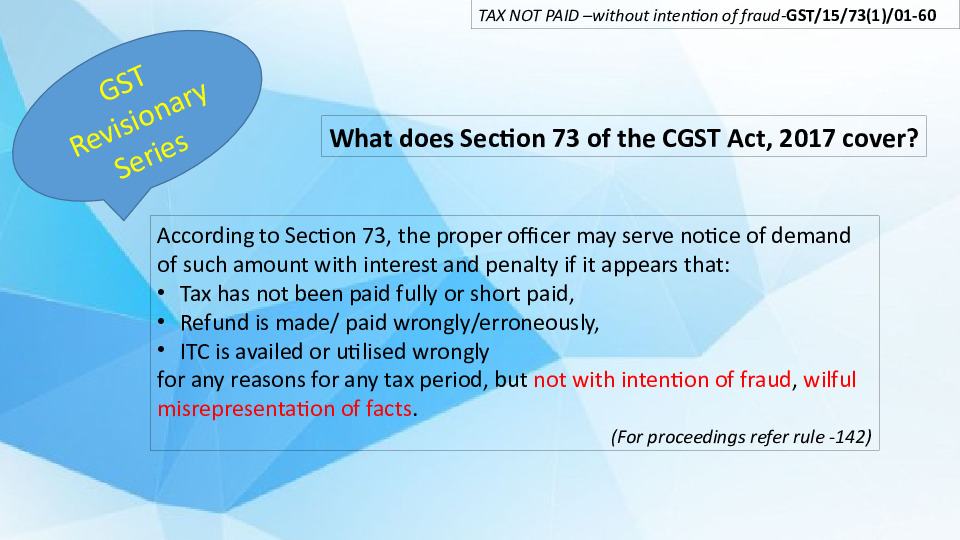
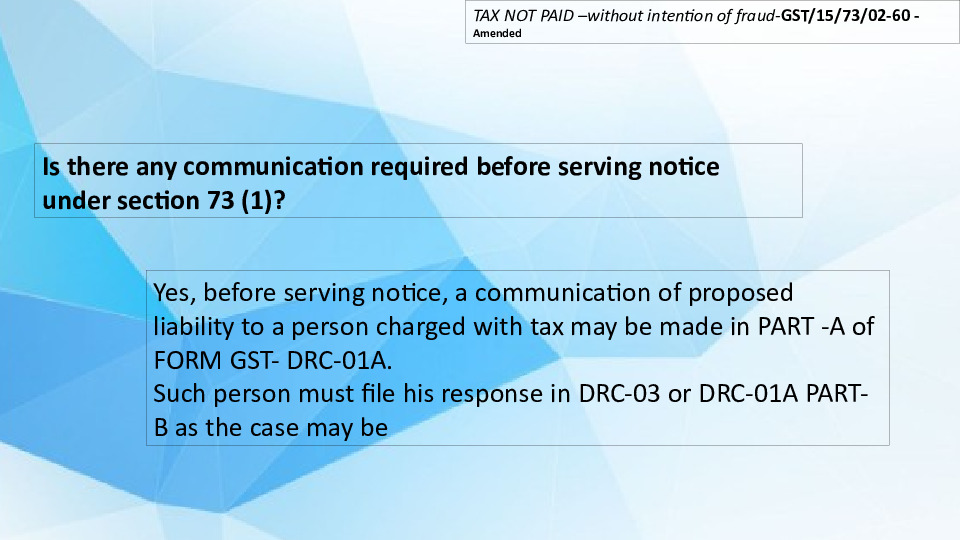
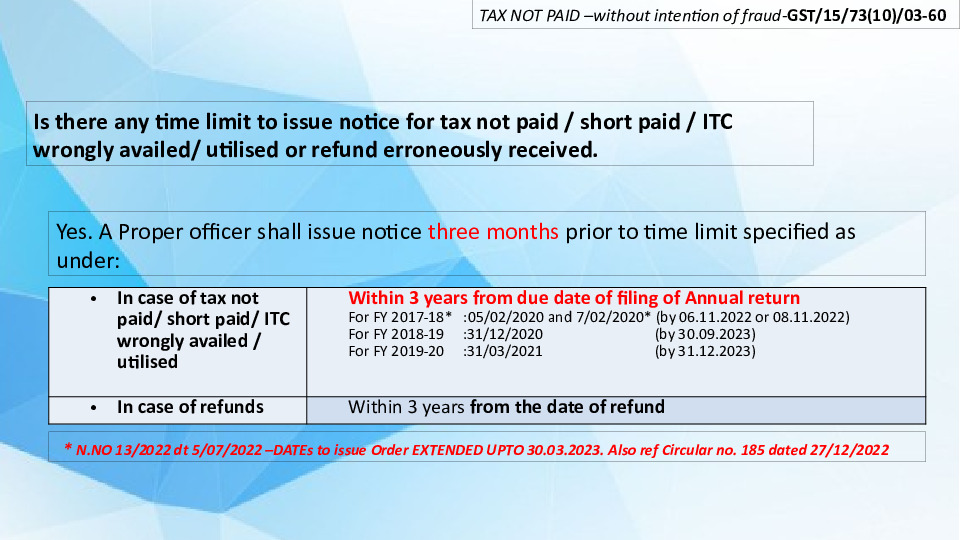
1) Shri CMA Anil Sharma, Shri CMA Gurdev Singh Saini and Smt. CMA Bhawna Sharma posted Chapter-15 containing CGST Act in simple language in PPT format. This is to make dealers, professionals, academicians, students etc. understand the basics of GST laws. Each Chapter in CGST Act, 2017 is explained in the form of Slides as given below for easy understanding of the Act:
|
Chapter-15 slides given below:-
|
|
|
|
|
|
|
|
|
|
|
You wish to publish your Article?
|
If you wish to share your article with maximum readers then please send the article at taxupdate.otu@gmail.com. We shall publish it with all due credit to you.
|
|
|
|
|
|
|
Hope the above updates is of use to you. Please share your input and feedback at taxupdate.otu@gmail.com
|
|
|
|
|
|
 
|
Visit our website
|
OTU provides you
|
- Articles on various topics
|
|
- Media - GST, Income Tax & Press R.
|
|
- Notes / Newsletter at 149/ p.a.
|
|
|
|
|
