|
|

|
|
|
|
|
|
onlinetaxupdate team wish to express sincere thanks to all the readers, authors, subscribers for the support extended to us.
|
|
|
|
Dear Reader,
|
Please find newsletter for your reading and reference.
|
|
Newsletter no.104 dated 07.12.2023
|
|
|
Index of the Newsletter
- Recent updates
- GST/IT in media
- Article
- Lawgics - Judgments by Ms. Nidhi Aggarwal
- GST notes by CMA Anil Sharma
|
|
|
|
|
|
|
The Goods and Services Tax Appellate Tribunal (“GSTAT”), Chennai Bench in LTM Limited v. Commissioner of GST & Central Excise cured the registry defect relating to pre-deposit and directed admission of the appeal on the ground that the amount of Rs. 32,94,735 already deposited at the first appellate stage exceeded the cumulative pre-deposit of Rs. 10,78,084 required under Sections 107(6) and 112(8) of the Central Goods and Services Tax Act, 2017 (“the CGST Act”) on the tax surviving in dispute, and held that a fresh 10% payment cannot be insisted upon merely because Section 112(8)(b) uses the words “in addition to the amount paid under sub-section (6) of section 107”.
|
- LTM Limited (“the Appellant”) was served with Order-in-Original No. 02/2021-GST-JC dated October 29, 2021 confirming a tax demand of Rs. 3,29,47,353 along with interest and penalty.
- The Appellant deposited Rs. 32,94,735 (being 10% of the tax in dispute) through FORM GST DRC-03 dated January 28, 2022 and filed the first appeal under Section 107 of the CGST Act.
- By Order-in-Appeal No. 16/2023 dated March 31, 2023, the First Appellate Authority (“FAA”) remanded the demand of Rs. 2,75,56,933 and upheld the demand of Rs. 53,90,420 (transitional credit of Rs. 17,965 and input tax credit of Rs. 53,72,455). The remanded demand, since reduced to Rs. 17,43,997 vide de novo order dated August 13, 2024, is the subject of separate proceedings.
- The Appellant filed an appeal before the GSTAT confined to the upheld demand of Rs. 53,90,420. The Registry raised a defect on pre-deposit under Section 112(8) and, by Defect Notice dated August 06, 2026, called for the Electronic Liability Register reflecting adjustment of the pre-deposit against the relevant demand ID.
- Appellant: The aggregate pre-deposit required under Sections 107(6) and 112(8) on the disputed tax of Rs. 53,90,420 is only Rs. 10,78,084, against which Rs. 32,94,735 already stands deposited. No demand ID/FORM GST APL-04 had been generated on the portal for the impugned order, making an adjustment through FORM GST DRC-03A impossible. Reliance was placed on Manoranjan Dash (GSTAT, Cuttack), Ashirwad Food Industries (Jharkhand High Court), CBIC Circular No. 224/18/2024-GST and the recommendations of the 53rd GST Council.
- Revenue: While confirming the deposit of Rs. 32,94,735 (FORM GST DRC-04 issued), it was contended that Section 112(8)(b) requires payment of 10% of the remaining tax in dispute “in addition to” the amount paid under Section 107(6), and hence Rs. 5,39,042 must be separately paid notwithstanding that the earlier deposit is in excess.
- Whether, where the amount deposited under Section 107(6) of the CGST Act exceeds the cumulative pre-deposit under Sections 107(6) and 112(8) computed on the tax surviving in dispute before the Tribunal, a further deposit of 10% is required for maintaining the appeal before the GSTAT?
- Whether an amount already lying with the Revenue against the same demand can be reckoned towards the pre-deposit under Section 112(8)(b) without a fresh challan being paid after the first appellate order?
The GSTAT, Chennai Bench in Filing No. 2626059101000236 held as under:
|
- Observed that, the measure of pre-deposit under Section 112(8)(b) is the tax in dispute “arising from the said order” and “in relation to which the appeal has been filed”, i.e. Rs. 53,90,420 and not the much larger original demand; the remanded demand is not before the Tribunal.
- Observed that, the words “in addition to the amount paid under sub-section (6) of section 107” fix a cumulative quantum of 20% of the tax in dispute (10% at the first appellate stage plus a further 10% at the Tribunal stage), and the opening words “has paid” only require that the requisite amount stands paid on the date of filing. The Act neither requires the further 10% to be paid by a fresh challan after the first appellate order nor bars reckoning an amount already lying with the Revenue against the same demand.
- Noted that, even on the Revenue’s reading of “in addition to”, the requirement is met: out of Rs. 32,94,735 already deposited, Rs. 5,39,042 is attributable to the first appeal under Section 107(6)(b) and a further Rs. 5,39,042 to the present appeal under Section 112(8)(b), together making the aggregate of Rs. 10,78,084.
- Observed that, pre-deposit is not a separate levy but a portion of the disputed tax itself, adjusted against the demand if the appellant fails and refunded with interest under Section 115 read with Section 56 if the appellant succeeds. Requiring the Revenue to first refund the excess with interest and the Appellant to then re-deposit out of the very same money is a circular exercise that serves no revenue purpose, and a construction leading to such an anomalous result must be avoided. Section 112(8) being a procedural condition for access to the appellate remedy and not a charging provision, a literal reading does not require a meaningless double payment.
- Noted that, the view is supported by Ashirwad Food Industries v. Union of India (Jharkhand High Court), Manoranjan Dash v. Commissioner, CT & GST, Odisha (GSTAT, Cuttack – affirmed on the Revenue’s review application) and MMTC-PAMP India (P.) Ltd. v. Deputy Commissioner (Madras High Court), and that no contrary decision was cited by the Revenue.
- Noted that, para 7.2 and para 8.2 of CBIC Circular No. 224/18/2024-GST dated July 11, 2024 permit amounts paid through the Electronic Liability Register or FORM GST DRC-03 to be adjusted towards pre-deposit under Sections 107 and 112, and such circulars bind the departmental officers. The Revenue’s own verification report dated September 07, 2026 proved the deposit.
- Noted that, the Finance (No. 2) Act, 2024 reduced the pre-deposit under Section 112(8) from 20% to 10% and the cap from Rs. 50 crore to Rs. 20 crore to ease the working-capital burden of appellants, and insisting on a fresh deposit when three times the required amount already lies with the Revenue would defeat this object.
- Held that, the pre-deposit requirement under Section 112(8) of the CGST Act stands satisfied, no further pre-deposit is required and the defect stands cured.
- Directed that, (i) out of Rs. 32,94,735, an amount of Rs. 10,78,084 shall stand appropriated for this appeal and shall not be reckoned for any other proceeding (the deposits of Rs. 20,40,200 dated June 12, 2026 relating to the separate appeal against Order-in-Appeal No. 332/2025 and Rs. 1,74,399 relating to the remanded demand were not reckoned); (ii) the jurisdictional proper officer shall map Rs. 10,78,084 against the demand in the Electronic Liability Register as and when the demand ID is generated and the Appellant shall file FORM GST DRC-03A in terms of the Circular; (iii) the FAA shall electronically generate FORM GST APL-04 within one month, which the Revenue’s Authorised Representative shall upload on the GSTAT portal immediately upon generation; and (iv) the Appellant shall upload an undertaking that the 10% pre-deposit already made shall not be utilised or adjusted against any other demand.
- Hence, the Registry is directed to admit the appeal after compliance of the above directions.
Statutory scheme. Section 107(6) of the CGST Act makes payment of the admitted amount in full and 10% of the remaining amount of tax in dispute (subject to the prescribed cap) a pre-condition for filing an appeal before the FAA. Section 112(8) similarly provides that no appeal shall be filed before the GSTAT unless the appellant has paid the admitted amount in full and a sum equal to 10% of the remaining amount of tax in dispute, “in addition to the amount paid under sub-section (6) of section 107”, subject to a maximum of Rs. 20 crore. Before the Finance (No. 2) Act, 2024, the Tribunal-stage deposit was 20% with a cap of Rs. 50 crore. The cumulative deposit across both stages is thus 20% of the tax in dispute, and a successful appellant is entitled to refund of the pre-deposit with interest under Section 115 read with Section 56.
|
The controversy. The Revenue’s stand has been that the words “in addition to” create a separate, fresh liability of 10% at the Tribunal stage, irrespective of the amount lying in the Electronic Liability Register. The difficulty arises most acutely where the first-stage deposit was made against a large original demand which was thereafter substantially reduced or remanded by the FAA, so that the earlier deposit already exceeds 20% of the surviving demand. The Bench has rightly held that the yardstick is the tax in dispute in the appeal being filed and that the earlier deposit, being part of the disputed tax and not a separate levy, must be given credit. The ruling also underlines that Section 112(8) is a procedural gateway to the appellate remedy, and must receive a purposive construction.
|
Illustration of the computation adopted by the Bench:
|
CBIC Circular No. 224/18/2024-GST dated July 11, 2024. The Circular, issued under Section 168(1) of the CGST Act, clarifies the mechanism for adjustment of amounts paid through the Electronic Liability Register or FORM GST DRC-03 (and adjusted through FORM GST DRC-03A) towards pre-deposit under Sections 107 and 112. The Bench has used it to show that the Board itself treats the stage and mode of payment as immaterial so long as the amount stands deposited against the disputed demand.
|
Pari materia provisions. The erstwhile indirect tax laws contained a similar pre-deposit regime in Section 35F of the Central Excise Act, 1944 and Section 129E of the Customs Act, 1962. CBEC Circular No. 984/08/2014-CX dated September 16, 2014 recognised that amounts paid during investigation or audit, before filing of the appeal, count towards the mandatory pre-deposit. The Bench drew on this position to hold that GST law, which was aligned with the erstwhile regime by the 2024 amendment, cannot be read more harshly.
|
- Ashirwad Food Industries v. Union of India – the Hon’ble Jharkhand High Court held that where Rs. 23.85 lakh was deposited at the first stage against a demand of about Rs. 2.38 crore, later reduced to about Rs. 40 lakh, there was no question of making any further pre-deposit before the Tribunal.
- Manoranjan Dash v. Commissioner, CT & GST, Odisha – the GSTAT, Cuttack Bench held that no further pre-deposit is required. On the Revenue’s application seeking reconsideration of the expression “in addition to”, the Bench affirmed its view by order dated September 21, 2026 , holding that pre-deposit is not a payment towards any separate or independent liability and that a literal insistence would give an anomalous or unworkable result.
- MMTC-PAMP India (P.) Ltd. v. Deputy Commissioner [ 164 taxmann.com 37] – the Hon’ble Madras High Court computed the Section 112(8) requirement cumulatively, giving credit for amounts already remitted and directing payment only of the shortfall.
Contrary view. No decision taking a contrary view was cited by the Revenue before the Bench. The Revenue’s contention rests on a literal reading of Section 112(8)(b) and on the settled principle that the right of appeal is a creature of statute which can be exercised only on fulfilment of the conditions attached to it, pre-deposit being one such condition (Vijay Prakash D. Mehta v. Collector of Customs (Preventive) ). However, that principle only requires the condition to be satisfied; it does not answer whether an amount already lying with the Revenue against the same demand satisfies it. Where the deposit actually falls short of 20% of the surviving tax, the shortfall must still be paid, as in MMTC-PAMP.
|
Practical takeaways. (i) The pre-deposit is to be tested against the tax surviving in dispute in the appeal and not the original demand; (ii) keep the DRC-03/DRC-04 and Electronic Liability Register records ready to answer a Registry defect notice; (iii) ensure that the FAA generates FORM GST APL-04 so that a demand ID is available for adjustment through FORM GST DRC-03A; (iv) where the same deposit could serve several proceedings, earmark it carefully, as the Bench has directed that the amount appropriated to one appeal cannot be reckoned again elsewhere, and an undertaking to that effect is required; and (v) Revenue may yet carry the issue further, but this order, read with the Odisha and Jharkhand rulings and the Circular, gives taxpayers a strong footing against a demand for a second 10%.
|
|
|
|
|
|
|
|
The GST Appellate Tribunal, Bengaluru Bench (“GSTAT”) in Commissioner of Central GST, Bengaluru v. M G Automobiles Sales and Services dismissed the Revenue’s appeal and upheld the order of the First Appellate Authority setting aside the demand of CGST and SGST along with interest and penalty on the ground that the assessee had adjusted excess IGST, arising from an erroneous payment of output tax on credit notes, against its CGST and SGST liability, and held that such cross-head adjustment, though procedurally incorrect, was bona fide and revenue neutral during the first year of GST implementation and could not justify a fresh demand.
|
M/s M G Automobiles Sales and Services (“the Respondent”), a partnership firm in Ballari, Karnataka, is engaged in the sale and service of motor vehicles and parts.
|
During September, October and November 2017, the Respondent received credit notes from its supplier and, instead of reversing the corresponding ITC, added the tax attributable to those credit notes to its output tax liability and paid it in GSTR-3B by utilising ITC from the electronic credit ledger (CGST Rs 3,53,544, SGST Rs 3,53,544 and IGST Rs 22,30,083).
|
In December 2017, on realising the error, the Respondent reversed the ITC and reduced its output tax liability in GSTR-1 and GSTR-3B, reporting only the net figures. As there was no sufficient IGST output liability in that month and GSTR-3B had no column to carry forward the excess, the Respondent adjusted the excess IGST of Rs 22,30,083 on its own against its CGST liability of Rs 11,15,064 and SGST liability of Rs 11,15,064 for December 2017, without claiming a refund.
|
Pursuant to an audit, a show cause notice was issued under Section 73(1) of the CGST Act, 2017 proposing to recover Rs 22,30,083 as short-paid IGST along with interest and penalty. The Adjudicating Authority confirmed a demand of Rs 22,30,128 (CGST Rs 11,15,064 and SGST Rs 11,15,064) with interest and penalty under Sections 50 and 73(9). The First Appellate Authority set aside the order, holding that the tax had already reached the exchequer, there was no net loss of revenue and a lenient view was warranted in the initial period of GST. The Revenue, after a review under Section 112(3), appealed to the GSTAT.
|
The Revenue contended that Sections 9 and 49 mandate payment under the specific tax heads, that no provision permits “offsetting” an IGST overpayment against CGST and SGST through GSTR-3B, that Circular No. 26/26/2017-GST dated December 29, 2017 allows adjustment only within the same head in subsequent months, that the only remedy for overpayment was a refund under Section 54 and that revenue neutrality cannot override the statutory mechanism.
|
The Respondent contended that all payments (except RCM) were made by utilising ITC, that Section 49 permits cross-utilisation of IGST credit towards CGST and SGST, that the adjustment followed Para 4 of the said Circular, that the excess IGST would in any case have been absorbed by its IGST liability of Rs 1,04,84,872 for March 2018, and that there was effectively no short payment. It also relied on decisions of the Kerala, Allahabad and Madras High Courts on payment under a wrong tax head.
|
- Whether the Respondent could, on its own, adjust the excess IGST arising from an erroneous payment of output tax on credit notes against its CGST and SGST liability for December 2017 through GSTR-3B, without claiming a refund under Section 54 or carrying the amount forward against IGST liability of subsequent months?
- Whether the decisions on payment under a wrong tax head were applicable to such utilisation of excess IGST against CGST and SGST?
- Whether such adjustment, being procedurally incorrect but bona fide and revenue neutral in the first year of GST, could sustain the demand of tax, interest and penalty under Section 73?
The GST Appellate Tribunal, Bengaluru Bench in Appeal No. APL/43/BUR/2026 held as under:
|
- Observed that, during July 2017 to March 2018 there was no provision under the Act or Rules requiring a recipient to reverse ITC on receipt of a credit note, and the notice’s premise that ITC ought to have been reversed had no legal support.
- Noted that, GSTR-3B had no column to carry forward excess tax and, in terms of Para 4 of Circular No. 26/26/2017-GST, the Respondent had correctly reported only the net figures in GSTR-1 and GSTR-3B.
- Noted that, had the Respondent claimed a refund of the excess IGST under Section 54, the amount debited from the electronic credit ledger would have been re-credited as IGST ITC under Rule 92(1A), usable towards CGST and SGST under Section 49; the other option was to adjust the excess against IGST liability of subsequent months. The only infraction was that the refund and re-credit procedure was not followed.
- Held that, the wrong-head decisions relied upon (Kerala, Allahabad and Madras High Courts) do not directly apply, as the case concerns utilisation of excess IGST against CGST and SGST and not payment of CGST and SGST as IGST, though the principle that an assessee should not suffer where there is no loss of revenue supports the Respondent.
- Held that, the initial payment of tax and subsequent reversal of ITC show bona fide conduct, the adjustment caused no revenue loss, and a lenient view is warranted for errors in the first year of GST, relying on the Hon’ble Karnataka High Court in Orient Traders.
- Condoned the variance between the notice (IGST Rs 22,30,083) and the order (CGST and SGST Rs 22,30,128) as a departmental oversight in the initial phase of GST.
- Hence, dismissed the appeal and set aside the demand of tax, interest and penalty for July 2017 to March 2018, with no order as to costs.
The dispute turns on the interplay of Sections 49, 54 and 39(9) of the CGST Act. Section 49(4) permits the amount in the electronic credit ledger to be used for payment of output tax, and Section 49(5)(a) provides that IGST credit is first utilised towards IGST and the balance towards CGST and SGST. The Revenue’s case was that this covers utilisation of credit and not adjustment of excess output tax already paid under one head. The Tribunal bridged the gap through Section 54 read with Rule 92(1A) of the CGST Rules, 2017, under which a refund of tax paid by debiting the electronic credit ledger is re-credited through FORM GST PMT-03 as ITC in the same ledger. As the same IGST would thus have become available for CGST and SGST, the direct adjustment was treated as a shortcut that skipped the procedure and not as a loss to the exchequer.
|
Para 4 of Circular No. 26/26/2017-GST clarifies that, as GSTR-3B has no provision for differential figures of past months, corrections are to be made on a net basis in the return of the month in which the error is noticed, with no negative entries, the balance being adjusted in subsequent months and a refund being claimed where adjustment is not feasible. The Tribunal read this as supporting the net reporting by the Respondent but not the cross-head set-off, which it described as a procedural lapse that was condoned. Once the amount was treated as already paid, there was no short payment to attract Section 73 or interest under Section 50.
|
The Tribunal also noted that, for 2017-18, a recipient was not required to reverse ITC on a credit note: Section 34 operated only on the supplier’s output tax liability, the matching under Section 43 was never operationalised and the section was omitted with effect from October 01, 2022. The proviso to Section 34(2) has since been substituted with effect from October 01, 2025 to link the supplier’s reduction of output tax with reversal of ITC by the recipient, so credit notes must now be handled under the amended mechanism.
|
Pari materia and supportive decisions
|
The Hon’ble Kerala High Court in Saji S. v. Commissioner, State GST Department directed that tax and penalty remitted under the SGST head instead of IGST be transferred to the IGST head, reading Section 77 along with Rule 92. The Tribunal drew on its principle that an assessee should not suffer for a technical error where there is no loss of revenue.
|
The Hon’ble Karnataka High Court in Orient Traders v. Deputy Commissioner of Commercial Taxes (Audit)-3 took a lenient view of bona fide errors in GSTR-3B for July 2017 and March 2018 and permitted the figures to be corrected, as the periods fell in the first year of GST. The Court, however, clarified that the order was passed on peculiar facts and would not be a precedent, a caution that applies equally to the present ruling.
|
The Hon’ble Madras High Court in SYA Homes v. Assistant Commissioner (ST) held that where the entire tax was discharged within time but under the IGST head instead of CGST and SGST, the taxpayer cannot be made to pay again and then seek a refund, and directed appropriation of the IGST towards the CGST and SGST liability within 30 days of an application. The Court held that Section 77 and Section 19 of the IGST Act cover only cases of mischaracterisation of the supply and not a mere wrong-head payment.
|
The Hon’ble Karnataka High Court in GR Tech Services Pvt. Ltd. v. Assistant Commissioner of Commercial Taxes (Audit) quashed the demand, interest and penalty where IGST had been paid on supplies later held to be intra-State, and remanded the matter for adjustment under Section 77(2) read with Rule 92.
|
Where the refund route is chosen, the Hon’ble Karnataka High Court in Merck Life Science Pvt. Ltd. v. Union of India held the limitation under Section 54 and Rule 89(1A) to be directory where the excess IGST was undisputed and the same tax had been discharged under the correct head, so that the refund cannot be rejected merely as time barred.
|
The Hon’ble Supreme Court in Union of India v. Bharti Airtel Ltd. held that rectification of GSTR-3B is permissible only through the mechanism under Section 39(9) read with Rule 61 and that a registered person cannot unilaterally rectify an electronically filed return, given the cascading effect on other stakeholders. The Revenue is likely to rely on this decision, which the present order does not refer to; the Tribunal rested its view on revenue neutrality and the first-year context. Even the favourable High Court rulings above direct an application or an order for adjustment and do not endorse self-help.
|
The ruling is a lenient view confined to the first year of GST and to a revenue-neutral error. Going forward, excess tax paid under one head should be recovered through a refund under Section 54 with re-credit under Rule 92(1A), or carried forward against the same head in later returns, and not set off against another head in GSTR-3B. Taxpayers facing demands for similar errors in the early years may rely on this order along with the decisions above.
|
|
|
|
|
|
|
|
A Practical Analysis of Sections 15(2)(d), 12(6), 34 and 50 of the CGST Act, 2017
|
Legal position discussed with reference to 15 November 2026
|
In normal business transactions, suppliers allow customers a specified credit period for payment of invoices. If customers delay payment beyond the agreed period, suppliers may charge interest as per the agreed terms.
|
Under Section 15(2)(d) of the CGST Act, 2017, such interest is included in the value of the original taxable supply and generally attracts GST at the rate applicable to the goods.
|
Such interest also forms part of the supplier's aggregate turnover for GST purposes.
|
However, an important practical question arises:
|
If an interest debit note is issued in October but the supplier receives the interest only in November, when does GST liability arise? Can the Department demand interest under Section 50 from the original goods invoice date?
|
The purpose of this article is to examine the relevant provisions, highlight the practical difficulties faced by suppliers and invite expert opinions on the correct legal and compliance approach.
|
2. Relevant legal provisions
|
A. Section 15(2)(d) – Value of supply
|
Section 15(2)(d) provides that the value of supply includes interest, late fee or penalty charged for delayed payment of consideration.
|
Therefore, interest charged for delayed payment of a goods invoice generally forms part of the value of the original supply and attracts GST at the applicable rate.
|
CBIC Circular No. 102/21/2019-GST dated 28 June 2019 also provides clarification regarding the GST treatment of additional or penal interest.
|
The question for expert consideration is how the inclusion of interest in the value of the original supply under Section 15(2)(d) should be read along with the separate time-of-supply provision under Section 12(6).
|
B. Section 12(6) – Time of supply
|
Section 12(6) specifically provides:
|
"The time of supply to the extent it relates to an addition in the value of supply by way of interest, late fee or penalty for delayed payment of any consideration shall be the date on which the supplier receives such addition in value."
|
This provision specifically refers to the date on which the supplier receives the additional interest.
|
For example, if an interest debit note is issued in October but the interest is received in November, the question arises as to how Section 12(6) should be applied in determining the time of supply.
|
Does the actual receipt of interest determine the time of supply even when the debit note has already been issued in an earlier month? This is an important point on which expert guidance would be valuable.
|
C. Section 34(3) and 34(4) – Debit notes
|
Section 34(3) provides for issuing a debit note where the taxable value or tax charged in the original invoice is less than the actual taxable value or tax payable.
|
Section 34(4) requires the supplier to declare the debit note in the return for the month in which it is issued.
|
Therefore, two separate matters need consideration:
|
- Reporting the debit note under Section 34(4).
- Determining the time of supply of interest under Section 12(6).
How should these two provisions be reconciled when the interest debit note is issued in one month but the interest is received in another month? I leave this question open for expert interpretation.
|
D. Section 50 – Interest on delayed payment of GST
|
Section 50 provides for interest when GST is not paid within the prescribed time. Rule 88B explains the manner of calculating such interest.
|
Whether Section 50 interest can be demanded from the original goods invoice date on GST relating to subsequently received interest is another important question requiring consideration of the applicable time-of-supply provisions.
|
3. Practical example – Debit note issued in October, interest received in November
|
ABC Traders supplied goods taxable at 18% GST to XYZ Ltd. on 1 September 2026, allowing a credit period of 30 days.
|
The customer paid the original invoice amount only on 5 October 2026. ABC Traders calculated interest and issued an interest debit note on 6 October 2026. However, the interest was received only on 10 November 2026.
|
Assume the interest amount is ₹5,000, excluding GST.
|
In this example, the debit note is issued in October, but the interest is actually received in November.
|
Section 12(6) refers to the date on which the supplier receives the additional interest. At the same time, Section 34(4) deals with reporting the debit note in the month of its issuance.
|
How these provisions should be reconciled for GST payment and return reporting is the central issue discussed in this article.
|
4. GSTR-1 and GSTR-3B – Which month should be adopted?
|
This is one of the most important practical compliance issues.
|
- Section 34(4) requires reporting of the debit note in the month of its issuance.
- Section 12(6) refers to the actual receipt of interest for determining the time of supply.
Accordingly, in the above example:
|
Another practical difficulty faced by the supplier
|
There is an important practical issue from the supplier's side.
|
Even if the supplier issues the interest debit note in October 2026, the supplier cannot predict when the customer will actually pay that debit note amount. The customer may pay in October, November or even after several months.
|
Therefore, the supplier faces two uncertainties:
|
- At the time of issuing the original goods invoice, the supplier cannot predict when the customer will pay the original invoice or how many days the payment will be delayed.
- Even after calculating the interest and issuing the debit note in October, the supplier cannot predict when the customer will pay the interest amount.
In both situations, the supplier has no control over the customer's payment date. However, the supplier remains responsible for complying with GST provisions.
|
My practical concern is this: How should a supplier report the debit note in GSTR-1 and discharge GST through GSTR-3B when the debit note is issued in one month but the interest is received in a subsequent month?
|
Rule 88C provides for electronic intimation in Form GST DRC-01B when the difference between GSTR-1 and GSTR-3B satisfies the prescribed conditions and limits.
|
Every difference does not automatically mean that there is a tax default. However, the supplier should maintain proper reconciliation and supporting documents and provide an explanation wherever required.
|
Whether an October GSTR-1 reporting entry and a November GST payment would create a reporting difference, and how such a difference should be handled, is also left open for expert guidance.
|
5. Can the Department demand Section 50 interest from the original invoice date?
|
This is another important question.
|
Section 15(2)(d) includes delayed-payment interest in the value of the original supply. However, Section 12(6) specifically deals with the time of supply of such additional interest.
|
The relevant provisions need to be considered together:
|
- Section 15(2)(d) – Inclusion of interest in the value of supply.
- Section 12(6) – Time of supply of additional interest.
- Section 34 – Issuance and reporting of debit notes.
- Section 50 – Interest on delayed payment of GST.
- Section 39 – Furnishing of returns and applicable payment deadlines.
For example, the original goods invoice was issued on 1 September 2026, but the additional interest was received only on 10 November 2026.
|
Should the Department calculate Section 50 interest on the GST relating to the additional interest from 1 September 2026, or should the specific time-of-supply provision under Section 12(6) be considered?
|
In my view, this question requires detailed examination by GST professionals, particularly regarding the interaction between Sections 12(6), 15(2)(d) and 50.
|
Any separate interest liability relating to delayed payment of GST on the original goods supply must also be examined independently.
|
6. An important practical question – The supplier must pay GST even without receiving payment from the customer. Then why this additional demand?
|
This is the main practical concern I would like to highlight.
|
When a supplier issues the original goods invoice, GST becomes payable within the prescribed statutory time, even if the customer has not paid the invoice amount.
|
In other words, the supplier must pay GST to the Government within the prescribed time, even when the customer delays payment or does not pay at all. The supplier may have to arrange funds from its own resources.
|
Similarly, after issuing an interest debit note, the supplier cannot predict when the customer will actually pay that amount.
|
The customer may pay after one month or even after several months.
|
In both situations, the supplier has no control over the customer's payment date. Nevertheless, the supplier remains responsible for complying with GST provisions.
|
This raises an important question:
|
When GST on the original goods invoice must be paid within the statutory time even without receiving payment from the customer, why should GST on subsequently charged interest be treated as payable from the original invoice date, when Section 12(6) specifically refers to the date of actual receipt?
|
For the original goods supply, the supplier has to pay GST within the prescribed time irrespective of whether the customer has paid the invoice amount.
|
But for the additional interest, the supplier cannot determine the final amount until the actual delay is known. Even after issuing the interest debit note, the supplier cannot predict when the customer will pay it.
|
The supplier has no control over either payment date.
|
My concern is whether it is appropriate to demand Section 50 interest from the original goods invoice date on an additional interest amount without first examining the specific time-of-supply provision under Section 12(6).
|
Only after receiving the original invoice payment can the supplier calculate the actual delay and determine the interest amount. The supplier may then issue an interest debit note, but the actual receipt of that interest may happen much later.
|
I request experts to examine this practical difficulty and clarify how the relevant provisions should be applied in such circumstances.
|
7. Conclusion – Open for expert opinion and discussion
|
The above discussion raises several important questions:
|
- How should Sections 15(2)(d) and 12(6) be read together when interest is charged for delayed payment of goods invoices?
- If an interest debit note is issued in October but the interest is received in November, how should the supplier report the debit note in October GSTR-1 and discharge GST through GSTR-3B?
- Does reporting the debit note in October necessarily mean that GST must also be discharged in October, even though the interest is received only in November?
- If GST on the additional interest is paid after actual receipt, how should the difference between GSTR-1 and GSTR-3B be explained?
- Can the Department demand Section 50 interest from the original goods invoice date without considering Section 12(6)?
- How should suppliers deal with the practical difficulty of not knowing in advance when customers will pay their original invoices and subsequent interest debit notes?
These are important questions for which I would welcome the views and guidance of experienced GST professionals and legal experts.
|
I do not wish to arrive at a final conclusion on the interpretation of Sections 12(6), 15(2)(d), 34 and 50 or the appropriate GSTR-1 and GSTR-3B treatment.
|
I leave the entire legal interpretation, applicability of Section 50, debit note reporting and GST payment approach open for expert opinion and case-wise consideration.
|
I hope this discussion will help bring clarity to an important practical issue faced by suppliers.
|
The views expressed in this article are entirely my personal views and understanding of the relevant GST provisions. These are my views only and should not be treated as a final legal opinion or professional advice.
|
This article is shared purely for knowledge-sharing purposes. I am still learning and welcome suggestions, corrections and opinions from experienced GST professionals and legal experts to improve my understanding of the subject.
|
|
|
|
|
|
|
|
Union Commerce and Industry Minister Piyush Goyal on Wednesday set March 31, 2027 , as the deadline for complete digitisation of services provided by the Directorate General of Foreign Trade (DGFT), aiming to eliminate the need for physical visits to its offices from 01.04.2027, according to a statement by the Ministry of Commerce and industry.
|
The announcement came as Goyal virtually inaugurated Vanijya Bhawan and Udyog Bhawan in Jaipur, making Rajasthan the first state to bring offices of the Ministry and its associated organisations under one roof.
|
Congratulating the Department of Commerce and the Department for Promotion of Industry and Internal Trade (DPITT) on the initiative, Goyal called replicating the model across the country, particularly in all state capitals. He said the proposed centres would serve as one-stop hubs for promoting exports, investments, international trade and industrial development, while supporting businesses in contributing to the vision of Viksit Bharat 2047.
|
"Goyal said that the co-location of offices, digitisation and introduction of faceless assessments would enhance transparency, accountability and public confidence. A unified presence of the Ministry of Commerce and Industry in each State would assure businesses and stakeholders that they could access support and guidance through a single location," the release said.
|
He further emphasised that the initiative should go beyond bringing government offices under once roof and focus on improving service delivery, simplifying procedures and enhancing ease of doing business. He also called for greater participation from government departments, state representatives, exports, importers, investors and industry stakeholders to ensure effective implementation, the Ministry said in the release.
|
Setting March 31, 2027, as the deadline for complete digitisation, Goyal directed that all services, including applications for licenses, permits and Special Chemicals, Organisms, Materials, Equipment and Technologies (SCOMET) approvals, be made available entirely online.
|
He further directed the digitisation of historical data and records maintained by Regional Authorities (RAs) of the Directorate General of Foreign Trade (DGFT) across the country.
|
The Minister said that April 1, 2027 , applicants should no longer be required to physically visits government offices to access these services.
|
For cases requiring verification of original documents, Goyal suggested setting up dedicated counters and installing computers at office entrances to facilitate document verification and uploading.
|
He also advocated greater reliance on self-certification and a trust-based approach towards citizens and businesses, emphasising the need to reduce unnecessary procedural requirements.
|
"Goyal also called for the simplification of processes, formats, and forms, and urged the departments to break organisational silos and work collectively to deliver better outcomes for businesses and citizens. He said that improved coordination between the two departments and the various organisations under the Ministry would be essential to achieving the objectives of the initiative," the release added. (ANI)
|
|
|
|
|
|
|
|
The Income Tax Appellate Tribunal (ITAT) is open to setting up a camp office at Shimla for Himachal Pradesh litigants and considering a similar arrangement for Jammu and Kashmir, even as it rules out the feasibility of a separate regular Bench for Himachal Pradesh because of its relatively small contribution to the pending caseload at Chandigarh. The tribunal has brought down its nationwide pendency from around 3 lakh cases to approximately 60,000, with fresh institution and disposal rates now almost matching.
|
ITAT Officiating President Mahavir Singh, in Chandigarh on an official visit, said a proposal from the local zone could pave the way for a camp office at Shimla or anywhere else in the State to facilitate litigants from Himachal Pradesh. He also indicated that a similar arrangement could be considered for Jammu and Kashmir.
|
On the possibility of expanding the tribunal’s presence in the region, Singh clarified that its jurisdiction covered Punjab, Haryana, Jammu and Kashmir and Himachal Pradesh. The tribunal presently has two Benches at Chandigarh and one at Amritsar.
|
Explaining why a separate regular Bench for Himachal Pradesh was not feasible, he said: “We are having two Benches at Chandigarh and one Bench at Amritsar. Pendency in Chandigarh is around 2,400. So, out of 2,400, Himachal contributes only 400. So, it is not feasible.”
|
However, he made it clear that a camp office remained a possibility. “But camp office, yes. If proposal will come from local zone, then definitely at Shimla or any camp office can be done. So that, to give ease to the local litigants,” he said.
|
He separately extended the possibility to Jammu and Kashmir, saying: “Similarly, J&K also, if proposal will come from general office, it will be done.” The indication assumes significance for litigants who otherwise have to travel to the existing Benches for the adjudication of income tax appeals.
|
Pendency reduced from 3 lakh to 60,000
On the tribunal’s nationwide pendency, Singh said the institution had achieved a substantial reduction from approximately 3 lakh cases at an earlier stage to around 60,000 presently.
|
“Tribunal presently is having a pendency of around 60,000. And I’ll tell you, we take great pride in telling that we are the only institution in the country which has reduced the pendency. At one point of time, our pendency was 3 lakh,” he said.
|
Describing the reduction as a major institutional achievement, he added: “From 3 lakh to 60,000, it is a big achievement. I feel pride in this because I am part of this institution from last 25 years.”
|
He acknowledged that pendency had increased somewhat over the past two to three years, attributing it to the improved disposal rate of appeals by Commissioners of Income Tax (Appeals).
|
“Again, because in last 2-3 years, because CIT appeals are working, so the disposal rate in CIT appeal in last 2 years increased. So, due to that, little increase is there. Now, it is at 60,” he said.
|
Asked whether fresh institution exceeded disposal, Singh answered in the affirmative but said the two were almost matching. “Institution is more, yes. But we are matching, almost matching,” he said.
|
New buildings, land acquisition and cadre restructuring
On the need to strengthen infrastructure and manpower in view of the increasing demands on the tribunal, Singh said several initiatives had been undertaken under the leadership of ITAT President Justice C.V. Bhadang. He said new buildings had been created for the Calcutta, Ahmedabad and Delhi Benches, while land was being acquired at other locations.
|
“Our President Justice C.V. Bhadang, after taking over, has taken many steps like building infrastructures. He has created new buildings of Calcutta Benches, Ahmedabad Benches, Delhi for that purpose. And other places also, we are acquiring plots,” he said.
|
The tribunal was also in the process of acquiring land for its Mumbai operations. “For Bombay, we are in the process of acquiring a land,” he added.
|
On manpower, Singh said a cadre restructuring proposal had been mooted and was undergoing the requisite inter-ministerial process. “We have mooted a cadre restructuring proposal before Ministry. And that is in the process. And I think within a year or six months, it will be over,” he said.
|
Explaining the time involved, he said: “Because it is a long process. We have to go to DOPT, we have to go to Expenditure Ministry. So, that process is taking time. But we are in the process of doing the things.”
|
ITAT itself functions as an ADR mechanism
On whether alternative dispute resolution (ADR) could help reduce litigation, Singh said the tribunal’s own functioning incorporated elements of an informal dispute-resolution mechanism because it was not bound by the strict procedural requirements applicable to ordinary civil courts.
|
“ADR, we are working as an ADR actually as far as litigation at this level is concerned because we are not bound by strict civil procedure code, strict evidence Act,” he said.
|
Describing the tribunal’s hearing procedure, he added: “The tribunal procedure is very informal. Any day, if you have occasion to see, you will see it is very normal and formal. It is not strict rule based.”
|
He said the relatively informal procedure enabled the tribunal to pronounce decisions in a large majority of cases on the same day. He added the relatively informal procedure enabled the tribunal to pronounce decisions in a large majority of cases on the same day. “In 90 per cent cases, we pronounce there and there. So, we work as an ADR also,” he said.
|
However, he distinguished the tribunal’s role from the scope for resolving income tax disputes before they reach the appellate stage. Such mechanisms, he said, would have to be developed by the Revenue Ministry or the Income Tax Department.
|
Asked specifically whether pre-litigation counselling could make a difference, Singh agreed that it could prevent a certain proportion of disputes from entering the litigation process. “Yes, it can. It can reduce. For that, department has to take steps,” he said.
|
One order can dispose of 20 similar cases
On measures to improve case management and accelerate disposals, Singh said the tribunal was regularly identifying matters in which the issues had already been covered by the Supreme Court or the High Court, and segregating them. It was also consolidating disputes involving similar questions so that a common decision could help dispose of multiple appeals.
|
Explaining the benefit, he added: “One case can dispose of 20 cases. So, these type of steps we are taking regularly.” He also underlined the role of technology in identifying and consolidating matters and tracking the institution of appeals.
|
“Yes, role of technology is very much needed. It helps in consolidation of the matters…. Everything is on fingertips. Technology is helping,” he said.
|
AI cannot take final judicial decisions
On the possibility of AI-driven courts handling income tax disputes in the future, Singh said artificial intelligence was still at a nascent stage and could not be entrusted with final judicial decision-making. “AI is in very nascent stage actually. And it is only in experimental stage. In final decision making, it cannot be implemented,” he said.
|
He acknowledged that AI could assist in litigation-related work, including arguments, but maintained that such assistance could not be equated with the actual exercise of judicial discretion. “No doubt, it can be used for the purpose of litigation, arguments, etc. And to some extent, some help can be taken. But it is not a final thing,” he said.
|
Explaining the limitation, he said adjudication required the application of the human mind and an approach grounded in compassion and fairness. “Because AI, what result it will give, nobody knows. Litigation is such a thing where you have to apply your mind. And you have to be compassionate and even-handed,” he said. “If you are not compassionate, then no purpose of this creating courts.”
|
Same-day pronouncement of orders a transparency measure
On transparency and building public and corporate confidence in the tribunal, Singh highlighted its practice of pronouncing judgments immediately after hearings in most cases. He said the tribunal’s rules provided for pronouncement of judgments in court, enabling litigants and their counsel to know the outcome without waiting for a subsequent date.
|
“Actually, the decision making in tribunal, like our rules say so, that you pronounce judgments there and then. I know that 80-90 per cent cases, our pronouncement is there and then. That means finality comes in that judgement,” he said.
|
Explaining the procedure, he added: “Then public knows that immediate after conclusion of hearing. In court itself, we pronounce that your appeal is allowed, dismissed or partly allowed. This issue is allowed; this issue is dismissed.”
|
He said the presence of the counsel and assessee during the pronouncement ensured that the parties immediately knew the outcome. “So, if counsel along with the assessee is sitting, they come to know that it has become final. So, this is a transparency. So, there is complete transparency,” he said.
|
Clarifying that the practice did not extend to every matter, Singh said larger cases requiring deliberation were reserved for judgment.
|
“Some bigger matters, etc., there we reserve the judgments. And we keep for, their deliberations are required. There are very few cases,” he said.
|
|
|
|
|
|
|
|
|
|
A Pune woman has won a ₹60 lakh income tax dispute after the Income Tax Appellate Tribunal (ITAT) accepted her explanation that the cash deposited in her bank account had been gifted by her late husband for her and their two minor daughters. The tribunal directed the tax department to delete the entire addition, ruling that her explanation could not be rejected merely because her husband was no longer alive to confirm the gift.
|
In its order dated 13 October 2026, in the case of Surekha Subhash Parve vs ITO, Ward 5(4), Pune (ITA No. 3137/PUN/2025), the Pune bench of the ITAT set aside the decision of the National Faceless Appeal Centre (NFAC), which had upheld the tax officer's addition of ₹60 lakh as unexplained money under Section 69A of the Income Tax Act, 1961.
|
The ruling is relevant for families dealing with financial transactions and cash gifts between spouses, particularly when one spouse dies and the surviving family has to establish the source of money during income tax proceedings.
|
Why did the income tax department question the ₹60 lakh deposit?
The dispute relates to the financial year 2015-16, corresponding to assessment year 2016-17. Information available with the income tax department showed that Parve had deposited ₹60.07 lakh in cash in her Bank of Maharashtra savings account during the year.
|
The department initiated reassessment proceedings after finding that she had not filed an income tax return for the relevant assessment year. The assessing officer issued notices seeking an explanation for the deposits. In response, Parve said that ₹60 lakh represented a gift from her husband, Subhash Ashruba Parve, who had subsequently died.
|
She explained that her husband had been handling the family's financial affairs and that the money was intended for her and their two minor daughters. She also said that she had difficulty gathering the supporting documents after his death on 17 March 2023.
|
The assessing officer, however, was not satisfied with the explanation. He noted that her bank account had total unexplained credits of ₹75 lakh, including ₹60 lakh in cash deposits and ₹15 lakh received through clearing cheques. In the absence of what he considered adequate documentary evidence establishing the source of the cash, he added ₹60 lakh to her taxable income under Section 69A.
|
The NFAC subsequently upheld the addition, noting that Parve had not furnished the necessary supporting documents during the first appeal proceedings.
|
What evidence did the widow submit before ITAT?
Before the tribunal, Parve's counsel argued that the cash belonged to her late husband and had been gifted to her and their two daughters. The counsel also pointed out that she was a homemaker without an independent source of income and had not regularly filed income tax returns.
|
To substantiate her explanation, she submitted her bank statements showing the transactions, Form 26AS, her own affidavit, affidavits from her two daughters, her husband's death certificate and other supporting documents. She also provided the PAN details of her daughters and explained the circumstances surrounding the cash gift.
|
The tribunal observed that Parve had established the identity of the donor, her relationship with him and the PAN details of the donor. It also noted that her husband was no longer alive to provide a confirmation or affidavit regarding the gift.
|
The bench comprising Vice-President R.K. Panda and Judicial Member Astha Chandra held that the affidavits and confirmations submitted by the family had not been established to be false or untrue.
|
The tribunal also considered the Supreme Court's ruling in CIT vs Smt. P.K. Noorjahan (1999), which clarified that additions under deeming provisions such as Section 69A are not automatic. The word 'may' in the provision gives tax authorities discretion, which must be exercised after considering the facts and circumstances of each case.
|
Accepting the widow's explanation, the tribunal concluded that the source of the cash deposits could not simply be rejected because the donor had died. It directed the assessing officer to delete the entire ₹60 lakh addition and allowed her appeal.
|
Are cash gifts from a spouse taxable?
Under the income tax provisions applicable to assessment year 2016-17, gifts received from a spouse were not taxable under Section 56(2)(vii), as a spouse is treated as a relative for this purpose.
|
However, this exemption does not automatically protect every cash deposit from tax scrutiny. Taxpayers may still be required to establish the nature and source of money when the assessing officer questions unexplained deposits under Section 69A.
|
Under the current tax framework, Section 56(2)(x) also exempts gifts received from specified relatives, including a spouse. The exemption from tax on gifts and the requirement to explain the source of money are separate issues.
|
The ITAT's decision therefore highlights the importance of maintaining supporting documents for family financial transactions. Bank statements, gift declarations, affidavits, donor identification details and other evidence establishing the circumstances of a transfer can help taxpayers defend their claims during scrutiny.
|
The ruling is based on the specific facts and evidence presented in this case and does not mean that every unexplained cash deposit claimed as a gift from a spouse will automatically be accepted.
|
|
|
|
|
|
|
|
The Securities and Exchange Board of India (SEBI) has recommended scrapping long-term capital gains (LTCG) tax on equity investments by foreign investors and proposed tax relief for domestic mutual fund investors switching between schemes. The recommendations are aimed at attracting overseas capital and encouraging retail investors to remain invested in domestic mutual funds amid weak equity market returns.
|
According to a Reuters report on 2 November, the proposals have been submitted to the government as part of SEBI's pre-Budget representations ahead of the Union Budget in February 2027. The recommendations are non-binding, and the final decision rests with the government.
|
SEBI proposes removing LTCG tax for foreign investors
Currently, foreign investors pay 12.5% LTCG tax on eligible equity investments held for more than 12 months. Short-term capital gains (STCG) on equity investments held for 12 months or less attract a 20% tax. Investors also pay securities transaction tax (STT) on trades and withholding tax on dividends.
|
SEBI has recommended removing the LTCG tax to reduce the tax burden on foreign investors and improve India's attractiveness as an investment destination.
|
The proposal comes amid sustained foreign investor selling in Indian equities. Foreign investors have sold a record $31 billion worth of Indian stocks in 2026, while domestic markets have underperformed several emerging market peers over the past two years.
|
Vishal Lohia, Partner at Dhruva Advisors, said the proposed tax relief was a constructive step but cautioned against viewing taxation as the only reason behind foreign investor outflows. “Taxes do not act in isolation,” he said, pointing to factors such as India's relatively high equity valuations, global geopolitical developments, oil prices and currency movements. He added that greater regulatory and tax certainty, along with faster dispute resolution, would be important to sustaining long-term foreign investment.
|
SEBI's recommendations follow several meetings with foreign investors over the last two years, during which taxation emerged as a recurring concern. The regulator has also flagged that transaction costs associated with investing in Indian equities are among the highest across jurisdictions.
|
Mutual fund investors may get tax relief on scheme switches
SEBI has also proposed exempting domestic mutual fund investors from LTCG tax when they switch from one scheme to another, provided they have held the existing investment for more than a year.
|
Currently, switching between mutual fund schemes is treated as a redemption from the existing scheme and a fresh investment in another. Any resulting taxable capital gain attracts tax, even when investors are simply moving their money between schemes rather than withdrawing it from the market.
|
If accepted, SEBI's proposal could allow investors to switch eligible holdings without an immediate LTCG tax liability. This would give investors greater flexibility to realign their portfolios without the tax implications associated with redemption.
|
The proposal is particularly relevant given the size of India's mutual fund industry. Domestic mutual funds manage assets worth ₹82.6 trillion, while monthly investment schemes bring in an average of ₹3,000 crore.
|
What happens next?
Both proposals are part of SEBI's pre-Budget recommendations and are yet to receive government approval. The Finance Ministry will have the final say on whether these tax changes are incorporated into the Union Budget 2027.
|
Until then, existing capital gains tax provisions will continue to apply to foreign equity investors and domestic mutual fund investors.
|
|
|
|
|
|
|
|
The Goods and services tax (GST) authorities are planning to electronically record details of invoices issued by shops and businesses to retail consumers under a pilot project covering select sectors from April 1, 2027, to improve tax compliance, two officials told Business Standard.
|
The move will enable tax officials to access the large volume of retail transactions in sectors prone to tax evasion and assess whether businesses are correctly reporting their sales and paying the appropriate amount of GST, they said.
|
Currently, businesses with annual sales of more than ₹5 crore have to electronically register invoices issued to other businesses on a government-designated portal, subject to certain exemptions. Extending this reporting requirement, known as e-invoicing, to sales to end consumers is the next logical step towards enhancing tax compliance.
|
Businesses currently report their aggregate sales through GST returns rather than individual retail transactions. E-invoicing at the retail level is expected to help tax officials match these transactions with the sales reported by businesses in their tax returns, one of the officials said.
|
The GST Council, at its 54th meeting in September 2024, had recommended a voluntary trial of electronic recording of consumer bills in select sectors and states.
|
The Council proposed introducing the system on a voluntary basis initially and subsequently making it mandatory in sectors prone to tax evasion, according to the minutes of the meeting, which are publicly available. Restaurants were cited as one of the sectors where retail e-invoicing could be introduced.
|
The Council had identified several potential benefits, including better tax compliance, environmental gains from avoiding physical invoices and lower costs. Consumers would receive e-invoices on their mobile phones.
|
Officials said the government was now keen to take the pilot project forward.
|
An email sent to the Ministry of Finance on October 23 seeking comments for the story remained unanswered till press time.
|
Banks, insurers and non-banking financial companies (NBFCs) are among those currently exempt from e-invoicing for transactions with other businesses. However, the Centre and state governments are also considering bringing their business-to-business invoices under the requirement, the first official said. This is not part of the proposed pilot project.
|
Managing retail sales data
A third official, who also spoke on condition of anonymity, said the idea of electronically capturing retail invoices had been discussed for years, but implementation was delayed by the challenge of processing the enormous volume of small-value transactions taking place every day.
|
Storing and processing such volumes would require substantial server capacity, and the earlier technology infrastructure was not equipped to handle that scale, the official said.
|
Retail e-invoicing could also help foreign tourists claim GST refunds on purchases made in India before taking the goods back to their home countries, as customs officers would be able to verify the tax paid more easily, the official said.
|
Another government official said the GST Network (GSTN), which manages the technology backbone of the GST system, awarded Infosys a fresh seven-year contract in 2025 after the original arrangement, which had already been extended beyond its initial five-year term, ended.
|
Officials believe the new arrangement has factored in the need for higher storage and processing capacity.
|
They said storing invoices in a common system could reduce compliance costs by enabling more efficient invoice matching and audits, instead of relying on separate statements and manual checks.
|
Digital records carrying timestamps could also improve transparency and make subsequent changes to invoices easier to track, they said.
|
The government is also studying how countries such as Brazil and Chile operate their e-invoicing systems. Both have long used electronic invoices for business and consumer transactions, officials said.
|
Experts said the impact of e-invoicing in retail could be significant. “E-invoicing could be leveraged by the government to incentivise customers who seek GST valid invoice for their purchases, thereby encouraging the unorganised sector moving to the organised,” an tax expert said.
|
Experts also welcomed the possibility of withdrawing the business-to-business (B2B) exemption for financial sector entities. Another tax expert said e-invoicing in sectors such as banking, NBFCs and insurance would bring all B2B transactions in the economy under the system.
|
“Customers of these sectors would also benefit. It would be important to give sufficient time to these sectors as they have very high volumes of B2B transactions, and also use several custom/bespoke billing systems,” he said.
|
“Overall, it is a positive change and the GST Policy wing can collaborate with the sector associations to make this a success,” he said.
|
On B2C e-invoicing, he said it could enable better integration of digital payment and invoicing systems, supporting automated reconciliation and reporting.
|
Another tax expert said banks and NBFCs handle millions of small charges every day.
|
“Keeping the B2C pilot focused on technology-enabled sectors such as organised retail, e-commerce, quick commerce and online gaming while moving financial institutions only on the B2B side first, is a practical approach,” he said.
|
Source: Business Standard
|
|
|
|
|
|
|
|
Under the current GST returns framework, taxpayers are required to furnish details of their outward supplies in FORM GSTR-1. Based on such details, a statement of input tax credit (ITC) is made available to the recipients in FORM GSTR-2B for availment of input tax credit. To aid furnishing of return in FORM GSTR-3B of a tax period, tax liability of a supplier is being auto-populated on the portal based on the details furnished in his FORM GSTR-1, and available input tax credit is being autopopulated in his FORM GSTR-3B on the portal based on his FORM GSTR-2B. Currently, taxpayers can edit such auto-populated tax liability and available input tax credit in FORM GSTR-3B, before filing the same. Such editing may result in discrepancies between
|
a. tax liability reported in FORM GSTR-1 and tax paid in FORM GSTR-3B; and
|
b. ITC available in FORM GSTR-2B and ITC availed in FORM GSTR-3B.
|
2. These discrepancies often lead to issuance of demand notices by tax officers and system generated intimations to taxpayers. In view of reducing the mismatches between the tax liability reported in FORM GSTR-1 and the tax paid in FORM GSTR3B, and between the ITC available in FORM GSTR-2B and the ITC availed in FORM GSTR-3B, various facilities have been introduced on the portal in the past. These facilities enable correct reporting of tax liability and ITC details in FORM GSTR-3B, including correction of such details, wherever required, in the source statements i.e. FORM GSTR-1 and FORM GSTR-2B, rather than direct editing in FORM GSTR-3B. These facilities include:
|
a. FORM GSTR-1A, to enable taxpayers to amend their FORM GSTR-1 details before filing FORM GSTR-3B;
|
b. Invoice Management System (IMS), to facilitate reconciliation of ITC available in FORM GSTR-2B with the ITC availed in FORM GSTR-3B;
|
c. Electronic Credit Reversal and Re-claimed Statement, to facilitate accurate reporting of reversal and re-claim of ITC; and
|
d. RCM Ledger/ITC Statement, to facilitate accurate reporting of ITC availment in respect of supplies liable to reverse charge
|
3. The above-mentioned facilities though made available on the portal, have, except for FORM GSTR-1A, not been notified in CGST Rules, 2017. It is seen that some taxpayers are either not using or not properly using these facilities and continue to manually edit auto-populated details in FORM GSTR-3B, resulting in continued issuance of demand notices by tax officers and system generated intimations to taxpayers on account of mismatches in tax liability and ITC, causing inconvenience to taxpayers while also weakening the ITC chain integrity.
|
4. Accordingly, there is a need to further strengthen the return-filing framework, so as to provide an improved alternate mechanism of amendment of tax liability and ITC details in return in FORM GSTR-3B, which reconciles with the details of outward supplies furnished in FORM GSTR-1 and the details of available ITC in FORM GSTR2B, thereby minimizing mismatches. Such a framework will improve the accuracy of tax liability and ITC reporting, enhance compliance, and strengthen the foundation for the effective implementation of other process reforms recommended by the GST Council.
|
GST Council recommendations
5. In view of the above, the GST Council in its 57th meeting held on 8th October, 2026, took note of the various scenarios which require the taxpayers to edit autopopulated values in FORM GSTR-3B and recommended an Alternate mechanism of amendment of tax liability and ITC details in return in FORM GSTR-3B, building on the existing facilities and recommending certain new facilities as follows:
|
- i. Enhancement of FORM GSTR-1/1A/IFF for better reconciliation with FORM GSTR-3B and other statements
- The absence of supply-type-wise granularity in FORM GSTR-1/1A/IFF may lead to incorrect auto-population of the corresponding tables in FORM GSTR-3B, requiring manual correction by taxpayers. For instance, credit notes, debit notes, advances received, and advances adjusted are not categorised by the nature of supply, such as regular outward supplies, supplies under section 9(5), or zero-rated supplies. As a result, they may be reported under the table for taxable outward supplies in FORM GSTR- 3B, instead of the appropriate relevant table.
- Further, the existing format of FORM GSTR-1 does not enable taxpayers to reconcile supplies made through electronic commerce operators with the corresponding details furnished by the ECOs in FORM GSTR-8 and made available on the common portal.
- Accordingly, enhancements to FORM GSTR-1/1A/IFF have been recommended to enable identification of the nature of the underlying supply in respect of credit notes, advances, and similar documents. This would ensure correct auto-population of tax liability in FORM GSTR-3B and obviate the need for amending the auto-populated liability in FORM GSTR-3B.
- Further, to facilitate the taxpayers in furnishing details in FORM GSTR1/1A/IFF on the portal, user interface improvements, such as tool tips and guided navigational paths on the portal have been suggested.
- ii. Expanding the scope of rectifications to be made through FORM GSTR-1A
- At present, FORM GSTR-1A cannot be used to add or amend details relating to earlier tax periods, or to correct the GSTIN of the recipient. This restricts taxpayers from rectifying any error regarding the earlier tax period or relating to change in GSTIN of the recipient before filing FORM GSTR-3B. Accordingly, it has been recommended that this restriction may be removed.
- iii. Rectification of details furnished in FORM GSTR-3B of an earlier tax period
- It was observed that certain taxpayers rectify tax liability for outward supplies of an earlier tax period directly in FORM GSTR-3B, without correcting the underlying details in FORM GSTR-1/1A. Accordingly, it has been recommended that such rectification be made only through the amendment tables of FORM GSTR-1/1A, instead of amending the autopopulated liability detail in FORM GSTR-3B, directly. However, rectification of reverse-charge tax liability may be made directly through adjustments in the FORM GSTR-3B of a subsequent tax period.
- iv. Reporting of details of outward supplies in FORM GSTR-1 where tax had been discharged through FORM GST DRC-03
- Where any amount of tax has been paid through FORM GST DRC-03 in pursuance of a proceeding such as the audit, inspection, scrutiny or enforcement activity by the tax authorities, and the taxpayer intends to pass on the ITC in respect of the same to the recipient, then if he reports the invoice or debit note details in FORM GSTR-1/1A, the liability gets auto-populated in FORM GSTR-3B. As the taxpayer has already paid the tax liability through FORM GST DRC-03, he may be resorting to editing liability in FORM GSTR-3B, so as to avoid duplication of payment of said tax liability.
- To prevent such duplication, it has been recommended that FORM GST DRC-03 be enhanced to enable the taxpayer to declare, within seven days of payment, the details of the underlying invoice(s) or debit note(s). In such cases, when the said invoice or debit note details are reported in FORM GSTR-1/1A, the corresponding tax liability for the said invoice or debit note will not be added to the auto-populated liability in FORM GSTR-3B, thus avoiding any duplication of payment of tax. The details of such invoice or debit note will also be made available in corresponding FORM GSTR-2B of the recipient for availment of ITC.
- v. Correct reporting of reverse charge liability in FORM GSTR-3B
- To facilitate the taxpayers in correct reporting of tax liability and input tax credit in respect of supplies liable to reverse charge, RCM Liability and ITC Statement was introduced on the portal from August 2024 period onwards for monthly filers and July-September 2024 period onwards for quarterly filers. A facility was also provided to report cumulative closing balance, if any, upto that period.
- To further streamline correct reporting of such tax liability and ITC, it has been recommended to notify the said statement in CGST Rules, 2017 and to require that ITC claimed on inward supplies under reverse charge (other than import of goods) in FORM GSTR-3B of a tax period should not exceed the tax liability under RCM declared in the said FORM GSTR-3B and the closing balance available in the said statement.
- Accordingly, an Electronic Statement of tax paid on Reverse charge basis and input tax credit claimed has been recommended in FORM GST PMT-02B. Also, amendment has been recommended in FORM GST PMT-04, so as to allow a taxpayer to report discrepancies, if any, in the said statement.
- vi. Mandating and clarifying the usage of Invoice Management System (IMS) for better reconciliation of input tax credit details in FORM GSTR-3B
- IMS has been available on the portal since October 2024. It allows recipients to accept, reject, or keep pending inward supply details communicated by supplier. The salient features of IMS are as follows:
- The taxpayer may keep documents pending on IMS, in respect of which the conditions of eligibility of ITC under section 16(2) of CGST Act are presently not fulfilled, but which may get fulfilled subsequently. Upon fulfillment of the requisite conditions, such documents may be subsequently accepted by the recipient on IMS.
- The taxpayer may reject a document on IMS, if any discrepancy in the document communicated on IMS is noticed or where the document is found to not pertain to him.
- If no action is taken on a document communicated on IMS for generation of FORM GSTR-2B of a tax period before filing of FORM GSTR-3B for the said tax period, the same is considered to have been accepted by the recipient on IMS.
- ITC pertaining to accepted or deemed accepted documents is made available in FORM GSTR-2B and accordingly autopopulated in Table 4(A) of FORM GSTR-3B for the corresponding tax period. Conversely, the ITC pertaining to documents kept pending or rejected in IMS is not made available in FORM GSTR2B and accordingly not auto-populated in Table 4(A) of FORM GSTR-3B for the corresponding tax period.
- An action taken on any document on IMS by the recipient can be revised any number of times upto the filing of his FORM GSTR3B for the tax period for which FORM GSTR-2B is being generated. Based on the revised action taken on IMS, FORM GSTR-2B can be also revised, which will also revise the autopopulated ITC in FORM GSTR 3B.
- These above-mentioned features of IMS improve the reconciliation between ITC available in FORM GSTR-2B and ITC availed in FORM GSTR-3B.
- With a view to facilitate ease of taking action on IMS, offline tool has been made available on GST Portal, to enable taxpayers to undertake actions on both individual as well as bulk invoices in an efficient manner.
- To reduce inadvertent rejections or premature acceptance of credit notes, it has been recommended to extend the period for which a credit note may be kept pending on IMS:
a) By Monthly filers: Until filing of FORM GSTR-3B for next-to-next month, to the month in which the credit note was communicated to the taxpayer, but not later than the end of the month in which the due date for filing of the return in FORM GSTR-3B for the said next to next month falls. Thereafter, the credit note will be deemed accepted.
|
Example: Say a credit note was communicated by the supplier in his FORM GSTR-1 filed on 11th May, 2026, for the month of April 2026, to the recipient “A”. The same shall reflect in the IMS of “A” for the month April 2026. This credit note can be kept pending on the IMS by “A” till the date of filing of FORM GSTR-3B for the month of June, 2026 (which is next to next month of April 2026). However, if FORM GSTR-3B of June 2026 is not filed by “A” upto 31st July 2026 (which is the last date of the month in which the return for the month June 2026 was due), then the said credit note shall be deemed to have been accepted by “A” on IMS.
|
b) By Quarterly filers: Until filing of FORM GSTR-3B for the next quarter after the quarter in which the credit note was communicated to the taxpayer, but not later than the end of the month in which the due date for filing of the return in FORM GSTR-3B for the said next quarter falls. Thereafter, the credit note will be deemed accepted.
|
Example: Say a credit note was communicated by the supplier in his FORM GSTR-1 filed on 11th May, 2026 for the month of April 2026, to a recipient “A”,. The same shall reflect in the IMS of “A” for the quarter April–June 2026. This credit note can be kept pending on the IMS by “A” till the date of filing of FORM GSTR-3B for the quarter of July–September 2026 (which is next quarter to April–June 2026). However, if FORM GSTR-3B of July–September 2026 is not filed by “A” upto 31st October 2026 (which is the last date of the month in which the return for the quarter July–September 2026 was due), then the said credit note shall be deemed to have been accepted by “A” on IMS.
|
-
- It has further been recommended to provide an option for the suppliers to link credit notes and debit notes with the underlying invoices in FORM GSTR-1/1A/IFF, on a purely voluntary basis, to help recipients take informed decisions and to reduce the need of keeping credit notes pending or rejecting them on IMS.
- Since acceptance, rejection, and keeping documents pending on IMS improve ITC reconciliation, the GST Council has recommended that management of available ITC in FORM GSTR-3B should be carried through IMS instead of directly amending auto-populated ITC in FORM GSTR-3B. GST Council has also recommended notifying relevant amendment in GST Rules and FORMS for the same purpose.
- The Council also recommended issuance of a circular to guide the taxpayers in correct manner of taking action on IMS.
- vii. Facilitating taxpayers in correct reporting of reversal and reclaim of ITC in FORM GSTR-3B:
- In order to facilitate the taxpayers in correct and accurate reporting of reversal and reclaim of input tax credit, a statement namely, Electronic Credit Reversal and Reclaim Statement was introduced on the GST portal from August 2023 return period onwards, with a facility to report their cumulative closing balance of input tax credit, if any, which had been reversed but not re-availed upto that time.
- To further streamline correct reporting, it has been recommended to notify the said statement in CGST Rules, 2017 and to require that reclaimed input tax credit in FORM GSTR-3B shall not exceed the balance available in the said statement.
- Accordingly, an Electronic Credit Reversal and Reclaim Statement has been recommended in FORM GST PMT-02A. Also, amendment has been recommended in FORM GST PMT-04, so as to allow a taxpayer to report discrepancies, if any, in the said statement.
- Further, amendment has been recommended in Table 4 of FORM GSTR3B to provide for a separate Table 4(AA) in FORM GSTR-3B for reporting reclaimed ITC, so as to obviate the need for amending the auto-populated ITC details in Table 4(A)(5) of FORM GSTR-3B.
- viii. Streamlining the manner of rectification of errors made in reporting input tax credit in FORM GSTR-3B
- After suppliers furnish outward supply details, recipients act on IMS to generate FORM GSTR-2B and are generally required to manually report RCM ITC, ITC reversals, and ITC re-claims in FORM GSTR-3B. Such manual interventions are prone to errors and omissions.
- As the temporary reversals made in Table 4(B)(2) of FORM GSTR-3B are credited to the Electronic Credit Reversal and Re-claim Statement, any excess temporary reversal done in Table 4(B)(2) can be rectified by reclaiming the excess amount so reversed in a subsequent return. However, no such systematic mechanism exists to rectify any excess reversal of ITC, reversed permanently in Table 4(B)(1) of FORM GSTR3B.
- Accordingly, it has been recommended to provide a systemic mechanism, by way of a new form, FORM GST PMT-10 to undertake rectifications of such excess reversals of permanent nature reported in Table 4(B)(1) of FORM GSTR-3B of an earlier tax period, on the basis of self-assessment.
- ix. Enhancement in FORM GSTR-2B in respect of ITC distributed by ISD
- ITC distributed by an Input Service Distributor (ISD) as ineligible in FORM GSTR-6 does not currently flow as available ITC in FORM GSTR2B and is therefore not auto-populated in Table 4(A)(4) of FORM GSTR3B.
- Accordingly, enhancements have been recommended in FORM GSTR2B and FORM GSTR-3B, to provide that ITC distributed by an ISD as ineligible need not be reversed again by recipients in Table 4(B)(1) of FORM GSTR-3B as such ITC will be auto-populated as ineligible ITC in Table 4(D)(2) of FORM GSTR-3B.
- Currently, ITC attributable to an ineligible ISD credit note is reduced from eligible ITC on the portal. Since such a credit note relates to ineligible ITC, its impact should instead flow to the ineligible ITC section, i.e., Table 4(D)(2) of FORM GSTR-3B.
- Accordingly, enhancements have been recommended in FORM GSTR2B to ensure that ITC relating to ineligible credit notes distributed by an ISD is not adjusted against eligible ITC distributed by the ISD.
6. Besides the above, the GST Council also recommended issuance of a circular to clarify the correct manner of reporting ITC availment and its reversal in FORM GSTR3B, in the context of IMS, the Electronic Credit Reversal and Re-claimed Statement, and the Electronic Statement of tax paid on reverse charge basis and ITC claimed.
|
7. The Council recommended that, with the above proposed measures, there may not be any need for directly rectifying/amending the details of liability (autopopulated from FORM GSTR 1/1A/IFF) and details of ITC (auto-populated from FORM GSTR-2B) in FORM GSTR-3B. Thus, any amendment/correction of liability will be done through FORM GSTR-1/1A/IFF instead of directly amending auto-populated values in FORM GSTR-3B. Further, any management of ITC will be done through IMS, Electronic Credit Reversal and Re-claimed Statement, and the Electronic Statement of tax paid on reverse charge basis and ITC claimed, FORM GST PMT-04 and FORM GST PMT-10, instead of directly amending the auto-populated details in FORM GSTR-3B. To allow stakeholders sufficient time to align their systems and practices, the Council recommended that this proposed Alternate mechanism of amendment of tax liability and ITC details in return in FORM GSTR-3B, and corresponding amendments to the CGST Rules, 2017, may be brought into force from the return period of April, 2027.
|
Public consultation
8. Furthermore, the Council recommended that the proposed measures be placed in the public domain for a time-bound consultation to provide an opportunity to taxpayers, tax practitioners, industry associations, and other stakeholders to submit comments and suggestions on the proposed measures. In this regard, the amendments recommended by the Council in CGST Rules, 2017 and in the CGST FORMs are placed at Annexure A* and Annexure B*, respectively. The circular recommended by the Council for clarifying the correct manner of reporting ITC availment and its reversal in FORM GSTR-3B is placed at Annexure C*.
|
9. Accordingly, all the stakeholders are invited to examine the proposed measures and submit their comments, suggestions, and inputs by Monday, 30th November. The same shall be examined and duly considered before finalisation of the amendments to the said Forms and Rules.
|
* Kindly note that the amendments proposed in the CGST Rules, 2017 and CGST Forms placed in Annexure A and Annexure B respectively, have been highlighted in red.
|
|
|
|
|
|
|
|
India’s ambition to become a Viksit Bharat requires an economy in which enterprises of every size can grow, wherever they begin. Over the past twelve years, our government has worked to create those conditions. The introduction of the goods and services tax (GST) in 2017 established a common national framework for indirect taxation. Next-Gen GST carries that effort forward, drawing on nine years of implementation and the experience of taxpayers and states.
|
Under Prime Minister Narendra Modi’s vision, Next-Gen GST was conceived with two connected purposes: To reduce and rationalise rates, and to make compliance easier. The rate changes took effect on September 22, 2025. The next phase of process reforms will come before the GST Council shortly. Together, these efforts seek to give households relief, businesses greater certainty and taxpayers a system in which they can fulfil their obligations without avoidable difficulty.
|
The states have been partners throughout. They brought their priorities and experience to the Council, helped shape the decisions and undertook their implementation. I thank them for that commitment. GST’s progress rests on this willingness to pursue a shared national purpose while respecting each government's responsibilities.
|
The results provide grounds for confidence. Between October 2025 and July 2026, the value of reported taxable supplies grew by 25.8 per cent over the corresponding period a year earlier. A lighter rate structure has been accompanied by a substantial expansion in reported economic activity. This is an encouraging foundation for a reform intended to support both enterprise and public finances.
|
That resilience is visible in the latest revenue figures. Gross GST collections reached ₹12.46 trillion during April-September 2026, up 11.6 per cent over the corresponding period last year. Every month from June through September recorded double-digit annual growth; together, collections for these four months accelerated by nearly 15 per cent. Net collections, after refunds, also grew by 10.4 per cent over the half year. Taxpayer relief has coexisted with growth in the resources available for development.
|
The breadth of the expansion matters as much as its scale. Reported taxable supplies grew across all 11 sector groups and all major states. In an economy as diverse as India’s, this spread is significant. Growth across sectors and regions creates opportunities for more businesses to participate in expanding markets, and for more communities to benefit from the demand, investment and employment that follow.
|
Reported sales to consumers (B2C) also rose by 26.7 per cent in the post-reform comparison. When tax relief is reflected in prices, families have more room to meet other needs or save. Consumer relief and enterprise growth are closely connected: The purchasing power of households sustains demand for the goods and services that businesses provide. The benefits can extend from the household to the retailer, the supplier and the producer.
|
For small and medium enterprises, a national market is valuable when it opens a practical route to customers beyond their immediate surroundings. Businesses in Tier-II and Tier-III towns should be able to build those relationships while continuing to invest and employ people locally. Enterprises expanding into these towns, in turn, can create opportunities for local suppliers and distributors. GST’s common framework supports these connections; simpler administration must make them easier to sustain.
|
Participation in that framework is substantial. GST registrations across Central and state jurisdictions stood at approximately 17.1 million at the end of August, up nearly 15 per cent from a year ago. For the April–July 2026 tax periods, GSTR-3B returns filed by their due dates were 12.6 per cent higher than for the same periods last year. These improvements place a corresponding responsibility on the administration: Regular compliance must be supported by reliable service, clear guidance and timely resolution of difficulties.
|
The functioning of input tax credit is another important part of this experience. The post-reform figures show that the share of tax liability discharged through credits rose, while accumulated credit declined relative to taxable supplies. This is encouraging for businesses that depend on the effective use of eligible credit. For a smaller firm, working capital determines how readily it can purchase inputs, fulfil an order and take on the next one.
|
Refunds are equally relevant. Approximately ₹1.80 trillion was refunded during April-September. Returning amounts due to businesses is part of a well-functioning tax system. Greater predictability in this process would help enterprises plan purchases and production with more confidence. The taxpayer’s experience of receiving an eligible refund is an important measure of administrative performance.
|
The states also have a stronger revenue position. Their aggregate SGST (state GST) receipts, including their share of IGST (integrated GST) settlements, grew by about 16 per cent during April-September this year. These resources support investment in infrastructure and public services, which improve the conditions in which families and enterprises pursue their aspirations. The gains can therefore reinforce one another: Household relief supports demand, enterprise strengthens economic activity, and public revenues help sustain development.
|
The experience also points to the work ahead. A growing system must remain attentive to the costs it imposes on smaller participants. Their time and resources are limited. Each improvement in filing, credit or refunds should allow more of those resources to be devoted to running and expanding a business.
|
The proposals before the Council on October 7 have been developed through sustained work with the states. They address registration, returns, refunds, disputes and improved flow of input tax credit, with the aim of reducing the time and cost of compliance. Taxpayer experience must continue to guide implementation.
|
The GST’s growing maturity gives us a stronger foundation for the next stage of reform. The same commitment to clarity, certainty and respect for the taxpayer guides our work on direct taxes. A dependable tax system enables enterprises to plan beyond their immediate obligations and invest in opportunities that take time to mature. Giving them that confidence, wherever they operate, helps build the economic strength of a Viksit Bharat as envisioned by Prime Minister Narendra Modi.
|
The writer is the Union Minister of Finance and Corporate Affairs
|
Source: Business Standard
|
|
|
|
|
|
|
|
Businesses should engage constructively with the government as well as regulators and avoid turning every disagreement into litigation, Finance Minister Nirmala Sitharaman said on Tuesday, calling for greater trust, predictability and transparency among the parties.
|
“Legal recourse will always remain available, but every disagreement need not begin as litigation,” Sitharaman said at the All India Management Association’s (AIMA's) 53rd National Management Convention.
|
She said businesses should engage early with the government, put evidence on the table, participate seriously in consultations and work towards solutions before differences become disputes.
|
“Trust between businesses cannot be demanded; it has to be built through conduct on both sides,” Sitharaman said.
|
Businesses, too, must provide predictability, transparency and a willingness to listen, she said, adding that a mature economy should be capable of handling disagreements without immediately becoming adversarial.
|
Sitharaman also called for greater institutionalisation of Indian businesses, saying the challenge over the next 20 years would not simply be to create more startups but to ensure that today's startups grow into large, professionally managed and enduring corporations.
|
“The real prize is not how many unicorns we create, but how many endure — turning today’s startups into tomorrow’s big corporations,” she said.
|
She said management institutions and established corporate leaders could help startups make the transition from founder-led ventures to institution-led companies without losing the entrepreneurial energy that drove their creation.
|
The same institutionalisation challenge also extends to India’s family-owned businesses, she said.
|
A large share of the country’s micro, small and medium enterprises (MSMEs) and mid-sized businesses are family-owned. While many have strong products, loyal customers and significant growth potential, their expansion can be held back by unclear roles, succession disputes, informal decision-making and disagreements within the family, she said.
|
“The challenge is often not entrepreneurship, but institutionalisation,” Sitharaman said, calling for greater professionalisation through separation of ownership from management, clearly defined responsibilities, preparation of the next generation and resolution of conflicts before they affect the business.
|
She said AIMA could expand short, practical programmes for family businesses covering succession planning, governance, professionalisation, conflict management and delegation.
|
Sitharaman also called for an overhaul of management curricula to reflect today’s techno-economic realities and promote greater interdisciplinary learning.
|
Managers today need a stronger grounding in geopolitical and supply-chain risks, climate risk, behavioural science, data, regulation and technology-aided project execution, she said.
|
She urged management institutions to produce leaders capable of connecting different disciplines rather than operating within functional silos.
|
Source: Business Standard
|
|
|
|
|
|
|
|
The policy provides financial and administrative support to companies establishing Global Capability Centres in Uttar Pradesh
|
POLICY AT A GLANCE
What is the Uttar Pradesh Global Capability Centres Policy?
The policy provides financial and administrative support to companies establishing Global Capability Centres in Uttar Pradesh. A Global Capability Centre, or GCC, is an operation owned and controlled by a parent company to provide specialised services to that company or its group entities.
|
Such centres may undertake functions including:
|
- Information technology and digital services;
- Engineering and product development;
- Research and development;
- Finance and accounting;
- Human resources;
- Data analytics;
- Cybersecurity;
- Supply-chain management;
- Legal, compliance and other corporate support functions.
The policy defines a GCC as a global in-house centre or offshore unit established by a multinational corporation or Indian company and fully owned and operated by its parent. Pure third-party service providers, staffing companies, sales entities and professional-services businesses do not qualify merely because they provide similar services to external clients.
|
Why was the policy introduced?
India’s GCC sector has evolved from relatively routine back-office operations into technology, engineering, analytics and research centres integrated with companies’ global business strategies. The Uttar Pradesh policy seeks to attract a larger share of these investments by using the state’s labour pool, higher-education institutions, proximity to the National Capital Region and expanding technology infrastructure.
|
The framework is also intended to encourage companies to establish operations beyond established technology centres such as Noida and Ghaziabad. Its eligibility thresholds and payroll incentives are generally more favourable in other districts, reflecting the objective of distributing skilled service-sector employment more widely across the state.
|
The policy’s objectives and promotional material should not be interpreted as evidence that the projected investment or employment has already been realised.
|
What are the main objectives?
- Attract new domestic and multinational GCC investments;
- Encourage existing GCCs to expand their operations in Uttar Pradesh;
- Develop high-value employment in technology, engineering, finance and research;
- Create an innovation network involving companies, start-ups and educational institutions;
- Promote Centres of Excellence and industry-academic collaboration;
- Encourage recruitment and training of students from Uttar Pradesh;
- Support employment outside Gautam Buddha Nagar and Ghaziabad;
- Facilitate continuous operations and regulatory approvals.
The policy also seeks to position Uttar Pradesh as an alternative GCC location to established centres elsewhere in India. These are intended policy outcomes rather than verified implementation results.'
|
Who is eligible?
The policy creates two principal categories.
|
A unit may qualify by satisfying either the applicable capital-investment threshold or the employment threshold. The employment and investment must relate to the eligible GCC operation in Uttar Pradesh.
|
The official material also provides for case-specific incentive packages for projects meeting at least one of the following conditions:
|
- Employment of at least 1,500 people;
- Capital investment exceeding Rs 250 crore, excluding land;
- Foreign direct investment of at least Rs 50 crore;
- A qualifying Fortune Global 500 or Fortune India 500 parent company employing at least 1,000 people in the proposed operation.
Such projects do not receive additional assistance automatically. Any customised package is subject to appraisal and state Cabinet approval.
|
What financial incentives are available?
Capital subsidy
Eligible units may receive a capital subsidy equal to 25 per cent of eligible capital investment.
|
Level-I GCC: maximum Rs 10 crore;
|
Advanced GCC: maximum Rs 25 crore.
|
The subsidy is to be disbursed in seven equal annual instalments, subject to continued compliance with investment and employment conditions.'
|
Land-related support
The policy provides a front-end land subsidy of 30–50 per cent on land allotted by state Industrial Development Authorities or another eligible state government agency. The applicable rate depends on the project location and category.
|
It also provides full exemption or reimbursement of stamp duty on the purchase of land or office space, subject to the prescribed bank guarantee or post-commencement reimbursement mechanism. The operative benefit must be confirmed from the applicable government order and implementation rules before a transaction is completed.
|
Interest subsidy
Eligible units may receive an interest subsidy of 5 per cent on term loans, capped at Rs 1 crore a year for five years. The implementation rules require supporting loan and interest documentation for a claim.'
|
Operating-cost subsidy
The policy provides reimbursement equal to 20 per cent of specified operating expenditure, including:
|
- Office lease rent;
- Bandwidth expenses;
- Electricity charges;
- Data-centre and cloud-service costs.
- Rs 40 crore for a Level-I GCC;
- Rs 80 crore for an Advanced GCC.
The subsidy is available for five years, subject to the eligibility, documentation and annual claim conditions prescribed under the policy.
|
What employment incentives are available?
Payroll subsidy
The payroll subsidy reimburses part of the salary paid to qualifying on-roll employees who maintain the required continuous employment.
|
For units in Gautam Buddha Nagar and Ghaziabad, the indicative rates are:
|
For units in other districts:
|
The overall annual payroll-subsidy ceiling is Rs 10 crore for a Level-I GCC and Rs 20 crore for an Advanced GCC. The official policy page contains an apparent inconsistency in its third-year Gautam Buddha Nagar and Ghaziabad description, referring to both 25 per cent and 30 per cent. Applicants should follow the notified policy text and implementation rules rather than relying solely on the website summary.
|
Recruitment of fresh graduates
An eligible GCC may receive Rs 20,000 for each qualifying fresher who:
|
- Is domiciled in Uttar Pradesh;
- Has graduated or completed postgraduate study at a recognised Uttar Pradesh institution;
- Is being recruited for a first job;
- Remains employed for at least one year.
The unit must recruit at least 30 such employees annually. The incentive may be claimed for five years from the commencement of operations.
|
Employees’ Provident Fund reimbursement
The policy provides full reimbursement of the employer’s Employees’ Provident Fund contribution for women, Scheduled Caste, Scheduled Tribe, transgender and persons with disabilities who are domiciled in Uttar Pradesh.
|
The reimbursement is capped at Rs 2,000 per employee per month and Rs 1 crore per unit annually for three years.
|
What training and innovation support is available?
An eligible unit may receive reimbursement equal to 50 per cent of internship expenditure, capped at Rs 5,000 per intern per month. The support covers up to 50 interns annually for three years, and an internship must generally last at least two months.
|
Skill-development assistance is available at:
|
- Rs 50,000 per employee towards eligible course fees; or
- 50 per cent of the cost of conducting an eligible training programme.
The benefit covers up to 500 employees and is capped at Rs 50 lakh annually for three years.'
|
The policy also includes:
|
- Support for establishing Centres of Excellence;
- Reimbursement of 50 per cent of approved proof-of-concept expenditure involving start-ups;
- Patent-cost reimbursement of up to Rs 5 lakh for a domestic patent and Rs 10 lakh for an international patent.
The Invest UP policy page states a lower Rs 50 lakh annual ceiling for proof-of-concept assistance, while another official policy summary refers to a ceiling of Rs 2 crore annually. This discrepancy should be resolved from the final notified text and the implementation rules before a claim is prepared.
|
How can an applicant access the benefits?
Invest UP is the nodal agency. The Rules-2025 set out the appraisal, approval, verification and incentive-disbursement framework.
|
The broad process involves:
|
- Submission of a project application to Invest UP;
- Verification of the GCC’s ownership, business activity, investment and employment;
- Classification as a Level-I or Advanced GCC;
- Appraisal of the proposed incentive package;
- Issue of a Letter of Comfort after approval;
- Commencement or expansion of operations;
- Submission of incentive claims with expenditure, payroll, provident-fund, training and other supporting records;
- Verification and annual disbursement.
The rules require documentary evidence specific to each incentive, including loan statements, payroll records, Employees’ Provident Fund filings, employment evidence and training-completion reports.
|
A GCC claiming benefits under this policy cannot ordinarily claim incentives for the same project under another Uttar Pradesh policy. Approved incentive packages are, however, protected in accordance with the policy and implementation rules.
|
Implementation and progress so far
The policy was notified in May 2025, and Invest UP subsequently held a GCC conclave in June 2025 to present the framework to potential investors. Implementation rules were later issued to govern applications and incentive claims.
|
Invest UP states that more than 40 GCCs were already operating in Uttar Pradesh when it presented its technology-sector profile. This figure describes the state’s existing GCC base and must not be treated as the number established or approved under the 2024 policy.
|
No consolidated official data were identified on:
- Applications received under the policy;
- Letters of Comfort issued;
- Level-I or Advanced GCCs approved;
- Incentives sanctioned or disbursed;
- New investment realised;
- Employment generated specifically under the policy.
How does the policy support Uttar Pradesh’s wider economic strategy?
The policy extends Uttar Pradesh’s investment framework from manufacturing and physical infrastructure into high-value corporate services, engineering, analytics and research. Its stronger incentives outside Gautam Buddha Nagar and Ghaziabad are intended to encourage technology-led employment in other cities.
|
The policy also complements the state’s information technology, data-centre, start-up and business-park frameworks. However, a company must independently satisfy the eligibility rules of the GCC policy, and overlapping benefits cannot be assumed merely because a project falls within more than one sector.
|
Key challenges and limitations
Complex incentive administration:Payroll, operating-cost and employee-category subsidies require extensive annual documentation.
|
Dependence on skilled labour: Locations outside the National Capital Region may need stronger university-industry links, transport and urban services to attract and retain specialised workers.
|
High employment thresholds: Smaller captive operations may not qualify even if they perform advanced functions.
|
Official inconsistencies:Differences in the published payroll and proof-of-concept provisions require clarification from the final policy and implementation rules.
|
Limited outcome disclosure: Official data do not yet show policy-specific approvals, employment or disbursements.
|
What businesses should keep in mind
A prospective applicant should establish whether the proposed operation is genuinely captive to a parent or group company and not a third-party outsourcing business.
|
- The correct GCC category;
- Whether investment or employment will be used to establish eligibility;
- District-specific thresholds;
- Eligible capital and operating expenditure;
- Employee domicile and continuity requirements;
- Treatment of existing operations and expansion;
- Restrictions on incentives under another state policy;
- Documentation required under the Rules-2025;
- Current clarifications on inconsistent incentive provisions.
Eligibility and benefits remain subject to the notified policy, subsequent amendments, applicable government orders and approval by the competent authority.
|
FAQs
What is the main purpose of the policy?
It seeks to attract captive corporate technology, research, finance and support operations to Uttar Pradesh.
|
What is the minimum investment for a Level-I GCC?
It is Rs 20 crore in Gautam Buddha Nagar and Ghaziabad and Rs 15 crore in other districts. A unit may alternatively qualify through the prescribed employment threshold
|
What is an Advanced GCC?
It is a larger eligible operation meeting the higher investment or employment threshold specified in the policy.
|
Does a third-party outsourcing company qualify?
Not merely on the basis of providing technology, staffing or professional services to clients. The eligible centre must be owned and operated by its parent company as a captive operation.
|
What capital subsidy is available?
The subsidy is 25 per cent of eligible capital investment, capped at Rs 10 crore for a Level-I GCC and Rs 25 crore for an Advanced GCC.
|
Which agency implements the policy?
Invest UP is the nodal agency.
|
How long is the policy valid?
It remains in force for five years from its notification date, unless amended or replaced earlier.
|
Conclusion
The Uttar Pradesh Global Capability Centres Policy, 2024 combines capital and operating-cost assistance with substantial employment, training and innovation incentives. Its differentiated thresholds and payroll support are designed to encourage investment both within and beyond the established Noida-Ghaziabad technology cluster.
|
The framework is detailed, but access to benefits depends on strict classification, employee-level evidence and annual verification. The principal measures of progress will be approved GCCs, investment realised, skilled jobs created outside the National Capital Region and incentives actually disbursed.
|
Sources
- Uttar Pradesh Global Capability Centres Policy, 2024, Infrastructure and Industrial Development Department, Government of Uttar Pradesh; notified in May 2025.
- Rules-2025 for the Implementation of the Uttar Pradesh Global Capability Centers Policy, 2024, Government of Uttar Pradesh; uploaded by Invest UP on March 14, 2026.
- UP GCC Policy, 2024 — policy page and incentive summary, Invest UP, Government of Uttar Pradesh; last updated June 3, 2026.
- Uttar Pradesh notifies Global Capability Centres Policy, 2024, Invest UP, Government of Uttar Pradesh; May 6, 2025.
- Global Capability Centres introduction and policy overview, Invest UP, Government of Uttar Pradesh; June 2025.
|
|
|
|
|
|
|
The Preventive Wing of the Central Goods and Services Tax (CGST) Commissionerate, Shimla, has uncovered an alleged GST fraud involving input tax credit of around ₹5.55 crore in the Kala Amb industrial area of Sirmaur district. The investigation has also led to the arrest of Gaurav Jain, managing director of M/s Samay Pharma India Private Limited, Trilokpur.
|
How Was the Alleged GST Fraud Carried Out?
CGST officials alleged that Samay Pharma and M/s Dual Healthcare claimed input tax credit using fake invoices issued by several firms that either did not exist or were found to be non-genuine.
|
The investigation found that ITC worth around ₹5.55 crore was allegedly claimed through invoices linked to 10 such firms. Officials examined the transactions to determine whether the supplies mentioned in these invoices had actually taken place.
|
What Did Officials Find About the Goods?
Officials said the invoices showed the purchase of goods, but there was no evidence confirming that those goods were actually transported.
|
E-way bills and toll-plaza records also did not support the movement of goods mentioned in the invoices, raising questions about whether the transactions reflected genuine supplies.
|
How Were GST Refund Claims Allegedly Involved?
Officials further alleged that the fake input tax credit was later included in GST refund claims.
|
The suspected credit was allegedly used in an attempt to obtain money back from the government through the GST refund mechanism.
|
What Other Irregularities Were Found?
During the investigation, officials found several suspicious transactions, fake firms and invoices without actual movement of goods.
|
They also alleged that shell entities were being used to manipulate the GST credit and refund system.
|
What Evidence Did Investigators Examine?
The CGST team recorded statements from several people during the investigation and examined digital evidence.
|
The inquiry also looked at invoices, the firms connected to them and records relating to the alleged movement of goods.
|
Why Was the Managing Director Arrested?
Based on the evidence collected during the investigation, Gaurav Jain, managing director of M/s Samay Pharma India Private Limited, was arrested.
|
The arrest was made under Section 69(1) of the Central Goods and Services Tax Act, 2017.
|
Follow for daily updates on cybercrime, corporate fraud, DFIR, hacking, investigations, and digital forensics
|
|
|
|
|
|
|
|
GST officers have arrested a partner of a firm engaged in trading of iron and steel goods for fraudulently availing input tax credit of over Rs 15.78 crore.
|
Investigations by the Central Goods & Services Tax (CGST), Delhi South Commissionerate's anti-evasion branch revealed that the firm had availed inadmissible ITC on the basis of invoices issued by multiple firms, several of which were found to be non-existent, non-functional, suspended or cancelled.
|
Field verification also established that certain suppliers had no genuine business activity at their declared places of business.
|
In a statement, the Finance Ministry said, "CGST Delhi South Commissionerate have arrested a partner of the firm engaged in trading of iron and steel goods in a case involving fraudulent availment, utilisation and passing on of inadmissible ITC aggregating to over Rs 15.78 crore through bogus invoices of approximately Rs 87.67 crore."
|
Further inquiry established that ITC was availed without actual receipt of goods and was also passed on to various recipients through invoices issued without corresponding supply of goods.
|
Based on the evidence gathered during the investigation and statements recorded under Section 70 of the CGST Act, 2017, the accused was arrested on September 14 and produced before the Patiala House Court, which remanded him to judicial custody for 14 days.
|
|
|
|
|
|
|
|
The September 30, 2026 deadline for filing tax audit reports for assessment year (AY) 2026-27 is fast approaching, but the government has not announced any extension so far. Several Chartered Accountant (CA) associations have sought more time, citing the workload involved in completing audits, reconciliation issues and delays in getting audit-related information and utilities.
|
For taxpayers whose accounts are subject to audit, September 30 remains the applicable deadline unless the Central Board of Direct Taxes (CBDT) announces a change. Experts say taxpayers should continue working towards the existing deadline rather than wait for an extension.
|
CA associations seek more time
The demand for an extension has gained momentum as professional bodies have raised concerns over the time available to complete tax audits. The Chartered Accountants Association, Jalandhar has sought an extension of the tax audit deadline to October 31, while the Punjab Accountants Association and Rajasthan Consultants Association has also made a similar representation.
|
The associations have cited the delayed release of ITR forms and utilities, increased compliance requirements and the overlap between the August 31 non-audit ITR deadline and the September 30 tax audit deadline. They have argued that extending the audit deadline would provide CAs with more time for proper reconciliation and verification.
|
The request comes against the backdrop of a tax audit process that requires detailed reporting and verification across several financial and tax records.
|
Mohit Gupta, partner – direct & international taxation, PNAM & Co. LLP, said taxpayers and professionals should continue to work on the assumption that September 30 is the deadline unless the CBDT formally announces an extension.
|
“At present, taxpayers and professionals should proceed on the basis that September 30, 2026 remains the applicable deadline unless the CBDT issues a formal extension notification,” Gupta said.
|
He said the demand for additional time is not merely about getting more time to file the report. Auditors need to reconcile books of account with GST records, TDS/TCS data, AIS/TIS and other information before finalising the report.
|
“The demand for additional time is therefore primarily about ensuring quality and accuracy of compliance rather than merely seeking additional time for filing,” he said.
|
What are the biggest challenges?
The audit process has become increasingly data-intensive, with auditors required to examine information from multiple sources. Any mismatch between the books and tax records may need further investigation before the report can be finalised.
|
Dinesh K. Jain, managing partner, Dinesh Aarjav & Associates, said the pressure is coming from several issues at the same time.
|
“Three things are stacking up: a compressed working window, recurring portal issues — login failures, OTP delays, DSC errors, and glitches pulling AIS/TIS/Form 26AS data; and reconciliation friction,” Jain said.
|
Taxpayers may have to reconcile turnover with GST returns, verify TDS/TCS details, check AIS and TIS entries and match bank transactions with the books. Pending information from taxpayers can further delay the process.
|
Gupta said bank statements, fixed-asset details, loan schedules, related-party information, expense details and other supporting documents need to be available with the auditor before the report can be completed.
|
Another factor this year is the transition to the Income-tax Act, 2025. However, the tax audit relating to FY 2025-26 and AY 2026-27 continues under the Income-tax Act, 1961.
|
Will the government extend the deadline?
There is a precedent for extending the tax audit deadline. For FY 2024-25, the CBDT had extended the deadline for filing tax audit reports from September 30, 2025 to October 31, 2025.
|
However, last year's extension does not mean that the government will necessarily take a similar decision this year.
|
What should taxpayers do now?
With the deadline approaching, taxpayers whose accounts are subject to audit should start closing any pending gaps rather than wait for a government announcement.
|
The immediate priority should be to provide CAs with all outstanding documents and complete key reconciliations. This includes GST turnover, AIS/TIS and Form 26AS, bank and loan accounts, fixed assets, statutory dues, related-party transactions and expenses that may require tax-disallowance analysis.
|
Experts say taxpayers should work backwards from the deadline and ensure that their reports are not left for the final day.
|
“Work backward from September 30, not toward it,” Jain said.
|
Taxpayers should also remember that uploading the audit report is not the end of the process. The CA files the report electronically, after which the taxpayer has to approve it through their income-tax e-filing account.
|
Therefore, taxpayers should keep sufficient time for the approval step as well.
|
For now, September 30 remains the tax audit deadline for AY 2026-27. Unless the CBDT formally announces an extension, taxpayers and CAs should proceed on the basis that the existing deadline will apply.
|
|
|
|
|
|
The Union government has moved the Supreme Court against a Punjab and Haryana High Court ruling that declared Section 147A of the Income Tax Act unconstitutional, a decision that has raised questions over the validity of reassessment proceedings conducted by jurisdictional tax officers.
|
Additional Solicitor General N Venkataraman, appearing for the Centre, on Wednesday sought an urgent hearing of the Centre’s special leave petition (SLP) before Chief Justice of India Surya Kant. The CJI agreed to have the matter listed on an urgent basis.
|
Seeking an early hearing, Venkataraman told the court that the High Court ruling had created a “huge vacuum” in the law and that the issue was being closely followed by taxpayers.
|
The challenge concerns the statutory framework governing reassessment proceedings under Sections 148 and 148A of the Income Tax Act, particularly the respective roles of the jurisdictional assessing officer (JAO) and the National Faceless Assessment Centre (NFAC).
|
The dispute gained prominence after the introduction of the faceless assessment regime. A key question before the courts was whether jurisdictional officers retained the authority to independently issue reassessment notices under Section 148 and pass orders under Section 148A, or whether such functions were required to be routed through the faceless assessment mechanism.
|
The Punjab and Haryana High Court, in Income Tax Officer, Ward 2(1), Chandigarh v Tej Partap Singh, was among the courts that invalidated reassessment proceedings initiated by jurisdictional officers where the prescribed faceless procedure had not been followed. Some other High Courts, however, adopted a different interpretation of the statutory scheme.
|
Against this backdrop, Parliament retrospectively introduced Section 147A with effect from April 1, 2021. The provision stipulated that references to the “Assessing Officer” in Sections 148 and 148A would mean an assessing officer other than the National Faceless Assessment Centre.
|
The amendment effectively sought to preserve the jurisdiction of jurisdictional officers to undertake reassessment-related functions, notwithstanding the earlier judicial rulings concerning the faceless mechanism.
|
The Punjab and Haryana High Court subsequently examined the constitutional validity of Section 147A and struck it down. The court held that legislation could not retrospectively alter the legal position merely by declaring that a position contrary to earlier judicial findings was valid.
|
The High Court found that the provision attempted to overcome the effect of judicial decisions holding the earlier reassessment procedure legally defective rather than curing the underlying legal infirmity. It consequently held the retrospective legislative intervention to be impermissible.
|
The Centre’s challenge before the Supreme Court will now bring the validity and effect of Section 147A into focus, including the extent to which Parliament can retrospectively alter the statutory basis of reassessment proceedings following judicial pronouncements on the issue.
|
Source: Business Standard
|
|
|
|
|
|
|
|
Tax officer imposed a 200% penalty of Rs. 4.85 lakh, but ITAT cut it to Rs. 1.21 lakh.
|
You file your income tax return but end up under-reporting your income. But, the income tax department treats it as mis-reporting of income and imposes a heavy penalty on you. What happens then?
|
This is the case of a 57-year old non-resident Indian (NRI) woman who ended up under-reporting her income when she filed here Income tax return, and the gap was huge.
|
What the case is about
The NRI woman declared an income of Rs. 43,796/- for the assessment year 2020-21. But the Income tax department tracked an interest income of Rs. 14,46,321 that was not disclosed in here return and imposed a 200% penalty on her.
|
The assessing officer treated the omission as misreporting and imposed a penalty of Rs. 4.85 lakh, equivalent to 200% of the tax payable on the under-reported income.
|
The additional interest income was brought to tax during reassessment because it had not been disclosed in the original return. The tax officer classified the omission as misreporting, which attracts a penalty of 200% under Section 270A, rather than the 50% penalty applicable to ordinary under-reporting.
|
The woman denied deliberately concealing income. In here appeal, she said she had consistently filed her returns on time and had never intentionally under-reported her income.
|
The CIT(A) upheld the penalty, observing that interest income of Rs. 14,02,525/- had been completely omitted from the return.
|
The CIT(A) found that the interest income of Rs. 14,02,525/- had been entirely left out of the return. It also noted that the taxpayer had not voluntarily disclosed the income or provided an explanation and supporting documents despite receiving several notices.
|
The taxpayer then approached the Income tax Appellate Tribunal (ITAT), Mumbai, which upheld the penalty for under-reporting but reduced the applicable penalty rate from 200% to 50%.
|
How did she explain the mismatch?
Her advocate said the woman was living abroad, had limited technological knowledge and had handed over her tax compliance to an accountant. She therefore remained unaware of the electronic notices issued by the department. After learning about the discrepancy, she paid the additional tax and interest.
|
"She was only informed about the additional tax liability of Rs. 2,42,589/- plus interest amounting to Rs. 3,06,821/- totaling to Rs. 5,49,410, which was paid on 23.01.2025, as the said tax plus interest liability had arisen due to the accountant's mistake."
|
The taxpayer argued that the case involved under-reporting rather than misreporting and that the penalty should therefore have been 50% of the tax liability, or Rs. 1,21,295/-.
|
The woman maintained that she was an NRI during the relevant period and remained so until 01.04.2025. She attributed the omission to the accountant handling her tax compliance and her lack of awareness of the electronic notices.
|
What did ITAT Mumbai say?
The Tribunal found that omission of income cannot automatically be classified as misreporting. It considered the taxpayer's circumstances and the fact that she paid around Rs. 5 lakh in tax and interest after becoming aware of the discrepancy.
|
"In our considered view, non-compliance with electronic notices in these peculiar circumstances cannot by itself establish that the original omission of interest income represented deliberate misreporting warranting penalty at 200%," it said.
|
The tribunal also stressed that the law makes a distinction between ordinary under-reporting , which attracts a 50% penalty, and under-reporting resulting from mis-reporting, which attracts 200%.
|
"The higher rate cannot be applied merely because the department detected the omitted income or because the assessee did not respond to notices."
|
ITAT Mumbai therefore sustained the penalty under Section 270A for under-reporting , but directed the Assessing Officer to apply the 50% rate instead of 200%.
|
Anuj Dave, Practice Head (Ahmedabad & Mumbai) at Clavius Legal told ET that several circumstances taken together supported the taxpayer's case. "She was a non-resident living abroad, had entrusted her compliance to an accountant, claimed limited technological knowledge and to have been unaware of the electronic notices, and paid tax and interest of Rs. 5,49,410 on becoming aware of the liability."
|
It is important to note that the Rs. 5,49,410 already paid towards tax and interst does not cancel the separate penalty liability.
|
The payment of tax and interest was considered in the taxpayer's favour, but did not serve as a defence against the penalty.
|
The original penalty was Rs. 4,85,178/- at the 200% rate. That rate has now been reduced to 50%, but the taxpayer will still have an additional penalty liability, Mathews said.
|
What's important to note is that an addition to income during assessment or reassessment does not, by itself, establish misreporting . The Revenue must show that the facts fall within one of the specified categories.
|
Similarly, failure to respond to statutory notices can be relevant, bud does not by itself prove deliberate misreporting.
|
Source: The Times of India
|
|
|
|
|
|
|
|
The Hon’ble Delhi High Court in Treco Wire India Private Limited v. Additional Commissioner Central Tax Delhi North & Ors. set aside the Order-in-Original confirming a demand of Input Tax Credit (“ITC”) of Rs. 3,34,21,261/- along with interest and an equal penalty under Section 74 of the Central Goods and Services Tax Act, 2017 (“the CGST Act”), raised on the ground that the registrations of the suppliers had been cancelled retrospectively, and held that an order under Section 74 must disclose the factual foundation of the demand, namely the identity of the suppliers, the invoices, the dates of cancellation and the ITC attributable to each supplier, and must record specific findings of fraud, wilful misstatement or suppression of facts, since mere reproduction of the audit objection and the statutory language does not demonstrate application of mind. The Hon’ble Court, however, rejected the challenge to the constitutional validity of Section 16(2)(c) of the CGST Act in view of the judgment of the Hon’ble Supreme Court and remanded the matter for fresh adjudication.
|
- M/s. Treco Wire India Private Limited (“the Petitioner”) is engaged in the manufacture of copper wires and is registered under the CGST Act. An audit was conducted by the Revenue Department (“the Respondent”) for the period from July 01, 2017 to March 31, 2021.
- An Audit Memo dated July 23, 2023 alleged that the Petitioner had availed ITC of Rs. 3,34,21,261/- on supplies received from suppliers whose GST registrations had been cancelled with effect from a date prior to the date of the invoices. Interest of Rs. 50,30,256/- was also proposed for alleged delay in payment to suppliers beyond 180 days. The Audit Report in Form GST ADT-02 was issued on July 27, 2023.
- The Petitioner disputed the objections and submitted that the transactions were genuine commercial transactions and that the suppliers held active registrations at the relevant time.
- An intimation in Form GST DRC-01A was issued, followed by a Show Cause Notice dated September 22, 2023 (“the SCN”) under Section 74 of the CGST Act. The Petitioner filed its reply specifically contending that the ingredients of Section 74 were absent.
- The Respondent passed Order-in-Original No. 45/ADC/D.N./Bhavan Meena/2024 dated January 15, 2024 (“the Impugned Order”) confirming the ITC demand of Rs. 3,34,21,261/- under Section 74(1) along with interest under Section 50 and an equal penalty, and the interest demand of Rs. 50,30,256/-.
- Aggrieved, the Petitioner filed a writ petition challenging the SCN and the Impugned Order, and also the constitutional validity of Section 16(2)(c) and the proviso to Section 16(2) of the CGST Act.
- The Petitioner contended that the Impugned Order does not disclose the names of the suppliers, the invoice dates, the dates of cancellation of registration or the material relied upon, and that neither the SCN nor the Impugned Order gives any particulars of fraud, wilful misstatement or suppression of facts. Subsequent cancellation of a supplier’s registration cannot by itself satisfy Section 74.
- The Respondent sought to sustain the demand on the basis of the audit objections and relied upon an earlier order dated September 24, 2025 passed in W.P.(C) 14428/2025 filed by the Petitioner. On a query from the Court, the Respondent’s counsel was unable to confirm whether the case involved fraudulent ITC from a particular entity.
- Whether Section 16(2)(c) of the CGST Act is liable to be struck down or read down so as to protect bona fide recipients where the supplier has failed to discharge the tax liability?
- Whether a demand of ITC confirmed under Section 74 of the CGST Act on the ground of retrospective cancellation of the suppliers’ registrations can be sustained when the order neither identifies the suppliers and transactions nor records any specific finding of fraud, wilful misstatement or suppression of facts?
The Hon’ble Delhi High Court in W.P.(C) 583/2026 held as under:
|
- Observed that, the challenge to the validity of Section 16(2)(c) of the CGST Act no longer survives, as the Hon’ble Supreme Court in Bhandari Scraps Traders v. Union of India has affirmed the judgment of the Hon’ble Gujarat High Court in Maruti Enterprises v. Union of India and held that there is no parity between a purchasing dealer under the CGST Act and a bona fide purchasing dealer under the Delhi Value Added Tax Act, 2004. The prayers for striking down or reading down the provision were accordingly rejected.
- Noted that, the question is not whether the Petitioner is ultimately entitled to the ITC, but whether the demand under Section 74 has been adjudicated in accordance with the statutory requirements and with sufficient factual findings.
- Noted that, the Impugned Order merely reproduces the audit objection. It does not set out the names or GSTINs of the suppliers, the invoice dates, the dates from which the registrations were cancelled, the ITC attributable to each supplier or the material from which the cancellation dates were ascertained. The Petitioner’s defence that the suppliers were registered at the relevant time has also not been dealt with.
- Observed that, the validity of the eligibility condition in Section 16(2)(c) does not dispense with the requirement that the authority invoking Section 74 must satisfy itself that the ingredients of that provision are met in the facts of the case. The Impugned Order contains no specific finding as to how the Petitioner committed fraud, made a wilful misstatement or suppressed any fact to evade tax.
- Held that, where Section 74 is invoked, the order must disclose the factual basis on which its ingredients are satisfied, and mere reproduction of the statutory language does not show application of mind. The omission of supplier-wise particulars is not a technical defect, as these particulars are the factual foundation of the demand and their absence deprives the assessee of an effective opportunity to meet the case, more so when an equal penalty is imposed.
- Held that, the earlier order dated September 24, 2025 in W.P.(C) 14428/2025 is not determinative, and the adjudication must stand or fall on the SCN, the material relied upon in it and the Impugned Order.
- Directed that, the Impugned Order and the consequential proceedings are set aside and the matter is remanded for fresh adjudication. The adjudicating authority shall issue notice, grant an effective hearing, identify the suppliers and transactions concerned, deal with the Petitioner’s reply and independently examine whether the requirements of Section 74 are satisfied. The Petitioner shall appear on October 08, 2026 and the authority shall endeavour to pass a fresh order within eight weeks thereafter.
- Clarified that, no opinion has been expressed on the merits of the ITC demand or on the Petitioner’s entitlement to ITC under Section 16 of the CGST Act.
Hence, the matter was remanded back to the adjudicating authority.
|
Section 74(1) of the CGST Act permits recovery of tax not paid or short paid, or of ITC wrongly availed or utilised, only where this has happened “by reason of fraud, or any wilful-misstatement or suppression of facts to evade tax”, and it carries a penalty equal to the tax and an extended limitation of five years. Explanation 2 to Section 74 defines “suppression” as non-declaration of facts which a taxable person is required to declare in a return, statement or report, or failure to furnish information when asked for in writing. Section 75(6) requires the proper officer to set out the relevant facts and the basis of the decision in the order. Section 16(2)(c), on the other hand, is only a condition of eligibility for ITC, namely that the tax charged on the supply has actually been paid to the Government. The judgment keeps these two questions apart. A recipient may fail the eligibility test of Section 16(2)(c) and still not be guilty of fraud or suppression.
|
This distinction is now the centre of the defence in supplier-default matters. With the Hon’ble Supreme Court in Bhandari Scraps Traders (supra) affirming Maruti Enterprises (supra), the validity of Section 16(2)(c) stands settled for the GST regime. The earlier line under the VAT law, namely On Quest Merchandising India Pvt. Ltd. v. Government of NCT of Delhi , against which the Special Leave Petition was dismissed in Commissioner of Trade and Taxes, Delhi v. Arise India Limited , and the recent decision in Commissioner Trade and Tax Delhi v. Shanti Kiran India (P) Ltd. , has been distinguished on the footing that the scheme of the CGST Act is different. The view taken by the Hon’ble Patna High Court in Aastha Enterprises v. State of Bihar and the Hon’ble Andhra Pradesh High Court in Thirumalakonda Plywoods v. Assistant Commissioner , upholding the provision, therefore prevails. Decisions which had read down Section 16(2)(c) for bona fide recipients, such as that of the Hon’ble Tripura High Court in Sahil Enterprises v. Union of India , will have to be read subject to the ruling of the Hon’ble Supreme Court. Most recently, the Hon’ble Punjab and Haryana High Court in Shaurya Alloys Pvt. Ltd. v. State of Punjab and Another , while disposing of a batch of 424 writ petitions, upheld the constitutional validity of Section 16(2)(c) read with Section 155 of the CGST Act in deference to Bhandari Scraps Traders (supra) and declined to read it down, but held that the provision cannot be invoked mechanically or in isolation merely because the supplier failed to deposit tax, filed nil or short returns, discharged its liability through inadmissible ITC or suffered retrospective cancellation of registration. A supplier’s default may trigger an inquiry but cannot by itself establish the recipient’s liability; the proper officer must examine the genuineness of the transaction, the recovery proceedings taken against the supplier and any direct connection between the recipient and the alleged fraud, and where Section 74 is invoked, the notice itself must contain facts connecting the recipient with fraud, wilful misstatement or suppression. The Hon’ble Court laid down fourteen guidelines for pending and future proceedings and remitted the matters for fresh consideration. The approach of the Hon’ble Delhi High Court in the present case is in line with this ruling.
|
On the Section 74 limb, the judgment is in line with settled law that the extended period and the equal penalty cannot be invoked mechanically. The Hon’ble Supreme Court in Pushpam Pharmaceuticals Company v. Collector of Central Excise, Bombay , Continental Foundation Jt. Venture v. Commissioner of Central Excise, Chandigarh-I and Uniworth Textiles Ltd. v. Commissioner of Central Excise, Raipur held that suppression means a deliberate act to evade duty and that the burden of proving it lies on the Revenue. The position now stands affirmed under the GST regime itself. The Hon'ble Supreme Court in G.R. Infra Projects Limited, Ratlam v. State of Madhya Pradesh & Ors. held that the extended period under Section 74 can be invoked only where the allegations leading to the inference of fraud, wilful misstatement or suppression of facts emanate from the show cause notice itself, that a mechanical use of the statutory expressions without listing the facts is not sufficient, and that the Revenue cannot supply the missing reasoning through a counter affidavit. This was reiterated in Tata Steel Limited v. Union of India , where the Hon'ble Supreme Court held that proceedings under Sections 73 and 74 can be initiated only on the independent satisfaction of the proper officer, that an ITC mismatch or short payment pointed out in an audit objection cannot by itself be treated as such satisfaction, and that a mere recital of the words of Section 74 is lip service which does not indicate application of mind. The show cause notice and the Order-in-Original were accordingly set aside. Under GST, the Hon’ble Allahabad High Court in HCL Infotech Ltd. v. Commissioner, Commercial Tax quashed proceedings under Section 74 where the notice contained no allegation of fraud, wilful misstatement or suppression. The CBIC has also directed, vide Instruction No. 05/2023-GST dated December 13, 2023, that Section 74 may be invoked only where there is material evidence of fraud, wilful misstatement or suppression and that such evidence must form part of the show cause notice.
|
On retrospective cancellation of the supplier’s registration, several High Courts have held that ITC cannot be denied to the recipient only for this reason where the supplier was registered on the date of the transaction and the recipient has paid the consideration with tax. Reference may be made to LGW Industries Limited v. Union of India ,Gargo Traders v. Joint Commissioner, Commercial Taxes (State Tax) and Balaji Exim v. Commissioner, CGST . Similarly, in Suncraft Energy Private Limited v. Assistant Commissioner, State Tax , it was held that the department must first proceed against the defaulting supplier, and the Special Leave Petition of the Revenue was dismissed on December 14, 2023. As a contrary view, the Hon’ble Supreme Court in State of Karnataka v. Ecom Gill Coffee Trading Private Limited held that the burden of proving the genuineness of the transaction, including actual movement of goods, lies on the purchasing dealer and that invoices and payment by cheque are not enough. After Bhandari Scraps Traders (supra), these recipient-friendly rulings can no longer be pressed as a protection against Section 16(2)(c) itself, but they remain relevant on the question of whether the recipient acted with any intent to evade.
|
The judgment is also notable for the exercise of writ jurisdiction. The Hon’ble Delhi High Court has generally declined to entertain writ petitions in cases of alleged fraudulent ITC and has relegated assessees to the appellate remedy, as in Mukesh Kumar Garg v. Union of India . The present case shows that this approach does not apply where the order itself does not disclose the transactions on which the demand rests. The defect here was in the adjudication, not in the assessee’s conduct.
|
From a practical standpoint, three points deserve attention in the remand proceedings and in similar matters. First, the assessee should insist on supplier-wise details, i.e., GSTIN, invoice number and date, effective date and order of cancellation and ITC involved, and should place on record evidence of receipt of goods, payment through banking channels, e-way bills and the status of the supplier’s registration on the date of each invoice. Second, under Section 75(2) of the CGST Act, where the charge of fraud, wilful misstatement or suppression is not sustained, the tax is to be determined as if the notice had been issued under Section 73. In that event the equal penalty goes, and the demand for each financial year has to be tested against the limitation applicable to Section 73. For a period beginning from 2017-18, this may decide the fate of a large part of the demand. Third, the audit objection relies on Rule 36(4) of the Central Goods and Services Tax Rules, 2017 read with Section 37(1) of the CGST Act for the proposition that ITC is available only on invoices of a registered person. Rule 36(4), which was inserted with effect from October 09, 2019, dealt with restriction of ITC by reference to details furnished by suppliers, and its relevance to an allegation of cancelled registration is open to question.
|
For periods from Financial Year 2024-25 onwards, demands are governed by Section 74A of the CGST Act, which provides a common limitation period but retains a higher penalty where fraud, wilful misstatement or suppression is established. The requirement laid down in this judgment, that the order must contain specific findings on these ingredients supported by particulars, would apply equally to proceedings under Section 74A.
|
|
|
|
|
|
|
|
The Telangana AAR in the matter of M/s. Sai Silks Kalamandir Limited ruled that Input Tax Credit (“ITC”) on expenses incurred in the course of an Initial Public Offering (“IPO”) relating to the fresh issue of shares is eligible to be claimed when the net proceeds are utilised for furtherance of business, as such expenses have an indirect but substantial nexus with the business and are not blocked under Section 17(5) of the Central Goods and Services Tax Act, 2017 (“the CGST Act”). However, ITC on the portion of expenses relating to the Offer for Sale (“OFS”) by existing shareholders is not eligible, as the proceeds thereof do not accrue to the company.
|
M/s. Sai Silks Kalamandir Limited (“the Applicant”) is a public limited company engaged in the retail of ethnic and affordable fashion clothing under the brands Kalamandir, Kancheepuram Varamahalakshmi Silks, Brand Mandir and KLM Fashion Mall, with stores across Telangana, Karnataka, Andhra Pradesh and Tamil Nadu.
|
The Applicant offered its shares to the public through an IPO of 5,40,99,027 equity shares at a price of Rs. 222 per share aggregating to Rs. 12,009.98 million. The offer was a combined offer comprising a fresh issue of 2,70,27,027 equity shares aggregating to Rs. 6,000 million and an OFS of 2,70,72,000 equity shares aggregating to Rs. 6,009.98 million by the promoter and promoter group selling shareholders.
|
The net proceeds of the offer were earmarked for funding capital expenditure towards setting up 30 new stores and two warehouses, funding working capital requirements, repayment or pre-payment of certain borrowings and general corporate purposes. The offer related expenses in relation to the fresh issue, such as merchant banker fees, legal consultancy, registrar fees, underwriting commission, advertising and listing fees, were estimated at Rs. 33.763 crore.
|
The Applicant contended that the funds generated through the IPO are utilised for furthering the operations of the company, such as expanding capacity, investing in new technologies, entering new markets and paying off existing debts to strengthen its financial position, and therefore the GST paid on such expenses is eligible as ITC. Accordingly, the Applicant filed an application for advance ruling under Section 97(1) of the Telangana Goods and Services Tax Act, 2017.
|
Whether ITC on expenses incurred in the course of an IPO (fresh issue) by the Applicant is eligible under Section 16 of the CGST Act?
|
The Telangana AAR in TS AAR Order No. 10/2026 held as under:
|
- Observed that, the instant IPO falls under the category of a combined offer, i.e., a fresh issue of shares by the company together with an OFS by the existing shareholders. In a fresh issue the proceeds go directly to the company, whereas in an OFS the company does not receive any proceeds and only the selling shareholders benefit.
- Observed that, the expenses relatable to the OFS by the existing shareholders cannot be deemed to be part of the business of the company. Therefore, though the OFS may be facilitated by the company, the GST charged on such expenses is not eligible for ITC in the hands of the company.
- Noted that, the expression “in the course of business” covers activities forming part of or occurring during the normal conduct of business, whereas “in furtherance of business” is a wider expression covering activities that promote, facilitate, support or advance the business even though they do not form part of the principal business activity. It is a misconception that an inward supply must be directly related to the goods or services sold by the taxpayer.
- Noted that, Section 16(1) of the CGST Act deliberately uses the wider expression “in the course or furtherance of business” and does not require the input to be directly incorporated into the output supply. Further, IPO expenses are not one of the blocked categories specified in Section 17(5) of the CGST Act.
- Noted that, the IPO services facilitate the company’s access to capital, which in turn facilitates its business activities, and thus there is an indirect but substantial nexus with furtherance of business. Reliance was placed on the judgment of the Hon’ble Supreme Court in Safari Retreats and the decision of the CESTAT, Bengaluru in Kernex Microsystems (India) Ltd.
- Held that, ITC on expenses incurred in the course of the IPO (fresh issue) is eligible to be claimed when the net proceeds are utilised for furtherance of business. However, ITC on the portion of expenses incurred towards the OFS by the existing shareholders, the proceeds of which do not accrue to the company, is not eligible to be claimed.
Relevant provisions: Section 16(1) of the CGST Act entitles every registered person to take credit of input tax charged on any supply of goods or services or both “which are used or intended to be used in the course or furtherance of his business”. Section 2(17) of the CGST Act defines “business” in an inclusive manner to cover, inter alia, any activity or transaction in connection with or incidental or ancillary to the main trade or commerce. Section 17(5) of the CGST Act lists the specific inward supplies on which ITC is blocked, and services such as merchant banking, legal, registrar, underwriting, advertising and listing services availed for an IPO do not find place therein.
|
The ruling is a welcome one for companies tapping the capital market, since the department has in several cases questioned the credit on IPO expenses on the reasoning that such services are used for issuing shares and not for making taxable outward supplies. The AAR has rightly applied the “furtherance of business” test, which looks at the purpose for which the capital is raised and not at a one-to-one correlation with the output supply.
|
Pari materia judgments: The Hon’ble Supreme Court in Chief Commissioner of Central Goods and Service Tax v. M/s. Safari Retreats Pvt. Ltd. recognised that Section 16(1) of the CGST Act is the enabling provision conferring entitlement to ITC on supplies used or intended to be used in the course or furtherance of business, while Section 17(5) carves out specific exceptions to that entitlement.
|
The Hon’ble Bombay High Court in Coca Cola India Pvt. Ltd. v. Commissioner of Central Excise, Pune-III held, in the context of the definition of “input service” under Rule 2(l) of the CENVAT Credit Rules, 2004, that credit is available on services used in relation to the business of the assessee and that the requirement is of integration with the business and not a direct nexus with the final product. The same view was followed in Commissioner of Central Excise, Nagpur v. Ultratech Cement Ltd. , wherein it was held that services having a nexus with the business of manufacturing the final products qualify as input services.
|
Specifically on IPO expenses, the CESTAT, Bengaluru in M/s. Kernex Microsystems (India) Ltd. v. CCE, Cus. & ST , relied upon by the AAR, took the view that services availed in connection with floating an IPO for expansion of the manufacturing plant fall within the inclusive part of the definition of “input service”.
|
Contrary view and points of caution: The Hon’ble Supreme Court in Maruti Suzuki Ltd. v. Commissioner of Central Excise, Delhi-III had insisted on a nexus between the input and the manufacture of the final product for availing credit. The said judgment, however, was rendered in the context of “inputs” used in or in relation to manufacture under the erstwhile CENVAT regime, whereas Section 16(1) of the CGST Act uses the much wider expression “in the course or furtherance of business”.
|
More importantly, the AAR has not examined Section 17(2) and Section 17(3) of the CGST Act. Securities are excluded from the definitions of “goods” under Section 2(52) and “services” under Section 2(102) of the CGST Act. However, the Explanation to Section 17(3) of the CGST Act provides that the value of exempt supply shall include “transactions in securities”, and the Explanation to Chapter V of the Central Goods and Services Tax Rules, 2017 (“the CGST Rules”) provides that the value of security shall be taken as one per cent of the sale value of such security. The department may, therefore, still seek proportionate reversal of common credit under Rule 42 and Rule 43 of the CGST Rules. A good argument is available that a fresh issue of shares is a creation of securities and not a “sale” of securities, and hence there is no “sale value” to be reckoned for reversal. This aspect remains untested and companies should take a considered position on the same.
|
As regards the OFS portion, the denial of credit is in line with the principle that the sale of shares by the promoters is their own activity and not the business of the company. In practice, the offer expenses are shared between the company and the selling shareholders in the ratio of the shares offered by each, and the selling shareholders reimburse their share to the company in terms of Section 28(3) of the Companies Act, 2013. The ruling does not lay down the basis of apportionment, nor does it deal with the GST treatment of such recovery from the selling shareholders. Companies should ensure that the offer agreement and the invoices of the intermediaries clearly reflect the split between the fresh issue and the OFS.
|
Further, the eligibility has been made conditional upon the net proceeds being “utilised for furtherance of business”. Companies should, therefore, maintain proper documentation of the objects of the issue and the actual utilisation of the proceeds, including the monitoring agency reports, to substantiate the claim. It may also be noted that in terms of Section 103 of the CGST Act, an advance ruling is binding only on the applicant and the jurisdictional officer in respect of the applicant. Nevertheless, the ruling carries persuasive value and may be relied upon by similarly placed taxpayers in replying to notices proposing denial of ITC on IPO expenses.
|
|
|
|
|
|
|
|
The Hon’ble Telangana High Court (Full Bench) in Gudla Vanaja and Ors. v. Assistant Commissioner (ST), Saroor Nagar-I Circle, Telangana and Ors. answered the reference against the assessees and rejected the challenge to the Show Cause Notices and adjudication orders uploaded on the common portal without a visible physical or digital signature, and held that the presence of a digital signature on the Forms is not a requirement for documents covered under Chapter XVIII of the Central Goods and Services Tax Rules, 2017 (“the CGST Rules”). Notices and orders electronically authenticated by the Proper Officer and made available on the common portal are valid in the eye of law and constitute valid service under Section 169(1)(d) of the Central Goods and Services Tax Act, 2017 (“the CGST Act”), though the absence of a Document Identification Number (“DIN”) or Reference Number (“RFN”) would render such a document invalid. The contrary view in Bigleap Technologies and Solutions Pvt. Ltd. v. State of Telangana was held not to lay down the correct position of law.
|
Gudla Vanaja and around 190 other taxpayers (“the Petitioners”) filed writ petitions challenging Show Cause Notices and adjudication orders issued under Sections 73 and 74 of the CGST Act / Telangana Goods and Services Tax Act, 2017, along with the summaries in Form GST DRC-01 and Form GST DRC-07, mostly for the tax periods 2017-18 to 2020-21. The documents were only uploaded on the common portal and the PDF copies downloaded by the Petitioners bore neither a physical nor a visible digital signature of the Proper Officer. In several cases the documents were placed under the “Additional Notices and Orders” tab, some were alleged to be without a DIN, and in some cases the first appeals had already been rejected as time-barred.
|
Co-ordinate Division Benches of the Hon’ble Telangana High Court had taken divergent views on the issue in Silver Oak Villas LLP v. Assistant Commissioner (ST) , Sahithi Marketers v. Superintendent of Central Tax and Bigleap Technologies (supra). The Division Bench, therefore, vide order dated June 12, 2026, referred the batch to a Full Bench for an authoritative pronouncement. The Goods and Services Tax Network (“GSTN”) was impleaded and gave a live demonstration of how notices and orders are generated, authenticated and served through the portal.
|
The Petitioners contended that an unsigned notice or order is non est; the Forms prescribed under Rule 142 of the CGST Rules carry a column for “Signature, Name and Designation”, and what the law requires to be done in a particular manner must be done in that manner alone; logging in through a Digital Signature Certificate (“DSC”) enabled portal is not the same as affixing a digital signature on the electronic record as required by Sections 3, 3A and 5 of the Information Technology Act, 2000 (“the IT Act”); GSTN itself rolled out the functionality of visible DSC on notices and orders only in January 2025; Section 160 of the CGST Act cannot cure a jurisdictional defect; mere uploading on the portal is not “tendering” or service, and limitation should run only from the date of actual retrieval; and orders without a DIN cannot be relied upon.
|
The Revenue and GSTN contended that Rule 26(3) of the CGST Rules, which requires a digital signature or e-signature, operates only within Chapter III (Registration) and has no application to Chapter XVIII (Demand and Recovery), which contemplates documents being issued “electronically” through the common portal; Forms are subservient to the Rules; the officer can generate a notice or order only after onboarding and logging in with his DSC, and each document is hashed and mapped to that DSC, so that the document stands electronically authenticated irrespective of what the PDF displays; such authentication has legal recognition under Section 5 of the IT Act; there is a presumption of regularity of official acts; no prejudice was pleaded; and RFN is a valid mode of verification in terms of Circular No. 249/06/2025-GST dated June 09, 2025.
|
- Whether Show Cause Notices and adjudication orders issued under Chapter XVIII of the CGST Rules and uploaded on the common portal without a visible physical or digital signature are unsigned documents and therefore a nullity in the eye of law?
- Whether making such notices and orders available on the common portal, including under the “Additional Notices and Orders” tab, amounts to valid service under Section 169(1)(d) of the CGST Act, and from which date limitation would run?
- Whether the absence of a DIN or RFN affects the validity of such notices and orders?
The Hon’ble Telangana High Court (Full Bench) in W.P. No. 20397 of 2025 and batch held as under:
|
- Observed that, the reference was maintainable since co-equal Benches had taken conflicting views on the applicability of Rule 26(3) of the CGST Rules and on unsigned documents, and judicial discipline required the matter to be placed before a larger Bench. The earlier Benches also did not have the benefit of GSTN’s presence or its demonstration of the portal.
- Noted that, Rule 26 of the CGST Rules, which prescribes authentication by DSC or e-signature, falls under Chapter III dealing with Registration. The procedure under Chapter XVIII (Rules 142, 142A, 142B, 145, 146 and 147) conspicuously does not refer to any digital signature to be affixed on the relevant Form, and Rule 26(3) cannot be imported into Chapter XVIII.
- Noted that, Forms do not override legislation. Being subservient to the Rules under which they are prescribed, the column for signature in the Forms cannot override or supplant those Rules.
- Observed that, once the Proper Officer, after onboarding and logging in through his DSC, finalises a notice or order, the system creates an immutable electronic record in JSON format, generates a hash value and maps the unique identifier of the document to the officer’s DSC, creating an audit trail and non-repudiation. The PDF is generated from that record merely for readability. The absence of a visible signature on the PDF therefore does not mean that the underlying record is unauthenticated. The later introduction of visible digital signatures on PDFs was only to enhance taxpayer confidence and did not alter the legal position.
- Held that, such electronic authentication satisfies Sections 3, 3A and 5 of the IT Act. The presence of a digital signature on the Forms is not a requirement for documents covered under Chapter XVIII of the CGST Rules, and notices and orders electronically authenticated by the Proper Officer and uploaded on the common portal are valid documents in the eye of law.
- Held that, there is a presumption of regularity attached to such official acts and electronic records, which the Petitioners failed to rebut. The regularity of the process can be questioned only where demonstrable abuse of the mechanism is made out.
- Held that, the modes of service under Section 169(1) of the CGST Act are to be read disjunctively and making the notice or order available on the common portal is valid service under Section 169(1)(d). The common portal is a designated computer resource for the Department as well as the taxpayer, and the period of limitation to avail the statutory remedy or to make other compliances runs from the date of upload on the portal.
- Held that, in view of the Note placed on the portal on January 16, 2024, a taxpayer cannot feign ignorance of notices or orders uploaded under the “Additional Notices and Orders” tab after that date. The question of service through that tab prior to January 16, 2024 was left open to be raised before the appropriate forum.
- Held that, the document must reflect either a DIN or an RFN, and the absence of both would render it invalid. Circular No. 249/06/2025-GST dated June 09, 2025 cannot be read as operating only prospectively. In the present cases, either the RFN or the DIN was quoted.
- Held that, since the notices and orders are not a nullity, the bar on entertaining writ petitions after expiry of the statutory limitation for appeal, as laid down in Assistant Commissioner (CT), LTU, Kakinada v. Glaxo Smith Kline Consumer Health Care Ltd. , would be attracted. The contrary view in Bigleap Technologies (supra) does not lay down the correct position of law.
- Directed that, as the writ petitions had remained pending for a considerable time, the Petitioners are at liberty to avail the statutory remedy of appeal within two weeks from the date of the judgment and to raise all other grounds of law and fact left open in the reference.
Hence, the reference was answered in favour of the Revenue, and the writ petitions were disposed of with liberty to file appeals.
|
Sections 73 and 74 of the CGST Act require the Proper Officer to “serve notice” and “issue an order”, and Rule 142 of the CGST Rules provides that a summary of the notice and of the order shall be served or uploaded “electronically” in Form GST DRC-01 and Form GST DRC-07. Neither the sections nor Rule 142 speak of a signature, although the Forms carry a signature block. Rule 26(3) of the CGST Rules, which expressly requires notices, certificates and orders to be issued electronically through DSC or e-signature, is placed in Chapter III and opens with the words “under the provisions of this Chapter”. Section 146 of the CGST Act provides for the common portal, Section 169(1)(d) recognises “making it available on the common portal” as a mode of service, and Section 160 saves proceedings from invalidity on account of any mistake, defect or omission where they are in substance in conformity with the Act. On the IT Act side, Sections 3 and 3A deal with authentication of electronic records by digital and electronic signature, Section 5 gives legal recognition to electronic signatures wherever a law requires a document to be signed, and Section 13(2) fixes the time of receipt of an electronic record at the point it enters the designated computer resource.
|
The judgment turns on the distinction between a document being authenticated and a signature being visible. The earlier line of cases proceeded on the Department’s own concession that the documents were neither physically nor digitally signed. With GSTN before it, the Full Bench has found as a fact that every notice and order under Chapter XVIII is bound to the officer’s DSC at the back end, and has treated the missing signature on the PDF as a matter of display and not of authentication.
|
Pari materia rulings: The view is in line with the Hon’ble Delhi High Court in Swarn Cosmetics (India) v. Union of India , which held that since notices and orders can be uploaded only through the digital key of the officer and bear his name and designation, their authenticity cannot be disputed unless misuse of the digital key is shown. The Hon’ble Gujarat High Court took the same view in Vishwa Enterprise v. State of Gujarat and Radhe Enterprise v. Assistant Commissioner of State Tax , as did the Hon’ble Andhra Pradesh High Court in Sahiti Agencies v. Assistant Commissioner of Central Tax and Pedda Masthan Enterprises v. Assistant Commissioner (ST) . On service, the Hon’ble Madras High Court in Pandidorai Sethupathi Raja v. Superintendent of Central Tax and Poomika Infra Developers v. State Tax Officer has held that uploading on the portal is sufficient service and that the portal is a designated computer resource, so that limitation runs from the date of upload.
|
Contrary rulings: Apart from Silver Oak Villas (supra) and Bigleap Technologies (supra), which no longer hold the field in Telangana, the Hon’ble Andhra Pradesh High Court in A.V. Bhanoji Row v. Assistant Commissioner (ST) and SRK Enterprises v. Assistant Commissioner (ST) had set aside unsigned assessment orders, holding that Sections 160 and 169 of the CGST Act cannot cure the absence of a signature. The Hon’ble Delhi High Court in Railsys Engineers Pvt. Ltd. v. Additional Commissioner of CGST (Appeals-II) and the Hon’ble Bombay High Court in Ramani Suchit Malushte v. Union of India had also held unsigned notices and orders to be unsustainable, though the latter arose from cancellation of registration where Rule 26(3) applies directly, a distinction the Full Bench has now drawn. On service, the Hon’ble Allahabad High Court in Bambino Agro Industries Ltd. v. State of Uttar Pradesh was relied upon by the taxpayers for the proposition that mere availability on the portal is not tendering, and the Hon’ble Kerala High Court in Ramanattu Motor Corporation v. State of Kerala had remanded matters where notices were placed under the “Additional Notices” tab before the portal was clarified. The Special Leave Petition against Bigleap Technologies (supra) is stated to be pending, and given the divergence among High Courts, the last word on the issue may come from the Hon’ble Supreme Court.
|
Takeaways for taxpayers: First, a writ petition founded solely on the absence of a visible signature on a DRC-01 or DRC-07 is unlikely to succeed in Telangana, and reliance on that ground in pending matters needs to be reassessed; the stronger grounds are absence of both DIN and RFN, or demonstrable misuse of the officer’s credentials. Second, limitation for reply, appeal under Section 107 and other compliances will be counted from the date of upload and not from the date the taxpayer actually views the document, so both the “Notices and Orders” and “Additional Notices and Orders” tabs, as well as the registered e-mail and mobile number, must be monitored regularly and kept updated. Third, every notice or order should be verified through the RFN or DIN facility on the portal at the time of receipt. Fourth, taxpayers who received notices under the “Additional Notices and Orders” tab before January 16, 2024 retain an open ground on service before the appellate forum. Lastly, grounds such as non-issuance of Form GST ASMT-10 or DRC-01A, monetary jurisdiction of the Proper Officer and audit procedure under Section 65 have not been decided and remain available on merits in appeal.
|
|
|
|
|
|
|
|
The GSTAT, Bengaluru Bench in M/s Flora Kingdom Farm Resort v. Commissioner of Commercial Taxes dismissed the appeal of the Assessee and sustained the demand of tax, interest and penalty on Input Tax Credit (“ITC”) availed on goods and services used for construction of a resort, and held that a resort building cannot be “plant and machinery” for any period from July 01, 2017, that the functionality test laid down in Safari Retreats was never available to a hotel or resort building, and that a building which serves as the setting of the taxpayer’s own business is constructed “on his own account”.
|
M/s Flora Kingdom Farm Resort (“the Appellant”), a partnership firm, runs a resort at Udupi, Karnataka, supplying room accommodation, restaurant and catering services, and hosting weddings, events and photo shoots.
|
Pursuant to an inspection, a Show Cause Notice dated May 20, 2024 was issued under Section 73(1) of the Central Goods and Services Tax Act, 2017 (“the CGST Act”) proposing to deny ITC of ₹9,93,894 availed during FY 2019-20 on goods and services procured for construction of the resort, as blocked under Section 17(5)(d) of the CGST Act.
|
The Adjudicating Authority, vide Order-in-Original dated August 13, 2024, allowed ITC of ₹1,47,922.92 on the invoices identified by the Appellant as not relating to the building (electrical equipment, air-conditioners and items expensed off) and confirmed tax of ₹8,45,972, interest of ₹1,607 and penalty of ₹84,598. The First Appellate Authority, vide Order-in-Appeal dated December 08, 2025 (“the Impugned Order”), upheld the demand on the plain words of Section 17(5), without dealing with the judgment of the Hon’ble Supreme Court in Safari Retreats or the retrospective amendment to clause (d).
|
The Appellant contended that the resort is the very apparatus of its trade and therefore a “plant” on the functionality test; that a building constructed for making taxable supplies is not constructed “on his own account”; that the orders below were unreasoned; that the Revenue must establish, invoice by invoice, that each item went into construction; and that the balance credit on movable assets, machinery, furniture and fixtures be allowed “subject to verification”.
|
The Revenue contended that Section 124 of the Finance Act, 2025 substituted “plant and machinery” for “plant or machinery” in Section 17(5)(d) with effect from July 01, 2017; that the definition of “plant and machinery” excludes land, building and civil structures; that even in Safari Retreats the functionality question was framed for buildings other than a hotel or a cinema theatre; and that the balance credit related to cement, steel, bricks, tiles, sand and sanitary items built into the structure.
|
Aggrieved by the Impugned Order, the Appellant filed an appeal under Section 112 of the CGST Act before the GSTAT.
|
Whether ITC on goods and services used for construction of a resort building, used by the taxpayer for supplying accommodation, restaurant and event services, is blocked under Section 17(5)(d) of the CGST Act?
|
The GSTAT, Bengaluru Bench in APL/05/BUR/2026 held as under:
|
- Observed that, the First Appellate Authority ought to have referred to Safari Retreats when it was cited. However, since all the contentions were fully argued before the Tribunal, being the final fact-finding forum, the reasons were supplied by the Tribunal itself under Section 113(1) of the CGST Act and no prejudice was caused to the Appellant.
- Noted that, by virtue of Section 124 of the Finance Act, 2025 read with Notification No. 16/2025-Central Tax dated September 17, 2025, and the corresponding State amendment, Section 17(5)(d) must be read, for every period from July 01, 2017, with the defined expression “plant and machinery”. Explanation 1 to Section 17 expressly excludes “land, building or any other civil structures”. Hence, a resort building, however central to the business, cannot fall within the exception.
- Noted that, even under the unamended clause, the Hon’ble Supreme Court in Safari Retreats framed the functionality test for “a mall, warehouse or any building other than a hotel or a cinema theatre”, having noted CIT v. Anand Theatres . A resort supplying accommodation and food is, in substance, a hotel building, and the functionality test was therefore not available to it.
- Opined that, the distinction for “on his own account” is not between business use and personal use, but between a building the taxpayer uses as the setting of its own business, and a building it intends to sell, lease or license to someone else. If use in business were enough to take a building outside the clause, the words “including when such goods or services or both are used in the course or furtherance of business” would have no work to do. The 2025 amendment did not alter the words “on his own account”.
- Observed that, the Appellant itself admitted that the resort was constructed for use in its own business. No lease deed, licence agreement or invoice for renting of immovable property was produced to show that any part of the resort was built for letting to others. Hosting weddings, events and photo shoots with its own staff and facilities is the Appellant’s own supply of service.
- Held that, Section 17(5)(d) is not a blanket bar on every purchase made by the owner of a resort. Two questions arise for every item, namely, whether it was received for construction of the building or other civil structure, and if so, whether the resulting property is “plant and machinery” as defined. The treatment in the books of account is relevant but not decisive.
- Held that, under Section 155 of the CGST Act, the burden of proving eligibility to ITC and of identifying items falling outside the blocked category lies on the Appellant. All the invoices identified by the Appellant were already allowed. A general request for verification, without naming a single further invoice, supplier or category, does not discharge the burden.
- Held that, the interest of ₹1,607 computed under Section 50(3) read with Rule 88B of the Central Goods and Services Tax Rules, 2017 (“the CGST Rules”) only on the credit actually utilised, and the penalty of ten per cent. under Section 73(9) of the CGST Act, are sustained. Hence, the appeal is dismissed and the demand of ₹9,32,177 is confirmed.
Section 17(5)(d) of the CGST Act blocks ITC on “goods or services or both received by a taxable person for construction of an immovable property (other than plant and machinery) on his own account including when such goods or services or both are used in the course or furtherance of business”. Explanation 1 to Section 17 defines “plant and machinery” as apparatus, equipment and machinery fixed to earth by foundation or structural support used for making outward supply, and specifically excludes land, building or any other civil structures, telecommunication towers and pipelines laid outside the factory premises.
|
The Hon’ble Supreme Court in Chief Commissioner of Central Goods and Service Tax v. Safari Retreats (P.) Ltd. upheld the constitutional validity of Section 17(5)(c) and (d), but held that the expression “plant or machinery” used in clause (d) was distinct from the defined expression “plant and machinery”, and that whether a building such as a mall or warehouse qualifies as a “plant” is a question of fact to be decided on the functionality test. The Hon’ble Supreme Court further explained that construction is not “on his own account” where the building is intended to be sold, leased or licensed. The review petition filed by the Revenue against the said judgment was dismissed by the Hon’ble Supreme Court vide order dated May 20, 2025.
|
To neutralise this ruling, on the recommendation of the 55th GST Council Meeting, Section 124 of the Finance Act, 2025 substituted “plant and machinery” for “plant or machinery” retrospectively with effect from July 01, 2017 and inserted Explanation 2, which applies notwithstanding any judgment, decree or order to the contrary. The present ruling is among the first decisions of the GSTAT applying the amended provision, and it makes the position clear that the first limb of Safari Retreats (building as a “plant”) no longer survives for any period, whereas the second limb (“on his own account”) continues to hold the field.
|
“32. Clause (d) of Section 17(5) is different from clause (c) in various aspects. Clause (d) seeks to exclude from the purview of sub-section (1) of Sections 16 and 18, goods or services or both received by a taxable person to construct an immovable property on his own account. There are two exceptions in clause (d) to the exclusion from ITC provided in the first part of Clause (d). The first exception is where goods or services or both are received by a taxable person to construct an immovable property consisting of a “plant or machinery”. The second exception is where goods and services or both are received by a taxable person for the construction of an immovable property made not on his own account. Construction is said to be on a taxable person’s “own account” when (i) it is made for his personal use and not for service or (ii) it is to be used by the person constructing as a setting in which business is carried out. However, construction cannot said to be on a taxable person’s “own account” if it is intended to be sold or given on lease or license.”
|
On the “plant” limb, the Tribunal has drawn support from CIT v. Anand Theatres , wherein the Hon’ble Supreme Court held that a building used for running a hotel or cinema business is not a plant but only the premises in which the business is carried on. The reliance of the Appellant on CIT v. Taj Mahal Hotel was distinguished, as that case concerned sanitary and pipeline fittings and not the hotel building itself. The Tribunal also reiterated, following Jayam & Co. v. Assistant Commissioner , that ITC is a statutory concession available only on the conditions prescribed.
|
On the other hand, taxpayers constructing buildings meant to be leased or licensed, such as malls, commercial complexes and warehouses, may still rely on Safari Retreats to contend that the construction is not “on his own account”, since the amendment has left those words untouched. Likewise, the Hon’ble Delhi High Court in Bharti Airtel Ltd. v. Commissioner, CGST Appeals-1, Delhi held that telecommunication towers are movable in nature and ITC thereon is not hit by Section 17(5)(d), and the Hon’ble Tripura High Court in SR Constructions v. Union of India allowed ITC to a works contractor constructing a hotel for its owner, as the restriction applies to the owner building for itself and not to the contractor supplying works contract service.
|
The ruling carries the following practical takeaways for the hospitality sector and other businesses that construct premises for self-use:
|
- ITC on cement, steel, bricks, tiles, civil work and other inputs going into the building and civil structures of a hotel, resort, banquet or convention facility is blocked for all periods from July 01, 2017.
- ITC on furniture, air-conditioners, generators, electrical equipment and other movable assets is not hit by Section 17(5)(d), but the taxpayer must maintain and produce an invoice-wise segregation at the adjudication stage itself. A prayer for “verification” at the appellate stage will not be entertained in view of Section 155.
- Where a distinct portion of the property is genuinely leased or licensed to third parties, the taxpayer should keep lease or licence agreements, renting invoices and an attribution of credit to that portion ready, to bring that part outside the expression “on his own account”.
- Interest on wrongly availed ITC is payable only to the extent the balance in the electronic credit ledger falls below the disputed credit, in terms of Section 50(3) read with Rule 88B of the CGST Rules, and this plea should be specifically taken with ledger workings.
It may also be noted that the Tribunal did not examine the constitutional validity of the retrospective amendment, observing that a tribunal created by statute cannot sit in judgment over the law it administers. Further, the finding that hotels and resorts were excluded from the functionality test even before the amendment rests on the manner in which the Hon’ble Supreme Court framed the question for remand and remains open to be tested before the Hon’ble High Court in appeal under Section 117 of the CGST Act. Any challenge to the retrospective operation of the amendment will lie only before the Constitutional Courts.
|
|
|
|
|
|
|
|
The Hon'ble Supreme Court in M/s Surya Business Private Limited v. The State of Assam & Ors. issued notice in the Special Leave Petition filed by the assessee against the judgment of the Hon'ble Gauhati High Court, which had upheld a show cause notice dated November 29, 2024 for FY 2020-21 as having been issued within the time prescribed under Section 73(2) of the Central Goods and Services Tax Act, 2017 ("the CGST Act") by reckoning "three months" as the three intervening calendar months before the Section 73(10) deadline rather than by the corresponding-date rule, and directed that the matter be listed along with SLP (C) No. 18994 of 2026, wherein an identical issue is pending consideration.
|
- M/s Surya Business Private Limited ("the Petitioner") is registered under the CGST Act and the Assam Goods and Services Tax Act, 2017 ("the AGST Act") and is engaged in the wholesale distribution of cellular phones at Jorhat, Assam.
- For FY 2020-21, the due date for furnishing the annual return stood extended to February 28, 2022, and the Petitioner filed its GSTR-9 and GSTR-9C on February 27, 2022. Consequently, the three-year time limit under Section 73(10) of the CGST Act for issuance of the adjudication order expired on February 28, 2025.
- The Revenue Department ("the Respondent") issued a show cause notice dated November 29, 2024 ("the SCN") under Section 73(1) of the CGST/AGST Act proposing a demand of Rs. 33,03,968/- along with interest and penalty, alleging wrongful/excess availment of Input Tax Credit ("ITC") from cancelled dealers, return defaulters and non-taxpayers.
- The Petitioner challenged the SCN before the Hon'ble Gauhati High Court in WP(C) No. 6666 of 2024 solely on the ground of limitation. During the pendency of the writ petition, an interim order dated February 12, 2025 restrained coercive action, while an ex-parte order dated February 28, 2025 came to be passed under Section 73(9) of the CGST/AGST Act.
- The Petitioner contended that Section 73(2) of the CGST Act mandates issuance of the notice "at least three months prior" to the time limit under Section 73(10); hence, counting three months backwards from February 28, 2025, the last date for issuance of the SCN was November 28, 2024, and the SCN dated November 29, 2024 was a day beyond limitation.
- The Respondent contended that, after excluding the date of issuance, three calendar months (December 2024, January 2025 and February 2025) expired only on February 28, 2025, and the SCN was therefore within time.
- The learned Single Judge dismissed the writ petition vide judgment dated February 12, 2026, following which an amount of Rs. 10 lakh was recovered from the Petitioner. The Writ Appeal filed there against was dismissed by the Division Bench vide judgment dated September 15, 2026. Aggrieved, the Petitioner filed the present Special Leave Petition before the Hon'ble Supreme Court.
- Whether a show cause notice for FY 2020-21 issued on November 29, 2024, when the time limit under Section 73(10) of the CGST Act for issuance of the order expired on February 28, 2025, was issued "at least three months prior" to such time limit as mandated by Section 73(2) of the CGST Act?
- Whether the expression "three months" in Section 73(2) of the CGST Act is to be computed by applying the corresponding-date rule backwards from the terminal date under Section 73(10), or is satisfied if three full calendar months remain available after excluding the date of issuance of the notice?
- Observed that, Section 73 of the CGST Act sets out a single adjudicatory process in which the notice under Section 73(1) is merely the commencement of proceedings and Section 73(10) fixes their terminal point. Sections 75(1) and 75(10) of the CGST Act reinforce this link between the time prescribed for the notice and the time prescribed for the order.
- Noted that, there was no dispute that "month" means a calendar month under Section 3(35) of the General Clauses Act, 1897 ("the GC Act"), and that the first day is ordinarily excluded under Section 9 of the GC Act.
- Observed that, the object of Section 73(2) of the CGST Act is to ensure that proceedings are not initiated so close to the deadline that adjudication becomes illusory, and it prescribes a minimum interval rather than an independent limitation period expiring on a corresponding date calculated backwards.
- Held that, upon excluding November 29, 2024, the Petitioner had the full calendar months of December 2024, January 2025 and February 2025 before the terminal date, thereby satisfying the three-month requirement, and the corresponding-date construction would import a rigidity which Section 73(2) does not contain.
- Held that, while the corresponding-date principle is one possible method of computation, the view of the learned Single Judge was a reasonable construction and did not warrant interference in an intra-court appeal. Accordingly, the Writ Appeal was dismissed.
- Directed that, the ex-parte order dated February 28, 2025 stood interfered with, the Petitioner may file a reply to the SCN within four weeks, and the proceedings be concluded within three months thereafter, failing which the order dated February 28, 2025 shall revive.
The Hon'ble Supreme Court in SLP (C) No. 34476 of 2026 held as under:
|
- Noted that, the counsel for the Petitioner submitted that an identical issue has arisen for consideration in SLP (C) No. 18994 of 2026.
- Directed that, notice be issued in the Special Leave Petition.
- Directed that, the matter be listed along with SLP (C) No. 18994 of 2026.
Section 73(2) of the CGST Act requires the proper officer to issue the notice under Section 73(1) at least three months prior to the time limit specified in Section 73(10) for issuance of the order, while Section 73(10) requires the order to be issued within three years from the due date for furnishing the annual return for the relevant financial year. The pari materia provision for fraud cases, Section 74(2), similarly requires the notice to be issued at least six months prior to the five-year limit under Section 74(10). Section 75(1) excludes the period of any court stay from both computations, and Section 75(10) deems the adjudication proceedings to be concluded if the order is not issued within the period under Section 73(10).
|
Since the CGST Act does not define "month", both sides draw on Section 3(35) of the GC Act, which defines a month as one reckoned according to the British calendar, and on the corresponding-date rule laid down by the Hon'ble Supreme Court in State of Himachal Pradesh v. Himachal Techno Engineers and by the House of Lords in Dodds v. Walker , under which a period of three months expires on the corresponding date of the third month, or on the last day of that month where no corresponding date exists. The outcome turns on the direction of computation. Counted backwards from February 28, 2025, three months end on November 28, 2024. Counted forwards from a notice dated November 29 or 30, 2024, the corresponding date (February 29 or 30) does not exist in 2025, so the period ends on February 28, 2025. The Hon'ble Gauhati High Court effectively adopted the forward computation, read with the exclusion of the first day under Section 9 of the GC Act.
|
The assessee's argument carries real textual weight. Section 73(2) measures the interval backwards from a fixed terminal date ("prior to the time limit"), not forwards from the date of the notice, and Section 9 of the GC Act is framed for periods running "from" a date. The words "at least" also indicate a minimum to be strictly complied with. Notably, the Hon'ble Gauhati High Court itself accepted that the corresponding-date approach is one possible method of computation and declined interference largely within the limited scope of an intra-court appeal. Where two constructions of a provision restricting the Revenue's power to initiate proceedings are reasonably possible, the authoritative resolution by the Hon'ble Supreme Court is necessary.
|
The High Courts are divided on the issue:
|
- The Hon'ble Andhra Pradesh High Court in M/s The Cotton Corporation of India v. Assistant Commissioner (ST) (Audit) (FAC) quashed a show cause notice dated November 30, 2024 for FY 2020-21, holding that the corresponding date of the corresponding month is the cut-off, that the last date for issuing the notice was November 28, 2024, and that the time limit under Section 73(2) of the CGST Act is mandatory, so that even a delay of two days cannot be condoned. The Court reasoned that the safeguards of personal hearing and adjournments under Section 75 of the CGST Act would be rendered otiose if notices were issued without the minimum waiting period.
- Contrarily, the Hon'ble Delhi High Court in Tata Play Ltd. v. Sales Tax Officer Class II/Avato held that "three months" under Section 73(2) of the CGST Act means three calendar months, being December 2024, January 2025 and February 2025, and upheld a show cause notice dated November 30, 2024 for FY 2020-21, relegating the assessee to the appellate remedy under Section 107 of the CGST Act.
- The Hon'ble Gauhati High Court in the present case aligned with the Hon'ble Delhi High Court and declined to follow the view of the Hon'ble Andhra Pradesh High Court, while also relying on Bibi Salma Khatoon v. State of Bihar , Tarun Prasad Chatterjee v. Dinanath Sharma and Saketh India Ltd. v. India Securities Ltd. .
The divergence is not merely academic. It arises wherever the Section 73(10) deadline falls on the last day of a month that is shorter than the month three months earlier. For FY 2020-21 (deadline February 28, 2025), notices dated November 29 and 30, 2024 are affected. Similarly, for FY 2018-19, where the deadline stood extended to April 30, 2024 under Section 168A of the CGST Act, notices dated January 31, 2024 fall in the same grey zone. Where the deadline is December 31 (as for FY 2017-18 and FY 2021-22 to FY 2023-24), both methods lead to September 30, and the controversy does not arise. For FY 2024-25 onwards, Section 74A of the CGST Act prescribes a period of 42 months from the due date of the annual return for the notice and 12 months from the notice for the order, so the "prior to" construction will cease to be relevant.
|
Since the Hon'ble Supreme Court has only issued notice and has not stayed the impugned judgment, the remand directions of the Hon'ble Gauhati High Court continue to operate in the Petitioner's case. Taxpayers holding show cause notices or orders for FY 2020-21 based on notices dated November 29 or 30, 2024, or for FY 2018-19 based on notices dated January 31, 2024, should specifically plead the bar of limitation under Section 73(2) of the CGST Act in their replies, appeals under Section 107 and second appeals before the GSTAT, so that the ground is preserved and the benefit of the eventual ruling of the Hon'ble Supreme Court is not lost.
|
|
|
|
|
|
|
|
Part 3 | GST Updates | Finance Act, 2026 | Section 155
|
The Central Government, through Notification No. 03/2026–Central Tax dated 26th October 2026, has brought Section 155 of the Finance Act, 2026 into effect from 1st November 2026.
|
This amendment relates to Sections 54(6) and 54(14) of the CGST Act, 2017.
|
It introduces two important changes to the GST refund mechanism:
|
- Extension of the 90% provisional refund facility to eligible inverted duty structure claims.
- Removal of the ₹1,000 minimum refund restriction for specified export refund claims.
These changes are expected to provide relief to manufacturers and exporters by improving refund processing and cash flow.
|
1. Extension of 90% Provisional Refund Facility to Inverted Duty Structure
|
What Is Inverted Duty Structure?
|
An inverted duty structure arises when the GST rate on inputs purchased by a business is higher than the rate applicable to its outward supplies.
|
Because of this difference, businesses accumulate excess Input Tax Credit (ITC) in their electronic credit ledger.
|
A manufacturer purchases raw materials and pays 18% GST.
|
However, the GST rate applicable to the finished goods sold by the manufacturer is only 5%.
|
- GST paid on purchases is higher.
- GST collected on sales is lower.
- Excess ITC accumulates in the electronic credit ledger.
Such businesses may be eligible to claim a refund of unutilised ITC under Section 54(3), subject to the applicable conditions.
|
What Was the Earlier Provision?
|
Section 54(6) provides for provisional refunds of up to 90% of certain eligible refund claims, subject to prescribed conditions.
|
Earlier, this facility was available for specified refund categories, including zero-rated supplies.
|
What Is the New Amendment?
|
Section 155 of the Finance Act, 2026 amends Section 54(6) to extend the provisional refund facility to eligible claims arising from an inverted duty structure.
|
In simple terms, businesses facing accumulated ITC because the GST rate on inputs is higher than that on outward supplies can now benefit from the 90% provisional refund facility, subject to applicable conditions.
|
2. Removal of ₹1,000 Minimum Refund Limit for Certain Exporters
|
What Was the Earlier Provision?
|
Under Section 54(14) of the CGST Act, GST refunds below ₹1,000 are generally not allowed.
|
For example, if an exporter is eligible for a refund of ₹750, the minimum refund restriction would ordinarily prevent the claim.
|
What Is the New Amendment?
|
Section 155 of the Finance Act, 2026 introduces an exception to the ₹1,000 minimum refund restriction.
|
The restriction will not apply to refund claims relating to goods exported out of India with payment of tax.
|
This allows eligible exporters to claim refunds even when the amount is below ₹1,000.
|
ABC Exports exports goods outside India after paying GST.
|
After completing the export transaction, the company becomes eligible for a refund of ₹750.
|
Under the amended provisions:
|
- The refund amount is below ₹1,000.
- The minimum refund restriction will not apply to this specified category.
- The exporter can claim the eligible refund of ₹750, subject to applicable conditions.
This amendment will particularly benefit:
|
- Small exporters.
- Businesses undertaking low-value export transactions.
- Exporters regularly claiming small-value refunds.
The relaxation applies specifically to goods exported out of India with payment of tax.
|
It should not be understood as a general removal of the ₹1,000 minimum refund restriction for all GST refund categories.
|
3. Summary of Changes Under Section 155
|
4. What Should Businesses Do?
|
Businesses operating under an inverted duty structure should review their accumulated ITC and identify eligible refund claims.
|
Exporters should examine their refund claims relating to goods exported with payment of tax, particularly where the amount is below ₹1,000.
|
Businesses should also ensure that refund applications are supported by the necessary documents and comply with the applicable GST refund procedures.
|
Section 155 of the Finance Act, 2026 introduces important changes to the GST refund mechanism.
|
The extension of the 90% provisional refund facility to eligible inverted duty structure claims will help businesses access refund amounts faster and improve working capital.
|
Similarly, the removal of the ₹1,000 minimum refund restriction for specified exports of goods with payment of tax will provide relief to exporters undertaking small-value transactions.
|
Overall, these amendments are expected to improve the refund mechanism and provide additional financial flexibility to eligible businesses.
|
Effective Date: 1st November 2026.
|
Legal Reference: Section 155 of the Finance Act, 2026 read with Sections 54(6) and 54(14) of the CGST Act, 2017.
|
Thank you for taking the time to read this article. I appreciate your attention and interest in the topic. I hope the insights shared here prove valuable in your professional endeavours. Your feedback or perspective is always welcome — please feel free to connect or continue the conversation.
|
Disclaimer The author has tried to avoid mistakes, but doesn’t promise that the information in this document is complete, correct, or up to date. The author isn’t responsible for any problems, losses, or damages caused by using this information.
|
Readers are encouraged to consult with qualified professionals to obtain advice tailored to their individual circumstances.
|
|
|
|
|
|
|
|
Part 2 | GST Updates | Finance Act, 2026 | Section 154
|
The Central Government, through Notification No. 03/2026–Central Tax dated 26th October 2026, has brought Section 154 of the Finance Act, 2026 into effect from 1st November 2026.
|
This amendment relates to Section 34(1) of the CGST Act, 2017, which deals with the issuance of GST credit notes and debit notes.
|
It specifically provides for the issuance of GST credit notes in respect of qualifying post-supply discounts.
|
1. What Was the Earlier Provision?
|
Section 34(1) of the CGST Act deals with situations in which a supplier can issue a credit note.
|
Under the earlier provision, credit notes could generally be issued in situations such as:
|
- The taxable value charged in the invoice was more than the actual taxable value.
- Excess GST was charged.
- Goods supplied were returned by the recipient.
- Goods or services supplied were found to be deficient.
Businesses also faced practical difficulties in adjusting GST for certain post-supply commercial discounts.
|
2. What Is the New Amendment?
|
Section 154 of the Finance Act, 2026 amends Section 34(1) of the CGST Act.
|
The amendment expressly includes discounts covered under Section 15(3)(b).
|
This allows suppliers to issue GST credit notes for qualifying post-supply discounts.
|
The amendment is closely connected with Section 153 of the Finance Act, 2026, which relaxes the conditions for excluding such discounts from taxable value.
|
In simple terms, Section 153 provides the valuation benefit, while Section 154 provides the credit note mechanism.
|
3. Important Compliance Points
|
Businesses should remember the following:
|
- A proper GST credit note must be issued.
- The recipient must reverse the ITC attributable to the discount.
- The supplier must comply with the applicable requirements of Section 34.
- The prescribed statutory timelines must be followed.
- Proper reconciliation should be maintained between suppliers and recipients.
Issuing a credit note alone does not automatically permit reduction of output tax liability. The applicable statutory conditions must also be satisfied.
|
Section 154 of the Finance Act, 2026 provides express recognition for issuing GST credit notes against qualifying post-supply discounts.
|
When read along with Section 153, this amendment provides greater flexibility in managing year-end discounts, turnover incentives and other commercial arrangements.
|
It is an important change for manufacturers, traders, distributors and GST professionals.
|
Effective Date: 1st November 2026.
|
Legal Reference: Section 154 of the Finance Act, 2026 read with Section 34(1) of the CGST Act, 2017.
|
Thank you for taking the time to read this article. I appreciate your attention and interest in the topic. I hope the insights shared here prove valuable in your professional endeavours. Your feedback or perspective is always welcome—please feel free to connect or continue the conversation.
|
The author has tried to avoid mistakes, but doesn’t promise that the information in this document is complete, correct, or up to date. The author isn’t responsible for any problems, losses, or damages caused by using this information.
|
Readers are encouraged to consult with qualified professionals to obtain advice tailored to their individual circumstances.
|
|
|
|
|
|
|
|
Part 1 | GST Updates | Finance Act, 2026 | Section 153
|
The Central Government, through Notification No. 03/2026–Central Tax dated 26th October 2026, has brought Section 153 of the Finance Act, 2026 into effect from 1st November 2026.This amendment brings an important change to Section 15(3)(b) of the CGST Act, 2017, which deals with the deduction of post-supply discounts from the taxable value of goods or services.The amendment is expected to provide relief to manufacturers, traders, distributors and other businesses granting discounts after the supply of goods or services.
|
1. What Was the Earlier Provision?
|
Under the earlier provisions of Section 15(3)(b) of the CGST Act, businesses could reduce the taxable value by claiming post-supply discounts only when certain conditions were satisfied.
|
The following conditions were required:
|
- The discount must be established in terms of an agreement entered into at or before the time of supply.
- The discount must be specifically linked to relevant invoices.
- The recipient must reverse the ITC attributable to the discount.
Because of these conditions, businesses faced difficulties while providing year-end discounts, turnover-based incentives and other commercial benefits.
|
2. What Is the New Amendment?
|
Section 153 of the Finance Act, 2026 amends Section 15(3)(b) of the CGST Act.
|
With effect from 1st November 2026, the requirements relating to the following have been removed:
|
- An agreement entered into before or at the time of supply.
- Linking the discount to specific invoices.
This gives businesses greater flexibility in providing discounts after the supply.
|
However, the following conditions must still be satisfied:
|
- The supplier must issue a GST credit note.
- The recipient must reverse the ITC attributable to the discount.
- The applicable requirements of Section 34 must be followed.
Section 153 of the Finance Act, 2026 introduces an important relaxation in the treatment of post-supply discounts under GST.
|
The removal of the prior agreement and invoice-wise linkage requirements provides businesses with greater flexibility while granting commercial discounts.
|
However, businesses must ensure that the recipient reverses the corresponding ITC and that the supplier follows the applicable credit note requirements under Section 34 of the CGST Act.
|
Effective Date: 1st November 2026.
|
Legal Reference: Section 153 of the Finance Act, 2026 read with Section 15(3)(b) of the CGST Act, 2017.
|
Thank you for taking the time to read this article. I appreciate your attention and interest in the topic. I hope the insights shared here prove valuable in your professional endeavours. Your feedback or perspective is always welcome—please feel free to connect or continue the conversation.
|
Disclaimer The author has tried to avoid mistakes, but doesn’t promise that the information in this document is complete, correct, or up to date. The author isn’t responsible for any problems, losses, or damages caused by using this information.
|
Readers are encouraged to consult with qualified professionals to obtain advice tailored to their individual circumstances.
|
|
|
|
|
|
|
|
Once the ITC reconciliation ( books vs 2B) is completed, the correction process needs to be initiated. The correction needs to be done by the vendor for missing and mismatched invoices in his GSTR 1. He can do it on or before 11th November.
|
Some invoices appearing open in 2B have been called for from the vendor. Some invoices from the internal team. These both activities take time. Either internal team (procurement) to find an invoice at their desk if that was kept on hold for deficiency in service or quality issue in the goods received Or vendors need to supply them.
|
Such invoices need to be accounted in books to claim the ITC in 3B. However, the question is whether the invoices need to be accounted for in the month of October for which the 3B is due for filing on or before 20th November or those invoices can be accounted for in the month of November?
|
Section 16(4) of the CGST Act provides time till 30th November to claim ITC on the invoices of the last financial year. ITC can be claimed only via 3B , therefore the 3B which is filed before 30th November is the return to claim the ITC. 3B of October is due on 20th November. Hence , October month 3B is the last return for claiming itc of previous financial year. 3B needs to be carefully filed.
|
Since, the aforesaid section gives time till 20th November (if 3B filed late then 30th November) the accounting should also be allowed to be done in books for invoices now considered for claiming ITC by 20th November. By the time the invoices are collated for claiming itc (some vendor may respond late) the October month books must be already closed. So there is no way to go back even on the 14th November (the time when 2B is generated and available) for accounting. Hence, it is clear that ITC may be claimed in October 3B whereas the accounting can be done in November.
|
One view came up that the missing or mismatched invoices should already have been accounted for in the last year itself. The ITC claim may have been kept on hold and availed in the next financial year. Only those invoices which are accounted for in the last financial year are eligible to claim ITC by 20th November (30th November).
|
In accounting, there is a matching principle where provision for expenses of which invoices would be received in next financial year is made. This provision concept allows the buyer to make provision for invoices not received but is expected to receive in the next financial year.
|
However, there is no mention of this provisional entry method in books of accounts for missed invoices in GST law. As such the matching concept is for proper accounting as per Companies Act. Even under income tax act the provisions are disallowed in the computation of income tax payable.
|
Going by GST law to take ITC the condition for method of accounting is absent and hence the eligibility of ITC is independent of the accounting method. That is , the provision was made in the last financial year or not or the invoice is booked in October or in November, the ITC is eligible.
|
So, let us focus on the missed and mismatched invoices, follow up with the vendor to make them necessary correction in GSTR 1, or check internally etc and avail it.
|
|
|
|
|
|
|
|
One vendor was charging GST. GSTIN was also mentioned in the invoice so the buyer made payment of invoice value (including GST) to the vendor. In GSTR 2B the invoice was not appearing.
|
The return filing periodicity matters. It may be quarterly. Also, the invoice may have been wrongly reported or not reported, so the buyer kept on marking the invoices as a mismatch without having any doubts.
|
Now came the November month, the last month to reconcile the invoices of last financial year. The buyer sent email communication to the vendor informing about the mismatch. The buyer also checked the GSTIN in the GST portal. Surprisingly, the GSTIN was showing status as 'inactive'.
|
The date of inactive was last year itself and that too before issuance of invoice which means the vendor very well collected the tax from the buyer but did not deposit the same to the exchequer. The tax is gone and along with that the Trust. The business relationship would stop now. No more buying from that vendor.
|
However, follow up via communication facility in the GST portal, mobile, email etc have been initiated. The money will be recovered, there is hope.
|
The tax credit is substantial. Buyer want to take that credit. He can take it now and meet the time line and then show under temporary reversal row in table 4 of GSTR 3B. So that he does not lose the credit. The buyer then expect the vendor to pay pending taxes and regularise the return. In which case the buyer would get the tax credit.
|
And , there is also hope of getting notice from the GST department if the buyer takes a decision to claim ITC without waiting for the vendor to regularise his return relying on the legal maxim 'Lex non cogit ad impossibilia ". This maxim says that the law does not compel the impossible.
|
It is impossible for a buyer to keep watch on the vendor and ensure that the tax collected is deposited and also GSTR 1 is filed by furnishing invoices. Recover the tax amount from the vendor in case the regularisation does not happen.
|
Basis the above instance, buyer should put in practice of checking the GSTIN of the vendor on a periodic basis. A corrective timely action can be taken to save the tax portion.
|
|
|
|
|
|
4 Judgment by Ms.Nidhi Aggarwal
|
Ms. Nidhi Aggarwal is delighted to present judgment with a great vision to spread complex GST law in a simple manner amongst the taxpayers, tax professionals, students and knowledge seeker.
|
|
Lawgics- 12 Judgment is added for your reading
|
|
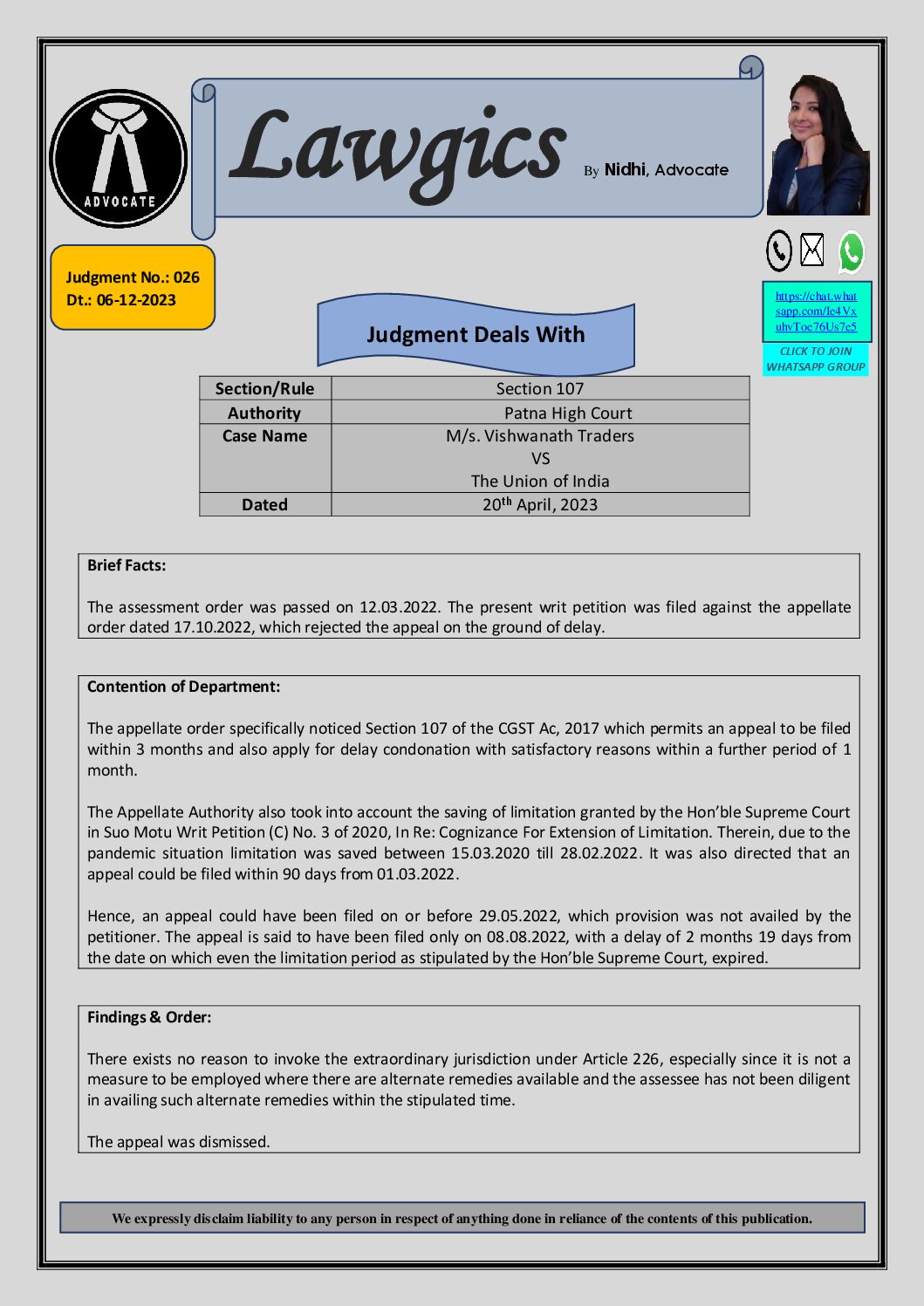
|
|
|
|
|
5. GST Notes by CMA Anil Sharma
1) Shri CMA Anil Sharma, Shri CMA Gurdev Singh Saini and Smt. CMA Bhawna Sharma posted Chapter-19 recently containing CGST Act in simple language in PPT format. This is to make dealers, professionals, academicians, students etc. understand the basics of GST laws.
|
Chapter-19th slide is given below.
|
|
|
|
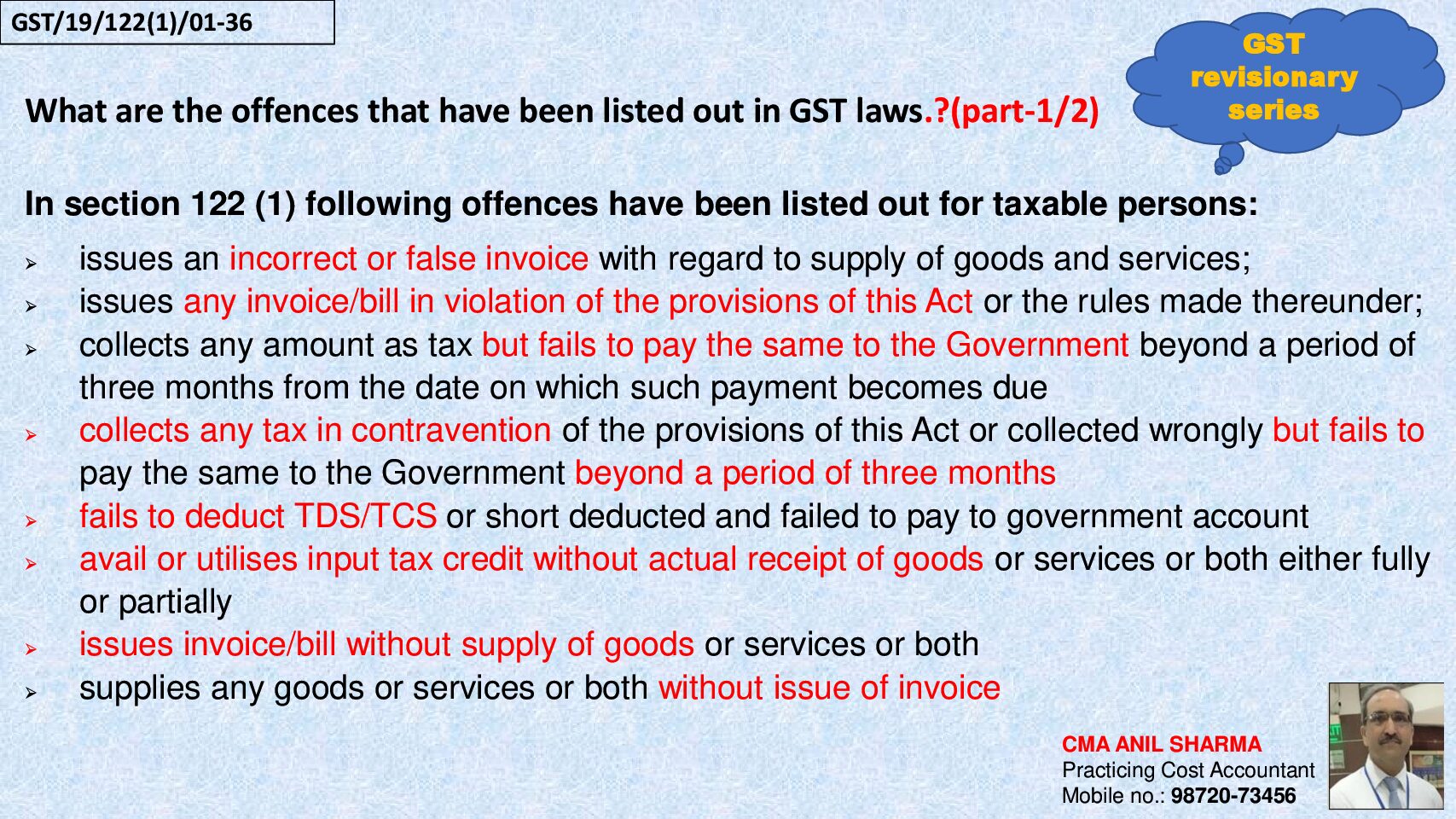
|
|
|
|
|
Do you wish to publish your Article?
If you wish to share your article with maximum readers then please send it at taxupdate.otu@gmail.com. We shall publish it with all due credit to you.
|
|
The topic can be on GST, Income Tax, Pre-GST laws, PPT, Notes etc. The article may contain 500 words to 1500 words or it may be more than that if the article demands.
|
|
|
|
|
|
|
If you wish to subscribe to weekly Newsletter at Rs. 149/- for one year, please subscribe. We shall send you the updates weekly.
|
|
|
|
|
|
|
Hope the above updates is of use to you. Please share your input and feedback at taxupdate.otu@gmail.com
|
|
|
|
|
|
 
|
Visit our website
|
OTU provides you
|
- Articles on various topics
|
|
- Media - GST, Income Tax & Press R.
|
|
- Notes / Newsletter at 149/ p.a.
|
|
|
|
|