|
|

|
|
|
|
|
|
This website contains information about recent changes mainly in GST laws. It also contains Articles on various topic in GST. Please visit the website and read more.
|
|
|
|
Dear Reader,
|
Please find newsletter for your reading and reference.
|
|
Newsletter no. 93 dated 17.07.2023
|
|
|
Index of the Newsletter
- Recent updates
- GST in media
- Income Tax in media
- Lawgics by Ms.Nidhi Aggarwal
- GST notes by CMA Anil Sharma
|
|
|
|
|
|
|
Office of the Commissioner of Commercial Taxes, Nandanam, Chennai issued Circular No. 07/2026-TNGST dated 25.06.2026 regarding GST- Return Scrutiny under Section 61 of the TNGST Act, 2017 and adjudication proceedings - Prior approval for suo moto scrutiny notices and ex parte orders.
|
Detailed guidelines were issued to the Proper officers for adjudication in the Assessment Circles, in the Circular cited, to make adjudication process more transparent, reduce the litigations and realize revenue.
|
In this direction, system generated scrutiny notices based on risk parameters have been made available to the Proper Officers to ensure uniformity and monitoring of the return scrutiny process. Instructions have also been issued to all Proper Officers to process the system-generated scrutiny notices by following the provisions of the GST Acts and Rules and training has been imparted for adherence to quality standards in the adjudication process.
|
The scrutiny notices generated by the IT wing of the department and made available are detailed below:
|
|
|
|
|
|
|
|
Income Tax, Income Tax misc
|
Income tax department issued FAQs on the Taxation and Other laws (Amendment) Bill, 2026.
|
|
|
|
|
|
2. GST in Media - Council meeting
|
|
|
|
|
The Preventive Wing of the Central Goods and Services Tax (CGST) Commissionerate, Shimla, has uncovered an alleged GST fraud involving input tax credit of around ₹5.55 crore in the Kala Amb industrial area of Sirmaur district. The investigation has also led to the arrest of Gaurav Jain, managing director of M/s Samay Pharma India Private Limited, Trilokpur.
|
How Was the Alleged GST Fraud Carried Out?
CGST officials alleged that Samay Pharma and M/s Dual Healthcare claimed input tax credit using fake invoices issued by several firms that either did not exist or were found to be non-genuine.
|
The investigation found that ITC worth around ₹5.55 crore was allegedly claimed through invoices linked to 10 such firms. Officials examined the transactions to determine whether the supplies mentioned in these invoices had actually taken place.
|
What Did Officials Find About the Goods?
Officials said the invoices showed the purchase of goods, but there was no evidence confirming that those goods were actually transported.
|
E-way bills and toll-plaza records also did not support the movement of goods mentioned in the invoices, raising questions about whether the transactions reflected genuine supplies.
|
How Were GST Refund Claims Allegedly Involved?
Officials further alleged that the fake input tax credit was later included in GST refund claims.
|
The suspected credit was allegedly used in an attempt to obtain money back from the government through the GST refund mechanism.
|
What Other Irregularities Were Found?
During the investigation, officials found several suspicious transactions, fake firms and invoices without actual movement of goods.
|
They also alleged that shell entities were being used to manipulate the GST credit and refund system.
|
What Evidence Did Investigators Examine?
The CGST team recorded statements from several people during the investigation and examined digital evidence.
|
The inquiry also looked at invoices, the firms connected to them and records relating to the alleged movement of goods.
|
Why Was the Managing Director Arrested?
Based on the evidence collected during the investigation, Gaurav Jain, managing director of M/s Samay Pharma India Private Limited, was arrested.
|
The arrest was made under Section 69(1) of the Central Goods and Services Tax Act, 2017.
|
Follow for daily updates on cybercrime, corporate fraud, DFIR, hacking, investigations, and digital forensics
|
|
|
|
|
|
|
|
GST officers have arrested a partner of a firm engaged in trading of iron and steel goods for fraudulently availing input tax credit of over Rs 15.78 crore.
|
Investigations by the Central Goods & Services Tax (CGST), Delhi South Commissionerate's anti-evasion branch revealed that the firm had availed inadmissible ITC on the basis of invoices issued by multiple firms, several of which were found to be non-existent, non-functional, suspended or cancelled.
|
Field verification also established that certain suppliers had no genuine business activity at their declared places of business.
|
In a statement, the Finance Ministry said, "CGST Delhi South Commissionerate have arrested a partner of the firm engaged in trading of iron and steel goods in a case involving fraudulent availment, utilisation and passing on of inadmissible ITC aggregating to over Rs 15.78 crore through bogus invoices of approximately Rs 87.67 crore."
|
Further inquiry established that ITC was availed without actual receipt of goods and was also passed on to various recipients through invoices issued without corresponding supply of goods.
|
Based on the evidence gathered during the investigation and statements recorded under Section 70 of the CGST Act, 2017, the accused was arrested on September 14 and produced before the Patiala House Court, which remanded him to judicial custody for 14 days.
|
|
|
|
|
|
|
|
The Superintendent of Central GST, Mohit Pratap Singh, was caught while allegedly accepting a bribe of Rs 8 lakh through a mediator, the Lokayukta said.
|
Lokayukta sleuths trapped the Central government officer while he was allegedly accepting the bribe at Kendriya Sadan in Koramangala here, according to a statement.
|
According to the Lokayukta, Singh had demanded the money to "close a false complaint" filed against the complainant, Syed Zameer, in connection with pending Central GST dues. PTI GMS SSK
|
|
|
|
|
|
|
|
Punjab’s excise and taxation officials detained 170 vehicles carrying goods suspected to be in violation of GST provisions, officials said on Monday.
|
The operation, carried out jointly by all State Investigation and Preventive Units with special focus on Mandi Gobindgarh and Khanna, led to the seizure of iron scrap and finished iron/steel goods valued at more than Rs 5 crore.
|
Excise and Taxation Minister Harpal Singh Cheema described the drive as “a wake-up call for those who think they can get away with it.” He emphasised that the government is determined to plug every loophole and ensure that tax compliance becomes the rule of the day rather than the exception.
|
A substantial number of vehicles were found without proper invoices and prescribed documents, a clear violation of the GST law.
|
Punjab will not allow tax evasion to eat into the state’s revenue. Every legitimate rupee must reach the public exchequer, for it is the lifeblood of development, Cheema said in a statement.
|
The minister further informed that the detained consignments are undergoing detailed verification, which is expected to be completed within a week. PTI CHS MPL MPL
|
|
|
|
|
|
|
|
The Telangana Commercial Taxes Department has issued detailed guidelines governing the use of Artificial Intelligence tools and other third party online platforms by its officers, making individual officers personally accountable for any unauthorised sharing of taxpayer information through such platforms.
|
Circular No. 1/2026, issued by the department, allows officers to use AI for generic research, drafting and administrative efficiency, but makes it clear that such use cannot come at the cost of taxpayer confidentiality, data security or the independent application of mind by officers.
|
The circular prohibits officers and staff from typing, pasting, uploading, scanning, photographing, dictating, transcribing or otherwise transmitting taxpayer related information into any public or commercial AT tool, chatbot, generative AI platform, document analyster, summariser translation or transcription service, or cloud based analytical software, unless the platform has been expressly authorised in writing by the Commissioner of Commercial Taxes or the Government of Telangana.
|
CA Jitendra Patel, Partner, Indirect Tax, N.A.Shah Associates LLP, said the circular was a significant and welcome step towards the responsible use of AI by tax officers.
|
"The Telangana commercial taxes department's circular No. 1/2026 is a significant and welcome step towards the responsible use of Artificial Intelligence (AI) by tax officers. While the circular encourages the use of AI for research, drafting and administrative efficiency, it rightly emphasises that taxpayers' confidentiality and the independent application of mind by officers cannot be compromised and liable to penal action," Patel said.
|
Officers face personal accountability
The restrictions cover a wide range of taxpayer information, including GSTIN, PAN, legal name or trade name, address and contact particulars, bank account details, returns and annexures, financial statements, invoices, e way bill data, discrepancy reports, notices, assessment, adjudication or appellate orders, audit material, refund applications, inspection , search and investigation records, statements recorded during proceedings, and internal notes or legal opinions relating to an identifable taxpayer.
|
The circular also makes clear that the responsibility for protecting such information rests with the officer concerned. Unauthorised transmission of taxpayer information to an external AI platform can therefore expose the officer to disciplinary, legal and data protection consequences.
|
Ikesh Nagpal, Lead, Indirect Tax, AKM Global, said the circular strikes a balance between the use and AI and the need to protect taxpayer confidentialy.
|
"The Telangana Commercial Taxes Department's circular strikes a pragmatic balance between embracing AI and safeguarding taxpayer confidentiality. Rather than prohibiting AI, it permits its responsible use while drawing a firm boundary against sharing identifiable taxpayer information on unauthorised platforms. This is particularly relevant for tax administration, where officers routinely handle highly sensitive financial and transactional data," Nagpal said.
|
"More importantly, the circular reinforces that AI may assist but cannot replace the officers' independent application of mind. Every AI generated legal proposition or case citation must be independently verified, and the final order must reflect the officer's own reasoning. This approach places accountability where it belongs with the decision make while still allowing technology to improve efficiency in tax administration," he added.
|
AI cannot replace tax officer's judgment
The department has also stressed that AI cannot replace the independent judgment required from officers, particularly while issuing notices, assessments, adjudication orders and other quasi judicial decisions.
|
Manoj Mishra, Partner and Tax controversy Management leader, Grand Thornton Bharat, said the circular comes at a time when AI is becoming increasingly embedded in legal and tax workflows.
|
"As AI becomes increasingly embedded in legal and tax workflows, the focus has rightly shifted from whether AI should be used to ensuring it is used responsibly and within the boundaries of law. Recent judicial interventions, where courts have cautioned against mechanical reliance on AI generated content and even set aside orders lacking independent application of mind, underscore that technology cannot substitute statutory decision making. Recent Telangana's Circular on AI use is therefore a timely and pragmatic intervention. It reinforces that taxpayers information remains confidential under the GST framework and the Digital Personal Data Protection Act, and that unauthorised disclosure on public AI platforms can trigger disciplinary, legal and data protection consequences. By permitting AI for generic research and drafting while mandating human verification, confidentiality safeguards and independent judgment, the circular offers and balanced governance framework that could serve as a useful precedent for tax administrations across the country , "Mishra said.
|
"The circular makes one point unmistakably clear: custodianship of taxpayer data carries personal accountability. Any unauthorised disclosure through public AI platforms may expose the officer to disciplinary action, criminal and data protection consequences, while also jeopardising the validity of the underlying tax proceedings. AI may improve administrative efficiency, but responsibility for data security, legal accuracy and independent decision making cannot be delegated to an algorithm," he added.
|
Public AI platforms treated as third party transmission
Aravind Srivatsan, Partner and India Tax Leader, Nangia Global, described the framework as what could be termed a first of its kind detailed code governing the use of AI tools by tax department staff.
|
He said the Telangana Government has acknowledged that officers are increasingly using AI based tools to improve the speed, consistency and quality of their work, while making it clear that such use cannot compromise taxpayer confidentiality, data security of the officer's independent judgment.
|
Srivatsan pointed out that large language models, generative AI platforms, chatbots, document analysers, summarisers, translators, transcription services and coding assistants may process information on private servers, frequently outside India. Information entered into such platforms may also be logged, retained , reviewed or used for model training, he said.
|
According to Srivatsan , typing , pasting, uploading, scanning, photographing or dictating departmental material into an external AI platform amounts to electronic transmission of information to a third party and can create risks of data leakage, misuse and subsequent litigation.
|
He said that where an officer transmits taxpayer particulars to an external AI engine without authority of law or taxpayer consent, the act can attract personal accountability.
|
Disciplinary, criminal and data protection consequences
The circular provides for consequences where taxpayer information is disclosed without authorisation. These can include disciplinary action under the applicable Telangana Civil Services rules, possible criminal consequences under applicable law and data protection consequences under the Digital Personal Data Protection Act, 2023.
|
The circular also addresses the potential impact on tax proceedings where AI generated material is used without proper verification. An officer remains responsible for the accuracy of statutory provisions, legal propositions and judicial precedents relied upon in an official proceeding.
|
Aditya Singhania, Founder of Trackase, said the guidelines could address the unauthorised and unconscious sharing of taxpayer data through general AI applications while also establishing individual responsibility for breaches.
|
He said the framework draws a clear distinction between the role of humans and machines in proceedings where tax officers exercise quasi judicial authority. He also pointed to instances where courts have taken cognisance of non existent. AI generated citations and said the Telangana framework provides detailed guidance for responsible use of AI by tax officials.
|
Officers told to delete past taxpayer data
The department has also addressed information that may already have been entered into AI platforms.
|
Officers and staff have been directed, to the extent technically feasible, to delete taxpayer related information previously entered into AI platforms, along with associated chat histories and stored files.
|
The restrictions also extend to the use of personal mobile phones, tablets, laptops, personal email accounts and personal cloud storage for processing departmental material through AI tools.
|
At the same time, the circular does not prohibit AI use altogether. Officers can use AI for generic research, drafting assistance and language related tasks, provided identifiable taxpayer information is not shared and AI generated material is independently verified before being relied upon.
|
The framework effectively places a clear boundary around the use of AI in tax administration. AI can be used as an efficiency tool, but the responsibility for taxpayer confidentiality, data security, legal accuracy and independent decision making remains with the tax officer.
|
Source: cfo economictimes
|
|
|
|
|
|
|
|
The tax department is increasingly using artificial intelligence (AI), data analytics and information from multiple government databases to identify anomalies, detect potential tax risks and sharpen scrutiny of taxpayers.
|
According to tax officials and chartered accountants TNIE spoke to, the approach is moving beyond checking individual tax returns to analysing patterns across Income Tax Returns, GST returns, e-invoices, e-way bills, registrations and historical taxpayer behaviour. The objective is to make scrutiny more targeted and improve voluntary compliance.
|
The Income-Tax department already processes information available through systems such as the Annual Information Statement (AIS), which gives taxpayers details of financial transactions and income-related information available with the tax authorities. More sophisticated AI tools could help identify patterns across these datasets and flag cases requiring closer examination.
|
Jigar Doshi, country head - Indirect Tax, Ascentium India, said the department's scrutiny and audit process was no longer limited to information submitted in a particular return.
|
“Increasingly, the department is able to run data-driven simulations across multiple sources — including Income Tax Returns, GST returns, e-invoices, e-way bills, registrations and historical taxpayer behaviour — to identify anomalies and potential tax risks,” he said.
|
GST audits go deeper
GST administration is also making greater use of centralised analytics to identify suspicious transactions and taxpayers. Platforms such as DGRAM are used to flag fake registrations, suspicious input tax credit (ITC) chains and potential tax-evasion patterns, while BIFA (Business Intelligence and Fraud Analytics) acts as a risk and exception-reporting engine using the all-India GST database.
|
At the state level, tax administrations are also developing their own analytical capabilities. Maharashtra's Business Intelligence & Data Warehouse (BIDW), for instance, combines a data warehouse with an analytics layer to help identify cases for scrutiny and audit.
|
“Manual audits and sample testing alone may not be sufficient against AI-enabled regulatory scrutiny,” says Rajat Mohan, managing partner at AMRG Associates, adding that businesses are facing greater scrutiny of historical transaction data and cross-period discrepancies.
|
GST audits can involve reconciliation across GSTR-1, GSTR-3B, GSTR-2B, e-way bills and e-invoices. Automated systems can identify differences in ITC, outward supplies and turnover, as well as claims involving suppliers whose registrations were subsequently cancelled or who failed to discharge their tax liabilities.
|
The scale of information available to tax authorities is significant. India had more than 1.65 crore GST taxpayers as of May 2026, generating millions of invoices and returns that can be analysed alongside income-tax information.
|
This allows authorities to identify issues such as unusual refund claims, short payment of GST, excessive ITC claims and inconsistencies between sales and purchases.
|
The growing ability to combine information from GST, income tax, customs and other government systems could allow tax authorities to build a wider financial profile of taxpayers.
|
According to experts, this means for businesses conventional reconciliation of books with tax returns may no longer be sufficient. Companies may increasingly need to identify potential risks before they are flagged by the department.
|
AI could also allow the department to alert taxpayers to potential discrepancies, seek clarification digitally and escalate cases for formal scrutiny where required.
|
However, AI is likely to remain an aid rather than a substitute for human judgment. Officers would still have to verify facts and take responsibility for assessment decisions.
|
“AI is an enabler,” one tax official said, stressing that the taxpayer or professional taking the final tax position would continue to be accountable. AI cannot be treated as a substitute for human judgment, particularly in complex tax matters.
|
Source: The New Indian Express
|
|
|
|
|
|
3. Income Tax in Media
|
The Ministry of Finance is not planning to extend the deadline for filing income tax returns. The last date for filing income tax (I-T) returns for the financial year 2022-23 (assessment year 2023-24) is July 31. Revenue Secretary Sanjay Malhotra on Friday said that there is no proposal under consideration for extending the ITR filing deadline like last year.
|
|
“There is no proposal under consideration and we don’t intend to. My advice to all the taxpayers is that they should file their tax returns. There will not be any extension in the deadline like last year and the earlier they do it the better,” said Revenue Secretary Sanjay Malhotra, as per a Business Today report. He was asked if the government was planning to extend the ITR deadline in view of the floods and heavy rains in parts of north India.
|
|
|
|
|
|
4 Lawgics by Ms.Nidhi Aggarwal
|
|
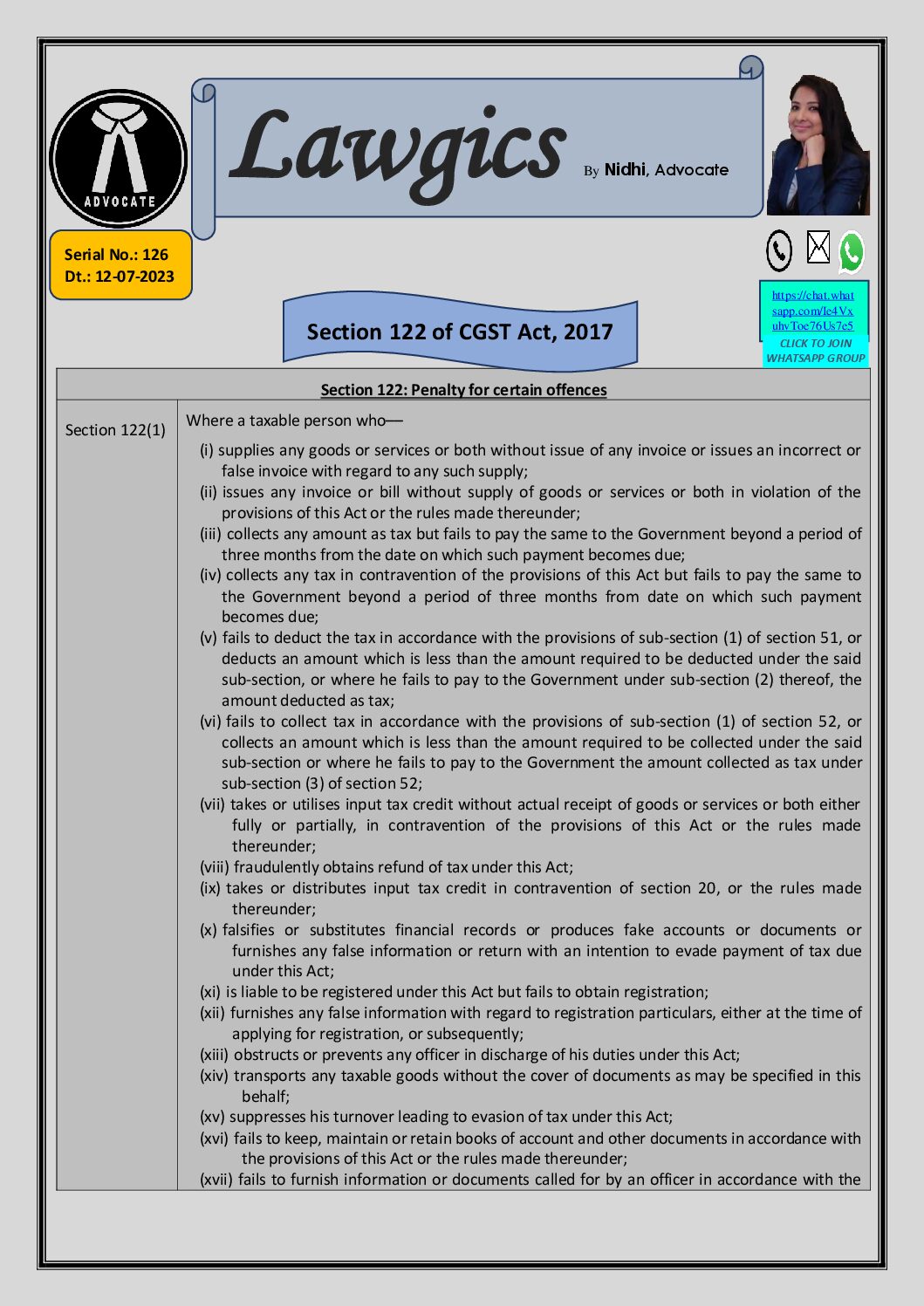
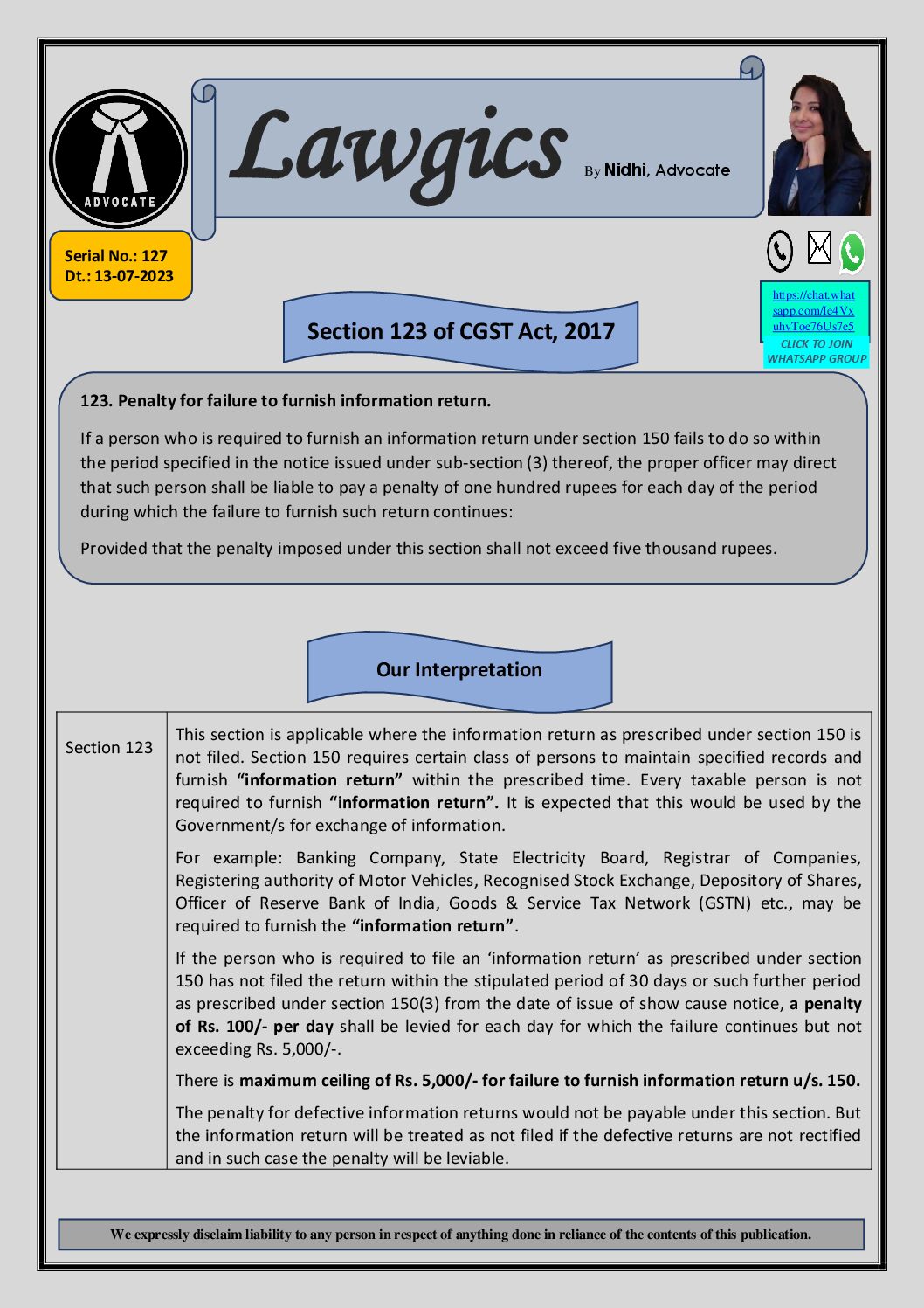
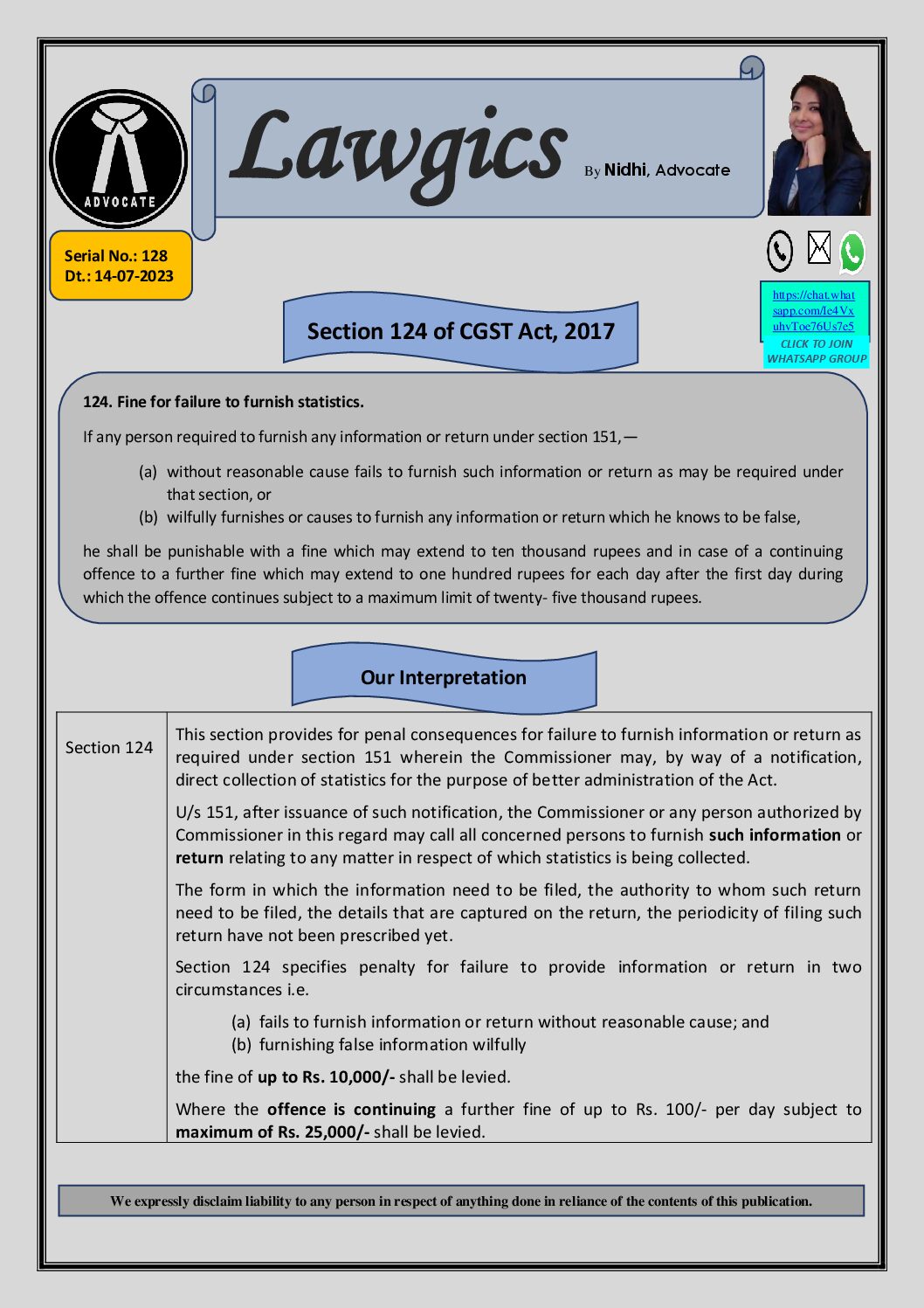
Ms. Nidhi Aggarwal is delighted to present GST Notes/Law in a simplified manner under the title “ Lawgics ”. The note is prepared in a series of PDFs encompassing GST Law and the interpretations thereof in simple manner. The author with a great vision to spread complex GST law in a simple manner amongst the taxpayers, tax professionals, students and knowledge seeker is presenting the Lawgics in piecemeal at regular interval.
|
|
|
|
|
|
|
|
|
5. GST Notes by CMA Anil Sharma
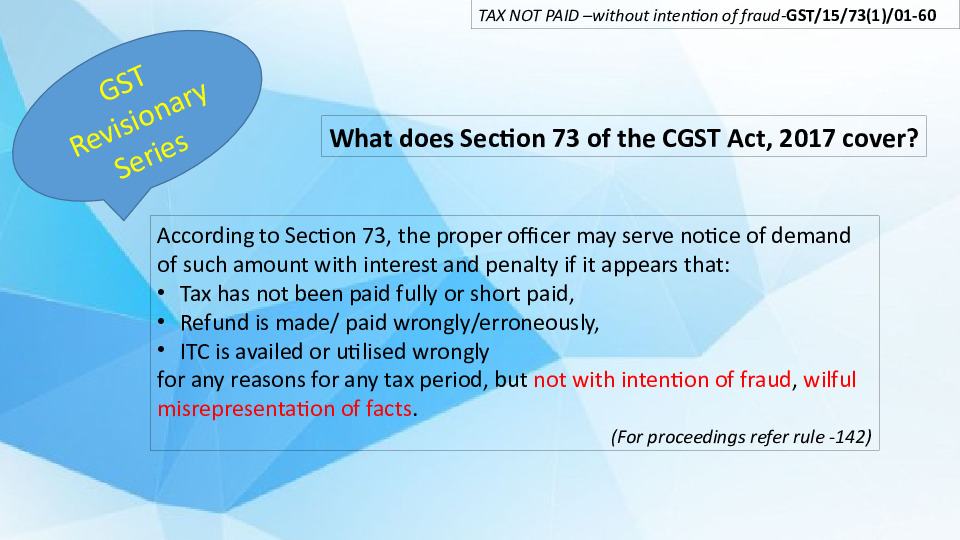
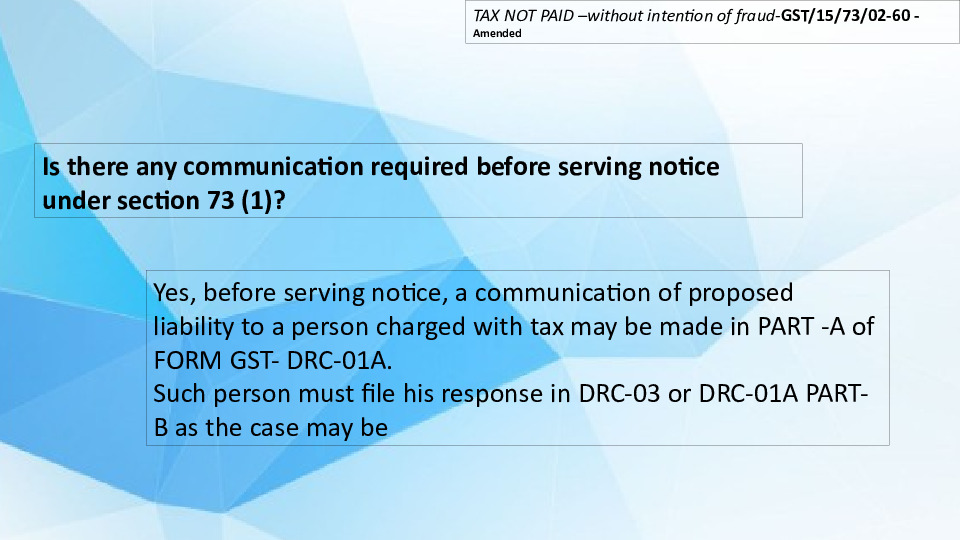
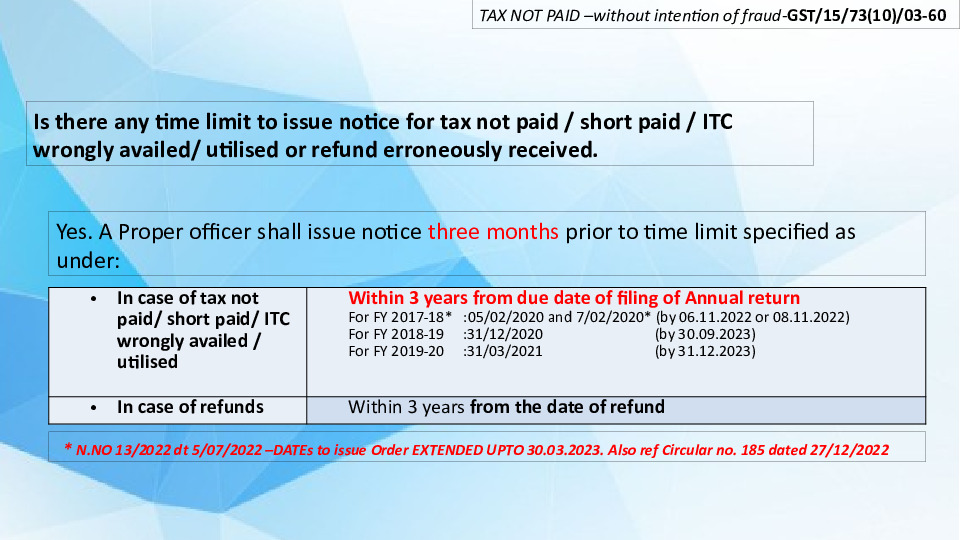
1) Shri CMA Anil Sharma, Shri CMA Gurdev Singh Saini and Smt. CMA Bhawna Sharma posted Chapter-15 containing CGST Act in simple language in PPT format. This is to make dealers, professionals, academicians, students etc. understand the basics of GST laws. Each Chapter in CGST Act, 2017 is explained in the form of Slides as given below for easy understanding of the Act:
|
Chapter-15 slides given below:-
|
|
|
|
|
|
|
|
|
|
|
You wish to publish your Article?
|
If you wish to share your article with maximum readers then please send the article at taxupdate.otu@gmail.com. We shall publish it with all due credit to you.
|
|
|
|
|
|
|
Hope the above updates is of use to you. Please share your input and feedback at taxupdate.otu@gmail.com
|
|
|
|
|
|
 
|
Visit our website
|
OTU provides you
|
- Articles on various topics
|
|
- Media - GST, Income Tax & Press R.
|
|
- Notes / Newsletter at 149/ p.a.
|
|
|
|
|