|
|

|
|
|
|
|
|
onlinetaxupdate team wish to express sincere thanks to all the readers, authors, subscribers for the support extended to us.
|
|
|
|
Dear Reader,
|
Please find newsletter for your reading and reference.
|
|
Newsletter no.103 dated 16.11.2023
|
|
|
Index of the Newsletter
- Recent updates
- Article
- Lawgics - Judgments by Ms. Nidhi Aggarwal
- GST notes by CMA Anil Sharma
|
|
|
|
|
|
|
Mr. Nilesh Modi presenting 20 case studies on Tax audit report by Taxmann
|
|
|
|
|
|
|
|
The Institute of Chartered Accountants of India (ICAI) presenting Background Material on GST - Volume I & II. This is 14th Edition , the first one was published in July , 2026
|
|
|
|
|
|
|
|
The Institute of Chartered Accountants of India (ICAI), New Delhi issued Handbook on Residential Status for NRIs - Tax and FEMA Aspects in July 2026.
|
Basic draft of this publication was prepared by CA. Uday Ved
|
|
|
|
|
|
|
|
Office of the Commissioner of Commercial Taxes, Nandanam, Chennai issued Circular No. 07/2026-TNGST dated 25.06.2026 regarding GST- Return Scrutiny under Section 61 of the TNGST Act, 2017 and adjudication proceedings - Prior approval for suo moto scrutiny notices and ex parte orders.
|
Detailed guidelines were issued to the Proper officers for adjudication in the Assessment Circles, in the Circular cited, to make adjudication process more transparent, reduce the litigations and realize revenue.
|
In this direction, system generated scrutiny notices based on risk parameters have been made available to the Proper Officers to ensure uniformity and monitoring of the return scrutiny process. Instructions have also been issued to all Proper Officers to process the system-generated scrutiny notices by following the provisions of the GST Acts and Rules and training has been imparted for adherence to quality standards in the adjudication process.
|
The scrutiny notices generated by the IT wing of the department and made available are detailed below:
|
|
|
|
|
|
|
|
Central Board of Direct Taxes published Advance Pricing Agreement (APA) Programme: Annual APA Report FY 2025-26.
|
The Advance Pricing Agreement (APA) programme of the CBDT, is one of its leading programmes for fostering a tax regime in India that provides an investor conducive environment. 1035 APAs have been entered into by the CBDT till March 2026, which demonstrates the widespread acceptance of the programme by taxpayers and stakeholders alike. In continuation of the exemplary performance last year, the programme was successfully taken forward in FY 2025-26 and witnessed one of the highest number of APA signings (220 in number) in any single year since the commencement of the APA programme.
|
|
|
|
|
|
|
|
The Institute of Chartered Accountants of India (ICAI) presented GST Sectoral Guide on Fast-Moving Consumption Goods - July 2026 Edition.
|
|
|
|
|
|
|
|
The Institute of Chartered Accountants of India (ICAI), has released the “Handbook on Safe Harbour Rules” to provide comprehensive and practical guidance on the application of India’s Safe Harbour framework. The publication has been issued in July 2026.
|
|
|
|
|
|
|
|
The Institute of Chartered Accountants of India (ICAI) issued Guidance Note on Tax Audit u/s 44AB of the Income tax Act, 1961 (Revised 2026). It is 11th Edition. Authored by CA. Chandrashekhar Vasant Chitale.
|
|
|
|
|
|
|
|
Foreign Tax & Tax Research Division release on 24.07.2026 the Guidance Note on Crypto-Asset Reporting Obligations u/s 509 of the Income tax Act, 2025.
|
|
|
|
|
|
|
|
ICMAI The Institute of Cost Accountants of India released first edition in June 2026 the "Income Tax Ready Reckoner for Tax Year 2026-27"
|
|
|
|
|
|
|
|
|
|
The Preventive Wing of the Central Goods and Services Tax (CGST) Commissionerate, Shimla, has uncovered an alleged GST fraud involving input tax credit of around ₹5.55 crore in the Kala Amb industrial area of Sirmaur district. The investigation has also led to the arrest of Gaurav Jain, managing director of M/s Samay Pharma India Private Limited, Trilokpur.
|
How Was the Alleged GST Fraud Carried Out?
CGST officials alleged that Samay Pharma and M/s Dual Healthcare claimed input tax credit using fake invoices issued by several firms that either did not exist or were found to be non-genuine.
|
The investigation found that ITC worth around ₹5.55 crore was allegedly claimed through invoices linked to 10 such firms. Officials examined the transactions to determine whether the supplies mentioned in these invoices had actually taken place.
|
What Did Officials Find About the Goods?
Officials said the invoices showed the purchase of goods, but there was no evidence confirming that those goods were actually transported.
|
E-way bills and toll-plaza records also did not support the movement of goods mentioned in the invoices, raising questions about whether the transactions reflected genuine supplies.
|
How Were GST Refund Claims Allegedly Involved?
Officials further alleged that the fake input tax credit was later included in GST refund claims.
|
The suspected credit was allegedly used in an attempt to obtain money back from the government through the GST refund mechanism.
|
What Other Irregularities Were Found?
During the investigation, officials found several suspicious transactions, fake firms and invoices without actual movement of goods.
|
They also alleged that shell entities were being used to manipulate the GST credit and refund system.
|
What Evidence Did Investigators Examine?
The CGST team recorded statements from several people during the investigation and examined digital evidence.
|
The inquiry also looked at invoices, the firms connected to them and records relating to the alleged movement of goods.
|
Why Was the Managing Director Arrested?
Based on the evidence collected during the investigation, Gaurav Jain, managing director of M/s Samay Pharma India Private Limited, was arrested.
|
The arrest was made under Section 69(1) of the Central Goods and Services Tax Act, 2017.
|
Follow for daily updates on cybercrime, corporate fraud, DFIR, hacking, investigations, and digital forensics
|
|
|
|
|
|
|
|
GST officers have arrested a partner of a firm engaged in trading of iron and steel goods for fraudulently availing input tax credit of over Rs 15.78 crore.
|
Investigations by the Central Goods & Services Tax (CGST), Delhi South Commissionerate's anti-evasion branch revealed that the firm had availed inadmissible ITC on the basis of invoices issued by multiple firms, several of which were found to be non-existent, non-functional, suspended or cancelled.
|
Field verification also established that certain suppliers had no genuine business activity at their declared places of business.
|
In a statement, the Finance Ministry said, "CGST Delhi South Commissionerate have arrested a partner of the firm engaged in trading of iron and steel goods in a case involving fraudulent availment, utilisation and passing on of inadmissible ITC aggregating to over Rs 15.78 crore through bogus invoices of approximately Rs 87.67 crore."
|
Further inquiry established that ITC was availed without actual receipt of goods and was also passed on to various recipients through invoices issued without corresponding supply of goods.
|
Based on the evidence gathered during the investigation and statements recorded under Section 70 of the CGST Act, 2017, the accused was arrested on September 14 and produced before the Patiala House Court, which remanded him to judicial custody for 14 days.
|
|
|
|
|
|
|
|
The September 30, 2026 deadline for filing tax audit reports for assessment year (AY) 2026-27 is fast approaching, but the government has not announced any extension so far. Several Chartered Accountant (CA) associations have sought more time, citing the workload involved in completing audits, reconciliation issues and delays in getting audit-related information and utilities.
|
For taxpayers whose accounts are subject to audit, September 30 remains the applicable deadline unless the Central Board of Direct Taxes (CBDT) announces a change. Experts say taxpayers should continue working towards the existing deadline rather than wait for an extension.
|
CA associations seek more time
The demand for an extension has gained momentum as professional bodies have raised concerns over the time available to complete tax audits. The Chartered Accountants Association, Jalandhar has sought an extension of the tax audit deadline to October 31, while the Punjab Accountants Association and Rajasthan Consultants Association has also made a similar representation.
|
The associations have cited the delayed release of ITR forms and utilities, increased compliance requirements and the overlap between the August 31 non-audit ITR deadline and the September 30 tax audit deadline. They have argued that extending the audit deadline would provide CAs with more time for proper reconciliation and verification.
|
The request comes against the backdrop of a tax audit process that requires detailed reporting and verification across several financial and tax records.
|
Mohit Gupta, partner – direct & international taxation, PNAM & Co. LLP, said taxpayers and professionals should continue to work on the assumption that September 30 is the deadline unless the CBDT formally announces an extension.
|
“At present, taxpayers and professionals should proceed on the basis that September 30, 2026 remains the applicable deadline unless the CBDT issues a formal extension notification,” Gupta said.
|
He said the demand for additional time is not merely about getting more time to file the report. Auditors need to reconcile books of account with GST records, TDS/TCS data, AIS/TIS and other information before finalising the report.
|
“The demand for additional time is therefore primarily about ensuring quality and accuracy of compliance rather than merely seeking additional time for filing,” he said.
|
What are the biggest challenges?
The audit process has become increasingly data-intensive, with auditors required to examine information from multiple sources. Any mismatch between the books and tax records may need further investigation before the report can be finalised.
|
Dinesh K. Jain, managing partner, Dinesh Aarjav & Associates, said the pressure is coming from several issues at the same time.
|
“Three things are stacking up: a compressed working window, recurring portal issues — login failures, OTP delays, DSC errors, and glitches pulling AIS/TIS/Form 26AS data; and reconciliation friction,” Jain said.
|
Taxpayers may have to reconcile turnover with GST returns, verify TDS/TCS details, check AIS and TIS entries and match bank transactions with the books. Pending information from taxpayers can further delay the process.
|
Gupta said bank statements, fixed-asset details, loan schedules, related-party information, expense details and other supporting documents need to be available with the auditor before the report can be completed.
|
Another factor this year is the transition to the Income-tax Act, 2025. However, the tax audit relating to FY 2025-26 and AY 2026-27 continues under the Income-tax Act, 1961.
|
Will the government extend the deadline?
There is a precedent for extending the tax audit deadline. For FY 2024-25, the CBDT had extended the deadline for filing tax audit reports from September 30, 2025 to October 31, 2025.
|
However, last year's extension does not mean that the government will necessarily take a similar decision this year.
|
What should taxpayers do now?
With the deadline approaching, taxpayers whose accounts are subject to audit should start closing any pending gaps rather than wait for a government announcement.
|
The immediate priority should be to provide CAs with all outstanding documents and complete key reconciliations. This includes GST turnover, AIS/TIS and Form 26AS, bank and loan accounts, fixed assets, statutory dues, related-party transactions and expenses that may require tax-disallowance analysis.
|
Experts say taxpayers should work backwards from the deadline and ensure that their reports are not left for the final day.
|
“Work backward from September 30, not toward it,” Jain said.
|
Taxpayers should also remember that uploading the audit report is not the end of the process. The CA files the report electronically, after which the taxpayer has to approve it through their income-tax e-filing account.
|
Therefore, taxpayers should keep sufficient time for the approval step as well.
|
For now, September 30 remains the tax audit deadline for AY 2026-27. Unless the CBDT formally announces an extension, taxpayers and CAs should proceed on the basis that the existing deadline will apply.
|
|
|
|
|
|
|
|
The Union government has moved the Supreme Court against a Punjab and Haryana High Court ruling that declared Section 147A of the Income Tax Act unconstitutional, a decision that has raised questions over the validity of reassessment proceedings conducted by jurisdictional tax officers.
|
Additional Solicitor General N Venkataraman, appearing for the Centre, on Wednesday sought an urgent hearing of the Centre’s special leave petition (SLP) before Chief Justice of India Surya Kant. The CJI agreed to have the matter listed on an urgent basis.
|
Seeking an early hearing, Venkataraman told the court that the High Court ruling had created a “huge vacuum” in the law and that the issue was being closely followed by taxpayers.
|
The challenge concerns the statutory framework governing reassessment proceedings under Sections 148 and 148A of the Income Tax Act, particularly the respective roles of the jurisdictional assessing officer (JAO) and the National Faceless Assessment Centre (NFAC).
|
The dispute gained prominence after the introduction of the faceless assessment regime. A key question before the courts was whether jurisdictional officers retained the authority to independently issue reassessment notices under Section 148 and pass orders under Section 148A, or whether such functions were required to be routed through the faceless assessment mechanism.
|
The Punjab and Haryana High Court, in Income Tax Officer, Ward 2(1), Chandigarh v Tej Partap Singh, was among the courts that invalidated reassessment proceedings initiated by jurisdictional officers where the prescribed faceless procedure had not been followed. Some other High Courts, however, adopted a different interpretation of the statutory scheme.
|
Against this backdrop, Parliament retrospectively introduced Section 147A with effect from April 1, 2021. The provision stipulated that references to the “Assessing Officer” in Sections 148 and 148A would mean an assessing officer other than the National Faceless Assessment Centre.
|
The amendment effectively sought to preserve the jurisdiction of jurisdictional officers to undertake reassessment-related functions, notwithstanding the earlier judicial rulings concerning the faceless mechanism.
|
The Punjab and Haryana High Court subsequently examined the constitutional validity of Section 147A and struck it down. The court held that legislation could not retrospectively alter the legal position merely by declaring that a position contrary to earlier judicial findings was valid.
|
The High Court found that the provision attempted to overcome the effect of judicial decisions holding the earlier reassessment procedure legally defective rather than curing the underlying legal infirmity. It consequently held the retrospective legislative intervention to be impermissible.
|
The Centre’s challenge before the Supreme Court will now bring the validity and effect of Section 147A into focus, including the extent to which Parliament can retrospectively alter the statutory basis of reassessment proceedings following judicial pronouncements on the issue.
|
Source: Business Standard
|
|
|
|
|
|
|
|
Tax officer imposed a 200% penalty of Rs. 4.85 lakh, but ITAT cut it to Rs. 1.21 lakh.
|
You file your income tax return but end up under-reporting your income. But, the income tax department treats it as mis-reporting of income and imposes a heavy penalty on you. What happens then?
|
This is the case of a 57-year old non-resident Indian (NRI) woman who ended up under-reporting her income when she filed here Income tax return, and the gap was huge.
|
What the case is about
The NRI woman declared an income of Rs. 43,796/- for the assessment year 2020-21. But the Income tax department tracked an interest income of Rs. 14,46,321 that was not disclosed in here return and imposed a 200% penalty on her.
|
The assessing officer treated the omission as misreporting and imposed a penalty of Rs. 4.85 lakh, equivalent to 200% of the tax payable on the under-reported income.
|
The additional interest income was brought to tax during reassessment because it had not been disclosed in the original return. The tax officer classified the omission as misreporting, which attracts a penalty of 200% under Section 270A, rather than the 50% penalty applicable to ordinary under-reporting.
|
The woman denied deliberately concealing income. In here appeal, she said she had consistently filed her returns on time and had never intentionally under-reported her income.
|
The CIT(A) upheld the penalty, observing that interest income of Rs. 14,02,525/- had been completely omitted from the return.
|
The CIT(A) found that the interest income of Rs. 14,02,525/- had been entirely left out of the return. It also noted that the taxpayer had not voluntarily disclosed the income or provided an explanation and supporting documents despite receiving several notices.
|
The taxpayer then approached the Income tax Appellate Tribunal (ITAT), Mumbai, which upheld the penalty for under-reporting but reduced the applicable penalty rate from 200% to 50%.
|
How did she explain the mismatch?
Her advocate said the woman was living abroad, had limited technological knowledge and had handed over her tax compliance to an accountant. She therefore remained unaware of the electronic notices issued by the department. After learning about the discrepancy, she paid the additional tax and interest.
|
"She was only informed about the additional tax liability of Rs. 2,42,589/- plus interest amounting to Rs. 3,06,821/- totaling to Rs. 5,49,410, which was paid on 23.01.2025, as the said tax plus interest liability had arisen due to the accountant's mistake."
|
The taxpayer argued that the case involved under-reporting rather than misreporting and that the penalty should therefore have been 50% of the tax liability, or Rs. 1,21,295/-.
|
The woman maintained that she was an NRI during the relevant period and remained so until 01.04.2025. She attributed the omission to the accountant handling her tax compliance and her lack of awareness of the electronic notices.
|
What did ITAT Mumbai say?
The Tribunal found that omission of income cannot automatically be classified as misreporting. It considered the taxpayer's circumstances and the fact that she paid around Rs. 5 lakh in tax and interest after becoming aware of the discrepancy.
|
"In our considered view, non-compliance with electronic notices in these peculiar circumstances cannot by itself establish that the original omission of interest income represented deliberate misreporting warranting penalty at 200%," it said.
|
The tribunal also stressed that the law makes a distinction between ordinary under-reporting , which attracts a 50% penalty, and under-reporting resulting from mis-reporting, which attracts 200%.
|
"The higher rate cannot be applied merely because the department detected the omitted income or because the assessee did not respond to notices."
|
ITAT Mumbai therefore sustained the penalty under Section 270A for under-reporting , but directed the Assessing Officer to apply the 50% rate instead of 200%.
|
Anuj Dave, Practice Head (Ahmedabad & Mumbai) at Clavius Legal told ET that several circumstances taken together supported the taxpayer's case. "She was a non-resident living abroad, had entrusted her compliance to an accountant, claimed limited technological knowledge and to have been unaware of the electronic notices, and paid tax and interest of Rs. 5,49,410 on becoming aware of the liability."
|
It is important to note that the Rs. 5,49,410 already paid towards tax and interst does not cancel the separate penalty liability.
|
The payment of tax and interest was considered in the taxpayer's favour, but did not serve as a defence against the penalty.
|
The original penalty was Rs. 4,85,178/- at the 200% rate. That rate has now been reduced to 50%, but the taxpayer will still have an additional penalty liability, Mathews said.
|
What's important to note is that an addition to income during assessment or reassessment does not, by itself, establish misreporting . The Revenue must show that the facts fall within one of the specified categories.
|
Similarly, failure to respond to statutory notices can be relevant, bud does not by itself prove deliberate misreporting.
|
Source: The Times of India
|
|
|
|
|
|
|
|
The Superintendent of Central GST, Mohit Pratap Singh, was caught while allegedly accepting a bribe of Rs 8 lakh through a mediator, the Lokayukta said.
|
Lokayukta sleuths trapped the Central government officer while he was allegedly accepting the bribe at Kendriya Sadan in Koramangala here, according to a statement.
|
According to the Lokayukta, Singh had demanded the money to "close a false complaint" filed against the complainant, Syed Zameer, in connection with pending Central GST dues. PTI GMS SSK
|
|
|
|
|
|
|
|
Punjab’s excise and taxation officials detained 170 vehicles carrying goods suspected to be in violation of GST provisions, officials said on Monday.
|
The operation, carried out jointly by all State Investigation and Preventive Units with special focus on Mandi Gobindgarh and Khanna, led to the seizure of iron scrap and finished iron/steel goods valued at more than Rs 5 crore.
|
Excise and Taxation Minister Harpal Singh Cheema described the drive as “a wake-up call for those who think they can get away with it.” He emphasised that the government is determined to plug every loophole and ensure that tax compliance becomes the rule of the day rather than the exception.
|
A substantial number of vehicles were found without proper invoices and prescribed documents, a clear violation of the GST law.
|
Punjab will not allow tax evasion to eat into the state’s revenue. Every legitimate rupee must reach the public exchequer, for it is the lifeblood of development, Cheema said in a statement.
|
The minister further informed that the detained consignments are undergoing detailed verification, which is expected to be completed within a week. PTI CHS MPL MPL
|
|
|
|
|
|
|
|
The Telangana Commercial Taxes Department has issued detailed guidelines governing the use of Artificial Intelligence tools and other third party online platforms by its officers, making individual officers personally accountable for any unauthorised sharing of taxpayer information through such platforms.
|
Circular No. 1/2026, issued by the department, allows officers to use AI for generic research, drafting and administrative efficiency, but makes it clear that such use cannot come at the cost of taxpayer confidentiality, data security or the independent application of mind by officers.
|
The circular prohibits officers and staff from typing, pasting, uploading, scanning, photographing, dictating, transcribing or otherwise transmitting taxpayer related information into any public or commercial AT tool, chatbot, generative AI platform, document analyster, summariser translation or transcription service, or cloud based analytical software, unless the platform has been expressly authorised in writing by the Commissioner of Commercial Taxes or the Government of Telangana.
|
CA Jitendra Patel, Partner, Indirect Tax, N.A.Shah Associates LLP, said the circular was a significant and welcome step towards the responsible use of AI by tax officers.
|
"The Telangana commercial taxes department's circular No. 1/2026 is a significant and welcome step towards the responsible use of Artificial Intelligence (AI) by tax officers. While the circular encourages the use of AI for research, drafting and administrative efficiency, it rightly emphasises that taxpayers' confidentiality and the independent application of mind by officers cannot be compromised and liable to penal action," Patel said.
|
Officers face personal accountability
The restrictions cover a wide range of taxpayer information, including GSTIN, PAN, legal name or trade name, address and contact particulars, bank account details, returns and annexures, financial statements, invoices, e way bill data, discrepancy reports, notices, assessment, adjudication or appellate orders, audit material, refund applications, inspection , search and investigation records, statements recorded during proceedings, and internal notes or legal opinions relating to an identifable taxpayer.
|
The circular also makes clear that the responsibility for protecting such information rests with the officer concerned. Unauthorised transmission of taxpayer information to an external AI platform can therefore expose the officer to disciplinary, legal and data protection consequences.
|
Ikesh Nagpal, Lead, Indirect Tax, AKM Global, said the circular strikes a balance between the use and AI and the need to protect taxpayer confidentialy.
|
"The Telangana Commercial Taxes Department's circular strikes a pragmatic balance between embracing AI and safeguarding taxpayer confidentiality. Rather than prohibiting AI, it permits its responsible use while drawing a firm boundary against sharing identifiable taxpayer information on unauthorised platforms. This is particularly relevant for tax administration, where officers routinely handle highly sensitive financial and transactional data," Nagpal said.
|
"More importantly, the circular reinforces that AI may assist but cannot replace the officers' independent application of mind. Every AI generated legal proposition or case citation must be independently verified, and the final order must reflect the officer's own reasoning. This approach places accountability where it belongs with the decision make while still allowing technology to improve efficiency in tax administration," he added.
|
AI cannot replace tax officer's judgment
The department has also stressed that AI cannot replace the independent judgment required from officers, particularly while issuing notices, assessments, adjudication orders and other quasi judicial decisions.
|
Manoj Mishra, Partner and Tax controversy Management leader, Grand Thornton Bharat, said the circular comes at a time when AI is becoming increasingly embedded in legal and tax workflows.
|
"As AI becomes increasingly embedded in legal and tax workflows, the focus has rightly shifted from whether AI should be used to ensuring it is used responsibly and within the boundaries of law. Recent judicial interventions, where courts have cautioned against mechanical reliance on AI generated content and even set aside orders lacking independent application of mind, underscore that technology cannot substitute statutory decision making. Recent Telangana's Circular on AI use is therefore a timely and pragmatic intervention. It reinforces that taxpayers information remains confidential under the GST framework and the Digital Personal Data Protection Act, and that unauthorised disclosure on public AI platforms can trigger disciplinary, legal and data protection consequences. By permitting AI for generic research and drafting while mandating human verification, confidentiality safeguards and independent judgment, the circular offers and balanced governance framework that could serve as a useful precedent for tax administrations across the country , "Mishra said.
|
"The circular makes one point unmistakably clear: custodianship of taxpayer data carries personal accountability. Any unauthorised disclosure through public AI platforms may expose the officer to disciplinary action, criminal and data protection consequences, while also jeopardising the validity of the underlying tax proceedings. AI may improve administrative efficiency, but responsibility for data security, legal accuracy and independent decision making cannot be delegated to an algorithm," he added.
|
Public AI platforms treated as third party transmission
Aravind Srivatsan, Partner and India Tax Leader, Nangia Global, described the framework as what could be termed a first of its kind detailed code governing the use of AI tools by tax department staff.
|
He said the Telangana Government has acknowledged that officers are increasingly using AI based tools to improve the speed, consistency and quality of their work, while making it clear that such use cannot compromise taxpayer confidentiality, data security of the officer's independent judgment.
|
Srivatsan pointed out that large language models, generative AI platforms, chatbots, document analysers, summarisers, translators, transcription services and coding assistants may process information on private servers, frequently outside India. Information entered into such platforms may also be logged, retained , reviewed or used for model training, he said.
|
According to Srivatsan , typing , pasting, uploading, scanning, photographing or dictating departmental material into an external AI platform amounts to electronic transmission of information to a third party and can create risks of data leakage, misuse and subsequent litigation.
|
He said that where an officer transmits taxpayer particulars to an external AI engine without authority of law or taxpayer consent, the act can attract personal accountability.
|
Disciplinary, criminal and data protection consequences
The circular provides for consequences where taxpayer information is disclosed without authorisation. These can include disciplinary action under the applicable Telangana Civil Services rules, possible criminal consequences under applicable law and data protection consequences under the Digital Personal Data Protection Act, 2023.
|
The circular also addresses the potential impact on tax proceedings where AI generated material is used without proper verification. An officer remains responsible for the accuracy of statutory provisions, legal propositions and judicial precedents relied upon in an official proceeding.
|
Aditya Singhania, Founder of Trackase, said the guidelines could address the unauthorised and unconscious sharing of taxpayer data through general AI applications while also establishing individual responsibility for breaches.
|
He said the framework draws a clear distinction between the role of humans and machines in proceedings where tax officers exercise quasi judicial authority. He also pointed to instances where courts have taken cognisance of non existent. AI generated citations and said the Telangana framework provides detailed guidance for responsible use of AI by tax officials.
|
Officers told to delete past taxpayer data
The department has also addressed information that may already have been entered into AI platforms.
|
Officers and staff have been directed, to the extent technically feasible, to delete taxpayer related information previously entered into AI platforms, along with associated chat histories and stored files.
|
The restrictions also extend to the use of personal mobile phones, tablets, laptops, personal email accounts and personal cloud storage for processing departmental material through AI tools.
|
At the same time, the circular does not prohibit AI use altogether. Officers can use AI for generic research, drafting assistance and language related tasks, provided identifiable taxpayer information is not shared and AI generated material is independently verified before being relied upon.
|
The framework effectively places a clear boundary around the use of AI in tax administration. AI can be used as an efficiency tool, but the responsibility for taxpayer confidentiality, data security, legal accuracy and independent decision making remains with the tax officer.
|
Source: cfo economictimes
|
|
|
|
|
|
|
|
The tax department is increasingly using artificial intelligence (AI), data analytics and information from multiple government databases to identify anomalies, detect potential tax risks and sharpen scrutiny of taxpayers.
|
According to tax officials and chartered accountants TNIE spoke to, the approach is moving beyond checking individual tax returns to analysing patterns across Income Tax Returns, GST returns, e-invoices, e-way bills, registrations and historical taxpayer behaviour. The objective is to make scrutiny more targeted and improve voluntary compliance.
|
The Income-Tax department already processes information available through systems such as the Annual Information Statement (AIS), which gives taxpayers details of financial transactions and income-related information available with the tax authorities. More sophisticated AI tools could help identify patterns across these datasets and flag cases requiring closer examination.
|
Jigar Doshi, country head - Indirect Tax, Ascentium India, said the department's scrutiny and audit process was no longer limited to information submitted in a particular return.
|
“Increasingly, the department is able to run data-driven simulations across multiple sources — including Income Tax Returns, GST returns, e-invoices, e-way bills, registrations and historical taxpayer behaviour — to identify anomalies and potential tax risks,” he said.
|
GST audits go deeper
GST administration is also making greater use of centralised analytics to identify suspicious transactions and taxpayers. Platforms such as DGRAM are used to flag fake registrations, suspicious input tax credit (ITC) chains and potential tax-evasion patterns, while BIFA (Business Intelligence and Fraud Analytics) acts as a risk and exception-reporting engine using the all-India GST database.
|
At the state level, tax administrations are also developing their own analytical capabilities. Maharashtra's Business Intelligence & Data Warehouse (BIDW), for instance, combines a data warehouse with an analytics layer to help identify cases for scrutiny and audit.
|
“Manual audits and sample testing alone may not be sufficient against AI-enabled regulatory scrutiny,” says Rajat Mohan, managing partner at AMRG Associates, adding that businesses are facing greater scrutiny of historical transaction data and cross-period discrepancies.
|
GST audits can involve reconciliation across GSTR-1, GSTR-3B, GSTR-2B, e-way bills and e-invoices. Automated systems can identify differences in ITC, outward supplies and turnover, as well as claims involving suppliers whose registrations were subsequently cancelled or who failed to discharge their tax liabilities.
|
The scale of information available to tax authorities is significant. India had more than 1.65 crore GST taxpayers as of May 2026, generating millions of invoices and returns that can be analysed alongside income-tax information.
|
This allows authorities to identify issues such as unusual refund claims, short payment of GST, excessive ITC claims and inconsistencies between sales and purchases.
|
The growing ability to combine information from GST, income tax, customs and other government systems could allow tax authorities to build a wider financial profile of taxpayers.
|
According to experts, this means for businesses conventional reconciliation of books with tax returns may no longer be sufficient. Companies may increasingly need to identify potential risks before they are flagged by the department.
|
AI could also allow the department to alert taxpayers to potential discrepancies, seek clarification digitally and escalate cases for formal scrutiny where required.
|
However, AI is likely to remain an aid rather than a substitute for human judgment. Officers would still have to verify facts and take responsibility for assessment decisions.
|
“AI is an enabler,” one tax official said, stressing that the taxpayer or professional taking the final tax position would continue to be accountable. AI cannot be treated as a substitute for human judgment, particularly in complex tax matters.
|
Source: The New Indian Express
|
|
|
|
|
|
|
|
The Central Bureau of Investigation (CBI) has arrested Superintendent, Land and Building Section at office of Commissioner of CGST and Central Excise, Raigad and a CGST consultant, in a bribery case.
|
The CBI registered the instant case on 09.09.2026 against the accused Superintendent and unknown others based on a complaint by the Project Head of a private realty company at New Panvel. The realty company had undertaken a redevelopment project of two Buildings at Sector 17, New Panvel. A total of 24 of these flats are owned by the CGST & Central Excise, Raigad Commissionerate for which the necessary approvals from the local authority have already been received. It was alleged in the complaint that the accused Superintendent demanded Rs. 1 Crore for the NOC and handing over of the flats for redevelopment. During the verification of the complaint, the accused officer demanded Rs. 10 Lakh in cash on 10.09.2026, Rs. 20 Lakh as downpayment of a flat purchased by the accused public servant and Rs. 70 Lakh on later stage for other officers of DG HRD CGST, New Delhi.
|
The CBI laid a trap on 10.09.2026 while the accused Superintendent directed the complainant to handover Rs. 10 Lakh undue advantage to a CGST consultant, who was present there. Both the accused persons have been arrested on 10.09.2026 and were produced before the competent court on 11.09.2026 which has granted two days of police custody of both the accused persons.
|
Further investigation is being undertaken.
|
|
|
|
|
|
Two income-tax officials and two others were arrested Thursday for allegedly conducting a fake raid on a Chakala company and demanding Rs 1 crore, taking the total arrests in the case to 10. It was masterminded by a driver sacked by the company three months ago, said police.
|
The two officials – I-T inspector Sureshkumar Mishra (57) posted at the Piramal Chamber office in Lalbaug, and tax assistant Sunil Gore (59) posted in the Kautilya Bhavan office in BKC – had earlier allegedly conducted a similar raid on a Manpada company and demanded Rs 65 lakh.
|
In the Chakala case, the extortion was foiled by the company owner after he asked for authorisation documents for the raid.
|
The raid was carried out at Two M Ophthotronics Pvt Ltd in Sahar Cargo Estate on July 17. Andheri police registered an FIR on September 4 following a complaint by company owner Rajkumar Kandasami, who sought documents for the raid. The ‘raiding’ party could not produce one and left empty-handed after 3 hours, police said. An internal inquiry and checks through his chartered accountant found that the I-T department had ordered no raid.
|
Police sub-inspector Rohan Surve said two plainclothes men had approached Kandasami and his wife near their home, displayed an identity card, and forced them into an aggregator cab and took them to his office. The duo questioned employees, examined documents, and obtained Kandasami’s signature on a purported search warrant. They questioned him about cash transactions, threatened a substantial penalty, and offered to settle the purported case for Rs 1 crore.
|
Senior inspector Umesh Machindar said they learnt that Kandasami’s former driver, Santosh Khopatkar (37), had provided the tip-off. Khopatkar, sacked three months earlier, wanted revenge and had allegedly sought I-T officials’ help to raid his former employer. Others arrested earlier were Vinay More (37), Prem Sabnani (50), Pragnya M, Reshma Warang (41) and Shabina Shaikh (48).
|
DCP (West Zone-3) Datta Nalawade said they also took custody of Jitendra More of Thane and Ashok Shinde of Vile Parle West on Thursday. The duo was in judicial custody in the Manpada case.
|
Source: The Times of India
|
|
|
|
|
|
|
|
The tax department cannot tax rental income in the hands of individual landowners if the commercial building was constructed under a joint development agreement (JDA) and the earnings from it have already been disclosed and assessed in the hands of a genuine partnership firm, the Income Tax Appellate Tribunal (ITAT) Bangalore has recently ruled.
|
The tribunal also held that withdrawals by the landowners from the firm’s bank account did not, by themselves, justify taxing the rental income in their hands.
|
The ruling came in a dispute over rental income from a commercial property developed under a JDA. The income tax department treated the landowners as the actual owners of the building and apportioned the rent among them, despite the partnership firm having disclosed the rental receipts.
|
In a judgment pronounced on 21 August, however, ITAT Bangalore held that the firm was a genuine legal entity and that taxing the same rental income again in the hands of the landowners would amount to double taxation.
|
Why did I-T Dept tax landowners?
According to the complaint, the landowners entered into a JDA with a developer in March 2005 to develop their land. Subsequently, the landowners and the developer formed a registered partnership firm to construct Block C1 in a Special Economic Zone (SEZ).
|
The JDA was executed between the owners, Lakshmamma, her son, Late Venkatesh Reddy, and five daughters, V Kothanda Reddy and his father, Late Venkataswamy Reddy, and the builder, Shyamaraju & Company (India) Pvt Ltd.
|
After the building was constructed, it was rented out to several companies, with the rent being directly credited to the partnership firm's bank account.
|
During a search conducted in June 2022, the tax department decided that the landowners, rather than the partnership firm, were the actual owners of the property. The assessing officer (AO) relied, among other things, on withdrawals made by owner-partners from the firm's account and on the fact that the landowners paid property tax.
|
The rental income was consequently apportioned among the landowners and added to their taxable income under the head “Income from House Property," which in turn increased their tax liability.
|
How did landowners win case
The landowners contended that the partnership firm was a genuine, registered legal entity, recognized by several government authorities as the co-developer of the SEZ. They maintained that the rental receipts had been recorded in the firm's books and credited to its bank accounts.
|
They argued that the tax department had itself assessed the firm after accepting the rental income it had declared and therefore could not tax the same income again in its hands.
|
The ITAT Bangalore agreed with this argument. It was accepted that the partnership firm was a legal entity, that its partnership deed was registered, and that the building was rented out, with the rent directly credited to the firm's bank account.
|
The tribunal also found that the tax department had itself assessed the firm on the rental income. After hearing both sides and considering available evidence, the body held that the firm owned Block C1 and had correctly received and disclosed the rental income.
|
It further held that withdrawals by partners from the firm's account could not, by themselves, be treated as rental income in their hands. Such withdrawals were recorded as debits to the partners' capital accounts and did not transfer ownership of the building from the firm to the partners.
|
“The Ld.AR (learned authorized representative) submitted that the addition made on the assessee is not warranted since she is neither a partner in the firm nor withdrawn any amount from the firm. The Ld.AR further submitted that the withdrawals at the best could be a liability in the partners' capital account and not to be treated as income in the hands of the individuals,” the ruling said.
|
Since the tribunal also noted that there was no concrete corroborative evidence establishing that the landowners were the real owners of Block C1, the landowners ultimately won the case. The tax department was asked to delete the addition of rental income in the hands of the taxpayers, and the appeals concerning the undisclosed rental income were thus allowed.
|
|
|
|
|
|
|
|
ITC on RCM invoice, ISD, rental service and other
|
|
|
|
|
|
|
|
The Hon’ble Supreme Court in GVK Jaipur Expressway Pvt. Ltd. issued notice in the Special Leave Petition filed by the Assessee challenging the judgment of the Hon’ble Rajasthan High Court, which had dismissed its writ petition against a total GST demand of Rs. 14,06,54,640/-,
|
|
|
|
|
|
|
|
Let us see some scenario where Input tax credit claim need critical thinking -
|
|
|
|
|
|
|
|
Input tax Credit (ITC) should be correctly recorded in the books of accounts. Timely recording in books is of great advantage. It helps in working capital management.
|
|
|
|
|
|
|
|
There are no free lunches in this world. India's businesses just found out the one they'd been eating for years had a bill attached all along.
|
|
|
|
|
|
|
|
The Hon'ble Supreme Court in M/s Nageen Traders and Molding India Pvt. Ltd. v. State of U.P. & Ors. issued notice and stayed the operation of the judgment of the Hon'ble Allahabad High Court, Lucknow Bench, in M/s Nageen Traders and Molding India Pvt. Ltd. v. State of U.P. & Ors. , wherein the High Court had held that the …
|
|
|
|
|
|
|
|
Input Tax Credit (ITC) as a concept is easy to understand, but it pose challenges when we want to claim the credit.
|
|
|
|
|
|
|
|
The Hon’ble Supreme Court in M/s PVCON Engineering Co. issued notice on the question whether the mandatory pre-deposit for preferring an appeal before the Goods and GSTAT in penalty-only matters
|
|
|
|
|
|
|
|
The Hon’ble Delhi High Court in Rohit Garg disposed of a batch of writ petitions assailing the SCN and Orders-in-Original (“OIO”) passed under Section 122 of the the CGST Act
|
|
|
|
|
|
|
|
First of all the taxpayer must ascertain the eligibility of the Input Tax Credit (ITC) on his purchases, expenses and capital goods.
|
|
|
|
|
|
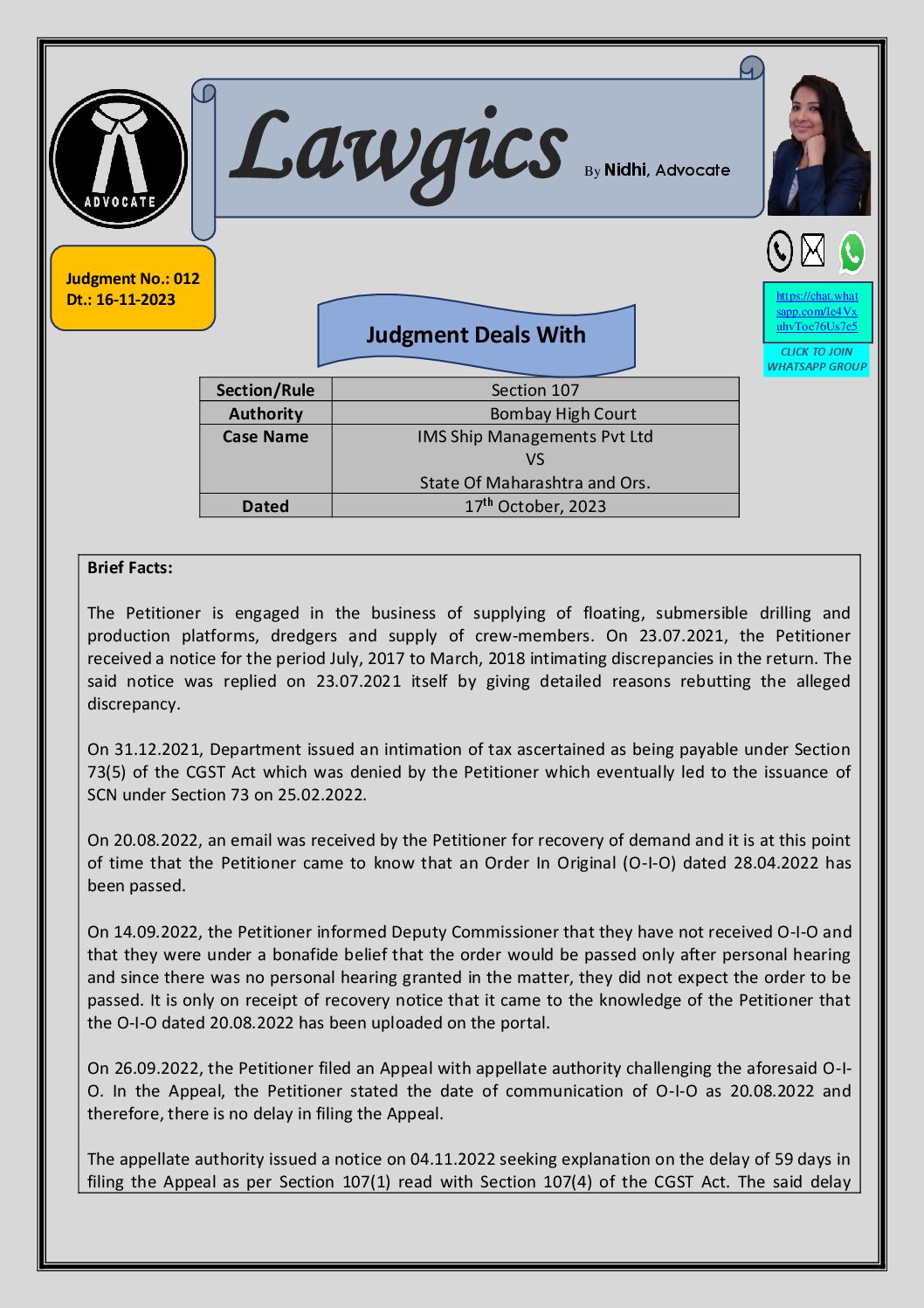
4 Judgment by Ms.Nidhi Aggarwal
|
Ms. Nidhi Aggarwal is delighted to present judgment with a great vision to spread complex GST law in a simple manner amongst the taxpayers, tax professionals, students and knowledge seeker.
|
|
Lawgics- 12 Judgment is added for your reading
|
|
|
|
|
|
|
5. GST Notes by CMA Anil Sharma
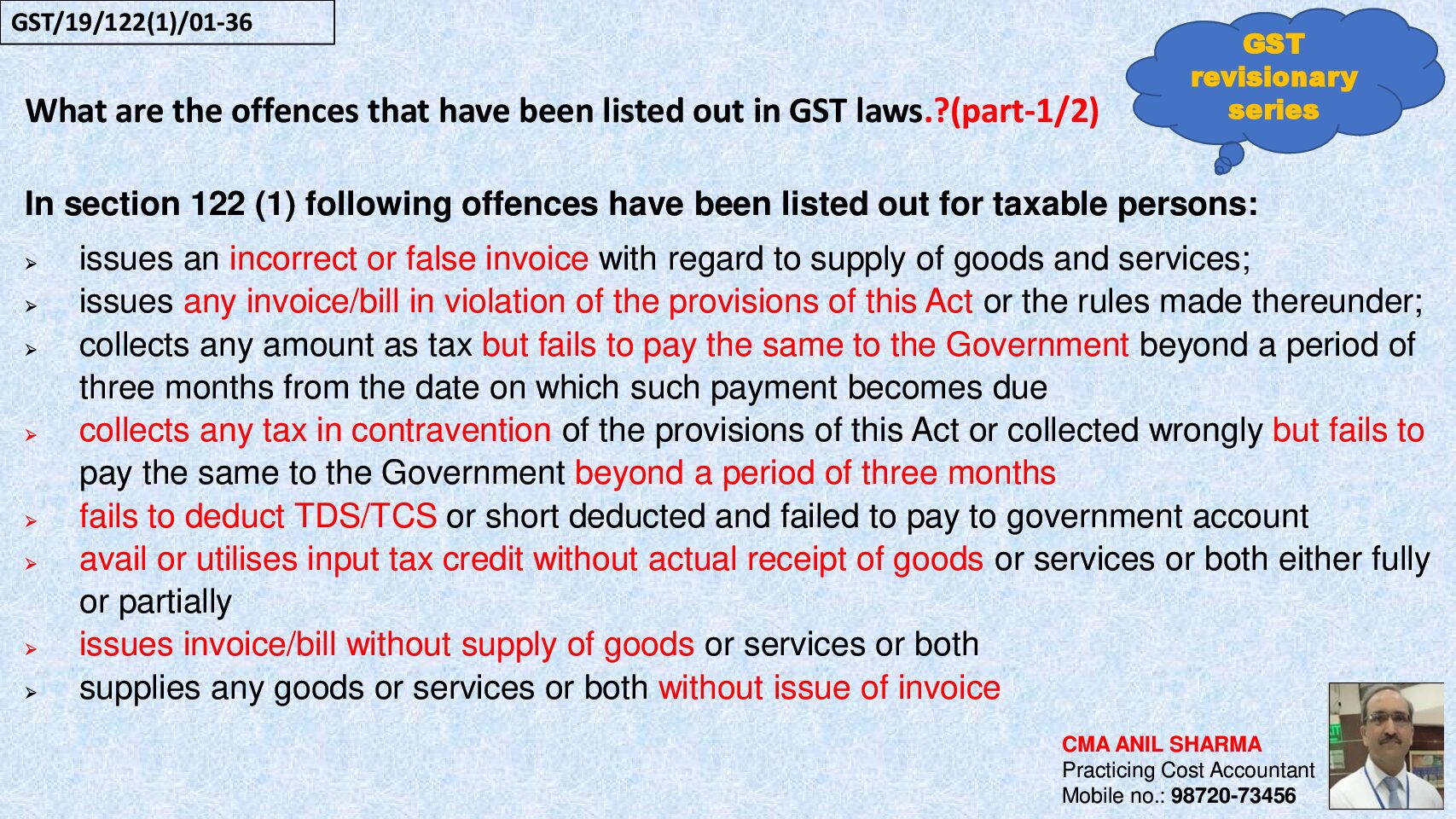
1) Shri CMA Anil Sharma, Shri CMA Gurdev Singh Saini and Smt. CMA Bhawna Sharma posted Chapter-19 recently containing CGST Act in simple language in PPT format. This is to make dealers, professionals, academicians, students etc. understand the basics of GST laws.
|
Chapter-19th slide is given below.
|
|
|
|
|
|
|
|
|
Do you wish to publish your Article?
If you wish to share your article with maximum readers then please send it at taxupdate.otu@gmail.com. We shall publish it with all due credit to you.
|
|
The topic can be on GST, Income Tax, Pre-GST laws, PPT, Notes etc. The article may contain 500 words to 1500 words or it may be more than that if the article demands.
|
|
|
|
|
|
|
If you wish to subscribe to weekly Newsletter at Rs. 149/- for one year, please subscribe. We shall send you the updates weekly.
|
|
|
|
|
|
|
Hope the above updates is of use to you. Please share your input and feedback at taxupdate.otu@gmail.com
|
|
|
|
|
|
 
|
Visit our website
|
OTU provides you
|
- Articles on various topics
|
|
- Media - GST, Income Tax & Press R.
|
|
- Notes / Newsletter at 149/ p.a.
|
|
|
|
|