|
|

|
|
|
|
|
|
onlinetaxupdate team wish to express sincere thanks to all the readers, authors, subscribers for the support extended to us.
|
|
|
|
Dear Reader,
|
Please find newsletter for your reading and reference.
|
|
Newsletter no.108 dated 16.01.2024
|
|
|
Index of the Newsletter
- Recent updates
- GST/IT/Press Release
- Lawgics by Ms. Nidhi Aggarwal
- GST Notes by CMA Anil Sharma
- GST Daily by CA Pradeep Modi
- Judgment Analysis by CA Nitin Bhuta
- Article
- PPT
|
|
|
|
|
|
|
Export consignments to West Asia will continue to receive enhanced insurance cover against payment defaults until September 30, the Directorate General of Foreign Trade (DGFT) said in a notification on Monday.
|
Earlier, the enhanced cover for exporters taking credit risk insurance from Export Credit Guarantee Corporation (ECGC) was available for shipments to West Asia sent between March 16 and June 15.
|
The enhanced risk cover announced on March 19 was part of the Resilience and Logistics Intervention for Export Facilitation (RELIEF) scheme under the Export Promotion Mission (EPM) to support exports to West Asia in view of the Iran war.
|
"The eligibility timelines under Component II of the EPM RELIEF intervention are extended up to September 30, 2026 to support Indian exporters and mitigate logistics challenges arising out of the continuing West Asia Crisis," the DGFT said.
|
Source: The Economic Times
|
|
|
|
|
|
|
|
Threshold limit for Inter-state movement of goods is Rs. 50,000/-. However, for intra-state movement of goods there is exceptional higher limit of Rs.1,00,000/- in some states.
|
Here is the list of e-way bill limit state-wise.
|
|
|
|
|
|
|
|
Directorate General of Foreign Trade (DGFT) issued Public Notice No. 17/2026-27 dated 04.06.2026 regarding Enlistment under Appendix 2E of FTP, 2023-Agency Authorised to issue Certificate of Origin (Non-Preferential)
|
|
|
|
|
|
2 Media - GST/IT/Press Release
|
|
|
|
|
CBIC -
To commemorate nine years of the Goods and Services Tax (GST), the Central Board of Indirect Taxes and Customs (CBIC) organized a special celebration at CSOI, New Delhi, on 1 July 2026. The event was held under the theme, ‘सुगम कर व्यवस्था, सशक्त भारत’, highlighting GST's
|
GST Indore -
The 9th #GSTDay was celebrated with great enthusiasm at CGST & Central Excise Commissionerate, Indore under the theme "सुगम कर व्यवस्था, सशक्त भारत".
|
GST Samvad an interaction among officers, taxpayers, trade & industry representatives, and tax professionals was organised on 30.06.2026 to commemorate nine years of GST as a transformative reform. The programme highlighted taxpayer facilitation initiatives, digital services, policy updates, and the importance of timely and voluntary compliance.
|
9 Years of GST! The CGST Indore Commissionerate celebrated the 9th anniversary of the Goods and Services Tax. The event marked nearly a decade of economic transformation and a unified national market.
|
Recognizing Excellence: The Department felicitated leading revenue contributors-Bharat Petroleum( @BPCLimited), HDFC Limited(@HDFCLTD), and MRF Limited(@MRF_Corporate)-for their exemplary tax compliance.10 dedicated departmental officers and a meritorious student were also honored
|
Taxpayer First: CGST Indore Commissioner Shri Peeyoush Bhati highlighted GST’s role in nation-building and announced that the Commissionerate will now regularly host monthly meetings with taxpayers to address grievances and ensure a transparent, efficient regime.
|
GST Aurangabad Commissionerate -
CGST AURANGABAD building lit up to kick in early 9th GST day celebrations
|
CGST Mumbai West -
As part of the #GSTPakhwada on occasion of upcoming 9th GST Day, on this year’s theme "सुगम कर व्यवस्था, सशक्त भारत” (Easy Tax System, Empowered India), CGST Mumbai West Commissionerate organised an Essay Writing Competition for officers and staff.
|
The winners and participants were felicitated by the Hon’ble Commissioner, CGST&C.Ex. Mumbai West appreciating their enthusiasm and insightful contributions.
|
WIRC of The Institute of Cost Accountants of India
Celebrating one of India’s landmark tax reforms that strengthened transparency, unity and the vision of One Nation, One Tax, One Market.
|
DGTPS MUMBAI CBIC
9वें GST दिवस के उपलक्ष्य में DGTS MZU & AZU द्वारा "Nine Years of GST: Perspective from Taxpayers" विषय पर Kendriya Vidyalayas के विद्यार्थियों हेतु एक वेबिनार आयोजित किया गया।
|
इस सत्र के माध्यम से GST के प्रति जागरूकता, वित्तीय साक्षरता को बढ़ावा दिया गया तथा विद्यार्थियों को राष्ट्र निर्माण में कराधान की भूमिका से अवगत कराया गया।
|
CGST Thane -
CGST Thane organized a 'Hindi & Marathi Essay Competition' for officers & staff
|
The Commissioner honored winners with certificates for outstanding performance
|
Celebrating language, awareness & commitment to GST
|
CGST MUMBAI EAST
As part of the 9th GST Day celebrations, CGST & Central Excise, Mumbai East Commissionerate organised Essay Writing and Drawing Competitions for students of Sandesh Vidyalaya & Junior College, Vikhroli (East), on 30.06.2026, with enthusiastic participation from young students.
|
The essay competition focused on GST and citizens’ responsibility towards tax compliance, while the drawing competition encouraged students to express ideas creatively. Prizes were awarded to winners, promoting taxation awareness and responsible citizenship among young minds.
|
As part of the 9th Anniversary celebrations of GST, CGST & Central Excise, Mumbai East Commissionerate organised GST "SAMVAD" and interactive session with members of trade and tax professionals on 29 June 2026 at Vikhroli to mark the occasion with active participation.
|
The session witnessed enthusiastic participation. Queries on filing of appeals, GST returns and other GST-related issues were addressed by officers, making it a valuable platform for knowledge sharing, constructive dialogue and promoting voluntary tax compliance across sectors.
|
CGST & Customs Thiruvananthapuram Zone
On the occasion of International Day Against Drug Abuse & Illicit Trafficking, the officers and staff of CGST & Customs Thiruvananthapuram Zone took a solemn pledge under the #NashaMuktBharatAbhiyan to build a society free from the menace of drugs.
|
DGTS AHMEDABAD CBIC
30.06.2026 को,DGTS AZU और MZU ने JG University के साथ मिलकर GST Awareness & Overview पर एक हाइब्रिड सेमिनार आयोजित किया।DGTS के Pr. ADG,श्री सुमित कुमार ने उद्घाटन भाषण दिया। CBIC के रिटायर्ड सुपरिटेंडेंट श्री जॉन क्रिश्चियन मुख्य वक्ता थे। #DGTS #GST #GSTDAY2026 #CBIC
|
Article Writing Competition 2026
To commemorate 9th Year of GST, Online Tax Update (OTU) launched 'Article Writing Competition 2026'. Registration starts today 1st July 2026 and ends on 15th July 2026. Article submission till 31st July 2026 and Winner Announcement in August, 2026. Cash Award + Certificate of Participation. Participation fees Rs. 300/- Read more
|
|
|
|
|
|
|
|
Centre has extended the last date for filing appeals before the Goods and Services Tax Appellate Tribunal (GSTAT) to July 31, 2026, giving taxpayers an additional month to submit their cases after a surge in filings led to technical difficulties on the GSTAT portal.
|
The extension applies to appeals filed under Section 112(1) read with Section 112(3) of the Goods and Services Tax (GST) law.
|
The revised deadline replaces the earlier cut-off of June 30, 2026, which had been notified by the government on September 17, 2025.
|
The decision follows recent representations from various stakeholders who flagged technical issues arising from a rush of appeals being filed on the GSTAT portal ahead of the deadline.
|
While noting that the original due date had been notified well in advance in September 2025, the government said filing activity had intensified sharply in recent weeks. It said 30,000 appeals were filed in the last 15 days alone, with daily filings touching a peak of 5,500 appeals.
|
Advising against eleventh-hour filings, the government urged taxpayers to complete their appeal submissions well in advance to ease pressure on the GSTAT portal.
|
The GST Appellate Tribunal serves as the first judicial appellate forum for taxpayers seeking to challenge orders issued by GST authorities after the disposal of their first appeals.
|
Source: The Economic Times
|
|
|
|
|
|
|
|
|
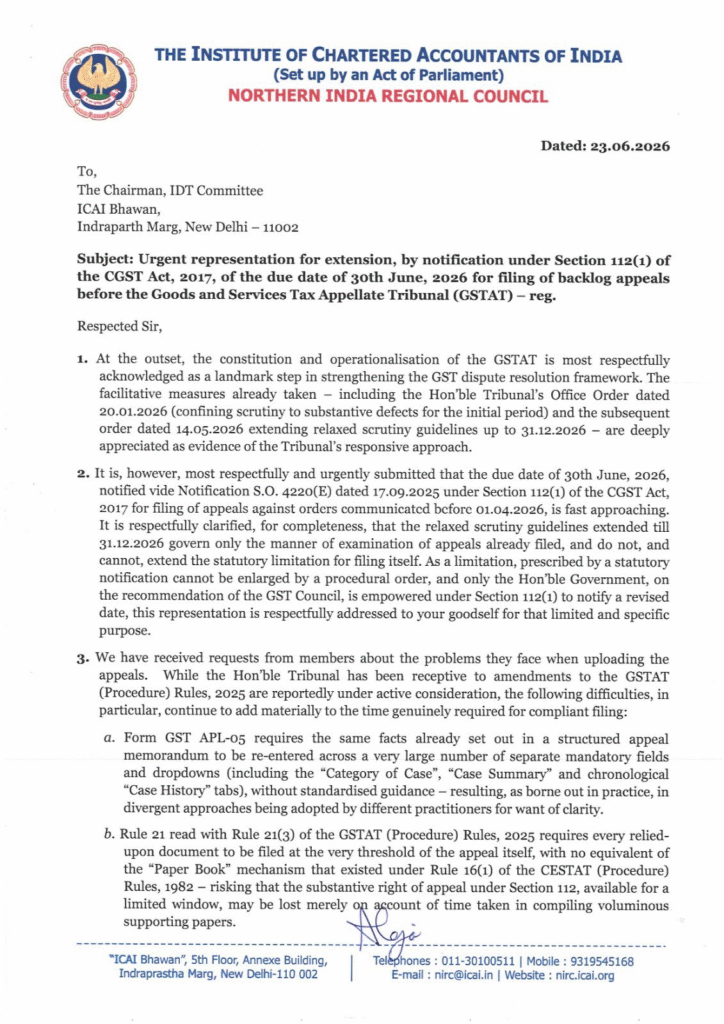
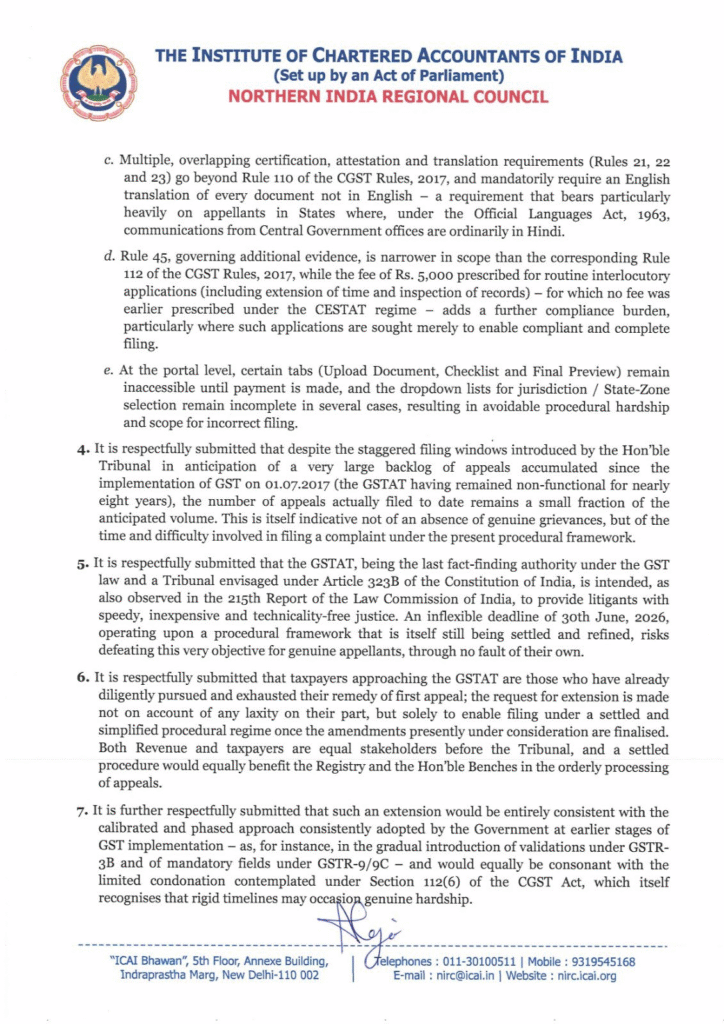
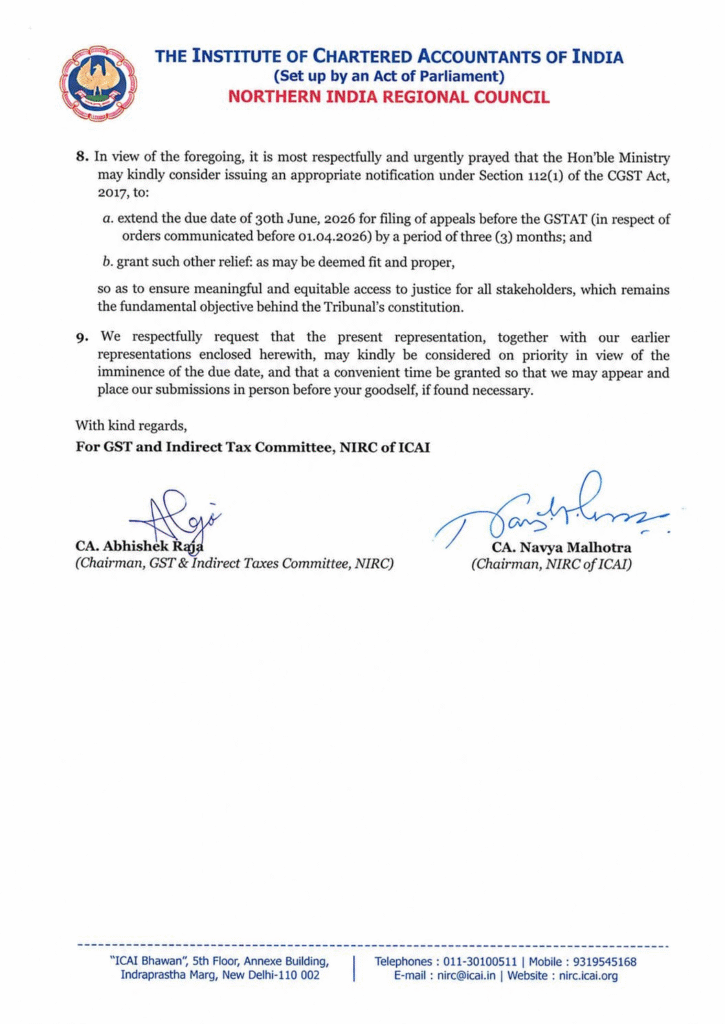
GST & IDT Committee has requested the Chairman, IDT Committee, ICAI, New Delhi to urgently represent before the respective forums for the date extension of GSTAT, i.e., 30-Jun-2026.
|
|
|
|
|
|
|
|
|
|
|
|
|
|
|
|
|
Tata Steel Limited said tax authorities have filed an appeal seeking restoration of penalties worth Rs. 368.72 crore that were earlier dropped in a GST adjudication order, even as proceedings on the underlying demand remain stayed by the Jharkhand High Court, according to a stock exchange filing.
|
"One June 16, 2026, the Assistant Commissioner, Division-I, CGST & Central Excise , Jamshedpur, Jharkhand filed an appeal before the Commissioner (Appeals) of CGST & Central Excise, Ranchi against the above-mentioned Adjudication Order dated December 18, 2026, to the extend that the Adjudicating Authority has dropped the penalty amounting to Rs. 3,68,72,21,158/-," Tata Steel said in its exchange filing.
|
The appeal, filed on June 16 by the Assistant Commissioner, CGST & Central Excise, Jamshedpur, challenges the December 18, 2025, adjudication order to the extent it waived the penalty.
|
The original show-cause notice, issued in June 2025, proposed disallowance of input tax credit for FY 2018-19 to FY 2022-23, with an aggregate GST demand of about Rs. 1,007.55 crore. Of this, Tata Steel said it has already paid Rs. 514.19 crore in the normal course, leaving an alleged exposure of Rs. 493.35 crore.
|
In December 2025, the adjudicating authority confirmed the tax demand of Rs. 493.35 crore, imposed a penalty of Rs. 638.83 crore and applicable interested, while dropping an earlier proposed penalty of Rs. 368.72 crore. Tata Steel subsequently moved the Jharkhand High Court, which granted a stay on all further proceedings in March 2026.
|
"This matter is, inter-alia, contingent upon the final adjudication of the issue concerning the issuance of show cause notices for multiple periods, which is presently sub judice before the High Court," Tata Steel said.
|
Tata Steel added that it has a good case on merit and hence will contest the same before the Appellate Authority within the statutory timelines, noting that the development has no impact on its financial or operational position, arising from the said appeal.
|
Source: The Economic Times
|
|
|
|
|
|
|
|
With the June 30 deadline for filing legacy appeals before the Goods and Services Tax Appellate Tribunal (GSTAT) fast approaching , tax professionals, chartered accountants and industry bodies have urged the Finance Ministry to extend the filing window, warning that persistent technical glitches on the GSTAT portal could prevent thousands of taxpayers from filing their appeals before the deadline.
|
The demand comes as taxpayers seek to file appeals arising from nearly nine years of litigation accumulated during the period when the Tribunal remained non-operational. Experts said the combination of a massive backlog, voluminous documentation and continuing portal-related issues has significantly constrained taxpayers' ability to meet the deadline.
|
According to Aditya Singhania, Founder of Trackase, the backlog is estimated at nearly four lakh to 4.5 lakh legacy appeals, while only around 36,929 appeals have been filed nationalwide so far.
|
"The ground reality is deeply concerning. Against an anticipated backlog of nearly four to four and a half lakh appeals accumulated over nine years of the Tribunal's non-operationality, only around 36,929 appeals have been filed nationally as of now," Singhania said.
|
He attributed the slow pace of filings to the teething troubles of the newly launched e-filing portal, including server time-outs, authentication challenges, payment gateway reconciliation issues and a filing structure that requires considerable time and effort to navigate.
|
Experts cite portal hurdles, record backlog
According to experts and representations submitted to the Finance Ministry, taxpayers continue to face multiple technical issues on the GSTAT portal, including session expiry, repeated login failures., Aadhaar authentication problems, Digital Signature Certificate (DSC) validation failures, payment reconciliation delays and incomplete integration between the Goods and Services Tax Network (GSTN) and the GSTAT portal.
|
Experts said taxpayers are also required to retrieve and compile extensive records accumulated over several years, including adjudication orders, invoices, reconciliations, e-way bills, ledger extracts and other supporting documents, making the filing process particularly time-consuming.
|
CA Nitin Bansal, State-President, BJP CA Cell Haryana, said the Finance Ministry has received several representations highlighting the practical challenges taxpayers are facing in filing appeals before the Tribunal.
|
"With the Tribunal becoming operational after nearly nine years, taxpayers must now prepare and file a substantial backlog of appeals within a limited window, many involving voluminous, multi-year records, even as the GSTAT e-filing portal continues to stabilise," Bansal said.
|
He added that extending the deadline would be revenue-neutral as the mandatory pre-deposit and other conditions would remain unchanged while ensuring genuine taxpayers are not denied their appellate remedy because of circumstances beyond their control.
|
Over-time extension sought
CA Sonu Goel, Chairman, Panipat Branch of the Institute of Chartered Accountants of India (ICAI), said a one-time extension would ensure disputes are decided on their merits rather than procedural constrints.
|
"One-time extension would safeguard taxpayers' right to appeal, uphold the principles of natural justice, and ensure that dispute are decided on merits rather than being defeated by procedural or technological constraints. This pragmatic relief would further reinforce the Government's commitment to ease of doing business while maintaining certainty and confidence in the GST ecosystem," Goel said.
|
Parag Mehta, Partner at N.A. Shah Associates LLP, said the portal continues to experience issues ranging from login failures and incorrect fee calculations to disappearing data.
|
"Considering the fact that the portal is not fully supporting the filing process and the number of appeals filed remains significantly lower than expected, the deadline should be extended. GSTAT is an important appellate remedy and taxpayers should not be deprived of that opportunity," Mehta said.
|
Bas association flags nationwide concerns
The Sales Tax Bar Association has also written to the Finance Ministry seeking an extension of the filing deadline, stating that taxpayers and tax professional across the country continue to face significant practical and technical difficulties while filing appeals through the GSTAT portal.
|
In its representation, the association said the present limitation period covers appellate orders accumulated over nearly nine years when the Tribunal remained non-functional, requiring taxpayers to retrieve historical records and prepare detailed documentation within a limited period.
|
The association highlighted recurring issues including server interruptions, repeated Aadhaar authentication and DSC validation failures, payment gateway reconciliation delays, manual duplication of information already available on the GSTN portal and challenges in uploading voluminous records.
|
It warned that if the deadline is not extended, thousands of taxpayers could lose the opportunity to pursue their statutory appeals because of technological and procedural constraints, potentially leading to avoidable litigation before various High Courts.
|
Prabhat Ranjan, Senior Director at Nexdigm, said extending the filing deadline has become "the need of the hour".
|
"The appellate process should be about the actual merits of the issues between both parties and not technical questions of delay. This is a taxpayer-friendly measure that will make GST dispute resolution processes more fair and credible," he said.
|
As of publication, the government has not announced any extension of the June 30 deadline for filing legacy GSTAT appeals. While the GSTAT has extended the period for relaxed scrutiny of filed appeals until December 31, 2026 , tax professionals, industry experts and representative bodies continue to seek a one-time extension of the filing deadline, arguing that additional time would enable taxpayers to exercise their statutory right of appeal without affecting revenue, as the mandatory pre-deposit requirements would continue to apply.
|
Source: The Economic Times
|
|
|
|
|
|
|
|
Businesses shifting their principal place of business to a new GST jurisdiction will not have to restart pending tax proceedings with the Central Board of Indirect Taxes and Customs (CBIC) clarifying that the new jurisdictional authority will take over and complete all ongoing cases from the stage at which they were left, reported PTI.
|
The clarification comes after the CBIC received references from field formations seeking guidance on the validity of proceedings and the authority responsible for handling cases when a registered taxpayer changes jurisdiction because of a shift in its principal place of business.
|
Under the circular, any action or proceeding - including investigation, audit, show cause notice or adjudication under the Central GST law - initiated by the tax officer having jurisdiction over the registered taxpayer at the time the action was undertaken (transferor jurisdiction authority) will remain valid even if the taxpayer subsequently shifts to another tax jurisdiction (transferee jurisdictional authority).
|
"The transferee jurisdictional authority shall act upon, give effect to, and proceed on the basis of such earlier valid action taken by the transferor jurisdictional authority, as if it had itself initiated the same," the CBIC said in the circular.
|
The indirect tax board further clarified that if any fresh issue comes to the notice of the earlier jurisdictional authority after the taxpayer has shifted, the tax officer should intimate the new jurisdictional officer for appropriate action.
|
"Where the taxable person migrates to another jurisdiction during the pendency of any action or proceeding initiated by the transferor jurisdictional authority, the transferee jurisdictional authority shall take over and conclude the same from the stage at which it stood at the time of migration/ transfer," the CBIC circular said.
|
The new jurisdictional officer will also have the authority to initiate and conclude any consequential proceedings arising from the case.
|
Rajat Mohan, Managing Partner at AMRG Global, said the clarification addresses a key procedural gap under the GST regime.
|
"By clearly defining the responsibilities of transferor and transferee authorities, CBIC has removed ambiguity that often resulted in jurisdictional objections and delays in adjudication," Mohan said.
|
Source: The Times of India
|
|
|
|
|
|
|
|
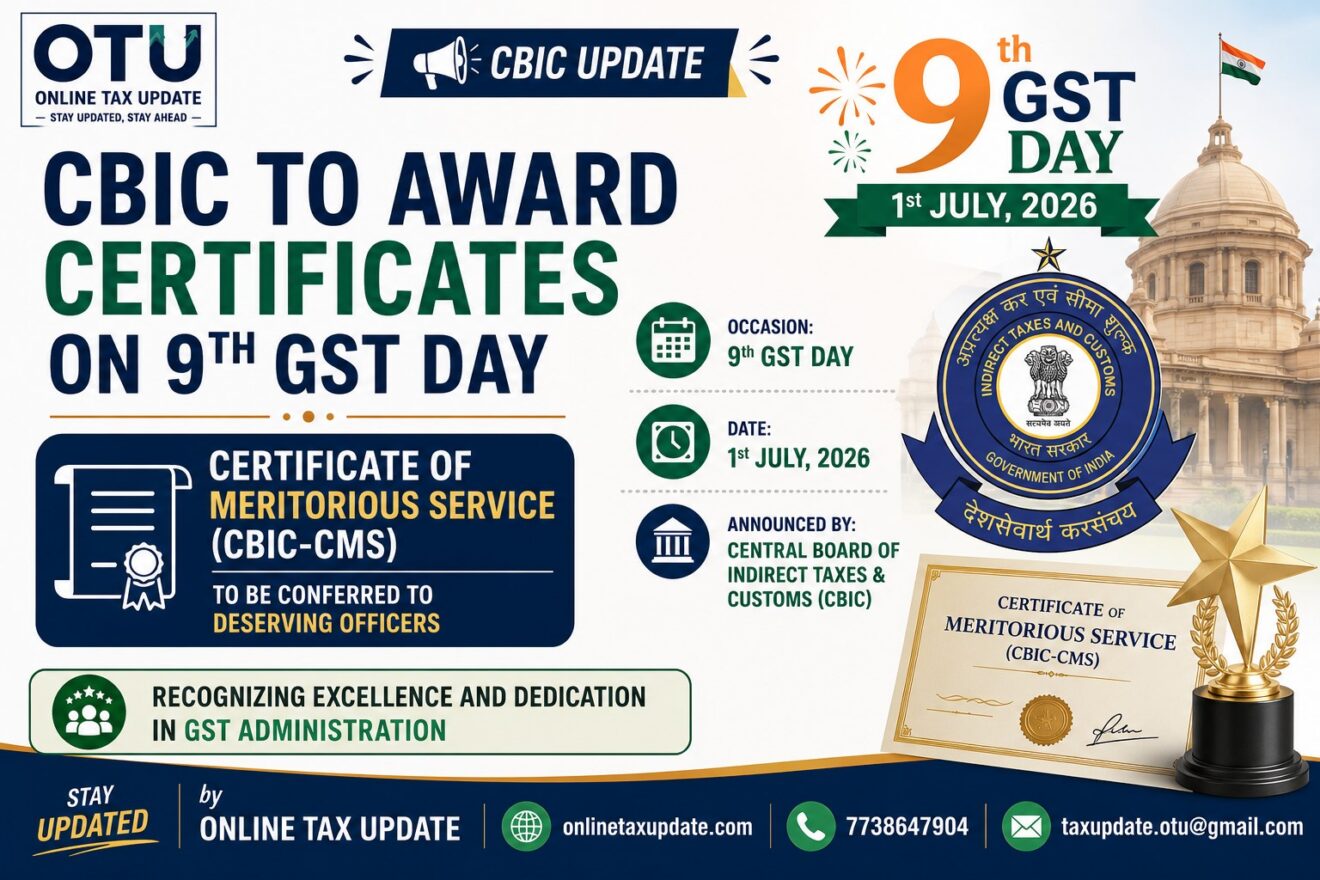
On the occasion of 9th GST Day to be celebrated on 1st July, 2026 the Central Board of Indirect Taxes and Customs vide Office Memorandum dated 29.06.2026 has decided to grant Certificate of Meritorious Service (CBIC-CMS) to the following officers:
|
|
|
|
|
|
|
|
The Malad Chamber of Tax Consultants made a representation to the Hon'ble Union Finance Minister, Smt. Nirmala Sitharaman, New Delhi on 26.06.2026 requesting an extension of the statutory deadline for filing GSTAT appeals under Section 112 of the CGST Act, 2017 from 30th June 2026 to 31st December 2026.
|
|
|
|
|
|
|
|
The recent meeting between Prime Minister Narendra Modi and President Droupadi Murmu, followed by a meeting between Home Minister Amit Shah and the President, have fuelled speculation over a possible Union cabinet reshuffle as well as changes in the BJP's organisational structure.
|
According to sources, the reshuffle is likely to take place before the upcoming Monsoon Session of Parliament.
|
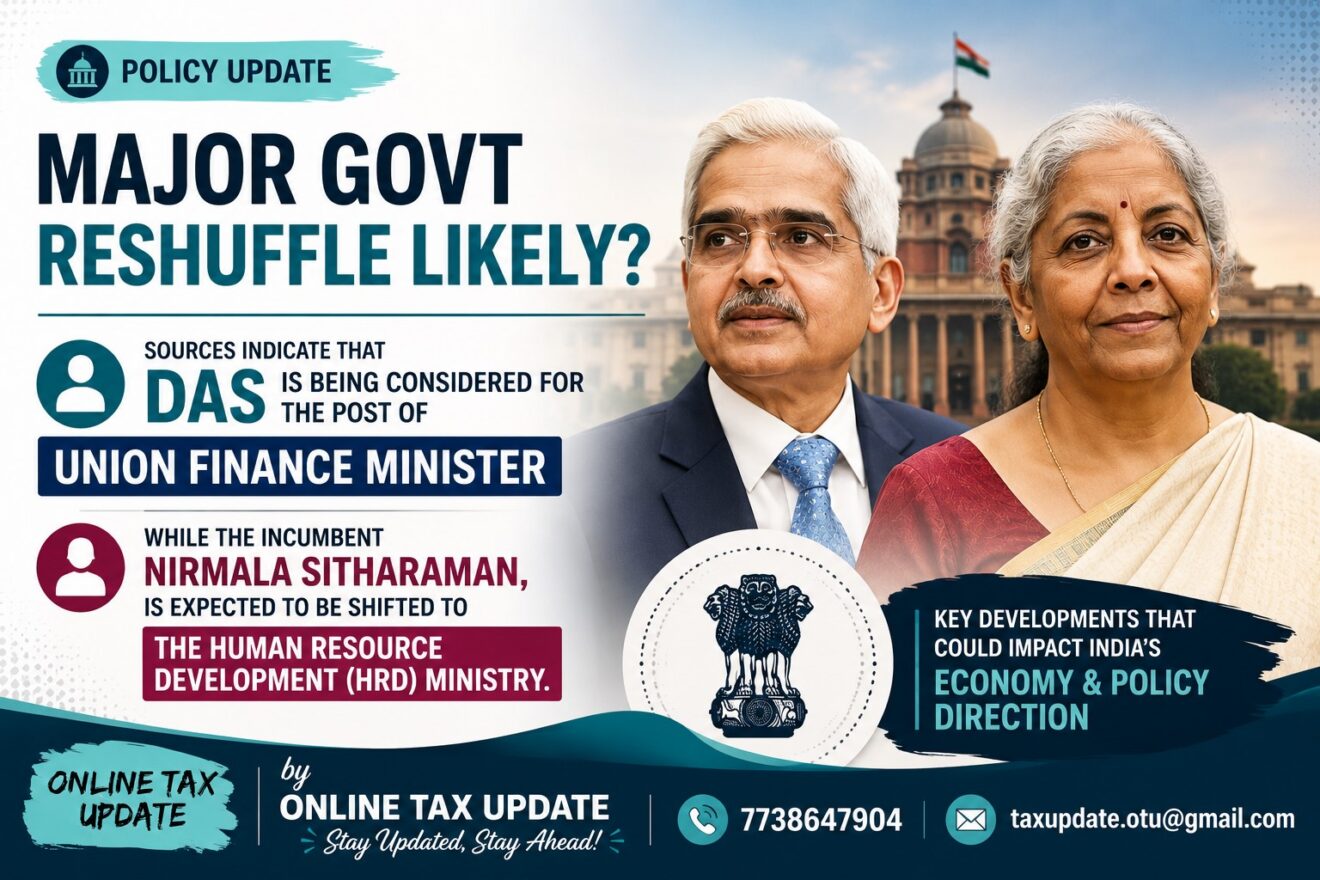
Among the names being discussed is that of former Reserve Bank of India (RBI) governor Shaktikanta Das, who is currently serving as the Principal Secretary to the Prime Minister.
|
Sources indicated that Das is being considered for the post of Union finance minister, while the incumbent , Nirmala Sitharaman, is expected to be shifted to the human resource development (HRD) ministry. Sitharaman has been serving as the Union Minister for finance and corporate affairs since 2019.
|
There has, however, been no official confirmation from either the government or the BJP regarding any proposed changes.
|
If the move materialises, it would bring into the Cabinet a seasoned administrator with more than four decades of experience across several areas of governance.
|
Das served as the 25th Governor of the RBI from 2018 to 2024. Before assuming charge at the RBI, he was a member of the 15th Finance Commission and India's G20 Sherpa.
|
Over the course of his career, Das has held several key positions in both the Central and State governments, handling portfolios related to finance, taxation and industries and infrastructure.
|
During his tenure in the finance ministry, he was closely associated with the preparation of eight Union Budgets, giving him extensive experience in public finance and economic policymaking. Besides, Das was also the senior Department of Economic Affairs official in the finance ministry during the planning and implementation phase of demonetisation.
|
A postgraduate from St. Stephen's College, University of Delhi, Das has also served as India's Alternate Governor to the World Bank, the Asian Development Bank, the New Development Bank, and the Asian Infrastructure Investment Bank. He has represented India at major international forums, including the IMF, G20, BRICS, and SAARC.
|
|
|
|
|
|
|
|
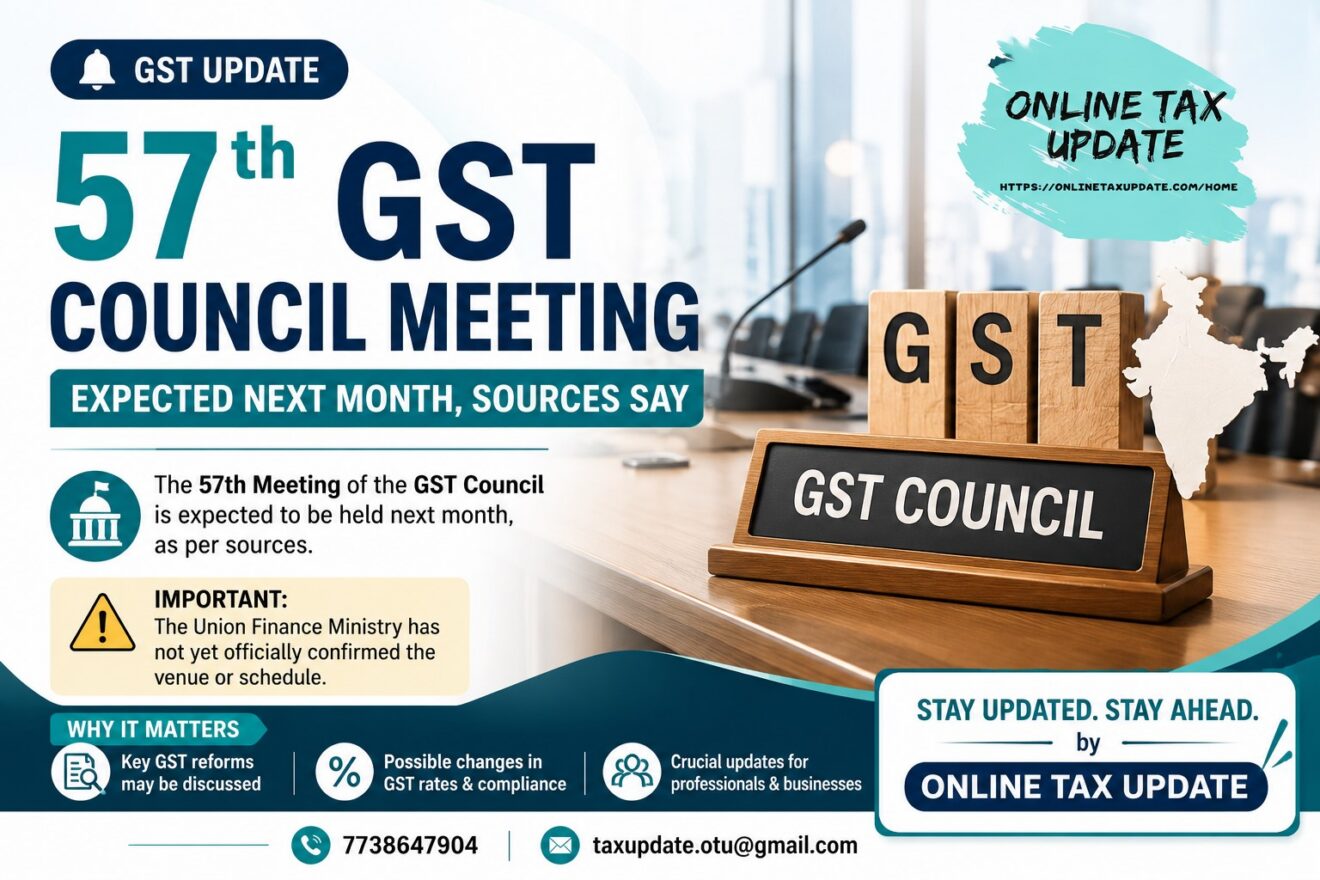
Kolkata is likely to host the 57th meeting of the GST Council next month, sources said, although the Union Finance Ministry has not yet officially confirmed the venue or the schedule. The meeting is expected to be held in the second half of July, and could take up the next round of indirect tax policy reforms.
|
Hosting the meeting in Kolkata holds significance as it would mark one of the first major meetings of a Constitutional federal body in West Bengal after the Assembly elections. While the GST Council independently decides its agenda and meeting schedule, the choice of Kolkata would coincide with the Centre’s broader emphasis on strengthening the State’s profile as a destination for investment and financial activity following the change in government.
|
New reforms
The previous GST Council meeting, held on September 3, 2025, came after a gap of nearly nine months, despite the rules providing for at least one meeting every quarter. That meeting unveiled GST 2.0, including rate rationalisation and measures to ease compliance. Tax experts now expect the council to consider another set of policy reforms, some of which were discussed during 4th Annual Seminar on Direct and Indirect Taxes of the Bengal Chamber of Commerce & Industry (BCCI).
|
Vivek Jalan, Chairperson of the National Fiscal Affairs and Taxation Committee of BCCI, said that in the spirit of GST 2.0, which was launched to strengthen India’s manufacturing base, the council should correct the anomaly of non‑refund of Input Service ITC under the inverted duty structure. While GST 2.0’s rate rationalisation has supported consumption, the cost pressures has deepened on manufacturers. “Addressing this gap will ensure reducing cascading taxes, boosting competitiveness and advancing India’s vision of becoming the world’s third‑largest economy by 2047,” he said.
|
Also, it has been proposed before the GST Council to consider reducing the GST rate on autism care centres and allied sectors from 18 per cent to 5 per cent. Such a measure under GST would ease the financial strain on families and institutions, while reinforcing the government’s vision of inclusive growth. “By aligning tax policy with compassion, the council can ensure that essential services for differently‑abled children remain affordable, accessible and sustainable, a step that truly reflects the spirit of GST reforms,” said Jalan.
|
Source: The Hindu businesline
|
|
|
|
|
|
|
|
The Karnataka State Chartered Accountants Association (R) (KSCAA) has submitted a representation highlighting practical and procedural issues faced by taxpayers and professionals in relation to the Goods and Services Tax Appellate Tribunal (GSTAT). The representation focuses on addressing operational challenges and suggesting measures to enhance the efficiency, accessibility, and effectiveness of the GSTAT framework.
|
Considering the initial challenges faced by stakeholders in adapting to the newly operational GSTAT framework and portal, KSCAA has also requested an extension of the timelines for filing appeals and related compliances, so that taxpayers are not prejudiced on account of procedural and technical difficulties. Addressing these concerns and providing adequate transition time will facilitate smoother implementation, reduce avoidable litigation, and ensure meaningful access to the appellate remedy envisaged under the GST law.
|
|
|
|
|
|
|
|
Nine years after the rollout of the goods and services tax (GST) regime, businesses have largely embraced India's biggest indirect tax reform, with 99% reporting a positive or neutral experience, according to a Deloitte India survey. As the tax regime matures, businesses are now shifting their focus to ‘GST 2.0’, seeking reducing disputes, speeding up of refunds, improving working capital and simplifying compliance.
|
The findings come at a time when GST collections continue to be robust. In May, the Centre and states together collected ₹1.94 trillion in gross GST revenue, before adjusting for refunds, up 3.2% from ₹1.88 trillion mopped up a year ago.
|
The survey covered 1,096 C-suite and C-1 level executives across banking and financial services, consumer, energy, resources and industrials, government and public services, life sciences and healthcare, global capability centres, private equity and venture capital, and technology, media and telecommunications. Respondents included micro small and medium enterprises (MSMEs), large companies and very large enterprises.
|
About 69% respondents identified compliance digitalization as the biggest benefit of GST, followed by supply chain optimization and gains from rate rationalization. The survey noted that confidence in GST has been driven by the digitalization of compliance, automation of tax processes and the stabilization of e-invoicing and e-way bill systems.
|
"GST has significantly improved compliance and transparency with the GST Network as India's trusted tax framework. This digital backbone enables taxpayers, businesses and the government with real-time compliance and data-driven decision-making," said Gokul Chaudhri, president, tax at Deloitte South Asia.
|
Businesses ranked interpretational clarity as their top policy priority, with 87% of the respondents seeking greater certainty in tax administration. This was followed by demands for improved working capital management (67%), uniform audits (61%) and faster refunds.
|
The survey also found strong support for centralized audits, simplified GST rates and allowing reverse-charge mechanism payments through input tax credit.
|
"The key industry expectations include the need to resolve interpretational ambiguities, improve working capital through streamlined refunds and credit utilization, address ITC disputes and implement a unified and harmonized audit process," said Mahesh Jaising, partner and leader, indirect tax at Deloitte India.
|
Addressing inverted duty structures emerged as another major area of concern. Nearly 69% of respondents favoured expanding the refund formula to include all input taxes, while 63% supported further rate rationalization to reduce inversion-related issues. More than half sought refund benefits for accumulated input tax credit balances.
|
Technology is expected to play a bigger role in the next phase of GST reforms. Nearly 89% of respondents supported the use of artificial intelligence (AI) for tax data processing and reconciliation, while many sought a unified taxpayer dashboard, automatic tax utilization and improved integration across GST systems.
|
The survey found that priorities varied across sectors. Consumer and energy firms highlighted supply-chain optimization as the biggest gain from GST, while technology companies placed greater emphasis on compliance digitalization. Life sciences and healthcare companies cited benefits from competitive pricing following rate rationalization, while BFSI and global capability centres favoured greater automation and integrated digital infrastructure.
|
For MSMEs, quarterly return filing emerged as the most appreciated reform, with positive responses rising to 67% in 2026 from 12% in 2023. Smaller businesses also strongly supported invoice-based input tax credit eligibility, quarterly payment mechanisms and faster refunds to ease liquidity pressures, the survey said.
|
Some economists underscored the need for a more efficient refund mechanism under GST.
|
“Faster and more predictable GST refunds are critical for improving business cash flows. Delays in refunds increase working capital requirements and financing costs," said Dharmveer, assistant professor, economics at the Delhi School of Economics. "A more streamlined refund mechanism would enhance liquidity, especially for MSMEs and exporters, and support investment and growth.”
|
GST was introduced on 1 July 2017 as India's biggest indirect tax reform, replacing multiple central and state taxes with a single tax system. Since then, the regime has evolved with the rollout of e-invoicing, e-way bills and other digital compliance measures aimed at making tax administration easier and more transparent.
|
|
|
|
|
|
|
|
A Kanpur man is making headlines after he received relief from the Income Tax Appellate Tribunal (ITAT) in a case involving a Rs 1.95 crore trading loss incurred through his wife’s account.
|
According to The Economic Times, the man, whose identity remains undisclosed, transferred funds to his wife's account and used it to carry out Futures and Options (F&O) trading. The transactions resulted in a loss of Rs 1.95 crore during the financial year. When filing his income tax return, he reported the loss on his own return and adjusted it against his income.
|
However, the Income Tax Department challenged the claim and raised a tax demand, stating that the loss belonged to his wife's account and therefore could not be adjusted against the husband's income.
|
The dispute eventually reached the ITAT's Lucknow Bench. After examining the facts, the tribunal found that the husband had transferred funds to his wife's account, and that he carried out the trading through his wife's account, and the loss occurred there.
|
The tribunal pointed out that, under the Income Tax Act’s clubbing rules, income generated from assets gifted or transferred to a spouse is typically included in the transferor’s income.
|
|
|
|
|
|
|
|
The Uttar Pradesh Electricity Regulatory Commission (UPERC) has ruled that the reduction in GST on renewable energy equipment from 12% to 5% will be treated as a “Change in Law” event under power purchase agreements signed under the PM-KUSUM Component-C2 scheme.
|
In a suo motu order issued on June 23, the Commission said the GST reduction, effective September 22, 2025, lowers the cost of procuring solar and other renewable energy equipment and therefore reduces the overall capital cost of projects. The resulting financial benefit must be passed on to the power procurer, Uttar Pradesh Power Corporation Ltd (UPPCL), and, ultimately, to consumers.
|
UPERC noted that the Ministry of Power had advised regulators to recognise the GST reduction as a Change in Law event and ensure that the benefits are transferred to consumers at the earliest.
|
The order applies to projects whose bids were submitted before September 22, 2025, and where invoices were raised or payments made on or after that date. The Commission directed that project-wise assessments be conducted to quantify the actual savings resulting from the GST reduction.
|
To implement the exercise, UPERC has ordered the constitution of expert committees comprising representatives of UPNEDA, UPPCL, the concerned discom and finance officials. Developers will be required to submit supporting documents, including invoices, payment records and auditor certificates, to establish the benefit accrued.
|
The Commission said revised tariffs would be determined on a project-by-project basis and directed developers and UPPCL to complete the assessment process within 90 days of the project’s commercial operation date.
|
Source: The Hindu business line
|
|
|
|
|
|
|
|
Sales Tax Bar Association (Regd.) (STBA) made representation for extension of the time limit for filing appeals before the Goods and Services Tax Appellate Tribunal (GSTAT) vide letter reference STBA/2026/25 dated 25.06.2026
|
Subject: Representation seeking extension of the time limit for filing appeals before the Goods and Services Tax Appellate Tribunal (GSTAT) beyond 30.06.2026 on account of persistent technical and practical difficulties in the GSTAT e-filing portal.
|
- Sales Tax Bar Association (Regd.), having been established on 30th March, 1957, is one of the oldest and the largest Association of Tax Professionals in the country. The Bar represents majority of members of various professions practicing in the Direct & Indirect Taxes. Sales Tax Bar Association (Regd.) plays a major role in revenue collection by the department. Present membership of our Bar Association is around 2000 comprising of Advocates, CA's and Tax Practitioners. Some of our members were elevated as Judges of the Hon'ble Delhi High Court and elevated as Judges of the Hon'ble Supreme Court. Some of our members further were also selected for appointment as Member of the Income Tax Appellate Tribunal (ITAT) and Goods & Services Tax Appellate Tribunal (GSTAT).
- However, despite the commencement of the Tribunal and the introduction of the online filing mechanism, taxpayers and tax professionals across the country continue to face substantial practical and technical challenges in filing appeals through the GSTAT portal. These difficulties are neither isolated nor individual in nature. Our Association has received numerous grievances from Professionals practicing across different State highlighting recurring issues that have significantly affected the ability of taxpayers to file appeals within the prescribed period.
- It is respectfully submitted that the Government has already been very sensitive to the problems faced by the taxpayers in filing of the appeals in the GSTAT and accordingly the Government vide Notification No. S.O. 4220 (E) dated 17.09.2025 had issued a notification by exercising its power under Section 112 (1) of the CGST Act, 2017. That vide the said Notification the Government had notified the due date for filing of appeal before the Appellate Tribunal as 30th June, 2026 in respect of all cases, where the order sought to be appealed against was passed on or before 01st April, 2026.
- It is respectfully submitted that thus the present limitation period pertains to appellate orders accumulated over almost nine years, during which the Tribunal remained non-functional. Preparation of these appeals itself requires considerable effort, including retrieval of old records, compilation of tax demands and preparation of detailed paper books. The recent operationalisation of the GSTAT portal has, therefore, resulted in an unprecedented volume of appeals being required to be prepared and filed within a comparatively shot period.
- While taxpayers and professionals have made every endeavour to comply with the prescribed timelines, the practical functioning of the portal has substantially reduced the effective period available for filing appeals. Some of the major difficulties experienced across the country are summarised below:
- Firstly, taxpayers continue to experience frequent portal-related issues including slow response time, session expiry, server interruptions and repeated login failures. In several instances, professionals spend considerable time completing an appeal, uploading documents and entering detailed information, only to find that the session has expired or the portal has hanged and become unresponsive, compelling them to recommence the entire process.
- Secondly, repeated failures in Aadhaar authentication and Digital Signature Certificate (DSC) validation have caused significant disruption in completing the filing process. Even where taxpayers possess valid Aadhaar credentials and duly registered Digital Signature Certificates, authentication, frequently fails or requires multiple attempts before the appeal can proceed further to the next stage.
- Thirdly, payment of the mandatory pre-deposit and court fee through the integrated payment gateway has also presented considerable practical difficulties. There have been instances where payments are debited from the taxpayer's account but the payment status is not immediately reflected on the portal, creating uncertainty regarding successful filing and necessitating further follow-up and reconciliation.
- Fourthly, the portal presently requires extensive manual entry of information which is already available on the GST common portal. Instead of seamless integration between the GSTN and the GSTAT portal, taxpayers are required to repeatedly enter registration particulars, order details and other information , making the filing process unnecessarily time-consuming and increasing the possibility of inadvertent errors.
- Fifthly, appeals under the GST regime frequently involve voluminous records comprising show cause notices, replies, adjudication orders, appellate orders, invoices, reconciliations, e-way bills, ledger extracts bank details and other supporting documents accumulated over several years. Preparation of such records in accordance with the portal's prescribed technical specifications regarding document size, format and uploading requirement has itself become a substantial exercise, particularly for appeals involving complex factual issues.
- Further, practical issues continue to be experienced in filing appeals relating to certain categories of persons, including matters involving penalties imposed upon directors, partners and other persons who do not have a valid GST registration. In several such cases, the portal does not presently facilities smooth filing of appeals, thereby creating uncertainty regarding the availability of the appellate remedy.
- It may also be appreciated that the GSTAT is a newly operationlised appellate forum with a completely new electronic filing framework. Taxpayers, advocates, chartered accountants and tax practitioners across the country are simultaneously familiarising themselves with the portal architecture, procedural requirements and filing methodology. A reasonable transition period is, therefore, both necessary and desirable to ensure effective implementation of this important final facts finding appellate forum.
- The above circumstances demonstrate that the request for extension does not arise on account of any lack of diligence on the part of taxpayers or professionals. On the contrary, taxpayers are making genuine efforts to exercise the statutory remedy available to them but are encountering practical difficulties beyond their control while navigating a newly introduced electronic problem.
- If the present timeline is not extended, thousands and thousand of genuine taxpayers may lose the opportunity to avail the appellate remedy solely because of technical and procedural difficulties associated with the portal. Such a situation would inevitably lead to avoidable litigation before various High Courts seeing appropriate reliefs in respect of limitation and portal-related issues , thereby increasing the burden upon the judiciary, the Department and the Tribunal itself. This would also run contrary to the Government's consistent objective of promoting ease of doing business, reducing litigation and facilitating voluntary tax compliance through efficient digital governance.
- It is respectfully submitted that granting a reasonable extension would not prejudice the interest of the Revenue in any manner. The statutory conditions governing appeals, including the mandatory pre-deposit prescribed under the Act, would continue to remain fully applicable. The extension would merely ensure that genuine taxpayers are afforded a fair and effective opportunity to avail the appellate remedy intended by the Legislature, while simultaneously allowing adequate time for further stabilisation of the GSTAT portal.
- In these circumstances, we most respectfully request your kind intervention to :
- Extend the last date for filing appeals before the GST Appellate Tribunal from 30.06.2026 to 30.09.2026 or for such further period as the Government may consider appropriate.
- Ensure that taxpayers facing genuine portal-related technical difficulties are not deprived of their opportunity to file appeals on account of circumstances beyond their control; and
- Continue strengthening and stabilising the GSTAT e-filing system during the extended period so that the objective of establishing an efficient, accessible and technology-driven appellate mechanism may be fully realised.
We are confident that your good office, which has consistently demonstrated its commitment towards taxpayer-friendly reforms and fair tax administration, will kindly consider this genuine request sympathetically in the larger interest of justice, efficient tax administration and ease of doing business.
|
We shall remain grateful for your kind consideration.
|
,
President (m) : 9810071545
|
,
Secretary (m) : 9811949733
|
- Hon'ble Minister of State for Finance, Room no. 16042, 6th Floor, A Wing, Kartavya Bhawan -I, New Delhi - 110001.
- The Revenue Secretary, Ministry of Finance, Govt. of India, Room No. 14102, Kartavya Bhawan - I, New Delhi -110001.
- The Joint Secretary, GST Council, 5th Floor, Tower II, Jeevan Bharti Building, Connaught Place, New Delhi-110001.
- The Chairman, CBIC, North Block, Central Secretariat, Room No. 14042, Kartavya Bhawan - I, New Delhi -110001.
- The President, GSTAT Pr. Bench, 6th Floor, Tower II, Jeevan Bharti Building, Connaught Place, New Delhi-110001.
|
|
|
|
|
|
|
GST Appellate Tribunal Bar Association, Delhi made a representation before The Chairman, Central Board of Indirect Taxes and Customs, Department of Revenue, Ministry of Finance, Government of India, North Block, New Delhi - 110001 vide Letter Ref. No. GSTATBAR/2026/005 dated 20.06.2026 seeking extension of the last date for filing appeals before GSTAT.
|
- Locus standi of the Association : The GSTAT Bar Association, Delhi ("the Association") is a duly constituted representative body of Advocates, Chartered Accountants and other tax professionals enrolled to practise before the Goods and Services Tax Appellate Tribunal ("GSTAT"/"the Tribunal"), with its registered office at the address mentioned above. The Association is a recognised stakeholder body under the GST Appellate Tribunal (Procedure) Rules, 2025, and its locus standi to espouse the collective grievances of its members, and through them of the larger body of assessees they represent, is fortified by the law laid down by the Hon'ble Supreme Court in S.P. Gupta v. Union of India, (1981) Supp SCC 87, wherein it was authoritatively held that any person or body possessing sufficient interest is entitled to maintain an action for redressal of a public injury, more so where the grievance concerns denial of affective access to a statutory forum of adjudication. It is in this representative capacity, in furtherance of the collective professional and public interest, that the present representation is respectfully submitted, and not in any individual cause.
- Statutory backdrop: Vide Notification bearing F. No. A-50/7/2025-GSTAT-DoR dated 17.09.2025 (S.O. 4220(E)), issued in exercise of the power conferred by sub-section (1) of Section 112 of the Central Goods and Services Tax Act, 2017 (‘the CGST Act’), and on the recommendation of the GST Council made at its 56th meeting held on 03.09.2025, the Central Government notified 30.06.2026 as the outer date up to which appeals in respect of orders communicated to the appellant before 01.04.2026 may be filed before the GSTAT. It is respectfully submitted that the said Notification was itself a product of the Government’s own recognition articulated through the Council’s recommendations – that the Tribunal, having remained non-functional for over nine years from the enactment of the CGST Act despite its constitution under Section 109 thereof, required a calibrated and staggered window to absorb the entire backlog of second appeals, estimated at over 4.8 lakh matters nationally against which only 20,111 appeals were filed by today. The Association submits, with the utmost respect, that the very rationale which persuaded the Government to grant this one-time window continues to subsist – and has, if anything, been aggravated – by reason of the persistent and substantial technical infirmities of the GSTAT e-filing portal (efiling.gstat.gov.in), none of which lie within the control of the taxpayer or his authorised representative, as elaborated in the grounds set out hereinbelow.
- It is further submitted that under Section 1 12(8) of the CGST Act, a pre-deposit of ten per cent (10%) of the disputed tax amount, over and above the deposit made under Section 107(6) at the first appellate stage, is a mandatory jurisdictional condition precedent for maintainability of the second appeal. The Board itself, recognising the difficulty faced by taxpayers in complying with this requirement during the period when the Tribunal was yet to become operational, had issued an interim mechanism vide Circular No. 224/18/2024 GST dated 11.07.2024. The grievances articulated below demonstrate that infirmities of a closely analogous nature persist even at the present, post operationalisation stage.
GROUND I – The Department’s own Advisory on online payment of court fees is, in substance, an admission of the payment-gateway infirmity, and offers no enforceable safeguard
|
It is submitted that the Department has itself issued an Advisory regarding online payment of court fees on the GSTAT portal (enclosed as Annexure B), which records, in terms, that where online payment has been made but the status is not reflected as ‘Success’: (i) the taxpayer is to wait upto 72 hours for the status to update; (ii) if the status does not update even thereafter, the system will not restrict or prevent filing; (iii) the taxpayer may proceed with filing without interruption; and (iv) the payment status shall be reconciled at the back end without adverse effect on the filing.
|
The Association submits, with respect, that this Advisory is, by itself, a candid and authoritative admission by the Department of the very Bharatkosh payment-gateway infirmity. More fundamentally, the Advisory is a mere administrative instruction having no statutory force under the CGST Act, the GSTAT Procedure Rules, 2025, or any notification issued thereunder; it is well settled that administrative circulars and instructions, howsoever salutary, cannot rewrite or substitute for the statute or the rules, and confer no independently enforceable right upon the taxpayer in the event the promised back-end reconciliation does not, in fact, materialise. A taxpayer whose appeal is, notwithstanding the Advisory, subsequently treated as deficient or time barred for want of a reconciled payment is left without remedy, since the Advisory creates an expectation without a corresponding statutory guarantee and therefore, it itself underscores the necessity of the extension and safeguards prayed for herein.
|
GROUND II – The mandatory checklist on the GSTAT portal travels beyond the requirements of the CGST Act and the Rules framed thereunder
|
It is submitted that several of the declarations and fields comprised in the mandatory checklist at the GSTAT Portal find no corresponding requirement either in Section 1 12 of the CGST Act or in the GSTAT Procedure Rules, 2025, and are, in substance, extra-statutory conditions superimposed by the portal’s own design.
|
It is a settled principle of administrative law that subordinate legislation and, a fortiori, a portal-level procedural prescription having even less statutory sanctity than a rule must conform to, and cannot travel beyond, the scope of the parent enactment. A checklist item unmoored from any statutory requirement, yet mandatorily insisted upon as a pre-condition to filing, is to that extent ultra vires and cannot be permitted to obstruct the substantive right of appeal conferred by Section 112.
|
GROUND III – Technical specifications such as 300 DPI scanning resolution and a 250-page document limit, nowhere prescribed under the Act, impose an unreasonable burden on tax professionals who are not, and cannot be expected to be, Information Technology professionals
|
It is submitted that’ the portal mandates document uploads to conform to a specific scanning resolution of 300 DPI and a per-document page 1imit of 250 pages, neither of which finds any mention whatsoever in the CGST Act, the GSTAT Procedure Rules, 2025, or any notification or circular issued thereunder. Such granular technical specifications, devised entirely at the portal’s back end, cannot reasonably be expected to be known> let alone complied with, by a tax professional whose domain expertise lies in tax law and litigation, and not in information technology or document engineering. A procedure that is just, fair and reasonable. A tax professional ought not to be held, nor in fact be capable of being held, to the standard of an Information Technology professional, and the imposition of such an undisclosed and disproportionate technical threshold renders the filing process oppressive and arbitrary qua an entire class of otherwise diligent and compliant appellants.
|
GROUND IV – Non-generation of Temporary ID in penalty matters under Section 122 read with Section 125
|
In matters involving penalty levied under Section 122 read with Section 125 of the CGST Act, the portal does not generate a Temporary Identification Number for the affected category of taxpayers, thereby foreclosing the very gateway for initiating the appeal process. The inability to even register on the forum, let alone file an appeal, amounts to a complete denial of the statutory right of appeal under Section 112, and calls for the justice-oriented approach.
|
GROUND V – Demand tab rendered uneditable upon submission
|
Once particulars in the ‘Demand’ tab of Form GST APL-05 are submitted on the portal, the same become permanently non-editable, even where a bona fide, inadvertent error requires correction before final submission. This rigidity, devoid of any provision for rectification, offends the rule of audi alteram partem and the broader principle that the maxim actus curiae neminem gravabit , “an act of the forum administering justice shall prejudice no one”, applies with equal force to a defect engineered by the portal’s own design and not by any fault of the appellant.
|
GROUND VI – The Act nowhere excludes filing of physical/hard copies of the appeal; an electronic-only filing regime devised by the Tribunal itself, without statutory warrant, amounts to a denial of the right of appeal and, in consequence, of justice itself
|
It is submitted, with the utmost respect but in the strongest terms, that neither Section 112 of the CGST Act nor any other provision thereof anywhere stipulates that an appeal before the GSTAT shall be maintainable only if filed electronically, to the exclusion of physical or hard-copy filing. The insistence on an electronic-only mode of filing is a creature of the Tribunal’s own procedural prescription, and not of the parent statute, and falls within the same vice of excess delegation.
|
Where the electronic mode is itself beset with substantial and unremedied infirmities, the foreclosure of any physical or manual fallback mechanism converts a procedural choice into a complete denial of the substantive right of appeal for the class of appellants who fall victim to those infirmities. Access to a forum of adjudication is not a matter of mere procedural convenience but is itself part of the guarantee of Article 14, and, in appropriate cases, Article 21 of the Constitution, as authoritatively held by the Hon’ble Supreme Court in various cases, where access to justice was recognised as a fundamental right in itself. The maxim ubi jus ibi remedium, “where there is a right, there is a remedy”, stands inverted on its head where the only prescribed remedy is rendered, by the remedy-giver’s own infrastructural failure, practically inaccessible: in such a state of affairs, no appeal is possible, and no appeal, in the plainest and most literal sense, means no justice; and justice withheld in this manner is justice denied as surely and as completely as if it had been refused outright.
|
GROUND VII – Repeated failure of Aadhaar authentication
|
Aadhaar-based authentication, intended to be a one-time, auto-populated exercise at the threshold of registration (the portal having itself fetched the taxpayer’s data from GSTN at the time of registration), is, on account of server side malfunction, required to be repeated eight to ten times within a single filing session, with complete Aadhaar particulars having to be manually re-entered on each occasion despite the data already being available with the system. Such repetitive, server-induced failure falls squarely within the mischief addressed by the Hon’ble Supreme Court in Union of India v. Filco Trade Centre Pvt. Ltd. , (2022) SCC OnLine SC 1006, wherein, taking judicial notice of technical glitches on the GST Network preventing taxpayers from availing ofa statutory right (transitional credit, in that case), the Apex Court directed reopening of the common portal for a further period of two months, holding in effect that a genuine technical inability to comply cannot be visited upon the taxpayer or permitted to defeat a substantive statutory right.
|
GROUND VIII – Bharatkosh payment gateway failures
|
The integration between the GSTAT portal and the Bharatkosh (Non-Tax Receipt Portal) gateway, through which both court fees and the Section 112(8) pre-deposit are required to be remitted, suffers from chronic latency, with sessions repeatedly timing out before the transaction can be completed despite multiple attempts. Where the appellant’s account is debited but no corresponding receipt is generated – a scenario expressly acknowledged in the portal’s own help documentation under the description ‘ Account Debited, but Payment Failed’ – the appellant is left remediless pending manual reconciliation, a delay wholly attributable to the Respondent’s own payment infrastructure and to no laches whatsoever on the part of the appellant.
|
GROUND IX – Non-availability of pre-deposit functionality for directors/partners
|
The mandatory pre-deposit under Section 1 12(8) cannot, as of date, be remitted by directors of companies or partners of firms who are very often the persons legally competent to operate the entity’s payment instruments. The relevant functionality being unavailable or non-responsive for such category of users. This persistence of difficulty, even after the Tribunal has purportedly become operational, defeats the very object of Circular No. 224/18/2024-GST dated 11.07.2024 (referred to in para 3 above), and renders the mandatory pre-deposit condition impossible of compliance for an entire category of bona fide appellants.
|
GROUND X – Non-synchronisation of GSTN and GSTAT databases
|
The data architecture of the GSTAT portal does not synchronise with that of the GST common portal administered by GSTN, with the result that particulars already available with the Department/GSTN like registration details, order particulars, ARN/CRN data which must be manually re-fed at the GSTAT portal, leading to duplication of effort, recurrent validation failures, and avoidable consumption of time within an already truncated limitation window. This sits uneasily with the object of an integrated and seamless Common Goods and Services Tax Electronic Portal contemplated under Section 146 of the CGST Act, and is contrary to the spirit of ‘ease of compliance’ repeatedly emphasised by the GST Council, including in its 56th meeting recommendations referred to in para 2 above.
|
GROUND XI – Difficulty in uploading voluminous paper-books
|
The portal’s upload functionality is configured with restrictive file-size upto 20/50mb and format limitations, rendering it practically unworkable to upload voluminous paper-books in complex matters involving multiple years, multiple show-cause notices, detailed reconciliations and judicial precedents and documents which the GSTAT Procedure Rules, 2025 themselves contemplate being filed along with the memorandum of appeal. The resultant repeated upload failures consume disproportionate time, more acutely for practitioners situated outside metropolitan centres with constrained internet infrastructure.
|
GROUND XII – DSC registration errors despite valid, subsisting registration
|
Practitioners and taxpayers attempting to digitally sign appeals through a validly registered Class III Digital Signature Certificate are confronted with a system error stating that the DSC stands ‘not registered’, notwithstanding that the very same DSC is duly registered and has been successfully used on the portal on prior occasions. This is a verifiable, recurring technical malfunction, attributable to no default of compliance on the part of the user, and forecloses the final and mandatory step of submission of an otherwise complete appeal.
|
GROUND XIII – Multiplication of the Authorised Representative’s particulars at the ‘ Add Representative’ stage, rendering self-induction impossible
|
At the stage of ‘ Add Representative’ on the portal, the name and enrolment number of the Authorised Representative (AR) is found to be reflected thrice in the very same drop-down/selection field, as a consequence whereof the AR is rendered unable to add herself as the authorised representative for the purpose of filing. This is a significant and self-evident lapse in the design of the portal, and directly impairs the right of a taxpayer to be represented by a person of his choice before a quasi-judicial forum and such right is statutorily embedded in Section 1 16 of the CGST Act, 2017. A portal-level defect that forecloses, rather than facilitates, the exercise of this right strikes at the very root of the filing process.
|
GROUND XIV- Complaints raised at GSTAT Portal are pending for more than 3 weeks
|
It is submitted that a formal complaint in respect of the aforesaid defect was duly lodged on the GSTAT portal’s grievance mechanism as far back as 26.05.2026, and that, despite the lapse of over three weeks as on the date of this representation, no resolution or even an interim workaround has been communicated by the Tribunal’s technical team. In the absence ofredressal, the taxpayer concerned stands completely foreclosed from filing the appeal and faces the real and imminent prospect of being rendered time-barred for no fault attributable to him. It bears emphasis that the law assists those who are vigilant of their rights, not those who sleep over them, inures squarely to the taxpayer’s benefit here: the grievance was raised promptly and within the limitation window itself, and the resultant prejudice flows entirely from the Respondent’s own failure to act upon a complaint of which it stands duly seized.
|
GROUND XV – Truncated window between launch of the portal and the statutory cut-off
|
As is duly borne out from the official flyer and the minutes of the inaugural proceedings of the launch programme, the GSTAT portal with detailed procedures was formally inaugurated only on 15.06.2026, a mere fifteen days prior to the statutory cut-off of 30.06.2026. This, notwithstanding that the Tribunal stood constituted as far back as 2017 under Section 109 of the CGST Act, and that its operationalisation has been an avowed legislative object of the GST regime for over nine years. A window of fifteen days for an entirely untested digital platform to be understood and operated by lakhs of taxpayers and professionals across the country, in respect of a backlog exceeding 4.8 lakh appeals, is manifestly unreasonable. The arbitrariness inherent in such a truncated window offends Article 14 of the Constitution where arbitrariness was held to be the very antithesis of equality, and disappoints the legitimate expectation of the trade and professional fraternity to a reasonable transition period.
|
GROUND XVI – The relief already granted is confined to scrutiny and does not address the anterior difficulty of filing
|
It is a matter of record, and one squarely within the Board’s own knowledge, that the difficulties faced by taxpayers and professionals on the GSTAT portal stand already partially acknowledged, inasmuch as the lenient scrutiny dispensation, under which defects of mere form not going to the merits are not insisted upon at the threshold, has itself been extended from 30.06.2026 to 31.12.2026
|
The Association submits, with respect, that this extension, salutary as far as it goes, addresses only the scrutiny of appeals that have already been filed, and does nothing whatsoever to redress the anterior and more fundamental difficulty, namely, the inability of taxpayers to file the appeal at all within the truncated window on account of the infirmities set out in above Grounds. The grant of relief at the scrutiny stage, without corresponding relief at the filing stage, is, with respect, incongruous and self-defeating, since a taxpayer who cannot complete the act of filing derives no comfort from a relaxed scrutiny of a filing that was never made. Far from militating against the present prayer, this circumstance constitutes the strongest internal corroboration of its merit, the Board having, in substance, already conceded the existence of system-level hardship warranting administrative relaxation.
|
CUMULATIVE SUBMISSION AND THE POWER OF THE BOARD TO GRANT RELIEF
|
- Each of the grounds set out hereinabove, viewed individually or, a fort tori, cumulatively, establishes that the inability of the taxpaying and professional community to file appeals within the window ending 30.06.2026 stems not from any want of diligence on their part but from systemic and unrectified infirmities of the Respondent’s own digital infrastructure. The settled position in law is that where failure to exercise a statutory right within time is attributable to the inadequacy of the very mechanism through which that right is required to be exercised, equity leans firmly in favour of an extension of the prescribed window.
- The Association is conscious that, under Section 112(6) of the CGST Act, the Tribunal possesses a limited power to condone delay in filing for a further period not exceeding three months, and that the Hon’ble Supreme Court in Singh Enterprises v. Commissioner of Central Excise, Jamshedpur, (2008) 3 SCC 70, and Commissioner of Customs & Central Excise v. Hongo India (P) Ltd., (2009) 5 SCC 791, has held that neither a Tribunal nor a Court can enlarge a period of limitation beyond what the statute itself permits. It is precisely for this reason that the Tribunal’s condonation power is both limited in degree and, more fundamentally, premised on an appeal having first been filed that the present representation is addressed to the Board. The remedy sought is not condonation of delay in a filed appeal, but an upstream extension, by the Government on the recommendation of the Council, of the cut-off date already notified under Section 1 12( 1), exactly as was done vide the Notification dated 17.09.2025 that fixed the present 30.06.2026 date. The power once exercised to grant a staggered window remains equally available, mutatis mutandis , to extend it further where, as here, the underlying rationale continues to subsist and has, if anything, been compounded by intervening and continuing technical failure.
In view of the foregoing facts, circumstances and submissions, the Association most respectfully prays that this Hon’ble Board may be pleased to:
|
(a) recommend to the GST Council, and thereafter notify under sub-section (1) of Section 1 12 of the CGST Act, 2017, an extension of the statutory cut-off date for filing of appeals before the GST Appellate Tribunal in respect of orders communicated before 01.04.2026, from 30.06.2026 to 3 1 . 12.2026;
|
(b) pending such extension, issue appropriate administrative instructions that no coercive or recovery action under Sections 78 and 79 of the CGST Act be initiated against taxpayers who are unable to file their appeals on or before 30.06.2026 on account of the technical infirmities of the GSTAT e-filing portal set out hereinabove;
|
(c) direct a time-bound technical audit and remediation of the pre-deposit, DSC-validation, Aadhaar-authentication, document-upload and payment-gateway modules of the GSTAT portal, in consultation with GSTN and the authority administering Bharatkosh; and
|
(d) pass such other order(s)/direction(s) as this Hon’ble Board may deem fit and proper in the facts and circumstances of the case.
|
The Association shall remain grateful for the consideration extended to this representation, made bona fide in the larger interest of the trade, industry and professional fraternity, and in furtherance of the object of access to justice that animates the Goods and Services Tax Appellate Tribunal itself.
|
Yours faithfully,
For GSTAT Bar Association Delhi
|
|
|
|
|
|
|
|
Taxation Bar Association, Agra represented by General Secretary Adv. Akhilesh Bhatnagar made representation to Hon'ble Smt. Nirmala Sitharaman vide Letter dated 22.06.2026.
|
Hon'ble Smt. Nirmala Sitharaman, Union Minister of Finance, Government of India, North Block, New Delhi - 110001
|
Subject: Request for Extension of the Last Date for filing of appeals before the Goods and Services Tax Appellate Tribunal (GSTAT) beyond 30.06.2026
|
On behalf of the members of the Taxation Bar Association, I most respectfully submit this representation seeking extension of the last date for filing appeals before the Goods and Services Tax Appellate Tribunal (GSTAT), which is presently fixed as 30.06.2026.
|
At the outset, we sincerely appreciate the Government of India for establishing the GST Appellate Tribunal, which fulfills a long-awaited need under the GST regime and provides an effective statutory forum for resolution of tax disputes. However, despite the operationalization of the GSTAT, taxpayers and professionals across the country have been facing several genuine technical and practical difficulties, due to which a large number of appeals could not be filed within the prescribed time.
|
The GSTAT e-filing portal has become reasonably stable only during the last one month. Prior to that, taxpayers and professionals continuously encountered several technical glitches, making the filing of appeals extremely difficult. The statutory limitation period has thus substantially elapsed without taxpayers being able to effectively utilize the online filing facility.
|
The major practical difficulties experienced by taxpayers and professionals are as follows:
|
- Frequent failure of Aadhaar OTP authentication, resulting in repeated interruption of the filing process.
- Digital Signature Certificate (DSC) related issues, including failure in DSC registration, validation, signing and successful submission of appeals.
- Frequent portal login failures, session expiry, server errors and unexpected technical interruptions, compelling taxpayers to restart the entire filing process repeartedly.
- Difficulties in uploading appeal documents, annexures and supporting records due to file validation errors and portal restrictions.
- Since the GSTAT portal remained unstable for a considerable period after its launch, taxpayers and tax professionals could not effectively utilize the statutory period available for filing appeals.
- A substantial number of appeals pertain to old adjudication and appellate orders passed over the last several years. Preparation of such appeals requires collection of assessment records, certified copies, show cause notices, replies, evidence and other supporting documents, which is a time-consuming exercise.
- Since GSTAT is a newly constituted appellate forum, taxpayers as well as professionals also required sufficient time to understand the new filing procedure, portal requirements and technical compliances.
- Limited availability of GSTAT Benches has also created serious practical difficulties. At present, there is one Principal Bench at New Delhi and only 31 State Benches for the entire country. In the State of Uttar Pradesh, only three State Benches have been notified at Lucknow, Ghaziabad and Varanasi, while Agra and Prayagraj have been notified as Circuit Benches. Consequently, taxpayers residing in cities where no regular Bench is available are compelled to identify and engage advocates practicing at the concerned Bench location. Considerable time is consumed in identifying competent counsel, coordinating documents, executing authorizations, finalizing pleadings and completing the filing process. These practical difficulties have significantly affected the timely filing of appeals.
- Many taxpayers belong to small towns and rural areas, where obtaining old records, coordinating with professionals and completing procedural formalities requires additional time and effort.
It is respectfully submitted that the right of appeal is a valuable statutory right and an essential component of the principles of natural justice. Genuine taxpayers should not be deprived of this valuable right merely because of technical and procedural difficulties beyond their control.
|
It is further submitted that extension of the limitation period would not cause any loss of revenue to the Government, whereas refusal to grant such extension may compel thousands of taxpayers to approach the Hon'ble High Courts seeking condonation of delay or appropriate relief, thereby resulting in avoidable litigation and unnecessary burden upon the judiciary as well as the Government.
|
In view of the above facts and circumstances, we most humble request your kind intervention to extend the last date of filing appeals before the Goods and Services Tax Appellate Tribunal from 30.06.2026 to at least 30.12.2026, or for such further period as the Central Government may deed fit in the interest of justice.
|
Such an extension would uphold the principles of fairness, natural justice and ease of doing business, while ensuring that no genuine taxpayer loses the valuable statutory right of appeal due to reasons beyond his control.
|
We are confident that your goodself, who has always been committed to promoting a taxpayer-friendly and transparent tax administration, will kindly consider this genuine request sympathetically in the larger interest of justice.
|
We shall remain ever grateful for your kind consideration.
|
(Adv. Akhilesh Bhatnagar)
|
Taxation Bar Association, Agra
|
- The Hon'ble Minister of State for Finance : Ministry of Finance, Government of India, New Delhi
- The Revenue Secretary: Ministry of Finance, Government of India, North Block, New Delhi.
- The Chairman: Central Board of Indirect Taxes & Customs (CBIC), North Block, New Delhi.
- The President: Goods and Services Tax Appellate Tribunal (GSTAT), New Delhi.
- The Secretary: GST Council Secretariat, New Delhi
- The Pre Commissioner, CGST & Central Excise, Agra Zone
|
|
|
|
|
|
|
Advocates' Tax Bar Association address representation to Hon’ble Smt. Nirmala Sitharaman seeking extension of the last date for filing appeals before GSTAT.
|
I have the honour to submit this representation on behalf of the Advocates Tax Bar Association, New Delhi, a national association of Advocates engaged in the practice of Direct and Indirect Taxation Laws before the Hon’ble Supreme Court of India, various High Courts, Appellate Tribunals and tax adjudicatory forums throughout the country.
|
The Association represents the collective concerns of tax practitioners and, through them, lakhs of taxpayers who depend upon the fair and efficient functioning of the tax administration and appellate system established under the Goods and Services Tax laws.
|
At the outset, we place on record our sincere appreciation for the Government’s efforts in operationalising the Goods and Services Tax Appellate Tribunal, thereby restoring the long-awaited statutory appellate remedy envisaged under Section 112 of the Central Goods and Services Tax Act, 2017.
|
However, despite the commencement of the Tribunal and the launch of the electronic filing platform, significant practical and technical difficulties continue to impede the effective filing of appeals before GSTAT, resulting in serious hardship to taxpayers across the country.
|
GSTAT: A Long Awaited Forum for Justice
|
The GST Appellate Tribunal occupies a central position in the architecture of GST dispute resolution. Since the introduction of GST in July 2017, taxpayers have waited nearly nine years for the availability of an effective second appellate forum.
|
During this prolonged period, disputes involving substantial revenue and significant legal issues remained pending without access to the statutory remedy specifically contemplated by Parliament.
|
Consequently, an enormous backlog of matters has accumulated across the country. The opening of the Tribunal therefore marks not merely the commencement of another forumbut the revival of an important statutory safeguard intended to ensure fairness anduniformity in GST administration Continuing Technical Difficulties on the GSTAT Portal
|
While the launch of the GSTAT portal is a welcome development, the practical experience of taxpayers and Advocates indicates that the system is still undergoing stabilisation.
|
Members of our Association from various States have reported recurring issues including:
|
- Repeated failures in Aadhaar authentication and registration processes;
- Difficulties in payment of court fees and mandatory pre-deposits;
- Delays in payment confirmation despite successful bank debits;
- Errors relating to Digital Signature Certificates;
- Restrictions in uploading voluminous records and paper books;
- Validation failures and system-generated errors;
- Non-synchronisation of GSTN data with GSTAT records;
- Difficulties in registration and authorisation of representatives;
- Delayed resolution of grievances raised through the portal support mechanism.
These difficulties are not attributable to taxpayers or their legal representatives. They arise from the technological infrastructure supporting the filing process and are therefore beyond the control of litigants seeking to avail their statutory remedy.
|
Statutory Right of Appeal Cannot Be Lost Due to Technological Limitations
|
The right of appeal conferred under Section 112 of the CGST Act constitutes an essential component of the GST dispute resolution framework.
|
A taxpayer willing to comply with statutory requirements, deposit the prescribed amounts and pursue the remedy provided by law should not be deprived of that right because of technical impediments in the filing mechanism.
|
The constitutional principles of fairness, reasonableness and access to justice require that procedural systems facilitate adjudication on merits rather than create obstacles that prevent litigants from entering the appellate forum itself.
|
Where technological shortcomings impede access to justice, corrective administrative intervention becomes necessary to preserve confidence in the legal system.
|
Limited Operational Window and Large Volume of Appeals
|
The practical filing ecosystem became available only recently, leaving taxpayers and professionals with a highly restricted period to understand and comply with the new procedures.
|
This limited window assumes greater significance when viewed against the backdrop of several years of accumulated disputes awaiting adjudication before GSTAT.
|
A substantial number of taxpayers are presently engaged in arranging documents, reconciling records, making mandatory pre-deposits and completing procedural formalities. Technical interruptions during this critical period have further reduced the effective time available for filing.
|
In these circumstances, strict adherence to the present cut-off date is likely to result in avoidable hardship and a large volume of litigation concerning limitation issues.
|
Extension Would Advance the Cause of Justice
|
The relief sought by this Association would not adversely affect the interests of Revenue. On the contrary, extending the filing period would:
|
1. Enable taxpayers to avail the remedy intended by Parliament;
|
2. Reduce unnecessary litigation before constitutional courts;
|
3. Promote adjudication of disputes on merits;
|
4. Facilitate smooth transition to the GSTAT regime;
|
5. Strengthen confidence in the GST dispute resolution framework; and
|
6. Ensure uniform access to justice for taxpayers across the country.
|
The requested extension is therefore not merely a matter of procedural convenience but a measure necessary to secure substantive justice.
|
In view of the above facts and circumstances, the Advocates Tax Bar Association, New Delhi, most respectfully requests Your Goodself to kindly consider:
|
i. Extending the last date for filing appeals before GSTAT from 06.2026 to 31.12.2026;
|
ii. Granting appropriate protection to taxpayers who have encountered technical difficulties while attempting to file appeals;
|
iii. Directing the concerned authorities to ensure expeditious resolution of portal-related grievances;
|
iv. Providing suitable transitional relaxations until the GSTAT portal becomes fully stable and seamless in operation; and
|
v. Passing such further orders as may be necessary to safeguard the statutory right of appeal of taxpayers throughout the country.
|
The Association firmly believes that such intervention at this stage will strengthen the GST dispute resolution mechanism and reaffirm the Government’s commitment to fairness, transparency and taxpayer confidence.
|
We shall remain grateful for your kind consideration of this representation.
|
Yours faithfully,
Om Kumar, Advocate)
National General Secretary
Advocates Tax Bar Association, New Delhi
|
|
|
|
|
|
|
|
Name of the Officers coming in and going out - GST & CX Zone wise.
|
CBIC | DC/AC grade | Dated 23 June 2026 | Relieving immediate, joining by 6 July 2026
|
|
|
|
|
|
|
|
The Lucknow Crime Branch busted an organised GST fraud network allegedly involved in creating fake firms, obtaining fraudulent registrations and facilitating tax evasion through bogus input tax credit (ITC) claims. A key accused was arrested on Friday in connection with a case registered by the state tax department, with investigators uncovering suspicious transactions worth nearly ₹2.5 crore and more than 100 linked registrations.
|
According to officials, the accused would rent shops in the Itaunja area and use those addresses to obtain GST registrations. These firms allegedly existed only on paper and were used to generate fake invoices and fraudulent tax credits.
|
Additional deputy commissioner of police (crime) Kiran Yadav said the criminal antecedents of the arrested accused are also being verified from other districts, while further legal action in the case is continuing.
|
The case stems from an FIR registered at Itaunja police station on August 27, 2025, following a complaint by Abhimanyu Pathak, assistant commissioner, state tax, Lucknow. The FIR was lodged under Sections 419, 420, 467, 468 and 471 of the Indian Penal Code after authorities found that a firm had allegedly obtained GST registration using forged rent and lease documents and was claiming inadmissible ITC benefits, resulting in revenue loss to the government.
|
During the investigation, the name of Buddhi Prakash Awasthi, 35, a resident of Sitapur, who was currently living in Faizullaganj, Lucknow, surfaced. He was arrested on Friday with the assistance of the crime branch’s Cyber Cell, Surveillance Unit, and Itaunja police.
|
Crime branch officials said the investigation expanded after technical analysis of mobile numbers linked to the suspected GST fraud. Examination of 10 IMEI numbers led investigators to 225 additional mobile numbers. Further scrutiny revealed that 107 of these numbers were connected to registrations of different firms and companies, indicating the existence of a larger organised network operating through multiple identities and entities.
|
Investigators said the probe also established that ‘Altamas Traders’ (firm) had no real existence despite being registered under GST and conducting substantial financial transactions.
|
During interrogation, police found that the accused and his associates allegedly operated several shell entities, including Altamas Traders, Kumar Traders, Supreme Enterprises and Buddha Enterprises. Investigators also came across another firm, Sunlight Enterprises, during the course of the probe.
|
Police said the gang’s modus operandi involved targeting poor and financially vulnerable individuals. The accused and his associates allegedly offered money to obtain Aadhaar cards, PAN cards, bank account details and mobile numbers from such persons.
|
Using these documents, the gang allegedly prepared forged rent agreements, electricity bills and other supporting records to secure GST registrations. Once registered, fake invoices were generated online to claim fraudulent ITC benefits and evade GST payments.
|
Officials said similar GST fraud modules had been detected earlier, where unsuspecting people were lured with promises of Mudra loans and their documents were later used to establish fake firms.
|
Investigators found that a bank account operated in the name of Altamas Traders recorded transactions worth approximately ₹2.25 crore. The money was allegedly routed through several bank accounts as part of the network’s operations.
|
Crime Branch officials said the overall financial trail linked to the fake firms and associated accounts has crossed ₹2.5 crore. Efforts are underway to freeze the bank accounts involved while investigators continue to trace additional beneficiaries and transactions.
|
During the arrest, police recovered several banking and digital documents allegedly used in the fraud. The seizure included debit cards, mobile phones, a cheque book, a SIM card and other records linked to the operation.
|
Officials said further investigation is underway to identify other members of the network, verify additional firms and examine the complete extent of the GST evasion racket.
|
|
|
|
|
|
|
|
A study conducted by the Centre for Multi-Disciplinary Development Research (CMDR), Dharwad, found that while many people are not fully familiar with the technical aspects of the GST, they largely recognise its benefits in improving transparency, widening the tax base and making the tax system more organised.
|
The study, titled ‘Socioeconomic Impact of GST: Both its Introduction and Reforms, Consumption Patterns, and Influence on the Middle Class and Neo-middle Class,’ was sanctioned by the Indian Council of Social Science Research (ICSSR), ministry of education, Govt of India.
|
As part of the research, CMDR conducted nine focus group discussions across different districts of Karnataka and collected data to understand the impact of GST on consumers, traders and various sectors of the economy.
|
To discuss the findings, CMDR organised a GST colloquium in Dharwad on June 18. The event brought together 36 delegates from seven districts representing the chartered accountancy, garments, construction, finance, cooperatives, hospitality, insurance and education sectors. Senior officials, including the deputy commissioner of GST, Dharwad, and vice chancellors of Karnataka university and University of Agricultural Sciences, Dharwad, attended the programme.
|
The discussions revealed that GST’s broader objectives have received support from stakeholders. Participants acknowledged that GST has increased transparency and encouraged formal business practices. However, many felt that compliance procedures remain complicated, especially for small traders and micro, small and medium enterprises (MSMEs).
|
The panel recommended simplifying GST return filing and input tax credit (ITC) procedures to reduce the compliance burden. It also suggested strengthening AI-based monitoring and grievance redressal systems, introducing nationwide GST education and certification programmes, and establishing stronger price monitoring and anti-profiteering mechanisms.
|
The participants recommended greater support and higher threshold limits for MSMEs, and emphasised that future GST reforms should protect purchasing power of middle and neo-middle-class households while ensuring a stable and easy-to-understand tax system. The colloquium concluded that policymakers must balance revenue collection with ease of compliance to ensure GST delivers its full benefits to businesses and consumers alike.
|
Source: The Times of India
|
|
|
|
|
|
The Union government on Tuesday granted a six-month extension to the tenure of Central Board of Direct Taxes (CBDT) Chairman Ravi Agrawal till December 2026.
|
The 1988 batch IRS officer was to retire on Tuesday(June 30).
|
The Appointments Committee of the Cabinet (ACC) in an order on Tuesday said it has approved "re-appointment" of Ravi Agrawal as Chairman, CBDT on contract basis for a period of six months with effect from 01.07.2026 or until further orders, whichever is earlier, on the terms and conditions applicable to re-employed central government officers, in relaxation of the Recruitment Rules.
|
He was made chief of CBDT, the policy-making body for the Income Tax Department, for a one-year term in June 2024. His tenure was extended by a year in June 2025.
|
The CBDT is headed by a chairman and can have up to six members, who are equivalent to special secretary rank.
|
Source: The Economic Times
|
|
|
|
|
|
|
|
Several important financial changes are set to take effect on July 1, 2026. These changes could impact taxpayers, bank customers, credit card users, passport applicants and Aadhaar card holders. Here's a look at the key financial changes coming into effect in July 2026.
|
1. ITR-1, ITR-2 deadlines
For taxpayers filing ITR-1 and ITR-2 forms, due dates for filing returns for the Financial Year 2025-26 (Assessment Year 2026-27), is July 31, 2026. Missing the prescribed deadlines could result in penalties, restrictions on choosing certain tax regimes and limitations on carrying forward eligible losses to future assessment years.
|
2. Free update in Aadhaar card
Starting July 1, the Unique Identification Authority of India (UIDAI) has temporarily waived off the Rs 75 fee for updating your registered email address on your Aadhaar card. This service will be completely free of cost for six months (until December 31, 2026).
|
According to an official notification, "It has been decided to waive off the charges (i.e., Rs 75) for availing the service of email address update through the Aadhaar mobile application and make it free of cost for a period of six months with effect from July 1, 2026, to December 31, 2026."
|
3. SBI credit card changes
SBI Card has announced changes to the reward point programme for select PhonePe SBI Credit Cards, which will come into effect from July 1, 2026. The revision affects both PhonePe SBI Credit Card PURPLE and PhonePe SBI Credit Card SELECT BLACK card holders, as new limits on earning reward points and a broader list of transactions that won't earn reward points have been introduced.
|
4. HDFC Credit card changes
From July 1, 2026, HDFC credit card holders will be eligible for three complimentary domestic airport lounge visits per calendar quarter, provided they have spent at least Rs 60,000 in the preceding calendar quarter.
|
For instance, to avail lounge access during the July–September 2026 quarter, a card holder must have spent Rs 60,000 or more between April and June 2026. This spend-based eligibility will apply to every subsequent calendar quarter.
|
5. Higher passport fees
Obtaining a passport will soon become more expensive for both normal and Tatkaal applicants. The Ministry of External Affairs has increased services fee for normal and tatkal passports (India and overseas) from July 1, 2026.
|
6. New rules for banks on mis-selling of bank products
The RBI has announced new rules to curb the mis-selling of financial products by banks. Under the new framework, customers who are mis-sold products will be entitled to a full refund and compensation for losses. The rules are set to come into effect on July 1, 2026.
|
Source: The Economic Times
|
|
|
|
|
|
|
|
When Mr. Yadav from Kanpur filed his income tax return (ITR) for FY 2018-19, he combined his wife's stock market and F&O trading losses with his own income under clubbing provisions (Section 64(1)(iv)) and claimed a set-off, thereby reducing his total tax liability.
|
However, the tax department objected to the claim on two grounds.
|
First, her total stock market trading loss was about Rs 1.95 crore, of which only Rs 1.15 crore was attributable to funds gifted by Yadav to his wife; the remaining Rs 80 lakh came from her own resources.
|
Second, the Assessing Officer treated her as an independent taxpayer and held that the gains and losses arose from trading activities undertaken in her name and account, making the losses her own and not eligible for set-off in her husband's hands. Accordingly, the tax officer rejected the clubbing claim and denied the set-off of losses.
|
Unhappy with this decision, Mr Yadav filed an appeal before the commissioner of appeals (CIT (A) arguing that he maintains a joint bank account with ICICI Bank and routinely transfers money to this account citing reasons like 'investment', 'gift', 'budget'. He explained that just like these routine transfers, he transferred Rs 1.15 crore of his own money to their joint bank account and used it to trade in the stock market from her demat account.
|
To support his claims, he submitted the gift deed showing he had transferred Rs 1.15 crore to his wife without any consideration and fully out of his earnings and past savings. He also filed an affidavit declaring that the amount has been transferred without any consideration and without agreement to live part.
|
However, CIT (A) rejected his appeal, and so he took his case to ITAT Lucknow. The primary reason why both the CIT (A) and tax officer didn't believe him was because they thought that the income / loss generated in his wife's case was not merely the result of asset transfer (money) but rather the result of risk-taking by her.
|
The idea that she herself possessed enough skill to trade in the stock market was solidified by the fact that she had earned an independent income of Rs 30,239 shown as speculative business profit, as evident from the statement of income submitted.
|
CIT (A) and the tax officer concluded that on the one hand, Yadav was treating speculative business profit as an independent income of his wife, while on the other hand, a large portion of the Rs 1.14 crore-loss of his wife was being set off against his own income. Therefore, the reply of the assessee was not found to be acceptable on merits.
|
Thus both CIT (A) and the tax officer ruled that Section 64(1) (iv) is not applicable if the wife possesses technical or professional qualifications and the income or loss was solely attributable to the application of his or her technical or professional knowledge and experience.
|
Chartered Accountant Dharmendra Kumar appearing on Yadav's behalf in ITAT Lucknow told the tribunal that Yadav had opened that demat account in her name as well as the joint bank account in ICICI Bank. Kumar told the tribunal that she had no technical or professional expertise to trade in the stock market and so Yadav used to contribute funds to their joint bank account for trading in F&O, derivates and equities using her demat account.
|
Kumar also told the tribunal that during the year, Yadav had transferred Rs 1.15 crore to her in their joint bank account where she also had Rs 80 lakh of her own funds. As a result of this, his wife had a total capital of Rs 1.95 crore. From this capital, Yadav had undertaken trading in derivatives and equities on her behalf, as a result of which she incurred a loss of Rs 1.95 crore.
|
Bifurcating this loss from the derivative trading in her demat account, Kumar said while derivative trading losses of Rs 80 lakh (coming from her own funds) were attributable to her, the loss of Rs 1.15 crore were attributable to derivative transactions from the gift received from Yadav.
|
Thus, Kumar argued that as per the provisions of Sections 64(1)(iv), any loss derived from such transactions was allowed to be set off against the profits made by Yadav. On May 19, 2026, Yadav won the case in ITAT Lucknow (ITA No.585/LKW/2024).
|
Chartered Accountant Ashish Karundia said to ET Wealth Online: "The Tribunal has rightly reaffirmed that the clubbing provision under Section 64(1)(iv) is not a one-way street."
|
According to Karundia, if income arising from assets transferred to a spouse is liable to be clubbed in the hands of the transferor, the same principle must equally apply to losses attributable to such transferred assets.
|
Karundia says: "The Tribunal correctly held that derivative trading losses arising from transactions funded through the taxpayer's gift to his spouse are eligible for set-off in the taxpayer's hands. The ruling reinforces the principle that tax law should operate symmetrically, preventing a selective application of clubbing provisions."
|
Chartered Accontant Naveen Wadhwa, Vice President, Research and Advisory Division, Taxmann, said to ET Wealth Online: "A common misconception is that the clubbing provisions of the Income-tax Act operate only when there is an income. Where a spouse's income is liable to be clubbed in an individual's hands, a loss from that very source is equally liable to be clubbed."
|
According to Wadhwa, this conclusion is based on the principle that the expression 'income' has always been read to include a loss. So if the conditions for clubbing are otherwise met, the spouse's loss is set off against the individual's income, and any unabsorbed portion is carried forward in his own hands. The principle remains the same under the new Income-tax Act, 2025.
|
ITAT Lucknow judgement and discussion
ITAT Lucknow cited several Supreme Court rulings and decisions from other ITAT benches, concluding that losses incurred by a spouse in derivative transactions from money gifted to them, must be allowed and deducted from the income of the gifting spouse. This is in accordance with Section 64(1)(iv) read with Explanation 3(i).
|
ITAT Lucknow said: "Thus, the decision of the Assessing Officer and the ld. CIT(A) to deny the assessee the benefit of this set off, is not in accordance with the law and the judgments cited aforesaid."
|
Therefore, ITAT Lucknow held that Yadav is entitled to set off that portion of the loss arising from trading in derivatives by his wife that resulted from transactions made with the money he had gifted her.
|
However, since Yadav did not submit any evidence or working or statement showing the bifurcation of this Rs 1.95 crore loss or how these losses arose, ITAT Lucknow restored the matter to the Assessing Officer for the limited purpose of verifying the extent of losses incurred by her from transactions undertaken with the money gifted by Yadav and to allow it in accordance with the provisions of Explanation 3(i) to Section 64(1)(iv).
|
In view of the fact that the debate over the assessment order and the order of the ld. CIT(A) is mainly focused on the principle of allowability, the matter of the actual amount of losses that need to be adjusted against the income of Yadav, has not been enquired into by ITAT Lucknow.
|
Order: In the result, the appeal of the assessee (Yadav) is partly allowed. Orders pronounced on 19.05.2026.
|
Source: The Economic Times
|
|
|
|
|
|
|
|
Taxpayers who have accidentally deposited tax deducted at source (TDS) challans under the wrong financial year during transition to the new Income-tax Act, 2025 will have to rely on the old TRACES portal to correct the mistake.
|
The new TRACES platform currently does not support this correction facility.
|
The error can create problems later because the TDS credit may not reflect correctly against the taxpayer’s records for tax year 2026-27.
|
This could increase the tax payable at the time of filing the income tax return (ITR) and may also trigger mismatches between TDS statements and tax records.
|
The Income Tax department has been rolling out changes linked to the implementation of the new Income-tax Act, 2025. During this transition, taxpayers and deductors need to be careful while selecting the relevant financial year and tax details while making TDS payments.
|
Why the TDS challan correction matters
TDS deducted by an employer, bank, company or any other deductor is linked to challan details submitted to the Income Tax department. If the financial year mentioned in the challan is incorrect, the tax payment may not get mapped properly.
|
For example, if a TDS challan that should have been filed for FY27 is mistakenly deposited under FY26, the system may not recognise it for the correct tax year. This can affect the availability of tax credit while filing returns.
|
According to guidance available on the Income Tax department and TRACES platforms, corrections for eligible challan details can be made through the OLTAS Challan Correction facility.
|
New TRACES portal does not support this correction yet
|
During the transition from the Income-tax Act, 1961 to the Income-tax Act, 2025, certain legacy correction facilities continue to remain available only on the older TRACES portal.
|
Taxpayers and deductors who need to change the financial year of a TDS challan must currently use the old TRACES platform instead of the new portal.
|
The correction facility is mainly relevant for deductors managing TDS payments through TAN-based compliance.
|
How to correct wrong financial year in TDS challan
The correction process needs to be completed through the old TRACES portal:
|
- Visit the TRACES website and log in using TAN credentials.
- Go to the section for challan correction or OLTAS challan correction.
- Select the relevant statement/payment details and raise a correction request.
- Choose the correction category and submit the request.
- Once the request becomes available, update the incorrect details, such as the financial year, wherever permitted.
- Submit the corrected request and track the status.
After processing, deductors should verify whether the updated challan details are correctly reflected in the tax records.
|
What happens if the mistake is not corrected?
A wrong financial year entry can lead to several compliance issues. The taxpayer may not receive the expected TDS credit, which can increase the tax demand during ITR processing.
|
- mismatch between TDS returns and challan details;
- incorrect reflection of tax payments;
- possible tax department communication;
- delays in resolving refund or credit-related issues.
Tax experts advise deductors to check challan details carefully, especially during the shift to the new tax law framework.
|
Taxpayers should verify before filing returns
With changes being introduced under the Income-tax Act, 2025, taxpayers should ensure that payments, TDS statements and tax credits are aligned with the correct tax year.
|
The Income Tax department has advised taxpayers to use official portals for compliance-related actions and check the latest instructions as digital systems continue to be updated.
|
For now, those facing a wrong-year TDS challan entry for FY26 and tax year 2026-27 need to complete the correction through the legacy TRACES portal to avoid future tax credit issues.
|
Source: Business Standard
|
|
|
|
|
|
|
|
As the ITR filing season for AY2026-27 gathers pace, salaried taxpayers need one of the most important documents to file their tax returns: Form 16. While employers are legally required to issue Form 16 by 15 June under Rule 31(3) of the Income Tax Rules, 1962, delays are not uncommon.
|
With the deadline for salaried taxpayers to file their ITR set for 31 July 2026, filing ITR without Form 16 could result in costly reporting errors.
|
According to Mrinal Mehta, Joint Secretary at Bombay Chartered Accountants' Society (BCAS), while filing without Form 16 is legally permissible, it can expose taxpayers to several reporting risks if proper precautions are not taken.
|
Form 16 remains a key document for salaried taxpayers
Form 16 is a Tax Deducted at Source (TDS) certificate issued by an employer under Section 203 of the Income Tax Act, 1961. It serves as a consolidated record of an employee's salary income, taxes deducted, exemptions, allowances, perquisites, and deductions claimed during the financial year.
|
“Form 16 is the primary document a salaried employee uses to file their Income Tax Return. In essence, it is a consolidated salary summary of gross pay, allowances, perquisites, exemptions, and deductions — all in one place,” Mehta explains.
|
Because it brings together all salary-related tax information, Form 16 often acts as the foundation for preparing an accurate income tax return.
|
What can go wrong when you file without it?
When Form 16 is unavailable, taxpayers have to compile and verify their income details from several documents. Mehta elaborated on the key errors that could occur in filing ITR without Form 16.
|
Income and TDS mismatches
The Income Tax Department cross-checks every return against your Annual Information Statement (AIS) and Form 26AS. If your reported income or TDS credit does not tally with these records, you may receive a notice, face a refund hold, or receive a demand for additional tax.
|
Missed or wrong deductions
Claims under Section 80C, 80D, HRA, housing loan interest under Section 24(b), and donations under Section 80G can go wrong if you rely solely on memory or incomplete documents. A wrongly claimed deduction or a missed one can affect your tax liability significantly.
|
Complex salary structures
If your pay package includes ESOPs, perquisites such as rent-free accommodation or concessional loans, or expatriate benefits, these require precise reporting.
|
Such components are often reported by the employer in Form 12BA or in Part B of Form 16. Their omission or misreporting is one of the more common triggers for scrutiny.
|
Other income overlooked
Bank interest, fixed deposit interest, dividends, rental income, and capital gains are not captured in salary documents but are fully visible in AIS. Missing these could result in under-reporting and attract interest and penalties.
|
What taxpayers should do if Form 16 is delayed?
Mehta advises taxpayers not to wait indefinitely for Form 16, but also not to rush into filing an inaccurate return. Instead, he recommends taking the following steps to ensure correct reporting.
|
Taxpayers should first download and review their AIS and Form 26AS from the Income Tax Department's e-filing portal. These documents provide the most reliable record of income and taxes reported to the government.
|
Salary income can be reconstructed using monthly payslips, salary credit entries in bank statements, and any bonus or increment letters received during the year.
|
Taxpayers should also gather all supporting documents relating to deductions, including investment proofs, home loan interest certificates, rent receipts and donation receipts carrying valid 80G registration details.
|
Where discrepancies arise or the tax situation is complex, Mehta says consulting a Chartered Accountant can help ensure accurate reporting.
|
Why is accuracy most important in filing ITR?
According to Mehta, filing without Form 16 is not prohibited, but it is unforgiving of errors.
|
“The Income Tax Department's systems today are highly data-driven, and any inconsistency between what you report and what the government already knows is quickly flagged," he noted.
|
“A little patience and diligence now can save you considerable trouble in the form of notices, demands, and delays down the line,” he added.
|
|
|
|
|
|
|
|
The Income Tax (I-T) Department has introduced Form 168, a new version of the Annual Information Statement (AIS) form, under the Income-tax Rules, 2026. This has left many taxpayers wondering whether Form 168 has replaced the traditional Form 26AS.
|
Form 168 is designed to be a much more comprehensive statement compared to Form 26AS. It brings together information on taxes paid, income reported by various entities, specified financial transactions, refunds, demands and even details of tax proceedings.
|
What is Form 168?
Form 168 is a comprehensive annual tax information statement reflecting all tax-related and specified financial transactions linked to a taxpayer’s PAN. It enables taxpayers and the I-T Department to verify taxes paid, income sources and compliance history.
|
Form 168 contains details relating to:
-> Tax Deducted at Source (TDS)
-> Tax Collected at Source (TCS)
-> Advance tax, self-assessment tax and regular tax payments
-> Specified Financial Transactions (SFTs)
|
-> Refunds and outstanding tax demands
-> Pending and completed proceedings
-> Other information prescribed under Rule 245 of the Income-tax Rules, 2026
|
Who should file Form 168?
Form 168 is auto generated by the Income Tax Department. It is uploaded in the registered e-filing account of the taxpayer by:
Principal Director General of Income-tax (Systems)
Director General of Income-tax (Systems)
Or any authorised person designated by them
Taxpayers do not file Form 168 manually
|
So, what happened to Form 26AS?
Form 168 now formalises this expanded framework under the new Income-tax Rules, 2026. In effect, it serves as the new comprehensive annual information statement and incorporates much more information than the traditional Form 26AS.
|
Structure of Form 168
Part A –Particulars of the person
|
- Name (full, no abbreviations)
- Date of birth / incorporation
- Address (flat/door/block, premises, road/street/lane, area/locality, town/city/district, state, PIN)
- PAN
- Email ID
- Contact number (country code + number; multiple numbers allowed)
Part B--Nature of Information
Information relating to tax deducted or collected at source (TDS/TCS)
Information relating to specified financial transactions (SFT)
Information relating to payment of taxes (advance, self-assessment, regular)
Information relating to demand and refund
Information relating to pending proceedings
Information relating to completed proceedings
Any other information under sub-rule (2) of Rule 245, 2026
|
Does Form 168 need to be filed by taxpayers and how often is it updated?
Form 168 is not filed by a taxpayer. Instead, it is an automatically created annual tax statement provided by the Income Tax Department based on data submitted by various deductors, collectors and reporting businesses.
|
Form 168’s availability is contingent on the periodic submission of TDS/TCS returns, SFT statements, and other statutory reports by these organisations.
|
Therefore, Form 168 does not have a filing frequency of its own; it is updated dynamically throughout the year as and when the underlying statements are filed and processed by the Department.
|
What are the sources of information used to prepare Form 168?
Form 168 is compiled using information received from multiple sources. These include:
|
- TDS/TCS data: Submitted by deductors/collectors through quarterly returns (Forms 24Q, 26Q, 27Q, etc.)
- Tax payment details: From challans (OLTAS/online payments)
- SFT information: From banks, mutual funds, registrars and other reporting entities
- Refund/demand data: From CPC-ITR module
- Proceedings information: From assessment units / faceless assessment centres
Source: The Economic Times
|
|
|
|
|
|
|
|
Net direct tax collections grew 14.64% to Rs 5.21 lakh crore in the current fiscal till June 17, aided by healthy growth in both corporate and non-corporate tax receipts, official data showed on Thursday.
|
Net corporate tax collection rose 22.47% to Rs 2.08 lakh crore, while taxes from non-corporates, including individuals, HUFs, firms and other entities, increased 8.40% to Rs 2.94 lakh crore.
|
Securities Transaction Tax (STT) collection stood at Rs 18,856 crore during the period, compared with Rs 13,013 crore in the corresponding period of the previous fiscal.
|
Tax refunds issued during the period rose 1.19% to Rs 89,026 crore.
|
Gross direct tax collections increased 12.46% to Rs 6.10 lakh crore till June 17, against Rs 5.42 lakh crore a year ago. Gross corporate tax collections stood at Rs 2.77 lakh crore, while non-corporate tax receipts were Rs 3.15 lakh crore.
|
Advance tax collections rose 15.3% year-on-year to Rs 1.78 lakh crore. Corporate advance tax payments increased 16.01% to Rs 1.41 lakh crore, while non-corporate advance tax collections grew 12.73% to Rs 37,620 crore.
|
The strong growth in advance tax receipts is seen as an early indicator of healthy income and profitability trends among taxpayers in the current financial year.
|
Source: The Economic Times
|
|
|
|
|
|
|
|
In a peculiar case, income-tax officials during reassessment considered the entire income reflected in Form 26AS as taxable in the hands of a Mumbai based taxpayer. However, no credit was given for tax that had been deducted at source (TDS).
|
The Mumbai bench of the Income Tax Appellate Tribunal (ITAT) has ruled that once income reflected in Form 26AS is taxed, the income tax department cannot deny the taxpayer credit for tax deducted at source (TDS) merely because no Income-tax (I-T) return was filed.
|
The tribunal observed that granting TDS credit is “consequential and co-terminus” with the assessment of the corresponding income and that taxes already deducted and deposited with the govt cannot be denied on “technical grounds”.
|
The case involved a Navi Mumbai resident, one Soman, whose assessment for the financial year 2010-11 was reopened under Section 147 on the basis of information in the annual information return (AIR) and Form 26AS which showed certain receipts (income) in his hand. The ITAT order does not specify the nature of such income.
|
Since Soman had not filed an I-T return nor responded to notices under Section 148, the I-T officer completed the assessment ex-parte and treated the entire receipts appearing in Form 26AS as taxable income.
|
The taxpayer successfully argued before the ITAT that once the receipts were brought to tax, denial of TDS credit would amount to double taxation and unjust enrichment of the revenue. The I-T department, on the other hand, contended that since no I-T return had been filed, no formal claim for TDS credit was made before the I-T officer. The ITAT did not agree with this contention and directed the I-T officer to verify the TDS from Form 26AS and grant credit for tax already deducted at source.
|
Tax experts say the ruling reinforces the principle that once the revenue relies on Form 26AS data and treats income as taxable, the corresponding TDS credit reflected in the same statement must necessarily follow. While Form 26AS has now been replaced under the Income-Tax Act, 2025, by the new annual information statement framework in Form 168, the underlying principle remains unchanged — taxes already deducted and deposited with the govt cannot be ignored when computing a taxpayer’s final liability.
|
Source: The Times of India
|
|
|
|
|
|
Many market participants believe that the South Korean market has also been weighted down by the government's new proposal to tax unrealised gains. Introduced on Tuesday, the proposal seeks to treat unrealised gains from assests such as stock and real estate as actual taxable income.
|
The South Korean market fell 10% on Tuesday in what was dubbed "Bloody Tuesday," with the new proposal adding to concerns of the overstretched AI rally.
|
The government's proposals would lead to significantly higher costs for investors, especially for foreign institutional investors, who have been heavily investing in the South Korean market.
|
|
|
|
|
|
Central Board of Indirect Taxes and Customs (CBIC) issued Notification no. 16/2024-CT dated 06.08.2024 to hereby appoint the -
|
a) the 1st day of October, 2024, as the date on which the provisions of sections 13 of THE FINANCE ACT, 2024 (No. 8 of 2024) shall come into force;
|
(b) the 1st day of April, 2025, as the date on which the provisions of sections 11 and section 12 of THE FINANCE ACT, 2024 (No. 8 of 2024) Act shall come into force.
|
Section 11 of aforementioned Finance Act states as,
In the Central Goods and Services Tax Act, 2017 (hereinafter referred to as the Central Goods and Services Tax Act), in section 2, for clause (61), the following clause shall be substituted, namely:––
‘(61) “Input Service Distributor” means an office of the supplier of goods or services or both which receives tax invoices towards the receipt of input services including invoices in respect of services liable to tax under sub-section (3) or sub-section (4) of section 9, for or on behalf of distinct persons referred to in section 25, and liable to distribute the input tax credit in respect of such invoices in the manner provided in section 20;’
|
Section 12 of aforementioned Finance Act states as,
- For section 20 of the Central Goods and Services Tax Act, the following
section shall be substituted, namely:––
“20. (1) Any office of the supplier of goods or services or both which receives tax invoices towards the receipt of input services, including invoices in respect of services liable to tax under sub-section (3) or sub-section (4) of section 9, for or on behalf of distinct persons referred to in section 25, shall be required to be registered as Input Service Distributor under clause (viii) of section 24 and shall distribute the input tax credit in respect of such invoices.
|
(2) The Input Service Distributor shall distribute the credit of central tax or integrated tax charged on invoices received by him, including the credit of central or integrated tax in respect of services subject to levy of tax under sub-section (3) or sub-section (4) of section 9 paid by a distinct person registered in the same State as the said Input Service Distributor, in such manner, within such time and subject to such restrictions and conditions as may be prescribed.
|
(3) The credit of central tax shall be distributed as central tax or integrated tax and integrated tax as integrated tax or central tax, by way of issue of a document containing the amount of input tax credit, in such manner as may be prescribed.”.
|
Section 13 of aforementioned Finance Act states as,
- After section 122 of the Central Goods and Services Tax Act, the following
section shall be inserted, namely:––
“122A. (1) Notwithstanding anything contained in this Act, where any person, who is engaged in the manufacture of goods in respect of which any special procedure relating to registration of machines has been notified under section 148, acts in contravention of the said special procedure, he shall, in addition to any penalty that is paid or is payable by him under Chapter XV or any other provisions of this Chapter, be liable to pay a penalty equal to an amount of one lakh rupees for every machine not so registered.
|
(2) In addition to the penalty under sub-section (1), every machine not so registered shall be liable for seizure and confiscation:
|
Provided that such machine shall not be confiscated where––
|
(a) the penalty so imposed is paid; and
(b) the registration of such machine is made in accordance with the special procedure within three days of the receipt of communication of the order of penalty.”.
|
|
|
|
|
|
|
|
The Hon'ble Finance Minister of Assam Smti. Ajanta Neog presented budget 2024-25 on 12.02.2024
|
Relevant para from the Budget speech about taxation is reproduced below.
|
- In financial year 2023-24, the Excise Department through effective regulation and licensing of various alcoholic beverages generated an impressive revenue of over Rs. 2000 crore in 2023. A major highlight of the year was the department's extensive crackdown on illicit activities with more than 13,000 illicit liquor cases registered and 3,000 arrests made. Furthermore, the Excise Department promoted local businesses through a liberal heritage beverage policy. Incentives and reduced levies for local alcohol producers were introduced, encouraging the growth of the local alcohol industry. This resulted in the establishment of wineries by local entrepreneurs within the state.
- Initiatives were undertaken to enhance transparency and efficiency, including the introduction of e-tendering for issuing new wine licenses and implementation of the 'track & trace' initiative for monitoring of alcohol throughout the supply chain, reducing evasion.
- I allocate an amount of Rs. 111.82 crore to this department.
Speaker Sir, it is my proud privilege to inform that there has been considerable increase in Revenue receipts to Government in last three years.
|
With profound satisfaction, I wish to inform the House that there has been a growth of 30.7% in State’s Own Revenue in 2022-23 compared to 2021-22. This kind of phenomenal growth is unprecedented and has been possible due to slew of reforms across all revenue earning departments. At every stage of this journey, the guidance and leadership provided by our Honourable Chief Minister has been exemplary.
|
This growth in revenue is reflected in all segments like Taxation, Excise, Forest, Land Revenue, Transport etc. It is pertinent to mention some of the achievements and initiatives that we propose for the upcoming year:
|
- There is mop up of Rs.19,715 crore in FY 2022-23 under Finance (Taxation) Department, exceeding the previous year receipt by 21%. Assam is among the top few states in the country with highest growth in GST collection. GST and non-GST collection till 31stJanuary 2024 is Rs.18,474 crore against Rs.16,240 crore collection for the corresponding period during financial year 2022-23, registering a growth of 14%. Next year, we will strive for a growth of 16%.
- With help from IIT Hyderabad, Data Analytics capabilities are being developed in Commissionerate of Taxes to check tax evasion.
- To support the Tea industry, an exemption from income tax was extended for three years. Additionally, generation of renewable captive power plant received a three-year exemption from electricity duty till FY 2025-26. I would like to continue these exemptions till 2025-26 without any change.
- Excise Department, through set of reforms and effective regulation generated impressive revenue of Rs.2527 crore in 2022-2023. This department has been able to collect Rs.2459 crore till 31stJanuary, 2024, against Rs.2008 crore for the corresponding period during 2022-23, registering an impressive growth of over 22%.
- A major highlight of the year was the department's extensive crackdown on illicit activities with more than 13,000 illicit liquor cases registered and 3,000 arrests made.
- Our government is committed to have transparent process of selection of licensee and implementation of the 'track & trace' initiative for monitoring of leakages throughout the supply chain.
|
|
|
|
|
|
|
Tamil Nadu Government presented the interim Budget on 19.02.2024 highlighting major milestones achieved over the century. It is mentioned in the speech that - In the the Budget of 1939-40, the General Sales Tax was introduced in Madras Presidency for the first time in the country, at the rate of 1 per cent, generating a revenue of 439 lakh rupees during its first year, among other development.
|
From the Budget Speech presented by Thiru. Thangam Thenarasu, Minister for Finance and Human Resources Management, Government of Tamil Nadu, the following relevant to indirect taxation proposals are highlighted below.
|
183. The Government of Tamil Nadu has introduced the SAMADHAN Scheme aimed at simplifying the process involved in recovery of tax arrears from traders in the State. Under this scheme, long-pending arrears of small traders including taxes, penalties, and interest payment upto Rs. 50,000 have been waived to the tune of Rs. 143 crore.
|
184. With the objective of increasing revenue realization by the Commercial Tax Department, a Memorandum of Undertaking (MoU) has been signed with IIT Hyderabad to identify and combat tax evasion. This collaboration aims to enhance the operational efficiency of the department through implementation of Big Data Analysis solution. Further, a Data Analytics Unit will be established to augment GST revenue and prevent evasion. This unit will be established to facilitate real-time analysis and monitoring supported by technical experts and big data monitoring software at an estimated cost of Rs. 4 crore.
|
185. To augment digitization of the Registration Department and modernize registration services, a new scheme under STAR-3.0 is being implemented at an estimated cost of Rs 320 crore to leverage advanced technologies such as Big Data Analysis, Artificial Intelligence and Machine Learning. With an objective of providing modern offices, 71 century-old dilapidated buildings have been identified for re-construction in the first phase. The works are being implemented at a cost of Rs. 133 crore.
|
193. .... Further, the termination of GST compensation regime since 30.06.2022 has caused a revenue shortfall of approximately Rs.20,000 crore per annum. Under these challenging circumstances, the Budget for the year 2023-24 had been presented in March last year.
|
Budget 2024 - State Tamil due
|
Speech of Thiru. Thangam Thenarasu, Minister for Finance and Human Resources Management, Government of Tamil Nadu, presenting the Budget Estimates for the year 2024-25 to the Legislative Assembly on 19th February 2024.
|
|
|
|
|
|
|
|
Karnataka Chief Minister Siddaramaiah on Friday presented his record 15th Budget as Finance Minister, and the second under the present Congress regime. In his address to the Karnataka Assembly, he emphasised that his government was striving to establish a new standard of development, known as the 'Karnataka Model of Development,' based on the principles of justice, equality, and fraternity enshrined in the Constitution.
|
Here are the key takeaways:
|
1) Siddaramaiah announced the implementation of ‘Karnataka Raitha Samruddhi Yojane’ to encourage integrated farming by consolidating various pro-farmer schemes.
|
2) He also announced the formation of Agriculture Development Authority to facilitate effective implementation of policies related to agriculture and allied activities coming under various departments.
|
3) Establishment of food parks at airports in Sogane of Shivamogga, Ittangihala of Vijayapura and Pujenahalli of Bengaluru Rural district.
|
|
|
|
|
|
|
|
In his budget presentation, Karnataka Chief Minister Siddharamaiah announced a slew of initiatives aimed at improving land record management, providing drought relief, and streamlining the Goods and Services Tax (GST) system.
|
While speaking on the revenue front, CM Siddaramaiah said, "Two State benches of the GST Appellate Tribunal will be constituted and operationalized this year, which would benefit a large number of taxpayers by providing an effective platform for adjudicating disputes. The department is developing a new interactive user application based on Real-time GST Database Management and an Artificial Intelligence-driven Analytical system Data Accuracy and Predictive Analysis would enhance revenue mobilisation. e-Training will be provided to officers and officials of the Commercial Taxes Department to develop technical expertise, legal acumen and analytical perspective. This will help in exploring new tax avenues and also help in tackling fraudulent registrations."
|
The revenue collection target of Rs. 1,10,000 crore has been fixed to Commercial Tax Department for the year 2024-25, said CM Siddaramaiah.
|
|
|
|
|
|
|
|
The Finance Act, 2024 received the assent of the President on 15.02.2024. In the said Act, Section 2 to 10 which pertains to changes in the Income Tax Act, shall come into force on the 1st day of April, 2024; Section 11 to 14 which pertains to Goods and Service Tax (GST) shall come into force on such date as the Central Government may, by notification in the Official Gazette, appoint.
|
Find the copy of the the Finance Act, 2024 here
|
|
|
|
|
|
|
|
Rajasthan Deputy Chief Minister and Finance Minister Diya Kumari on Thursday presented the Interim Budget in the Assembly. A full Budget for 2024-25 will be presented in July.
|
Provision of Rs 1,000 crore to establish and upgrade schools, colleges, hospitals and administrative buildings and recruitment to fill 70,000 posts were among the key announcements in Rajasthan's Interim Budget.
|
Rajasthan Finance Minister Diya Kumari announced 'Mukhyamantri Jal Swavlamban Abhiyan' to create five lakh water harvesting structures in 20,000 villages over the next four years, for which a Rs 11,200 crore provision has been made.
|
The Finance Minister announced a 'Lado Protsahan Yojana' in which a saving bond of Rs 1 lakh will be issued on the birth of a girl in poor families. The Deputy CM announced a 'Lakhpati Didi Yojana' for the economic empowerment of women. This will benefit five lakh families with an annual income of Rs 1 lakh. She announced that there would be no land tax imposed now. All previous demands will be waived off on payment of 10% of the tax demand.
|
The Finance Minister said that a provision of Rs 1,500 crore is being made for the development of roads in the state. Diya Kumari said that Jaipur Metro will be expanded. DPR of the new route Sitapura to Vidyadhar Nagar has been approved. At the same time, 500 electric buses will be run in Jodhpur, Kota and Jaipur. Under PM Suryodaya Yojana, solar plants will be installed in five lakh houses in the state. Along with this, one Anganwadi Centre in every block will be made an ideal Anganwadi Centre and Rs 20 crore will be spent on the project.
|
Diya Kumari said that the Gopal Credit Card Scheme will be launched for farmers and loans will be granted to five lakh cowherds. Under the Gopal Credit Card Scheme, an interest-free short-term loan of up to Rs 1 lakh and a loan for five lakh Gopalak families in the first phase has been announced. Graduate free education has been announced for students belonging to low-income group families, small/marginal/bataidar farmers/ farm labourers.
|
She also announced the Mission Olympics 2028 under which world-class sports facilities will be provided to 50 talented youths, a Centre of Excellence for Sports has been announced in Jaipur with a provision of Rs 100 crore. 'Chief Minister Chiranjeevi Yojana' has now been renamed as 'Chief Minister Ayushman Arogya Yojana'. This scheme will also include daycare treatment for cancer. From next year, 25 advanced life support ambulances will be made available to save lives in accidents on the highway.
|
Furthermore, employees will be given additional opportunities for promotion. Pension-related approvals will be given on the day of their retirement only. Life certificates will be issued online to pensioners sitting at home. From next year, the honorarium of Asha associates, Anganwadi workers, Asha assistants and Panchayati Raj employees will be increased by 10 per cent.
|
Special announcements were made regarding religious places and tourist places. Rs 300 crore will be spent on facilities and development works at major religious places. A provision of Rs 100 crore has been made in this budget by including the places related to the life of Maharana Pratap in the Maharana Pratap Tourist Circuit.
|
The Finance Minister also announced the 'Chief Minister Vishwakarma Pension Scheme' for labourers and street vendors. Furthermore, a Rajasthan Agriculture Fund of Rs 2,000 crore will be created for the agriculture sector. In all, 20,000 farm ponds, vermicomposts, food parks and horticulture hubs will be built for 5,000 farmers. In all, 500 customer hiring centres will be built and farmers will be given free seed kits of millets.
|
During her speech, Kumari accused the former government of financial mismanagement, corruption and lack of vision and held it responsible for the financial burden on the state and electricity companies. The remarks triggered a ruckus in the House following which Rajasthan Chief Minister Bhajan Lal Sharma requested members to listen to the Budget speech "by a woman Finance Minister".
|
Leader of the opposition Tikaram Jully said there is no objection over the presentation of a vote on account by a woman minister, but said it was inappropriate to make political allegations in it and should stick to the Budget speech.
|
Meanwhile, every year, the Budget was announced by the Chief Minister in Rajasthan, however, this year, the Finance Minister of the state presented the Budget. Speaking to the reporters, Finance Minister Diya Kumari thanked the Chief Minister for allowing her to present the Budget. (With Agency Inputs)
|
|
|
|
|
|
|
|
The Lok Sabha on Wednesday passed the Finance Bill, 2024, thus completing the exercise for passage of the interim budget 2024-25.
|
The Finance Bill, 2024, does not propose any change in the tax structure as the final budget will be tabled in July after the new government assumes office post the general elections in April-May.
|
Minister of State for Finance Pankaj Chaudhary said the Finance Bill, 2024, does not propose any change in the tax structure.
|
"We have focused on development despite presenting an interim budget ahead of elections, Chaudhary said replying to a discussion on the bill. Earlier in the day the Lok Sabha approved the Rs 47.66-lakh crore interim Budget 2024-25 of the Union Government and second batch of supplementary demands for grants.
|
The House also approved the Appropriation Bill authorising government to meet expenses for four months in the next financial year.
|
The lower house also approved the Rs. 1.8 lakh crore budget of the Union Territory of Jammu and Kashmir.
|
|
|
|
|
|
Press release ID 2279424 dated 30.06.26
|
The Government had earlier provided a full Customs Duty exemption on imports of critical petrochemical products till 30th June 2026, as a temporary and targeted relief in view of the conflict in West Asia and the consequent disruptions in global supply chains.
|
The exemption was provided to ensure sufficient availability of petrochemicals in the domestic market as Indian petroleum companies had been asked to concentrate on the production of LPG during this period. As the situation is gradually normalizing, to ensure a smooth and non-disruptive transition for the affected sectors, it has been decided to extend the said exemption by a further period of 15 days, that is, till 15th July 2026.The list of products covered remains the same as notified earlier.
|
The Government remains committed to supporting India's manufacturing sector. As before, the exemption is expected to benefit a wide range of sectors dependent on petrochemical feedstock and intermediates, including plastics, packaging, textiles, pharmaceuticals, chemicals, automotive components and other manufacturing segments. This will also provide relief to consumers of final products.
|
Link to previous press note issued:
|
|
|
|
|
|
|
|
Press release ID 2279409 dated 30.06.2026
|
|
In a major operation the officers of the Directorate of Revenue Intelligence (DRI) successfully dismantled a trans-border gold smuggling syndicate and seized 15 kg foreign-origin smuggled gold, valued at approximately Rs. 21.40 crore, operating from Delhi.
|
|

|
DRI officers intercepted an international courier consignment originating from Thailand at Courier Terminal, Delhi. The consignment was in the name of a firm linked to a foreign national.
|
A meticulous examination of the consignment declared as "worn gear", led to the recovery of eight disc-shaped pieces of foreign-origin gold, each weighing 1.5 kg, ingeniously concealed inside gear parts. In total, 12 kg smuggled foreign-origin gold was recovered from the courier consignment.
|
Simultaneous searches conducted at the residence of the intended recipient and the alleged mastermind resulted in the recovery of two more identical disc-shaped pieces of foreign-origin gold, each weighing 1.5 kg.
|
Four persons, including the mastermind, who is a repeat offender, and a foreign national have been arrested in relation with the case.
|
Preliminary investigations also reveal that crypto-currency was being used to transfer the money across borders to finance the smuggling.
|
|
|
|
|
|
|
|
Source: Press release id 2279274 dated 30.06.26
|
The government has extended the due date for filing of appeal before the Goods and Services Tax Appellate Tribunal (GSTAT) under section 112(1) read with section 112(3) to 31.07.2026.
|
The government has extended the due date in view of the recent representation from various stakeholders , highlighting technical difficulties due to rush to file appeals on the GSTAT portal. It is to be noted that in the last 15 days alone, 30,000 appeals were filed, with daily volumes peaking at 5,500 appeals.
|
|
Taxpayers are advised to plan their appeal filings well in advance and not wait until the deadline.
|
|
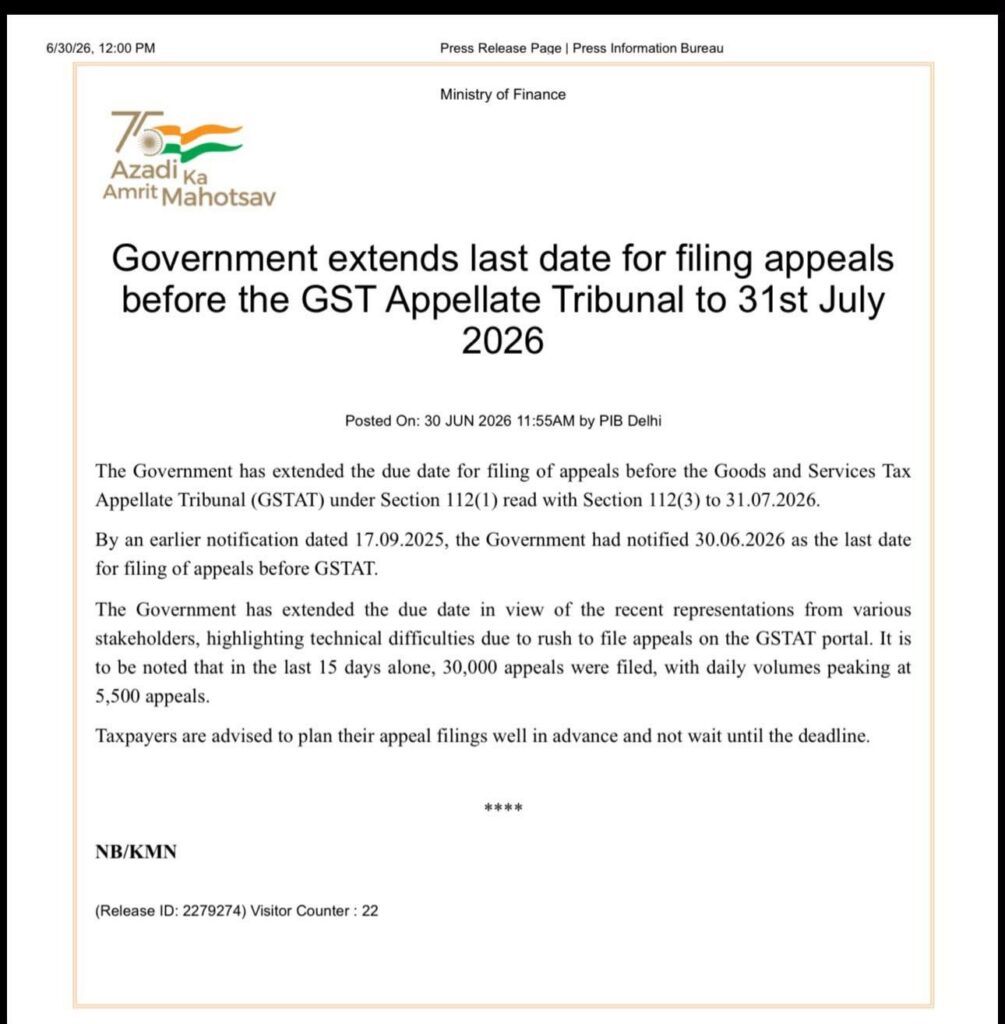
|
|
|
|
|
|
|
|
|
Press release ID 2278205 dated 26.06.26
|
|
In a major crackdown against smuggling of foreign origin gold, the the Directorate of Revenue Intelligence (DRI) has successfully unearthed and dismantled a highly organised gold smuggling syndicate operating through Mumbai Airport. In this operation DRI detected and busted gold melting facility that was being used for melting of foreign origin smuggled gold.
|
|
|
Seized gold from melting facility in Mumbai
|
A total of nine persons involved across the entire smuggling chain, including the airport staff, her handler, three intermediaries, the melting facility operator, and three persons engaged in the melting process have been arrested. Further, about 6 kg foreign-origin smuggled gold recovered at the spot has been seized.
|
|
This case underscores the evolving sophistication of organised gold smuggling syndicates, which increasingly exploit insider access at airports and employ layered distribution networks to evade detection. In another operation at Bengaluru, DRI seized 1.8 kg 24 KT gold in paste form ingeniously concealed within the layers of garments of an international passenger. Subsequent follow up search at his residential premises led to seizure of around 1.5 kg gold jewellery, 45 kg silver, and Indian & foreign currencies. The person was arrested.
|
|

|
Gold in paste form concealed in undergarments; Seized at Bengaluru
|
|
earlier in this week, DRI has conducted a series of operations at other airports, railways station and land customs stations at Hyderabad, Rajkot, Calicut, Vishakhapatnam, Calicut, Guwahati and Petrapole, leading to the cumulative seizure of another 6 kg foreign-origin smuggled gold. Five persons have been arrested in these operations.
|
|

|
Overall, with busting of gold smuggling syndicate, these operations resulted in seizure of about 15 kg gold, 45 kg silver, valued at around Rs. 23 crore, and arrest of 15 persons.
|
|
|
|
|
|
3. Lawgics by Ms.Nidhi Aggarwal
|
|
Ms. Nidhi Aggarwal is delighted to present judgment with a great vision to spread complex GST law in a simple manner amongst the taxpayers, tax professionals, students and knowledge seeker.
|
|
|
|
|
|
Synopsis: The Delhi High Court dismissed the writ petition involving fraudulent ITC claims, directing the petitioner to pursue appellate remedy u/s 107 of the CGST Act.
|
Caste name: Banson Enterprises & Anr. vs Assistant Commissioner CGST & Ors.
|
Citation: W.P. (C) 6503/2025 dated 15.05.2025
|
Authority: Delhi High Court
|
The petition challenges the Order-in-Original dated 02.02.2025 based on a Show Cause Notice (SCN) dated 03.08.2024 A search was conducted, and statements were recorded including that of one Director admitting to the issuance of fake invoices during the Central Excise period. It was alleged that the Petitioner issued goods-less invoices to enable fraudulent Input Tax Credit (ITC) claims amounting to Rs. 1.85 crore.
|
Contentions of the Petitioner:
|
SCN was issued by unauthorized officer, thus, violates Rule 142(1)(a) of CGST Rules. No pre-consultation as required under Rule 142(1A) of CGST Rules was issued. Consolidated SCN for multiple financial years was issued and challenge to such consolidated action is pending in a separate matter (Quest Infotech case).
|
Contentions of the Department:
The impugned order is appealable, hence writ is not maintainable. The Petitioner’s Director admitted to allegations. Natural justice was followed as the Petitioner received the SCN, filed a reply, and availed of personal hearing. Reliance must be made on SC judgments and Allahabad HC rulings emphasizing alternate remedy u/s 107 CGST Act.
|
Findings and Decision of the Court:
The Court refused to interfere under writ jurisdiction, citing:
|
- No breach of fundamental rights or principles of natural justice.
- Availability of a statutory remedy (appeal) under Section 107 CGST Act.
The Court noted that the Allegations involve serious misuse of ITC, requiring fact-based adjudication, not suited for writ jurisdiction. Thus, the Petitioner was granted liberty to file appeal, and if filed with pre deposit, the appeal shall not be dismissed on limitation.
|
|
|
|
|
|
|
|
Synopsis: GST RC cancellation is not justified as petitioner was not given fair opportunity to respond.
|
Case Name: M/s. Genius Orthos Industries VS Union of India & Ors.
|
Citation: WRIT TAX No. 542 of 2023 dated 24.04.2025
|
Authority: Allahabad High Court
|
The petitioner was engaged in the business of surgical goods and its GST registration was cancelled on 19.12.2022 after a physical verification of its premises allegedly found no inputs, finished goods, or workers. A show cause notice was issued prior to cancellation, but the petitioner claimed they were not informed of the specific material findings leading to the cancellation. The appeal against the cancellation was also dismissed.
|
Contentions of the Petitioner:
|
The principles of natural justice were violated, as no proper notice of the specific material against them was given. Cancellation was based on vague grounds, and the watchman at the premises had confirmed that business activities were conducted, albeit irregularly. Rule 25 of the CGST Rules and Form GST REG 30 was not referenced in actual SCN.
|
Contentions of the Department:
|
The petitioner had due knowledge of the discrepancies found during physical verification and failed to provide a satisfactory explanation. Claimed that the cancellation order was justified due to absence of business activity at the registered premises.
|
Findings and Decision of the Court:
|
The High Court found that the cancellation was done without due process, especially considering that:
|
- The material used for cancellation was never properly shared with the petitioner.
- The statement of the watchman indicating occasional business activity was ignored.
- The physical verification report (GST REG-30) was not referenced in the show cause notice.
Thus, impugned cancellation and appellate orders were quashed and the matter was remanded to the proper authority for fresh adjudication within three months, ensuring that a reasoned and speaking order is passed after an Opportunity of hearing is granted. The petitioner may submit relevant evidence.
|
|
|
|
|
|
|
|
Synopsis: Rejection of appeal on ground that appeal was not filed electronically under Rule 108 of CGST Rules, 2017 is invalid in case of non availability of order–in–original on GST portal and Appeal being filed manually.
|
Case Name: M/s Appolo Sesame Industries & Anr. VS Assistant Commissioner of CGST, Division X, Nadiad & Ors
|
Citation: R/Special Civil Application No. 571 of 2025 dated 24.04.2025
|
Authority: Gujarat High Court
|
The petitioners challenged the rejection of their appeal against an Order-in-Original dated 30.10.2023. They had filed the appeal manually in Form GST APL-01, as the order was not available on the GST portal, making electronic filing impossible. Despite this, the Appellate Authority rejected the appeal on 27.09.2024, stating it was not filed electronically, as required under Rule 108(1) of the CGST Rules, 2017.
|
Contentions of the Petitioner:
|
The order-in-original was not available on the portal, so manual filing was the only viable option. A pre-deposit of 10% of the disputed dues was paid. The Appellate Authority ignored the proviso to Rule 108(1), which allows manual filing if the order is unavailable electronically. The Appellate Authority failed to issue the mandatory provisional acknowledgment, despite receiving the appeal.
|
Contentions of the Department:
|
The appeal was filed offline without fulfilling electronic filing requirements. The Appellate Authority argued that procedural rules were not followed, hence the rejection was valid.
|
Findings and Decision of the Court:
|
The High Court found that the Appellate Authority failed to apply its mind to the facts. It held that the rejection of the appeal violated Rule 108(1) of the CGST Rules, as manual filing is permitted when the order is not available on the portal. The impugned rejection order was set aside and the matter was remanded to the Appellate Authority to hear and decide the appeal on merits.
|
|
|
|
|
|
|
|
Synopsis: The demand order was quashed on the ground that the hearing notices must not be merely uploaded on portal but also e-mailed to petitioner.
|
Case Name: Shri Krishna Sales VS Commissioner of Delhi Goods and Service Tax & Ors.
|
Citation: W.P. (C) 5524/2025 dated 29th April, 2025
|
Authority: Delhi High Court
|
Brief facts of the case:
The petitioner challenged the Show Cause Notice (SCN) dated 26.09.2023 and demand order dated 25.12.2023, issued by the Delhi GST authorities. The challenge also extended to Notification No. 09/2023 Central Tax dated 31.03.2023, which extended the time limits for adjudication under Section 73 of the CGST Act. The SCN was only uploaded under the "Additional Notices and Orders" tab on the GST portal and did not come to the petitioner’s notice. The petitioner filed a rectification application, which was considered time-barred.
|
Contentions of the Petitioner:
The SCN and subsequent hearing notices were not properly served, being uploaded in a location on the portal that made them easy to miss. The notification extending limitation was issued improperly under Section 168A without valid GST Council approval and is under challenge before the Supreme Court (SLP No. 4240/2025).The demand order was passed ex parte without giving a fair opportunity to respond.
|
Contentions of the Department:
The SCN was uploaded properly as per current GST portal functionality. The notification extending time limits is valid and backed by GST Council recommendation (in some cases), with related petitions already under consideration in the Supreme Court. The petitioner’s application for rectification was rightly rejected due to limitation bar.
|
Findings and Decision of the Court:
The demand order dated 25.12.2023 was set aside. The Court allowed the petitioner to file a reply to the SCN within 30 days. The hearing notice must be communicated not just through the portal but also via email. The adjudication order shall be passed afresh, after granting a personal hearing. The outcome of this case will be subject to the final decision of the Supreme Court in the pending SLP on the validity of the notifications.
|
|
|
|
|
|
4. GST Notes by CMA Anil Sharma
1) Shri CMA Anil Sharma, Shri CMA Gurdev Singh Saini and Smt. CMA Bhawna Sharma posted Chapter-19 recently containing CGST Act in simple language in PPT format. This is to make dealers, professionals, academicians, students etc. understand the basics of GST laws.
|
Chapter-19th slide is given below.
|
|
|
|
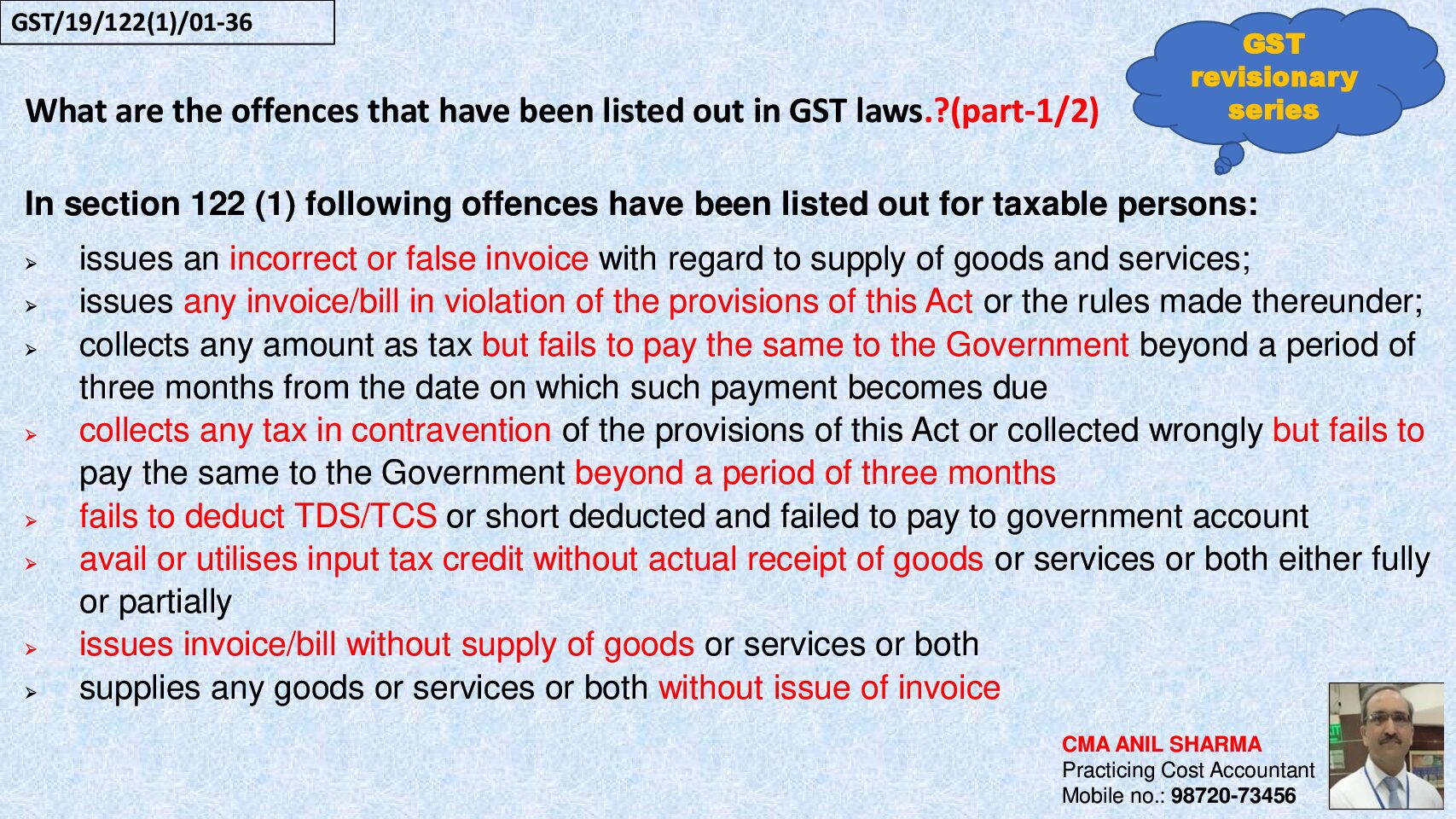
|
|
|
|
|
5. GST Daily by CA Pradeep Modi
|
|
CA Pradeep Modi is presently daily notes on GST under title "GST Daily - Stay updated yourself on GST"
|
|
|
|
|
|
THE HON'BLE ALLAHABAD HIGH COURT IN THE CASE OF Vibhuti Tyres V/s State of U.P., decided on 7-5-2025
|
✔️ Is it justified that GST order with higher demand than show-cause notice?
|
👉 The Hon'ble High Court Judgement:-
|
✔️ Where in show-cause notice amount representing tax, interest and penalty was indicated as Rs. 8,81,080, but in order, much higher demand was raised at Rs. 32,97,336, same was in violation of section 75(7); matter was to be remanded back.
|
Section 75 of Central Goods and Services Tax Act, 2017
|
|
|
|
|
|
|
|
THE HON'BLE JHARKHAND HIGH COURT IN THE CASE OF Sadanand Prasad Barnwal V/s State of Jharkhand, decided on 8-5-2025
|
✔️ Is it valid if SCN and order under section 73 for lack of digital signature of issuing authority?
|
👉 The Hon'ble High Court Judgement:-
|
✔️ Where both summary of SCN in Form GST DRC-01 and order under section 73 did not bear digital signature of concerned authority, both SCN and order were to be quashed.
|
Section 161, read with section 73 of Central Goods and Services Tax Act, 2017
|
|
|
|
|
|
|
|
THE HON'BLE CALCUTTA HIGH COURT IN THE CASE OF Edelweiss Rural & corporate Services Ltd. V/s Deputy Commissioner of Revenue, decided on 5-5-2025
|
✔️ What would be Refund if business stood closed and registration was cancelled?
|
👉 The Hon'ble High Court Judgement:-
|
✔️ Where Refund sanction order had itself observed that assessees business was closed down, its registration was cancelled and it had no tax dues refund claim was already allowed, direction to credit refund amount to credit ledger instead of bank account of assessee was self-contradictory since there was no business for assessee to take benefit of refund credited to assessees credit ledger.
|
Section 54 of Central Goods and Services Tax Act, 2017
|
|
|
|
|
|
|
|
THE HON'BLE JHARKHAND HIGH COURT IN THE CASE OF Sri Ram Stone Works V/s State of Jharkhand, decided on 9-5-2025
|
✔️ Can GST Notice would be issued under Section 61 of CGST Act merely on the basis of difference between sale price and market price?
|
👉 TheHon'ble High Court Judgement:- ✔️ Clear objective of section 61 is to enable an Assessing Officer to point out discrepancies and errors which are occurring in return filed by a registered person with that of related particulars; notice under section 61 cannot be issued comparing particulars at which assessee has sold its goods with that of prevalent market price.
|
|
|
|
|
|
6. Judgment Analysis by CA Nitin Bhuta
|
|
|
|
|
Decoding Recent Judgment under GST
|
About Webinar
mail us at taxupdate.otu@gmail.com or at 7738647904 for any query or for webinar recording and PPT
|
Recent Judgment/ ruling under GST will be discussed
|
Join the insightful webinar and stay updated
|
|
|
|
|
|
|
|
06.01.2024 : Today, the author was browsing through the database, and an underlying judgement caught my attention, which may be relevant for many of us, especially in connection with issues of GST registration cancellation. The author is summarising the juice of judgement with my comments for the readers. The same can be applied to any analogue’s scenarios.
|
Sub: GST Registration cancellation – Violation of Principles of Natural Justice
|
- RTP was registered under the provisions of GST Law;
- RTP was issued SCN for the cancellation of GST Registration
- SCN did not provide any particulars as to the alleged fraud committed by the RTP;
- SCN also didn’t provide a specific reason for proposing cancellation of the RTP’s GST registration.
- SCN also does not provide any particulars regarding the alleged fraud committed by the RTP.
- SCN also does not provide any clue as to the wilful misstatement made or the facts allegedly suppressed
- Thus, RTP, being aggrieved, filed the writ petition before the jurisdictional HC to seek reprieve;
- A plain reading of the impugned SCN indicates that it is bereft of any specific reason for proposing cancellation of the petitioner's GST registration. It does not provide any particulars as to the alleged fraud committed by the petitioner. It also provides no clue as to the wilful misstatement made or the facts allegedly suppressed.
- It is settled law that the Show Cause Notice must clearly set out the reasons for proposing an adverse action. This is to enable the Noticee to meet the said allegations. Clearly, the impugned SCN was incapable of eliciting any meaningful response in the absence of any specific allegation
- There is merit in the petitioner's contention that the impugned SCN is liable to be set aside
- In the event that the respondents propose to take any action for cancellation of the petitioner's GST registration, it would be open for the respondents to do so, albeit in accordance with the law. The respondents would be required to issue a proper Show Cause Notice and take an appropriate decision after affording the petitioner a reasonable opportunity to be heard
- The respondents are also not precluded from taking any steps for the recovery of any tax, penalty or interest that may be due from the petitioner
- The suspension of the petitioner's GST Registration will stand lifted forthwith, and the respondents are directed to take immediate steps for the same
- Nowadays, registration applications are also rejected for frivolous reasons. Can we derive support from the judgement? In my opinion, yes
- Please examine the contents of SCN under lenses to shortlist lacunae in the issue of SCN besides Time Limits and Jurisdictions;
- If GST registration is cancelled without citing any reasons, RTP can explore the option of filing writ petitions before jurisdictional HC
Judgement Citation: Neelkanth Metal v. Union of India 158 taxmann.com 142 (Delhi)
|
Please read the judgement before you reach any conclusions.
|
|
|
|
|
|
|
|
Sub: Time Limit to Respond to Notices – Violation of Principles of Natural Justice
|
Today, the author was browsing through the database, and underlying judgement caught my attention, which may be relevant for many of us, especially in connection with Faceless Assessment Time Limits. The author is summarising the juice of judgement with his comments for the readers. The same can be applied to any analogue’s scenarios.
|
- Assessee was carrying on business
- Assessee filed loss return of income
- The Assessee case was selected for scrutiny as there was a substantial gap in the purchase of property vis-à-vis stamp duty valuation
- Assessee was issued a Notice on 16.09.2022 whereby due date to response was stated to be 20.09.2022 . Thus, only one day was available for the assessee to submit the response
- Assessee requested the adjournment of just 3 days from 20.09.2022 to 23.09.2022. Such adjournment was requested to gather data and evidence for providing the response.
- Section 144B order r.w.s Section 143(3) was framed by disabling the submission option on the portal, whereby an addition of Rs.1.85 crores was made, and consequently, tax, interest and penalty were demanded.
- Assessee, being aggrieved, approached HC by way of a writ petition to seek justice on the grounds of natural justice and unfairness arising on account of the Faceless Assessment Scheme as per the provisions of the Act by stating the facts as stated above
- DR, in his affidavit, stated that all submitted that the order u/s. 143(3) r.w.s. 144B was passed after following due procedure and after giving opportunities to file a reply to the assessee.
- DR also stated that all comprehensive submissions filed by the assessee were duly considered. Thus, there is no illegality as alleged;
- Section 144B (1) (xvi) (b) mandates providing an opportunity to the assessee in case any variation prejudicial to the interest of the assessee is proposed.
- Section 144B (9) stipulates that an assessment made u/s. 143(3) or 144 shall be honest if such assessment is not made in accordance with the procedure laid down under this section.
- We have noticed that the adjournment request made by the assessee on 20.09.2022 till 23.09.2022 was not acceded by the A.O. as it is admitted in the affidavit-in-reply that no such request was reflected on the portal
- Therefore, in our opinion, in the case on hand, the opportunity to respond to the show-cause notice was not made available to the assessee, particularly when the huge variation/ addition was proposed to be made, which is prejudicial to the interest of the assessee, it violates the principles of natural justice.
- We allow the present petition and quash and set aside the order dated 29.09.2022 passed u/s. 143(3) r.w.s. 144B
- The penalty proceedings and the demand notice are also quashed and set aside
- however, we give liberty to the Assessing Officer to initiate the proceedings afresh from the stage of providing the opportunity to the petitioner of hearing if such request is made and thereafter, to decide the matter
- Needless to say, that A.O. thereafter is at liberty to pass appropriate orders in accordance with the law. It is clarified that this Court has not entered into the merits of the case
- Nowadays, lots of notices are issued u/s 133(6) requesting for the information to be filed by the next day, and if no such information is provided, then a Penalty of Rs.500/- per day is proposed to be levied u/s 272A (2)?
- Can we derive support from the above judgement to derive the support? Yes.
- Whether non-granting of adjournment is just, fair, and equitable even after comprehensive submissions are filed in the assessment proceedings by the assessee? Non-granting of adjournment is unfair and violates the principles of natural justice.
Judgement Citation: Sun Glory Education Foundation v NFAC Delhi 156 taxmann.com 390 (Guj)
|
Note: Please read the judgement before you reach any conclusions.
|
|
|
|
|
|
|
|
Sub: Inadvertent mistake in reporting of data
|
Transitional provisions - Inadvertent error - Cenvat credit - Filing claim under inapplicable head - Assessee, partnership firm claimed Cenvat credit on stock of goods - Claim was inadvertently filed under column 7(d) instead of making TRANS 1 Claim under column 7(b) - Revenue authority issued show cause notice and later rejected claim on ground that assessee had filed claim under inapplicable head - HELD: Since assessee had documents to support his claim under correct head matter should be remitted to revenue authority for reconsideration - Impugned order passed was to be set aside - Revenue authority was further directed to consider assessee's claim under correct head and grant consequential relief if claim was established
|
- The petitioner is a partnership firm registered under the Goods and Services Tax Act, 2017. The petitioner is engaged in supply of goods coming under the Chapter 8432, 31010010 and 10091090. Respondent No. 1 has issued show cause notice dated 9-12-2022 on the premise that GST returns submitted by the petitioner were the subject matter of scrutiny and sought explanation from the petitioner.
- The petitioner has replied to the said notice and claimed CENVAT Credit of Central Excise duty on the stock of goods held on 30-6-2017, for Rs. 6,18,796/-. Pursuant to the reply, hearing was fixed on 24-1-2023. Petitioner further claims that he has produced additional documents in support of his defence. Thereafter respondent No. 1 issued one more notice dated 6-2-2023 on the premise that the petitioner has filed TRAN-1 claim under Table 7(d) in terms of Rule 117(4) of Central Goods and Services Tax Rules, 2017 and took a view that the petitioner is not entitled to CENVAT credit.
- It is the case of the petitioner that he made a claim under column '7(d)' inadvertently, instead of making a TRAN-1 claim under column '7(b)'. The petitioner however submits that error is inadvertent and he has the documents to support his claim for necessary credit under the Head '7(b)'.
- Learned counsel for the petitioner in reply would contend that the Madurai Bench of Madras High Court has dealt with similar issue where the claim is inadvertently made under the inapplicable head and the Writ Court entertained the petition and issued a direction to the respondent-Authority to verify the claim of the petitioner and if the claim is found to be supported by materials, to grant necessary relief as available under law. This Court has perused the aforementioned judgment.
- From the aforementioned judgment, in W.P.(MD) No. 15531/2020 and W.M.P.(M.D.) NO.13042/2020, it can be noticed that in the said case, the claim was made under Column 7(d) of the Form instead of 7(a) and while allowing the writ petition, the Court directed the respondents to forward the petitioner's application to the concerned authority. It directed the concerned authority to verify the correctness of the claim made. It further directed that if satisfied with respect to the claim, the authority shall grant the relief sought in the writ petition.
9. This Court has also perused the records in the case. The petitioner makes claim that he ought to have filed returns under by making a claim under Column 7(b) and erroneously he made a claim under Column 7(d). Since the petitioner has claimed that he has necessary invoices and documents to support his claim under column '7(b)', this Court is of the view that the impugned order is to be set aside. The matter is remitted to respondent No. 1.
|
10. Respondent No. 1 shall consider the claim of the petitioner under Column 7(b) of CGST Rules, 2017 if there are supporting documents to make a claim under Column 7(b). If the claim is established, then the consequential relief should follow.
|
Ref: S V Halavagali & Sons v. Superintendent of Central Excise 157 taxmann.com 711 (Karnataka HC) WRIT PETITION NO. 102048 OF 2023 (T-RES) DT 03.11.23
|
|
|
|
|
|
|
|
by CA Umesh Sharma - Karneeti Part 607
|
Arjuna (Fictional Character): Krishna, as the tax audit season begins, businesses need to ensure that their Form 3CD is filed correctly. Are there any recent updates or changes that they should be aware of ?
|
Krishna (Fictional Character): Yes, Arjuna. This year, there are important updates, especially regarding MSMEs (Micro, Small, and Medium Enterprises). The key changes are related to Clause 22 of Form 3CD, which businesses must pay close attention to.
|
Arjuna: I understand that Clause 22 deals with MSMEs, but what specific changes should businesses be aware of?
|
Krishna: Clause 22 in Form 3CD has undergone significant updates concerning payments to MSMEs under the MSMED Act. Here's what you need to know:
|
Clause 22(ii) - Total Amount Payable to MSMEs: Businesses must now disclose the total amount required to be paid to MSMEs during the previous year, regardless of whether it was paid on time or not, as per Section 15 of the MSMED Act.
|
Clause 22(iii) - Breakdown of Payments:
|
- Payments made within 45 days: Businesses must report the amount paid on time (within 45 days period as mandated by the MSMED Act).
- Payments not made on time: The amount payable to MSME which was not paid on time must be disclosed.
Additionally, the amounts that were not paid within the due date are disallowed under Section 43B(h) of the Income tax Act, 1961.
|
Previously, only the payment not made on time was reported in this cause, but now both on time and delayed payments need to be disclosed separately.
|
For Example: For XYZ Pvt. Ltd. the total amount required to be paid to MSMEs during the previous year was Rs. 10,000. Out of this, Rs. 7,000 was paid within the required 45 days period and is therefore reported as paid on time. However, Rs. 3,000 was not paid within the 45 days period and is reported as a delayed payment in the form as required by Clause 22(iii) of Form 3CD.
|
Previously, only the Rs. 3,000 delayed payment was reported in the clause, but with the new changes, both the on-time and delayed payments must now be separately disclosed.
|
Arjuna: What does this mean for business?
|
Krishna: The key takeaway is that businesses need to accurately ascertain both on-time and delayed payments to MSMEs, along with any penalties for late payments. The disallowance of delayed payments under Section 43B(h) is critical because it means businesses cannot claim deductions for payment that were not made within the statutory time limit. Timely compliance with the with the MSMED Act and proper reporting is essential to avoid penalties, disallowances, and ensure smooth audits.
|
Source: Lokmat Times dated 04.08.2025
|
|
|
|
|
|
|
|
Adv. Ashu Dalmia of ADA Law Chambers, prepared this PPT on topic "GST Litigation - Key issues & Case laws". It is a comprehensive guide to critical GST provisions, natural justice principles, time limits, ITC disputes, penalties, arrest, and electronic evidence —with landmark judicial pronouncements.
|
|
|
|
|
|
|
Hope the above updates is of use to you. Please share your input and feedback at taxupdate.otu@gmail.com
|
|
|
|
|
|
|
|
 
|
Visit our website
|
OTU provides you
|
- Articles on various topics
|
|
- Media - GST, Income Tax & Press R.
|
|
- Notes / Newsletter at 149/ p.a.
|
|
|
|
|