
Sale!


Original price was: ₹1,695.00.₹1,187.00Current price is: ₹1,187.00.
Advertisements
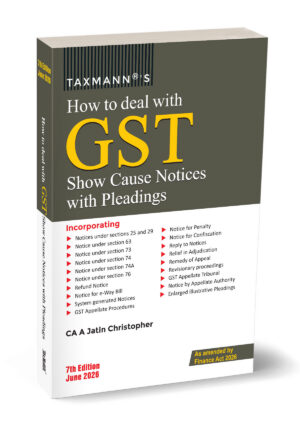
Title: How to Deal with GST Show Cause Notices with Pleadings-Taxmann
Author: CA. A. Jatin Christopher
Publisher: Taxmann publication
Edition: 7th Edition, 2026
This Edition covers the new section 74A demand regime, system-generated notices, revisionary proceedings, and the GST Appellate Tribunal (GSTAT)—its structure, procedure, and the GSTAT Procedure Rules.
Description
The coverage of the book is as follows:
- Notices, by Provision and Type (Division One)
- Sections 25 & 29—registration notices: rejection of applications, suspension, suo motu and voluntary cancellation, revocation, appealable orders
- Section 63—best-judgment assessment of unregistered persons; ‘best judgment is not wild guesswork’; challenges to jurisdiction
- Section 73—non-fraud demands: pre-notice consultation, limitation, service and its validity, deficiencies and discrepancies, non-denial as admission
- Section 74—fraud/suppression demands: special circumstances, the penalty stages, ‘cum-tax’ demand
- New Section 74A—date of commencement, terminal date for old notices, ingredients to jurisdiction, fresh limitation, definition of suppression, ‘mother notice v. child notice’
- Section 76—tax collected but not paid; composite demand; absence of limitation
- System-generated notices—Rules 88C, 142B and 88D, response options, adverse inference, auto-generated appropriation
- Refund notice—unjust enrichment, credit-note mischief, protective notices, erroneous refund with interest
- Notice for e-Way Bill—binary verification, alteration/expansion of enquiry by circular, cryptic notices, pleading for lenience
- Notice for Penalty—general discipline on penalty, personal penalty on directors, penalty under section 52, waiver of penalty notice
- Notice for Confiscation—seizure as a pre-condition, release from detention, the (unlimited) limitation position
- Adjudication and Remedies (Division One)
- Preparation to reply; the jurisprudence of adjudication (e.g., interest as automatic rather than penal, the bar on plurality of penalty); drafting the reply; relief and outcomes in adjudication
- Remedy of appeal; the ‘sequel notice’ by the Appellate Authority; relief in appeal
- Revisionary proceedings—the anomaly of executive revision of appellate orders, the narrow grounds (illegal, improper, or omitting material facts), doctrine of election, bar on revision, ‘mischievous appeals,’ limitation
- GST Appellate Tribunal—GSTAT structure and benches, pre-deposit (including penalty-only and fine-only disputes), statement of facts and grounds, paper-books, interlocutory applications; Tribunal Procedure (APL-5, cross-objections, computational tables, condonation, withdrawal); the GSTAT Procedure Rules (powers, instituting appeal, registry, hearing, case management, e-filing, CPC); and a closing chapter on applicable jurisprudence
- Pleadings (Division Two) — Enlarged Illustrative Pleadings
- Pleadings for reply to notices—Chapter 26 alone runs to 58 numbered sub-paragraphs, the bulk of them worked reply scenarios: DRC-3 payments, GSTR-2A/3B and GSTR-1/3B mismatches, RCM unpaid, credit/debit notes, TRAN-1 transition credit, composition-taxpayer defaults, Rule 86A/86B, blocked and common credits, supplier-in-default, ‘interest only’/’penalty only’ demands, classification and exemption disputes, pure-agency collections
- Pleadings in departmental engagement—DRC-13 (third-party recovery), DRC-22 provisional attachment, CMP-6, ‘call book,’ time-barred-notice intimations, death of proprietor/appellant
- Pleadings in appeal memo—audit-led, inquiry-led and interception-led demands; relief under section 75(2); RVN-1/ADT-2 situations; condonation-of-delay affidavits
- Appellate Tribunal pleadings—notes on APL-5/APL-6, preliminary grounds (sections 61/65/67), special and common grounds
- Inherent powers of GSTAT—including extended-adjournment/call-book applications
Related products
-
Sale!
Handbook to Direct Taxes (with free e-book access)
Original price was: ₹2,395.00.₹1,552.00Current price is: ₹1,552.00. Add to basket -
Sale!
GST Manual (Act and Rules)
Original price was: ₹895.00.₹555.00Current price is: ₹555.00. Add to basket -
Sale!
Book: How to Handle GST Notices Scrutiny, Assessment, Adjudication & Appeals as amended by Finance Act, 2025
Original price was: ₹1,495.00.₹1,016.00Current price is: ₹1,016.00. Add to basket -
Sale!
Technical & Legal Issues & Solutions under Income Tax Act with Youtube Videos
Original price was: ₹1,395.00.₹1,040.00Current price is: ₹1,040.00. Add to basket