|
onlinetaxupdate team wish to express sincere thanks to all the readers, authors, subscribers for the support extended to us. Please share your feedback at
|
taxupdate.otu@gmail.com or 7738647904
|
Newsletter 133 dated 03.09.2024
|
|
|
|
|
|
|
|
|
Dear Reader,
|
Please find newsletter for your reading and reference.
|
|
Index of the Newsletter
- Recent updates
- GST Council - 54th meet proposed
- Article
- Lawgics by Ms.Nidhi Aggarwal
- GST Notes by CMA Anil Sharma
- GST Daily by CA Pradeep Modi
- PPT/Handbook
- GST/IT/Customs in media
- Latest Update - Recap
|
|
|
|
|
|
|
Office of the Commissioner of Commercial Taxes, Nandanam, Chennai issued Circular No. 07/2026-TNGST dated 25.06.2026 regarding GST- Return Scrutiny under Section 61 of the TNGST Act, 2017 and adjudication proceedings - Prior approval for suo moto scrutiny notices and ex parte orders.
|
Detailed guidelines were issued to the Proper officers for adjudication in the Assessment Circles, in the Circular cited, to make adjudication process more transparent, reduce the litigations and realize revenue.
|
In this direction, system generated scrutiny notices based on risk parameters have been made available to the Proper Officers to ensure uniformity and monitoring of the return scrutiny process. Instructions have also been issued to all Proper Officers to process the system-generated scrutiny notices by following the provisions of the GST Acts and Rules and training has been imparted for adherence to quality standards in the adjudication process.
|
The scrutiny notices generated by the IT wing of the department and made available are detailed below:
|
|
|
|
|
|
OFFICE OF THE COMMISSIONER OF STATE TAXMAHARASHTRA STATE, MUMBAI issued NOTIFICATION NO: - SGST/e-way bill/02/2025-26 dated 20.02.2026 Waiving off requirement of e-way bill for motor vehicles for road testing where goods are transported for reasons other than by way of supply under sub-rule (5) of rule 138A of MGST Rules, 2017.
|
M/s. Tata Motors Limited, having principal place of business at TATA MOTORS LIMITED, Nigadi Bhosari Road, Pimpri Chinchwad, Pune, Maharashtra, 411 018. (GSTIN: 27AALCT0864B1ZE) (hereinafter called as ‘taxpayer’), have made a representation vide their letter GST/MH/056 dated 13th November 2025. for waiving off requirement of e-way bill for motor vehicles for road testing where goods are transported for reasons other than by way of supply under sub-rule (5) of rule 138A of MGST Rules, 2017(hereinafter referred as MGST Rules, 2017).
|
Whereas I, Asheesh Sharma, Commissioner of State Tax. Maharashtra State, am of the opinion that the difficulties being faced by the ‘taxpayer’ are genuine and require due consideration. Now, therefore I, Asheesh Sharma, Commissioner of State Tax, Maharashtra State, in exercise of the powers conferred upon me under sub-rule (5) of rule 138A of the MGST Rules, 2017, am pleased to issue this notification for grant of permission to M/s. Tata Motors Limited. having principal place of business at TATA MOTORS LIMITED, Nigadi Bhosari Road, Pimpri Chinchwad, Pune, Maharashtra, 411 018 (GSTIN: 27AALCT0864B1ZE) to waive the requirement of e-way bill for motor vehicles to perform various road tests across India, subject to the following procedure and conditions as mentioned below.
|
(i) The ‘ taxpayer ’ shall execute a bond sufficient to cover the value of the motor vehicle being cleared for the purpose of road testing in a calendar month, with the Jurisdictional State Tax Officer, PIMPRI_702, Division - PUNE_SOUTH_EAST, Zone - PUNE_SOUTH_WEST, PUNE undertaking to follow all the conditions mentioned hereunder;
|
(ii) Motor vehicles shall be removed by the ‘taxpayer’ for the purpose of road test under a delivery challan, duly signed by the authorized signatory of the “taxpayer”;
|
(iii) The exemption to carry delivery challan instead of e-way bill is limited only to transportation of motor vehicles for reasons other than by way of supply and limited to road test of such motor vehicles;
|
(iv) The delivery challan shall be induplicate, pre-authenticated and having running serial number for every calendar year and printed format and shall contain the following information.
|
(a) The name and address of the “taxpayer”, it’s ‘GSTIN’
|
(b) Name of the jurisdictional officer, Division and Zone with whom the taxpayer is registered for the purpose of GST and notification number under which permission under sub-rule (5) of rule 138(A) of MGST Rules, 2017 for such removal has been given;
|
(c) The description, vehicle serial number/ engine number/ chassis number, as the case may be, to identify the vehicle which has been cleared for the purpose carrying out road test along with the value of such motor vehicle;
|
(d) The date of dispatch of such motor vehicle for road test and probable time line for return of the motor vehicles to its place of clearance;
|
(v) The Motor vehicle/ transport equipment will also carry trade plate as prescribed under Central Motor Vehicles Rules, 1989 or under any other law in force for the purpose of undertaking testing of such motor vehicle as the case may be;
|
(vi) The ‘taxpayer’ shall maintain proper records to correlate the dispatch and return of the motor vehicles sent for road testing. If at any point of time the value of the motor vehicles cleared for road test exceeds the amount for which the bond has been executed, the ‘taxpayer’ shall execute a separate bond of differential value with the concerned, before removal of the motor vehicle for testing purpose;
|
(vii) The taxpayer’ shall submit to the Jurisdictional State Tax Officer, PIMPRI_702, Division - PUNE_SOUTH_EAST, Zone - PUNE_SOUTH_ WEST, PUNE a monthly account containing the details of all motor vehicles sent and received back after road testing;
|
(viii) The ‘taxpayer’ shall furnish any additional relevant information pertaining to the instant subject matter which may be required by the Jurisdictional State Tax Officer, PIMPRI_702, Division-PUNE_SOUTH_EAST, Zone - PUNE_SOUTH_WEST, PUNE.
|
2. The ‘ taxpayer ’ shall be fully responsible and accountable for the taxable goods so removed without generation of e-way bill under sub-rule (5) of rule 138(A) of MGST Rules, 2017 as permitted under this notification.
|
3. If the above said conditions are not adhered to or are violated, the impugned permission shall be revoked/withdrawn without any prior intimation.
|
4. This notification is valid for financial year 2025-26, i.e. up to 31st March 2026
|
|
|
|
|
|
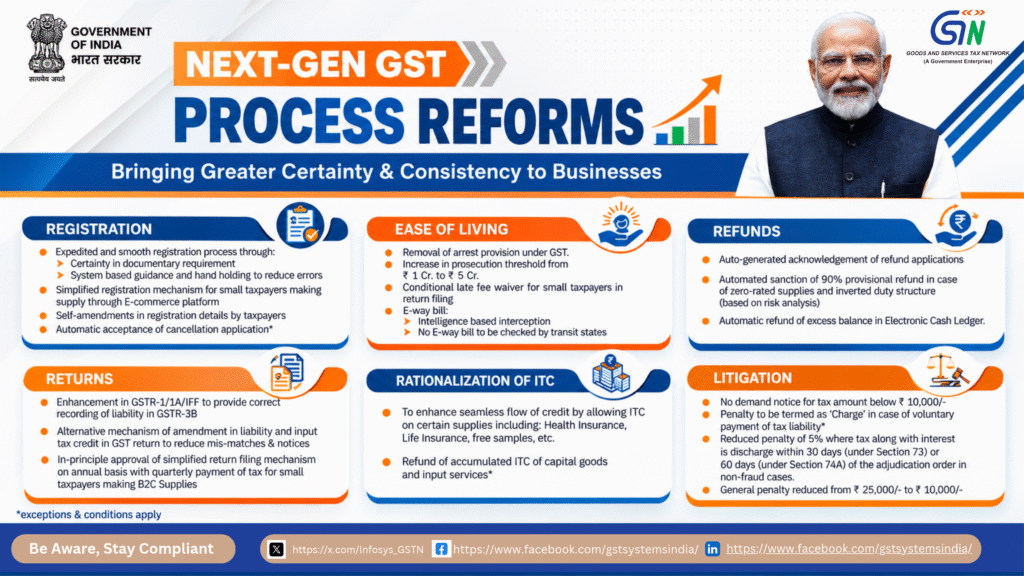
Government of India taken following decisions for process reforms
|
- GST Registrations
- Ease of Living
- Refunds
- Returns
- Rationalisation of ITC
- Litigation
|
|
|
|
|
|
|
|
|
|
GSTN Advisory no. 687 dated 04.11.2026
|
It is hereby informed that, in view of the substantial volume of E-Way Bills generated, the existing numbering capacity is expected to be exhausted. Accordingly, the following revisions in the numbering formats are proposed with effect from 1 January 2027
|
It is hereby informed that, in view of the substantial volume of E-Way Bills generated, the existing numbering capacity is expected to be exhausted. Accordingly, the following revisions in the numbering formats are proposed with effect from 1 January 2027
|
All stakeholders, including taxpayers, GSPs, ERP/software providers and API integrators, are advised to make necessary modifications to their applications, APIs, database schemas and validation rules to accommodate the revised numbering formats.
|
The changes will be released in the Sandbox environment shortly for testing, and the relevant details will be published on the E-Way Bill Portal. Stakeholders are requested to ensure system readiness well before 1 January 2027 to facilitate a seamless transition and avoid any disruption to E-Way Bill-related operations.
|
|
|
|
|
|
|
|
GSTN Advisory no. 685 dated 01.11.2026
|
Some changes have been introduced on the GST portal for taxpayers registered under or opting for, the Composition Scheme. These changes will apply to applications filed through Form REG-01, CMP-02, CMP-04 and REG-14.
|
1. Introduction of New Composition Category
A new category has been introduced for composition taxpayers: “Person eligible for composition levy under Section 10(2A)”
|
Accordingly, taxpayers will now have the following options related to composition scheme:
|
Option A (Existing categories – multiple selections allowed)
|
- Manufacturers, other than manufacturers of such goods as may be notified by the Government for which option is not available
- Suppliers making supplies referred to in clause (b) of paragraph 6 of Schedule II
- Any other supplier eligible for composition levy falling in Section 10(1)
Option B (New category – single selection)
|
- Person eligible for composition levy under Section 10(2A)
Taxpayers can select either Option A categories or Option B category. But both the options cannot be selected together.
|
2. Facility to Change Composition Category through REG-14
A new functionality has been introduced to enable composition taxpayers to change/update their category through Amendment application (REG-14).
|
Taxpayers must ensure that the selected category is correctly updated across all GSTINs linked to the same PAN.
|
|
|
|
|
|
GST Council recommends removal of arrest provisions under GST
|
GST Council recommends raising prosecution threshold from ₹1 crore to ₹5 crore
|
GST Council recommends reduction in general penalty from ₹25,000 to ₹10,000
|
GST Council recommends wider eligibility for input tax credit and refunds
|
GST Council recommends further simplification of registration and compliance processes
|
GST Council recommends faster refunds to improve working capital for businesses
|
GST Council recommends common standards for GST notices and proceedings
|
GST Council recommends measures for smoother movement of goods across states
|
GST Council recommends intelligence-based and authorised interception of goods
|
GST Council recommends simplified GST registration for small sellers on e-commerce platforms
|
GST Council recommends measures to facilitate export of services
|
GST Council approves in-principle optional scheme for small consumer-facing businesses with turnover up to ₹5 crore
|
Press release ID 2320934 dated 08.10.2026
|
The 57th Meeting of the GST Council was held today in New Delhi, under the chairpersonship of the Union Finance & Corporate Affairs Minister Smt. Nirmala Sitharaman.
|
The participants included Chief Ministers of Delhi, Goa, Haryana, Jammu & Kashmir, Karnataka, Kerala, Maharashtra, and Meghalaya; Deputy Chief Ministers of Manipur and Telangana; the Finance Ministers and senior members of States/Union Territories with Legislative Assembly, Secretary, Department of Revenue; Chairman and Members of Central Board of Indirect Taxes & Customs and senior officials of the Ministry of Finance.
|
Next-Gen reforms made as per recommendations of the GST Council in its 56th meeting last year had focussed on rate rationalisation and reduction of rates. In the 57th meeting today, GST Council made recommendations relating to process reforms primarily covering registration, returns, refund and adjudication; clarifications regarding applicability of GST on supply of certain goods and services; and other measures for trade facilitation and streamlining compliances in GST. FAQs are being issued for clarification of doubts. Major recommendations made in the 57th GST Council meeting are as below:
|
A1. Registration related reforms
|
1. Streamlining registration process with clear guidelines on filing and processing
|
1.1 As per recommendations of GST Council made in 56th meeting, automatic registrations, without officer intervention, are being granted by the portal under rule 14A of the CGST Rules, 2017, in cases where the applicant does not intend to pass on ITC more than ₹2.5 lakh per month. To streamline processing of registration applications in remaining cases, the GST Council made the following recommendations in the 57th meeting:
|
- issuance of a comprehensive circular specifying the documents and information required for GST registration, along with frequently asked questions (FAQs), to simplify the filing and processing of registration applications.
- amendment in the registration application in FORM GST REG-01, to provide for drop boxes for selection of prescribed documents/information, so that both the taxpayer and the tax officer have clarity regarding the documents/information to be furnished.
- The GST portal to provide user-friendly interface, for filing registration application with clear navigational paths, drop-down lists, tool-tips and contextual guidance to facilitate correct filing of such applications.
1.2 This will reduce rejections and queries raised in respect of registration applications on account of lack of correct information/details and will expedite processing of registration applications by the tax officers.
|
2. Rationalization of Procedure for Amendment in GST registration:
|
2.1 The GST Council recommended an amendment to rule 19 of the CGST Rules, 2017, to provide for automatic acceptance of amendments to all registration particulars on the portal, except those relating to the Principal Place of Business (PPoB). Further, for taxpayers registered under rule 14A of the CGST Rules, 2017 (automatic route), amendments of all registration particulars, including those relating to the PPoB, will be accepted automatically on the portal.
|
2.2 This will facilitate easy and almost real time updation of registration details on the portal in such cases, without interface with the tax officers.
|
3. Rationalization of registration cancellation process under GST:
|
3.1 The GST Council recommended amendments in the CGST Act, 2017 and the CGST Rules, 2017, to simplify the registration cancellation process, as follows:
|
3.1.1 Automatic cancellation of registration on the application of the taxpayer
|
Phase 1: The applications for cancellation of registration in FORM GST REG-16 will be accepted automatically by the system, once all pending returns are filed and all dues are paid, in the following cases:
|
- where the taxpayer has not passed on ITC exceeding ₹2.5 lakh in any of the months since registration;
- where the taxpayer has passed on ITC exceeding ₹2.5 lakh in a month, but has filed the final return in FORM GSTR-10 within specified time period.
Phase 2: All the applications for cancellation of registration will be accepted automatically by the system, once all pending returns are filed and all dues are paid. FORM GST REG-16 will be amended so that the details of FORM GSTR-10 can be furnished in the said application itself.
|
3.1.2 Suo-moto cancellation of registration
|
- Amendment in rule 21 of the CGST Rules, 2017, to omit certain grounds of cancellation of registration by the tax officers.
- Amendment in rule 21A and rule 22 of the CGST Rules, 2017 and insertion of rule 23A in CGST Rules, 2017, to provide for a mechanism of system based cancellation and revocation of registration based on non-compliance and subsequent compliance of the defaults of non-filing return or non-furnishing of the details of the bank account, within specified time period.
3.2 These measures will simplify and expedite the process of cancellation of registration and will reduce officer interface and bring more transparency to the cancellation process.
|
4. Simplified GST registration mechanism for small sellers on the Electronic Commerce Operators (ECO) platform:
|
4.1 The GST Council, in its 56th meeting had given an in-principle approval to provide a Simplified GST registration mechanism for small sellers on the Electronic Commerce Operators (ECO) platform. In continuity of the same, the Council in the 57th meeting recommended insertion of rule 14B in the CGST Rules, 2017, to provide for a simple mechanism for registration for small suppliers making supplies of goods through ECOs, in States/UTs, where they do not have physical presence, and where they intend to pass on ITC not more than₹2.5 lakh per month, excluding stock transfers between distinct persons, by declaring the warehouse of an ECO in that State/UT, as their Principal Place of Business (PPoB). Registration in such cases will be granted automatically by the system, subject to certain conditions.
|
4.2 This will enable small sellers to expand their business to other States through e-commerce platforms without having to set up a place of business in each State and will give a significant boost to ease of doing business.
|
A2. Return related reforms
|
5. Alternate mechanism for making amendment of liabilities and input tax credit in returns to minimize mismatches and reduction of notices/intimations on account thereof:
|
5.1 The GST Council recommended inter-alia the following measures to streamline return filing process, so as to minimize mismatches in liability and input tax credit (ITC) in returns:
|
- Enhancements in FORM GSTR-1/1A/IFF to enable better reconciliation of the details furnished in these forms with the details reported in the return in FORM GSTR-3B.
- Insertion of a rule 86D in the CGST Rules, 2017, to provide for a facility namely, “Electronic Statement of tax paid on Reverse charge basis and input tax credit claimed” on the portal, to facilitate the taxpayers in correct reporting of tax liability and ITC on supplies liable to RCM in returns.
- Insertion of sub-rule (1A) in rule 61 of the CGST Rules, 2017 to provide a mechanism of correct reporting and correction/rectification of liability in the return, so that liability in the return in FORM GSTR-3B aligns with the details of liability furnished in FORM GSTR-1/1A/IFF.
- Amendment in FORM GST DRC-03, to declare the details of the underlying invoice for which payment has been made.
- Insertion of sub-rule (6A) in the rule 60 of the CGST Rules, 2017, in respect of the facility namely, Invoice Management System (IMS), to allow a recipient to accept, reject or keep pending a document pertaining to inward supply received on the portal, for the purpose of generation of statement of ITC in FORM GSTR-2B, subject to certain conditions, including the period for which a credit note can be kept pending on IMS.
- Insertion of rule 86C in the CGST Rules, 2017 to provide for a facility namely, “Electronic Credit Reversal and Reclaim Statement” on the portal, to facilitate the taxpayers in correct reporting of ITC reversed and reclaimed in FORM GSTR-3B.
- Insertion of sub-rule (1B) in the rule 61 of the CGST Rules, 2017, to provide a mechanism of correct reporting and correction/rectification of ITC in the return, so that ITC availed in the return in FORM GSTR-3B aligns with the details of ITC made available in FORM GSTR-2B.
- Issuance of a circular to clarify the manner of furnishing correct and proper information of ITC and reversal thereof in return in FORM GSTR-3B, in the context of IMS, Electronic Credit Reversal and Reclaim Statement and Electronic Statement of tax paid on Reverse charge basis and input tax credit.
5.2 The Council recommended that the provisions regarding alternate mechanism for amendment of liability and ITC in the GST return, may be brought into force from the return of April, 2027.These measures will considerably reduce mismatches in liability and ITC in returns, thus not only reducing demand notices and system generated intimations on account of such mismatches, but also improving the integrity of ITC across the supply chain, thereby facilitating taxpayers.
|
5.3 Further, the Council recommended placing the proposed revised mechanism in the public domain for a time-bound consultation. Union Finance Minister was authorized to approve requisite changes/modifications, as may be necessary, based on feedback received from the stakeholders.
|
A3. Refunds related reforms
|
6. Faster, system-based automated processing of refunds
|
6.1. The GST Council recommended amendments in section 54 of the CGST Act, 2017 and the relevant CGST Rules, 2017, to provide for system-based processing and sanctioning of refund claims, pertaining to excess balance in electronic cash ledger, zero-rated supplies, and inverted duty structure, in the following two phases.
|
- Full refund claim of excess balance in the electronic cash ledger will be sanctioned automatically by the system, without officer intervention.
- Time limit for issuance of acknowledgement or deficiency memo to be reduced from 15 days to 10 days. Deemed acknowledgement by the system, where such acknowledgement or deficiency memo is not issued by the proper officer within 10 days of the application.
- For refund claims on account of zero-rated supplies and inverted duty structure, 90% of the amount claimed will be sanctioned on provisional basis automatically by the system, without officer intervention, on the basis of identification and evaluation of risk by the system.
- System-based automated acknowledgment (without officer intervention) on due verification of the refund application by the system.
- In such acknowledged cases, automated sanction of full refund claim by the system (without officer intervention), in respect of claims pertaining to zero rated supplies, after adjusting pending dues, if any, on the basis of identification and evaluation of risk by the system.
6.2 For expediting and streamlining the refund process, the Council further recommended amendments in the CGST Act, 2017 and the CGST Rules, 2017, to inter-alia provide for:
|
- Amendment in refund application in FORM GST RFD-01, to capture the details in the said application in a system-readable format and dispense with the requirement of uploading scanned documents in case of refund claims pertaining to zero rated supply and inverted duty structure.
- Amendment in rule 89(4)(C) of the CGST Rules, 2017, to remove the restriction for maximum amount of turnover of zero-rated supply of goods, as 1.5 times the value of like goods domestically supplied.
- Amendment in section 54(14) of the CGST Act, 2017, to add an explanation that the threshold of Rs. 1000 shall be applicable in respect of total refund amount, i.e. the amount under CGST, SGST/UTGST and IGST taken together.
6.3 With a view to ensuring greater clarity and certainty on the interest payable on refund of pre-deposit paid for filing appeals, the Council recommended, -
|
- amendment in section 115 of the CGST Act, 2017, to make it a standalone provision in respect of the rate of interest applicable for the refund of such pre-deposit amount, and
- issuance of a circular to clarify issues regarding rate of interest on refund of pre-deposit.
6.4. These measures will streamline and expedite refund processing through greater automation and reduced manual intervention, thereby facilitating timely sanction of eligible refunds and reducing compliance burden for taxpayers as well as interface with the department. Introduction of automation will ensure transparency, certainty, and uniformity and will also improve cash flows for taxpayers.
|
A4. Reforms related to dispute resolution
|
7.1 The GST Council recommended issuance of a circular to provide comprehensive guidelines to the tax officers to streamline process of issuance of demand notices, adjudication orders and appeal orders, inter alia, covering issues relating to, quality of demand notices and adjudication/appeal orders, timely issuance such notices/orders, proper invocation of grounds of fraud, wilful misstatement or suppression of facts only based on merits in each case, adherence to the principles of natural justice including the conduct of personal hearings.
|
7.2 Further, to reduce compliance burden and litigation, the Council further recommended amendment in section 73, section 74 and section 74A of the CGST Act, 2017, to inter-alia provide:
|
- minimum threshold of Rs. 10,000/- (CGST + SGST + IGST + Cess) for issuance of show cause notices. Thus, no notices will be issued if the tax amount involved is less than Rs. 10,000/-. The Council also recommended for a statutory provision to provide that any notices and appeals, involving an amount less than Rs. 10,000, and pending on date of the provision for the said minimum threshold coming into force, will be decided as if the said threshold of Rs. 10,000/- had been in force when the notice was issued.
- for deeming penalty amount as ‘charge’, where full tax amount is voluntarily paid, alongwith interest and penalty, within the specified time limit.
- for a reduced penalty of 5% in non-fraud cases, where tax along with interest is discharged within 30 days (under section 73) or 60 days (under section 74A) of the adjudication order.
- removal of condition of minimum penalty of Rs. 10,000/-, in non-fraud cases.
7.3 The GST Council recommended reducing the maximum general penalty under section 125 of the CGST Act, 2017 from Rs. 25,000/- to Rs. 10,000/-.
|
7.4 The Council recommended amendment in the provisos to section 107(6) and section 112(8) of the CGST Act, 2017 to provide an upper limit of ₹40 crore (Rs. 20 crore under CGST and Rs. 20 crore under SGST/UTGST) on the pre-deposit payable for filing an appeal before the Appellate Authority or the Appellate Tribunal, respectively, in cases where the order involves only penalty and no demand of tax. This will ease the financial burden on taxpayers and make it easier for them to access appellate remedies in such cases.
|
B. Other major reforms under GST
|
B1. Reforms for improving seamless flow of Input Tax Credit (ITC)
|
8. Refund of accumulated ITC on account of capital goods and input services:
|
8.1 The Council recommended amendment in clause (ii) of proviso to section 54(3) of the CGST Act, 2017, and in the CGST Rules, 2017, to provide for refund of accumulated ITC on account of capital goods in case of refund pertaining to zero-rate supplies, and of accumulated ITC on account of input services and capital goods in case of refund pertaining to inverted duty structure.
|
8.2 The Council recommended that the refund of accumulated ITC on input services for refunds pertaining to inverted duty structure shall be available in respect of ITC availed on input services on or after 1st November, 2026.
|
8.3 In respect of refund of ITC on capital goods in refunds pertaining to zero rated supplies and inverted duty structure, the Council recommended that refund of ITC on capital goods will be spread over 60 months, and shall be available in respect of ITC availed on capital goods on or after 1st April, 2027.
|
8.4 This will ease working capital constraints for taxpayers and remove blockage of ITC on account of input services and capital goods in such cases.
|
9. Rationalization of blocked ITC by amendment in section 17(5) of the CGST Act, 2017: The Council recommended amendment in section 17(5) of the CGST Act, 2017 to remove the restrictions on availment of ITC inter-alia on the supplies of outdoor catering, health and life insurance, telecommunication towers, pipelines laid outside factory premises, free samples, goods destroyed or written off on expiry of shelf life as required by law. This will reduce the cascading of taxes and ensure a smoother flow of ITC across the supply chain.
|
B2. Reforms relating to exports/zero rating of supplies of goods and services
|
10. The GST Council recommended:
|
- omission of sub-clause (v) of clause (6) of section 2 of the IGST Act, 2017, so as to remove the condition of supplier and recipient of services not being establishments of a distinct person, under Explanation 1 to section 8 of the IGST Act, 2017, for a supply of services to qualify as an “export of services”. This will facilitate refunds for Indian services providers in respect of services supplied to/through their foreign offices/branches and thus will promote export of services from India.
- issuance of a circular to clarify various issues related to receipt of payment in foreign exchange or Indian rupees as permissible, for export of goods and services.
- omission of clause (a) of section 13(3) of IGST Act, 2017, so that the place of supply for services in cases where goods are made physically available by the recipient of services to the supplier, will be determined as per the default provision under section 13(2) of the IGST Act, 2017 i.e. the location of the recipient of such services. This will facilitate access to export-related benefits under GST for Indian service providers providing such services to foreign recipients.
- insertion of an explanation to section 16(1) of the IGST Act, 2017 to provide that in the cases where goods are supplied to an overseas buyer, but the delivery of goods is made to the said buyer in an SEZ/FTWZ, and the payment for such supply is received in convertible foreign exchange or in Indian Rupees wherever permitted by the RBI, then such a supply will be deemed to be supply of goods to an SEZ/FTWZ. This will provide certainty regarding zero rating benefit to Indian manufacturers making supply of goods for overseas buyers by making delivery to them in an SEZ/FTWZ for warehousing or further processing.
B3. Ease of living and doing business
|
11. Rationalization of provisions relating to arrest and prosecution
|
11.1 The Council has recommended complete withdrawal of arrest powers under GST by omission of section 69 of CGST Act, 2017.
|
11.2 With a view to further strengthening a progressive and trust-based tax regime, while retaining effective deterrence against fraud and evasion, the Council recommended the following measures:
|
- The monetary threshold for prosecution to be raised from ₹1 crore to ₹5 crore.
- Omission of clause (i) of section 132(1) of the CGST Act, 2017, deletion of the words "evades tax" in clause (e) of section 132(1) and deletion of words "or in any other manner deals with" in clause (h) of section 132(1) of the CGST Act, 2017.
- Amendment in clause (c) of section 132(1) of the CGST Act, 2017, to cover only offence of fraudulent availment of ITC without receipt of goods or services or without invoice or bill.
- Rationalizing the amount of punishment for various offences under section 132 of the CGST Act, 2017.
12. Rationalization of provisions relating to E-way Bill
|
12.1 The GST Council recommended amendments in section 68, section 129 and section 130 of the CGST Act, 2017 so as to inter-alia provide that, -
|
- a conveyance carrying goods can be intercepted only on specific intelligence and with the authorisation of an officer not below the rank of Joint Commissioner.
- Inspection and further action for detention or seizure can be taken when either the supplier, or the recipient, is located or registered in the State where interception is being made. No interception in the transit States.
- Where no e-way bill has been generated, or the conveyance is not carrying any document to show the origin or destination of the goods, as the case may be, the goods can be inspected, detained or seized, irrespective of the jurisdiction.
- Provision of confiscation of goods/conveyances under section 130 of CGST Act not applicable in respect of goods/conveyances in transit.
12.2 This will enable smooth movement of goods and conveyances and will improve businesses supplies and transportation efficiency.
|
13. Treatment of transfer of title in Intellectual Property Rights (IPR): The Council recommended amendment in Schedule-II of CGST Act, 2017 to provide that transfer of title in IPRs, whether temporary or permanent, will be uniformly treated as supply of services. This will ease GST compliances and will facilitate smoother cross border transactions involving IPR.
|
14. Amendment in rule 86A of the CGST Rules, 2017 to provide for opportunity of being heard to the taxpayer: The GST Council recommended amendment in rule 86A of the CGST Rules, 2017 to provide a mechanism for enabling a taxpayer to file an objection against blocking of any amount in electronic credit ledger and to avail a personal hearing before the proper officer takes a decision on such objection.
|
15. Extending relief for small taxpayers on late fees: The GST Council recommended waiver of late fee on delayed filing of return under section 39(1) of the CGST Act, 2017, for taxpayers with an annual turnover up to Rs. 5 crore in the preceding financial year, if the said delayed return is filed by the end of the month in which it was due.
|
16. Clarification in respect of various issues through circulars: The GST Council recommended issuance of circulars to provide clarity and to remove ambiguities arising due to varied interpretations by the field formations, in respect of the following issues:
|
- Issues relating to Input Service Distributor (ISD) mechanism for distribution of input service credit.
- Availment of input tax credit by banking companies and financial institutions including NBFCs who opt for section 17(4) of the CGST Act, 2017.
- Various issues relating to payment of pre-deposits.
- Admissibility of input tax credit in respect of demonstration vehicles in certain situations.
- Omission of rule 96 (10) of the CGST Rules, 2017 to be effective from 23.10.2017, in accordance with the Hon’ble Supreme Court decision.
17. Concept note for an optional scheme for Annual Return Quarterly Payment (ARQP): The GST Council approved in-principle a concept note for an optional Annual Return Quarterly Payment (ARQP) scheme for taxpayers having an aggregate turnover equal to or less than Rs. 5 Crore in the preceding financial year and engaged exclusively in supplies to unregistered persons (B2C supplies).
|
18. The Council also made the following recommendations to streamline compliances in GST:
|
- amendment in section 16, section 37 and section 39 of the CGST Act, 2017, to align provisions relating to furnishing of statement of outward supply under section 37 and the return under section 39 of the CGST Act, 2017 with the provisions relating to time limit for availment of input tax credit under section 16(4) of the CGST Act, 2017.
- amendment in section 9(5) of the CGST Act, 2017, to provide clarity regarding liability of the ECO to pay tax for the notified services, irrespective of the business models being followed by him.
- introduction of a validation clause in CGST Act, 2017, for validation of notices which have been held invalid by various courts on the ground of having been issued for multiple financial years.
- extending e-invoicing to domestic supplies received from an unregistered person where the tax is payable under reverse charge mechanism, as well as to the import of services, for taxpayers having aggregate annual turnover of Rs. 5 crore and above.
19. The Council approved various amendments to the CGST Act, 2017 and the GSTAT (Appointment and Conditions of Service of President and Members) Rules, 2023 to align the provisions in respect of the GST Appellate Tribunal with the relevant provisions of the Tribunals Reforms Act, 2026 and the National Tribunals Commission and Qualification, Selection and Conditions of Service of Chairpersons and Members of Tribunals Rules, 2026.
|
C. Changes/ Clarifications in relation to GST rates on Goods and Services:
|
C1. Recommendations relating to goods
|
1. To clarify that sublimation paper is classified under heading 4809. It has also been decided to regularise the past cases on “as is where is” basis.
|
2. To clarify that the notification entries related to toys in the GST Rate Schedules also covers all other categories of toys (such as dolls, puzzles and other toys) mentioned in heading 9503 in the Customs Tariff Act, 1975 and is not restricted to tricycles, scooters, pedal cars only (Sr. No. 497 of Schedule I and Sr. No. 616 of Schedule II of notification No. 09/2025-CTR dated 17.09.2025).
|
3. To provide clarity that sea-weed extract based bio-stimulants, which are registered under Schedule VI to the Fertiliser (Inorganic, Organic or Mixed) (Control) Order, 1985, are classifiable under heading 3101 as fertilisers. Further, it has been decided to regularise the past cases on “as is where is” basis (Explanation to be inserted in Sr. No. 237 of Schedule I of notification No. 09/2025-CTR).
|
4. To clarify that the suppliers of second-hand vehicles, under the GST margin scheme, are allowed to avail Input Tax Credit (ITC) on various inputs (other than second-hand vehicles) or input services such as spares, repair and maintenance services, technology services, rent, marketing and advertisement services, etc. The restriction on availment of ITC under the said scheme applies only on the tax paid on the procured second-hand vehicles. .
|
5. To bring waste and scrap of plastics, electrical and electronics waste and scrap, waste and scrap of tyres, and used cooking oil under Reverse Charge Mechanism (RCM) when the said waste and scrap is supplied by unregistered person to registered person provided that the supplier shall take registration as and when it crosses threshold limit and the recipient who is liable to pay under RCM shall pay tax even if supplier is under threshold. Further Tax Deducted at Source (TDS) @ 2% has been introduced when the said specified waste and scrap is supplied by registered person to registered person (B to B).
|
6. To provide clarity on the tax treatment of supply of Psyllium seeds (Isobgul/ Isabgol) by prescribing NIL rate of GST on the same, irrespective of whether the seeds are fresh, chilled, frozen or dried.
|
7. To correct the anomaly of GST treatment on re-treaded tractor tyres by aligning the GST rate thereon with that applicable on new tractor tyres.
|
8. To exempt the Compensation Cess not levied by the Canteen Stores Department (CSDs) on two and four wheelers for the period 01.07.2017 to 30.09.2022, and by CSDs and Unit Run Canteens on aerated drinks for the period 01.07.2017 to 31.03.2022.
|
C2. Recommendations relating to services
|
1. Passenger transport and rental of motor vehicles using Electric Vehicles
|
- To provide an option to pay GST at the rate of 5%, with restricted input tax credit, on passenger transport services and rental services of motor vehicles with operators, where the service is supplied using an electric vehicle, and the cost of battery charging is included in the consideration.
2. Transportation and delivery services supplied through Electronic Commerce Operators
|
- To bring delivery services, other than courier and postal, supplied through an ECO under Section 9 (5) of CGST Act, 2017, where the person supplying such services is not liable for registration under Section 22 (1) of the CGST Act, 2017 and to prescribe GST rate of 5% without ITC for such delivery services;
- To prescribe a GST rate of 5% without ITC for delivery services in relation to goods where such goods are supplied/ordered through an ECO;
- To exclude the GST exemption on the services of transportation of goods to unregistered persons by GTA under Entry 21A of Notification No. 12/2017-Central Tax (Rate), where such services are in relation to goods which are supplied/ordered through an ECO.
3. Motor vehicle leasing transactions
|
- To clarify the GST treatment of certain statutory and ancillary recoveries such as registration charges, road tax, insurance and FASTag charges incurred by the lessor which are subsequently recovered from the lessee in connection with the leasing of motor vehicles.
4. Input Tax Credit in the same line of business
|
- To allow limited input tax credit in the same line of business, for the supply of restaurant/outdoor catering services, hotel accommodation services for value up to Rs. 7500 per unit per day, and gym/fitness services in the same manner as is currently available for passenger transportation services, tour operator services and renting of motor vehicles services.
5. Transport of passengers by Helicopters from/to specified states
|
- To exempt from GST, the services of passenger transportation by helicopter on seat-sharing basis from/to airports/helipads located in north-eastern states, Sikkim and Bagdogra in West Bengal.
6. Storage or warehousing of seeds meant for sowing:
|
- To exempt from GST, the services by way of storage or warehousing of seeds meant for sowing.
- To exempt from GST, the agricultural support services of curing coffee provided by the coffee curers to the cultivators.
8. Taxability of the services of Seamen’s Provident Fund Organisation
|
- To exempt from GST, the services provided by Seamen’s Provident Fund Organisation (SPFO) to persons governed by the Seamen’s Provident Fund Act, 1966.
9. Research & Development Services
|
- To provide for a simple mechanism of self-certification by the head of institution/organization undertaking research and development services, certifying that the activity is in the nature of research and development and not consultancy, for the purpose of determining eligibility for exemption under Entry 44A of Notification 12/2017 – Central Tax (Rate).
10. Import of services by Indian establishments of foreign shipping lines
|
- To exempt the import of services by an establishment of a foreign shipping company in India from a related person or any of its establishment outside India, when made without consideration;
- To regularize the past period on “as is where is” basis.
11. Upfront/concession amount paid to NHAI under Toll Operate Transfer Model for highway projects
|
- To exempt from GST, the services of the grant of exclusive right, license and authority by the Government including local Authority, governmental authority and government entity to the concessionaire for highway projects to demand, collect and appropriate toll fee.
12. Operation and Maintenance services for highway projects under TOT model
|
- To provide a special procedure regarding the valuation and time of payment of GST on Operation and Maintenance (O&M) services provided by concessionaires to the concessioning authority for highway projects in TOT model.
13. Fund Transfer Pricing mechanism in banks
|
- To clarify that the notional amount regarded as “interest” in the books of accounts for the activity of notional transfer of funds between the branches of the banks by the head office as part of Funds Transfer Pricing transactions is covered by the definition of “interest”, given in Notification No. 12/2017-Central Tax (Rate).
Note: The recommendations of the GST Council have been presented in this release containing major item of decisions in simple language for information of the stakeholders. The same would be given effect through the relevant circulars/ notifications/ law amendments which alone shall have the force of law.
|
|
|
|
|
|
CBIC issued Notification No. 81 /2026-Customs (N.T.) dated 07.10.2026 regarding "Substitution in notification of Dabhol Port, Maharashtra" and it was issued under Section 7(1)(a) of Customs Act, 1962.
|
|
|
|
|
|
|
|
CBIC issued Notification No. 80 /2026-Customs (N.T.) dated 30.09.2026 regarding Fixation of Tariff Value of Edible Oils, Brass Scrap, Areca Nut, Gold and Silver.
|
|
|
|
|
|
|
|
CBIC issued Notification No. 79 /2026-Customs (N.T.) dated 24.09.2026 regarding Appointment of Common Adjudicating Authority in the case of M/s. R&M India Pvt. Ltd. (IEC: 0710003323) – Consolidated Adjudication of Multiple Show Cause Notices arising from SVB Investigation Report No. 24/2024 dated 23.01.2025.
|
|
|
|
|
|
|
|
CBIC issued Notification No. 78 /2026-Customs (N.T.) dated 23.09.2026 regarding Appointment of common adjudicating authority in respect of M/s Tirupati Udyog Limited, Kotur
|
|
|
|
|
|
|
|
CBIC issued Notification No. 77 /2026-Customs (N.T.) dated 23.09.2026 regarding Appointment of common adjudicating authority in respect of M/s Meenakshi Trading Corporation and others
|
|
|
|
|
|
Central Board of Indirect Taxes and Customs (CBIC) issued Circular no. 45/2026-Customs dated 09.10.2026 regarding Clarification regarding scope of the term "Power Bank" under S.no. 325 of Table I of notification No. 45/2025-Customs dated 24.10.2025
|
|
|
|
|
|
|
|
Central Board of Indirect Taxes and Customs (CBIC) issued Circular no. 44/2026-Customs dated 28.09.2026 regarding Establishment of a Special Notified Zone (SNZ) at Surat International Diatrade Centre (SIDC), 2nd Floor, Tower-B, Surat Diamond Bourse, Khajod, Surat.
|
|
|
|
|
|
Union Commerce and Industry Minister Piyush Goyal on Wednesday set March 31, 2027 , as the deadline for complete digitisation of services provided by the Directorate General of Foreign Trade (DGFT), aiming to eliminate the need for physical visits to its offices from 01.04.2027, according to a statement by the Ministry of Commerce and industry.
|
The announcement came as Goyal virtually inaugurated Vanijya Bhawan and Udyog Bhawan in Jaipur, making Rajasthan the first state to bring offices of the Ministry and its associated organisations under one roof.
|
Congratulating the Department of Commerce and the Department for Promotion of Industry and Internal Trade (DPITT) on the initiative, Goyal called replicating the model across the country, particularly in all state capitals. He said the proposed centres would serve as one-stop hubs for promoting exports, investments, international trade and industrial development, while supporting businesses in contributing to the vision of Viksit Bharat 2047.
|
"Goyal said that the co-location of offices, digitisation and introduction of faceless assessments would enhance transparency, accountability and public confidence. A unified presence of the Ministry of Commerce and Industry in each State would assure businesses and stakeholders that they could access support and guidance through a single location," the release said.
|
He further emphasised that the initiative should go beyond bringing government offices under once roof and focus on improving service delivery, simplifying procedures and enhancing ease of doing business. He also called for greater participation from government departments, state representatives, exports, importers, investors and industry stakeholders to ensure effective implementation, the Ministry said in the release.
|
Setting March 31, 2027, as the deadline for complete digitisation, Goyal directed that all services, including applications for licenses, permits and Special Chemicals, Organisms, Materials, Equipment and Technologies (SCOMET) approvals, be made available entirely online.
|
He further directed the digitisation of historical data and records maintained by Regional Authorities (RAs) of the Directorate General of Foreign Trade (DGFT) across the country.
|
The Minister said that April 1, 2027 , applicants should no longer be required to physically visits government offices to access these services.
|
For cases requiring verification of original documents, Goyal suggested setting up dedicated counters and installing computers at office entrances to facilitate document verification and uploading.
|
He also advocated greater reliance on self-certification and a trust-based approach towards citizens and businesses, emphasising the need to reduce unnecessary procedural requirements.
|
"Goyal also called for the simplification of processes, formats, and forms, and urged the departments to break organisational silos and work collectively to deliver better outcomes for businesses and citizens. He said that improved coordination between the two departments and the various organisations under the Ministry would be essential to achieving the objectives of the initiative," the release added. (ANI)
|
|
|
|
|
|
|
|
Directorate General of Foreign Trade (DGFT) issued Trade Notice 30/2026-27 dated 13.10.2026 regarding Simplified procedure for expedited issuance of import authorisations for silver bullion under ITC(HS) 7106
|
|
|
|
|
|
|
|
Directorate General of Foreign Trade (DGFT) issued Notification No. 44/2026-27 dated 12.10.2026 regarding Amendment in Export Policy of Prepared Culture Media
|
|
|
|
|
|
|
|
Directorate General of Foreign Trade (DGFT) issued Notification No. 43/2026-27 dated 12.10.2026 to make Amendment in Import Policy of Glufosinate and its salts covered under Chapter 38 of Schedule–I (Import Policy) of ITС (HS), 2022
|
|
|
|
|
|
|
|
Directorate General of Foreign Trade (DGFT) issued Notification No. 42/2026-27 dated 09.10.2026 to make Amendment to Para 4.49 of FTP-2023
|
|
|
|
|
|
|
|
Directorate General of Foreign Trade (DGFT) issued Public Notice 32/2026-27 dated 09.10.2026 regarding Allocation of quantity 5,841 MT of Sugar by EU for export from India under TRQ for the year 2026-27 (October 2026 to September 2027)
|
|
|
|
|
|
Central Board of Direct Taxes (CBDT) issued notification no. 134/2026 dated 08.10.2026 to hereby make following rules to amend the income tax rules, namely -
|
These rules may be called the Income tax (Sixth Amendment) Rules, 2026
|
They shall come into force on the date of their publication in the official gazette
|
|
|
|
|
|
Income tax department issued FAQs on the Taxation and Other laws (Amendment) Bill, 2026.
|
|
|
|
|
|
|
|
Recommendations of the Group of Ministers (GoM) looking into issues pertaining to GST on life and health insurance will be placed before the GST Council when received, Parliament was informed on Monday. The issue of exempting/reducing GST on life and health insurance was placed before the GST Council in its 54th meeting on September 9, 2024.
|
After detailed deliberations, the Council recommended constituting a GoM to holistically look into issues pertaining to GST on life and health insurance. Accordingly, a GoM was constituted under the Chairmanship of Samrat Chaudhary, Deputy Chief Minister of Bihar.
|
First meeting of the GoM was held on October 19, 2024 at New Delhi where issues of GST rate on health and life insurance policies were discussed, Minister of State for Finance Pankaj Chaudhary said in a written reply to the Lok Sabha.
|
"Recommendations of the GoM when received will be placed before the GST Council," he said.
|
GST on health insurance services and pure term life insurance services is levied at standard rate of 18 per cent.
|
GST rates and exemptions on all services (including health and life insurance) are prescribed on recommendations of the GST Council, a constitutional body comprising members from both the Union and State/UT governments.
|
Replying to another question, the minister informed the House that revenue generated from GST on healthcare and life insurance services was Rs 8,263 crore and Rs 8,135 crore, respectively during fiscal 2023-24, as against Rs 7,638 crore and Rs 9,132 crore in the preceding financial year.
|
|
|
|
|
|
|
|
by R.SRIVATSAN, IRS, NACIN, Chennai
|
The 54th GST Council meeting has recommended rectification processes related to the ITC for demands under section 73, 74, 107 and 108 of the CGST Act, 2017.
|
The Council recommended that section 118 and 150 of the Finance (No.2) Act, 2024, which provides for insertion of sub-section (5) and sub-section (6) in Section 16 of CGST 2017 retrospectively w.e.f 01.07.2017 may be notified at the earliest.
|
Issues related to wrong availment of Input Tax Credit (ITC) by the taxpayers.
|
Special procedure for rectification of orders u/s 148 of the CGST Act, 2017 will be followed by the class of taxable persons, against whom any order u/s 73 or 74 or section 107 or 108 of CGST Act has been issued confirming demand for wrong availment of ITC on account of contravention of provisions of sub-section (4) of section 16 of the CGST Act, but where such ITC is now available as per newly inserted provisions of sub-section (5) or sub-section (6) of section 16 of CGST Act 2017.
|
The wrong availment of ITC due to non-filing of returns by the sellers has caused a lot of trouble for the buyers.
|
In fact, section 16(4), CGST Act 2017 has succeeded in reducing these issues in related to the availment of ITC to an extent but still in many cases recipient of supply were being issued with the notice u/s 73, 74, 107 and 108 of CGST Act 2017, for no fault of them.
|
Therefore, the introduction of 16(5) and 16(6) of CGST Act, 2017 will resolve the issues on availment of ITC.
|
According to Section 16(5) and 16(6) CGST Act :
|
Notwithstanding anything contained in sub-section (4), in respect of an invoice or debit note for supply of goods or services or both pertaining to the Financial Years 2017-18, 2018-19, 2019-20 and 2020-21, the registered person shall be entitled to take input tax credit in any return under section 39 which is filed up to the thirtieth day of November, 2021.
|
Where registration of a registered person is canceled under section 29 and subsequently the cancellation of registration is revoked by any order, either under section 30 or pursuant to any order made by the Appellate Authority or the Appellate Tribunal or court and where availment of input tax credit in respect of an invoice or debit note was not restricted under sub-section (4) on the date of order of cancellation of registration, the said person shall be entitled to take the input tax credit in respect of such invoice or debit note for supply of goods or services or both, in a return under section 39,– (i) filed up to thirtieth day of November following the financial year to which such invoice or debit note pertains or furnishing of the relevant annual return, whichever is earlier; or (ii) for the period from the date of cancellation of registration or the effective date of cancellation of registration, as the case may be, till the date of order of revocation of cancellation of registration, where such return is filed within thirty days from the date of order of revocation of cancellation of registration, whichever is later.] The Council also recommended issuance of a circular to clarify the procedure and issues related to the implementation of the provision of 16(5) and 16(6) of CGST Act, 2017.
|
Lot of disputes, appeals, refunds and pre-deposit, refund of pre-deposits and similar obligations causing financial stresses on the business and procedural compliances by tax administration will get resolved by this progressive move.
|
|
|
|
|
|
|
|
As the 54th GST Council Meeting last week formed a Group of Ministers (GoM) to decide the future of the GST compensation cess, data show that the tax component contributes substantially to the government coffers and merits continuation in new form once its levy ends in March 2026.
|
|
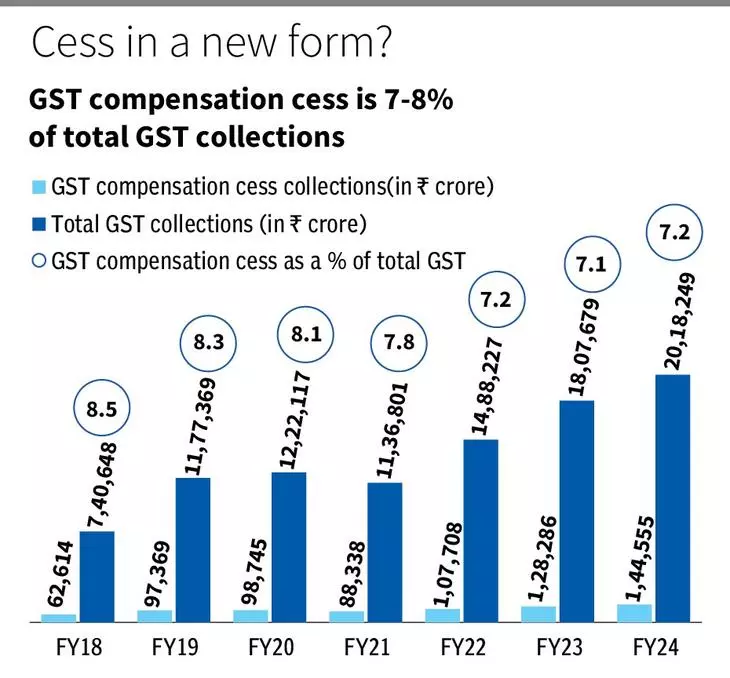
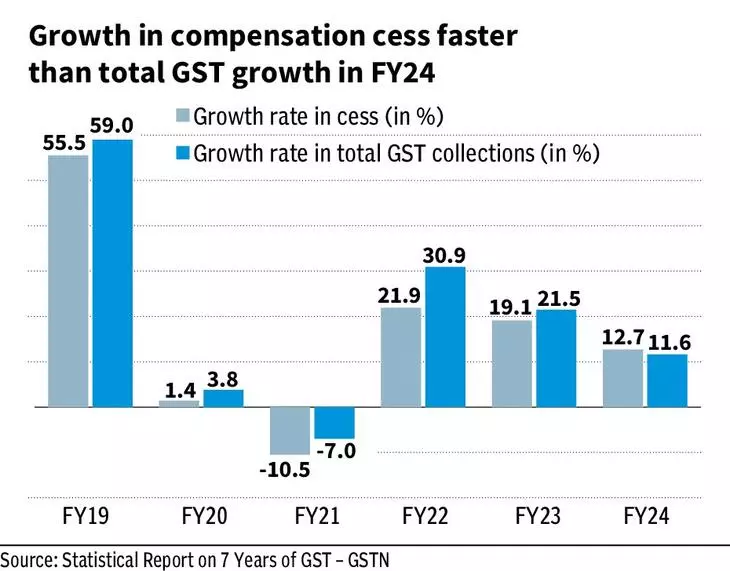
businessline analysis of the annual GST compensation cess collections from FY18 to FY24 shows that the tax contributed average 8 per cent to the total GST collections during the said years, and has been growing at almost the same rate as rise in overall GST collections. In fact, in FY24, the growth in cess outpaced that of total GST collections.
|
|
|
The GST compensation cess grew around 22 per cent in FY22 at ₹1.07 lakh crore, 19 per cent in FY23 to come in at ₹1.28 lakh crore, and 12.7 per cent in FY24 (₹1.44 lakh crore). Overall GST collections grew at 31 per cent, 21.5 per cent and 11.6 per cent during the same post-Covid years. The growth rate in Central Goods and Services Tax (CGST) is at 29 per cent, 19.7 per cent and 16 per cent in the period.
|
The cess is levied on supply of select so-called sin goods, luxury products and those with adverse environmental or health impacts. The list includes items such as tobacco, Pan Masala, carbonated beverages and also on products such as motor vehicles beyond certain capacity and coal products. It is also chargeable on certain goods imported to India.
|
|
“Industries like automobile, aerated beverages and others affected by the compensation levy were hoping for its discontinuation after the five-year period and then again after its extension for covering up the previous shortfall,” Abhishek Jain, Indirect Tax Head & Partner, KPMG, said. “The GoM is faced with a tough balancing act between industry expectations and the government’s interest in maintaining this key revenue source in some form,” he added.
|
|
|
While the levy on tobacco and related products helps in influencing consumer behaviour towards purchase of such goods, analysts also note that given the rising demand for large motor vehicles and redefinition of luxury goods, the GoM should also review items on which the cess is currently levied and rationalise it.
|
GST compensation cess was brought in as a measure by the Centre to meet its promise to the States to offer a 14 per cent CAGR in tax revenue for five years from the date of GST rollout. The payout to States ended in June 2022, but subsequently it was extended till March 2026, to repay the loan of around ₹2.7 lakh crore that the Centre borrowed during the pandemic period to meet the deficit.
|
Finance Minister Nirmala Sitharaman at the 54th Council meet said that government will likely clear the back-to-back loan and the interest thereon by January 2026 itself, and thus two months of compensation cess collections (February and March 2026) totalling to roughly ₹40,000 crore is likely to be surplus. “It shall no longer be ‘compensation cess’ post March 2026, but what is to be done with it, it will be decided by the GoM,” she said.
|
|
|
|
|
|
|
|
No, the Honorable High Court of Madras in the case of M/s. The Coronation Fireworks Factory V. The Joint Director & Another (W.P. (MD) No. 14221 OF 2024 And W.M.P (MD) No. 12477 of 2024 dated 01.07.2024) dismissed the writ petition seeking a refund of the seized amount of Rs. 1,82,25,000/-. The Honorable Court observed that the petitioner cannot obstruct the show cause proceedings merely because of the favourable order obtained from the Tribunal in Appeal No. 40138 of 2023. The impugned show cause notice is concerned with the appropriation of the seized amount from the petitioner's partner towards the tax liability under the respective GST enactments. It does not propose to confiscate the cash but seeks to address the tax liability. The Honorable Court noted that the petitioner is required to explain why the seized amount should not be appropriated towards the tax liability and dismissed the writ petiion.
|
It is important to note that cash is not 'goods liable to confiscation' under section 130(1) but are 'things' which are considered 'useful or relevant' by the Authorized Officer to carry out 'any further proceedings'. What, therefore, can be the 'use or relevance' of cash to be seized? There is a popular, mysterious, and erroneous understanding that 'cash' is illicit if discovered in search proceedings. Officers tend to seize cash without even ascertaining to whom it belongs. 'Cash' seizure does not directly point to proceeds from unaccounted sales. Seizure is a necessary requirement to 'secure' the specific 'goods and documents, books, or things' and to 'identify' them in later proceedings. A seizure does not imply 'transfer of property'. Care must be taken that once the SCN is issued, it is the conclusion of the 'investigation' and therefore there is no further reason for Revenue to keep custody of seized articles. The Application must be preferred under section 67(6) to seek provisional release of seized ariticles.
|
|
|
|
|
|
The GST Council meeting scheduled next month has a key proposal on the agenda: to exempt companies from paying GST at the time of import, allowing them to defer the payment until the output services are performed.
|
This proposed change mirrors the principles of the MOOWR (Manufacture and Other Operations in Warehouse) scheme under customs, which defers customs duties on imported goods until they are removed from the warehouse.
|
By aligning GST compliance with this approach, the Council aims to reduce the immediate tax burden and improve cash flow position for business operating in India.
|
The proposed changes entail substantial amendments under the law, and with the Finance Bill recently passed, it will be imperative to see the date of implementation.
|
|
|
|
|
|
The recent relaxations in the eligibility criteria for Member (Technical) by states like UP, Rajasthan, and Odisha, along with the designation of Joint Commissioner instead of Additional Commissioner in Maharashtra, may raise further litigations and potentially delay the functioning of the Goods and Services Tax Appellate Tribunal (GSTAT).
|
These potential litigations may arise on the grounds that the state relaxations are in variance with the principles enshrined by the Hon’ble Madras High Court.
|
Key points from the ruling that seem deviated by these relaxations:
|
— Qualifications of Members: The court struck down provisions allowing less qualified individuals to serve as judicial members, highlighting the need for members to have adequate legal training and experience. Relaxing criteria for technical members undermines this standard.
|
— Independence and Impartiality: The tribunal must inspire confidence in its independence and impartiality. Lowering eligibility criteria for technical members could erode public trust and create a perception of bias.
|
— Complex Legal Interpretations: The tribunal’s decisions involve complex legal interpretations. Lowering the bar for technical members could compromise the quality and fairness of these decisions.
|
The Hon’ble High Court, while striking down certain provisions of the CGST law earlier, held that adherence to these principles is essential to maintain the integrity and effectiveness of GSTAT.
|
Let’s hope for no further delay!!
|
|
|
|
|
|
4. Lawgics by Ms.Nidhi Aggarwal
|
Ms. Nidhi Aggarwal is delighted to present judgment with a great vision to spread complex GST law in a simple manner amongst the taxpayers, tax professionals, students and knowledge seeker.
|
|
Recently added notes are listed below:
|
|
|
|
|
|
Synopsis: The Delhi High Court dismissed the writ petition involving fraudulent ITC claims, directing the petitioner to pursue appellate remedy u/s 107 of the CGST Act.
|
Caste name: Banson Enterprises & Anr. vs Assistant Commissioner CGST & Ors.
|
Citation: W.P. (C) 6503/2025 dated 15.05.2025
|
Authority: Delhi High Court
|
The petition challenges the Order-in-Original dated 02.02.2025 based on a Show Cause Notice (SCN) dated 03.08.2024 A search was conducted, and statements were recorded including that of one Director admitting to the issuance of fake invoices during the Central Excise period. It was alleged that the Petitioner issued goods-less invoices to enable fraudulent Input Tax Credit (ITC) claims amounting to Rs. 1.85 crore.
|
Contentions of the Petitioner:
|
SCN was issued by unauthorized officer, thus, violates Rule 142(1)(a) of CGST Rules. No pre-consultation as required under Rule 142(1A) of CGST Rules was issued. Consolidated SCN for multiple financial years was issued and challenge to such consolidated action is pending in a separate matter (Quest Infotech case).
|
Contentions of the Department:
The impugned order is appealable, hence writ is not maintainable. The Petitioner’s Director admitted to allegations. Natural justice was followed as the Petitioner received the SCN, filed a reply, and availed of personal hearing. Reliance must be made on SC judgments and Allahabad HC rulings emphasizing alternate remedy u/s 107 CGST Act.
|
Findings and Decision of the Court:
The Court refused to interfere under writ jurisdiction, citing:
|
- No breach of fundamental rights or principles of natural justice.
- Availability of a statutory remedy (appeal) under Section 107 CGST Act.
The Court noted that the Allegations involve serious misuse of ITC, requiring fact-based adjudication, not suited for writ jurisdiction. Thus, the Petitioner was granted liberty to file appeal, and if filed with pre deposit, the appeal shall not be dismissed on limitation.
|
|
|
|
|
|
5. GST Notes by CMA Anil Sharma
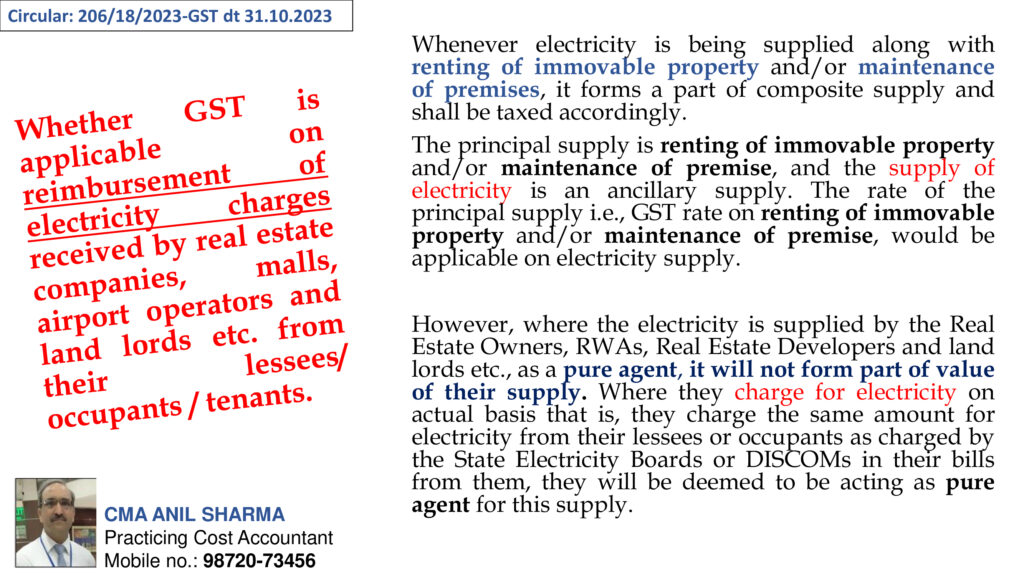
1) New slides on GST Circulars is added in the Notes section titled as "Capsules".
|
- Total 25 slides in capsule-01 is added
|
|
|
|
|
|
|
|
6. GST Daily by CA Pradeep Modi
CA Pradeep Modi is presenting judgment analysis under title 'GST Daily - Stay yourself updated'
|
|
|
|
|
|
|
Recap of Latest updates posted on 27.08.2026
|
CBIC issued Notification No. 30/2026-Customs dated 21.08.2026 regarding Seeks to exempt 10 lakh MT of raw sugar falling under tariff heading 1701 from the whole of the customs duty leviable thereon under …
|
GSTN is taking downtime to enhance its services on the GST Portal on 26.08.2026 from 12:00 AM onwards until 6:30 am of 26.08.2026.
|
The Hon’ble Supreme Court in M/s G.R. Infra Projects Limited set aside the Show Cause Notice dated June 13, 2025 issued under Section 74 of the CGST Act read with the MPGST Act for the FY 2018-19, and held that a bland and mechanical recital of the words ‘fraud or concealment of facts’,
|
Indian Railway Finance Corporation Ltd received a show cause notice from the GST Authority demanding ₹549.32 crore. The notice, issued under Section 73 of the Central Goods and Services Tax Act, 2017, cites excess input tax credit claims for FY23.
|
The Anti-Corruption Bureau (ACB) on Monday arrested a state tax officer and a senior assistant in Nirmal district for demanding and accepting a bribe of ₹50,000 in connection with a GST audit.
|
CBIC issued Notification No. 71/2026-Customs (N.T.) dated 25.08.2026 regarding Fixation of Tariff Value of Edible Oils, Brass Scrap, Areca Nut, Gold and Silver
|
CBIC issued Notification no. 21/2026-Customs (ADD) dated 21.08.2026 that Seeks to continue applicability of anti-dumping duty on imports of Natural Mica based Pearl Industrial Pigments ..
|
CBDT issued notification no. 115/2026 dated 21.08.2026 to hereby approves deduction under section 45(3)(a)(i) of the Income tax Act, 2025 to the International Institute of Bio Technology and Toxicology , Tamil Nadu for Scientific Research
|
I request the views of tax professionals and TDS experts on the following issue under the Income-tax Act, 2025, regarding reporting in Form 140.
|
|
|
|
|
|
|
|
THE HON'BLE ALLAHABAD HIGH COURT IN THE CASE OF Vibhuti Tyres V/s State of U.P., decided on 7-5-2025
|
✔️ Is it justified that GST order with higher demand than show-cause notice?
|
👉 The Hon'ble High Court Judgement:-
|
✔️ Where in show-cause notice amount representing tax, interest and penalty was indicated as Rs. 8,81,080, but in order, much higher demand was raised at Rs. 32,97,336, same was in violation of section 75(7); matter was to be remanded back.
|
Section 75 of Central Goods and Services Tax Act, 2017
|
|
|
|
|
|
|
|
THE HON'BLE JHARKHAND HIGH COURT IN THE CASE OF Sadanand Prasad Barnwal V/s State of Jharkhand, decided on 8-5-2025
|
✔️ Is it valid if SCN and order under section 73 for lack of digital signature of issuing authority?
|
👉 The Hon'ble High Court Judgement:-
|
✔️ Where both summary of SCN in Form GST DRC-01 and order under section 73 did not bear digital signature of concerned authority, both SCN and order were to be quashed.
|
Section 161, read with section 73 of Central Goods and Services Tax Act, 2017
|
|
|
|
|
|
|
|
THE HON'BLE CALCUTTA HIGH COURT IN THE CASE OF Edelweiss Rural & corporate Services Ltd. V/s Deputy Commissioner of Revenue, decided on 5-5-2025
|
✔️ What would be Refund if business stood closed and registration was cancelled?
|
👉 The Hon'ble High Court Judgement:-
|
✔️ Where Refund sanction order had itself observed that assessees business was closed down, its registration was cancelled and it had no tax dues refund claim was already allowed, direction to credit refund amount to credit ledger instead of bank account of assessee was self-contradictory since there was no business for assessee to take benefit of refund credited to assessees credit ledger.
|
Section 54 of Central Goods and Services Tax Act, 2017
|
|
|
|
|
|
|
|
THE HON'BLE JHARKHAND HIGH COURT IN THE CASE OF Sri Ram Stone Works V/s State of Jharkhand, decided on 9-5-2025
|
✔️ Can GST Notice would be issued under Section 61 of CGST Act merely on the basis of difference between sale price and market price?
|
👉 TheHon'ble High Court Judgement:- ✔️ Clear objective of section 61 is to enable an Assessing Officer to point out discrepancies and errors which are occurring in return filed by a registered person with that of related particulars; notice under section 61 cannot be issued comparing particulars at which assessee has sold its goods with that of prevalent market price.
|
|
|
|
|
|
7. PPT/Handbook on GST
|
|
|
|
8. GST/Income Tax in Media
|
|
|
- Retail e-invoicing pilot likely from April 2027 to improve GST compliance
- Alternate Mechanism of Liability and ITC in Form GSTR-3B - Public Consultation till 30th Nov.,26
- Next-Gen GST and India's next phase of growth
- ₹5.55 Crore GST Credit Under Scanner, Pharma Company MD Arrested
- GST Fraud: Partner Arrested for Rs 15.78 Cr ITC Claims
- Central GST officer caught accepting bribe in Bengaluru
- 170 vehicles detained, goods worth Rs 5 cr seized: Cheema
- Telangana tax dept holds officers personally accountable for unauthorised AI sharing of taxpayer data
- Tax department turns to AI for sharper scrutiny, compliance
- CBI Catches CGST Superintendent and Consultant Red-Handed in ₹1 Crore Bribery Trap Over New Panvel Flat Redevelopment
- Tax officials barred from sharing taxpayer data with AI tools
- Sirmaur pharma company MD held in Rs 6.55 crore GST refund fraud case
- West Bengal AAR says actual-cost electricity recovery not liable to GST
- Haryana: GST officer, CA held red-handed taking ₹3 lakh bribe
- HDFC Life Insurance faces ₹3,365 crore GST tax demand and penalty after appeal order
- GST data to track Andhra Pradesh’s economic growth live
- Gujarat Assembly passes GST amendment, livestock feed regulation bills
- SBI to use UPI data to lend to small businesses without GST registration
- IAMAI wants 5% GST dropped for app-based rides
- Rajasthan govt seizes 44 vehicles in 3 weeks in tax evasion crackdown
- States reject Gauba panel's push for single, nationwide GST registration
- Maruti sees strong growth as GST 2.0 pushes more customers to upgrade to cars, says Partho Banerjee
- Credai-Gujarat seeks GST clarity on FSI purchases
- Tata Steel gets major Supreme Court relief in ₹890 crore GST dispute
- TN Govt earns ₹50,845 crore from sales tax and excise revenue in liquor, aims for revenue expansion and de-addiction initiatives
- Despite GST Council’s no, legislators in UP, other states want Vidhayak Nidhi outside tax net
- CEAT wins ₹107 crore GST appeal, says no impact on financials or operations
- Mahindra Holidays receives ₹11.34-cr GST demand notice
- Gujarat High Court quashes GST order based on non-existent and AI-generated case law
- GST registration for big businesses: Centre, states work on uniform documents for faster approvals
- Telangana ACB traps state tax officer, senior assistant while taking ₹50,000 bribe in Nirmal
- IRFC receives ₹549.32 crore show cause notice from GST authority
- GST officials arrest All India Furnace Association chief KK Garg in Ludhiana
- Supreme Court dismisses Centre’s review plea in Airtel telecom tower GST case
- Tax row over Messi visit: Keralam GST department recommends action against officials
- Gujarat HC upholds GST on corporate guarantees, strikes down 'whichever is higher' clause
- Blood donation camps don’t qualify for GST exemption, Gujarat AAR rules
- Apportionment and Settlement of IGST Revenue
|
|
|
|
|
|
|
|
|
|
|
|
|
|
Hope the above updates is of use to you. Please share your input and feedback at taxupdate.otu@gmail.com
|
|
|
|
|
|
|
|
 
|
Visit our website
|
OTU provides you
|
- Articles on various topics
|
|
- Media - GST, Income Tax & Press R.
|
|
|
|
|
