
Original price was: ₹1,195.00.₹835.00Current price is: ₹835.00.
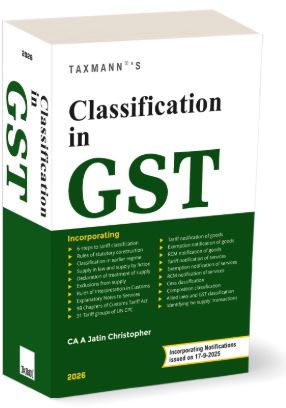
Title : Classificaiton in GST
Publication : Taxmann
Edition : 2026
Author : CA. A. Jatin Christopher is a Chartered Accountant, Cost Accountant, and law graduate with over two decades of professional experience in indirect tax laws. He qualified as a Chartered Accountant in 1996 and has since built a specialised practice in indirect taxation.
He is a published author and a recognised resource person for the Institute of Chartered Accountants of India (ICAI), contributing to various post-qualification programmes and supporting ICAI in the development of educational and research publications on indirect tax subjects. He also serves as a resource person for the Government, regularly conducting training programmes for practitioners, trade, and tax officers.
Based in Bengaluru, CA. A Jatin Christopher has been in professional practice since 2000 as a Partner at JCSS, a full-service firm with a pan-India presence
Description
Classification in GST offers a rigorous, rule-based framework for determining the correct GST classification of supplies—moving far beyond rate charts, presumptions or ‘common parlance’.
Using a structured six-step methodology grounded in the Customs Tariff Act, HSN, and UN CPC, it clarifies the distinction between supply and no-supply, object identification, tariff mapping, exemptions, RCM, cess, and composition.
The book is organised into 20 chapters, each dealing with a specific layer of classification. Illustratively:
- Background
- Why ‘common sense’ is unreliable; why classification is the pith of tax legislation; the six-step classification exercise; difference between tariff headings and tariff entries; role of substantive law (contract, property, etc.); commencement of business; implications of change in classification; affirmative actions; the limited role of AARs, circulars and Customs decisions; and the importance of ‘context-of-the-text’
- Interpretation in Classification
- Explores common, trade and expert parlance; how trade parlance can differ from consumer perception (e.g., tomato as botanically a fruit but commercially a vegetable); drafting errors and misprints; literal, golden and mischief rules; internal/external aids; and how to treat non-binding materials like FAQs and press notes
- Classification within Contracts
- Focuses on how contracts must be read to identify supply: title vs content, motivation vs consideration, performance conditions, performance risk, privity, sham contracts, jointly developed assets, unauthorised activities, fact patterns in e-commerce and digital platforms, and when contract terminology is misleading
- Essentials of Classification
- Separates supply classification, no-supply classification and object classification; addresses produce of cultivation; pure agency; subsidies and grants; transformation of goods into services (and vice versa); and how ‘information’ given by the taxpayer is treated as a fact, not a legal conclusion
- Classification Override
- Explains how law can substitute or override the contractual object (composite and mixed supplies, deemed goods/services), the role of residual entries, and how exemption and RCM provisions can only operate after classification is correctly fixed
- Supply, Fiction, Treatment & Exclusions
- Forms of supply (sale, transfer, barter, exchange, license, rental, lease, disposal); mutuality; import of services
- Legal fictions in Schedule I (supplies between related/distinct persons, principal–agent, branches, etc.)
- Schedule II (declaring certain activities as supply of goods or services)
- Schedule III (no-supply items, including sovereign functions, employment, actionable claims, land and completed building, and retrospective inclusions/exclusions)
- Classification Rules for Goods & Services
- Detailed analysis of HSN Rules of Interpretation for goods; section and chapter notes; application and limits of these rules under GST
- Introduction to UN CPC; how to use Explanatory Notes to the scheme of classification of services; coverage of all major groups, including construction, financial services, leases, R&D, education, health, public administration, club/association, cultural and extraterritorial services
- Goods – Tariff, Exemption, RCM
- Walkthrough of all 98 Customs Tariff Chapters and their GST relevance
- Chapter-wise analysis of goods exemption notification, including new and restructured entries post 17-09-2025
- Entry-wise reading of RCM notification for goods, highlighting how liability is shifted, the significance of the ‘supplier’ column, and constraints on creative reinterpretation
- Services – Tariff, Exemption, RCM
- Systematic classification of services under GST tariff entries (chapter 99), grouping 9954, 9961–9969, 9971–9973, 9981–9989, 9991–9999, etc.
- Comprehensive coverage of services exemption notification, with attention to education, health, government functions, charitable activities, transportation, financial services, social welfare and export-related exemptions
- Detailed examination of RCM notification for services, entry by entry, including special entries for online platforms, insurance, sponsorship, director services, renting, security services and others
- Cess, Composition & No-Supply
- Cess classification of goods (entries 1–56), the sub-set nature of cess HSN, residual entries and cess on services
- Composition classification, including two-class structure (goods and services), treatment of restaurant/hospitality, thresholds and interaction with RCM and cess
- Consolidated treatment of ‘no-supply’—purpose, statutory basis, examples, and practical consequences for GST compliance and litigation
- Within these chapters, the author frequently uses tables, checklists, ‘touchpoint’ matrices (especially for e-commerce business models), examples and hypotheticals to illustrate how the six-step method works in practice
The structure is deliberately layered and iterative:
- First Principles – Chapters 1–2 set the interpretative and conceptual foundations
- Transaction & Contract Analysis – Chapters 3–5 make the reader understand how to correctly read contracts and facts before touching tariff schedules
- Supply/No-Supply & Object Identification – Chapters 6–9 determine whether there is any supply in the first place and, if so, what exactly is being supplied
- Tariff-level Detail – Chapters 10–17 move into granular tariff, exemption and RCM analysis for both goods and services, using HSN and UN CPC
- Special Regimes & Exclusions – Chapters 18–20 complete the framework with cess, composition and no-supply
- The book can thus be used in two ways:
- Sequentially, as a deep study of classification in GST, and
- Referentially, by dipping into specific chapters when a classification question arises in practice, using the contents, chapter-heads and lists of cases to navigate

Related products
-
Sale!
Understanding Income Tax Bill, 2025 with Notes on Clauses
Original price was: ₹1,295.00.₹840.00Current price is: ₹840.00. Add to basket -
Sale!

Handbook to Direct Taxes (with free e-book access)
Original price was: ₹2,395.00.₹1,552.00Current price is: ₹1,552.00. Add to basket -
Sale!
Company Balance Sheet and Profit & Loss Account under AS & Schedule III (for F.Y. 2024-25)
Original price was: ₹2,850.00.₹1,935.00Current price is: ₹1,935.00. Add to basket -
Sale!

Handbook To INCOME TAX RULES
Original price was: ₹2,195.00.₹1,425.00Current price is: ₹1,425.00. Add to basket