
Budget 2026 Income Tax Change Expectations Live:
With signs of moderation in urban consumption and a continued need to stimulate growth, taxpayers and experts alike are hopeful that Finance Minister Nirmala Sitharaman will announce meaningful tax relief measures in Union Budget 2026. Expectations are high for further rationalisation of income tax slabs, an increase in standard deduction, enhanced rebates, and new incentives to boost household spending and long-term investments.
The budget is also expected to focus on strengthening private capital expenditure, reviving affordable housing demand, supporting senior citizens and retirees, and simplifying compliance for individuals and NRIs.
When will Budget 2026 be presented? Check date
FM Sitharaman will present the Union Budget 2026 on Sunday, February 1, 2026, while the Economic Survey is scheduled to be tabled on January 31, 2026, outlining the government’s assessment of the economy ahead of the budget announcement.
What major changes are taxpayers hoping for from Budget 2026?
Following the significant relief announced in Budget 2025, such as making income up to ₹12 lakh effectively tax-free under the new tax regime, taxpayers are now hoping for further easing of the tax burden, possibly including a higher basic exemption limit, enhanced deductions under Sections 80C, 80D, and 80CCD, and a more consumption-friendly tax framework.
Will there be any change expected in the Standard deduction?
A key demand is a further hike in the standard deduction, which currently stands at ₹75,000 under the new tax regime. Many experts have also called for revisiting outdated exemption limits, rationalising capital gains taxation, restoring indexation benefits on debt funds, and providing greater flexibility under the new tax regime by allowing select deductions. Homebuyers are seeking higher interest deduction limits on housing loans, expanded HRA benefits for more cities, and rationalisation of stamp duty and other levies.
What other changes can be expected in Budget 2026?
There are expectations that the government may continue nudging taxpayers toward the new tax regime while possibly outlining a roadmap for a gradual phase-out of the old regime. Senior citizens and retirees are hoping for higher deductions on interest income, health insurance premiums, pension schemes, and tax relief on debt-oriented investments. Simplification of ESOP taxation, NPS incentives, and insurance-related deductions are also on the wish list.
As the budget date approaches, Budget 2026 is widely seen as an opportunity to balance fiscal prudence with much-needed tax relief aimed at boosting disposable income, encouraging investments, and supporting inclusive economic growth.
Budget 2026 should improve take-home pay through thoughtful tax reforms
Mr. Avinash Godkhindi, MD & CEO of Zaggle, says targeted tax changes can directly benefit salaried employees.
“Thoughtful tax reforms have the potential to meaningfully improve take-home pay while shaping healthier spending behaviour and long-term financial planning.”
He adds that recognising structured benefits can deliver relief without complexity.
“Rationalising exemptions and deductions, especially for retirement savings, health, fuel, books and periodicals and other essential benefits, can deliver practical relief to salaried individuals.”
Budget 2026 should ease global investing under LRS
Viram Shah, Founder and CEO of Vested Finance, says Indian investors are increasingly using overseas investments for long-term diversification.
“Indian investors are increasingly viewing global investing as a long term diversification strategy rather than a short term opportunity.”
He adds that Budget 2026 can reduce friction for overseas investing.
“Easing global investing under the LRS through measures such as building on the higher TCS threshold and rationalising TCS rates can enhance liquidity and make long term overseas allocation more seamless.”
Budget should improve transparency and fairness in digital lending
Mr. Mukesh Pandey, Director of Rupyaa Paisa, says consumers are looking beyond easy access to credit as digital lending expands.
“With the Budget 2026 approaching, consumers will be looking for more than simply quick access to loans; they will also desire a fair rate of pricing, transparency in the lending process, and more innovative methods of evaluating borrowers.”
He adds that regulation and awareness are key to responsible credit growth.
“Ultimately, the Budget 2026 framework should incentivise disciplined borrowing and increase financial literacy so that credit can be a positive tool for economic development rather than a liability.”
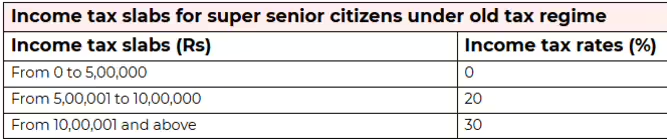
Income tax slabs for super senior citizens under old tax regime
Budget may boost term insurance with clearer tax incentives
Prantik Mitra, Director, Client Advisory Group at Alliance Insurance Brokers, says Budget 2026 should build on recent insurance reforms to widen protection.
“A key expectation is higher and clearly defined tax incentives for pure protection products, especially term life.”
He adds that separating protection from savings-linked insurance can help close India’s protection gap.
“Separating tax benefits for protection from savings-linked insurance would help close India’s protection gap, attract first-time buyers, and encourage people to prioritise risk cover over investment-oriented policies.”
Budget should address rising consumer credit stress
Mr. Tanish Sharrma, Co-founder, BillCut, says growing dependence on loans and credit cards calls for targeted policy action.
“The rising dependency on loans and credit cards indicates a requirement for a strong consumer credit awareness, transparent and fairer interest structures, and easier access to refinancing or consolidation options that help borrowers manage repayments more efficiently.”
He adds that incentives and awareness can help borrowers break debt cycles.
“Policy support in the form of incentives, such as tax benefits on interest paid, and the introduction of large-scale financial literacy initiatives will go a long way, helping borrowers break free from high-interest debt cycles.”
Lower entry barriers for mid-segment homebuyers
Amit Prakash, Co-Founder & CBO, Urban Money, says affordability must remain central to housing policy in Budget 2026.
“Housing continues to play an important role in supporting urban employment, allied economic activity, and rising middle-class consumption, making affordability a critical policy priority.”
He adds that smoother, more transparent borrowing systems can improve access for first-time buyers.
“Budget 2026 presents a timely opportunity to lower financial entry barriers, strengthen affordability, and modernise the systems that support long-term, responsible borrowing.”
Boost housing affordability through predictable EMIs and tax clarity
Atul Monga, Co-Founder and CEO, BASIC Home Loan, says housing finance needs focused policy support in Budget 2026.
“For first-time and affordable homebuyers, predictable EMIs, clear tax benefits and easier access to credit matter far more than short-term interest rate movements.”
He adds that targeted tax relief can revive genuine housing demand.
“Enhancing deductions on home loan interest and principal repayment, restoring higher limits for self-occupied homes and offering targeted tax relief first-time buyers can improve affordability without increasing property prices.”
Cut hidden costs and ease EMIs for homebuyers
Samarth Setia, Founder, Rezio.ai, says Budget 2026 must focus on reducing unseen costs that raise home prices for buyers.
“For consumers, Budget 2026 should expand homeownership by cutting the hidden costs that quietly get passed on to buyers. Approval delays create a real ‘time tax’ through interest, rework, and cost overruns, and that ultimately shows up in the final per-sq-ft price.”
He adds that targeted relief and faster approvals can ease buyer pressure.
“Time-bound single-window approvals and stamp duty rationalisation can reduce this friction, while targeted relief for first-time and mid-income buyers through higher home-loan interest deductions can ease EMI pressure.”
Address fixed-income taxes and strengthen investor protection
Sachin Jain, Managing Partner, Scripbox, flags key gaps affecting retail investors and retirees.
“Post-tax yields on fixed income instruments remain a major challenge, especially for retirees in higher tax brackets who depend on predictable income.”
He also highlights the need for stronger safeguards in an increasingly digital ecosystem.
“The rise in financial scams, unauthorised use of personal data, and misuse of consumer consent are serious concerns. Strengthening safeguards around data privacy, fraud prevention, and accountability must be an immediate priority.”
Ease crypto taxes and cut TDS to curb offshore migration
Sumit Gupta, Co-Founder, CoinDCX, says the virtual digital asset sector is looking for calibrated reforms in Budget 2026.
“As we approach Budget 2026, the virtual digital asset sector is naturally looking for measured relief, especially since it has been four years since the current taxation framework was introduced.”
He adds that tax and compliance clarity can bring users back to Indian platforms.
“Reducing TDS from 1% to 0.01% would retain monitoring while removing the primary incentive for offshore migration, encouraging users to return to Indian platforms and restoring transaction visibility under government oversight.”
Section 80D limits to improve health insurance affordability
Mr. Ashwani Dhanawat, Executive Director and Chief Investment Officer, Shriram General Insurance, says the non-life insurance sector needs structural reforms to expand coverage.
“As we approach Union Budget 2026, India’s non-life insurance sector stands at a critical inflection point. While recent reforms, including the increase in FDI limits to 100%, have strengthened capital availability and investor confidence, insurance penetration continues to hover around~1% of GDP.”
He adds that tax relief aligned with medical inflation can make health protection more accessible.
“Raising Section 80D limits (from the current ₹25,000/₹50,000 to ₹50,000/₹1 lakh) in line with medical inflation and extending full tax benefits to senior citizens opting for independent health covers will make adequate health protection more accessible.”
May raise standard deduction, ease compliance under new tax law
CA Akshay Jain, Direct Tax Partner, NPV & Associates LLP, says taxpayers are looking for clarity and simplification as the new income tax law comes into force.
“With New Income Tax Act coming into force, we expect simplified reforms, enhanced taxpayer services and experience, reduced disputes, speedy redressal of CIT Appeals and less harassment during scrutiny assessment. Faster processing of returns and timely issuance of refunds will be highly appreciated by the taxpayers.”
He adds that salaried taxpayers are also expecting higher deductions.
“It is highly expected by salaried class taxpayers that the limit of standard deduction should be increased. Standard deduction limit should ideally be increase to Rs.1,00,000 from existing limit of Rs.75,000.”
Boost health insurance through tax incentives
Abhishek Bansal, Chief Revenue Officer at InsuranceDekho, says widening health insurance coverage must be a priority as healthcare costs rise.
“Health insurance penetration in India is currently limited, even with the increasing expense of health care services. Encouragement of health insurance through greater penetration of health insurance products in India, particularly by middle-income and elderly people, will be critical in the Union Budget of 2026–27 to enhance the ways in which healthcare is financed and accessed through expansion and support of health insurance.”
He adds that tax incentives can play a key role in driving adoption.
“Providing additional tax benefits on premiums paid for health insurance policies may create an economic incentive for many families to obtain and retain comprehensive health insurance coverage.”

Share this content: