


Original price was: ₹1,050.00.₹735.00Current price is: ₹735.00.
Author : Roopali Singhal & Vineet Sahay
Title : GST A Simple Approach – Your Easy GST Guide.
Whether you are a student, a budding professional, or a small business owner, this book will help you build confidence in understanding GST laws, procedures, and compliance requirements. By the end of the book, readers will not only understand the basics but also be equipped with sufficient knowledge to handle GST-related matters at a professional level.
Publisher : Siddharth Publication
2nd Edition, 2025
Description
Index
Chapter-1: Goods and Services Tax
1. Introduction
2. GST Framework (Chapters I to VI)
- 2.1. Chapter I – Preliminary: Defining Key Terms
- 2.2. Chapter II – Administration: Establishing Tax Machinery
- 2.3. Chapter III – Levy and Collection of GST
- 2.4. Chapter IV – Composition Levy
- 2.5. Chapter V – Time and Value of Supply
- 2.6. Chapter VI – Input Tax Credit
3. Promote Self-Regulation (Chapters VII to XI)
- 3.1. Chapter VII – Registration
- 3.2. Chapter VIII – Invoicing
- 3.3. Chapter IX – Returns
3.4. Chapter X- Payment of Tax
- 3.5. Chapter XI – Refunds
4. Enforce and Correct if Needed Chapters XII to XV
- 4.1. Chapter XII – Assessment
- 4.2. Chapter XIII – Audit
- 4.3. Chapter XIV – Inspection, Search, and Seizure
- 4.4. Chapter XV – Demand and Recovery
5. Provide Dispute Redressal Mechanisms (Chapters XVI to XIX)
- 5.1. Chapter XII – Special Liabilities
- 5.2. Chapter XVII – Advance Ruling
- 5.3. Chapter XVII – Appeals and Revisions
- 5.4. Chapter XIX – Offences and Penalties
6. Ensure Smooth Closure and Special Handling (Chapters XX to XXI)
- 6.1. Chapter – XX – Transitional Provisions
- 6.2. Chapter XXI Miscellaneous Provisions
Chapter-2: GST and Constitution
1. Constitution of India and Law-making power
- 1.1. List-I: Union List
- 1.2. List-II: State List
- 1.3. LIST III: Concurrent List
2. Old Indirect Taxation System
- 2.1. Short comings of the old system
3. Goods and Services Tax
- 3.1. Destination based Indirect Tax:
- 3.2. Objectives and Benefits of GST
- 3.3. Dual GST
- 3.4. Compromised GST
- 3.5. Tax Replaced with GST
4. Evolution of GST
5. Constitutional Amendments
- 5.1. 101st Constitutional Amendment Act
- 5.2. Provisions of 101st Constitutional Amendment Act
6. GST Council
- 6.1. Council Recommendations:
Chapter-3: Supply
1. Introduction
2. Supply is not defined
3. Scope of supply.
- 3.1. Salient Features of Supply
- 3.2. Transactions Covered u/s 7
- 3.3. General Transactions
- 3.4. Supply for Consideration
- 3.5. In the course or furtherance of business
4. Special Transactions
- 4.1. Transactions Between Clubs/Associations and their Members
- 4.2. Import of Services for Consideration – Taxable Even for Personal Use
- 4.3. Deemed Supplies under Schedule I
- 4.4. Import of services from a related person.
5. Classification of Supply
- 5.1. Understanding Section 7(1A)
- 5.2. Implications of Section 7(1A)
- 5.3. Illustrative Examples from Schedule II:
6. Exclusions from GST
- 6.1. Activities or Transactions Listed in Schedule III
7. Composite and Mixed Supply
- 7.1. Composite Supply – Meaning and Provisions
- 7.2. Mixed Supply – Meaning and Provisions
8. Levy and Collection of Tax on Supply
- 8.1. Scope and Applicability
- 8.2. Tax Rate and Notification Power
- 8.3. Reverse Charge Mechanism (RCM)
- 8.4. Similar Provision under SGST and IGST Act
- 8.5. Taxable Supply
Chapter-4: Exemption under GST
1. Introduction
2. Legal Framework
3. Types and Classification of Exemptions
- 3.1. Absolute Exemptions
- 3.2. Conditional Exemptions
- 3.3. Optional Exemptions
- 3.4. Partial Exemptions
- 3.5. Turnover-Based Exemptions
4. Exemption under GST (Updated up to September 2025)
- 4.1. Goods Exempted – Notif. No. 10/2025-CT (Rate) (superseding 2/2017)
- 4.2. Services Exempted – Notif. No. 12/2017-CT (Rate)
- 4.3. Sector-Specific Exemptions
- 4.4. Compliance Note
5. Procedural Aspects of Claiming Exemption
- 5.1. Treatment in Tax Invoice
- 5.2. Disclosure in Returns
- 5.3. Documentation and Declaration
- 5.4. ITC Implications
6. Notifications and Clarifications
- 6.1. Key Exemption Notifications
- 6.2. Circulars and Clarificatory Guidelines
7. Compliance Challenges and Errors
- 7.1. Frequent Mistakes in Availing Exemptions
- 7.2. Risks of Misclassification and Non-Compliance
- 7.3. Audit Exposure and Penalties
- 7.4. Advisory for Risk Mitigation
Chapter 5: Composition Levy
1. Introduction
- 1.1. Legal framework
2. Composition – Goods & Restaurants
- 2.1. Eligibility Criteria for Composition Scheme
- 2.2. Ineligibility Conditions for the Composition Scheme
- 2.3. Procedure to Opt for the Scheme
- 2.4. Annual Return Filing – Form GSTR-4
- 2.5. Composition Scheme for Suppliers of Services
Chapter 6: Place of Supply
1. Introduction to Place of Supply
2. Legal Framework and Definitions
3. Place of Supply of Goods
- 3.1. Place of Supply within India
- 3.2. Supplies Without Movement of Goods
- 3.3. Import and Export (Section 11)
4. Place of Supply of Services (Domestic – Section 12)
- 4.1. General Rule for Place of Supply of Services
5. Place of Supply of Services (International Transactions)
- 5.1. General Rule for Cross-Border Services
- 5.2. Specific Rules for Cross-Border Services
6. Special Provisions for OIDAR Services
- 6.1. Meaning and Scope of OIDAR Services
- 6.2. Unique Taxation Challenge in Cross-Border Digital Supplies
- 6.3. Types of Services Covered under OIDAR
- 6.4. Place of Supply and Applicability of Section 14
- 6.5. Compliance Requirements for Foreign OIDAR Suppliers
- 6.6. Conditions to Determine Recipient Location
- 6.7. Role of Intermediaries and Designated Authority
- 6.8. Objective and Global Alignment
Chapter 7: Time of Supply
1. Time of supply of goods
- 1.1. Liability to Pay Tax on Goods
- 1.2. Time of Supply of Goods under Forward Charge
- 1.3. Time of Supply of excess Amounts
- 1.4. Time of Supply Under Reverse Charge
- 1.5. Vouchers: Time of Supply Section 12(4)
- 1.6. Residual Cases: Time of Supply (Section 12(5))
- 1.7. Interest, Late Fee, or Penalty: Time of Supply
- 1.8. Receipt of Advance: Time of Supply
2. Time of supply of services
- 2.1. Time of supply of Services under Forward Charge
- 2.2. Timeframe for Invoice Issuance
- 2.3. Handling GST on Excess Payments
- 2.4. Time of Supply for Services Under Reverse Charge
3. Time of Supply – Tax Rate Change
- 3.1. Supplied Before the Change in Rate of Tax
- 3.2. Supplied After the Change in Rate of Tax
- 3.3. Additional Provision
Chapter 8: Valuation of Taxable Supply
1. Introduction
2. GST framework for Valuation of Supply
3. Value of Taxable Supply
- 3.1. Transaction Value
- 3.2. Inclusion and exclusion while computing Transaction Value
4. Valuation Rules (Rules 27 to 35) under CGST Rules, 2017
- 4.1. Where the price is not sole consideration
- 4.2. When the supply between distinct or related person i.e.,
- 4.3. Value of supply of goods made or received through an agent
- 4.4. Value of supply of goods or services or both based on cost (Cost Plus Method)
- 4.5. Residual Method
- 4.6. Value of supply in case of lottery, betting, gambling and horse racing
- 4.7. Valuation in Online Gaming
- 4.8. Value of supply of actionable claims in case of casino
- 4.9. Determination of value in respect of certain supplies
Chapter 9: Input Tax Credit
1. Historical Background
2. Background of ITC in India
3. GST Mechanism of ITC
4. Legal framework of ITC
- 4.1. Statutory Provisions Governing ITC
- 4.2. Burden of Proof and Compliance Obligation
- 4.3. Controls to Prevent ITC Misuse
5. Eligibility and conditions for taking input tax credit
- 5.1. Eligibility Criteria for Availing ITC
- 5.2. Persons who are not eligible to get Input Tax Credit
- 5.3. Conditions for Taking Input Tax Credit
- 5.4. ITC Reversal After 180 Days
- 5.5. No Dual Benefit – ITC/Depreciation
6. Time Limit for Availing Input Tax Credit
7. Apportionment of Credit and Blocked Credits
- 7.1. Apportionment Between Business and Non-Business Use
- 7.2. Apportionment Between Taxable and Exempt Supplies
- 7.3. Vehicles & Related
- 7.4. Luxury/Personal Services
- 7.5. Construction
- 7.6. Special Categories
- 7.7. Lost, Destroyed, or Free Goods
- 7.8. Tax Paid for Fraudulent Activities
8. Availability of ITC in Special Circumstances.
- 8.1. ITC Allowed in Special Entry Cases
- 8.2. Time Limit to Claim ITC
9. Transfer of ITC on Business Reorganisation
- 9.1. Transfer of Credit on Business Reorganisation
- 9.2. ITC Reversal on Composition or Exempt Supplies
10. Manner of Calculation of claim and reversal of ITC
- 10.1. Manner of Claiming Input Tax Credit in Special Circumstances
- 10.2. Declaration in FORM GST ITC-01
- 10.3. Certification by Chartered Accountant
- 10.4. Matching of Credit
- 10.5. ITC on Sale of Capital Goods
11. ITC Claim & Reversal – Calculation
- 11.1. Reversal on Inputs and Semi-Finished/Finished Goods
- 11.2. Reversal on Capital Goods
- 11.3. Reversal by Tax Head
- 11.4. Estimation Where Invoices Are Not Available
- 11.5. Reporting and Filing Requirements
- 11.6. Certification by Professional
12. Reversal on Supply of ITC claimed Capital Goods
- 12.1. Calculation of ITC to be Reversed
- 12.2. Important Condition: Higher of Two Amounts
- 12.3. Reporting Requirement
13. Input Tax Credit by Input Service Distributor
- 13.1. Timely Distribution and Monthly Reporting
- 13.2. Limits and Attribution of Credit
- 13.3. Separate Distribution of Eligible and Ineligible ITC
- 13.4. Distribution of ITC Based on Tax Type and Location
- 13.5. Invoices, Credit Notes, and Debit Notes by ISD
- 13.6. Transfer of RCM Credit to ISD (Rule 39(1A))
- 13.7. Corrections and Adjustments (Rule 39(2) and (3))
- 13.8. h. Definitions and Explanation
14. ITC Apportionment – Sec 17(1) & (2)
- 14.1. Steps for Apportionment and Reversal of Common Credit
- 14.2. Annual Adjustment – Rule 42(2)
15. ITC on Capital Goods – Mixed Use
- 15.1. Exclusive Use Cases (Clauses a & b)
- 15.2. Common Use of Capital Goods (Clause c onwards)
- 15.3. Reversal for Exempt Supplies (Clause g & h)
- 15.4. Special Provision for Real Estate Projects
- 15.5. Multiple Project Allocation & Remaining Life ITC
- 15.6. Clarificatory Explanations
Chapter 10: Registration
1. Statutory provision for Registration
- 1.1. Threshold for Registration
- 1.2. Registration of Existing Businesses
- 1.3. Tax Tax Duties in Reorganization
2. GST Registration Requirements
- 2.1. Brief of Section 22
3. Persons not liable for registration
- 3.1. Exemption Based on Nature of Supply
- 3.2. Exemption for Agriculturists
- 3.3. Government’s Power to Exempt
4. Compulsory registration in certain cases
5. Persons liable for registration
- 5.1. Persons making any inter-State taxable supply
- 5.2. Casual Taxable Persons making taxable supply
- 5.3. Taxpayers Subject to Reverse Charge
- 5.4. Electronic Commence Operators
- 5.5. Non-resident Taxable Suppliers
- 5.6. Tax Deductors Under Section 51
- 5.7. Agents Making Taxable Supplies on Behalf of Others
- 5.8. Input Service Distributor
- 5.9. E-commerce Suppliers Subject to TCS Under
- 5.10. e-Commerce operators required to collect tax at source
- 5.11. Foreign OIDAR and Online gaming service providers
- 5.12. Notified persons
6. Procedure for registration
7. Deemed Registration
8. Special Rules – Casual/NR Taxpayers
9. Amendment of Registration
10. Cancellation of Registration
11. Revocation of Cancellation of Registration
12. Modification, Suspension and Cancellation Registration
13. Miscellaneous provisions
Chapter 11: Invoice and Adjustment Notes
1. Introduction
2. Tax Invoice
3. Time of issue of Tax Invoice in respect of Services
4. Content of Invoice
5. Bill of Supply
6. Receipt, Refund and Payment Voucher
7. Penalty for Wrong Invoicing
8. Credit and Debit Notes
Chapter 12: Returns
1. Overview of GST returns framework
2. Furnishing Details of Outward Supplies
3. Communication of input tax credit (ITC)
4. Return Filing Responsibilities: Section 39
5. Return Filing Requirements for Regular Taxpayers

Related products
-
Sale!
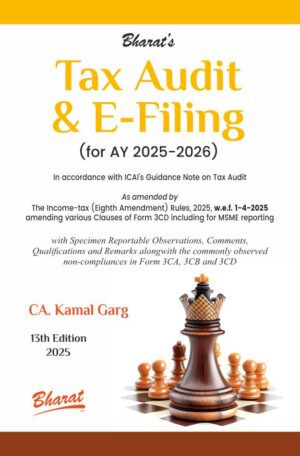
Tax Audit & E-filing (for AY 2025-26)
Original price was: ₹2,495.00.₹1,871.00Current price is: ₹1,871.00. Add to basket -
Sale!
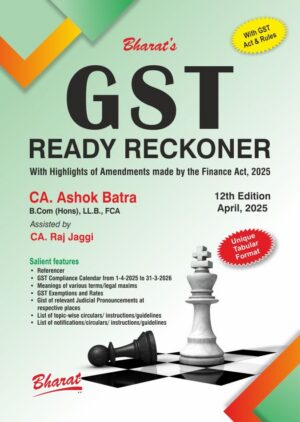
GST Ready Reckoner
Original price was: ₹3,150.00.₹2,200.00Current price is: ₹2,200.00. Add to basket -
Sale!
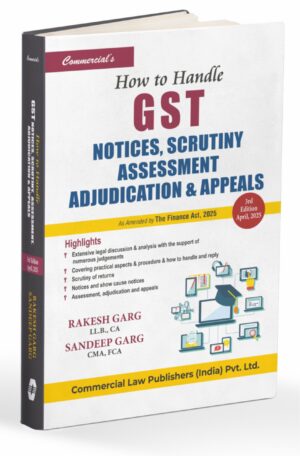
Book: How to Handle GST Notices Scrutiny, Assessment, Adjudication & Appeals as amended by Finance Act, 2025
Original price was: ₹1,495.00.₹1,016.00Current price is: ₹1,016.00. Add to basket -
Sale!
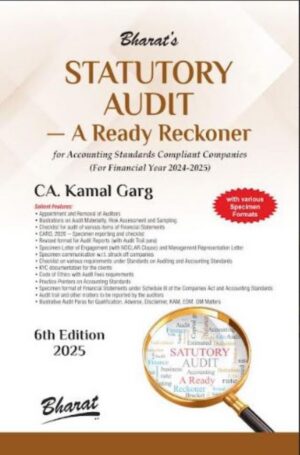
Statutory Audit – A Ready Reckoner for Accounting Standards Complaint Companies (for FY 2024-25)
Original price was: ₹2,295.00.₹1,600.00Current price is: ₹1,600.00. Add to basket