
Input Tax Credit (ITC) as a concept is easy to understand, but it pose challenges when we want to claim the credit. This is because we have GSTR-2B, 3B , IMS, purchase register, bank statement, vendor confirmation, etc. in addition to the conditions prescribed under section 16 of CGST Act, 2017, to be checked and verify before we arrive at claimable credit.
Table 4 of GSTR-3B
The only method to claim ITC is GSTR-3B. One cannot claim it by login into electronic credit ledger (ECL) and inputting the ITC amount or one cannot claim ITC in annual return – GSTR-9/9C.
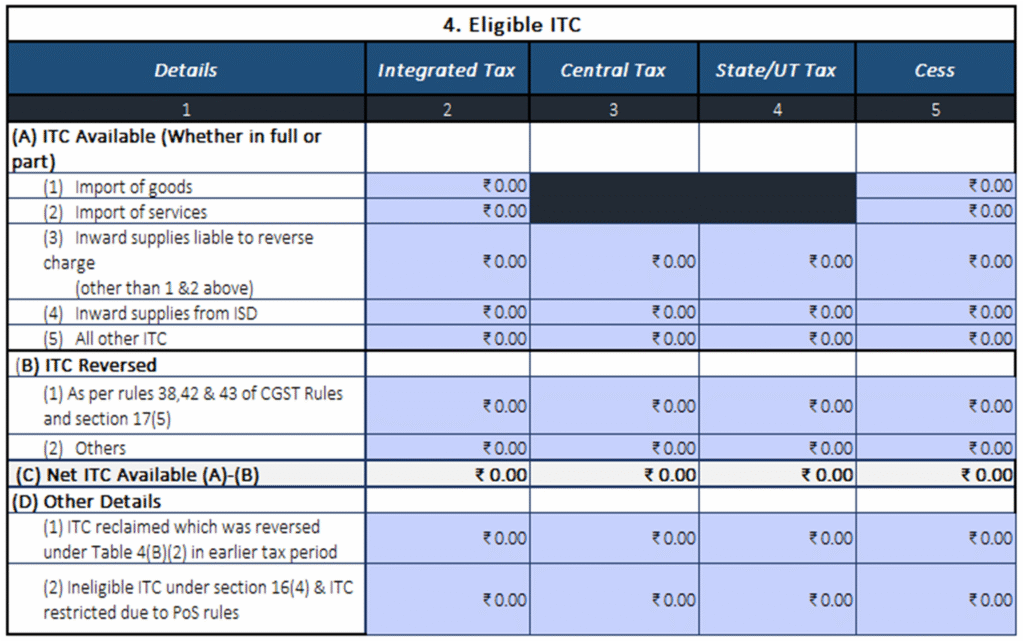
The ITC is claimed vide table 4 of GSTR-3B. It has 4 parts viz A, B, C & D. For better understanding it is termed as table 4(A), 4(B), 4(C) and 4(D).
Table 4(A) is further divided into 5 rows.
- row 1 – Import of goods,
- row 2 – Import of services,
- row 3 – RCM ,
- row 4 – ISD and
- row 5 – all other ITC
Table 4(B) –
- row 1 – blocked ITC and not claimable ITC
- row 2 – mismatch ITC and claimable ITC
Table 4(D)
- row 1 – reclaimed ITC
- row 2 – unclaimable ITC due to PoS and time barred ITC
Here is the screen shot of Table 4 of GSTR-3B
Circular No. 170/02/2022-GST dated 06.07.2022 requires a taxpayer to show ITC as per GSTR-2B. Then showing the matched and unmatched ITC is respective table 4 as instructed in the said circular.
In a situation where the invoices dated August, 2026 is received and recorded in books in the same month. Then ITC shall be shown in table 4 alone.
And , where an invoices dated August, 2026 is received and recorded in books in September, 2026 , the reporting of ITC shall be like this –
- report the ITC in table 4(A)(5)
- show in table 4(B)(2)
by this ITC will not flow to table 4(C) which is connected to ‘Electronic Credit Ledger’ in common portal. However, the government comes to know the ITC is reported by vendor but recipient could not claim it in the same month.
Electronic Credit Reversal and Reclaim Statement
The ITC reported in table 4(B)(2) is connected to ‘Electronic Credit Reversal and Reclaim Statement‘. This ledger tracks the ITC that recipient is eligible to claim but for time he could not claim it for valid reason.
In current month working in GSTR-2B mention a remark that this ITC could not be claimed and take an extract from ‘Electronic Credit Reversal and Reclaim Statement’ and keep it in separate sheet in 3B working file.
Next month the parked ITC accounted in books becomes eligible to claim. In current month 2B add the last month unmatched ITC from 2B and match it.
In table 4(A) the said last month ITC need to be added and the same is need to be shown in table 4(D)(1). By doing so, the ITC in table 4(A) which should be same as in current month 2B will be reduced by ITC in 4(D)(1) to match with current month 2B ITC. This table 4(D)(1) is linked to ‘Electronic Credit Reversal and Reclaim Statement’. The ITC so parked last month will get removed from this table basis 4(D)(1) table.
This exercise need correct tracking in working and in example it was one invoice but in practical there could be many invoicie.
Credit Note rejected by customer
Many time goods are sent back by customer due to poor quality or different product. In this case, customer has not accounted said goods in his books as his purchase because he has not accepted it. However, the vendor will issue a credit note to nullify the invoice that he had issued. Both are reported in GSTR-1 and the same gets populated in GSTR-2B of the customer.
Since customer had not received the goods he will reject the Credit note from IMS. This rejected credit note add up the GST liability of the vendor . The customer might also reject Invoice but that does not get adjusted in the liability of the vendor. In the case, the vendor ends up paying GST again by virtue of rejected Credit note.
He also cannot adjusted the credit only in 3B as it would be non-compliance of the aforesaid circular no. 170. Government should issue clarification to handle such scenario in GSTR-3B.
Bank ITC
Banks are charging GST on service charges for financial transaction handles by them. Those credit appear in bank statement. Sometime the GST component are unclear from the statement. However, the details do populate in GSTR-2B and basis this credit can be claimed. But one may request for a yearly statement from Bank having invoices number , GST component which should then match with 2B.
Flight ticket charges/ Bus charges through online portal
The air ticket or bus travel are booked through an online platform like Thomas Cook or Make My Trip (MMT) etc. These agents raises two invoices. One for their service charges which has GST component. The second is for claim reimbursement of air ticket, bus ticket at actual.
Air India, Indigo etc. raises and invoice on passengers name. And passenger gives the GSTIN of his company as it is a business tour. In books of account only the agents’ ledger are maintain but not the airline or MMT. As such the ITC cannot be matched with books directly. In such case, call for the passenger wise ticket details from the agents and match them with 2B.
So, two category of credits claimed –
- air ticket , red bus ticket
- travel agent charges
GSTR-2B clean up
As per the aforesaid circular , total ITC as per 2B is shown in table 4 and unmatched ITC gets parked in ‘Electronic Credit Reversal and Reclaim Statement’. There are possibility that in 2B some other vendors had by mistakenly shown the taxpayer’s GSTIN. And since this credit is not belonging to you the concerned vendor need to be informed to correct the GSTIN in his GSTR-1. Once they correct it the ITC parked in said ledger should be reversed by showing the concerned ITC by showing in table 4(A) and same in table 4(B)(1). This table bring back the ITC to 4(A) and removes through table 4(B). Thus it does not travels to table 4(C). By doing this, the government will come to know that unrelated ITC are removed from electronic ledger.
Glance into GSTR-2 and 3
Initially, it was told that GSTR-2 will populate all the ITC that their respective vendors upload in their GSTR-1. Then, the invoices in GSTR-2 need to be confirmed or accepted , rejected or kept on hold. The accepted credit will become claimable ITC which will flow into GSTR-3. In this the GST payable would also be coming from GSTR-1. Thus, GSTR-3 was a return with a consolidation of GSTR-1 and GSTR-2 which would compute net GST payable after offsetting the ITC with the liability. But, as everybody witnessed that GSTR-2 and GSTR-3 never came into effect. And a temporary form viz GSTR-3B was introduced through which tax has been collected by the Govt. This from GSTR-3B was in place of GSTR-3.
GSTR-3B as a return
Later on GSTR-3B was considered legally as a return in 2019 by amending Rule 61 of CGST Rules, 2017 vide Notification no. 49/2019- CT dated 09.10.2019. The same is reproduced below –
“(5) Where the time limit for furnishing of details in FORM GSTR-1 under section 37 or in FORM GSTR-2 under section 38 has been extended, the return specified in sub-section (1) of section 39 shall, in such manner and subject to such conditions as the Commissioner may, by notification, specify, be furnished in FORM GSTR-3B electronically through the common portal, either directly or through a Facilitation Centre notified by the Commissioner:
Provided that where a return in FORM GSTR-3B is required to be furnished by a person referred to in sub-rule (1) then such person shall not be required to furnish the return in FORM GSTR-3.”;
(b) sub-rule (6) shall be omitted with effect from the 1st July, 2017.
GSTR-2A /2B
This is a dynamic report which keeps getting update basis the GSTR-1 filed by the vendor. But since it is dynamic report it could not be relied by the officer. Thus a need of a static report was felt necessary and GSTR-2B was introduced in 2020.
Rule 36(4) allowed to take additional 20% credit on the invoices which are not appearing in 2A report. The limit was reduced to 10% and then to 5%.
- 09.10.2019 to 31.12.2019 – 20% additional claim
- 01.01.2020 to 31.12.2020 – 10% additional claim
- 01.01.2021 to 31.12.2021 – 5% additional claim
From 01.01.2022 , GSTR-2B was made mandatory for claiming ITC. The invoices which are populating in 2B report that much ITC only could be claimed.
Also, read – https://onlinetaxupdate.com/rule-364-of-cgst-rules-2017/

Share this content: